
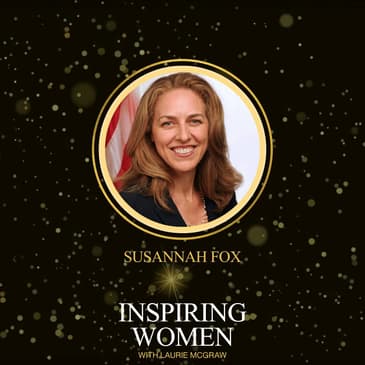
Susannah Fox spent 14 years at Pew Research mapping how Americans actually behave online, then became the third Chief Technology Officer of the U.S. Department of Health and Human Services. Somewhere between anthropology fieldwork and the federal government, she found the through line that has driven her entire career: wherever there is an imbalance of access to information, there is unnecessary suffering, and closing that gap is where health begins.
In this episode of Inspiring Women, host Laurie McGraw talks with Susannah, author of Rebel Health, A Field Guide to the Patient Led Revolution in Medical Care, about what happens when patients stop waiting for permission. She tells the story of John Costik, a father who jailbroke his four year old son's continuous glucose monitor so he could check his son's blood sugar from an Apple Watch instead of stumbling down the hallway every few hours, then shared exactly how he did it online. What started as one dad's hack became a global, patient built movement, and eventually an open source artificial pancreas system the FDA never saw coming.
The conversation moves into caregiving, a role nearly 40 percent of Americans quietly carry without ever calling it work, and then into the subject most people avoid entirely: dying. Susannah is a certified death doula, and she and Laurie share deeply personal stories about caring for their own parents at the end of life, what it means to die with dignity, and why so few families ever get the chance to plan for it. Susannah explains why she believes the missing piece isn't more medicine, but better data and better stories about how people actually want to leave this world.
Guest: Susannah Fox, health and technology strategist, former U.S. HHS Chief Technology Officer, and author of Rebel Health
Host: Laurie McGraw
Subscribe to Inspiring Women for more conversations with the women rewriting healthcare's leadership playbook.
#InspiringWomen #SusannahFox #Caregiving #Healthcare #DigitalHealth
[00:00:22] and today I'm speaking with Susannah Fox and I cannot even wait for this conversation. Susannah is a health and technology strategist. She is an author and she has spent more than two decades, even longer, doing research, mapping the intersection of patients, technology and healthcare innovation.
[00:00:49] She knows a ton about social media. She knows a ton about peer-to-peer networking, how important it is for people's health. She is the author of Rebel Health, A Field Guide to the Patient-Led Revolution in Medical Care. And she also was the third United States of America Chief Technology Officer of the United States Department of Health and Human Services.
[00:01:16] Susannah, thank you for being on Inspiring Women. I'm really glad to be here. We have a lot of talk about all of your research, the work that you do, caregiving, and we're going to talk about death and dying. And that is just an interesting, perhaps unusual, but great play, great thing for us to be talking about.
[00:01:38] But I think what I want to start with is you spent 14 years at Pew essentially studying Americans, how we behave, how we interact, how we consume information and everything else. You've published that research. You've led United States World News and World Report. You've shaped our opinions of how we consume information.
[00:02:04] So where I want to start is how did all of that research, anthropology, come to the United States Chief Technology Officer? So just can you connect those dots for me? Well, the person who was most surprised that I was able to find a job at all was my dad, who was an engineer by training, and he had convinced my two older siblings to be engineers. And then I pop up with an anthropology major.
[00:02:34] But anthropology is a training in how to be professionally curious about other people.
[00:02:41] And I've been able to apply that across my career, whether in building websites in the 90s to getting into research in the 2000s, and then applying that research and what I found to both work that's being done in the federal government, as well as in startups and big established companies in healthcare.
[00:03:04] And the through line for me is to notice where there is an imbalance of power. Where is there an imbalance of access to information that causes suffering? And how can we work together to make sure that we can correct that imbalance so that people do have access to the tools and information and data that they need to solve their own problems?
[00:03:32] Because that's really where health can begin. In terms of that, though, all of that data, today when we talk about social media, we all have enormous understanding of the harm that it can do, the harm it can do for youth. I mean, so many conversations about, you know, what has META done to young girls, the loneliness epidemic that we have out there.
[00:03:56] You were the United States Chief Technology Officer starting in 2015 to 2017, 10 years ago. And I think that was long before we had this acute understanding of what was happening. So how did that lead to that position, that enormous treasure trove of data that you had available? The research and the imbalance of power, that makes acute sense to me now. I don't know that I would have recognized that 10 years ago.
[00:04:26] Well, I'm happy to say that President Obama recognized that the federal government needed to bring in fresh perspectives. And he was the one who started the position of the Chief Technology Officer at the White House and a Chief Technology Officer at HHS. And Todd Park originated the role at HHS.
[00:04:49] And what's important about that insight that we needed to bring in fresh perspectives is that we not only wanted to bring in fresh perspectives of people who had built startups, people who had built technology that was transforming society, but not yet transforming the federal government. We wanted to bring that skill set in. But we also looked around at the federal government.
[00:05:18] What assets do the agencies have that are not yet being leveraged to full advantage for the American people? And one of those assets at HHS, and it became something across the government, is this idea of all of the data that the federal government collects. And here I'm talking about public health data that's collected by the CDC.
[00:05:41] It's all the data that's collected about the safety and effectiveness of drugs and medical devices at the FDA. All of the data that's collected in the work of discovery at NIH, all across the agency. A lot of that data had been published as PDFs, that traditionally the data was published and shared, but in PDF form, which as you and I know is useless.
[00:06:10] And so half the job of the office of the CTO was the open data initiative, opening this up, publishing this data so that it can be used by entrepreneurs to create new apps and to create new services for the American people. The other half was an innovation lab that people would identify frontline workers within the federal government, as well as people who were leading it at the secretarial level.
[00:06:36] They would identify what are really high impact challenges that we don't have the skill set in the federal government to effectively solve. And that's when I would put on my other hat and bring in outside talent to solve those problems.
[00:06:56] The fresh perspective that I brought to the role, which was different from what Todd Park and Brian Civic, the first two HHS CTOs brought, I also brought in the perspective of patients and caregivers, people with lived and loved experience in solving problems in health care. So let's dig into that.
[00:07:45] And what's the impact of the person who is impact either themselves personally or for their child, for their parent, for their family member or friend and what that allowed in terms of people's ability to have agency, control and actually improve health.
[00:08:03] So if you want to see the future, hang out with people with rare and life-changing diagnoses because they will run through a brick wall in order to get to what could help their child because about half of rare diseases affect children. And so it's often parents who are desperate to find a drug, to find a way to help their child or often to help themselves.
[00:08:32] A lot of rare diseases are inherited. And so if you can look to them and see how they're using data and unlock those sources for them so that they could start to do the pattern matching, that if a certain drug is working for this group of people and there's similarities with another group of people, it's going to be possibly a rare disease family or foundation that is able to see that.
[00:09:01] But what we also saw is entrepreneurs coming in and leveraging the data that was available to, again, serve populations that were not yet being served by the federal government, not yet being served by mainstream health care. And that's what's really exciting.
[00:09:22] If you look to the frontiers of science and medicine and health care and hang out with those pioneers, hang out with the rebels, you're going to see the future. And mainstream health care.
[00:09:37] And I argued when I argued when I was in public service, the federal government can learn from those rebels, can learn from those pioneers and maybe build services that are actually going to help millions of people, not just the few people that are working on a rare disease problem. Can you humanize that a little bit, Susanna? I mean, you've done so much work in this area.
[00:10:01] Can you just like bring it to light with some of the stories of what a mother, what a daughter, what a father might do and how that did impact the outcome for the person that whether it was themself or other in terms of what they were able to do that the government, a company, a hospital might not have otherwise been able to?
[00:10:24] One of my favorite stories is to tell the story of the DIY diabetes device liberation front. These are people who are living with type 1 diabetes, and that's not a rare disease, but it's still a small population deeply affected by this life-changing diagnosis. There was a dad named John Kostick who had a 4-year-old with T1D.
[00:10:51] They were lucky enough to have a continuous glucose monitor for that child. It meant that they could check on the child's blood sugar without waking him up. They would stumble down the hallway in the middle of the night. They would set alarms and look to see if the child's blood sugar was still in range. Well, Kostick was an engineer.
[00:11:13] He was somebody who said, if I could liberate the data from this CGM and just send it to my Apple Watch, I would still want to wake up all throughout the night to check on my kid, but I could just roll over and look at my Apple Watch and go back to sleep more easily. So we did. He was basically able to jailbreak his kid's medical device, send the data to his Apple Watch.
[00:11:39] And what's crucial is that he then shared what he did on what was then known as Twitter. He basically shared the recipe. All sorts of other people started doing the same, and patients all over the world started using this to liberate their own device data. By the way, no company had thought of that. Because the medical device companies think of their customers as the doctor that's prescribing the device.
[00:12:08] They weren't keeping the end users in mind. But the patients demanded access to that data, and it opened up a whole new marketplace. It opened up new product lines for the device companies in terms of new hardware, new apps to help control diabetes. And it's actually been used to create a DIY open source artificial pancreas system. Wow.
[00:12:38] And it's just like you can just hear in that. So here's the innovation and all the excitement. Just the humanness of what it means to know that you can roll over and know your child is safe or not, or needs attention, or needs something immediately. And what that might do for just like, you know, again, just living, having sleep, having the ability to care. I mean, this is just like astounding. And let the kid go on a sleepover, right?
[00:13:07] Let the kid go to school and know that the kid is in range. And the other unlock is that adults with type 1 diabetes were able to say, well, actually, I'm going to build an app that helps predict what my blood sugar is going to be so that I can better manage my diabetes. And here's what I love. When the FDA heard about this, they went to the patient rebels and said, wait, what are you doing?
[00:13:34] Why are you doing this? But the patients weren't selling this. And that's why the FDA didn't have purview over it. And the patients were able to say, because the FDA, of course, was saying, what you're doing is dangerous. And the patients were able to say, you know what's dangerous? Living with type 1 diabetes. Give us the tools that we need. And it changed the game.
[00:13:56] Yep. So, Susanna, you have really leaned into the side of the patient, the person, the one that needs help, support, and caring, and the one that is not in the power side of the equation. You talk openly and have written prolifically about being a caregiver.
[00:14:18] We were talking earlier about what it means to have a caregiver badge from archangels. I would like to just move our conversation to caregiving. What does it mean to be a caregiver? Why is that a medal, a badge of honor, and so important in both the research that you do and the work that you do?
[00:14:43] Well, as we know, because of our friend Alexandra Drain and the research that Archangels has done, 40% of us in the United States are caregivers. But so many people don't recognize that as the work that it is. And again, what I love about archangels is they talk about the intensity of the work, not the burden. Because so many people say, it's not a burden.
[00:15:09] This is what I do as a son or a neighbor or a daughter. But archangels wants to recognize people and honor them. Myself, when I have been in the thick of caregiving, I've cared for grandparents and for my father and for an elder cousin until the end of their lives.
[00:15:33] When I'm in the thick of it and I feel alone, it helps to know that I'm not alone. And this has come through in my own research about why people use the Internet. Why did John Kostic share what he did on Twitter so that other people could benefit? And that is the spotlight that Archangels is shining on caregivers to say, you are not alone.
[00:16:01] There are people who would love to help you if only they knew how to find you. That has come through in all the work that I've done. And it is a mega trend that health care cannot ignore. Well, it's also one that you've gone into even more deeply. You are a certified death doula.
[00:16:23] You are studying the way you're studying dying and what that means from both the lens of data to the human that's having to go through that for a loved one. First of all, what is a death doula? I mean, that sounds dark, but I don't think it is. I think actually what you're studying is pretty important.
[00:16:45] And we have three million people who die every year, half of whom have advanced directives, which is the what I want to actually have happen to me. Can you just talk about what that is, what your research is about? And I want to actually talk a little bit about dying. Sure. Death doula or end of life guide. There's lots of names for it. This is something that people have done forever.
[00:17:11] It's the person in your neighborhood or in your family who is not afraid to talk about the end of life, who if you need help, they show up. And that can be someone in your faith community. In my family, it was my mom. She always stepped forward and I became her apprentice. And that's how I began with my work. And I didn't even know the term. And by the way, neither did my mom.
[00:17:41] But it's something that what I noticed is that one of the best gifts that you can give to yourself or to your loved ones is a well-planned exit. Documents in order. Spiritual beliefs understood. The community that can surround you with love and care when you need it.
[00:18:06] And yet, most Americans don't give themselves that gift and aren't able to give that gift to their loved ones because death is a taboo topic. What I noticed is that with every person that I cared for until the end of their life, with each one, I was getting better at it. And I thought, well, why don't I skip ahead a few spaces on this game board and get training?
[00:18:32] By the way, in the same way that I studied when I was pregnant with my children, I studied childbirth. And that joyful, painful childbirth moment. I prepared for that. And so I wanted to prepare for the future end-of-life conversations that I would have. So I was so honored to get to work with Elua Arthur, who is a death doula who trains other people.
[00:19:01] Her organization is called Going With Grace. And if anybody's listening, they should just Google Going With Grace or read Elua's book. Totally incredible. And death doulas can be people who work with a family well before they are needed to get all of the documents in order,
[00:19:25] to make sure that you have your home set up so that when someone comes home, if you're going to set up home hospice, what that could look like. There's also people who specialize in grief, that there might be a sudden death that nobody had been able to prepare for.
[00:19:45] And instead of feeling alone, a death doula can come in and help the family organize all the administrative work that happens when someone dies. So that's just a quick overview and why I got into it. Well, I want to talk a little bit more about it. But before we do, actually, Suzanne, I want to tell you a story. So I know that 10 years ago, your father passed away from melanoma.
[00:20:11] And four years before that, my father, who passed away from melanoma, was diagnosed through a quick illness. And I was in a board meeting. I happened to be presenting there. I happened to be in Boston, where my father had to emergency go to the hospital because of his diagnosis, which was and his illness, which was going the wrong way.
[00:20:40] I spent the next six nights at his bedside in the hospital. I remember during that time being so frightened and scared and being one of other children, but had the ability to just be there by his side.
[00:20:54] I remember at that time, my family confused, my mother wanting emergency surgeries that would have been horrific for him to go through and most certainly would have ended any quality of life.
[00:21:13] I remember a physician who had the hard conversation with us at the bedside that this was not going to end in anything other than the natural end. And then the most important time was at that moment, taking my father home.
[00:21:33] I view that time as some of the most important emotional period of my life and the opportunity to have my father die with dignity and grace. It's very important to me in terms of the work that you're doing. And not everyone has the opportunity to be prepared. I know I have been able to deal with grief in a different way. And I know you've dealt with it, too.
[00:22:00] So I would like to know, in terms of this research that you're doing, what can we do with it? What should people know? How can they be prepared? People are older. We're doing everything possible to keep them alive. But can people die with grace and dignity and surrounded by people that they love? That, I think, is important. And so, Susanna, if you would just tell us more about this research that you're doing and what we should know about it.
[00:22:30] Well, before you do it, before I say anything more, I want to say thank you. That's a beautiful, beautiful story. Can I ask your dad's name? Arthur. Arthur Schreiner. Well, let's all lift up Arthur in our thoughts right now. And again, as a, you know, and I know, and he was in clinical trials. And I have such pride in knowing that we now have a melanoma vaccine that is coming about.
[00:22:59] And, you know, that came from important research at the time. So there's goodness in what happens, you know, when people are going through difficult, difficult things. There absolutely is. And my dad also was participating in clinical trials.
[00:23:18] And what's so challenging in this era when we have such incredible science and the ability to keep people alive, we believe that that can happen for all of us. And with my dad, my dad had a vision of total healing. And he wanted to live. He really wanted to live. And that was not available to him.
[00:23:49] Contrast that with my elder cousin, whose name was Mitsuru Yasuhara. He'd been born in Japan. He was older than my dad when he got his, what turned out to be his terminal diagnosis. And we had had a conversation. Unlike with my dad, unlike with my grandparents, I was more prepared when I was the caregiver for my cousin. I was kind of his honorary daughter.
[00:24:18] And because of the previous experiences that I'd had, I was able to have a conversation with Mitsuru well before he got sick, when he was still well, about what he wanted. And that meant when we got the diagnosis, I was able to break him out of the hospital like we were outlaws. And go home. And we co-created the home hospice that he wanted.
[00:24:43] But turning to the research that I want to do, my background is as a survey researcher. What I love to do is spot a trend, spot a gap, see where there's an area of life or society that there's not enough known about, that there hasn't been enough data to prove that it's important. And then I like to go and collect that data. That's what I've done with peer-to-peer health care.
[00:25:13] It's what I've done with rare disease. And now I'm looking at the siloed nature of the survey data around end of life. There are surveys about all these different domains of the end of life, but we don't have a whole picture. We need fresh data. And we need storytelling. And that's my specialty.
[00:25:38] And what I want to do is collect that fresh data so that we can see the whole person. We can see the whole picture of where we are as a society. And by the way, if somebody doesn't have a will, it might be that they have a spiritual practice that they can lean on. And we should celebrate that they are spiritually ready, even if they're not legally or financially ready.
[00:26:06] Let's look at that so that we can have new conversations, even if it's uncomfortable. We need to have more conversations and more sharing, like what you just said. And by the way, what an incredibly brave doctor.
[00:26:24] I have not seen in all the caregiving that I've done, it is not often the doctor in the hospital who has the training, who has the ability to speak that truth to the family. Which is why we need to empower people to ask the questions. That is what I think is so, there's so many things that are important about that work that you are doing.
[00:26:52] And the medical profession is about life. And the opportunity to die well is a challenging one. And it is a different conversation. I learned a lot about palliative care, which is a profession that I just think is one of the most humane things that exists in the world. And I'm just a huge fan of that.
[00:27:19] So, Susanna, I could talk a lot about this because I really believe that you are putting light on something that is incredibly important that most people are largely unprepared for. And the opportunity to learn, have resources, do it well in times when people are not prepared is extraordinary.
[00:27:46] So I want to just thank you for spending so much of your time on that. As we close out on this Inspiring Women conversation, it's an unlikely path that you have taken throughout your entire journey. You are hard at it. You are curious. You are excited about doing the great work that you're doing.
[00:28:09] What is your advice for a younger generation of women who aspire to have similar impact as you have already had? And there's much more coming, I know. My first piece of advice is to always be curious about the people that you work with and the people that you're not working with.
[00:28:32] I've gotten some of my best research ideas from observing what's going on in my community, observing what's going on in my family. Make those observations and then start to collect data because you need both. You need the stories and you need the numbers because a lot of the work that I do sounds like a nice to have.
[00:29:00] But in fact, it's a competitive advantage for businesses to pay attention to the real end user of health care, the patients and the caregivers. My second piece of advice is to align yourself with people who share your mission, who are more senior, and ask them to help you get into the rooms that they are in. And here, this might be a little bit different from what some younger people might expect.
[00:29:31] You might not be invited to sit at the table. You might not be given a speaking role those first few times that you're in that room. That's actually better. Listen. Listen. Listen to how people are making their arguments effectively in those powerful spaces so that you can learn that vocabulary and turn it to your advantage when you are ready to make your arguments. That is fantastic advice. I love that advice.
[00:30:00] That is so good. Well, this has been a great Inspiring Women Conversation. Susanna, it has been such a joy to talk to you. Thank you so much. It's been a pleasure. Thank you.