
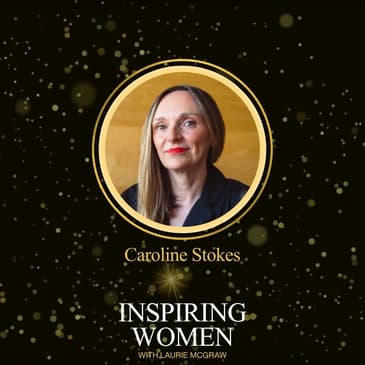

Caroline Stokes tells CEOs something most of them don't want to hear: the AI
question everyone is asking is the wrong one.
She is the founder of FORWARD, a human capital solutions firm for pioneers, and
the author of AfterShock to 2030: A CEO's Guide to Reinvention in the Age of AI,
Climate, and Societal Collapse. Named to the Thinkers50 Radar Class of 2026, she
was shortlisted for the Thinkers50 Leadership Award for a book she deliberately
published digital-only to keep its carbon footprint near zero.
Her route here was unusual. Raised between the UK and Singapore before the age of
ten, she went from PR at Virgin to the early PlayStation team, then to executive
search, then to coaching, and then back to school three separate times during and
after the pandemic to study ESG at MIT, AI business strategy, and the new space
economy. She is neurodivergent, and she credits that with how she reads systems
and spots what a room is missing.
━━━━━━━━━━━━━━━━━━━━━━━━━━━━━━━━━━━━━━━━━━━━
WHAT CAROLINE COVERS IN THIS EPISODE
1. THE FOUR SHOCKS ALREADY HERE
Economic instability, climate disruption, AI acceleration and societal
fragmentation are not separate agenda items. They are one interconnected
system, and leaders who treat them separately are already behind.
2. WHY AI IS THE WRONG FIRST QUESTION
Yes, learn it, the way you had to learn email in 1994. But the question a
board should actually be asking is how long the organisation can sustain
itself at all.
3. THE CEOs WHO ARE QUITTING INSTEAD OF ADAPTING
Many are cashing in their chips rather than building the polymathic
organisations this moment demands. Caroline explains who she will and will
not work with.
4. THE 100-DAY REINVENTION
Built after she watched leaders at a top-three technology company shrug off
a mandate from their new CEO with "it'll take two years." Her warning to
them: you will be laying people off before that.
5. FIGHT, FLIGHT, FREEZE, FAWN
The four avatars every leader defaults to under conflict. Not knowing yours
is how you quietly sabotage your own strategy.
6. CLIMATE AS AN OPERATING CONSTRAINT
Not an ESG line item. If your people are breathing smoke and getting
migraines, the work does not happen. Maslow, applied to the modern workforce.
7. THINK LIKE A SCIENTIST OR AN ARTIST
Michelangelo started with a block of marble and no finished image. Everyone
has to start somewhere in a reality with no playbook.
8. HER ADVICE TO WOMEN LEADING RIGHT NOW
Follow the curiosity that keeps stalking you. Ask what your seven-year-old
self would want from you, and then go learn something new.
━━━━━━━━━━━━━━━━━━━━━━━━━━━━━━━━━━━━━━━━━━━━
ABOUT CAROLINE STOKES
Founder of FORWARD and a global leadership strategist for the Fifth Industrial
Revolution. A Sony alum who worked on the PlayStation launch and a PCC-level,
EQ 2.0-certified coach, she moved from executive headhunting into leadership
reinvention. She is the author of AfterShock to 2030 (2025) and Elephants Before
Unicorns (Entrepreneur Press, 2019), and a co-author of the HBR Guide to
Navigating the Toxic Workplace (2024). Her 2019 TEDx talk predicted the
convergence of AI, climate and societal disruption now shaping boardrooms.
Website: theforward.co
Book: AfterShock to 2030, on Kindle, Audible, Spotify and Apple Books
━━━━━━━━━━━━━━━━━━━━━━━━━━━━━━━━━━━━━━━━━━━━
ABOUT LAURIE McGRAW
Laurie McGraw is the host of Inspiring Women and Executive Vice President at
Transcarent. A health technology executive with three decades of experience, she
has led product and commercial organisations, served on public and private
company boards, and advises early-stage ventures.
She started Inspiring Women around a gap she kept running into: women make up
roughly 70 percent of the healthcare workforce but hold about 20 percent of the
C-suite seats. Each episode is a direct conversation with a woman who has built
something, aimed at the practical questions that rarely get asked in public.
━━━━━━━━━━━━━━━━━━━━━━━━━━━━━━━━━━━━━━━━━━━━
INSPIRING WOMEN WITH LAURIE McGRAW
Website: inspiringwomen.show
Subscribe on Apple Podcasts, Spotify and YouTube.
#Leadership #CEO #AI #Climate #WomenInLeadership #Thinkers50
[00:00:00] The CEOs that are coming in that may not have been CEOs previously or they're building products that they want to solve. They're the pioneers that are wanting to change the world and they know that all of these systems are interconnected. What types of CEO decisions need to be made faster than people are comfortable? Most people assume that they need to jump on the AI bandwagon really, really quickly. But really the reality is, is that how long is your organization going to sustain itself?
[00:00:32] This is Inspiring Women and I'm Laurie McGraw and today I'm speaking with Caroline Stokes. And Caroline is an incredible voice, a leader, a podcaster, an author, and she is the founder of The Forward, which is a human capital solutions firm for pioneers. And I think that's an interesting way to talk about your firm. Caroline, we're going to talk about your firm.
[00:00:57] We're going to talk about all of the things that you do when you work with CEOs, forward thinking innovators, and what you're telling them in today's world where they're dealing with societal change and AI and climate change and all kinds of other large impact things. Caroline, you are a global voice. Thank you so much for being on Inspiring Women. Thank you so much for inviting me. It's a real delight and pleasure.
[00:01:24] All right. Well, let's get started. And I didn't do your introduction nearly any justice. So Caroline, would you just mind just giving us a little bit more about yourself and your origin story? There's a big origin story. So I think what I'll do is just quickly, I'll give it in three chunks. The first chunk is that I'm an international citizen. I was raised in the UK and in Singapore and was able to see the different cultures all before the age of 10.
[00:01:52] And then moving from a business perspective, which I think was the real learning opportunity for me is that I worked at Virgin very early after doing business and finance at college, went straight into working at Virgin, doing PR for them, working on games like the Space Shuttle launch or Space Shuttle, the simulation.
[00:02:16] And then moving to PlayStation to be employee number nine of the PlayStation launch. Again, I was so young. Really, the opportunities in the 90s were just absolutely phenomenal. Right place, right time. And it just gave me such a wide experience of how to launch products and to be the new, to be able to pioneer and to work with the pioneers to dominate in the market at that particular time.
[00:02:44] And then I moved from doing the whole PR thing back in the 90s to then going, OK, I really need to, I could see what was happening in the world. I could see what was happening with all of the different technologies that needed to evolve very, very early on. And I decided that I wanted to place talent in the right place because I thought very naively.
[00:03:07] And I like to think that naivety is the way forward to be able to make a difference in the world, which is to be able to, I naively believed that you would be able to find the right talent by hiring a right headhunter for the role and then realizing actually organizations needed to adapt really quickly. And they, to be able to bring the right people in to deliver the trajectory that CEOs wanted.
[00:03:35] So I then thought, hey, I should become a coach. So when I place people, I can coach people to, you know, fulfill the destiny of the CEOs without realizing or not realizing at the time that the systems had weren't right for the environment. So then it was during the pandemic, I realized actually I need to reinvent yet again myself. And I decided to go to college again three times specifically to learn at MIT about ESG.
[00:04:04] So environmental, societal governance aspects and how to create products, organizations and mindsets to traverse that and realizing where we need to be from a net zero perspective and how to create products relating to that. And then this thing called ChatGPT launched in 2022 and completely disrupted our way of communicating, thinking, you know, how it impacted everything. And I realized, OK, I need to do an AI for business strategy course there.
[00:04:31] And I created, before agentic was a thing, created an agentic system that could be used within the organization from a vertical and horizontal perspective to create goals and to be faster, to be able to adapt to the signals and adapt faster. And then the third one that I did just this year in 2026 was the new space economy, just months before SpaceX went public.
[00:04:58] That little thing, which, you know, debatable what's happening there. But there are some really important stories that come out of what's happening with the new space economy.
[00:05:10] So all of that kind of that whole six month, six year journey has demonstrated, really kind of dovetails in with the book that came out, Aftershock to 2030, A CEO's Guide to Reinvention in the Age of AI Climate and Societal Collapse, and how CEOs need to adapt rapidly to our new reality. Before we go to that, let's unpack a little bit of that trajectory.
[00:05:38] And what's so interesting to me is, so, you know, I find it very hard to sort of like see what's coming. But then in the rearview mirror, it is always obvious that this is like the place that we were going to get to.
[00:05:54] So, you know, PlayStation, right, you know, like that gaming industry that, you know, emerged as employee number nine, and then being able to recognize that the talent needed to do things like that are innovation, entrepreneurship. Those are words we use every day, like 100 times a day.
[00:06:15] Those words were infrequently used at the time that you are recognizing that you are breaking new ground with technology and changing industries and, you know, the global way we interact with technology. You know, just you recognize that and you recognize that you need a different type of people. Did you have the right words, you know, then? Were you just in it? Were you just following these things on instinct?
[00:06:42] Because you've taken every one of these chapters and you've turned it into a launching point for the obvious next thing that's going to be needed to have large impact in a very big set of changes that you're trying to help people orchestrate through. The quick answer to that is I'm neurodivergent and I have a sliver of autism, a sliver of ADHD. So I see the signals.
[00:07:11] I sense a lot. I read a lot. I absorb a lot. It's very heavy. It's very heavy duty. And there are lots of neurodivergent people out there. I think something like fifth or more of the global population are neurodivergent. And it enables us to be able to see all of the patterns and to be able to see all of the systems. And we do a lot of sitting and thinking and absorbing.
[00:07:38] And we'll probably be the quietest person in a meeting because we're assessing the land. We're assessing what people are saying and seeing, you know, whether or not there's a giant gap or whether or not people are ahead of it and what they're seeing, what they're not seeing. Which is why I love being a coach. I'm able to see and see all of these different systems. And then it's a case of being able to present those systems to the audience.
[00:08:02] So it was I have to say that my time in Singapore at a very young age was probably the most incredible experience. Because in Singapore back in the 70s, and we're talking in the 1970s, the technology was so advanced. And, you know, we were we were getting shots or inoculations or immunizations like literally with a staple gun instead of a giant scary.
[00:08:29] You know, it was just so advanced. And then I remember going back to England, whoa, it's so out of date. You know, why is it that the rest of the country stroke organization isn't adapting fast enough? What's holding it back? And you're able to see that, you know, various systems hold it back from moving fast and then it will accelerate in other areas, usually due to capitalism.
[00:08:51] So it was a case of, you know, I was very lucky to have had a systems learning experience back in the 70s. And to be able to absorb it all and to to synthesize it and to communicate it.
[00:09:05] You also talking about the sort of a special talent with that, you know, being neurodivergent process information and sort of whether it's seeing around corners or seeing it with a different lens that gives you the ability to to lean into what is a lot of confusing information. So let's now bring it forward to your most recent book, Aftershock to 2030.
[00:09:32] And so you're who you're speaking to your audience. There are CEOs facing a convergence of shocks. So first, if you could, please just like talk about what those different shocks are, because I think we'll all recognize them. But then for those who are those CEOs who are not don't have that, you know, neurodivergence, you know, how can they actually pull those together to then lead through during this time? So, first of all, what are those shocks?
[00:10:02] So the shocks, we all know it. We've been feeling it for a very long period of time ever since the pandemic, which is the world is not the same anymore. Our entire supply chain, the capitalist environments that have and economies that have gotten that got us to a particular point is completely it's just not really compatible with with the way that we are going. And there's a lot of technology and systems like the decentralization systems that are out there that people are saying we should be leaning towards.
[00:10:32] And I'm looking forward to, you know, various thinkers in the government space to be able to determine, you know, what that's going to look like and what will what will catch. So that's that's one aspect. And then you've got climate, which is, you know, anybody that's watching the news in or July, August of 2026 knows very well that hundreds of thousands of people have been evacuated from France and Spain, particularly because of the fires and the climate disaster.
[00:11:00] Or the disruption that we're experiencing is human made. A lot of people may say, well, it isn't. But, you know, the scientists have been communicating this since the 1970s. So when you move. So when we ignore those to our peril, you know, and we don't see CEOs adapt to that, we've got a problem on our hands because government is going to take a while. And then we've got AI.
[00:11:23] We've been experiencing AI, artificial intelligence or algorithms. You know, computers have been around for many decades and it's been able to predict and act on our behalf. You know, you just have to turn on Netflix and you get the algorithm telling you what you probably want to see next. You have somebody coming to use Netflix and they completely ruin your algorithm. You start getting to see all of these war movies. I want to see war movies.
[00:11:54] So, you know, the algorithm changes. If you have somebody else go on your claw, it will change. If you change your behavior with your financial system, it will respond differently and so on. So we've had AI in our systems for, you know, a good 10 years. It's just it hasn't and I was writing about it for Forbes, you know, since 2016, but people weren't able to tangibly feel it.
[00:12:19] They were able to see it, you know, with computer games or they were able to see it, you know, with your bank deciding that you were eligible for a line of credit or a boost because of good behavior. But really, you know, the acceleration of it now means that we're kind of meeting what people don't like the term of, which is a singularity.
[00:12:41] And you just have to read a book like Hum by Helen Phillips, which is an award winning book that came out quite recently to kind of see what that could look like. But there's also which has consequences. But at the same time, with everything accelerating with climate, you know, this is this is probably a closer reality. It may not just be fiction. And then obviously we've got the societal situation.
[00:13:07] Governments, trusting governments, trusting institutions, CEOs, organizations. Has Anthony Fauci taken the fifth, pleading the fifth today? I mean, like every day there is something that is just shocking, shocking our systems. So with all of this and with all of the companies, the executives, the CEOs that you work with, what I mean, we all feel it.
[00:13:35] What are people what are the common things that you're seeing? Perhaps, you know, are people not moving fast enough? Are they, you know, deer in the headlights and don't know what to do? What are the types of things as you lay this out that you're advising and seeing CEOs are some taking full advantage and leaning in in ways that you can teach others? I'd love to hear some common things across the C-suite.
[00:14:04] And I bet there's a million different things. You're out there joking earlier, like, I feel like you must be a therapist practically. For every CEO that you work with today. So a lot of people are still lamenting and grieving over the fact that it used to be really easy. People would be able to greenhush or DEI hush or whatever it was, or greenwash or, you know, DEI wash a lot of the realities.
[00:14:32] And everybody would just get along with business to reach quarterly targets. Now it's a case where, and we know from the data that many CEOs have decided to quit their roles and, you know, cash in the chips. And, you know, they just don't have, unfortunately, the stamina to adjust and to develop polymathic organizations to be able to solve the problems that need to be solved.
[00:14:56] So I wouldn't be speaking to those people unless they really had a hunger and they really had the energy to be able to, you know, make that change. The CEOs that are coming in that may not have been CEOs previously or they're building products that they want to solve, you know, a lot of the challenges and issues that we have around us. They're the new breed. They're the pioneers that are wanting to change the world. And they know that all of these systems are interconnected.
[00:15:25] They know that, you know, they have to look at the world and society in a different way to their predecessors. And a lot of really intelligent, thoughtful leaders in this space are expecting the new generation of CEOs to be making that difference. And they are essentially saying they can't come fast enough. But for those that want to make a difference that are still in that place, they've got to sit.
[00:15:52] And I think you used the term just a few minutes ago, which is that they need a therapist. You know, they need a coach that is able to sit with them and go, OK, what difference do you want to make in this world now? Based on all of the realities, all of the systems, what do you want to do? And that can take a little while to, you know, define. And in the book, I'd ask my clients, what would your seven-year-old want from you?
[00:16:19] Your own, when you were seven years old, what would they want from you? What do you want to be able to explain to your children who are actually having, they're very, very cynical and concerned about everything that is happening. And they're looking to us older adults that are in this position of power and influence to be able to make the change that we all really want to see in the world. Carolyn, what is moving too fast and what is moving too slow?
[00:16:48] So, you know, all of these different disciplines and shocks that are out there in the system, they're evolving in front of us. So if it's taking time to understand what impact that you want, what types of CEO decisions need to be made faster than people are comfortable and they might have been comfortable even a year ago that you are saying, like, if you don't move, you know, like, you know, you do it at the peril of having the business that you or the company that you expect to have.
[00:17:18] Most people assume that they need to jump on the AI bandwagon really, really quickly. And yes, that's like learning email, you know, back in 1994, you know, you needed to learn how to use email so you could communicate. So, yes, people need to learn AI. But really the reality is, is that how long is your organization going to sustain itself from a longevity perspective? What insurance are you giving boards to determine the landscape right now? So let's look at France and Spain again.
[00:17:49] There are crops. There's going to be crops issue. There's going to be housing issues. There's going to be all sorts of issues, you know, that entire system. If you've got employees in that destination, how are you going to sustain your organization now? How are you going to – they will need support. They're going to need – they'll have been very much traumatized. So you have to look at all of the systems all at once. And the AI isn't necessarily going to be the tool that is going to necessarily make you money,
[00:18:16] but it should and could enable organizations to create the right systems to support people. But really everything is now related to climate. It's impacting the air that we breathe. When we breathe the air and we get migraines from it, how are we supposed to work? Yeah. Yeah. That's going to be hard. It's like this is just a natural – you know, if Maslow's hierarchy of needs was to get involved in this now,
[00:18:43] and say, well, air, we need air, just as the most basic. How are we going to breathe? If it's impacting our ability, we have to go to the hospital. We're unable to work because, you know, various parts of the system has broken down. And it's just not possible to function. So this is why it's really important to really see that climate is going to be impacting –
[00:19:10] the environment is going to be impacting our ability to function. And if our customers aren't seeing that we're addressing this for their future longevity, I think this is where there's going to be some kind of uprising in the not-too-distant future. You're coaching people to really put the long-term impacts front and center in terms of what they're focused on,
[00:19:36] not jumping on the AI bandwagon as – I'm putting words in your mouth, but how I'm hearing you – as the one and only thing that you're doing if your intention is to have impact. You've also put – with Forward, your firm, you've put this concept of the first 100 days and embedding that in a coaching program.
[00:19:59] And so is that the first 100 days of the new CEO or is that the first 100 days of launching a program? Can you just, like, talk about, like, what that both program and mentality is and why it's so important and different than perhaps, you know, the first 100 days, you know, kinds of plans we've all got them, you know, of the first big job or next big job that you have. What's different about what you're suggesting? It's really about stopping and everybody then going,
[00:20:29] OK, we've got 100 days to completely reinvent ourselves. How do we do that? How do we do it with the entire organization? How do we start with the board? How do we start with the C-suite? How do we start with the C-suite? Then, you know, being able to roll it out within the organization. And too often, as you may be aware in the past, you know, organizations would say, OK, we have a mandate. This is how it's going to go. And everybody says, ah, it'll take two years for it to reach us. We don't need to change anything. Until HR get involved, we don't need to do anything.
[00:20:56] And at that time, and what inspired me to adapt my own business model is that it was in 2019, I was at a large organization, a top three technology company. And they had received new guidance from their new CEO that they were going to completely change the way that they worked. And the leaders in that organization, in the satellite office, said, ah, it'll take two years.
[00:21:26] And I said, no, no, no, no, no. Your organization will be, unfortunately, laying people off, maybe even experiencing studio closures if you do not pay attention to this and take the initiative. So I fast forwarded to everybody doing this all within 100 days because it requires that entire mindset. Otherwise, it just takes too long and it will sabotage the kind of results that a CEO and the leadership team will want.
[00:21:52] Well, you've become quite expert at, you know, forcing CEOs to face the uncomfortable truths of what's upon them. And, you know, whether that is changes in their workforce, layoffs, you know, divestitures, like, you know, moving forward with acquisitions or other things or changing their business models completely.
[00:22:16] In that moment when a CEO has to face, you know, something very, very uncomfortable, how do you go about those conversations? Just like, and then if they don't have a Caroline sort of on their shoulder at their side, how should CEOs be thinking about those things so that they can take the needed actions for the health of their companies? Yeah. So there are four avatars that I talk about in my book.
[00:22:44] It's, and it's basically the fight CEO, the flight CEO, the five flight freeze CEO, and the fawn CEO. And each CEO needs to understand their particular mode whenever they experience conflict. So once they realize what mode they are going in, what autopilot they go into that will unfortunately sabotage themselves, they may become too aggressive.
[00:23:10] They may have the wrong impression about where something is going. They may have too many, you know, assumptions without actually accepting anyone else's, or they'll just gravitate towards, you know, an area where it's most comfortable, a bit fawny, especially for their employees. It's going to sabotage that kind of growth. So it's reinventing themselves. So they are able to tackle all of these different challenges. And it's having those conversations with themselves.
[00:23:38] Which avatar am I? How do I evolve into a more sovereign CEO that's able to look at all of these systems that from a polymathic perspective? So they're able to move forward in a way that's a little bit more, that provides them with a little bit more confidence. And that reinvention is hard, especially as everybody's been working towards. Well, apart from math and like the different systems, you're because, because for any successful
[00:24:07] CEO, the historical success to be successful in today's world with all of these things that you're pointing out, it's a different set of skills. It's a different set of skills. And if you can't learn them aggressively, you know, and be open to not being the success of the past, but being the success of whatever is going to be forward, you're sunk. I mean, we're seeing remarkable change in iconic companies everywhere.
[00:24:36] How many CEOs have the capability to make that transformation? Most? Some? Less than half? What's your guess? I won't put numbers on it because it'll be wrong. What I will say is that it's all about attitude. And everybody, all CEOs can, and we can all have a mea culpa moment. It doesn't have to be public where it's like, I'm really sorry.
[00:25:03] I've just come to realize that the systems that I had been a part of, that I had contributed to are going to be our, you know, this is where we are. We're all collectively involved. We're all complicit in the reality that we have. How do I want to change the world? How can I make things better? Now, the issue is, is that whenever we make a change, there's going to be second order effects. There's, you know, things that things are going to be damaged in the process. It's still not going to be pretty.
[00:25:34] You know, we have to make changes. There are going to be changes to everything that is going to be created. But it's being able to be, and I hate this word because it's become so overused, become more resilient, which comes from being better educated, being able to look at the data, being able to experience pushback, and peer reviewed information. So you're able to go forward in the best possible way.
[00:25:57] And to think like a scientist or an artist, which I talk about in the book, which is artists don't, well, you know, just look at Michelangelo's, you know, Statue of David and what have you, where he's like, you know, he had a block of marble. He had to start somewhere. He didn't know what it was going to look like. We just look at the finished product and say it's perfection. He had to start somewhere. Everybody has to start somewhere with this new reality.
[00:26:21] Well, I like the word resilience, and I like the word resilience because women are particularly excellent at it. You know, there's a lot of resiliency for women, and this is an inspiring women conversation. So, Caroline, I'd like to close out on that. You are named to the Thinkers 50 Radar Class of 2026. You are shortlisted for the Thinkers 50 Leadership Award.
[00:26:48] You are recognized as one of the leading voices and thinkers and shapers of global management theories and practices. I am interested in advancing more women into leadership. Based on what you advise, based on what you know, based on how you are asking leaders to change their approaches, deal with all these concepts in new ways that they can advance forward,
[00:27:17] I would just love it if you would, the things for women in this moment in time so that they can be better leaders, the leaders. What do you advise women specifically today? My favorite thing to do is to learn something new. I really recommend it. Like I knew, I'll give you an example.
[00:27:38] When I was working on the space shuttle game or simulation for Virgin back in 1991, 1992, I knew I was interested in space. So that's why I did the new space economy. It was just the right time. I should have done it two years ago, but I was too busy doing the book. So, but, you know, it's like, what are you curious about? What are you genuinely curious about? You know, some people, you've obviously got very successful people listening to your podcast.
[00:28:07] So, you know, I'm curious as to what they might be most interested in. What does that seven-year-old, what does that 21-year-old you from way back, what were you really interested in? What was, what sparked a little bit of interest and curiosity? And start following that because that's, that's what, that's what we're about. I mean, I had, I'll give you an example here. Just this morning, it was the book's first birthday. I was very excited about it.
[00:28:34] And then all of a sudden I was flooded by these memories of, oh, you know, 20 years ago I quit doing PR so I could go on this journey. And, you know, I'm in a different country and I'm this and I'm that. And I'm like, yet here I am. I'm still the same brain. I'm still the same human. And, you know, with all of these changes around me, but I look for those little sparks of curiosity.
[00:28:57] And often somebody once said it's like that those ideas or those concepts or that those little delights will stalk you. So what is stalking you? What do you need to do to move forward and just start exploring? That is awesome and great advice. And we should all explore more. And this is the right time to do it. And this has been a fantastic, inspiring women conversation. I've been speaking with Caroline Stokes.
[00:29:27] And thank you. Thank you, Caroline, so much. Thank you so much for making this time. It's wonderful spending time with you.