
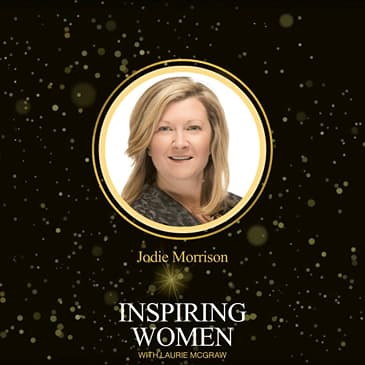

Jodie Morrison never planned to run a company. Her career goal was VP of Clinical, and when the board at Tokai Pharmaceuticals first offered her the CEO role, she said no. She eventually took it on one condition: her board chair would meet with her every week until she felt ready. Six months later, he asked her to take the company public.
Today Jodie is CEO of Q32 Bio, a public biotech that went through a painful restructuring in 2025 and came out the other side. In 2026, Q32 reported positive Phase 2 data for bempikibart in severe alopecia areata and completed a $200 million public offering to fund its registration-directed program.
In this episode of Inspiring Women, Laurie McGraw talks with Jodie about what it takes to lead through the hard years, why asking for help is a CEO skill, and how she built one of biotech's most trusted CEO networks.
In this episode
- Why she moved from bench science to clinical research, and the stroke patient who made her stay
- Turning down the CEO role, then taking Tokai Pharmaceuticals public in 2014
- The weekly board chair meetings that helped her learn the job
- Why first-time CEOs get into trouble when they "fake it till they make it"
- Q32 Bio's turnaround: choosing alopecia areata, selling the kidney asset, and holding the team together
- Explaining tough strategic calls to a board and to public investors
- Starting The CEO Forum in March 2020, growing from 10 CEOs to more than 100 in weeks
- Bringing COVID testing to Cambridge biotech employees
- Using CEO survey data to push back on boards about return-to-office
- How Q32 Bio is setting AI governance and training employees
- Learning that the Tokai IPO had set records for women in leadership
- Why women's college networks produce so many executives and board members
- Her advice for early-career women: do the work, and find people who tell you it's possible
About Jodie Morrison
- CEO, Q32 Bio (Nasdaq: QTTB)
- Former CEO, Cadent Therapeutics (acquired by Novartis)
- Former President & CEO, Tokai Pharmaceuticals (led 2014 IPO)
- Former interim CEO, Keryx Biopharmaceuticals; former COO, Syntimmune
- Earlier clinical roles at Dyax, Curis and Diacrin
- Founder, The CEO Forum
- Board of Managers, Life Science Cares
- B.A. Neuroscience, Mount Holyoke College
About Inspiring Women
Inspiring Women is hosted by Laurie McGraw. Each episode features women leaders in health, science and business sharing how they built their careers and what they learned along the way.
#InspiringWomen #Biotech #WomenInLeadership #CEO #LifeSciences #AlopeciaAreata #Leadership
[00:00:00] [SPEAKER_00] One of the biggest issues that I see with first-time CEOs in particular is sort of a desire to fake it till you make it and not being willing to ask for the help you need. And I think my first foray into the CEO seat, you know, I asked for that help from the chair. I said, like, if you want me to do this, you have to come weekly and meet with me because I don't know what I'm doing. And I'm okay saying that.
[00:00:24] [SPEAKER_01] This is Inspiring Women. I'm Laurie McGraw. And today I'm speaking with Jodie Morrison. It's going to be a bit of a comedy show speaking to Jodie today because as we've talked
[00:00:32] [SPEAKER_01] about in the pre-show here, I'm sitting in a busy airport that was at a quiet gate that is now getting quite full. But nevertheless, Jodie, I appreciate you being a great sport about it. You're a 25 veteran in the area of bioscience, biotech. You are the CEO of Q32Bio, a public company. You've had quite the year, Jodie, while you've been the CEO for several years.
[00:00:59] [SPEAKER_01] It was this year that you announced groundbreaking research in terms of the drug that you're bringing to market. And I want to hear about that. You filed the same day a $200 million offering on the public market. And so I am excited to talk to you on Inspiring Women. Thank you for being here.
[00:01:17] [SPEAKER_00] Really pleased to be here. Thank you so much. We've had a heck of a year here at Q32 and I'm excited to talk about it and talk about lots of different topics about women in the industry, women overall, and looking forward to it. Thanks so much for having me.
[00:01:29] [SPEAKER_01] It has been quite a year for our Q32. So let's start with the most important topic. And are you ready for your hike coming up next week?
[00:01:40] [SPEAKER_00] I love to hike, but I also like to put myself under pressure to get into shape because it's hard to find time to do so. So I like to sign up for charity hikes where I push myself into high altitude and but also do good at the same time.
[00:01:55] [SPEAKER_00] So we're raising capital for life science cares. I'm super proud of my collective team. We had a New Hampshire team and a Colorado team. New Hampshire went off great. Colorado is coming up next week. And collectively, we've raised over a million dollars for life science cares, which is doing a great job working on sort of food insecurity and addressing that in regions where the biotech sector is. So really proud of that work.
[00:02:18] [SPEAKER_01] Jodi, you have been prolific in terms of leading companies at inflection points in multiple, multiple occasions. Q32 is a star of the portfolio of things that you have done. Let's start there. What is Q32 focused on? What is the groundbreaking research that you're bringing to market?
[00:02:39] [SPEAKER_00] Yeah, absolutely. So Q32 is a longstanding company. I joined about four years ago when we had a couple different assets we were moving forward. Over the course of the last year, we've moved forward our Benpickabart asset, which is an IL-7 asset that has a bifunctional mode to it where it hits both IL-7 and T-slip.
[00:02:58] [SPEAKER_00] So we're coming at a critical point for patients with alopecia areata. So our role moving forward will be to move this program now into registration study and move it through to the process, hopefully, of a BLA submission and approval so that we can move a safe alternative forward in the biologic space for patients who have alopecia areata.
[00:03:20] [SPEAKER_01] Jodi, you're 25 years in this industry, but you didn't start in the area of research. There's nothing that is certain in the area of research and then bringing things to market. How did that become of interest to you? Because this is certainly not your first rodeo at Q32 Bio. You've been and led many inflection points at various companies.
[00:03:41] [SPEAKER_00] Yeah, you know, so I did my undergrad at Mount Holyoke in neuroscience. So I was really interested in science. It's an area that it's always been of interest to me, an area that I understood and kind of comprehended well.
[00:03:53] [SPEAKER_00] I started actually as a bench scientist initially, but very rapidly moved from that into the clinical research side of things. I had an opportunity to sort of recognize early on, I was actually med school tracking, but early on recognized that this evolving field of biotech and clinical research within biotech had the opportunity to bring drugs to market that could help thousands of people, hundreds of thousands of people, millions of people who were suffering from disease.
[00:04:20] [SPEAKER_00] And the idea of being a part of that journey versus what I expected to be doing as a one-on-one care provider as a doctor was just really appealing. I didn't expect to be running companies someday. That was not something I planned. I really had kind of fallen in love with this concept of clinical research, had the opportunity in my very first job when I transitioned from research to clinical research to be part of the team that had done the original animal studies for a trial in stroke.
[00:04:50] [SPEAKER_00] And then move into the clinic and actually be the clinical research associate who was collecting the data on the very first patient treated and watched this patient go from being wheelchair-bound to running a marathon. And I thought, I never want to do anything else. I have found my home in the industry. And so clinical research has been at the heart of everything I do. And even as a CEO, I tend to run clinical research stage companies. That's where I'm best. I've run early stage research project companies. I've run commercial companies.
[00:05:18] [SPEAKER_00] But kind of my heart is in the clinical research section, which is exactly where Q32 is now and at a massive inflection point as we've now put this data forth from phase two that I think has really shifted the tide. Super proud of the turnaround we've staged. We had had a rough go in 24. 25 was a sort of scaling down and rebuilding mode and then really, you know, a perseverance story for all the team here as we've moved now through 26.
[00:05:47] [SPEAKER_01] What does it take to, you know, sort of like know what to do, to move research along, to do it and, you know, under the public eye, you know, which is there's a lot of scrutiny and that is often and mostly about the financials of a company.
[00:06:03] [SPEAKER_01] But it takes a lot to move research forward. So can you talk about some of those choices that you needed to make as not just the researcher, you know, wanting to pursue something, but as the CEO, having to make the decisions to keep the company healthy, invested in and growing so that you can complete and get to these breakthroughs?
[00:06:25] [SPEAKER_00] Yeah, I wish it was always about growing. Oftentimes it's not right. It's about sort of going back to ground and insulating yourself while you sort of choose where you're going to focus your efforts. And so the CEO's job, I find, is as much about sort of building a culture of perseverance during the downtimes as it is celebrating the good ones.
[00:06:46] [SPEAKER_00] And I think as a CEO, our role is to really think about the opportunities within an organization and determine where you should be moving forward, where to take the risk and why. And it's my role to represent that to our board, to bring that to the company and inspire the team to focus on that. And to, in the case of a public setting, really sell that to investors, the why of those decisions. And in a public role, all investors are not always going to agree with you.
[00:07:15] [SPEAKER_00] We certainly had investors in the early days when we made the decision to double down on alopecia who might have wanted us to go towards a nephrology asset we had. In the end, we sold that asset. It was part of sort of getting to where we are today with the alopecia asset. But we had to make a strategic decision. And the CEO's role is to lead that decision and decide where the right risks for the organization lie and where the best opportunities for the organization lie.
[00:07:40] [SPEAKER_00] And so I think we've done a really great job as an executive team at Q32 of holding fast and sort of locking arms through this. And that paid off. You know, it doesn't always. Science is hard. You can never be 100 percent sure. But we felt very strongly with the data that we'd seen in alopecia back in 24 that we had an asset that could deliver. And in fact, we were absolutely right. We're pleased to be on the other side of that.
[00:08:04] [SPEAKER_01] That was about the time that you became CEO of the company. Isn't that right?
[00:08:08] [SPEAKER_00] So I actually became CEO now either in 22 or 23. And we had some ongoing programs that were moving forward at that time. Those read out in 24. We had some challenges with one of the readouts. And so I sort of had to stage the turnaround at that point moving forward.
[00:08:26] [SPEAKER_01] So it was those critical decisions that you made, you know, at the beginning that got you to the point to recognize that you really had something here. Yeah. Yeah. Amazing. Amazing. Jodi, what prepared you to take the CEO? Do you consider yourself a reluctant CEO? Was this the absolute, you know, so was this something that was a natural thing that as you advanced in leadership, you said, yeah, this is really where I want to be?
[00:08:52] [SPEAKER_00] No, it's definitely a reluctant CEO in the early days. Yes. So I had found my home, as I mentioned earlier in clinical research, thought that was going to be my home and actually had sort of if I had a vision board of what I was going to do, it was I wanted to be a VP of clinical without an MD. That was like that was the best I could I could think you could do. And so that was what I was climbing on. And I achieved that certainly as I was moving through the early days at Tokai. I had the pleasure of working on the Calvator program at Diox.
[00:09:22] [SPEAKER_00] That was a big part of my early career growth at Diox. But when I got to Tokai, I had this opportunity to continue to grow as you often do in small companies. And so as a small private company, I got the opportunity to take on more of the operations roles of that organization, which gave me a bird's eye view of the company. I've always said I became part of program management, got to use a Gantt chart for the first time. And my brain started to work like a Gantt chart. It just logically fit.
[00:09:50] [SPEAKER_00] And I could really think about the puts and takes of timelines and capital and how we did things through that lens. And so I was recognized by the board for that and had the opportunity to eventually step into the COO seat. And then over time was offered the CEO seat. I actually originally said I didn't want it because I was not interested in being a CEO. I didn't feel like I knew how to do that. I knew how to do the operations. I loved that job as a COO.
[00:10:17] [SPEAKER_00] But through various discussions with our board, decided I'd step into the CEO seat reluctantly. I had a chair who would come and meet with me weekly. Our agreement when I agreed to take the job was that he would come and meet with me weekly until I didn't feel like I needed that. So about six months in, I was like, all right, I think I've got the reins. I know what I'm doing. I understand, like, you know, the puts and takes I didn't understand. And then within, I like to say it was within a week, but it was probably a little bit more than that. He was like, all right, let's take the company public. And I was like, here we go again. I don't know how to do that, right?
[00:10:48] [SPEAKER_00] And so, you know, I took that company public. And so it was an incredible experience to do my first IPO. And this was back when IPOs were done very differently than they are now post-COVID. But a tremendous experience going through. Had a fantastic number two at that company who really had done all the major executive roles and just was a fantastic, you know, coach for me effectively through that first process. And worked with him and a couple other companies after that.
[00:11:16] [SPEAKER_00] But that was a great experience. Was really, you know, pleased with the ability to do that and then had the opportunity to do it again. I'm not sure what prepared me for it. I think it's partly personality. A huge part of the job as a CEO is raising capital, managing your board, and inspiring a team. I'm genuinely somebody who likes people. I've always been gifted with the gift of gab, as my parents would probably say.
[00:11:42] [SPEAKER_00] And you couple that with a scientific understanding that applies in these various companies. I'm therapeutic agnostic. So I've run, you know, public companies in this setting now of oncology. I've run a nephrology company. And now I'm running a derm company. And then along the way, I had other companies in immunology as well as in neuro on the private side that I ran.
[00:12:06] [SPEAKER_01] Can we talk about some of those, like, you know, some of those differences? I mean, it's one thing to sort of like discover and then think in the world of Gantt charts. That's kind of funny. I actually know exactly what you mean by that. But there's a very, very big leap to go from that operational excellence to then taking on the CEO responsibilities. So you might have been unprepared, but you certainly, you know, found the way to get it done and get it done well.
[00:12:35] [SPEAKER_01] So what were some of those differences, perhaps, that experience that you didn't know would be as valuable as it was from the CEO chair that you can speak about?
[00:12:47] [SPEAKER_00] Yeah, I mean, I think I've always been somebody who's not afraid to ask for help. So and I think that's a characteristic that actually plays well for CEOs because I've been on a lot of boards. I've replaced a number of CEOs over the years when there's been transitions, both in challenging situations and in succession planning.
[00:13:07] [SPEAKER_00] And I think that one of the biggest issues that I see with first-time CEOs in particular is sort of a desire to fake it till you make it and not being willing to ask for the help you need. And I think my first foray into the CEO seat, you know, I asked for that help from the chair. I said, like, if you want me to do this, you have to come weekly and meet with me because I don't know what I'm doing. And I'm OK saying that. And I'm OK saying that to my scientists if I don't understand.
[00:13:35] [SPEAKER_01] But did you have tremendous trust with that chair already? So because, like, sometimes the asking for help, it's like, you know, who do you ask? And, you know, because it's in that seat, it's not just like, hey, can I get some help? It's like you have board management, which is a very important part of running a company.
[00:13:57] [SPEAKER_00] Yeah, it's very clear. It's very clear. I had been working there for an extended period of time at that point, knew the company. They were invested in helping me be successful, right? So those are different circumstances. That's really fair. I think, though, that the challenge for CEOs is often that it is lonely at the top. And you don't have people you can really, especially in a public company, right, that you can ask for help because it's a public company, right?
[00:14:22] [SPEAKER_00] You can't be tipping the hand to anybody if there's a big crisis and you can't necessarily utilize your executive team for that or your board. And so it is isolating at times. I think we've done a really good job over the course of the last 10 years or so across the industry of building in some networks for CEOs to tap into. The CEO forum I run is one of them. The Sisterhood of Female CEOs is another.
[00:14:47] [SPEAKER_01] Did you start the CEO forum? Was that one that you actually created?
[00:14:51] [SPEAKER_00] Yeah, the CEO forum I did.
[00:14:52] [SPEAKER_01] Yeah. Can we talk about that? Because that's fairly impressive. I mean, you started that. It's now 300 people in the space. And so it's one thing to, you know, most women talk about how they've sought out mentors or sponsors or things like that. You actually created something really valuable for yourself.
[00:15:12] [SPEAKER_00] Yeah, I'm super proud of that effort. It actually came out. It wasn't like I was sitting around saying, let me build a network for CEOs. But when COVID hit, so back in 2020, I was at Cadent. I was running Cadent. It was my fourth CEO post at that point. And here comes COVID, right? And so I'm trying to run a company and figure out how to keep the company alive, keep employees, you know, in their seats, try to keep clinical trials running.
[00:15:42] [SPEAKER_00] And I realized that sort of all of us were doing the same thing. And if I was a fourth timer not having a clue how to handle a pandemic for my company, then first-time CEOs were really in trouble. And so I reached out to one of the VCs that I worked with closely and said, why don't you send me all of your CEO names? And I'll pull us all together into a group chat to talk about sort of the various things impacting us and get advice from each other. Like, how are you managing clinical trials? What are you doing about keeping your employees in or not? This is like first week of March 2020.
[00:16:12] [SPEAKER_00] So we were really early out of our seats at Cadent because we had overlapped with some folks that had been exposed. And so we called the company out very, very early in the first week of March. So I utilized that time to really sort of pull together this group. And it started with maybe 10 of us on the phone. By week two, we had expanded well beyond that VC firm to probably 50. Within a few weeks beyond that, we were well over 100. And it's continued to grow since then.
[00:16:37] [SPEAKER_00] And in the early days there, it was really focused on the critical areas of biotech. Raising capital, making sure the capital we had, if we had tranches outstanding, could still be pulled forward. What to think about for as far as in-person. Like some roles, we didn't have a lab, but some roles still needed to be in the lab. How to do that when there was no testing available? We brought up the first testing in Cambridge for the employees of biotech.
[00:17:02] [SPEAKER_00] So we had a trailer that was put into the middle of Cambridge for people to get their teams through. We had originally, some of the vaccinations were done through us eventually when those came out. Talking about HR considerations, requirements for vaccines or not. How to manage all the HR considerations if people were exposed. How did you notify while still maintaining confidence and HIPAA requirements? We had a lot of incredible volunteers that supported that effort.
[00:17:31] [SPEAKER_00] And then as COVID started to sort of slow, there was a discussion about do we close this down? I had committee chairs that had been put into place with me in this and we talked about it. So we moved it back to monthly meetings. I think my expectation was we would wrap that eventually. And then there was just always something else hitting biotech. And the reality is in CEO seats, there are always these outside impacts that occur.
[00:17:53] [SPEAKER_01] Well, it sounds like you went from practical applications in a crisis to the forum of network and coaching and support when you don't have others to turn to necessarily in the seat that you're in. Public company CEOs. I mean, it's lonely at the top. It is. You're at the top of a lonely, lonely mountain peak there for sure.
[00:18:19] [SPEAKER_00] Yeah, it is. And through things like the forum, you know, CEOs, I've gotten a reputation, I think, for being trustworthy. So if a CEO in a public company is having a challenge, they can ask me to, you know, put it out on a no-name basis within the forum for advice. Like, hey, there's a CEO looking to understand if anybody's been through this issue before. And then they can put that person under confidentiality and ask those questions more directly without having the company identified within the forum.
[00:18:44] [SPEAKER_00] And so we're able to make those networks and build those sort of connectivity points so that CEOs, private or public, can ask those questions in a safe environment.
[00:18:52] [SPEAKER_01] Would you mind sharing, Jodi, like an example, no, not a recent one, but an example of where you used a resource like that to help you make a decision that you couldn't make with the people, your board, your executive team, that you just needed some outside, been there, done that kind of advice?
[00:19:14] [SPEAKER_00] I think COVID pulled a lot of good examples, so I'll focus on those so it's kind of less identifiable by company. But I would say if a lot of us were thinking through the return to office consideration and whether to move companies back to fully five-day-a-week schedules. And sort of what was important there is not just the culture of your company and what you're building, but within the biotech sector at various points, it's more competitive than others.
[00:19:41] [SPEAKER_00] But we were in a very difficult point post-COVID where there were all of these companies that had been created during COVID because there was such an influx of capital that it was really hard to hire people. And so the decision about whether moving yourself back to hybrid or full-time or fully remote really impacted your ability to hire people. So understanding not just what you wanted, I want my company fully back or I want my company back three or four days or I don't want my company back at all, but what's competitive in the space? What are other people doing?
[00:20:12] [SPEAKER_00] And that translated to we still do surveys on a yearly basis about that point. We find out about what are boards doing, right? Are boards in person, virtual, blended? And that allows you to have a frame of reference that isn't just your own gut or what in a first-time CEO often happens, what the CEO hears from their board, which may not be what the industry is doing.
[00:20:34] [SPEAKER_00] And so we can arm CEOs, myself included, with data from hundreds of companies to say when your board says you need to come back five days to say that's not what 90% of the companies are doing and that's not what 50% of the companies are doing. And so we can push on that from the lens of actual data.
[00:20:51] [SPEAKER_01] I'm talking to a lot of CEOs right now who are using, whether it's their network or their forums with other CEOs, to have real talk about AI, you know, in terms of like the explosive change that is coming, all of the opportunity. And there is, I mean, you know, we are spending a lot more time talking about AI slop and like, you know, what is the reality of what is possible. And just like this is an area of just like incredible learning.
[00:21:19] [SPEAKER_01] So how is that impacting your work and how that might advance or hinder some of the research? You've been a big proponent for having more diversity actually in the trials, not in, of course, in the people who are running and all of those other things, but actually in the trials themselves.
[00:21:38] [SPEAKER_00] Yeah. Yeah. I think, so I think AI is going to be, you know, it's a lightning rod right now because it can go in both directions, but I think it's going to transform how we work in the biotech sector. I think it's transforming how we work in most sectors. I took a position about a year ago. I started taking classes, a CEO driven class for AI use and safety around company building. We're now integrating that here at Q32.
[00:22:06] [SPEAKER_00] We know we have our own infrastructure for it. We have our own governance for it. We have rules of the road for our employees. And so we're utilizing, I think, in a very healthy but careful way for the organization. And the CEO forum has now launched actually one of our working groups and committees is focused on AI in the biotech sector. So we can get a sense of what others are doing as well, bring some safeguards and get good examples of how AI is being utilized within clinical trials, within regulatory filings,
[00:22:36] [SPEAKER_00] and really try to learn how best to utilize this incredible technology that it is, but in a way that is safe. And how do we best teach our employees, too? Because to stay competitive in this space, we've got to be figuring out how to get our employees up to speed so that they understand how to use it, or we're going to fall behind. But we have to do that within a safe environment. That's critical for what we're doing.
[00:23:00] [SPEAKER_01] And continue to bring critical thinking to the use of the tools. I mean, that's what we're seeing a lot of places where those steps are being skipped, you know, as people, you know, use the tools in ways that are just like, you know, like it should not replace thinking is what, you know, I'm seeing too often. Yeah. Yeah. But you can be adequate. Yes. A hundred percent. Judy, just want to close out with a couple of things. This is Inspiring Women.
[00:23:26] [SPEAKER_01] You are an inspiring woman and you grew up probably as a lonely inspiring woman in areas of leadership. Can you just talk about the state of the industry and biotech? You know, where are we with gender diversity at the leadership level, at the board level, and how much more needs to be done in that regard?
[00:23:47] [SPEAKER_00] Yeah. So it's funny. I look back and I came up through the industry, I think, honestly, with my head down a bit. I was just like climbing the ladder so fast, especially during those Tokai years and then taking over companies for the first time. I didn't have time to look around. So I was actually pretty shocked when I learned that the Tokai IPO had broken all sorts of ceiling effects for having, you know, multiple women on the board, multiple women in the leadership team,
[00:24:14] [SPEAKER_00] and a female CEO that took a company public that year. I didn't expect that. I was at an event at J.P. Morgan when those stats were read, and as I was standing with a board member on one side and my CMO, who was also female Karen, on the other side, we heard these stats being read, and I was like, oh, my gosh, like, that's us. Like, and they said it was Tokai. We were like, oh, my gosh, like, how did that happen? And I didn't notice it. And as a women's college grad, right, I was like, I can't believe I didn't realize that, right? And it was – so I sort of doubled down at that point in really trying to address this.
[00:24:44] [SPEAKER_00] I joined the Gender Diversity Initiative group that we formed at MassBio and really started to spend time on taking a look at this. I think we made tremendous headway for a while. I think there's been a bit of a stall point. Some of the political overtones, I think, and the negativity towards discussions on diversity, equity, and inclusion maybe worked against that a bit. But I think groups like the CEO Sisterhood, I think, has really started to highlight the value of women in the industry,
[00:25:12] [SPEAKER_00] and we're seeing more appointments on a rolling basis. So I think we're continuing to make strides there. I think the Sisterhood Network is allowing female CEOs to have a good community where they can sort of work together and get good advice and mentorship and know where to pull female board members for their boards if they're looking to diversify. So we're making progress, but we've got a long way to go. We're not there yet. That's for sure.
[00:25:37] [SPEAKER_01] So as we close out on this Inspiring Women interview, would you mind, Jodi, just giving your best advice for earlier career stage women? Because I don't believe there's any sort of like, you know, no one's coming to save us. It kind of has to be something where people push forward. So what is your advice to earlier stage career women in terms of, you know, whether they aspire to be CEOs, whether they aspire to just be excellent at what they do? What's your advice?
[00:26:08] [SPEAKER_00] Yeah. I mean, I think that my experience early on was very head down, right? I think there's there you can't you can't rise without doing the work, right? So you have to be head down and do the work and be prepared to deliver. That's critical, right? But it is lonely at the top. And I think making sure you have people you can talk to when you're rising about that, because it's easy to talk yourself out of going up the ladder.
[00:26:37] [SPEAKER_00] There's a million things that tell us not to do that as women, right? And so having people who are your personal champions, I think, is a critical part of that. I have really dear friends from college, women's college, right? There's there's like 11 of us that are super close. And they were always there if I needed a voice well outside the industry. I had a tech CEO good friend in there who she and I are always talking to each other and riling each other up.
[00:27:04] [SPEAKER_00] And I think you need that group of people around you to tell you that it's possible. And if you don't have that, you have to tell yourself, right? You have to look yourself in the mirror and say, I can pull this off and do the work. But it's, you know, it isn't easy and it's not supposed to be easy. These jobs test you on the way up because once you're sitting in them, you're tested every day. So I think you have to be prepared for that. And so I tend to look at the challenges when you're climbing that ladder,
[00:27:33] [SPEAKER_00] when you're on the jungle gym going sideways for a while, whatever version of that you want to use. As opportunities to really test us for sort of the thick skin that's required to be at the top. And that's not just for women. That's for everybody. In all buckets of diversity, these jobs are not for the faint of heart. And it's not going to be easy when you get there. Q32 is a perfect example, right?
[00:28:00] [SPEAKER_00] Rode the wave up, rode the wave down, had to cast a complete turnaround for the company. And here we are again, you know, sitting at a 500% premium in 52 weeks, right? So you have to be prepared to ride that and muscle down when the time comes. So I think it's never going to be easy for anybody to climb. I do think women have to stick together. I think, you know, the sisterhood is a great example of that. My experience at Mount Holyoke is a great example of that.
[00:28:28] [SPEAKER_00] There's a reason that women from women's colleges, you know, hold massive percentages. Even though 2% of women go to women's colleges, 30% of Fortune 500, 30% of the boards at Fortune 1000s come out of female colleges. And it's that network of support, I think, that comes there. So groups like the Biotech Sisterhood, I think, are providing that now, that anchor point and that support network that allow women to rise more because there are other women standing
[00:28:57] [SPEAKER_00] next to them telling them they can do it. I think that's a critical part of it.
[00:29:00] [SPEAKER_01] Well, building networks, being part of networks has clearly always been important to you. And Jodi, I want to wish you nothing but success in climbing the mountains that you'll be doing next week as you go for yet another pinnacle achievement for yourself and for others as you're doing that for others. It's been such a pleasure to talk to you, Jodi, on Inspiring Women. Thank you so much. Absolute pleasure for me. Thank you for having me.