
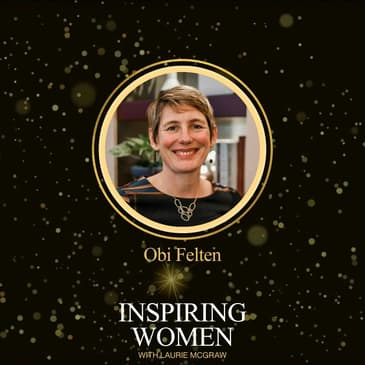

She led moonshot projects at Google X. Then she walked away to take on one of America's hardest problems: a youth mental health crisis where roughly 20 million teens and young adults need care — and only half get it.
In this episode of Inspiring Women, Laurie McGraw talks with Obi Felten, founder and CEO of Flourish Labs, about a different model for closing that gap: training young adults with lived experience to become accredited, professional peer supporters — and scaling it with telehealth and AI through Peers.net.
In this conversation:
- Why Obi left Google X moonshots for mental health
- The care gap: ~20M young people in need, only half reached
- Peer support as a way to expand the mental health workforce — not just add clinicians
- Winning Medicaid contracts to reach underserved youth
- Peer support in high-risk moments, like post-ER care for suicidal teens
- What it takes to scale a mission to a million supporters
About the guest — Obi Felten:
Founder and CEO of Flourish Labs, scaling professional peer support via Peers.net. Previously led technology moonshot projects at Google X and was Director of Consumer Marketing for Google across EMEA. BA in Philosophy and Psychology from Oxford; based in California.
→ obifelten.com · flourishlabs.com · peers.net
About the host — Laurie McGraw:
Laurie is a 30-year health technology executive and creator/host of Inspiring Women. She's Executive Vice President at Transcarent, and previously served as President and Chief Client Officer of Allscripts and SVP at the American Medical Association. A Brown University cognitive science graduate, board director, speaker and advocate for health equity and women's leadership, she started Inspiring Women to close a stubborn gap: women make up 70% of healthcare's workforce but hold only about 20% of C-suite roles.
—
Inspiring Women with Laurie McGraw advances women to healthcare leadership — and keeps them there. New episodes every Tuesday.
#InspiringWomen #MentalHealth #HealthcareLeadership #WomenInHealthcare #PeerSupport #DigitalHealth #GoogleX
[00:00:00] Hey listeners, Laurie here. When I first met Obi Felten, it was because she was one of the inaugural fellows of the WBL class program that I was the chair of. And she came to that program as the founder of an interesting company solving and aiming to solve the staggering mental health issue.
[00:00:21] We're talking about 20 million young Americans who have some form of mental health issue, but only half of them have access to care of any kind. So it's quite a staggering mental health gap and solving it is one of those problems that requires a level of innovation that Obi actually does have experience in.
[00:00:42] She doesn't have a medical background, but she does come from Google, Google X specifically, where she's used to dealing in moonshots, thinking big to solve problems of scale. You'll be impressed with how, just as I was, as she has dug into the science and has found that peer support training young adults to serve as coaches, mentors, to help these young vulnerable Americans with their mental health issues.
[00:01:10] It is perhaps a little wonky, but the more I talk to Obi about it, the more encouraged I am that this level of innovation really has potential. So please do listen in. Great Inspiring Women episode here. And I think you're really going to like what Obi has to say. Today, there are about 20 million teens and young adults who have a mental health issue and only about half of them get care.
[00:01:37] So there's over 10 million teens and young adults who get no care. This is Inspiring Women. I'm Laurie McGraw. And today I'm speaking with Obi Felton. She's from Flourish Labs, where she is the CEO and founder. And Obi, thank you for being on Inspiring Women. Thank you for having me. This has been, I've been waiting to come on your podcast.
[00:02:01] I know, I know, I know. So Obi and I know each other because Obi is one of the inaugural fellows for WBL, Women Business Leaders. But importantly, she is building a very important company. It is a young company that's starting to get quite a bit of traction in the space of adolescent mental health. Obi, tell us about Flourish Labs. Yeah. So our company is called Flourish Labs.
[00:02:26] And our mission is to solve the mental health crisis for youth with a new provider type. So today, there are about 20 million teens and young adults who have a mental health issue and only about half of them get care. So there's over 10 million teens and young adults who get no care.
[00:02:46] And when you look at the supply side, so the licensed therapists, psychologists, social workers, etc., the profession is not growing and there's not enough who are specialized in pediatrics. There's not enough in general. There's about 600,000 therapists and there's, you know, 30 million people in the U.S. who have a mental health issue who don't get any care. So when you look at the numbers overall, it's very frightening. But when you zoom into our population, so teenagers and young adults specifically, it gets even worse.
[00:03:14] And then when you look at populations like LGBTQ youth or BIPOC youth, they have a really hard time finding a therapist that they can build alliance with. So therapeutic alliance is a really important predictor of outcomes of therapy. And it's really a fancy word for saying, do you have alignment with the person you're talking to? Do you have chemistry? Do you trust them? Do you feel seen by them? And so on.
[00:03:41] And if you're talking to someone who is like me, you know, a middle-aged, white, straight, cisgender woman, which is how most therapists identify, that might work for you if you're a young, black, trans male.
[00:03:57] But it might not. And so our goal is to radically expand the mental health workforce by training young adults who have their own lived experiences of mental health issues and substance abuse and bringing them into the workforce. So it's an entry point into the profession. And we have a much, much broader pipeline from where we recruit. So I'm really proud of these numbers.
[00:04:22] Almost 60% of our providers identify as LGBTQ+. Half of them identify as BIPOC. So the chances of finding a match with us is just higher.
[00:04:34] Okay. So, Obi, the daunting issue of mental health in young adults and adolescents, 10 million people not able to access care, 20 million people who have a need to get care for mental health issues, that is overwhelming numbers.
[00:04:55] So to start in with a startup mindset, an entrepreneurial mindset, you have to come with some, you know, like big vision and big experience to be able to do that. And you worked at Google for quite a few years working on their moonshot projects. So I want to actually go back a little bit to the moonshot mindset. And what did you do at Google and how are you applying that to what you're trying to do at Flourish Labs? Yeah, I love that.
[00:05:25] So, I mean, I was at Google for 15 years and there's no doubt that that has shaped me. So first of all, I'm always thinking about how can we build a product that will work for everyone eventually? Not in the beginning. You actually have to narrow down and build for a specific user. But eventually it should be accessible to everyone. It should be open to everyone. It should work for everyone, right? So this idea that you think about how can I build something that has the potential to scale to everyone.
[00:05:53] And by everyone, I mean, you know, there's a lot of equity issues in mental health. So for instance, Medicaid, you know, has very depleted provider networks. And there's a lot of people in those 10 million youths and 30 million adults who are on Medicaid who are not getting access to care. So I think that's one thing I definitely learned from Google. It's like, how do you think about a solution that will scale to millions of people? You know, in our case, it was when I first joined Google in 2006, it was like we'd have to serve tens of millions and hundreds of millions of people.
[00:06:22] And then it became billions. Yep. Right? Like as the products were crossing a billion user thresholds. So that's one mindset that I took from there. Being very user-centric and building something that actually works for the end consumer first. So when people ask me, who's my customer? Well, I'm selling to health plans because we want to make peer support universally reimbursed. But really, the end customer for me, first and foremost, is the youth. Yep.
[00:06:50] Who are not well served in today's mental health system. And so even of the ones who do get care, about 45% say it's not useful for them. And that's terrible. Like I don't know any other industry where people get away with building a product that the end consumer doesn't actually find useful or helpful. And too much in healthcare, I think people are building products that don't have the patient or in our case, you know, we call them clients in mind. So that's the second piece I definitely took from Google.
[00:07:19] And then the third one is just, I think like a healthy disrespect for the impossible. So, you know, when I started the company, I said, I'm going to grow peer support. And, you know, we should have a million peer supporters in this country. And today there's 25,000. So people kind of laughed at me. Right. And then the White House issues a white paper that says peer support is part of our strategy for mental health workforce expansion. And suddenly people are like, oh, maybe there's something in peer support.
[00:07:47] So, and then people said, well, you're never going to sell to Medicaid plans. It's so hard to sell to Medicaid. It's, you know, it will take you 18 months to get your first contract. And, you know, you should sell to employers. It's much easier. Or you should do B2C and, you know, sell to consumers. You know, why don't you get parents to buy gift cards? And, you know, we have gift cards. So if you're a parent and you're listening to this, please go to peer.net and buy a gift card for 18 or young adult in your life. It doesn't have to be your own kids. But ultimately that's very inequitable.
[00:08:16] Like if I want to reach the people who are not getting care today, which both me and my co-founder who spent many years at Kaiser feel very passionate about, then we have to serve Medicaid. Yeah. So we built the whole company from the ground up in order to be able to sustain Medicaid reimbursement rates. And it took me 12 months to get the first contract with a managed care plan, which to me felt incredibly slow. I come from tech where everything moves much faster and people were like, you're in healthcare now. Yeah, exactly. Welcome to healthcare.
[00:08:45] Everything's slower and more expensive in healthcare is what I've learned in the last few years. And so, but once we got the first plan, you know, we now have four plans. So in the last sort of five months since we signed that first plan, it's like the pipeline has accelerated. Partly, I think, because we're a little bit more experienced. We've been in market for a year and a half now. We're delivering care. We're starting to show our first results. You know, we've survived.
[00:09:12] Like the plans are very wary of startups who pitch them like visions and that they actually can't deliver on. Yes. And partly because of social proof, right? Like everyone was always like, well, which other managed care plans are you working with? And now I can say, you know, I work with Pacific. But also like first-time founders, first-time female founders. I mean, you and I both know that, you know, the amount of investment that's going in to women-led companies is a lot less than it needs to be.
[00:09:39] And you don't come from, you know, a background history in healthcare first in terms of the things that you're working on. How much did that play a role in the getting started in terms of the skepticism of what you were trying to accomplish? Yeah. So it's interesting. So I'm very credible from a technology point of view. Yes. And my co-founder is a doctor. So I realized very quickly that if I want to sell into health plans, I have to convince the business person on the plan and the chief medical officer.
[00:10:07] Because peer support is not an established modality. And so I was very fortunate that Kim joined me in this endeavor. And so together we are definitely more sort of healthcare credible. Yep. Yep. But you're right. I didn't come from the industry. Like probably I had like a good dose of naivete about the industry. If I'd known all the things I know now, maybe I wouldn't have done this company. Yeah, probably working your favorite. It's just so hard, right?
[00:10:33] But what was interesting is like no health plan investor wanted to invest in our seat. Yep. They're like your first time founders. You kind of come from healthcare, but not really, you know. So we actually had tech investors and impact investors who led our first round. So it was Gradient Ventures, which is Google's AI fund, because we do a lot of AI work, both on the background, as well as now starting to interact directly with youth. And then Collaborative Fund, which is an impact fund in New York.
[00:11:01] And they sort of really bought into the vision and they sort of could see the potential, whereas the health funds are all saying, show me that you can sign health plan contracts. Yep. And now they're saying, and show me that you can activate those health plan contracts, which is our next step. Now we've got the health plan contracts. You know, how do you actually get a flow of clients at a reasonable CAC to LTV ratio and so on? So I'm finding like definitely health plan investors tend to invest in people who have been in the industry forever. Yep.
[00:11:29] And I think that's actually a miss because it means you're like missing new perspectives or like people who are like willing to do the impossible like we are. Yeah. Well, it sounds, I mean, the impossible task of getting into some of those Medicaid contracts, like you talked about the first one taking 12 months. By the way, that's a short cycle. That's a short cycle. So the naivety that you're bringing is quite excellent. It's working in your favor. That doesn't necessarily make it easier.
[00:11:57] Before we go to sort of like the next growth challenge that you're up against for peers.net, tell me a little bit about what you also learned when you were doing the moonshots that you don't want to carry forward as you take on this daunting problem of mental health for adolescents.
[00:12:41] Yeah.
[00:12:55] And so we were working on that problem.
[00:13:16] And so we had to put on a lot of wearable data to better assess depression and anxiety.
[00:13:42] And I realized the biggest problem in the mental health world was not better measurement. We'll need that one day because I don't think we can make value-based care and mental health work with PHP 9 and GAD 7. Yeah. But it just wasn't the most pressing. The most pressing was I heard over and over again, I can't find a therapist. You know, I can't find a therapist to refer to. And Kim, my co-founder, was a pediatrician who was one of the people who told me that.
[00:14:06] And so I think maybe at X we were sometimes too enamored with the technology and then tried to find a problem that fits that technology. And there's lots of problems that can be solved with technology. And healthcare, sort of like technology looking to solve just technology as the lead-in, often is actually never, like never the right way to approach it, quite frankly. I think even outside healthcare is not the right way to approach it.
[00:14:33] But, you know, I'm a product person at heart, so I will always start with a problem, deeply understanding the user and then using the technology tool that fits it. So, you know, for example, for us, we're sort of an AI company, but not yet. So I actually deprioritized the AI work, even though I know we're going to do lots of it, because I wanted to first build like a really good user experience, a HIPAA compliant platform, you know, all the kind of basics that we've had to put in place. And now we can start looking at like, how can we layer AI onto it?
[00:15:03] So I'm very pragmatic when it comes to technology. I've worked in tech all my life. I know the potential. I love it. I'm a tech optimist, but I also know what its limitations are. And mental health, I think, is particularly interesting when it comes to technology, because there's sort of two schools of thought. So there's some people who say, you know, we have to deliver mental health in person. There's no risk placement for sitting in a room with someone and like, you know, looking eye to eye. And then on the other extreme, you have companies starting AI therapists, right?
[00:15:32] Who say, no, actually, you can just do this with an LLM and a chat agent, right? Like my personal view is somewhere in the middle. We need to definitely inject a lot more tech into mental health. It's one of the sort of areas of healthcare that has less technology in it. Like, you know, there's less measurement. There's less, just less usage of it in general. And COVID was like the huge wake up call, right?
[00:15:58] Where like we have an amazing advisor who's a psychiatrist at Stanford at the time. And she said, you know, no, I need to see my people in person. She does like serious mental illness in teenagers. She's like, no way can I do it over the phone or on a video call. Right. And a few months into the pandemic, she called me and she's like, Obi, you know, you've been saying telehealth, like my patients are showing up. Yeah. I get an insight into what their home life is like, you know. So she has fewer cancellations is what I mean, right?
[00:16:27] Because if you're a youth who's deeply depressed, you can't even get yourself out the house. Right. So she's a convert now to telehealth. And I don't think telehealth is, we will always need some in-person provision. But I think in for youth audience, like we can do so much just through their device. Which is where they're at in any case. Well, the need is so big. So Obi, let's go back to just building the company. So I mean, you've had great success already, early success with a number of contracts with
[00:16:55] health plans, which you thought would be really hard. It was hard, but I'm telling you like what you've done, that is amazing. What is the next challenge? Because building a company, it's hard every day, every minute you're making some next decision. So what are you grappling with in terms of the next things that you need to focus on? Yeah. Before I go there, I would actually say there was one other thing that was really hard for us in the beginning, which is to build the right culture that sets us up for success. People often overlook that.
[00:17:24] They like immediately go to like KPIs, like, you know, how many contracts do you have or what's your revenue, et cetera, right? Well, they should be asking entrepreneurs in the early stages, it's like, how are you building a team that's going to enable you to build a company that's going to work? Right. And for us, we were mixing three different worlds, right? Like every healthcare, health tech company mixes like tech and health, right? And so you often have like a co-founder like me that comes from the tech world and a co-founder who comes from the healthcare world, right? Yeah.
[00:17:54] I'm very lucky. My co-founder and I get on, we have really healthy conflict. We definitely disagree on things, but we like really deeply respect each other and are very grateful for each other. But then we realized we have to mix in a third world, which is peer support traditionally has been delivered in public health by nonprofits who are, you know, not tech enabled, who have nothing to do with this world. And we realized that if we want to be part of that world and not come in as a sort of,
[00:18:21] you know, spaceship from outer space tech company that crashes into the peer world, we actually also need people from that world in our company. So our head of peer support, Ali Linford, ran peer support programs for a county in Oregon and she's just deeply part of that community. She's on the board of her local NAMI chapter and so on. So it not only gives us credibility with folks in that world, but also gave us like a deep, deep understanding of like, you know, who are we going to be serving? How do we enable that workforce to be successful?
[00:18:51] Yeah. And so I say like, we kind of this cultural melting pots of these three worlds, like, you Ali had never done OKRs before. I came from Google. Obviously, you do OKRs, objectives and key results. But she's also taught me so much of like, you know, how do you speak about mental health in a way that's respectful, that's, you know, strength led, resilience led, et cetera. Yep. So those, that culture building in terms of a foundational thing that you focused on is great.
[00:19:16] And the other thing about culture is it changes and needs to be cared for as companies grow and you are growing. So back to sort of like what's up next. No, for sure. So our, so when we, when we raise our seed round, we basically said we'd have to prove out three things. So the first question was, can we get health plans to reimburse it? Because that was the biggest skepticism I got, especially from healthcare investors in the seed. So that I feel like we've proven it. We've got a really good pipeline.
[00:19:46] Like people no longer believe we're not going to get these, these, these plans. And by the way, we're negotiating good rates. So, you know, everyone's like, you're not going to be able to negotiate. And it turns out, yes, because they have such a big gap in pediatric and, and sort of, you know, non-traditional providers. The second piece is, do youth want this as a service, right? Like, do they understand what peer support is? Mostly not, right? They like, like, how is this different from talking to a friend or how is this different from talking to a therapist?
[00:20:16] And so we have to explain, this is someone who's trained, they're qualified, they're supervised, they have their own backup. They use their lived experience, right? There's a lot of sort of education that we have to do around it and building a product that youth want. I would say that's our next biggest challenge is like, how do we get more client flow in? And because I'm building for Medicaid, I can't just buy clients on, on Google, right?
[00:20:41] Like, I can't compete with like BetterHelp and Talkspace and all the companies who are running these very large advertising campaigns. So it's really going to be about referral networks of like finding other provider groups who want to refer to us. Yeah. And one of the avenues that we realized is really underserved is step down from higher levels of care. Okay. So say a youth that's been to the emergency room with self-harm or suicide attempt, any parent
[00:21:11] will tell you it's almost impossible to find a therapist after that because most therapists, especially the ones who are in private practice, are like, I can't take on that risk. And just in the hospitals or the health systems also have no means to help that person, to help that child and no place to go. And they have this incredible event and then they're shipped to nowhere. I mean, it's devastating to hear those stories. It is. It is really devastating.
[00:21:37] And I'm on an advisory board for London Hospital, Chelsea and Westminster, where they're rebuilding the entire care experience for youth, including community outreach programs in order to get teens and young adults out of their emergency room. Yeah. Because every hospital loses money on it. It's heartbreaking. They don't know where to send them. In Oregon, you know, youth are boarding in the ER because there's no psych beds. Yeah. And most youth who come into that ER don't need a psych bed.
[00:22:05] Like I would actually say that's a real last resort. So, but the problem is they're supposed to get a follow-up call within seven days or 30 days. And it's only about a third that get the follow-up call. And then when you follow them longitudinally, if they don't get that follow-up care, about a third end up back in the emergency room. Yeah. And so that's both a very compelling use case for the end user, right? Who's like, I'm going to the emergency room because I have no other objects.
[00:22:31] Or they call it crisis line where like all crisis lines get about 30 to 40% repeat contacts. People don't know this. So Trevor Project is one of our partners who send us LGBTQ youth and they say, you know, they have what they call familiar voices. Like people will call them again and again. And that's because folks often who've been in crisis don't have anywhere good to go. Most digital health companies don't accept them. There's a few exceptions.
[00:22:59] So that's one area where we can take those referrals. And the reason we can is because that peer support culture that I talked about earlier, we decided right in the beginning, one of our company values was inclusion. So we wanted to take everyone. So we built our safety mechanisms and the backup in a way that we can take suicidal teens when others can't. Well, the problems are so large, Obi. So I just, you know, I just want that, you know, you to be so successful at building and
[00:23:27] handling that next challenge in terms of getting that company to grow. As we close out on this Inspiring Women interview, what is your vision for the company or the problem that you're trying to solve? Yeah. So my vision is we should have a million peer supporters in this country. Like if we had a million people who not all need to work full time, so this would include full time and part time, we could close the care gap for 35 million people. Like we'd be done. Yeah.
[00:23:56] And that sounds like a ridiculously large number if you consider there's about 25,000 today. But then when you think there's 60 million people with a diagnosis, it's not incredible that we could get a million of them into recovery and to do this job. Well, this is a great vision. And this has been an excellent Inspiring Women conversation. I've been speaking with Obi Felton. And Obi, thank you so much. Thank you, Lori. This has been an episode of Inspiring Women with Laurie McGraw. Please subscribe, rate, and review.
[00:24:26] We are produced at Executive Podcast Solutions. More episodes can be found on inspiringwomen.show. I am Lori McGraw, and thank you for listening.