
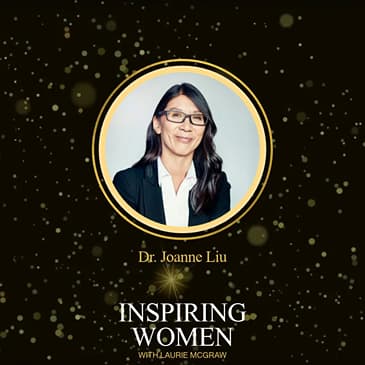

In September 2014, Ebola was killing people at the gates of her treatment centres every morning, and Dr. Joanne Liu went to the United Nations to tell member states the truth: the world was losing. A year later, on 3 October 2015, a US airstrike destroyed the Médecins Sans Frontières trauma hospital in Kunduz, Afghanistan, killing 42 people, 14 of them her colleagues.
Dr. Liu led Médecins Sans Frontières / Doctors Without Borders as International President from 2013 to 2019, through Ebola in West Africa, the bombing of hospitals in Afghanistan, Syria and Yemen, and the migrant crisis in the Mediterranean. In this episode of Inspiring Women, Laurie McGraw asks her what those years taught her, how ready we are for the next pandemic after COVID-19, and why she wrote her new book, Ebola, Bombs, and Migrants: Humanitarian Crises in a Security-Obsessed World (House of Anansi Press, out 13 October 2026).
WHAT YOU'LL LEARN
- The line from Camus's The Plague that sent a teenager into medicine: never trivialize death
- What leading the Ebola response in 2014 was really like, and why the world waited
- Why TIME named the Ebola fighters Person of the Year
- What happened in Kunduz, and why a hospital must never be a target
- Why the 2025 WHO Pandemic Agreement still leaves one big question open
- How fear and the "security agenda" shape who gets help, and who doesn't
- Why she tells every young ER patient: you have agency
- How Louise Arbour, now Governor General of Canada, became her sounding board for every hard decision
- Her advice to women: never apologise for being right
CHAPTERS
0:00 Trailer
0:50 Introduction
2:20 The book that sent her into medicine
3:40 Becoming a humanitarian doctor
5:15 Ebola, 2014
8:35 Kunduz: the hospital that was bombed
11:20 COVID-19 and the next pandemic
13:15 The pandemic agreement
15:20 A security-obsessed world
17:55 You have agency
18:50 Where are the leaders?
21:15 "Call me Louise": Louise Arbour
23:15 Why we need more women leaders
24:00 Advice to women
ABOUT THE GUEST
Dr. Joanne Liu is a paediatric emergency physician, a professor at McGill University's School of Population and Global Health, and director of its Pandemics and Emergency Readiness Lab. She was International President of Médecins Sans Frontières from 2013 to 2019, and TIME named her one of the 100 most influential people in the world.
ABOUT THE SHOW
Inspiring Women is hosted by Laurie McGraw. Each episode features women leaders in health, science and business sharing how they built their careers and what they learned along the way.
#InspiringWomen #Leadership #GlobalHealth #DoctorsWithoutBorders #Ebola #WomenInLeadership
[00:00:00] [SPEAKER_00] I remember when I went, we were only opening 30 minutes in the morning to fill the bed of people who died overnight.
[00:00:06] [SPEAKER_01] She's a pediatric emergency room physician and probably the most recognized voice in global humanitarian medicine. For two terms, the president of Doctors Without Borders.
[00:00:17] [SPEAKER_00] The case fatality rate, the number of people who died is between 50 to 75 percent. Something needs to happen. Five airstrikes on a fully functioning hospital of 110 beds. 42 people died, 14 of our colleagues. And a hospital is a place of healing and it should be respected. It cannot become a target. We know that virus, don't respect borders, don't ask for a visa. Honestly, I'm going to fight until the end, even if I'm defeated.
[00:00:49] [SPEAKER_01] This is Inspiring Women. I'm Laurie McGraw. And today I have an incredible guest. I am speaking with Dr. Joanne Liu. She is a professor, the director of the Pandemic and Emergency Readiness Lab at McGill University. She's a pediatric emergency room physician and probably the most recognized voice in global humanitarian medicine. She was for two terms, the president of Doctors Without Borders.
[00:01:17] [SPEAKER_01] She led during that time during the Ebola epidemic that was a little bit more than 10 years ago now. After that, there was an airstrike on a trauma hospital in Kunduz, which she spoke about very publicly. And last year she published a book that is Ebola, Bombs and Migrants, The Humanitarian Crises in a Security Obsessed World. That is coming out in English shortly.
[00:01:44] [SPEAKER_01] Dr. Liu, thank you for being on Inspiring Women. Thank you so much for having me. Well, I am going to just like take us immediately in the Wayback Machine. Your work is renowned and global and critically important to protecting people everywhere.
[00:02:03] [SPEAKER_01] Yet your original sort of like desire to go into humanitarian medicine was started at a young age when you read something about someone published with Doctors Without Borders. Can you bring us back to those early days and what brought you into this line of work?
[00:02:22] [SPEAKER_00] Well, just with respect to what has inspired me is when I was a teenager and I was in this sequence of my life of a quest for meaning in life. I read books that inspired me and one of them was a physician who was volunteering for MSF as a surgeon at the front line of crisis and war zones. And the other book I read is The Plague from Albert Camus.
[00:02:47] [SPEAKER_00] And I think that's probably the book that stayed most with me because I remember at one point the protagonist, the doctor, is being asked, what is driving you? Why do you keep going when your patients are dying and you don't have treatment to offer them and you don't even believe in God? And then the doctor answered, I never got used to death. I don't know more. And I remember telling myself that I will never travelize death and I will basically fight for life.
[00:03:15] [SPEAKER_00] And so this is how I ended up being a doctor at the front line of crisis.
[00:03:19] [SPEAKER_01] And so being a doctor and fighting for life is a tremendous profession. It takes quite a bit. But then you went on to really just think about it globally and the humanitarian part of medicine. So can you just talk about those early days as a physician and that pursuit of a much larger global impact?
[00:03:42] [SPEAKER_00] So basically is I went into medicine to do humanitarian aid work. I wanted to go and join an organization. And I think I'd already had targeted Doctors Without Borders, Medecins Sans Frontieres. And so as soon as I graduated, I ended up working at like what I call a hybrid profession. I was working in the tertiary health care in Montreal as an ER physician. But as well, I was working in, I would say, a remote area in Canada, in the northern area.
[00:04:11] [SPEAKER_00] I would say, northern geographic places of Canada. And then I was as well volunteering and doing a field assignment with Medecins Sans Frontieres. So initially I was a hands-on physician. And then you discover that if you want to have a little bit bigger of an impact, you need to take some more responsibility. But as well, you need to be exposed to many things.
[00:04:37] [SPEAKER_00] So for a few years, I ended up being a bit like what we call the emergency team of MSF. And I would go to all the big crises and be what they call the explo team, meaning that it's the people who go when there's a new crisis. They send you, you do an evaluation, make what is the urgent assessment, and then you build up a project of intervention. And so I did that for about a year and a half.
[00:05:06] [SPEAKER_00] And then I was offered to be a project manager in Paris for Doctors Without Borders, Medecins Sans Frontieres.
[00:05:13] [SPEAKER_01] And then Ebola happens. So Ebola comes, and that is a world crisis that was quickly recognized. And you were in the thick of it. Can you bring us back, this is 2014 to 2016, when you were leading the organization during this world crisis. And what was happening then? Because, you know, as you said, I fight for life. And yet you were seeing a lot of death.
[00:05:40] [SPEAKER_01] And so how did you bring the level of recognition that was needed, as well as the humanitarian efforts together to support dealing with that epidemic?
[00:05:56] [SPEAKER_00] Right. So we have to somehow bring ourselves back to 2014. And 2014 was the year that Qumay was annexed to Russia. It is the year as well that Syria was having this big, I would say, civil war. And as well, it is the year that Gaza was under fire during the summer.
[00:06:19] [SPEAKER_00] So there were a lot of conflicts that were basically not allowing any, I would say, high-level authorities to pay attention to an epidemic somewhere in the remote area of West Africa. And so we, as an organization, have been basically pulling the alarm and saying, there's something happening, it's different, there's a lot of people being infected,
[00:06:46] [SPEAKER_00] the case fatality rate, the number of people who die is between 50 to 75 percent. Something needs to happen. The countries are overwhelmed. The three countries who are affected, Liberia, Sierra Leone and Guinea are just overwhelmed. Something needs to happen. And even us, our Ebola center, I remember when I went, we were only opening 30 minutes in the morning to fill the bed of people who died overnight. And so when I went there, it was so dramatic.
[00:07:14] [SPEAKER_00] Every morning we would wake up and we'd see people in front of our Ebola center. And some of them were already dead. So that was absolutely so traumatic. It was one of the missions where we had to deal with so many deceased people. And so we decided, I decided with people from operation to go into the three countries, meet the head of state of each country, and after that go into a diplomatic tour
[00:07:42] [SPEAKER_00] and just ring their alarm and tell people something needs to happen. And then this is what happened. We didn't know if it would be successful. And what was, I would say, the game changer was the fact that there were two humanitarian aid workers from Samaritan Purse that were infected, repatriated to the states. And all of a sudden, the northern atmosphere felt threatened.
[00:08:09] [SPEAKER_00] And then the other thing is, as well, I, as an organization, as the head of the organization, I was invited to go and brief the member state at the United Nations. And that as well sort of increased, I would say, the visibility of what was going on.
[00:08:25] [SPEAKER_01] If you reflect back during that time, you know, had the, you know, during the course of those events, you know, having the microphone and sounding the alarm was certainly something that you brought forward just a year later. It was the trauma hospital that was hit by the United States airstrike. And you were very vocal about calling that out, not just grieving the loss of what happened during that time, but being very public of how this needed to be investigated.
[00:08:55] [SPEAKER_01] Was it the time of Ebola that gave you the strength to realize that you needed to be more vocal, more publicly vocal about what was going on there? Maybe bring us back to that.
[00:09:06] [SPEAKER_00] Well, I think that what happened is what Ebola gave us, it brought us to the world stage and gave us world visibility and as well, and then recognition from the general public. And we have to remind ourselves that in 2015, the Ebola frontline worker were the Time magazine person of the year. So it was very vivid in people's life.
[00:09:34] [SPEAKER_00] And so when our trauma center was attacked in Kunduz, the northeastern part of Afghanistan, five airstrikes on a fully functioning hospital of 110 beds, 42 people died, 14 of our colleagues. And we were devastated because everybody knew who we were. We've been working there for several years.
[00:09:56] [SPEAKER_00] And then everybody knew that in this part of this country, if you had a broken bone, the place to go was Kunduz's trauma center. And so when this happened, there was as well, not only in Kundu's, this one was particular because it was five airstrikes. So it was like a very insistent attack. But we were being bombed in Syria. We were being bombed in Yemen, in Sudan.
[00:10:20] [SPEAKER_00] And so what we decided, we need to tell the rest of the world that there are rules of war. And a hospital is a place of healing and it should be respected. It cannot become a target. And so this is how we decided to be much more vocal. And then as well, this did not happen alone. We had colleagues that I would say the humanitarian aid sector got together to support that.
[00:10:49] [SPEAKER_00] But we were as well invited to help in drafting a resolution for the protection of the medical mission in war zones with the International White Cross Committee by the elected member of the UN Security Council. So that's what happened somehow organically. But I think that the fact that people remember what we did in Ebola gave us a little bit of, I would say, public empathy.
[00:11:18] [SPEAKER_01] So now let's come forward to today. So a decade later, we still have wars throughout the world. We have a lot of conflict. We have different opinions about sort of, you know, preserving those statuses that you allowed, created there. And we've been through a global pandemic with COVID-19.
[00:11:45] [SPEAKER_01] In terms of preparedness, pandemic preparedness, epidemic preparedness, where are we today? You are sounding the alarm today in terms of things happening within or around the globe. Can you talk about some of those as well as your thoughts about how prepared we are at this moment today, given the work over the past 10 or 15 years?
[00:12:09] [SPEAKER_00] Well, I think that COVID-19 has brought to the general public, I would say, knowledge about what is a pandemic, how should we fight? And all of us carry a little bit of a trauma from that because it was the first time that basically our individual freedom was somehow constrained to a certain extent. There were curfews. There were places you couldn't go and then you have to line up.
[00:12:39] [SPEAKER_00] Anyway, it was very, very, I would say, impacting our daily life. And so what I do find somehow very surprising is in the last, I would say, since World War II, there is no collective trauma like this that have basically killed so many people. We talk of at least directly 6 million people and directly exceeding number of deaths during the COVID pandemic.
[00:13:07] [SPEAKER_00] We talk about 18 million people. There were a financial contraction of trillions of dollars in addition to have our daily life being impacted. And so you would think that we would want to fix that, that we would want to have mechanisms to respond to that. And so we signed a pandemic treaty at the World Health Assembly last May 2025. But there was one thing that we couldn't agree.
[00:13:34] [SPEAKER_00] It's what is called the access to the pathogen and the sharing of benefit of it. So if a country has a virus, you share the sequence of it. You just said, hey, if I share that, are you going to share what you're going to discover from that, like the treatment or the vaccine or the diagnostic? And the wealthy country are saying no.
[00:13:57] [SPEAKER_00] And so because of that, we haven't fully endorsed the pandemic treaty. We're still negotiating. We're still negotiating. And even one week ago, we were at the United Nations General Assembly and we were supposed to do a political statement on pandemic. And it didn't even pass for a vote. So are we better prepared? I think that individually, we know what it is about.
[00:14:23] [SPEAKER_00] And but I think collectively, we were not ready to come together in solidarity to fight a pandemic, despite the fact that we know that virus don't respect borders, don't ask for a visa.
[00:14:38] [SPEAKER_01] Right. And, you know, being here in the United States, you know, a nation that is withdrawn from the World Health Organization. And I look at that from a perspective of at a time where we have so much recency of understanding of the global pandemic. I look at the time of, you know, COVID-19, how quickly vaccines were put together through research, through science.
[00:15:06] [SPEAKER_01] Exceptional. And now we're also in a time where in the United States, most certainly vaccine skepticism is just it's unbelievable. It's just unbelievable that this can be true. We have measles that are coming back, just things that just make no sense to me, not as a clinician, but as somebody who's worked in health care for decades now. So I look at all of this and think like, you know, how can we be in this place?
[00:15:34] [SPEAKER_01] Yet I want to be hopeful. You've written this, your book, Ebola, Ebola, bombs and migrants. And you talk about there how what you've learned from these different aspects of things that you've been on the front line of and where we place our interests is not always just based on science or what is the humanitarian way to do something of benefit for people.
[00:16:01] [SPEAKER_01] Can you talk about Ebola, bombs and migrants and just, you know, the main themes of this book?
[00:16:08] [SPEAKER_00] Well, so the basic thesis of my book is. Since 9-11 in 2001, 25 years ago, we are living in an era of fear and that fear, I brought what I call the security agenda, our obsession for security. We sit everywhere, just going and taking a plane, but as well in our foreign policy. And so what I say is that security obsession is eroding our what I call solidarity mechanisms.
[00:16:36] [SPEAKER_00] And so three cases I put forward, the Ebola outbreak, we only respond the global north when we felt threatened about attacks on the hospital. Now we see the enemy everywhere, even in hospital. And then with respect to migrant, we are portraying the migrant as an existential threat to our identity, to our community. And so what is this book is a call for?
[00:17:03] [SPEAKER_00] It's a call to solidarity, but not in a naive way. I'm saying I do not believe that we're going to retract back on our security obsession. But I think that we should elevate what I call our common humanity, what makes us human, between different communities, different groups that we have the same, the same need of access to care, access to dignity, access to protection.
[00:17:32] [SPEAKER_00] And so to elevate our humanity to the same level of security. And I think that we're going to fare better. And then the reason why I'm saying that, because it sounds naive when I say that, but is the fact that we fought so hard as an organization, as MSF in the past, doing the Ebola outbreak or after we got under attack with the migrants. And each time everybody told us, you know what, you will accomplish nothing. And each time we made a difference, but a trivial difference.
[00:18:02] [SPEAKER_00] It was a difference in people's life. And so my call is to just say, hey guys, it is worth to fight and to not give up. It is worth it even if the solution is imperfect, but then because an imperfect solution is better than no solution. And I'm saying that because I'm an ER physician and every single day I work, I have kids who tells me, I don't want to leave. I don't want to have children. I don't want to get married. I don't want to carry on.
[00:18:32] [SPEAKER_00] And I wrote this book to tell them, please give it a try. Do not give up. You can make a difference. You have agency.
[00:18:41] [SPEAKER_01] Who is going to lead the charge for this? Because in a security-obsessed world, and there does not seem to be political leaders who are answering that call in the way that you are imploring us all to do. Will it be physicians? Will it, you know, what global communities or does it need to be global communities?
[00:19:04] [SPEAKER_01] Where do you see the leaders leaning in so that protecting the vulnerable is, from my perspective, an obvious thing to do? That is not the case. We do not protect the vulnerable. Here in the United States, our public safety nets, you know, our public health safety nets are eroded and never funded to the level that is needed to the need. So where do you see the leadership coming from and how can people come together for this cause?
[00:19:34] [SPEAKER_00] Well, I think that it's going to come from people. And I think people are going to think to get together and then come together. But we all have agency. And then, of course, I always take this example because I'm Canadian. But when Canada didn't want to go to the war against Iraq in 2003, by thousands, hundreds of thousands of people, we marched in the street to not go and we didn't go. And then when something is important and we go and then come together and say it out loud, it works.
[00:20:03] [SPEAKER_00] And I think, for example, if you think the attacks against the medical mission hospital, I thought it was very unfortunate that the medical community didn't get together. There were many medical associations who made a statement back then. The Canadian Medical Association did it, for example. But I thought that my dream was every physician would say a hospital is not a target.
[00:20:28] [SPEAKER_00] And this is possible, but people need to want to stick out their neck for things they believe. And it takes effort. But what is the other choice? You know, watching the world basically crumbling in front of my eyes and then handing over that to our children and grandchildren? Honestly, I'm going to fight until the end, even if I'm defeated.
[00:20:54] [SPEAKER_01] Sticking out your neck and leading with your own voice and agency is clearly who you are. You are a nationally recognized times, you know, most important for a reason. And you also, let's go back to you, Dr. Liu, for just, you know, your own mentors, the people that helped you along the way.
[00:21:14] [SPEAKER_01] You talk about your mentor, Louise Arbour, who is the current Governor General of Canada, just most recently appointed, and that she is somebody who has given you inspiration. And it seems like whatever, she is a nationally recognized, a world recognized person for her own work in humanitarian service and really international war crimes, prosecuting them.
[00:21:42] [SPEAKER_01] So talk about that relationship and how she has inspired you and given you the energy, because it is nothing but difficult what you are doing and what you're up against.
[00:21:53] [SPEAKER_00] Well, Louise is very, very special. And it's interesting because she was introduced to me just the day before I went into election to become the international president of MSF. And I remember meeting her in Belgium because she was the head of international crisis group. And then we met for like 20 minutes. And then at the end, she just said, listen, if you are elected, call me back. And I remember I called her back a month later. I said, hey, by the way, I got elected. And she just said, call me, Louise.
[00:22:21] [SPEAKER_00] And then from now on, I had this personal phone number. And when I would be somewhere and then wondering, am I on the right track? Am I thinking right? Because she's a woman of integrity. She's a woman of the rule of law. I would send her a message. I said, do you have a few minutes? And then she just said, call me in that many, like in one hour or this afternoon. And so she will ask questions. She never told me what to do. She asked me questions.
[00:22:50] [SPEAKER_00] And after a few minutes, she would say, you're on the right track. You're going to find your answer. You'll find it. And that was always this sort of little nudge that I needed to allow me to carry on. But yes, she's always been there for me. She's still today. And I was telling her last time, I said, are you aware that all my very hard decisions, I always run them by you?
[00:23:13] [SPEAKER_01] Well, it's always fantastic to have someone like that. So let's close out this incredible Inspiring Women conversation. So for everyone out there who needs their own Louise and for you, Dr. Liu, who is willing to stick your neck out, be that voice until your last breath in terms of fighting for something that is so, so important. What do you advise others? And in particular, women.
[00:23:39] [SPEAKER_01] It's my view that when women lead, we have a more just and equitable society. Full stop, full stop. And we do not have enough women leaders out there. So can you just inspire the others who are coming behind you to lead with a level of energy and commitment and passion and impact that you are having?
[00:24:03] [SPEAKER_00] Well, what I would say to women is that you should not be apologetic for being right and being smart. Don't let anyone make you believe that you're not worth to have this role of leadership. Untrue. Carry your head straight and high and just be, I would say, assertive and as well confident and humble about that. But it's not true.
[00:24:31] [SPEAKER_00] Because regularly, because I guess because I come from a community, visible minority woman, everybody somehow always make me feel that I should remain silent. Don't let yourself to be silent. Speak your throat. Keep your integrity. And then always, always be humble and empathic the way you lead.
[00:24:53] [SPEAKER_01] Well, that is incredible advice. And Dr. Liu, I cannot wait for your book, Ebola, Bombs and Migrants, which is coming out this month in English. And thank you, thank you, thank you for being on Inspiring Women. Thank you.