
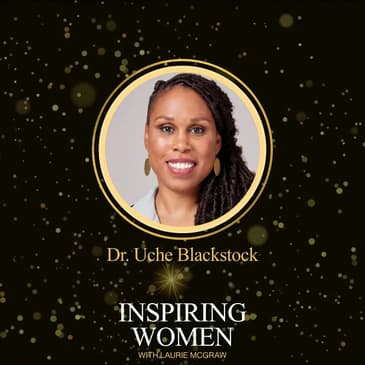

Dr. Uché Blackstock spent almost a decade as an associate professor at NYU School of Medicine. From the outside she looked happy and successful — inside, she had never felt so invisible, undervalued, and underappreciated.
So she left. When she wrote her resignation op-ed on why Black faculty leave academic medicine, she was sobbing — grieving the career she wished she could have had. That piece became lightning in a bottle, followed by her instant New York Times bestselling book, Legacy: A Black Physician Reckons with Racism in Medicine.
In this Inspiring Women conversation, host Laurie McGraw sits down with the founder of Advancing Health Equity to talk about the moment the window on health equity swung wide open in 2020 — and what happens now that it's closing. They get honest about the difference between performative statements and real systemic change, why the work is being renamed and re-embedded rather than erased, and why some disparities — like maternal health — are still getting worse.
She breaks down the strategic shift her own organization had to make when the inbound stopped overnight: from trainings to restructuring, from the moral case to the ROI case, from many projects to a few high-value partnerships. And she goes somewhere most leadership conversations don't — burnout, hiring a mindset coach, and picking up the violin again for the first time since she was 18.
Hosted by Laurie McGraw.
IN THIS EPISODE:
- Why she left academic medicine — "I never felt so invisible"
- The op-ed that changed everything — and the messages still arriving 6 years later
- Performative statements vs. real systemic change after 2020
- Why the work is being renamed, not erased — and why she kept her org's name
- The leaky pipeline myth — it's a systemic problem, not a pipeline problem
- Finding the open windows before they close
- The business case for health equity: ROI, clinical trial diversity, the bottom line
- Rebuilding her organization when inbound stopped overnight
- Leading through burnout — fewer, higher-value partnerships
- Protecting your wellbeing as a purpose-driven founder
Full episode on Inspiring Women. Link in comments.
#InspiringWomen #UcheBlackstock #HealthEquity #Leadership #WomenInMedicine #Legacy
[00:00:00] I think the pendulum will swing back. I don't think it will ever swing back as far as it was immediately post 2020, but I think it will swing back. What I'm seeing is its principles integrated into all aspects of how a health-related organization functions. Being operationalized and not being so explicitly saying, okay, this is our health equity team, right? Because our health equity team is actually working with all teams, right?
[00:00:27] We're working around quality, working around safety, we're working around outcomes, right? We're working with the community. This is Inspiring Women. I'm Laurie McGraw, and I'm speaking to you today from an airport, but I had to do this conversation and not postpone it because today I'm speaking with Dr. Uché Blackstock. I have been stalking her since the day she published the book, which was an instant bestseller, Legacy,
[00:00:56] a Black physician reckons with racism in medicine. She is the CEO, the founder, the creator of Advancing Health Equity. This is an incredibly important organization, Advancing Health Equity, a topic that has changed in terms of its meaning and its impact since the entire nation and world learned about the importance of that. Dr. Blackstock is a physician, she's an author, she's a change maker. Dr. Blackstock, thank you for being on Inspiring Women.
[00:01:25] Thank you so much, Laurie, for having me. I'm very excited for this conversation. Well, let's just begin where we were in, you know, just talking about a mutual friend of ours, Dr. Aletha Maybank, who I had the opportunity to work with and by the side of as she created the Center of Health Equity at the American Medical Association. That was a very, very important time at the American Medical Association.
[00:01:49] It was a big responsibility and a divisive and controversial topic at that time. Then the pandemic happened and everything changed. And of all the many, many things that I learned about health equity at the time, one of the things on the human level that I learned in working with Dr. Maybank is that she was exhausted with the work and the toll that it took to be the representative of this incredibly important work.
[00:02:19] Dr. Blackstock, where would you like to begin this conversation based on the work that you're doing today? Okay. So, yeah, it's interesting because, you know, people ask me this question all the time, like, given the platform that you have, you know, talking about these issues that have come back again to being considered by some divisive, like, how do you do it? Like, you know, how do you keep up the hope? How do you keep up the energy and keep up the mission?
[00:02:48] I think what I'll say is that, you know, I founded my organization, Advancing Health Equity, actually in December of 2019. So this is pre-pandemic. I had made the decision to leave academic medicine. I was associate professor at NYU School of Medicine for almost 10 years in early 2019, 2019 because I also felt like I really wanted to do this work in a very authentic and non-performative way.
[00:03:16] And I had a lot of experiences within academic medicine where I felt like I couldn't fully embrace that role and that work. And so it became obvious to me that after actually building this career all my life, I never thought I would leave academic medicine. You know, that was where that's all I knew, you know, to be in an environment where there is clinical work, where there's education, where there's research so intellectually stimulating.
[00:03:42] My mother was in academic medicine. My mother, the original doctor, Dale Blackstock. And so that's all I knew. But I had had these moments of deep, deep disappointment, deep demoralization, where it was very clear that in order for me to have stepped fully into that work, I really had to do it on my own in my own organization, in a culture that would promote that and nourish that.
[00:04:07] And so I made this decision. People looked at me like I had lost my mind. I had multiple roles at NYU School of Medicine. I think from the outside, people would have said she looks so happy and she's very successful. But I had never felt so invisible, undervalued and underappreciated before. And so, yes.
[00:04:28] The American dream, Harvard trained. Your twin sister, Harvard trained. Your mother, Harvard trained. Physician at one of the most esteemed organizations practicing medicine. Stepping away was a big moment for you, but it was a big moment for the entire physician industry and world.
[00:04:48] Yes, it really was. And it's interesting because I was I was having dinner with my literary agent last night, May, who has become a dear friend of mine and who who actually approached me about writing legacy. And the one thing like she says to me all the time, do you realize that the decision that you made? Many people don't make a decision to leave academia, first of all. And then when people leave, they leave quietly. You did not leave quietly.
[00:05:14] You wrote an op ed that was in Stat News entitled Why Black Faculty Are Leaving Academia. You became an MSNBC News contributor. You started talking about these issues that were really spoken about really quietly inside of academia. But I knew I had done something really powerful because when I wrote that when I left and I wrote the piece in Stat News, the number of responses that I got from people that I had never even met.
[00:05:42] Right. Other black medical students, trainees, attendings, physicians, they reached out to me, whether it was over text, email, DMs over social media and said, thank you so much for putting what I wish I could say into this article.
[00:06:04] And even that was January of 2020. I still get emails from people six years later that said, oh, I mentioned your article in my presentation today or in the article I wrote, I referenced your article. But for me, that that article was like I had no choice. It was my it was when I wrote it. I literally I was crying. I actually wrote it a few months prior. I was sobbing because I was in grief.
[00:06:31] I was grieving the career that I wish I could have had in academic medicine and so many others like me. Had we environments and cultures that really support us showing up as our full authentic selves, listening to our students, not feeling threatened when when people bring up like these are the issues that I'm seeing. I'm not getting mentored. I'm not getting promoted. I'm not getting the same opportunities.
[00:06:53] What can we do differently? Right. Not being not being scared to have the not only have the conversations, but do the work, measure the outcomes. Right. Because if you don't have the data, like when you look at the data and see the promotion of what women faculty, right, faculty of color, like you see that there is this leaky pipeline in medicine where you don't see as many in associate professor, full professor tenure.
[00:07:22] There is a problem, even though the representation of women in medicine has gone up significantly. You know, we still don't see that in leadership positions. And I think the leaky pipeline is almost like it's like the wrong term. It's not a pipeline problem. It is a larger systemic problem of the people pulling and advancing folks forward.
[00:07:44] So can we perhaps just it was lightning in a bottle when you wrote that op-ed and then you wrote legacy lightning in a bottle, a pandemic, a moment where the words health equity were something that everyone was talking about, even though people like your mother were doing that work long before it was named.
[00:08:05] Yes. What where are we now? Can you because there was a time there was a time when I was at the American Medical Association, it was very clear to me we were making systemic changes in the system to address racism in medicine. Have we made progress? I think we also know we have new roadblocks and have taken material steps backwards. Yeah, I mean, yes. So I would say I have so much to say.
[00:08:32] I would say that, OK, the bar was very low, right? The bar was very low in terms of what organizations and institutions thought they had to do. So, yes, there were performative statements by some and then others. There was a full their full strategy. Right. How are we integrating these themes into all aspects of the organization around health equity?
[00:08:54] So it's not siloed. Right. So I will say I do think the fact that we were talking about health equity as a major issue that needs to be addressed. That was a positive outcome of the moment. Right. The organizations had not been talking about it so explicitly. So thank you for that. But, you know, I will say that people dug there.
[00:09:17] And as you alluded, people really dug deeply and started doing the work in a way that said, you know, how can we make this work sustainable? The concern that I have is in the last year or year, year and a half, that a lot of that work has been either halted, slowed down, redirected. Right. And so.
[00:09:41] You know, and it's happening, it's happening at different in different patterns at different institutions. So I so and I know that through the work that I do with advancing health equity, I get to talk to a lot of organizations and the speaking I do in traveling. And so I know every organization is dealing with it differently.
[00:09:59] And it's like, OK, yes, we we want to understand there are implications of doing this work and that impacts funding and whether you're going to be, you know, under the microscope. Right. But at the same time, this is the time to be courageous. This is a time to be creative and transformative because the system we had before wasn't perfect. Right. So I think I think about health equity and people are using all these different terms now.
[00:10:29] Right. They're saying instead of health equity because they don't want to draw attention, population health, community engagement. Honestly, I care less about the words that are being described versus the fact that we're still going to focus on outcomes because the disparities haven't changed. And in fact, some of them like around maternal health continue to get worse. Right. And so you can't say because we're changing the language that we're going to act like these issues have been erased.
[00:10:57] The question is, and it is possible because I've seen it through working with organizations, it is possible to continue doing the work in a really intentional and thoughtful way if it is a priority for leadership. Can we talk about how that happens when I again, you know, that opportunity that I personally had to to work on the issues of health equity?
[00:11:21] I remember just speaking with health equity leaders who were their deep understanding of the work. And I would think like, wow, are we trying to move too fast and do too much at one time? And what I heard consistently was, Lori, you don't understand this window that is open. This too will close. Make no mistake. No one was confused.
[00:11:44] No one who has done the work and is deeply was confused that this window would close regardless of how optimistic people were. And the thing that I heard consistently, it is like when there is an open window, you put everything you can through that window because you never know when it's going to shut. So where are the open windows today? How do you find them? How do you lean into them?
[00:12:10] Yeah. And, you know, and, you know, there was part of me, I think back in the day, I used to be an incrementalist, but then it became very clear after 2020, like you were saying, people are like, no, we need to do the work. And I will say that I think the pendulum will swing back. I don't think it will ever swing back as far as it was immediately post 2020, but I think it will swing back.
[00:12:30] What I'm seeing is health equity, and I mentioned this, being integrated or its principles integrated into all aspects of how a health-related organization functions. Being operationalized and not being so explicitly saying, okay, this is our health equity team, right? Because our health equity team is actually working with all teams, right?
[00:12:55] We're working around quality. We're working around safety. We're working around outcomes, right? We're working with the community. And so the other piece is having tangible metrics you're focused on, right? Like, so how can you say, if we're saying this percentage of community members are getting their medications on time, or these percentage of community members are doing follow-up with their primary care, there's nothing controversial about that.
[00:13:24] Those are like, I think when we get really granular, like that's the information that every health care organization should want to have to make sure that the care that they're delivering is quality care. So that's what I'm seeing. I'm seeing it integrated, health equity integrated even further into the work in a way that doesn't disappear. It's so deeply embedded that we don't need to say we have like, you know, a center for excellence for health equity
[00:13:51] because it's literally in every vertical of how the organization functions. And so what are the types of organizations that are seeking an expert like you out to do that embedded work within their systems to advance? Because your organization is still advancing health equity. So who seeks you out? Who is still leaning in? Yeah, that's the other thing.
[00:14:17] And I will say, you know, it was a challenging last year and a half because, you know, the title of our organization is advancing health equity. That's I founded in 2019. And I will say I never considered renaming it. You know, because I did have conversations with my team about, is this going to be an issue with people working with us? Right. And it may be for some and that's fine, but for others, it wasn't.
[00:14:43] And what we did see is a really change in the work that we were being asked to do. Previously, we did a lot of trainings. We did a lot of organizational assessments around culture, program evaluations. Now we're being asked to do a lot of strategy. Strategy in terms of restructuring of how the health equity teams are working within organizations, how the language is being reframed, and also the comms piece, the communication piece.
[00:15:12] How are we talking about these changes, both to our internal stakeholders and our external stakeholders community? Because they're like, wait, so you're no longer doing this work? What's going on? Like, how can we clearly explain to them, yes, we're still doing the work. It may be look and sound a little bit different, but the end goals are still the same. And so the two buckets of organizations we've been seeing a lot of work for, we've been doing
[00:15:37] a lot of work with our payers and pharmaceutical companies and biotech. They are really digging their toes in very deep to this work, which honestly, I have to say, really gave me a lot of reassurance that it had not been abandoned. You know, because obviously for pharma, diversity in clinical trials is still really important. Like, it's actually good. And the thing is, we always talk about the moral case. Yes.
[00:16:06] And yes, of course, the moral case is the reason why I do the work. But also there's the business case. When you don't have a clinical trial that is representative of the patient population, that has, that ends up having an impact on who gets the medication, the results that you see, right? So it's actually in your best interest to make sure that the diverse clinical trial population.
[00:16:29] Well, that has always been my view, that the way to advance the work is through not the moral injury and moral imperative, which to me is so obvious and makes so much sense. But that's not the how work gets done generally. The business imperative, the tying it to, you know, capitalism,
[00:16:52] whatever, that is how this country runs largely. And so that you are focused on one hand, those objectives, but to still do the important work that you're driving. Sounds like a different approach, perhaps, than maybe when you originally founded Advancing Health Equity. Yeah. And as a leader and as a founder and CEO, like, you know, I recognize that very early last year
[00:17:18] that we're going to have to find a way to pivot in this moment and thinking about, like, how we're working with our, you know, our partner organizations. If they're not asking for the same work, things have changed, you know, focuses have changed, you know, rural health. Also, I mean, it's part of health equity, but now we're seeing, you know, increased funding for rural health. The other thing I wanted to say on that, you know, that other case around the business, the business argument, the business imperative for health equity
[00:17:45] is that I don't think we've always been very strategic in how we've talked about health equity over the years. Like, we really should be talking about what is the ROI, because that's the other piece that a lot of health equity leaders are hearing from their leaders. They want to know the pilots that we stood up post-2020, what's the impact then? What's the impact then? Not just in terms of
[00:18:08] patient metrics, but on the bottom line, how much are we saving, right? And so that's sort of the way that we needed to really think about what strategy around health equity looks like. It's a big strategic shift. Can you, Dr. Blackstock, talk about just for you personally, as a leader, as a founder, as an obvious spokesperson and nationally known and recognized,
[00:18:36] you know, expert in this space? People listen to you. They watch what you're doing and how you're doing it. But how has this changed your approach to leadership, how you think about yourself as a leader? I'm curious about that. Yeah, yeah, no, I definitely think, and I'll be honest, I think it was because the organization was founded in December 2019 and then 2020 hit, literally in 2020, 2021,
[00:19:02] I had to turn away business. My team wasn't big enough. So I literally had been in abundance, like working in abundance for the last few years as I'd grown my team. So last year, when things changed, you know, the political climate, where we, you know, we weren't getting inbound sales, you know, really had to say, to sit down with my team and say, okay, we have to recognize how the climate has shifted. We have to recognize what is our role in this moment in showing up for
[00:19:32] organizations that still want to do the work? How does the work look differently? And then thinking about our marketing, really, and having like a full on marketing strategy for how we can support organizations in this time. So that was something that I never, I never had to do. Lucky enough to have a really wonderful, committed team to like really, again, dig deep and think about how can we still continue to do this work in an impactful way, but also in a way that's authentic to us.
[00:20:02] I never want to take on a project that where I feel like we're compromising our values. So the other part was like being really clear on what our values, always being clear on what our values as an organization have been and making sure that that is showing up in our partnerships. So, Director Blackstock, as we close out this conversation, I'm curious as to where you are
[00:20:25] now with Advancing Health Equity, with all that you've learned, the leader that you've become, that you were almost forced into, you know, being that because of the work. Where is your viewpoint in terms of the work ahead? Clearly, your passion hasn't changed a bit, but what is your view for the work ahead? So it's interesting because I think often as leaders, sometimes it's, and as women leaders,
[00:20:56] it's easy to forget about your well-being because you're like, I'm just so good. I'm also a very purpose-driven, you know, individual, right? So I'm like, oh my goodness, this is happening. No, no, no. We're going to have to, you know, change things. And I will say that last year I was getting burnt out when I stepped back into my CEO role. I was actually, I had been planning to take a vacation because I had been going nonstop with my book for two years. So I'd actually been planning to take
[00:21:22] like a two-month vacation. And instead of that, I had to step back into CEO role because things were just kind of, you know, falling apart, right? In our world. So that was, so I've been going, going, going, going, going since then. And I've actually made some changes within the organization that were necessary for me to feel like this is manageable. So one of the other things I recognize
[00:21:47] is that while we still can have impact, I want to have very high value partners and engagements. I don't need to have a lot of them, but I want to have a few of them that I can make sure my hand is all, that I know what's going on. That is really important. So for me, it's more of the value and a smaller number actually of clients so that I feel this is more manageable because I need to be
[00:22:13] doing this work for the long run. And the bottom line is if we have like countless projects, I won't be able to make sure that we're delivering the quality that we need to and the excellence. So that was a big decision, but also that was making, that was for me in recognizing that advancing health equity will be only a fraction of the impact that I make. It's one of my, you know, I call it my fourth baby. I have two boys, the book Legacy and then Advancing Health Equity.
[00:22:41] It's one way that I make impact, but I'm not going to pour, I can't pour 100% of myself into it. And especially with everything that's happening. So I actually had a mindset coach. We worked together for six months. Her name is Joanna Brownstein. She's amazing. And she helped me come to this and saying, Uche, how do you want to spend your time? Right? I started playing the violin again. I hadn't played since I was 18 years old, but I needed to do something that brought me joy that
[00:23:10] wasn't, I didn't consider work. You know, I started doing yoga again. I started meditating again. And so I've been thinking this year has been, has given me so much clarity in terms of how do I want to spend my time? But how do I do it in a way where I can show up for Advancing Health Equity? I can show up for my speaking and my writing and still feel whole and not exhausted. I want to close out this conversation where I started it and just say thank you. Thank you for
[00:23:40] the work that you do. Thank you for needing to step away from medicine at one of the most important organizations and have the impact that you have. You put yourself into a space where you were all light shining on you. You bore a lot of something for a lot of people and you are an incredible,
[00:24:05] inspiring woman. I'm so happy to hear you talk about how you're taking care of yourself, but continuing to be focused on impact. The work you do is very meaningful and important. So thank you so much for being on Inspiring Women and thank you so much for what you do.