
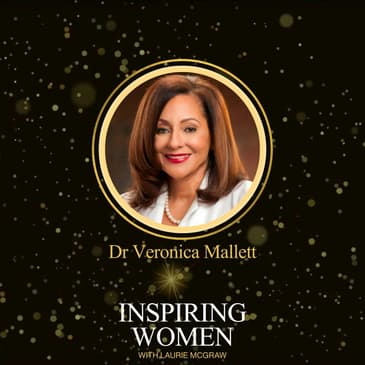

In this episode of Inspiring Women, Laurie McGraw speaks with Dr. Veronica Mallett, a physician, educator, and trailblazer with four decades of experience advancing health equity and workforce representation in American medicine.
Dr. Mallett is Senior Vice President and Chief Administrative Officer of the More in Common Alliance, a 10-year, $100 million partnership between Morehouse School of Medicine and CommonSpirit Health created to expand representation in medicine and close the physician shortage in underserved communities.
Dr. Mallett shares the story behind her drive, growing up in Detroit as the daughter of two educators and civil rights leaders, who taught her that education was "the great leveler" and that having a principle means being prepared to stand alone. She talks about deciding at age 9 to become a doctor, navigating Barnard College and medical training as one of very few women of color in the room, and learning to turn individual setbacks into collective action.
In this conversation, Dr. Mallett discusses:
- Why the More in Common Alliance is doubling the class size at Morehouse School of Medicine and building regional medical campuses and graduate medical education sites in underserved areas
- The work happening in communities like Bakersfield and Kern County, California — one of the most medically underserved regions in the state
- Why she believes the promise that women "can have it all" was a myth, and what to build instead: a real support system and intentional choices
- Her case for leaning into leadership roles — and how the autonomy that comes with them benefits your family, not just your career
- Managing a blended family of six children, and what work-life balance actually means in practice
- Overcoming imposter syndrome at every level, and the mantra her sister gave her: "Who I am is enough"
Dr. Mallett previously served as Senior Vice President of Health Affairs and Dean of the School of Medicine at Meharry Medical College, and as President and CEO of Meharry Medical College Ventures. Earlier in her career she helped launch a new medical school at Texas Tech University in El Paso. She is board certified in obstetrics and gynecology and in female pelvic medicine and reconstructive surgery, earned her medical degree at Michigan State University, and holds a master's in Medical Management from Carnegie Mellon University.
Inspiring Women, hosted by Laurie McGraw, features candid conversations with women leaders about the choices, setbacks, and turning points behind their careers.
Full conversation with Dr. Veronica Mallett on Inspiring Women.
[00:00:00] We were fooled as women in the 90s to be told we can have it all. The truth is we can't have it all. You know, work-life balance, you know, what is that? It's not a thing. It's not a real thing. It's not a thing. What are you suggesting that people lean into? Lean into opportunities. It might be more work. It may be taking on a director role or a managing partner role or a chair role. Sometimes women are like, well, I have a family.
[00:00:27] I'm like, yeah, your family will benefit. This is Inspiring Women. I'm Laurie McGraw and I'm speaking with Dr. Veronica Mallett. And Dr. Mallett is incredible. She has several decades as a physician, a trailblazer, and one of healthcare's most recognized voices, health equity and workforce representation.
[00:00:55] Dr. Mallett, your career spans decades. You have done so many things over the years. I'm so excited to be speaking with you on Inspiring Women. Thank you for being here. It is my honor and pleasure. Thank you for having me. You're welcome. And let's start. Dr. Mallett, 40 years, physician, trailblazer. What keeps you going with the work that you're doing today?
[00:01:19] Okay. This is probably not the answer that you're expecting, and I will come to a very serious answer. But my daughter recently called me up and she said, Mom, I want to share with you a funny thing that you've said to me that has stuck with me all this time.
[00:01:42] And she's recently a mother and working as a school social worker. And I am prepared for who knows what, right? I said, okay, well, what was it? And I said, Mom, what keeps you driving? What keeps you motivated?
[00:01:59] And I don't know what, what keeps you driving? What keeps you driving? What keeps you driving?
[00:02:25] Remembered. You know, the work that I'm doing now as the chief administrative officer of the More in Common Alliance, this partnership between Common Spirit Health and the Morehouse School of Medicine. $100 million. 10 years. I mean, it's an incredible, I actually do want to talk about that. Like that particular initiative is amazing.
[00:02:44] It is amazing. And what's more amazing about it for me personally, in line with what keeps me going, is the opportunity to have legacy leaving impact on today's world, on the workforce, on access, on communities having an opportunity to be cared for by people who understand their lived experience.
[00:03:08] And that really is what drives me to continue this work. You may be aware, having reviewed my CV, that I was dean of the School of Medicine at Meharry Medical College. And then I pivoted from being dean to being the president and CEO of Meharry's Investment Innovation Arm.
[00:03:31] And, you know, I really liked being in the venture space and meeting young founders and learning about deal making and investment. But it was away from my personal mission, which has always been health equity workforce expanding opportunity. And, you know, there are not that many women in the venture space.
[00:04:00] But its connection to the impact that I'm trying to leave was a little less straightforward. Dr. Mallett, maybe I can just even go a little bit sort of like backwards and forward all at the same time.
[00:04:15] Dr. Mallett, maybe I can just go a little bit more and more and more and more and more and more.
[00:04:40] The legacy work, the leaning into making sure that there's workforce representation for all, being a physician, you know, in the early years of being a physician, being a black woman physician, none of that came without a lot of hard work and effort and breaking new ground all along the way. Becoming the dean of a school, becoming a woman who leads a business venture.
[00:05:07] How did all of that, in terms of those breaking boundaries, was that wasn't about sort of knowing that you were going to have a legacy for the future generations? How did you, where did that drive come from? When did you know that, okay, you know, I can, I can have the confidence to break these boundaries. I can make that happen. Where did it come from? I really have to credit my parents, Conrad and Claudia Mallett.
[00:05:35] My parents were leaders in the civil rights movement. Some of my earliest memories are painting picket signs with my, you know, four-year-old penmanship on placards and being, having a chance to paint on a poster was fun to me.
[00:05:58] But I was a living witness to what they were trying to change and the way that they explained injustice and the lack of freedom for everybody in the United States. My mother was the president of the International Committee to End Racism and Ban the Bomb. And, you know, you talk about a laudable goal.
[00:06:24] It took her from the United States to the, at that time, the USSR to Russia to advocate for no nuclear disarmament in the world. So I had examples of having a strong moral compass, standing up for what you believe in.
[00:06:49] And my father used to say, when you have a principal or a position, you have to be prepared to stand alone. Because a lot of people will give voice, but you may end up being the only one who shows up. And so you have to be ready.
[00:07:08] And it was with those principles and guidance and observation that my brother, my sister, and I, all I think I would describe as strivers, determined towards leadership. And my parents really believed that education was the great leveler. So we got a dollar for A's and 50 cent for B's and a spanking for C's.
[00:07:37] Seriously, they were not playing. You cannot bring a C into the household. And so, and they were both educators. And so, there were standards set and values for advancing to as far as you could go.
[00:07:59] So, you know, I think that upbringing would sometimes people might think would be a conditional base love. But we experienced a whole lot of love. But there were expectations. Well, and also just that foundation of sort of like having a voice and that your voice actually matters and can have an impact. I mean, first of all, that's a powerful feeling.
[00:08:29] And to have that level of sort of, you know, just recognizing that in your parents and then bringing you along as a child, you can sort of see where those roots started, which is amazing. When did becoming a physician become something that was important to you? I wanted to be a doctor since I was nine. It was either a physician or a prima ballerina. Okay.
[00:08:54] And I went to a serious ballet school and Severo's Ballet in Detroit. And Miss Severo told my mom that I should forget it, that I didn't have the body of a ballerina. And she could always see how I was developing, that I wasn't going to have it so that, you know, I shouldn't invest in that trajectory. And rather than being crushed. Right. Exactly.
[00:09:23] Because my mom asked me, she said, you know, are you hurt? Because she said it right in front of me. Okay, I'll be a doctor. Right. Exactly. That's exactly what I said. I said, that's okay, mom. I'll just be a doctor. So, you know, and then I was good in science. I got a lot of reinforcement from the community. When I said I wanted to be a doctor, people will always, you know, be very supportive.
[00:09:48] And I got a lot of accolades and kind of began that trajectory. I went to public school, my whole, from junior high, high school. And I got accepted to Barnard College, Columbia University. And I do think it was part of affirmative action. But affirmative action only means that you have an opportunity. Opportunity. Right. Nobody studied for those tests.
[00:10:16] Nobody took those classes. Nobody took the MCATs other than me. And, but coming from Cass Technical High School in Detroit, there would, nobody else in my class who was from Detroit. There was one of my classmates who was at Columbia. And Columbia and Barnard were separate back then.
[00:10:37] And then, you know, the idea was that I could navigate that and have that opportunity and lead the way for somebody else. Mm-hmm. And provide counseling to whoever else wanted to go down that path. It was interesting reading Michelle Obama's book and Justice Sotomayor.
[00:11:05] They had a very similar story to mine. Mm-hmm. You know, in Princeton, again, affirmative action. At the same time, only opportunity. Nobody else is there to navigate for you and navigate the courses and give you the grades that makes you competitive on a standardized test.
[00:11:28] And there's the, you can imagine the, you know, what you were saying earlier from the words of your parents of being prepared to stand alone. Because I have to imagine there were many times that you were standing alone in terms of whether it was sort of like the test, getting to the, you know, whatever, the residency program that you needed to. So many of those firsts that were probably led by you. Right? Was that right? Right. True. You know, you just made me reflect.
[00:11:58] I was president of the Barnard Organization of Black Women. Mm-hmm. And, you know, we demanded to meet with the president about some of the unfortunate experiences we were having of racism on the campus. Mm-hmm. And demanding that there be some accountability among the professors for what we were experiencing and the outright discrimination that we were experiencing.
[00:12:27] So I had a, the pre-med advisor for the school was also the head of the Department of Chemistry. And she did not, she told us, each of us, and I kid you not, and I know my Barnard alumni will not be very happy with me sharing this story, but there were 17 women of color and this Afro-Caribbean, Latinx, African, and the black women.
[00:12:56] All the 17 of us were called in to Dr. Siegel's office and told after the first chemistry test, which, by the way, I got above the mean on, that we, you people, do not have the problem-solving skills to be pre-med, so you should just forget it now. And we were not aware that each of us had had this experience. And then we started talking.
[00:13:22] And I said, you know, Dr. Siegel called me in, she said this, she said that to you, she said that to me. And so you can see why we ended up in the president's office. But again. As a unified group now. As a unified group. Barnard organization of black women. And some amazing leaders have emerged from that experience.
[00:13:44] And Dr. Helene Gale, who was president of Spelman and CEO of CARE, and she was a senior when I was a freshman. So I can name some others, but the point was that, again, bringing voice, using your voice, and finding discrimination intolerable, and bringing action to that. And they were responsive.
[00:14:13] That's the beautiful thing. They listened. And they made changes. And, you know, I support my alma mater today because of that. So then, so from learning to stand alone, to then bringing others with you and being able to enact change with that voice, by standing up for what is important.
[00:14:37] Was that about the time that this became your life work to make sure that you were representing others, as well as making change for what is right? How do you define sort of like the course of your work? You've done research. You've led businesses. You have led schools. And so how do you sort of like think about the sum of your work in terms of what it represents?
[00:15:05] You know, as I reflect, I've always been focused on having an impact on who is able to care for the least of these. I have always worked in vulnerable populations, populations that would be described as historically marginalized or vulnerable.
[00:15:28] And now working with Common Spirit, who has within their mission, feeling the healing presence of God in the care that we delivered, especially vulnerable populations through a lens of social justice. That, along with Morehouse School of Medicine, leading the creation and advancement of health equity to achieve health justice, those two powerful missions align and are so complementary.
[00:15:54] And that brings the power to this partnership that I lead. When that leadership happened, you know, early on, it was intolerable to my parents that you said, you know, well, Susie or Mary was doing it, so I did it as well. That was never an excuse.
[00:16:21] And so I kind of got the message that you had to have your own mind in order to navigate. And then having those leadership opportunities in undergrad led me to be, again, a leader in our student organization in medical school, chief resident in my residency training.
[00:16:42] And there is something that was said about with leadership comes more autonomy. And that part is true. When you are the chair of the department, you get to make the schedule. You aren't thinking of what's good for the department, but you can also reflect on where it fits in your calendar.
[00:17:11] And sometimes women are afraid to lean in and to make the sacrifice, but there is a gain in the end if you do lean in. And I encourage your listeners to really reflect on that. It is, quote, unquote, dues paying. But if you pay your dues and you get into that position, you have much greater autonomy. And then you can really... What are you suggesting that people lean into?
[00:17:40] Lean into opportunities. It might be more work. It may be taking on a director role or a managing partner role or a chair role. And sometimes women are like, well, I have a family. I'm like, yeah, your family will benefit because you've leaned in and taken on this opportunity. Your family will not just benefit economically. They will benefit from the autonomy you gain.
[00:18:08] And like my parents being examples, they will benefit from seeing you take on those roles. It will be empowering for them to have you as a role model in a leadership position. And the message will be, you can do whatever you want. Now, I do think that we were fooled as women in the 90s to be told we can have it all. The truth is we can't have it all.
[00:18:38] You know, work-life balance, you know, what is that? It's not a fact. Right? It's not a real thing. It's our best. But what you can have is a cadre of people who support you so that you can do the work. You know, I'm an excellent cook, but I didn't prepare the meals for my family every day. I had women who helped me do that. Dr. Mallett, can I just ask you, just in preparing for this conversation, is it, do I understand this?
[00:19:07] You have six children. I have six children because I married a man with four and I had two. You have a large family. I do. You have a large family. You have an amazing amount of responsibility. You have leaned into helping so many others. So let's talk about this work-life balance because that is definitely not something that you have.
[00:19:35] How have you managed to pull these different things that are important to you? Because you started talking about your daughter. And you did it in terms of, you know, just like obviously your family, you're close to your family. They're very important to you. How have you kept all these things together over the years in terms of that balance? How do you define balance? I define balance as maintaining the relationships that are important to you. And that means if you have to.
[00:20:03] So last week I was at Becker's Health Care. I spoke there. And then I had to fly to Atlanta for the major fundraiser event for the Morehouse School of Medicine. But while I was in Chicago where my granddaughter and daughter and son-in-law live,
[00:20:21] I made it a point where I'm going to miss this speaker's dinner and go out to Irving Park to spend time seeing my daughter and my granddaughter and son-in-law because family is important. And so it means being intentional. That's what work-life balance means to me.
[00:20:43] It means that when my husband and I are budgeting for the year, I budget for all the family to be together at Christmas. That might mean that I'm the one spending money for the huge Airbnb that can sleep. Ten couples. A lot of people. Big family. Right. The big family so that we can all be together. And we've committed to a big family vacation at least every other year.
[00:21:11] As they grow in their professional careers, that becomes more complicated. But they all look forward to it. And as a blended family, I'm so proud of the way we have become a blended family. They don't introduce each other as my stepbrother or my stepsister. It's my brother and my sister. And they are all around the same age to the point where we had five in college at the same time. Okay.
[00:21:39] And that was when we were really broke. I mean, like, we had no money to do anything. Five hoopties in the circle drive trying to keep some old cars running. But it is about being intentional. And, you know, it's, I think that it's also about asking for what you need and investing in getting help
[00:22:07] and not feeling like you're less than if you're not the one preparing the meals or cleaning the house or, you know, mowing the lawn. I consider myself a relatively domestic person when I choose. But I choose to take my dollars to make life possible. I don't know. Make it possible. Make it possible. Anything.
[00:22:34] Let's sort of, like, close out a bit of this conversation back to what you're doing now, leading with intention, this important work that you're doing with the more in common alliance here. Is it alliance? Yes. With the more in common alliance. Yes. What is it you chose to do this work? You know its impact. What is its impact? Why are you doing this? Why is it so important to you?
[00:23:00] It's important because it's expanding the workforce so it mirrors the community served by Common Spirit Health. I've already shared with you the mission alignment that we share. We're doubling the class size in the School of Medicine. That means additional opportunity for communities that have not had opportunity or have had unequal opportunity to get an MD degree.
[00:23:25] And then creating the residency training or graduate medical education training sites so that expanded class has more opportunity to go into both primary care and specialties. And I commend our large health system for making the investment to make this possible. And that investment is coupled by a philanthropic effort.
[00:23:48] So any of your listeners interested in this work, we have raised money more locally. And think about it. One of our regional medical campuses and GME sites is in Bakersfield, California. A majority minority community of Latinx, mostly big agra and oil. Those community members are so supportive of this effort. Why?
[00:24:15] Because Bakersfield and Kern County are number five in the medically underserved designation in the state of California. That means their need is the fifth highest in the state, which, as you know, is as large as many countries. And so they embraced this partnership, the community, because they need doctors.
[00:24:41] They don't want to drive two and a half to three hours to have to see a specialist or to see a primary care. And they want their sons and daughters to be able to go to medical school and to come back and serve the community. And so we have gotten that level of community support in more of the communities than not because they understand the impact and the need. They deal with it all the time.
[00:25:11] And that is legacy leaving. It is. And when those physicians come back to the communities that they grew up in to care for those in the community, the level of outcomes and improvement is absolutely astounding. Can we just close out this incredible conversation, Dr. Mallett, with you have done so much already. You continue to lead every single day.
[00:25:35] What is advice that you give to other younger women who are starting out in their careers? Nobody needs to learn all the lessons the way that you did over the years. So for women starting out today, what do you advise to them? I think one key is really work at overcoming imposter syndrome.
[00:25:56] There are going to be rooms that you will go in that you will feel like you don't belong and have that self-talk and reach out to the people in your network to build you up so that you understand that you belong there. It doesn't go away. You just get in bigger rooms on bigger stages, and you continue to have to do the self-talk.
[00:26:25] And my sister, who is my best friend and coach, says, when you walk in the room, you say to yourself, who I am is enough. That's the bit of advice that I think holding on to that in multiple settings will help you get to wherever it is you want to be. Well, that is, first of all, it's great advice.
[00:26:52] It's hard to imagine, Dr. Mallett, that you still need that advice for yourself, but that is just incredible. I've been speaking with Dr. Veronica Mallett. Dr. Mallett, thank you so much. It's been my pleasure. Thank you.