
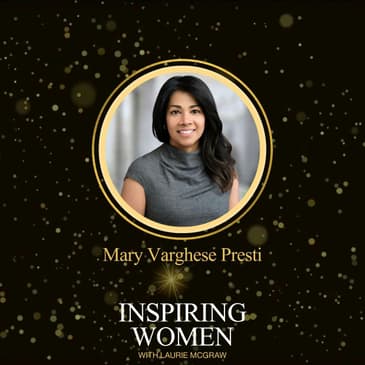

Mary Varghese Presti didn't plan to end up running healthcare AI for one of the most powerful technology companies on earth.
She came to the United States at four years old, the daughter of an Indian nurse recruited by Penn Medicine during India's brain drain era. Growing up in Philadelphia in the shadow of one of the world's top nursing schools, she watched her mother and many of the women in her Indian community use the nursing profession as a vehicle for immigration, education, and female empowerment in a generation where very few professional doors were open to them.
She began her career as a pediatric nurse at Johns Hopkins. On the floors, she saw everything in a single shift: early cases of congenital HIV, double lung transplants in young children, East Baltimore asthmatic exacerbations. And she kept asking the same question over and over again: why is healthcare organized this way?
That single question became a career.
From bedside nursing she moved into consulting, working on harmonizing clinical quality measures across NCQA, NQF, AMA and CMS, foundational work that paved the way for value-based care. She helped shape the policy framework that led to meaningful use and the electronic health record adoption wave. She joined Pfizer at the exact moment Lipitor was losing patent protection, watching 10 billion dollars in revenue evaporate in a single year while the entire pharma commercial model was rewritten around her.
Today she is the Corporate Vice President and Chief Operating Officer of Microsoft's Health & Life Sciences organization, leading at what she calls one of the few generational shifts in technology in her lifetime.
In this episode of Inspiring Women, host Laurie McGraw sits down with Mary to talk about the arc from bedside nursing to Microsoft, from the Manila folder era of medicine to a Stanford pilot where AI agents now compress cancer treatment decisions from weeks and months down to days. They go deep on the AI that hundreds of thousands of physicians are already using today, why nurses describing themselves as "data entry analysts" broke something in her, and what it actually means to build technology that fades into the background instead of getting between a patient and the person caring for them.
They discuss:
- Growing up as the daughter of an immigrant nurse, and what nursing did for female empowerment in her mother's generation in India
- Why she began her career at Johns Hopkins and the moment as a 24-year-old floor nurse that turned her into a systems thinker
- The four-act arc of her career across nursing, policy, pharma and technology, and why every zig and zag felt rational at the time
- Inside Pfizer during the Lipitor patent cliff, when one drug lost 10 billion dollars in revenue in a single year
- Why healthcare still tolerates a digital experience nobody would accept from Uber, Venmo, or online banking
- Dragon Copilot for physicians, and how it removes the keyboard from between doctor and patient
- Dragon Copilot for nurses, and why nursing workflows demand a fundamentally different technology design
- The physical, emotional and cognitive burden that AI is finally lifting off frontline clinicians
- The Stanford multi-agent tumor board experiment compressing cancer treatment decisions from weeks to days
- Why she refuses to be put in a box as clinician, operator, strategist or policy person, and what a lattice career actually looks like
- What she means when she says she expects to remain intrepid for the next five years
If you care about the future of healthcare, the real impact of AI on frontline workers, or what a non-linear career built across nursing, policy, pharma and tech actually looks like, this one is for you.
[00:00:00] People were often wanting to put me in a box. Oh, you're a clinician. Oh, no, you're a business strategist. Oh, no, you're a policy person. Oh, no, you're an operator. And I just rejected it. It's being able to translate and understand what's happening at the intersections of all of those different facets. It really goes back to my nursing training. I mean, really, if you think about the human body, it's a collection of systems. If you think about working in a hospital, it's a collection of systems. And it developed for me very early on this muscle around systems thinking.
[00:00:32] Laurie McGraw This is Inspiring Women. I'm Laurie McGraw. And today I'm speaking with Mary Varghese-Presti. She is one of the most senior and accomplished women executives in the space of technology and something we're all talking about, which is AI. Mary is the corporate vice president and chief operating officer of Microsoft's health and life sciences organization. It is a very large job and a very big player in the space of AI. Mary started her
[00:01:00] career as a nurse. And that has grounded her approach to how she thinks about AI, specifically in the world of technology and health and care. Mary, thank you for being on Inspiring Women. Thank you so much. It's such a privilege to be here, Laurie. Well, I really want to dive in on the technology. I really want to talk about what's really happening because you're not just doing like AI. You're deep AI. You're changing the industry in terms of what you're leading.
[00:01:29] But where I want to start is sort of like, you know, at the beginning, the origin story, Mary. You started as a nurse. Your mother was a nurse. Mary, I know that that is deeply personal to you. And I know we just celebrated, you know, Nurses Week and you honored your mother, whom is very important. Let's start there. Where did it begin? Why did you become a nurse? I know this might be a little bit difficult, as I know that your mother is your inspiration and someone you lost earlier this year.
[00:01:58] So I don't want to get too emotional about it, but I know how hard that is. So I'm sorry about that. But can you start there? Sure. You know, it's interesting. It's been over 30 years that I've been in health care. And when I think about the nursing profession, going back to even my mom's generation, it was really a profession that opened up opportunity and was very empowering for her time, at least.
[00:02:24] One of the areas that were socially accepted for females in India from a professional perspective. But it also allowed her to go abroad during the big time period in India where there was a great brain drain. And it was a reason it was my immigration story to the United States. I came here when I was four years old because my mother was recruited by Penn Medicine.
[00:02:47] And I grew up in a, you know, in an Indian community where many, many of the women were nurses because that was the opportunity for them to be able to leave India and go to the more developed nations and to create a career and a life for their families. I grew up in Philadelphia. And so, you know, growing up with Penn, where my mom was working, but also for many, many years over and over the number one nursing school in the world.
[00:03:16] And so it was really hard not to appreciate that you had this wonderful view of a profession that was also associated with elite academic development. And then on the personal front, really seeing what it did societally, what it did for female empowerment. And so I think it was just always a bit of the backdrop for me being an immigrant. My parents said, no liberal arts major for you.
[00:03:43] You need to pick a major where there's actually going to be a job at the end of the day. And so it served that as well. And I love children. And I was questioning whether I would go into teaching. It was much more pulled towards science. And so I ended up choosing nursing. And it was and continues to be a really, really important mark and experience in my career.
[00:04:06] You know, it never the the the zigs and zags that I've taken since my time at the bedside feels really nonlinear. But at the time, every single step I took felt so rational at for the moment. And then actually, if we were to zoom out now and as I look backwards, I see it very differently in terms of just for that time where health care was, where it was going.
[00:04:35] And then for me and sort of my intellectual curiosity and my training as a nurse, you know, in nursing, they teach you to really think about the root cause. There's symptoms, but then there's the underlying disease. And so when you couple that curiosity and that training around really wanting to understand what is the actual problem, it really created in me just a personality and an attitude of really wanting to understand the why, why, why, why behind it.
[00:05:04] And so knowing and appreciating that and looking backwards, you can make sense of the fact that I went from being a bedside nurse where health care continues to this day to be extremely fragmented to policy, to corporate health care America and eventually to tech. As you know, Lori, you know, really been heralded for many, many years as what's going to be the great enabler of so many different things.
[00:05:30] And we're still working hard at that for health care. And it's been such an arc. So we start with sort of, I would just say, the humanness of nursing. Nursing is one of the most respected professions that there is and that has been a consistency, you know, in a time where there is a lot of change in terms of trusted systems. Nurses are trusted.
[00:05:56] Technology is important and has amazing opportunity and is changing at a pace that is faster than it ever has. And, you know, you and I both have been, I've been at this longer in terms of the technology thing, but we're at a rapid pace of change. You've been through IBM Watson. You have built that entire business. And now we're doing it at a scale and you are leading it at Microsoft.
[00:06:22] Talk about the time where it pivoted from that caring human work that you were doing as a nurse to the larger, perhaps, impact with a technology lens. Yeah. So I went from pediatric nursing into consulting. And again, I think it really goes back to my nursing training. I mean, really, if you think about the human body, it's a collection of systems. If you think about working in a hospital, it's a collection of systems.
[00:06:49] And it developed for me very early on this muscle around systems thinking. And so when I was a cog in the wheel, so to speak, the unit economics of being a floor nurse, this is the time where, you know, children, it was some of the early cases of congenital HIV. Children were born with HIV. You know, it was a very difficult clinical course. And at Hopkins, you would see that. You would see double lung transplant in young children, patients being flown from across the globe.
[00:07:19] And you would also see East Baltimore asthmatic exacerbations. You saw everything. And with all the indignation and youth of being 24 on the floor, I would just rail it. Like, why? Why is it like this? And it really led me to policy. You know, well, why is health care organized this way? Why is it financed this way? Why is it structured this way?
[00:07:47] And, you know, we, for those of us who live in this space, we all know that we continue to have and have always had very misaligned incentives in the health care system. And I would say a lot of the root causes still to this day is because of that. So I went into consulting and back, you know, Lori, this is when some of my earliest engagements at the time. And it's funny because we've made so much progress. It feels like we don't, we didn't, but we have.
[00:08:12] One of the earliest efforts I was working on was harmonizing clinical quality measures, right? And so if you need to get to a value-based payment system, you need to have some consistency in how you define value. We couldn't do that because, you know, one insurance company would say an LDL outcome level would be this, and the Joint Commission would say this, and CMS would say this.
[00:08:34] And so there was so much foundational work to just say, okay, we're going to harmonize across NCQA and NQF and AMA and all of the acronyms in D.C. To say this is what it's going to be. And then we had to move towards, well, okay, so now if we're going to move to value-based, paying for the outcomes that we really want in the system, well, gosh, we can't. Because all the information we need to be able to even discern that is trapped in manila folders in physical locations across clinics and health systems.
[00:09:02] So then a lot of my work was around how do we speed electronic health record adoption? What should it look like? We studied what the U.K. did that led us to meaningful use. And so, you know, the work around health reform and high tech, again, this is what I mean by when you look backwards, it all built on itself for where we were at that time and what problem needed to be solved to get us to fixing the bigger issues.
[00:09:27] And so I really went from those sort of policy initiatives to really wanting to understand corporate America when it comes to health care. Because I had only ever worked in health system and then in management consulting before the federal government. So all around policy things and my time. And then I went to Pfizer.
[00:09:48] And it was just an extraordinary time at Pfizer because I was at Pfizer at the time during a period in which they were going to lose patent on Lipitor.
[00:09:58] And for people who don't know, Lipitor at that time, I haven't stayed up with it, but for sure at that time was the most lucrative revenue generating, not just drug, but one of the most lucrative products to have been created in the United States on par with the iPhone and the Toyota Corolla. Okay. Seriously, at that time. And so in one year, at its peak, it was $13 billion a year in revenue.
[00:10:27] In one year, it lost $10 billion. So you're working in this corporate environment where they're rapidly adjusting and adapting. And by the way, health reform and high tech is also happening. And so the entire commercial model of a sales rep going in and talking to a physician when you have pay for performance and accountable care and e-prescribing. And the Sunshine Act and all of those other things changing. Yes. Yes.
[00:10:52] And so I just was so just I was a voracious student of all of these different things, right? Because it's just another part of health care. But parts of where I was, clinical care, patient care, policy, it was like this learning laboratory where all of those things were coming to bear. But now from a business strategy, innovation, adaptation, commercial model, set of lenses.
[00:11:20] And so I just was extremely curious and wanted to learn as much as I could. I would say that in a lot of different parts of my career journey, and I'm sure a lot of your listeners feel this too, Lori. You know, people just I don't know if it's human nature or what. But for me, at least, people were often wanting to put me in a box. Oh, you're a clinician. Oh, no, you're a business strategist. Oh, no, you're a policy person. Oh, no, you're an operator.
[00:11:48] And I just rejected it, like, every single time. Because for me, again, going back to that systems thinking, it's being able to translate and understand what's happening at the intersections of all of those different facets where I found the opportunity to actually solve something or see something that hasn't been figured out yet. And so I would always reject being put in a box.
[00:12:10] But it does tend to slow down your trajectory sometimes, depending on the environment you're in, because you're not – you know, I've had to kind of look at my career as a lattice as opposed to a ladder because I'm not a traditional, like, you do this, then you get here, and then you get here, and you get here. And I also didn't have any interest in that because I really wanted to pursue what I thought was just intellectually.
[00:12:31] Well, you've also hit – like, what you just described is, like, so many different layers and different areas and aspects of the healthcare system. Policy, the commercialization sort of, you know, from companies, you know, where the different incentives are. And there is – you can be exhausted in learning and understanding what the healthcare system is about.
[00:12:57] It is easy once you get into sort of all of these different things to understand the complexity. But you're at Microsoft now. You're leading in one of the most powerful organizations that is at the absolute forefront of the fastest technology revolution that ever there was. We are at a new frontier, and it's changing in weeks, months, not years.
[00:13:22] So how do you take – you know, it's easy to sort of see how we can get more productivity gains. But you talk a lot about removing burden, bringing humanness back to the bedside. I'm not putting words in your mouth, but how do you think about this at scale with the work that you're leading right now? So, so I'm so thrilled to be where I am at this moment.
[00:13:48] I feel so lucky because it really does bring a lot of these different things. We were talking, again, all together in a really amazing opportunity and a time where you just said, right, it's so – it's happening so fast. And this really is one of the few sort of generational shifts in technology that we're all – that's going to, you know, have massive impact across all industries, all ways of life.
[00:14:16] And I get to focus on what that looks like specifically in healthcare. And so I think that there's a lot – there's a lot to be figured out. There's – you know, it's never boring here. But it really is about, you know, we had the digitization of healthcare as sort of these different horizons. So we had, you know, the adoption of electronic health records.
[00:14:39] I would say that that was – it's hard to find somebody who says, I love my EHR. Even today. Even today. Even today. And we tolerate an experience with health IT that we do not tolerate in any other aspect of our life, right, as consumers, you know, in terms of what it feels like to engage with Uber or Venmo or online banking or whatever it is.
[00:15:09] Then you look at these very expensive digital filing cabinets that we have to be in all the time.
[00:15:16] And so I think that what's really exciting about where we are today is with this big unlock around generative AI and really thinking through everything that's been kind of, you know, rapidly being evolved around co-pilots and agentic workflows is with the electronic health record, it's something that came between a clinician and a patient. And it wasn't by design. But it was our first chapter.
[00:15:45] And so we've all been in experiences where we're seeing a physician, but there's a keyboard between us. Or sometimes they're sitting and you're looking and they're asking you questions, but they have to file stuff that you're saying or look through your chart and you're talking to their back. So the really wonderful opportunity with AI for the AI that we have today is we are able to achieve what we had always set out to do, which is the AI – the technology is actually an enabler.
[00:16:13] The technology fades into the background. It's ambient. It's intuitive. It's proactive. And so that's what's really exciting because I think folks in healthcare have put up with technology. And actually big chunks of their day went from looking and working with patients to caring for the technology or having to input things. And, you know, there are many nurses I talk to that say they feel like data entry analysts. Yeah.
[00:16:43] And that's heartbreaking if you think about it. So I think, you know, really if I were to break it down, removing the friction in what's a typical workflow, you know, really thinking about – when you think about physicians, you know, they've had a lot of different kinds of technologies. I would say the electronic health records really have been designed with the physician as the primary sort of – Data entry clerk.
[00:17:12] And then, of course, reimbursement and all the – Yeah. You know, all of the things that a health system needs. And right now I think when you think about a nurse, you know, when – there's so many different things in a nurse's shift. They are – they have the most interrupted day in any kind of role, right? Like if they leave from one floor – one room to go into a nurse's station, there's probably five different interruptions that happen to them breaking their flow.
[00:17:39] And so to be able to delegate to an agent what I call the floor. So the floor of the things that a nurse doesn't have to do or a physician doesn't have to do, right, the rote, the redundant, the predictable, and actually having agents that you can delegate to. Like that's a huge capacity win.
[00:17:59] Can you, Mary, just like paint a picture of, you know, with both what exists today as where you're leading the future, what does that look like practically? What does that look like? What does the physician of – the AI physician augmented of tomorrow or today look like, nurse? Just a picture of what that might look like. Yep. So I'll start with today. So today – and I'll talk from a Microsoft point of view. So we have Dragon co-pilot.
[00:18:29] So the Dragon Copilot is a physician, walks into the encounter with the patient, gets consent. It's on their phone. They hit record. And now there's no technology. It's just you and me, Lori. I'm asking you how you're doing. Maybe you're talking about your vacation. Maybe you are also kind of chiming in about what brings you in today. We talk about the weather. You know, it's just a natural conversation.
[00:18:54] And at the end of our encounter, the physician can look down and the soap note is created. However the physician wants it to be designed. You know, for many, many physicians, their note is their art. And so it tunes out all the weather conversation. It tunes out your vacation discussion. But the physician can now go on to the next patient. Without that, and I'm sure you've heard about this, but we call it a pajama time.
[00:19:22] The physicians were like really backed up and spending a lot of time closing those charts. And there's the experience in and of itself that we talked about in terms of the having to have the technology between the patient and the physician. So that's today. We have hundreds of thousands of physicians that are on that co-pilot today. On the nursing side, it's very different on the bedside nursing because it's flow sheets. And so we have dragging co-pilot for nurses. And what's happening there is without this, you know, when I was on the floors, the nursing
[00:19:50] sort of workflow is, it's extremely multi-layered and it's a lot of silent observation. So I might go into a patient's room and I might say, oh, Lori, looks like you didn't, you know, I might not even say it, but I'm thinking in my mind, well, you only ate half of your breakfast and your IV site looks a little bit red. I need to flush that. It doesn't look like you've been out of bed yet at all. I'm looking at how much urine is in your Foley catheter. And then maybe I say to you, hey, on a scale of one to 10, you know, what's your pain today? Right.
[00:20:17] And you'll probably ask me some other questions and I'm in there for a while because at the end of the day, nursing is a relationship role and that relationship is super important. So maybe I'm, you know, allaying some of your anxiety or maybe you have a caregiver or a loved one at the bedside who was really confused and wants to know a lot of things. And that's my like 15 minutes of like what I had to spend in the room. But now I have to go back out. I have to remember all of these things. What was the temperature again? What was the respirations? What was the pulse ox?
[00:20:44] Like, and I'm writing it in all these different flow sheets, but they're very discrete values in very distinct fields. So again, the technology needs to be built differently because nurses document differently. And so that's what we built for Dragon Copilot for nurses is the nurses come in. They do have to speak some of these things out loud. Many nursing leaders would say that's what we want because it's shared decision making. It's much more patient engagement. The patient's lying in the bed and actually knows what's going on.
[00:21:10] And so now with Dragon Copilot, I'm coming in and say, hey, Lori, looks like you only ate half of your breakfast. How are you feeling? Did you get out of bed today, Lori? Let me look at your IV. Looks like it's a little red. I'm going to flush it. Okay, Lori. So I'm also like engaging you much more. But the great thing is when I leave the room, all of that is sitting now on my phone and I can look and say, I want to adapt this a little bit. I want to edit this. Done. I go to the next patient.
[00:21:36] And let me just break apart for you just because I can speak more genuinely because I was a nurse. There is a physical burden that is alleviated because I don't have to go from that patient's room to another patient's room and another patient's room. Don't forget the five interruptions that are happening. Do you have a blanket? Where's the orderly for this? Your patient has to go to MRI. La, la, la, la. So like I'm physically like more at peace.
[00:22:03] There is an emotional burden that's alleviated because there is an emotional tax around, oh, my gosh, am I going to forget something? Oh, my God. Like I need to go to these three other patients, but that first one really needs me. Yeah. Like there's an emotional burden. And then, of course, the cognitive load. Right. Because I don't have to remember all of these things and wonder if I've forgotten something. All of that has just been addressed because you spoke out loud and the technology happened behind the scenes.
[00:22:32] And it's a true assist. So that's today. That's on the floors today. It's in health systems today. Now let's talk about the future. And I can't even say this is the future because we have done this with Stanford health care system. And I'll just explain it as one example of agentic. Because agentic people are like, what the heck is agents? Like, what are you talking about? We're excited about agentic. Like, please do everything for me. Yes. So I'll give you one very specific example.
[00:23:00] It's a little bit more of an involved example because it tells you the totality of what's possible. But, you know, what we have done with Stanford is we created multiple agents so that when you are diagnosed with cancer, for your listeners who might not be, you know, all in the know, you know, you have so many different specialists. You have so many different physicians. You have so many different data sources. You have images. You have scans. You have pathology. Like, you have all lab values. And you're overwhelmed. You're overwhelmed. Yes.
[00:23:28] And these providers might be at different health care systems too, right? So they're on different instances of different MyCharts or whatever your, you know, portals are. And what happens is a number of different specialists have to come together to basically align on the type of cancer that you have, the type of treatment that we're going to all agree on is the best case for you. And in many cases, that can take weeks if not months depending on where you live.
[00:23:56] And so what we did with Stanford is we created a multi-agent tumor board. And so there are agents that are summarizing all the different data sources, summarizing all the information, creating a call on Microsoft Teams. All of the different specialists can look at all these different things async, but comprehensively they get on the call. They're able to say, okay, we have everything at our fingertips. This is what we need to do.
[00:24:25] You don't have to physically, the patient doesn't have to physically go to all, you know what I mean? So it's happening in days now, right? And so let's just step back for a second. You've just been told that you have cancer. And instead of waiting weeks or months to start treatment, right? Just to start fighting the cancer, we can shrink that to days because we have all these agents. Now let's think about what the agent's doing. It's trolling through all these files and pulling out all the relevant things, right? It's summarizing.
[00:24:55] It's going through all of your data, but pulling it all out, making it super easy, surfacing it in a way that multiple individuals can look at all of the same information together. So that, think about like the leverage and the capacity that that sort of thing is bringing into the healthcare system with real, real impact and real patient outcomes impacted here. That's what's exciting. And there's so much, like I can hear your intensity in terms of just like understanding
[00:25:24] all the complexities that need to be solved for, but then the outcome of like, I mean, just that simple thing of what you're saying, you know, it does. It takes weeks to get to cancer treatment. Once there's a diagnosis to shrink that time, the opportunity, what that means for not just the clinicians and the caregivers, but the people is absolutely amazing. I can't wait for all of that to materialize everywhere.
[00:25:54] Mary, as we close out, you have done so much across your broad career. I'm pretty confident you're only at the beginning. So if you just think ahead in terms of sort of like, you know, now just policy, leading businesses, leading, you know, industrial changes with, um, at the fastest pace ever, where do you expect to be in five years? Um, this is probably not a fulfilling answer, but I don't know.
[00:26:23] I've never had a master plan. I kind of go where the problems are. Um, I think where, I guess to answer the question, where I expect to be in five years is I expect to remain intrepid. I expect to not fit into any kind of expected mold. I expect to likely have some conviction on whatever I'm working on. And I expect to be, you know, wholly committed to patient outcomes and just the strengthening in the fabric of our healthcare system at large. That's where I expect to be.
[00:26:53] Who knows what that looks like? I think with everything changing so dramatically, I'm in an exciting way. I don't think I can paint the picture of like what part of healthcare or what environment I'd be working in. Um, but I am for sure having so much fun, uh, doing what I'm doing right now at Microsoft. Well, the, um, the impact that you have already had, um, for the industry is incredible and what you're driving forward has the opportunity for so much more.
[00:27:22] So thank you for that passion and the intensity that you're bringing to it. I'm excited about what's next and what's happening right now. This has been a great inspiring women conversation. I've been speaking with Mary Varghese Presti. Thank you so much. Thank you, Laurie.