
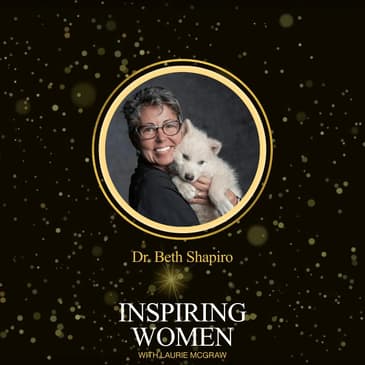

Dr. Beth Shapiro, Chief Science Officer at Colossal Biosciences, explains how her team brought back the dire wolf, what they've learned since, and how de-extinction tools are already helping endangered species like the red wolf. Hosted by Laurie McGraw on Inspiring Women.
Beth Shapiro is a world-leading ancient DNA scientist, MacArthur Fellow, Rhodes Scholar, member of the National Academy of Sciences, and Professor of Ecology and Evolutionary Biology at UC Santa Cruz. She is the author of How to Clone a Mammoth (2015) and Life as We Made It (2021).
IN THIS EPISODE
- How Colossal de-extincts a species: ancient DNA, genome editing, cloning
- Romulus, Remus and Khaleesi: life on a secure ecological preserve
- Why the dire wolves will not be released into the wild
- Red wolf clones and the Ghost Wolves Project with Bridgett vonHoldt
- Bringing back the dodo to Mauritius, and the woolly mammoth and thylacine
- New ancient DNA findings on cattle ancestry in North American bison
- From broadcast journalism to Oxford and the new field of ancient DNA
- Being a public face of science and changing your mind with new data
KEY QUESTIONS ANSWERED
What is de-extinction?
Using DNA from fossils and remains to edit the genomes of living relatives so extinct traits return in living animals.
Did Colossal bring back the dire wolf?
Colossal announced three dire wolves in April 2025: Romulus and Remus (born October 1, 2024) and Khaleesi (born January 30, 2025).
Will the dire wolves be released into the wild?
No. Beth Shapiro says they will stay on a secure preserve because they would compete with struggling gray wolf populations.
How does de-extinction help living species?
The same cloning tools produced red wolf clones (Hope, Blaze, Cinder and Ash) to add genetic diversity to the most endangered wolf in North America.
Why bring back the dodo?
To restore ecosystems in Mauritius, remove invasive species, support ecotourism and protect endangered native species.
Can dinosaurs be brought back?
No. Ancient DNA does not survive that long. Jurassic Park author Michael Crichton was inspired by early ancient DNA research from Allan Wilson's lab at UC Berkeley.
PEOPLE AND ORGANIZATIONS MENTIONED
Colossal Biosciences · UC Santa Cruz · University of Oxford · University of Georgia · Smithsonian Tropical Research Institute · Princeton University · Alan Cooper · Allan Wilson · Bridgett vonHoldt · Michael Crichton
ABOUT INSPIRING WOMEN
Inspiring Women with Laurie McGraw features conversations with women leading in science, health, business and technology.
#BethShapiro #ColossalBiosciences #DireWolf #DeExtinction #AncientDNA #Dodo #WoollyMammoth #RedWolf #InspiringWomen #LaurieMcGraw #WomenInScience
[00:00:00] [SPEAKER_02] The responsible phase two of any project that aims to create extinct species using living species as foundation there and then introduce those species into the wild. Because ultimately the goal of this work is to help ecosystems become more robust and resilient by restoring ecological interactions that are missing in those ecosystems because of extinction or because of the ways that people have changed habitats around the planet.
[00:00:27] [SPEAKER_00] This is Inspiring Women and I'm Laurie McGraw and today I'm speaking with Dr. Beth Shapiro. I have to say, I am a little bit starstruck talking to you, Beth. You are one of the world's leading scientists in ancient DNA. You've moved from studying extinction to actively trying to change what extinction means.
[00:00:53] [SPEAKER_00] You are awarded in so many things, you know, National Academy of Sciences, MacArthur Fellow, Rhodes Scholar. Let's just say you're a little bit smart. And you're also quite a bit famous for the work that you do as the Chief Science Officer at Colossal Biosciences. You have brought back the direwolf from over 10,000 years of extinction. I want to talk about that.
[00:01:20] [SPEAKER_00] Those three then puppies are nearly two years old or two years old very, very soon. So how is that going? You're working on bringing back the dodo. You're working on woolly mammoth.
[00:01:34] [SPEAKER_00] And you're also working on the reality that they're, according to Colossal Biosciences, just noting that the world of extinction, there's a lot to talk about there with, you know, maybe 50 percent, up to 50 percent of species in the next 25 years on the path to extinction. Beth, thank you so much for being on Inspiring Women. Thank you for inviting me.
[00:02:03] [SPEAKER_00] So let's get started. I'm like a foley moley, just like, you know, I just think about all of the people that I've spoken to, hundreds of women. Just the work that you're doing is absolutely astounding, taking what is seemingly impossible. And it is really in the world of possibility. So maybe, Beth, we could just start. What does the work look like as the chief science officer at Colossal Biosciences?
[00:02:32] [SPEAKER_02] Oof. That's a good question and, I think, a big answer. You know, for almost three decades, I ran a research lab at the University of California, Santa Cruz. I'm actually still there. I'm on leave from that role. But I still have three women graduate students that I work with on a daily basis to finish their programs as well.
[00:02:54] [SPEAKER_02] I mean, the project involves science that starts with collecting genetic information from fossil remains and then learning what that genetic information tells us about the way those extinct animals looked and acted, how they interacted with other species and with their habitat, using computational biology to figure out what it is in that DNA code that defines the way species look,
[00:03:23] [SPEAKER_02] using the latest tools in genome editing and genome engineering to be able to edit the genomes of living species so that these extinct traits, these extinct physiques and physiologies can come back to life, and then using advanced artificial reproductive technologies to turn those edited cells into living animals. And, of course, it doesn't stop there. It's then learning about these animals once they're alive.
[00:03:51] [SPEAKER_02] And as you've mentioned, Romulus and Remus are almost two years old. Khaleesi, she will be two in the beginning of the next year. And we've had a lot of time now to study them, to learn about how editing their DNA has changed them and how they're interacting with each other and their environment, which, of course, is the responsible phase two of any project that aims to create extinct species, using living species as foundation there,
[00:04:20] [SPEAKER_02] and then reintroduce those species into the wild. Because ultimately, the goal of this work is to help ecosystems become more robust and resilient by restoring ecological interactions that are missing in those ecosystems because of extinction or because of the ways that people have changed habitats around the planet.
[00:04:41] [SPEAKER_00] So, Beth, I'm practically cracking up over here. The logical phase two of an experiment. Okay, that's a little bit more than just an experiment. I do want to talk specifically about what you're learning with the three dire wolves today, having them back from extinction. But first, for you, Beth, when did...
[00:05:08] [SPEAKER_00] I mean, the pursuit of science is always the pursuit of something unknown, discovery, marveling at things. But you've taken something where it's literally the impossible and turning it into possible. So, in your trajectory, when you started to pursue science, can you just give us a little bit of that backstory?
[00:05:32] [SPEAKER_00] And when did something that significant, taking the impossible and it could be possible, when did that start to click for you?
[00:05:41] [SPEAKER_02] You know, my trajectory to where I am today is probably a little bit unusual. I actually started in broadcast journalism. I was very interested in communication, communication of stories, communication of ideas. And I went to... I actually worked professionally in broadcast journalism while I was in high school and between high school and college. When I started college, I went to the University of Georgia.
[00:06:10] [SPEAKER_02] They have an excellent broadcast journalism program. I'm from Georgia, so it was cool. I got to stay in state. And I was the news director at a local radio station. And I had to get up really early in the morning and go into the station and write the news to get... to be on the air for the morning drive time shows. I guess these things probably still happen, but I think people just listen to the internet now.
[00:06:39] [SPEAKER_02] It's a long time ago. But it was... That sort of job was not really compatible with being a freshman and living in a dorm. Right. It was very early morning and you could go out late at night, you get back. And I had one of those dorm rooms where you were sharing a bathroom between two rooms. And I remember one day in particular, we'd all been out the night before. And I got up at like 3.30 to be able to go into work to write the news. And they had locked me accidentally out of the bathroom.
[00:07:07] [SPEAKER_02] And I was just running to the station trying to figure out how to write the news. And I think I did a bad job. We did this thing where news would come in over the wire and you would look at it and figure out what you were going to do. And that day, I didn't really have time. And I remember taking the news and immediately going over and just reading it. And when I drove to class later that morning, when I got out of my car and I was walking to wherever I was going, I saw the person who was leading the broadcast journalism program. He was across the parking lot or something.
[00:07:36] [SPEAKER_02] And he looked at me and he did that thing where he pointed at his eyes. And then he did the rip signal and then the read. And he shook his finger at me like, don't do that. I was thinking, oh, he's right. And he got me.
[00:07:51] [SPEAKER_00] But what happened? How did that lead to impossible science? I'm missing the connect.
[00:07:58] [SPEAKER_02] Right. I got lost on a tangent. So I had an opportunity at the end of my freshman year to go on this really amazing class. It meant a lot to me. And it meant so much to me that I ended up teaching something really similar at Santa Cruz when I moved there. But it was a class where it was a nine-week class. We started off on the East Coast, drove across the country, drove up the West Coast, drove back across the country, slept in national parks,
[00:08:25] [SPEAKER_02] and learned about the history of people and of the landscape across the North American continent. And I was just captivated by this story. And you could see the scars on the landscape where people, the first people in the country had come, where advancing and retreating ice before there were any people here had changed the landscape. And also the way that we were affecting both indigenous people across the country, the animals across the country, and the habitats.
[00:08:55] [SPEAKER_02] And I thought maybe these are the stories that I want to tell. I want to be able to share the stories about how people have been manipulating the evolution of the species and landscapes around us for as long as we've existed so that maybe we can be more informed as a society about what we're doing. And I thought, I already know how to be a journalist, you know, the absurd naivete of a very young person who thinks they're expert at something that they're clearly not expert at, right? I should just learn to be a scientist.
[00:09:24] [SPEAKER_02] And I started taking science classes and just became equally enthralled with the process of science. You know, I spent a year living at the Smithsonian Tropical Research Institute in Panama. And while I was there, I met a lot of people who were working scientists doing really cool study, evolutionary work and ecological work. And it was a super El Nino year like this year is going to be. And my research project was totally messed up by the super El Nino year.
[00:09:52] [SPEAKER_02] But my experience was not because I could really see how these changes were affecting everything. Even my own research project had to turn over because of a change. Anyway, I got really excited about the possibility of working on a particular project that I developed that meant that I would want to join a lab at Edinburgh. And when I went back to Georgia, I said, I want to apply for a scholarship so that I can go to Edinburgh to do a PhD. And they said, cool.
[00:10:21] [SPEAKER_02] The only scholarship is this thing called a Marshall Scholarship. You can apply for that, but you have to apply for all of these super scholarships, whatever. I did not get even a first round interview for a Marshall Scholarship. So that didn't happen for me. But I did end up with the Rhodes. They're regretting it. They're regretting it.
[00:10:39] [SPEAKER_01] Went to Oxford and no idea.
[00:10:43] [SPEAKER_00] No idea what I was going to do. Ha, ha, ha. You fools.
[00:10:47] [SPEAKER_02] Well, you know, I don't know. I was honored, obviously. I ended up at Oxford not having any idea what I was going to do. And I met somebody called Alan Cooper who was just setting up a lab in this brand new field called ancient DNA. And I'd never heard of it. But it was the idea that you could get a fossil of something, not necessarily a fossil. Obviously, fossils are rock and they don't have DNA in them, but something on its way to being a fossil.
[00:11:14] [SPEAKER_02] And use the genetic information preserved in that fossil to reconstruct an entire ancient ecosystem. And learn to tell the story about how we got from the past to the present. And I thought, this is amazing. This is cutting-edge science to do something really neat that ends up with storytelling. It really puts all of these things that I'm interested in together.
[00:11:41] [SPEAKER_00] And that was how I got a proper thing to do. When you learned about it, I mean, that is such a far-reaching idea. I mean, I can appreciate where it started and I could imagine climate change and activism and conservation as a natural path. But you find this incredible lab, this incredible place of research. Did you then believe that it was possible or was this just more an interesting thing to study?
[00:12:11] [SPEAKER_00] When did it become the impossible turn into, like, wow, we could really make it happen? Or was it already there when you started getting involved?
[00:12:20] [SPEAKER_02] It's a good story. It's a good question. And it brings up, like, the beginning of the field of ancient DNA. Because when people hear about ancient DNA, the very first thing that they think about and often ask about is Jurassic Park. Right? Sure. It's about the same time the movies came out, the beginning of this field. Was the field inspired by Michael Crichton publishing Jurassic Park and the movies coming out? And the answer is no.
[00:12:47] [SPEAKER_02] In fact, Michael Crichton was inspired by the field to write the book. And he acknowledges the Extinct Species Study Group, which was at Berkeley at the time, led by a guy called Alan Wilson. And he acknowledges Alan Wilson and the Extinct Species Study Group and giving him the idea for Jurassic Park. But that idea was present. The idea that we could bring extinct species back to life if only we could get DNA from them from the very beginning.
[00:13:16] [SPEAKER_02] When I was writing my second book, a popular science book called Life As We Made It, I was using the—
[00:13:23] [SPEAKER_00] I downloaded this morning, and I can't wait to listen to it just by the way.
[00:13:28] [SPEAKER_02] Well, I read that one. I did the audiobook for that one. I'm excited. I didn't do the audiobook for my first book, which was weird. And I listened to it, and I thought, oh, no, that's not how it's supposed to be said. And then I wrote to the publisher. I was like, could I read my own book the second time? He said, you're going to have to audition. And I thought to myself, oh, no, what if I'm not good enough to read my own book? But I got the job. So it's all good. I hope you like it. Sure. If you let me know.
[00:13:54] [SPEAKER_02] Anyway, so when I was researching for that book, I was using the New York Times way back machine. Love it. Fantastic. Reading the first article that was ever written about the first people from Alan Wilson's lab to get ancient DNA from a sample. And this was in the 80s. So it was before PCR. It was before it was easy to do any of this. It's not easy to do it. But before it was relatively straightforward to do any of this.
[00:14:20] [SPEAKER_02] And they had gotten a tiny fragment of DNA from the preserved skin, 100-year-old preserved skin, of a quagga, which is an extinct subspecies of zebra. And the result of this analysis, they got DNA and they showed that it was closely related to a zebra, which obviously is scientifically not that amazing because we already knew that it looks like a zebra. But the idea that you could get DNA from something that was 100 years old was.
[00:14:48] [SPEAKER_02] And the journalist interviewing Alan Wilson became the first journalist to ask the first ancient DNA scientist whether this meant we were bringing dinosaurs and mammoths back to life. Right. And I will get around to the answer here. This is an important part of the answer. And that question was the question that was asked all the time. So we would publish—my first papers were on the dodo and on bison. And I've been working on bison forever. We just recently had another paper about bison. And we would be excited— Bison, not buffalo.
[00:15:18] [SPEAKER_02] By the way, for the internet. Same animal. Buffalo is a bison. The North American buffalo is a bison. The Asian buffalo and African buffalo are different. But the North American buffalo is—
[00:15:27] [SPEAKER_00] I'm not going to go into my love for bison. I have a big love of bison. I spent a lot of time in Yellowstone, and I'm not going to divert you on that. I'm sorry. Go back to your story.
[00:15:37] [SPEAKER_02] Well, we can talk about bison. I can tell you what the most recent paper said, which is great news for those Yellowstone bison. Because there's been this long-standing idea that most bison today have cattle ancestry because of mixture between cattle and bison that happened in the early 20th century. But we, because we were able to get DNA from ancient bison lived before there were any cattle in North America, were able to show that what people were thinking was cattle ancestry
[00:16:03] [SPEAKER_02] is just very old evolutionary history and that most bison in North America don't have any cattle ancestry. So that's actually really, really good news for bison conservation across North America today.
[00:16:15] [SPEAKER_00] That is fascinating. That is absolutely fascinating. But go back. But go back. So, like, now you're starting on this. And, like, bring it to perhaps the dire wolf. And so you actually, like, had this idea. You started researching it. It became possible. Now you're, like, on this. Like, we can make the impossible possible. It's real. And then it starts happening. And it literally happened.
[00:16:44] [SPEAKER_00] So can you talk about the dire wolf project? And then two years ago, nearly two years ago, actually taking creatures that have been extinct for over 10,000 years. Like, what is happening? I know it's a big question. But it is a well-known, exciting, exciting story.
[00:17:06] [SPEAKER_02] So my journey to de-extinction is through all of this work we were doing in ancient DNA, being asked whether it was possible. I wrote a book in 2015 called How to Clone a Mammoth that laid out the process and essentially said, this is really hard. There's a ton of technical challenges that need to be solved. There's also ethical ecological challenges that need to be solved.
[00:17:29] [SPEAKER_02] But while I was writing it, it became obvious to me that we already have the foundation of the tools to do it. And the goal really is to be able to develop a suite of tools that we can use to stop living species from becoming extinct. It's the exact same set of tools to bring dire wolves back to life and mammoths and dodos and thylacines
[00:17:54] [SPEAKER_02] that we would need if we're going to modify the genomes of Hawaiian honeycreepers to make them resistant to avian malaria so that they can survive in their habitats. And that is how I really got engaged with Colossal. I visited Colossal. I see that they have this goal of bringing extinct species back to life, but it's not just that. It's the bigger picture of slowing down rates of extinction, genuinely making human-caused extinction a thing of the past by developing all of these tools,
[00:18:24] [SPEAKER_02] a set of tools from ancient DNA through genome engineering and computational biology and discovery through advanced artificial reproductive technologies for animals across the tree of life that we can use to restore these interactions to ecosystems and help make species more robust. So for me, it was the discovery. It came from ancient DNA and constantly being asked if we could bring a mammoth back to life to saying, no, no, no, no, this is not possible technically,
[00:18:53] [SPEAKER_02] to writing the book and thinking, well, wait, yes, it is possible, probably. And not only that, but this set of tools is really important for us to develop. And it's really important for us to talk about. And so, I mean, you started by asking me what my job is. My job is a lot of science, but also a lot of this. Like, I think it's really important that we have conversations about this technology, about what it can do, what it can't do, what it might be able to do in five years, 10 years, 20 years,
[00:19:22] [SPEAKER_02] and how we all need to come together to think about what we want. You know, we don't take these projects and do them in isolation. For all of our projects, we have local advisory boards that are filled with people who are conservation biologists and scientists, but also indigenous stewards of the land who will be the caretakers of these species once they're released into the wild. Ecosystem engineers.
[00:19:44] [SPEAKER_02] In Tasmania, we have local government and the logging community that are engaged with talking about what will happen with Tasmanian tigers or thylacines when we have succeeded in bringing them back to life. So all of this is important. All of it is possible. And it's made possible because of these, like, advances that happen pretty much on a regular clocking TikTok way, both at Colossal but in other organizations that are working on developing these tools.
[00:20:12] [SPEAKER_00] And, like, could not be more exciting, you know. And I want to actually get to the acceleration of science, the challenge of science, because there's those two competing forces, you know. Like, thank goodness, you know, that you've got this roadmap and have been able to do it. Can we just talk briefly about now that you have done it with one species, the dire wolf, working on others,
[00:20:37] [SPEAKER_00] now that there's nearly two years of bringing a creature back from extinction, how does a dire wolf live in a habitat of today that is different from those thousands of years from when it was alive? What are the big ahas as you think about this? I don't know if you think about it as a race against time or, you know,
[00:21:01] [SPEAKER_00] the world that we're in right now with 50% of species potentially on the path to extinction in a very short period of time, acceleration of climate change, AI, you name it. But what are you learning that furthers the future research ahead of you?
[00:21:18] [SPEAKER_02] The answer is different for all of the different species. So the dire wolf that we're working on, obviously, we have three animals that are living in a secure, expansive ecological reserve. We are carefully monitoring their health and any impacts of genome editing. We're watching how they interact with the landscape. Dire wolves are different, though, than all of our other species because we don't have any plans ultimately to release dire wolves into wild habitat.
[00:21:46] [SPEAKER_02] There are gray wolves that they would compete with, and gray wolves are already struggling a bit in their wild habitat. But for the other species, we build, we call them care reports. They're conservation action, ecological resilience reports. And this is a way that we're really trying to do comprehensive analyses both about risks and the potential benefits of introducing these species
[00:22:11] [SPEAKER_02] and how they will impact ecosystems using predictive modeling as well as conversations with local people who will interact with them, people who will be impacted in any way by their presence. Maybe it's an economic interaction. In Mauritius, one of the main reasons that the government has been so excited about this is the possibility of having ecotourism in Mauritius because of dodos that are back on the landscape.
[00:22:40] [SPEAKER_02] And so there's ecological drivers, but in some instances, and this is a country that a big amount of the income is based on ecotourism, they see an enormous benefit in ecotourism that also leads to increased investment in conservation. Because if we're going to have healthy populations of dodos in that habitat, we need to do ecological restoration and remove the introduced species that actually caused dodo to become extinct in the first place.
[00:23:05] [SPEAKER_02] And all of that work and renewed investment has immediate escalating benefits to living species that are on that ecosystem that are endemic to Mauritius but in danger of becoming extinct. So this is an example.
[00:23:19] [SPEAKER_00] I can't believe all the different things that you're thinking about. It's not just the science and the awe-inspiring work there, but all of these other aspects of it. That is astounding to me. Was that all part of the original plan? Yep.
[00:23:37] [SPEAKER_02] Absolutely, yes. I mean, we can't think about bringing an extinct species back without thinking about how we're then going to sustain that species into the future. The goal isn't just to have an animal to look at it in a zoo. The goal is to have healthy populations of these animals that can be reintroduced into wild spaces, that can help those wild spaces become more robust and resilient. And so we do have to think about the entire lifetime of these tremendous projects.
[00:24:04] [SPEAKER_02] If you think about mammoths, this is a very long-lived species that takes 22 months of gestation. They reach sexual maturity as teenagers. This is a long-term project that we are thinking about and really want to be able to get right from an ecological perspective, an ethical perspective, and of course, all of the science that gets developed.
[00:24:27] [SPEAKER_02] And I'll say, you know, we talk about the dire wolves a bit, but one thing that we haven't brought up and I want to bring up is that when we announced the dire wolves, we also announced the birth of red wolf clones. Red wolves are a living endangered species, the most endangered wolf species in North America, an endemic wolf species. It's currently managed in a very small captive breeding population in the Carolinas, and it's a successful management program, but only a few individuals founded that population.
[00:24:56] [SPEAKER_02] And so there's not very much genetic diversity there. Just because there are so few of them, they will suffer the consequences of inbreeding and will lose diversity over time. So in collaboration with Bridget von Holt at Princeton, we were working on her, she calls it the Ghost Wolves Project in Louisiana. It's a population along the coast that the founding red wolf population was actually drawn from. She's seen individuals in that population that have red wolf ancestry.
[00:25:24] [SPEAKER_02] We captured some of those individuals from the wild, created clones from those individuals, so that now we have resources that we can introduce to the captive breeding population that aren't there, genetic resources to make that population more robust, as well as leaving that genetic diversity in the wild population so that that population maintains its robustness. And we used the same technologies, similar cloning technologies that we developed for the dire wolves on this red wolf breeding project,
[00:25:52] [SPEAKER_02] which is, I think, to me, a really important part of the communication about what we're doing, that we're applying the tools of de-extinction to stop living species from also becoming extinct and developing technologies that are usable by communities across the board who want to apply tools to stop and slow the rate of human-caused extinction.
[00:26:13] [SPEAKER_00] That is so promising. And my gosh, the detective work to understand sort of like those aspects so that you can have a healthy population to bring back what that means. That is astounding. Can we talk, Beth, about what it means for you to be this enthusiastic, incredible scientist leading these projects to then becoming the voice of science?
[00:26:43] [SPEAKER_00] Science has taken, I would say, a really bad rap over the past several years. And it is something else to put yourself out there and to be the face of something that does, is as awe-inspiring as it is. There is ethical questions and all kinds of other studies. But you are known, your talks, your books, millions and millions of people have awareness of what you're working on.
[00:27:12] [SPEAKER_00] So when you obviously started as a journalist, so there's a storytelling component that's important to you, but there's a really big leap to the public face that you have taken on. And how is that going? How are you holding up with that? Was that desired or was it something that you just felt necessary?
[00:27:33] [SPEAKER_02] I won't say that it's easy every day, but I do think that it is important. And as you say, you know, science has taken a bit of hit with the public recently. And I think that as a scientist that has a lot of visibility, that I need to do what I can to make sure that I am out there and that I say what we're doing.
[00:28:03] [SPEAKER_02] I try to communicate effectively. I'm, you know, it's one of those things where I have to be myself and I have to say, this is what we've done. This is what I'm not sure about for the next step. And this is why I'm not sure. And it's okay. And to try to communicate that good science means wanting to know when you're wrong and being willing to change your mind with new data. And I think that is where a lot of the trouble has come from.
[00:28:31] [SPEAKER_02] If scientists shift an opinion, and I'm not saying this is me, but I think this is what we've seen, at least in the healthcare space. If scientists shift an opinion, it's often thought of or seen or broadcasted as something negative. But in fact, it's not at all. This is what good science does. When you have more data, if that data changes the way you view the world, then you should be willing with that data to change what you're saying about the world. And if we can't trust scientists to absorb data and then change what they're saying
[00:29:00] [SPEAKER_02] because that data changed their mind, then that's not trusting science. That's not how science works. But yeah, so is it easy? No. Is it heartbreaking sometimes when you see headlines that call you out for saying, something that you know isn't true or you know you didn't say? Yeah, it is. But it's also part of the job, and I accept it. And as long as I can communicate to people and people everywhere, whether it means kids or adults or scientists or non-scientists or politicians, then I'm doing my job.
[00:29:30] [SPEAKER_00] Well, it's just absolutely amazing. It is just amazing. And I'm not kidding when I say how starstruck and in awe of the work that you are personally doing. And I know it's not alone. I know it's with teams. I know it's with bringing others along. And there's so many other questions I have, but we don't have time. And so, Beth, if we could just close out this Inspiring Women interview. You started as a journalist. You started exploring scientific questions.
[00:30:00] [SPEAKER_00] And now you're doing something that is truly changing the world. Us mere mortals will most likely never have decisions that we make that will change a species or an outcome like that. With that responsibility, the knowledge that you carry of what that means, what is your sort of like outlook for the future? What are you optimistic about?
[00:30:25] [SPEAKER_00] What do you expect from us to know about the work that you're doing as we close out this interview?
[00:30:32] [SPEAKER_02] What a great question. You know, I started by saying that I was inspired to get into this by recognizing that people have been changing the trajectory of every organism around us for as long as we've existed as people. And I think that that is also what gives me hope. I know that people are responsible for early extinctions, but people didn't mean, intend to cause those extinctions.
[00:31:00] [SPEAKER_02] And we have the capacity for intention that other species don't. And we don't want to cause extinctions. We want healthy ecosystems. We want a future that is both biodiverse and filled with people. And we have the capacity with these tools to get there. And that gives me hope.
[00:31:20] [SPEAKER_00] Well, that gives me hope. And this has been an incredible conversation. I've been speaking with Dr. Beth Shapiro. And Beth, thank you. Thank you so much.
[00:31:30] [SPEAKER_02] Thank you. I appreciate the conversation.