
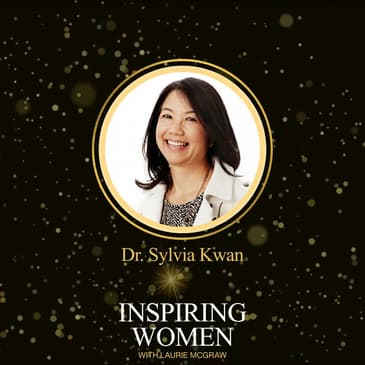

Women are great savers, but 70% of their money sits in cash, while it has to last longer because women live longer. Dr. Sylvia Kwan has built her career closing that gap.
Dr. Sylvia Kwan joins Laurie McGraw on Inspiring Women for a conversation about money, power, and why the financial industry has been quietly failing women for decades.
Sylvia is the CEO and Chief Investment Officer of Ellevest, a women-founded, women-led investment advisory firm dedicated to closing the gender wealth gap. The firm has grown to 3 million members and manages over $1 billion in assets.
Her path was not obvious. She studied applied mathematics and computer science at Brown University, planning a career in technology, before a final rotation in a quantitative investment group changed everything. She went on to earn a PhD in engineering-economic systems at Stanford, where her dissertation on how social interaction and investor behavior shape markets became one of the earliest works in behavioral finance. As Sylvia and Laurie discovered on the episode, they both share roots in Providence.
Sylvia took the reins as sole CEO after succeeding Ellevest founder Sallie Krawcheck, and this episode goes deep on what she has built and where the industry is heading. She walks through the first-of-its-kind gender-aware investing algorithm she created, built on the real data of women's lives: salaries that peak roughly 15 years earlier than men's, career breaks, and longer lifespans.
She also makes the case for "wealthcare," her term for shifting financial services away from the assumption that more is always better and toward quality of life, peace of mind, and goals that actually matter to a client. Plus the strategic decision to move Ellevest's digital investing business to Betterment so the firm could focus on private wealth and financial planning, and how she is preparing women for the $124 trillion great wealth transfer now underway.
TOPICS COVERED
- Why 70% of women's portfolios sit in cash and what it costs them
- The gender wealth gap and why women are not set up for financial success the way men are
- Building the first gender-aware investing algorithm
- Why women's salaries peak 15 years earlier and why career breaks cost far more than lost salary
- "Wealthcare" and measuring success by quality of life, not just returns
- The $124 trillion great wealth transfer and who is prepared for it
- Why 86% of widows fire their financial advisor within a year
- Leading Ellevest through a major leadership transition
- Investing for both returns and impact
- Her one piece of advice for women: don't wait, and don't delegate
Dr. Sylvia Kwan's advice to every woman watching: don't wait to claim your financial power, and don't fully delegate it. Get engaged, stay informed, and know what your money is doing.
Inspiring Women is hosted by Laurie McGraw, spotlighting the women leaders shaping business, healthcare, and beyond.
[00:00:00] Women have been sitting on the sidelines of investing for a very, very long time. And there is many studies year after year that show that women are great savers, but 70% of their portfolios are sitting in cash and that money has to last longer because women live longer than men do. Women are not really set up for financial success the way that men are.
[00:00:26] This is Inspiring Women and I'm Laurie McGraw. And today I am having a conversation with Dr. Sylvia Kwan.
[00:00:32] Now, Dr. Kwan is the CEO and Chief Investment Officer of Ellevest. Now, this is a women founded, women led investment advisory firm dedicated to closing the gender wealth gap through personalized wealth management, financial planning, values aligned impact investing. She is responsible for over $1 billion in investment assets. She has 3 million members. Dr. Kwan is the creator of Ellevest's Gender
[00:01:02] Aware Investing Algorithm. I'm very excited to learn about this first of its kind built on research. And she also created a new term called wealth care, a different approach to actually generating wealth and how to use it. Dr. Kwan, Sylvia, thank you for being on Inspiring Women. Thank you, Laurie, so much for having me. Well, let's talk about money. But before we're going to talk about money, Dr. Kwan and I just realized that we went to school together.
[00:01:31] Back in Providence, Rhode Island, we had a couple years of overlap and we both have this passion for really helping advance the next generations of women. You're bringing them into power through wealth management. I'm inspiring them through leadership. You're our inspiring person of the day, Dr. Kwan. And so I love that discovery.
[00:01:55] I know. It's so wonderful. Let's just talk a little bit about you first. Let's get grounded in where you started. And then, you know, your PhD thesis was actually about looking at some of the social behaviors in investment, which seems to align perfectly with Elvest. Just maybe give us a little bit of the backstory. Sure. So I actually had no intention of going into the financial services industry.
[00:02:24] So I my bachelor's degree was in computer science and applied math. And I had every intention of having a career in technology. Long story short, senior year, I decided, I don't think I'm going to be happy doing this. And I found myself in a management training program at a bank where you would rotate every three months into different areas. And my last rotation was in a quantitative investment management group.
[00:02:54] And that's really where I found my home and kind of where I started my my career in financial services. And because I didn't I felt like I didn't have kind of the formal training because I was an applied math, computer science person. I decided to go back to school after after spending four years in the industry managing institutional fixed income for large pension plans. I said back to school, get more formal education, et cetera. And so you made some reference to my dissertation, Laurie.
[00:03:23] And it's interesting, you know, as you know, in academia, there's a lot of theory. And the same goes for the investment world. There are various theories that govern how markets behave. And so, you know, my challenge was I had spent four years in the real world already.
[00:03:50] And I realized like theory is great, but the markets are actually made out of humans. Right. We're all voting with our dollars. And that's what creates market behavior. And unfortunately, fortunately, humans are not rational, at least not all of the time.
[00:04:06] And so I decided that I wanted to take the theories that we had, so modern portfolio theory in investment, in the investment field, and just relaxed one of the assumptions. And that assumption was kind of this humans are rational assumption that everybody, you know, you do your research on Apple. Apple, I do my research on Apple, and then we collect, you know, we decide independently whether we're going to buy, sell, hold.
[00:04:36] And that's why markets are efficient. And so what I did was I looked at kind of social systems and things like how plagues spread through human interaction. And I said, hey, if we relax this assumption and be like, oh, Laurie and I went to the same alma mater, I'm going to call her up and see what she thinks of Apple. And so we have all, I'm going to call my broker or whoever.
[00:05:02] And so because of those kinds of interactions, there is the possibility that there could be market crashes and booms, which is theoretically not supposed to happen under modern theory. And so I kind of view it as like I have this very quantitative background where numbers, you know, have lots of lots of rationale when it comes to numbers.
[00:05:27] But we always, always have to recognize kind of the human side, especially when it comes to money. Money is obviously very personal. And also markets are made up of humans. And so it's really this delicate balancing or delicate sort of integration of the two. Like how do you marry these two things that seem to be opposing and create solutions that meet real humans and real, real lives?
[00:05:55] Can't believe, I mean, just like the title of your PhD thesis, The Impact of Investor Interaction and Influence on Financial Market Behavior. So this is 25 years ago, more than 25 years ago. And, you know, I think, you know, in this world, I mean, in the world of that, that I work in, health and care, you know, bias, bias in behavior and how that leads to material outcomes and personal health.
[00:06:23] And, you know, different ways that people interact with a very broken healthcare system. I understand that deeply. Now, how that has fast forwarded to the work that you were doing and leading at Ellevest. Can you just tell us a bit about Ellevest and sort of like what the organization does and why is it only focused on women? Yeah. So Ellevest was founded more than 10 years ago by Sally Krawcheck. She was our co-founder and original CEO.
[00:06:51] If you don't know who Sally Krawcheck is, she is one of the most powerful women on Wall Street. Very, very influential. One of the most recognized women in finance. And what Ellevest was really founded to do is, you know, what we call kind of close the gender investing gap or close the gender wealth gap. And this was really in recognition that women have been sitting on the sidelines of investing for a very, very long time.
[00:07:21] And there is many studies year after year that show that women are great savers, but 70% of their portfolios are sitting in cash. And as you well know, over the last few decades, we've been a very low interest rate environment. And if women are have a gender pay gap and they're not investing what they are saving and that money has to last longer because women live longer than men do.
[00:07:48] Women are not really set up for financial success the way that that men are. And so that has really resulted in the gender wealth gap, which is, you know, pretty much, you know, woman has 30 cents for every dollar a white man has. And for women of color, it's literally one penny. And so we wanted to focus on the investing piece. Like, how do we close the gender investing gap?
[00:08:14] How do we get more women engaged with finances, engaged with investing? Because they are literally leaving thousands, hundreds of thousands, if not millions of dollars on the table if they are not investing over the course of a career. So L-O-VS was really founded to break down the barriers that women find in the investment industry, whether they're real or perceived.
[00:08:41] And to create a firm that would help engage women, that would resonate with women and make it very easy for women to invest. So that has always been our mission. That has never changed. And so we started out with a digital investment advisory experience to make it really easy. Women could start investing with as little as, say, even $5 a month.
[00:09:04] But the idea was we wanted women to start investing now so they have those many, many years of compounding to build their wealth. About a year or so after we launched that product, we launched our private wealth service. And this was really for women with more complicated financial situation. Often they had more assets. They might have concentrated stock positions or businesses they need to sell or things like that. Something that would not be appropriate for an algorithm to solve.
[00:09:34] And so we started a more high-touch private wealth service. And we grew both businesses for, you know, the bulk of 10 years. The mission has always remained the same. But we really wanted to have services, you know, for women of all ages and at different stages in their life and career. Well, let's talk about the impact. I mean, you're 3 million members strong. You have over a billion dollars in terms of assets that you're managing for.
[00:10:03] So, and for you, Sylvia, you have taken over as the CEO and the chief investment officer. Those are two important titles. And you started as a co-CEO and then you fully took the reins as CEO about a year ago. So for an organization this important, I mean, you don't need to tell me or convince anyone of how big of an issue you're tackling and how empowering it is. People know that women are living longer.
[00:10:33] People know that women have more complicated financial scenarios later in life. There are many people who their marriages change or, you know, somebody else they might have been counting on for making decisions that are now thrust upon them. They're ill-prepared. They're ill-prepared for dollars that are coming to them. They're ill-prepared for being the single most important person making financial decisions about healthcare, which is bankrupting many, many different Americas.
[00:11:01] So there's a lot of complications there that people can relate to. Let's talk about your role as CEO and taking the reins for such an important organization. First of all, what were the first big things that you were thinking about in that new leadership role that you took after helping build this organization for the past decade? Yes.
[00:11:23] So Sally is really the visionary, right, who built LFS, really created the voice and the brand that really has resonated with so many women of all ages and life stages. And so when she needed to step down for health reasons, I really felt a profound responsibility to carry that torch forward and to continue our work to close the gender wealth gap.
[00:11:51] Now, given the unexpected nature of the leadership transition, it wasn't really planned. My highest priority was really to provide stability, clarity, continuity, and really ensure our clients, the team, and other stakeholders in making sure that they remain confident and engaged.
[00:12:12] So what mattered most during this transition was really a laser focus on our financials and really the sustainability of the firm. So my top priorities were really to, you know, strengthen our financial footing, safeguard the integrity of the LFS brand, and to continue to reinforce our mission. How we accomplished this, however, had to evolve.
[00:12:41] And so what are some of those things that evolved? Yeah. So as you may or may not know, I talked a little bit about our first kind of business line, which was the digital advice, and then we added on the private wealth and grew both businesses to fairly sizable businesses, you know, over the last 10 years.
[00:13:01] So in February of last year, we made the difficult decision to transition our digital investing to another firm called Betterment, which we thought was a fantastic home for our clients. And this decision wasn't taken lightly. It really came down to a strategic focus and sustainability of the firm.
[00:13:27] So the automated digital-only advisory space really requires massive scale in order to monetize it effectively at the low fees that we were charging. And meanwhile, our private wealth business was expanding rapidly. And together with that, the great wealth transfer, which I know we're going to talk about, was already underway.
[00:13:51] And we began seeing more and more beneficiaries of this transfer, kind of taking agency over their capital for the very first time and really needing help along this journey that was, in many cases, brand new to them. And so pivoting to focus only on wealth management and financial planning, we felt would allow us to really focus on serving this audience because we knew it was kind of coming.
[00:14:18] And this audience, you know, whose needs really aren't more complex than an algorithm alone could solve. Well, I think just like, can we just talk about that great wealth transfer? I mean, first of all, like how exciting is this? So we have $124 trillion that is going to change hands in the next three decades, two decades. So that's a very short window of time.
[00:14:44] And a huge amount of that is going to be going to women who are going to inherit the majority of this money. So just in terms of that wealth transfer, who's prepared for it? And how are you at Ellevest, and I apologize, mispronounced the Ellevest before. How are you at Ellevest going to prepare women to take advantage of that great wealth transfer?
[00:15:10] I think what we're seeing is, so there's two kind of, I would say, populations that are the beneficiaries. You know, first, as you mentioned, there will be the widows who will be receiving that inheritance first or that transfer first. And in many cases, you know, they will have it for possibly a decade or more.
[00:15:35] I look at, you know, my own parents and, you know, my mom now has outlived my dad 12 years, still going strong. So, you know, having that money is, you know, for some time. And then, of course, you know, the next generation, both, you know, men and women. So for women who are widows, what we're seeing is oftentimes they had delegated the responsibility for that wealth to their spouse.
[00:16:03] And so this is the first time they're kind of claiming a seat at the table. And in many cases, it's, you know, it's a little scary at first. And so it's something that, you know, women have to wrap their heads around. There's an interesting statistic that when women become widows within a year, about 86% of them fire their family financial advisor. Really? Really? Wow. Wow.
[00:16:32] Because all of a sudden they're becoming educated and what? Like, what are the main reasons for that? I, the main reasons is the family financial advisor was so used to only talking and engaging with the man. So there's not, there's not an appreciation for what needs to be talked about. So, okay. Exactly. Exactly. And so she's like, well, you know, let me find somebody else. Yep.
[00:17:02] Who realizes that I'm your customer now. Exactly. And that I have, you know, different preferences and different needs. And so, you know, we, we've heard a lot from, from clients who have come to us and said, you know, I've been talking to my advisor and he's really, you know, he or she is really great. But I've asked about, you know, how can I invest, you know, more closely aligned to my values. I've asked again and again and again, and they just aren't helping me with that.
[00:17:30] So it's time for a change. So I think there's just different reasons for that. And Sylvia, you're also shaping how women should be thinking about wealth creation, wealth deployment, doing investing. And so you have a 2026 market outlook report that you have put out.
[00:17:49] You introduced this concept of wealth care, the idea that financial service, the financial services industry needs to shift from the assumption that more is always better. So can you talk about that? Is this a Mackenzie Scott sort of philosophy that's coming forward in terms of what you're putting? What is wealth care? Not, not, not exactly.
[00:18:12] So wealth, I like to describe wealth care as an expanded functional form of wealth management. So wealth management, our industry is really obsessed with returns and with optimization. So we optimize portfolios. We are seeking, you know, the highest risk adjusted returns. You know, we're minimizing taxes and it's all for the purpose of chasing outsized performance or outsized returns.
[00:18:40] And so there's this underlying notion that, hey, if I can drive higher returns for my clients, they're going to be wealthier and wealthier clients are going to be happier. Everybody wins. And that is the metric of success is just your portfolio returns. And what wealth care does is recognizes like that is not the only thing. And in fact, that's if that's the only thing that we're doing for our clients, we are totally missing the point. Because optimizing wealth does not automatically lead to optimize an optimized life.
[00:19:10] And so wealth care is kind of the recognition that while financial returns is one measure of success, it shouldn't be the primary measure of success. So what we're really trying to work with our clients is looking at how do we maximize the quality of life, your well-being of you and your family, your peace of mind.
[00:19:34] And, you know, we see all the time, you know, wealthy clients who will never run out of money, but they're still very deeply anxious for some one reason or another. And it's really trying to dig deep to find out, you know, what are those sources of stress and anxiety? And how do we align your finances to relieve that? So I can give you a couple of examples to kind of like bring this to life. So one example is we had a client who really wanted to pay off her mortgage.
[00:20:01] Now, in the investment industry, if you have a low-rate mortgage, the rule is you never pay off your mortgage early because you've got, you know, a 2.5%, 3% mortgage. And it's always like, hey, if you put that money into the market over the long term, you're just going to be better off. It's the wealth-maximizing answer. And that is what we've been trained to do. But this particular client, just the weight of having that mortgage on her shoulders was palpable.
[00:20:31] And it was something that she came back to again and again and again. And so our job as advisors is trying to figure out, okay, how do we make this happen for you? So we did. She paid off her mortgage. And now she just lives more freely. She doesn't have the weight of that burden, even if that is not the wealth-maximizing, the correct financial answer. It was the correct answer for her to really maximize her well-being. So that's a great example.
[00:21:00] And I think that, you know, if you are in a situation, a fortunate situation where you have options like that, those are great decisions. So as an advisor to women and, you know, for making these types of decisions, how do your clients measure you in terms of, you know, feeling success or trust?
[00:21:27] Or what are the important things that you are trying to get out of that relationship? Obviously, there's a financial interaction. But what are those measures of success? If I were to choose you, choose Ellevest, what would I be wanting out of that relationship? So the first thing we really want to do is determine, like, what is the purpose for your money? What is the purpose for your wealth? What are your goals?
[00:21:52] So it's a very goals-based approach as opposed to we're going to help, we're going to strive to help you beat the S&P 500 every year. It's like, I want to make sure I can send my kids to the colleges that they want, or I want to live a certain lifestyle in retirement. So it's really measuring how we're doing against those goals. That's how we're measuring the success.
[00:22:20] There's such a consistency in terms of your early studies and your PhD and behavioral science and paying attention to, you know, that that is materially important, not just in the decisions that you make, but in the satisfaction that you feel as a person, the confidence that you feel in terms.
[00:22:42] I mean, finances are one of the most worrisome aspects of any person's life. In these times, it's only becoming more worrisome as, you know, we have all kinds of different challenges in terms of new burdens of healthcare decisions, like I was talking about earlier, or, you know, things that are unaffordable that were previously affordable.
[00:23:07] So paying attention to how people feel about it, not just the financial, you know, black and white numbers, that speaks to me. Maybe that's because I am a woman. I don't know. I don't know. I want to talk about investing because I think that this is such an important area of where women just generally do not invest as a natural motion as men do.
[00:23:35] It says the statistics back it up. You created, Ellevest created the first gender-aware investing algorithm built on data about women's salary curves, career breaks, longevity, financial patterns. Talk to us about what that algorithm is and why it is so groundbreaking.
[00:23:55] Yeah, so this algorithm was one of the things that we did for the digital investing service because that service was a low-touch online experience only. And so all the advice was driven by the algorithm. And so when we really thought about, you know, hey, we were trying to build this for women.
[00:24:17] And most of the algorithms out there, I would say by default, are built on the more linear life of a man. Mm-hmm. And so what we found is, and this is data on salaries, that women's salaries peak 15 years earlier than men's do. You know, obviously, as we know, generally women live longer. Women take career breaks.
[00:24:43] And often when they come back after the career breaks, they come in at a lower salary than when they left at. And so thinking about, like most people think, oh, you're taking a career back. Okay, so you're missing, you know, those two years of salary. No, it's way more than that because you're not, you know, putting money into your 401k. You're not saving and you're using that compounding. So the impact is not just the loss in the salary, but it's much bigger than that.
[00:25:10] And so, you know, it's a little bit of a harsh reality actually to see this, but it is a reality that we felt we needed to be honest about. And so, you know, to cut to the chase, you know, really just told a woman, guess what? You've got to save more than a man in your sane position because of all of these things. And take more risk and invest more.
[00:25:36] I mean, one of my, just, you know, as I talked to many earlier career stage women, one of the pieces of advice that I love to give is like, I don't care what job you are going for, negotiate something. Because if you do not practice negotiating the difference at the early part of your career, you know, it is hundreds of thousands, if not millions of dollars, you know, over the course. And those early ways of doing it.
[00:26:03] And again, it's the compounding thing that you know much better than I do most certainly. But it's so wonderful that you're leaning into that. Sylvia, I want to actually talk a little bit more about you. I mean, you're just leading this really, really important area, wealth creation, wealth management, financial services, ensuring that women know what to do to take good care of their financial health and do more, do more with it.
[00:26:29] Personally, you sit on the board, you know, that oversees Grinwell College's endowment. You serve on a number of other boards, campaigns. What are the things that are important to you personally that you invest your additional time on? You know, where do you make those decisions? I'm sure you could do many other things with your time.
[00:26:52] And yet you choose to give back in both your board service and where you do your own personal work. Can you talk about that, please? Sure. So one of the things that is definitely near and dear to me is kind of this issue, being in San Francisco, being in California, this issue of homelessness that we have. And, you know, I'm not an expert on homelessness, but I'm aware enough to know how many billions of dollars we've poured into this problem and don't have a lot to show for it.
[00:27:21] And so the Lotus Campaign is an organization that actually came out of somewhat of a pilot that was done on some multifamily real estate investments that we had invested clients with.
[00:27:38] And it was kind of a pilot program just to see how we could part, you know, or not we, but landlords and nonprofits can partner to help address homelessness. And it was such a unique model and it really, it really works.
[00:28:00] And so it was something that I was like, wow, this is something, you know, you know, that, that from my experience, from the investment side in real estate, as well as, you know, one of the areas that I care most about was something that I, you know, I really wanted to be more involved in.
[00:28:17] But I think overall kind of my, you know, and some of the industry boards that I serve on, part of it is really, you know, how do I have the seat at the table to influence others in our industry, whether it's, you know, encouraging more women to be in the industry or, you know, how can I bring the L of us voice and what we're doing to L of us into the industry to have more influence. So that's certainly what I do.
[00:29:13] And then being able to do that in other ways and exploring different ways and different approaches, not just the tried and true, that just, that just makes so much sense that that's where you would spend your additional time wherever you are finding it. That's just really terrific. Really terrific. Oh, thank you. It's what I love to do. Yeah, clearly. So Sylvia, I would just love to close out this Inspiring Women conversation.
[00:29:40] Normally, I ask for sort of like, you know, best advice and all that. But just given what you are doing and what you have built with Ellevest and just the number, millions of people that you are impacting for earlier stage women who are building out careers, for later stage women who are grappling with financial complicated issues, but thinking about themselves, what is the advice that you give to these women?
[00:30:10] What is the advice that they should know early on? And even if they are in the crisis moment of looking at their years ahead, what are you telling us to do? I say the number one thing, the most important thing is don't delegate. It was between that and don't wait. I find in our research that often women wait.
[00:30:38] They wait to get started. So they wait to, I would say, even claim their financial power. They wait to get more financial education. They wait to feel like they're an expert before they get started. And we wait and wait and wait. And we lose those years of compounding. And so my number one thing is like, don't wait. And also get engaged. Get engaged with your finances and with investing. Know where your money is. Know what your money is doing.
[00:31:07] You don't have to do everything. I'm not telling women to do more. But you can work with a financial advisor. You can work with your spouse. You can certainly, you know, I'm all about divide and conquering in a household. But don't, you know, what I find many times women will just delegate and they won't, you know, they just don't know anything with, you know, what is happening with the household finances. You don't have to do everything. But you do need to be informed.
[00:31:35] And I think that that is going to really help women empower themselves because there will be a time perhaps when you are, you know, you have full independent agency over the money and you will be well equipped at that point to make those kinds of decisions. That is, I just feel like that is such an important point.
[00:32:00] I almost just want to put an asterisk on that because, you know, what women are quick to do as the people who are generally the ones making all of the health decisions for their household, their expanded family, they'll take on all the work associated with that easily.
[00:32:19] And the thing that you are talking about is something that is so important and powerful for their own financial health, you know, for the long term. So I cannot thank you enough for that advice. This has been an incredible Inspiring Women conversation. I've been talking to Dr. Sylvia Kwan. And Sylvia, thank you so much. Thank you, Lori. It's been a joy to be on.