
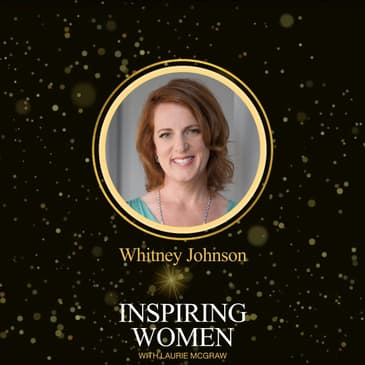

SHE THREW AWAY EVERY FINANCIAL MODEL SHE HAD BUILT IN EIGHT YEARS ON WALL STREET.
Whitney Johnson graduated from college with a music degree, arrived in New York newly married and broke, and took the only job she could get: secretary to a retail stockbroker. She watched the brokers around her open accounts and thought, I want to do that.
So she took business courses at night. A boss took a chance on her and moved her into investment banking. Then, while she was pregnant and on the strength of good performance reviews, she was pushed into equity research, a move she did not want and that felt like a step down. It became the making of her career. She spent nearly eight years as an equity analyst and was Institutional Investor-ranked every single year.
Then she read Clayton Christensen's The Innovator's Dilemma and realized disruption theory did not just explain the Latin American telecom stocks she covered. It explained her. She left Wall Street without keeping a single one of her models, cold-emailed Christensen one of her research reports, and eventually co-founded the Disruptive Innovation Fund with him.
Today she is the CEO and co-founder of Disruption Advisors, ranked by Thinkers50 among the top ten management thinkers in the world, and the author of four bestselling books with a fifth on the way.
In this conversation with host Laurie McGraw, Whitney breaks down the S Curve of Learning: why the launch point feels terrible even though your growth is mathematically at its fastest, what the sweet spot actually feels like, and why mastery is the most dangerous place to linger.
IN THIS EPISODE
- From music major to secretary to Institutional Investor-ranked equity analyst
- The maternity-leave moment that turned an unwanted job into a career-maker
- Reading The Innovator's Dilemma and realizing it applied to people, not just products
- Leaving Wall Street and burning the bridges on purpose
- How she reached out to Clayton Christensen, and what came of it
- The S Curve of Learning explained: launch point, sweet spot, mastery
- Why growth feels slowest at the exact moment it is fastest
- Dopamine, inaccurate predictive models, and why beginners feel like imposters
- Dr. Dan Siegel's "name it to tame it" and how to talk yourself through the discomfort
- Why mastery is where careers quietly stall
- "If I don't disrupt myself, the market will do it for me"
- The research on women needing 100% of qualifications versus men needing 70%
- Being judged on track record while men are judged on potential
- Getting her hand slapped asking for compensation, and what she'd do differently
- Sally Helgesen's How Women Rise and Sheryl Sandberg on naming the discomfort before the conversation
- Whether Whitney still disrupts herself, and what that looks like now
- AI as external disruption, and why self-regulation and calm are the real response
- Pulling the stake out of the ground: self-limiting beliefs women carry
- Her closing advice on connection, intuition, and discernment as superpowers
Hosted by Laurie McGraw.
Full episode on Inspiring Women. Link in comments.
#InspiringWomen #WhitneyJohnson #LaurieMcGraw #DisruptYourself #SmartGrowth #Leadership #WomenInLeadership #PersonalDisruption #CareerGrowth
[00:00:00] Growth Feels Like It's Not Happening, but mathematically it's actually happening at its fastest. So the growth at the launch point feels very slow, but it's actually happening fast. And so once you know that, when you start to do new things and you're feeling overwhelmed and scared, you can say, okay, it may be that I'm bad at this, but maybe it's just that I'm doing something new.
[00:00:23] One of the missing things that women often get trapped with is, but what about pushing for more power, more title, more compensation? How do you connect those two things? This is where I point people to people like Sally Helgeson.
[00:00:41] This is Inspiring Women. I'm Laurie McGraw and today I am speaking with Whitney Johnson. And Whitney is a world, the world authority on smart growth, leadership and disruption.
[00:00:53] She is the bestselling author of four books, soon to be five. And Whitney is talking always about leadership, about disruption and how to get to your highest potential. As the CEO and founder of Disruption Advisors, Whitney, thank you for being on Inspiring Women. Well, Laurie, thank you for inviting me. I'm delighted to be here.
[00:01:16] Well, as we were talking, Whitney, you are followed by people across the world. You are a leading thinker and you've defined new methodologies to help people advance in leadership. And you start with not just working with high growth companies, but you always start with the individual.
[00:01:36] So can we just go to the work where I want to talk about that because that's so important for women today, probably even more important in terms of what they can do to propel themselves into leadership. But you started out as a Merrill Lynch advisor. So how does, you know, somebody who understands stocks and what to do there turn into the business leading thinker that you are today?
[00:02:00] Well, and it goes back even further than that, Laurie, because I graduated from college in music and arrived in New York and I had just gotten married. My husband was getting his PhD. We had no money. So, you know, I needed to go work.
[00:02:16] And because I had majored in music, I actually started as a secretary to a retail stockbroker. And in this work, I would, you know, I'd go to work every day and I would see all these up and coming stockbrokers trying to open up accounts and think, you know what, I want to do that. I think I want to do more.
[00:02:38] And so they would say things like, you know, throw down your pom-poms and get in the game. And I'd hear them say that over and over again. And at first I was kind of offended because I was a cheerleader in high school. But then I realized, you know what, I actually need to throw down my own sort of proverbial pom-poms.
[00:02:55] And so I started taking business courses at night, accounting, finance, economics. And then I had a boss who believed in me that gave me a shot of moving from being a secretary to a retail broker to becoming an investment banking analyst.
[00:03:10] And I think even to this day, that doesn't happen very often. But that's really how I got my start is I started as a secretary, became an investment banking analyst. And then eventually after I had my first child, I had a boss who had gotten fired and they probably would have fired me too. Actually, I hadn't had my first child. I was pregnant and they probably would have fired me, but I was pregnant and I had good performance reviews.
[00:03:33] And so they actually moved me, but actually it was more like they disrupted, shoved me into equity research. But here's the thing that's so interesting. And I think this is an important thing for all of us, but for women in particular, that even though that's not what I wanted to do, I did not want to move into equity research. It felt like a step down.
[00:03:54] It turned out to be a career maker for me because I was really good at picking stocks and spotting the momentum of a company and being able to say, I think this stock's, you know, build my financial model, but I think this stock is going to be a winner. So when did it become something like, I don't want to do this? And then, oh my gosh, I'm really great at this. I'm really excellent at this thing that I didn't want to do. Was that quickly?
[00:04:21] Because usually when people like take those, you know, like, I don't think this is a good move for me. You're in that sort of like, you know, I sort of like, you know, slumped down period where you don't know that it's really an opportunity. When did you recognize it was that opportunity for you?
[00:04:37] I think there were two things that happened. One was, you know, I was still on maternity leave. So this was all happening while I'm on maternity leave. And I actually had what I would call kind of a spiritual experience of like, I didn't want to do this. And then I in my mind's eye, I could feel like there were all these doors opening up that if I would go into equity research, it would actually be a really good place for me. So I think that was certainly the turning point.
[00:05:03] And then as I started to dive in and started to see, you know, the brass ring that was within equity research as well as like, oh, you can be an institutional investor ranked analyst. This is exciting. Oh, look at that person over there and that person. And I started seeing role models and the challenge of building a financial model and challenge of being able to pick a good stock.
[00:05:24] I started as I started as I started to do the work and had this sense that I could be good at it. And I also had some mentors within the team that were really good at advocating for me, et cetera, and giving me confidence that I could do it. I think that was there was that sort of spiritual moment. But then once I started to do the work, I thought, oh, yeah, this is the place for me.
[00:05:45] And so, Whitney, you went from sort of like, you know, I would just say sort of like early beginnings to then advanced to now you're at you're very good at what you're doing in equity research. But then you paired up with one of the business leaders of our generation, you know, in terms of actually Clayton Christensen transforming how we think about business, how we adopt different methodologies.
[00:06:14] And you partnered with him to create Disruption Advisors. How did that happen? You know, when you say it like that, I'm like, wow, that's pretty amazing. That happened. You're like, this is oh, and then this happened and this happened. The way you describe it, I'm like, oh, yeah, that thing happened. So so as I as an equity analyst, I actually heard Clayton speak at a church meeting.
[00:06:43] And I was like, who is this guy? Because he was such a powerful speaker. He was like six foot eight and he was an amazing storyteller on this prodigious intellect. And in our particular faith tradition, we have a lay ministry. So that that was a pretty common thing. And so I started looking up all his books and I read The Innovator's Dilemma. And I'm like, wow, wait, what? And at the time I was covering emerging markets, telecom and media.
[00:07:08] And so when I read The Innovator's Dilemma and Disruption, I realized that this is what was happening with the stocks that I was following in Latin America. So I had this explanatory mechanism of why every quarter when I would set my estimates, they were too low is because disruption was happening of wireless to wireline. So that was happening. At the same time, this is this is now 2004, 2005. So 20 years ago, I was like, you know what? I've been an equity analyst for almost eight years.
[00:07:38] I've been institutional investor ranked every single year. And I had gone to my manager and said, hey, I think I want to do something else. And they they basically said to me, we like you right where you are. No one has ever else heard that on the planet besides me, of course. And I at this point, you know, I had read The Innovator's Dilemma and I thought, you know what? It's not just disruption for products and services. It's for people. This applies to me.
[00:08:08] And I had what I would call at this point a vague notion of like if I'm going to accomplish what I meant to accomplish in this life, which I didn't know what it is. You don't know for sure. I realized I was going to need to disrupt myself. And so that's when I left Wall Street. I had found Clayton. I had sent to him one of my equity research reports. So I was like, I want to work for this guy. Like I knew I wanted to.
[00:08:34] And then when I left Wall Street, I did not keep any of my models, my financial models, which tells me that I knew I was done. I was burning the bridges, right? I'm done. And it's not a smart career move, just by the way. Not a smart career move. It is not a smart career move. But sometimes we do impetuous things. All of us have those. But that was really the start of me reaching out to him.
[00:09:01] And then I ended up working with him on some church projects. And when he was ready to start his fund, because now I was working with him in a volunteer capacity, when he wanted to start this with his son and he knew I had the background on Wall Street, he tapped me and said, hey, do you want to do this with us? And it's so fun you asking me this, because I'm like, this is pretty amazing that this happened. It's incredible. It's absolutely incredible. And there's so many things that are interesting about that. One, sort of burning bridges. People don't do that.
[00:09:31] That's not good advice. That doesn't mean, though, you shouldn't follow something that you're deeply interested in that's speaking to you. And then also that you had the wherewithal to pursue somebody that impressed you. And then you sent to Clayton your information. Here's my background. And that became interesting to him. And I just think that that is incredible. And what you did is a masterclass for so many others.
[00:10:00] But that's just the beginning. So let's now talk about, you know, what you are doing with Disruption Advisors and this S-Curve, because you've actually developed your own business methodology for how to disrupt yourself. So what you learned personally, you turned into a business methodology. Can we just, like, talk about the S-Curve and what that means? Yeah, for sure. So there's two different—there's actually—there's a pattern of three. Oftentimes there are these patterns.
[00:10:28] So when I was still working on Wall Street, I realized, you know, we were doing—picking stocks. But I was doing this training, and I started comparing people to stocks. I was like, you know, how do you create conditions where you're a buy? And, you know, what are things that you might do that make you become a sell? So I found myself applying stock-picking to individuals. Then as I read the innovator's dilemma and disruptive innovation, I'm like, oh, this applies to people.
[00:10:56] And then when I was now working with Clayton and we were applying the S-Curve to figure out how quickly innovations would be adopted and then use that as part of our stock-picking methodology, now you see the pattern I said to myself, huh, I think we can actually use the S-Curve to understand what growth looks like and what it feels like for the individual. And at that point, it was just a hunch for me. Like, I had this intuitive leap that I was making, but I didn't have any way to back it up.
[00:11:26] And that's why I wrote the book Smart Growth, because I wanted to be able to say, to look at lots of different disciplines from biology, et cetera, and say, there's actually real substance and legs to this idea of the S-Curve models, what growth looks and feels like for the individual. And if we take that individual S-Curve, can you just like talk a little bit about what those different stages are?
[00:11:51] And I'm also interested, Whitney, on, you know, you wrote this in a business mindset that the individual and the growth and disruption of the individual will naturally translate to an entire company. That's, I mean, it sounds obvious, but companies are large organizations and it doesn't work that way.
[00:12:13] So I just want to make that leap of individual to how that translates to the large company or growing company and building growth. And then I also want to go into pre-pandemic, post-pandemic, because the world has changed and operates differently now. Yeah. Okay. Let's start with the S-Curve and then we'll see where we get. So the S-Curve, if you think about it, I mean, you think, so I'm going to draw this. It's an S. There are three major parts to it.
[00:12:41] And so here's what's happening in your brain when you start something new. Your brain has a hypothesis about what is it going to take for me to go from the bottom of this S to the top of the S. And it's running that model. And most of your predictions are inaccurate when you're at the bottom of the S or what I call the launch point. And so because those predictions are inaccurate, dopamine, which is the chemical messenger of delight, it de-delights.
[00:13:10] And so all of a sudden what you thought was a good idea, you start to feel overwhelmed and discouraged and frustrated and impatient and like an imposter. And so you're like, wait, what am I doing here? Like, why did I do this? And in a work situation, you might get very performative because you're worried that people think you don't know what you're doing. Now, what's interesting at the launch point of the S curve is this.
[00:13:33] Growth feels like it's not happening, but mathematically, it's actually happening at its fastest. So the growth of the launch point feels very slow, but it's actually happening fast. And so once you know that, when you start to do new things and you're feeling overwhelmed and scared, you can say, okay, it may be that I'm bad at this, but maybe it's just that I'm doing something new. And so you can start to talk yourself. This is normal.
[00:14:02] This way that I'm feeling is very normal. And then once you can name it, as Dr. Dan Siegel said, you can tame it and it allows you to stay in that place of doing the new thing. So that's the launch point. Now, sometimes that S curve is not going to be the right S curve and you'll go do something new, but no S curve is ever wasted because you've gotten those reps of doing a new thing. But if you stay with it and you've got the S curve person fit, at some point, you're going to tip into the sweet spot.
[00:14:28] And the sweet spot of the S curve is this place where you start that predictive model is increasingly accurate. And so dopamine starts to spike because you're beating your expectations and you have these emotional upside surprises and you feel exhilarated. And growth here is not only fast, it feels fast. And so it is just the place that you want to be as much as possible. And we need to talk more about that place because we tend to only talk about the launch point and mastery.
[00:14:57] But this is the place that you might describe as flow. So that's the sweet spot of the curve. And then mastery, the top of the curve, it doesn't necessarily mean you are the world's foremost healthcare executive. It just means I did what I came to do, whatever that is. I learned five songs on the ukulele. The challenge here is that because the predictive model has now been figured out, you're getting a little bit of dopamine, but not a lot.
[00:15:26] And so growth here is, in fact, slow. So you have to make a decision because part of you says, I like being really good at what I'm doing. I like that everybody reaches out to me. But your brain needs more dopamine. And so if you're willing to listen to that, then you disrupt yourself, jump to a new curve, and that growth cycle starts over all again. But this is a very simple way to talk yourself through what it feels like and what it looks like.
[00:15:54] And that launch point, I mean, that's a place of discomfort. People don't like to be in a place of discomfort. Can you talk about, Whitney, how this applies in particular to women? And many women who have gone through this in their own professional journeys and growth, they often get stuck here and don't get to a new level of growth. But also when you're in the launch point place, that's a place of discomfort.
[00:16:20] And usually people want to get away from that as fast as possible. What sort of do you know about or what can you advise to women who are going through this and the best women leaders that you know? Are they comfortable in every part of the S-curve stages? Oh, those are great questions. Okay. So when you're in mastery, I think for women in particular, and I'm sure you've seen the research, that women will tend to say,
[00:16:48] Okay, I need to have 100% of the qualifications in order to go do that new thing. Whereas men in general will say, I only need 70%. We also know that there's research suggesting that men are judged on potential and women are judged on track record. So those are all real systemic things that we need to contend with. But if you can understand that that's happening and that that resistance is going to be in place for you when you're in mastery,
[00:17:17] it allows you to start talking yourself through of, okay, I understand that those systemic pieces are here. But I also understand that if I try to stay here too long where I'm starting to feel bored or I'm starting to feel restless, it's just like a mountain climber. They get too high. They stop getting oxygen. And you're going to stop learning. And so you can say to yourself, if I don't disrupt myself at this point when I'm feeling restless and bored, the market will do it for me.
[00:17:44] So I'm better off just doing it myself instead of waiting for it to happen. Because I have seen this happen over and over again, including for myself. You can get to the top of a curve or you lose your... Let me back up. Sometimes people lose their jobs. They get fired or they get laid off. And frequently, frequently, they knew it was time to do something else. And they wouldn't do it because they were too scared.
[00:18:14] And so the universe gave them a nudge. You're much better off if you say, okay, I know I'm here. I've got to do something. I need to act on it. And I also know that I'm going to be afraid. But once I understand this S curve, then I can start talking myself through the process of disrupting myself and doing something new. So, Whitney, what do you say to women?
[00:18:33] Because I speak with so many women who are eager to disrupt themselves, are eager to learn more and pursue more from a perspective of leadership. But what I often hear is, I just want to contribute more. I just want to do my best work. I want to learn more.
[00:18:54] And I feel like one of the missing things that women often get trapped with is, but what about pushing for more power, more title, more compensation? How do you connect those two things? Because what you're talking about in terms of the disruption of the individual and the pursuit, that makes all kinds of sense to me. But for women who are pursuing that, how do they also get those leadership positions, pursue the compensation that they deserve?
[00:19:22] Because that's where it doesn't always connect. Right, right. Yeah. I mean, I had an experience early in my career where I had gone to my manager and I had talked to a male colleague about, like, here's how you have the compensation conversation at the end of the year. Right. So, like, okay, I've got a playbook. Can I go to my boss? And he's like, go back to your office, stop asking for more and just do the work. Right. So, my hand was basically slapped for it.
[00:19:48] So, here's where I would, and maybe you've already interviewed her, but this is where I point people to people like Sally Helgeson, How Women Rise. Because she, you know, talks about, we need to learn how to advocate for ourselves. We need to learn how to make the case.
[00:20:07] We also need to, I still remember something that Sheryl Sandberg said, this is years ago, where when she wrote Lean In, she said, I will sometimes say to people, I'm about to have a conversation with you. It's going to feel a little bit uncomfortable because I'm sitting on the other side of the table from you and the research says it's going to feel uncomfortable. So, I want to just name all of that stuff and now I'm going to have the conversation.
[00:20:31] So, what I would say is if you're feeling that resistance, there are systemic reasons for it. You've probably gotten your hand slapped and there are things that you can do. I would definitely look up Sally Helgeson's work. She wrote the book, How Women Rise is terrific. She wrote an earlier book that I had read earlier in my career called The Female Advantage. But there are things that you can start to do to understand, here's how I need to navigate this. Because you do need to navigate it differently than a man would.
[00:21:00] And if you think you don't, you know, maybe this happened to you too. I remember, you know, when I'm in my 20s, early 30s, I'm like, what glass ceiling? There is no glass ceiling. Yeah, I know. So much optimism. And then you hit the glass ceiling. And so, then you say, okay, I get it. There are some systemic things that are happening. And I still have a responsibility. And I have my agency. And what am I going to do with this? That's awesome. Whitney, let's just go back to disruption.
[00:21:29] You are an expert at it. You advise people to disrupt themselves all the time. And you're at what I would call the pinnacle of, you know, just like being a world thinker on this topic. Are you still disrupting yourself? And if so, what does that look like? Every single day I am. I mean, you know, I think my sense of integrity says if I'm going to talk about the idea of disruption.
[00:21:56] I had someone early in my career say to me, if you're going to talk about personal disruption, then it's important that you do self-disruption. And so, I'm continually thinking about what can I do to be a better human being? What can I do to be a better mother? What can I do to be a better wife? What can I do to be a better leader, to be a better speaker, to be a better writer? I mean, I'm continually in that process of doing that work to improve.
[00:22:25] I mean, my goal is that, you know, the day that I die, which I hope is still, you know, years and years away, that's the happiest day of my life. And that will be because I have done the work to continually be at greater peace with myself and who I am as a human. How does that apply for in this age that we're in of AI adoption, which is coming at a different pace?
[00:22:51] And just, you know, how does that apply to your thinking about disruption and the principles that you've outlined in four of your books, soon to be five, that is coming out? You know, so while I recognize that there are moments where all of us feel a little bit of terror at AI, like, wow, what is this all going to mean?
[00:23:15] At the same time, I think it is absolutely something that's magnificent. Because if it is used well, it gives us an opportunity to amplify our thinking and even improve ourselves more quickly because we can, you know, have it listen to a call that we're doing. And, you know, did I listen or did I interrupt people? Like, you're able to do all these things that allow you to improve.
[00:23:42] But what I am finding is that the work that we are doing has become even more important with AI because the only way through external disruption is to disrupt yourself. But disrupting yourself oftentimes looks like, how do I create the conditions where I can be more calm?
[00:24:11] How do I create the conditions where I can better self-regulate? How do I create the conditions where I work better with other people? How do I create the conditions where I'm able to become more human because of what AI makes possible? And so it creates this existential urgency. But at the same time, if we will do it, that all of that AI will help us disrupt ourselves even faster. So it's very much a both and.
[00:24:40] But I would say I feel really optimistic about it if we will use it well. That's awesome. Whitney, as we close out this Inspiring Women conversation for women leaders, for women who are aspiring to leadership, would you just mind giving your best advice for women in this moment that we're in today? We're confusing times, political times, and there's a lot of disruption going on. What is today's best advice for them? Yeah.
[00:25:09] So I have two thoughts are coming to mind as you ask me that question. Number one is that we all, and I would say women, we have some self-limiting beliefs that we have internalized because we're women in this society that we're living in. And so do the work to be aware of what those are so that you can move past them.
[00:25:33] And, you know, I oftentimes use a metaphor of an elephant with a stake in the ground with a chain around its leg. It's like pull those stakes out. Do that work. So that would be the first thing. I'm a big proponent. Obviously, I am a coach, but I'm a big proponent of coaching. I'm a big proponent of therapy. Do all those things. But the other thing that I would say to you is if you think about, if you've studied Carl Jung and this idea of masculine and feminine,
[00:26:00] and you think about AI as the masculine, and you think about women as, while we have both masculine and feminine qualities, the qualities that have traditionally historically been very feminine and very female of connection and intuition and discernment, the world needs these qualities more than ever. More than ever. And so what I would say to you is don't shy away from these things that are your superpowers
[00:26:29] because the world needs you to show up as a woman. That's my advice. Well, that is great advice. And I really appreciate you sharing that. And this has been an excellent Inspiring Women conversation. And I've been speaking to Whitney Johnson. And Whitney, thank you so much. Thank you.