
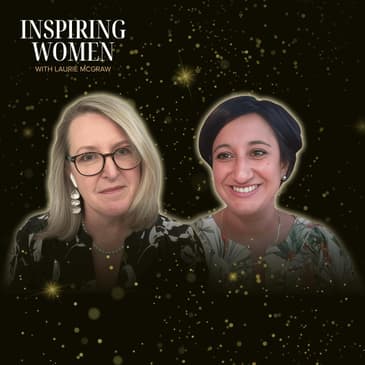

When Amee Devani watched her mother battle colorectal cancer in Kenya, she witnessed firsthand the stark reality of healthcare inequity. That experience would reshape her entire career trajectory—from investment banking at UBS to founding a digital health startup that's revolutionizing how hospitals manage post-acute care.
"I faint when they take my blood," Amee admits with characteristic candor. Yet today, as CEO and Co-founder of WellBeam, she's tackling one of healthcare's most persistent problems: the black box of care that swallows patients after hospital discharge.
This conversation with host Laurie McGraw reveals how a chance meeting on a Stanford cycling training ride led to a partnership that's now bridging the dangerous gap between acute and post-acute care. Amee and her co-founder Pascal—both Kenyans who met thousands of miles from home—shared more than a homeland. They shared mothers fighting cancer and a determination to fix a broken system.
What started as rejected startup ideas in Stanford surgeons' offices evolved into WellBeam after one crucial conversation with pancreatic surgeon Dr. Brendan Visser. His frustration was clear: exceptional inpatient care followed by total blindness once patients left the hospital. Fax machines. Phone tag. Patients bouncing back to the ER before anyone knew there was a problem.
Now, WellBeam serves as the critical infrastructure connecting hospital EMRs with home health, hospice, and skilled nursing facilities. The result? A 20-30% reduction in readmissions and millions in recovered revenue for physicians doing work they couldn't previously bill.
In this episode of Inspiring Women with Laurie McGraw, Amee also discusses:
- The unexpected value of "having too much fun" at Cambridge and how it shaped her leadership approach
- Why she left the prestige of investment banking and consulting to work out of a shoebox office in London
- How catching the "startup bug" at Pavegen prepared her for the healthcare innovation journey
- The importance of building a village of mentors, especially as a female founder in healthcare
- Why healthcare's biggest problems aren't glamorous—and why that's exactly where innovation is needed
- Navigating slow healthcare sales cycles while maintaining startup momentum
- Leading as a new mother and CEO: ruthless prioritization and trusting your team
Chapter Markers
00:54 - Introduction & Background
04:17 - The Stanford Connection & Finding a Co-founder
07:13 - WellBeam's Origin & Solution
11:28 - Business Model & Market Approach
14:06 - Leadership as a Female CEO & New Mother
21:39 - Advice for Aspiring Female Founders
Guest & Host Links
Connect with Inspiring Women
Browse Episodes | LinkedIn | Instagram | Apple | Spotify
[00:00:00] As I think about other early stage founders and female founders, there's a huge amount of grit and resilience I think that's required for the journey. And to say it is one thing academically to live it and breathe it is quite another. This is Inspiring Women. I'm Laurie McGraw and today I am speaking with Amee Devani and she is the CEO and co-founder of WellBeam.
[00:00:28] Amee, I'm excited about this conversation because for so long for digital health startup companies, there were few women founders and also importantly, there were fewer that were getting funded and being successful. That tide is changing. I'm eager to talk to you about it. Thank you for being on Inspiring Women. Laurie, thank you so much for having us this morning.
[00:00:54] All right. Well, let's get into it. Amee, tell us a little bit about yourself, you know, sort of like your background. It didn't start in digital health startups, but that's what you're doing now. You're an international professional. You've worked in many different countries, but tell us about your background and then I want to talk about well-being. Yeah, absolutely. I was born and raised in Nairobi, Kenya. So I'm from East Africa. And then I studied economics in the UK at Cambridge.
[00:01:23] So like a lot of economists, I followed a little bit blindly into financial services and I joined UBS and investment banking. And I think my early 20s were a little bit about trial and error in my career. I realized very quickly that I was not super inspired by investment banking. That was kind of a personal thing. I, you know, late hours, but I didn't find for me the work particularly meaningful. And so I made a switch.
[00:01:52] A foundation, a great foundation. Yeah, very good training ground. And then I switched to professional services with management consulting. And to be honest, the work was more varied, but equally over time, I found it also somewhat uninspiring. And I think looking back on it, it was really a function of as a consultant, I felt like I never really took the risk either of success or of failure of the project or the company that I was supporting.
[00:02:21] And so I joined an early stage startup in London called PaveGen. And it was founded by a design engineer, Lawrence Campbell Cook, who had this vision of a paving technology, which would generate electricity from people's footsteps. So as you walk over the paving slab, it would convert kinetic to electric output. Wow. And yeah, it's such a cool idea. And actually, so he was looking for someone who could help him commercialize that.
[00:02:51] And so we became a team and we operated out of a tiny shoebox of an office near King's Cross in London. But I had never had as much fun doing work and working those hours. And I think that was really where I caught the startup bug, where I realized my DNA was just geared towards building businesses. And I found the excitement and the unpredictability of it actually really, really enriching.
[00:03:19] It was also actually a hard personal time for me because that was when my mom was diagnosed with colorectal cancer. And we went through our first experience of the healthcare industry. And I think looking back, we were extremely fortunate that we had incredible healthcare and great surgeons and great medical teams. But equally, I come from a country, Kenya, where that's just not available.
[00:03:43] So that was really, I think, my pull up and reflection on where do I want to spend 12 hours of a work day? And what do I want to spend my energy and life doing? And I personally knew I could never be clinical. I faint when they take my blood. I'm just not made in that kind of way. But I have a skill set that can be applied to the support of surgeons and nurses and care teams. And that was really the origin of wanting to build a healthcare business and startup.
[00:04:13] And then I went to Stanford to try to explore what that might look like. So that's how today I've ended up building wellbeing. Well, that's a couple of jumps. Ami, I'm sorry to hear about your mother. And is she well? Is she? Yeah, thank you for asking. Yes, we are really fortunate that through really strong, as I said, surgical care and acute care, she came through well the other side.
[00:04:39] I would say it was also our experience of how the handoff between acute and post-acute care can really get dropped. In the UK, interestingly, there was no post-acute care. And so she caught an infection post-discharge with a stoma bag. So really, I think, again, where wellbeing sits today on that continuum of care, where we bridge acute to post-acute, that was also underscoring some of the importance of why I think that's particularly relevant
[00:05:08] and key for patient outcomes. Most people who come into wanting to do something with healthcare come from a personal journey, something, and it affects all of us in some way. That is a huge experience. And to take that and decide that you wanted to do something about it. But first, it brought you to Stanford. So tell us about that leap. Yeah, absolutely. So as I was thinking about business schools,
[00:05:37] I have to say one of my guiding lights was, I was a competitive cyclist, was where could I ride my bike in warm weather? California is a great place. Here's the criteria. Most people have different reasons for wanting to go to Stanford, but got it, biking. Biking is the number one criteria. In good weather. And so that's really kind of one of the core reasons I picked Stanford Business School. And ironically, I met my co-founder, Pascal, as part of Stanford's cycling team.
[00:06:07] So we were on a training ride and I got talking to a Kenyan and I recognized his accent right away. And I said, oh, you know, are you from Kenyan? There we were. It took us to meet each other in California, a long way from Kenya. And Pascal's journey and mine and our motivations have been actually very similar because his mom at the time was also going through esophageal cancer, so a different form of cancer.
[00:06:33] And that was where he was a computer science major at Stanford. But it was really where we sat down and we said, okay, we want to build something in healthcare. We're going to go figure out what we build now. What an amazing set of coincidences. Okay, so you're on a training ride. You meet somebody from a country that you both came from. You both have a very personal and large healthcare experience in your families.
[00:07:00] And Stanford is the, you know, the birthplace of so many innovations. So that brings us to WellBeam. So what is the idea and what is WellBeam? Yeah, so as we were, Pascal and I were, you know, unpacking what should we go build? We came up with various ideas of our own. And we, you know, at Stanford, one of the big things is this lean startup ideology. You test it in the market.
[00:07:29] You iterate on it. So we had gone with our ideas to surgeons, nurses at Stanford Healthcare. And very quickly, they had sort of shot down all of our ideas as not being that smart or that useful. And then we started listening much harder. And I remember being in the office of a pancreatic surgeon at Stanford, Dr. Brendan Visser, who actually has had a phenomenal impact on me personally and also on WellBeam.
[00:07:56] But he said, look, when I do these complex pancreatic surgeries, we provide exceptional inpatient care. And then as we discharge that patient off to home health care or SNF or hospice, we really just lose visibility into what's going on with that patient. They disappear into this black box of care. Our teams are still responsible for the oversight of that care. And yet we're dealing with managing that care through the fax machine.
[00:08:25] We're receiving orders on the fax line from home health that we have to authorize. We're getting phone calls sometimes from home health. But oftentimes we want to be able to see an image and we can't securely, through our IT infrastructure, see those images. And most of the time, those patients will be back in the ED even before we heard about anything. And I actually think that many people do not appreciate that there's still so many pockets of health care.
[00:08:52] I mean, fax machines, there's probably more fax machines in health care than there are in any other sector in the world, which is insane. You know, it's like that's a baseline that still exists. And the number of disjointed handoffs. I mean, I just happen to know that it still exists, but it shouldn't. It shouldn't. So how does well-being go about solving those problems? Yeah, absolutely.
[00:09:21] And in 2025, really, it shouldn't be the standard of care, especially when we're in this age of speaking about AI and really advanced technologies and we're still dealing with antiquated solutions. So well-being really sits as a mid-layer between an interoperability solution between acute EMRs, Epic, Cerner and others that are used by very large health systems.
[00:09:47] And then on the other side of the exchange, those partners that continue their patient care, so home health, hospice, SNF, they use a range of other EMRs. And so we see ourselves a lot like an international adapter plug that will integrate whatever the EMR is on either side. And then we're infrastructure in between that serves as that highway or that plumbing infrastructure to move key information over.
[00:10:15] So why that's important is when care is started by the next site of care, so a home health team, they will often still be requiring the following physician back in the hospital to manage and oversee that patient's care. And today, that physician without well-being will have to sign on paper, on FAGS, those care plans, those orders. And then his or her care team are fielding phone calls from post-acute teams. So instead of that being true,
[00:10:44] well-being allows for all of the information just to move seamlessly from one EMR to the other. And why that's important is it means that physicians are now able to quickly act on orders or clinical concerns and issues that are presenting themselves after discharge at the patient's bedside at home. So really, our purpose has been most importantly to improve patient outcomes and reduce those ED visits and bounce backs from after discharge.
[00:11:12] And then secondly, to optimize both revenue for the physician who's providing care, but not often able to bill for it because it's being done on FAGS. And importantly, optimize the value of his or her time and his team's time. Yeah. So, I mean, you know, in this world of digital health and health and care and all of this, you know, fantastic new options, technology, AI, I mean, you know, we, you haven't mentioned it like 18 times yet,
[00:11:41] but that's gotta be part of what you're doing. I mean, you're talking about gritty tech, the points in the middle that sort of make it all work. So who are your buyers? And by the way, how do you get them to be interested in well-being? Because you're up against a lot of, I'll just call it like super sexy, well hyped. And I, quite frankly, like there, there's so much that we're seeing move at a more rapid pace.
[00:12:08] How does well-being get the attention of what are really busy health systems or plans or whatnot? How are you, who are your, who are your buyers? How are you doing in terms of getting well-being implemented? Yeah, absolutely. You know, I think the truth about the, the non-beautiful truth about healthcare is that a lot of the really big problems are not very glamorous.
[00:12:32] And so I think like the data lakes, the ability to run algorithms and AI applications on top of things really rely on having plumbing and infrastructure and the ability to move data behind that. So our primary buyers, we lead by selling into health systems and their medical groups. And then we, we will build out their network of post-acute partners and their adoption around that.
[00:12:59] And so our sales motion has been really oriented towards the pain points and the value to health systems primarily. One of the key items, I think especially it was true during COVID. It's even unfortunately true now under the current administration when there's big question marks of where will reimbursement go and how are things changing? One of the main drivers is, is hard green ROI and, and the ability to build new revenue or,
[00:13:28] or to build revenue that they are not billing for today, but they are doing the work for. And so that's a, that's a key component here for wellbeing because physicians are doing this work today, but because on the fax line it doesn't automate the creation of the charges or the drop, the billing revenue. We now enable them to be able to bill right out the gate for services they're already providing.
[00:13:53] And then the benefits of driving, uh, 20, 20 to 30% reduction in ED visits and readmissions, the ability to optimize staff time, all of that then is just additive to the value that they receive. Yeah. Well, it sounds great, but I mean, I am so interested in sort of like you as a CEO and co-founder, you know, as a woman, and we're seeing, starting to see sort of like the tide turning for success,
[00:14:21] for people like you having that success. So as a female founder, as a, as a inspiring woman, how are you doing? How's the company doing? Yeah. Thank, thank you for asking. Um, I'd say I'm into even a new wave of that, uh, leadership as a woman, because I've just had my first child who's now four months old. So congratulations. Thank you. So I'm still drinking out of the fire hose and
[00:14:47] learning what it's like to be a female CEO. Um, I think there've been many lessons along the way. I, I would say that raising capital is harder for women has historically always been harder. Um, and I think one of my biggest takeaways is to really lean in to other, uh, CEOs, especially female CEOs about how they raise capital, what, what they learned through their journey. Um, most importantly for me,
[00:15:16] I think has been realizing that it's so important to surround ourself with other mentors and other female, uh, healthcare leaders. And I think there's been an old guard of female leadership and administration that got there with really sharp elbows and, and that's how they had to climb to leadership levels. But then there's another guard that have done so by kind of working collaboratively and learning from others and are paying that forward and working, uh, to support other female founders.
[00:15:45] And so truly, truly given there are really brutal sales cycle times in healthcare, it requires resilience. It requires us to be able to short track our learning curve, both of like the language, but also building our network of relationships of sales, contacts, et cetera. And such a big part of that as a female founder has been by building this village of, um, stakeholders, mentors, advisors
[00:16:13] that help to really kind of short track some of those learning curves. Yeah. I don't actually think there's sort of like, you know, there's two ways. I think there's infinite number of ways to successfully lead. And the thing that I see, um, and what you're talking about on me in terms of just, you know, being a founder, being a CEO is you're learning. You're, you're a student of it just as you're doing it. So if you were to describe your leadership style,
[00:16:42] what's working for you and, uh, in terms of what you're doing today, then what you might've even been doing a year ago. Yeah. And it changes. It's, it's, it's a dynamic journey. I think that's very true. You know, a couple of years ago when we started wellbeing, we were very scrappy. The hustle was real. The hustle is still real, but hustle is always real. You move fast, you break things,
[00:17:08] you, you try out different ideas, you're willing to kill them very quickly. And, and, and that's kind of the mindset. And, and as a founder, you're much more in the business than you are on the business initially. I think, um, I I'd say that starting to really change because as you grow, you just can't be in the business in the same way. Um, and for me, one of the biggest takeaways is to really hire well, and we're very careful with our hiring. I think that's one of the key things
[00:17:37] of how we run wellbeing, which is we run ourselves fairly lean and try to do it based on fundamentals. But as a result, every hire we make has to be a really strong hire. And then if you believe that you've run a really strong hiring process, there's a component. And now I'm, I'm really learning to lean into, to lean into this is, is learning to let go because you have, you have people who are frankly more skilled, more experienced, better at what they do than you're going to be. And so trusting that as
[00:18:06] long as you set up the guardrails that you're setting up, um, the goals and the QBRs and the OKRs of what you're aiming for, that frankly, the people that you have are going to be able to set the, how to get there much more effectively. Um, and so that's today, I think one of the key components of how I hope to lead us is really letting team members have that autonomy. But also one of the biggest takeaways is we've had much greater outcomes. We're at a company offsite
[00:18:34] currently when we come together and we collaborate and we brainstorm, um, face-to-face frankly on, on key problems. And so I think building an organization where the teams, although largely we're remote are still able to come together and work really in a multidisciplinary way to augment that brain power that we put into problem solving, I think is really more effective. Yeah. Well, I mean, I'm so excited about, um, just, you know, what you're doing and also as a new
[00:19:04] mother, you know, that you're still leading and charging ahead, hustling, you know, for your company. So, and this is, you know, look, I think the days of sort of balance, uh, you know, I hate the work life balance question that women, um, often get because I just believe you don't probably don't have any balance. Um, however, I am curious, um, how you are being successful as a CEO and as a new mother
[00:19:31] and how you think about it, what might've changed in terms of your leadership style that's allowing you to be successful? It's probably been one of the hardest transitions I've made professionally is, is becoming a parent and managing, uh, running the company still as a CEO. I think before it was, you know, work all hours as needed weekends, whatever was necessary to move things forward.
[00:19:58] And now, uh, with, with a baby, that's just not possible. And there's also the component of it's unpredictable. And so where you could really structure your day and your time before it, it's not, it's really not the same. I think, um, as I'm sure other moms know, one of the key things is just being really ruthless with how you prioritize and what you, what you determine is the most critical thing for the company at any one time and making sure that where before you might have spread yourself
[00:20:28] thin across a range of items or subjects. Now, now just being really focused on what moves the needle, um, for the company and, and doing that. And then the second really is back to what I was saying earlier is ensuring that you've made really strong hiring decisions. You've got a good team. I believe we've got a great team. And then, um, just seeing them shine, frankly, where you start to realize I'm not as good as this, as this other person is and letting them run with that autonomy,
[00:20:56] um, to, to whatever the assignment, whatever the task at hand. So I think those have been two of my key takeaways, which is be really ruthless with prioritization and focus. And then secondly, have very good staff that are able to keep the ball rolling as well. And then finally, actually, I think just as I reflect on the culture and the cultural discussions we've been having as a team is recognizing that, um, as long as the work gets done, how it gets done as a team is also less
[00:21:25] important. So I think that's really important because everyone is juggling family priorities and allowing everyone the flexibility to achieve a deliverable the way it works for them is also really key. I think those are really, really strong, um, you know, ways to sort of like keep the, we need to get the work done. It can get done ugly. Okay. As long as it gets done, we're good as we balance those things. I mean, as we close out on this inspiring women conversation, I mean, you've
[00:21:55] been through quite the journey, early startups, you know, investment banking, all that learning that's come into building a successful company. Where do you see yourself going next? And the last closing advice you might have for other aspiring female CEOs and founders, what do you have for them? I'm very much, uh, committed to the journey here at WellBeam. It's taken us a few years of grind and
[00:22:22] healthcare, slow healthcare sales cycles to really start to see this hockey stick now that we're, we're experiencing. And so for us as a company, this is our most exciting year since founding. Um, so I'm just thrilled to be on the journey. I think, as I think about other, um, early stage founders and female founders, that there's a huge amount of grit and resilience. I think that's required for the journey and to say it is one thing academically to live it and breathe it is
[00:22:52] quite another and, and kind of really double checking that you have that in the tank is, is quite key. But secondly, it really does take a village. Um, and so surround yourself by people that have gone before you and built startups. I have a great network and, um, of other CEO founders who are further along than I am. And I lean on them nearly every week. Um, and just the how to,
[00:23:17] how did you deal with, what does this look like type questions? And equally from a healthcare perspective, building like the administrative leadership network as well, so that you can short track all of the learnings, um, uh, that are needed for the journey ahead. So I think those are a couple of the main statements. Then finally, do something you love because you're going to get out of bed some days and it's going to be really hard. And so you've got to really love what you're doing and
[00:23:43] spending your 10 to 12 hours a day doing. Well, I am wishing you nothing but continued success as you build this company. And this has been a really wonderful, um, inspiring women conversation. I've been speaking with Ami Devani and Ami, thank you so, so much. Sorry. Thank you as well.