
What if the same data that helps sell cereal could also save a life? Kathleen Ellmore asked that question long before most people thought to—and long before healthcare caught up. With roots in consumer marketing, she was using behavioral science to influence buying habits when the term “micro-segmentation” barely existed. But when she stepped into healthcare in the early 2000s, everything changed.
As the mother of a daughter with cerebral palsy, Kathleen knew what it felt like to navigate a system that didn’t see her, didn’t remember her, and didn’t connect the dots. Kathleen’s daughter needs a wheelchair. She recalls all too well the months of time it took to get the right approvals for the appropriate wheelchair her daughter needed. Until something happened, a changed job, a new insurance plan, and then being told she would need to start the many month process ALL OVER again. It is hard to hear this story without feeling the agony of this mother for her child.
This proverbial straw led to this realization: data wasn’t the problem; disconnection was. That moment became the heartbeat of Kathleen’s work.
She began applying the tools of influence not to sell more products, but to build trust. Her early experiments, like discovering that a male voice on a robocall led to an 86% increase in screenings among Hispanic populations, proved that small shifts, driven by empathy and insight, could drive massive impact. It wasn’t about big data; it was about meaningful data.
Today, as cofounder of Engagys, Kathleen is leading a new era of engagement—layering AI on top of decades of behavioral science to ensure health plans don’t just reach people, but truly connect with them. For her, AI is not a shortcut; it’s a tool to scale human-centered care. And while others chase automation, she remains laser-focused on trust.
You’ll also hear from Kathleen on:
-
Why most health plans already have the data they need, but fail to use it meaningfully
-
How behavioral science can transform call center scripts into trust-building tools
-
What it really took to launch a profitable consultancy—no funding, no incubator, just mission and grit
-
How Kathleen balances technical innovation with ethical guardrails in a system under pressure
This conversation isn’t just about data. It’s about care, courage, and what happens when you decide to build something better because the system failed you.
Chapters
01:52 Applying Consumer Marketing to Healthcare
03:04 Building Engagys from the Ground Up
06:32 Trust, Data, and Personal Motivation
11:00 A Mother's Experience with a Broken System
13:10 AI, Behavioral Science, and Human-Centered Care
20:00 Leadership, LinkedIn, and Advice for Founders
Guest & Host Links
Connect with Inspiring Women
Browse Episodes | LinkedIn | Instagram | Apple | Spotify This episode of Inspiring Women was recorded at the WBL Summit, a leadership, networking, and professional development conference for WBL members that takes place each spring.
WBL is a network of 1500+ senior executive women in healthcare who convene to share ideas, make valuable connections, and solve business challenges. WBL’s mission is to connect and support our members in advancing their careers and impact on our industry.
[00:00:00] Too many times you're getting communications from your health plan that says, dear member, here's our smoking cessation program and you've never smoked in your life. Right? And so that becomes noise. You stop trusting what they're saying.
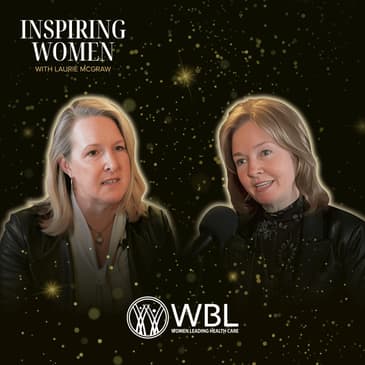
[00:00:16] This is Inspiring Women. I'm Laurie McGraw. I'm speaking with Kathleen Ellmore this morning, and she is the co-founder and partner at a company called Engageus. And we're going to talk about that. And Kathleen and I have been longtime members of WBL, where we've gotten to know each other a little bit. Kathleen, thank you for being on Inspiring Women. Thank you for having me. All right. Well, here we are. We wore matching outfits. So like, thank you for the color coordination. I appreciate that. That's awesome. Kathleen, let's start with what you do and how you got there.
[00:00:45] Sure. So I started my career ages ago at companies like Procter & Gamble and General Mills. Yep. Like to say, I was getting you to eat when you weren't hungry and buy things you didn't need. I came to health food. Wait, what? That's hysterical. I mean, all of the behavioral science, targeting, segmentation, A-B testing that they're using to get you to do things. When I came to health care in 2005, I said, how are we not using all those same great methodologies to instead get you to engage in your health? But it was still pre-ACA.
[00:01:13] I landed at a company that let me do just that. We launched a billion consumer interactions across 12 years using A-B testing and very quickly peeled back what works for which individuals to drive which actions. And as you can imagine, Lori, it gets personal fast. Yep. So let's just stop right there because if that's 2005, I mean, you know, I remember the days of 2005. And I think we all know a lot about digital marketing and behavioral change with digital marketing.
[00:01:41] But 20 years ago, that wasn't sort of like everyone's understanding. And we've all learned it. You know, we've learned about algorithms and everything else. But you were doing it 20 years ago. We were doing it kind of the old-fashioned way, digging into the data, looking at Excel spreadsheets. I'll give you an example. We were recognized by NCQA for moving the needle on colorectal screenings for people of Hispanic descent. Okay. So first we went into the data and said, who's not, you know, responding to the message?
[00:02:09] We look for the attributes that keep that segment, you know, kind of look for things that tie that segment together. Turns out most people were of Hispanic descent. Yeah. Then we started testing and learning. And it's interesting because we tested male and female voices across all ethnicities. Most ethnicities, the female voice wins. This was an automated call, the quintessential stereotype of the nurse. In the Hispanic population, people, the male voice won and it won by 86%. Okay.
[00:02:36] Not just saying they were going to get the colorectal screening, but went and got it. So when you think about those levers, how specific they get, and that was on ethnicity, we've seen differences in old versus young, condition specific, psychographic. So it's really important to really kind of continue to peel back what's working. Even when you see what's working for an entire population, there'll always be a segment that you could do better on. Right. A micro segment. Exactly. Okay. And so then what happened?
[00:03:06] So then that company got sold. We broke off, started a consultancy about eight years ago. I'm super proud to say we serve five of the top six national health plans, many blues, regionals. Who's the way? Myself and my partner. He and I met at the last company, Silverlink. Okay. Joel Radford. We broke off. Once it was sold, it was sold a couple of times. The first time was WellTalk.
[00:03:29] And so we help, you know, healthcare organizations, including health tech, because as you know, just because you build it, consumers don't come. So everybody needs better engagement and experience. Okay. So let's go back to the eight years ago starting the company. And even though you've been sold a couple of times, it's not quite obvious for people to go and just start companies. So in terms of doing that, Kathleen, what was that like? Was that a hard decision? Was that a, oh my gosh, this is so easy.
[00:03:59] We can absolutely do it. I mean, those are funding. You need capital. Like what were the, what was the decision? Did you go through an incubator program? Everyone goes through incubator programs now. You know, it's so, I'm so glad you asked that question, Lori, because I think we were just so naive. I'd never started a company before. I'd been at this startup that I watched the founders, but they made it look easy. So my partner and I, I think if we knew then what we knew now, you know, it's not for the faint of heart. And I started it a little bit older than many people.
[00:04:26] We were bootstrapped from the beginning and kind of, you know, profitable from the beginning. That's, but that's consulting services can do that versus tech. Okay. That's kind of amazing. Thank you. And then I think it's like, you know, picking the right partner. He's someone that doesn't mind getting into those like really nitty gritty details of which cybersecurity insurance should you have? Which, you know, kind of how many, you know, Salesforce licenses do we need?
[00:04:50] And, you know, what extra software subscriptions should we have to keep this company running? So people are giving you data right from the very beginning. So, I mean, that's a lot of trust that they place in you. We are now ISO certified, but at the beginning we just took de-identified data and worked on their instance. Yep. Yep. That still requires, you know, a lot of trust in your capabilities to do that. So how did you get your first customers?
[00:05:16] So we went to a conference together and we landed a very giant, you know, organization. Did you know them? I mean, did you have the relationships already? We did not have the relationships already. The second big client, we did have the relationships. And that also felt like the dog that caught the meat truck because at the time we were two people. We recruited a woman that we'd worked with in the past, met her at a coffee shop, told her what was happening, brought her into this national, you know, top five plan. And we were taking notes like crazy.
[00:05:44] And we left there and they both said, we have no idea what's going on. I'm like, I actually have this one. We're going to do this and we're going to do it great. And so we've stayed in that plan ever since that was 2018. So what are some of the types of behaviors that you're driving? So, you know, like now we think about like what is possible with these levers. It's not always positive. I mean, there's a lot of downside. People are very concerned about risk. People are also concerned about like targeting incorrectly populations.
[00:06:14] And we're also worried about how much data people actually or organizations actually have about us. So tell me how you sort of like square those circles, how you place sort of the center of trust in terms of what these organizations need to have. And are they ever asking you to do things that you just don't think is right? Those are great questions. So I started out, this is kind of mission driven for me, Laurie. I have a daughter who was born early. She has spastic quadriplegic cerebral palsy.
[00:06:43] And so I like to say that I'm not just a healthcare consumer expert. I'm a healthcare consumer. And so I look at the experience from what I as a consumer would love as I'm navigating this complexity day in, day out. And one of the things about sharing data is consumers need to know that there's a reason that you're asking for it and that you're going to deliver value back with that data. Too many times you're getting communications from your health plan that says, dear member, here's our smoking cessation program and you've never smoked in your life. Right?
[00:07:12] And so that becomes noise. You stop trusting what they're saying. And without trust, if I ask you to go use the strip model for colorectal screening instead of the system, you're going to say, I'm not going to listen to you. So it's starting to build up that everyday interactions that are valuable to consumers. And that's how we start with, you know, slowly but surely building the trust with consumers. But also when we show the results of what this looks like, then the plans say, I get it. I want in.
[00:07:39] But there's also a couple of things to think about, you know, if you're a health plan or a system. In many cases, people are trying to sell you outside data. You don't need that. You have so much data in your four walls. At Betty Crocker, I would have killed for this much data on my consumers. That you have all the data you need to drive behavior, but you're squandering it.
[00:07:59] So you need things like building a longitudinal repository of everyday interactions so that instead of thinking about a next best action on a plan level, oh, I'm near the cut point, right? I mean, that's the way to get started. But then you get to the point where Lori has a history of kidney disease. Do I send her the colorectal screening reminder since we're near the cut point? Yeah. Or do I send her the... Well, what's a cut point? Oh, sorry.
[00:08:24] For the stars, when you're managing your stars portfolio, you're trying to hit certain points. And so if you're close to kind of a threshold where you're going to jump into that next star range... Which is based on quality scores. Exactly. Okay. So just like literally give you wouldn't mind going through it. And I want to get back to your daughter, by the way. Sure. That's an amazing story. So, and obviously your why. So I'm curious about that.
[00:08:50] But the cut points, like what are you actually looking at and how do you get to a next beyond the cut point? Sure. So we often start with looking at the past stars data that plan has. And those stars data are made up of caps, which is a satisfaction score that consumers take surveys on. The HEDIS measures, which are quality measures, things like did they get their gaps in mammogram, colorectal screening? Are they taking their medications?
[00:09:17] And then the final area that we focus on is also is called HOSS, which is a health outcome survey. Things like falls prevention, physical activity. All things that all the plans have. And it's extra important for the Medicare Advantage plans. Okay. So when we first start with a plan, if we're talking to the quality folks, we look at where their opportunity areas are. Yeah. And we'll start talking to them about, we see that you have challenges in mammogram. Let's talk about what you're doing, who the folks are that aren't responding.
[00:09:47] Is it a, sometimes that's a contact data. If you're talking to, you know, a group that has, you know, low income sometimes or transient populations, sometimes they're having trouble even reaching the consumer. Right. Nevermind the consumer hearing your message. How do you solve that? That is, I mean, that's, that's a very difficult problem to reach people where they are. Absolutely. There's different tools and technologies out there. In one case, we were helping a plan.
[00:10:11] We hooked them up with an e-prescribing software company that could get them data through the refill data. We've hooked another firm up with cell phone data. Sometimes the prepaid phones, you can match numbers to consumers and that's a way to go about it. One of the biggest areas that people don't use to their advantage is caller ID. Okay. You can work with companies that help your caller ID say certain things.
[00:10:39] So instead of just being a number that says it might be spam, it can have a beautiful logo of your health plan on it. So at least you start the call with better trust. Okay. That's interesting. Yeah. In terms of that data, that goes back to the actual personalization, micro segmentation there. Let's go back to your daughter, Kathleen, because that's obviously such an important part of your life. How is your daughter? She's fantastic. Thank you for asking. She's graduating college this year. Oh my goodness. Wants to go on to law school to be a disability advocate.
[00:11:09] Thank you. How exciting. How exciting. But you've been in the healthcare system with your daughter as her mother. And so how have you experienced this sort of personalization or lack of personalization for the care that she's needed? Absolutely. I mean, forever we would get letters that felt like everything was a one-off. You'd call the call center about something. And then, you know, a month later you'd call back or, you know, if things weren't resolved,
[00:11:37] you'd have to tell your whole story over again. And so there was one day that I called like two months later and I was blown away because they actually had the notes from the last call and we could kind of pick up where we left off. But it seems like... It seems so simple and so obvious. And yet that's a remarkable experience. Absolutely. And another story that I've actually never told Lori is it takes about nine months to get a wheelchair. And so we started in March. The time that you get fitted, it's a, you know, it's a giant machine.
[00:12:06] And so they fit it to you specifically. It goes through massive approval processes because it's expensive. Then they actually build it. So you start in March and it was supposed to be delivered in December. One thing led to another. And then a snowstorm hit. They delivered it January 3rd. Well, my husband worked for a large telecom company and through no fault of his own, they decided to switch plans. And so the plan that had gone through all the approvals was no longer our plan.
[00:12:32] And the plan that, you know, we had when the wheelchair came, that's when they do the billing. And they were like, we didn't approve this. Oh my gosh. And I was like, can you guys talk to each other? So in the end, it was fine. But it was one of those moments of like, how can this be? Oh my gosh. Yeah. Oh my gosh. That must've been frustrating. Frustrating. Cause it's her legs. So if we had had to start over for another nine months. Oh my gosh. Yeah. That is incredible. That's incredible. Okay. So let's go back to Engage Us.
[00:13:01] So in terms of, so eight years of doing this, what's changed in those eight years in terms of what you're able to do now? Are you using AI at all? Tell us about that. Absolutely. So we built a RAG, we built an AI tool using a RAG model that sits on top of your typical. What is a RAG model? Thank you. It stands for retrieval augmented generation. Okay. And it allows you to do those, use those large LLMs, chat GPT and open AI in a much more directed
[00:13:31] sort of way so that you don't get hallucinations. You don't get data that you don't need. You don't get the wrong outcome. It actually kind of builds, the way we use it is it builds the best practices of engagement in. So as it pulls the data and information and content from there, it knows the rules to make that content much better. Because what happens is if you use open AI or chat GPT, it's non-verticalized information. Yeah. And so it'll take the best practices to move behavior across industries. Yeah.
[00:14:00] And there's a famous example that when Dana Farber used an AI tool to generate a subject line, they wanted an oncolorectal screening. And the AI tool came back with Miley Cyrus loves cancer, 10 reasons you should too. Oh my goodness. But they used what? Right? They used celebrity. They used listicles. Yeah. Right? And so pulling from the non-verticalized information can be filled and rife with bias, problems,
[00:14:28] you know, things that are not going to move behavior. Or don't make any sense. Exactly. So sometimes we have folks using that. Other times we help them train their own retrieval augmented generation models so that they can build those best practices right in from the start. Yeah. We're doing work with helping call centers adopt more AI for kind of prompting the agents of what to say and how to say it with behavioral science. Yeah. So things like if I were a care management nurse reaching out to you and you said, oh, no,
[00:14:58] now's not a good time. Yeah. If I said, great, I'll call you back. That's one thing. But if I said, I will hold a spot for you Thursday morning at 8 a.m., this is your spot. You're much more likely to actually call for a few reasons. One is ownership. Yeah. You own that spot now and loss aversion is real. Two, you've actually now have reciprocity because that person's doing something for you. So you feel obligated to then make sure that you do something back by showing up.
[00:15:26] So it's those types of things that we build into everyday interactions. So I'm hearing the behavioral science. I'm feeling like, oh, my gosh, am I lost of aversion now when I'm taking this action? So let's talk about at what point do we not need you and engage us to do these things and the AI will just do it for us? Are we anywhere close to that? We're not close to it yet, partly because we're still sometimes in worlds where a plan
[00:15:55] might have 30 percent of their communication preferences with a consumer. And preferences means I get to work with you digitally or I get to send you an email or I get to send you a text. Like we're still kind of in our infancy of really driving optimized engagement, but I'm bullish for the future for a few reasons. One is many plans are building or buying a consumer data platform, which will allow them to house
[00:16:20] all of Lori's interactions on a member centric basis so they can truly figure out, great, what's that next best action and someday automate and trigger it. For instance, if you call the call center three times without resolution, immediately a love message should be triggered and say, Lori, we didn't solve it. Do you want to talk to somebody who's our troubleshooter? Those kinds of things will be in our future. And how do I know that? Because American Express and Capital One and everybody's been doing those kinds of things
[00:16:49] for a long time now, you know, non-AI powered to now AI powered. But it's really about servicing that consumer in a way that's very personal. Yep. Okay. So promise me, Kathleen, that we're not going into a space of the, you know, just the bad part of all this micro segmentation and all this optimization and understanding what, you know, triggers me to take an action.
[00:17:16] So how do you coach, advise, and ensure that those negatives? Because that can destroy a brand. And so when you are trying to optimize to help a brand, you also know that you can destroy it. Not you, but that these algorithms can go in the wrong direction and create, you know, real problems for the, to the person, but to the brand.
[00:17:40] I mean, people with these algorithms, you know, we have seen brands be impacted from social media and be targeted in kind of ways if they make a mistake. So how do you not make mistakes? I love that you brought up brands, Lori. It's such, we have such a lack of brand. Like if you were to ask consumers what one health plan stood for versus the other, what's the one word you own a consumer's mind? You know, they're non-differentiated right now and they have to find a way to differentiate.
[00:18:07] And your idea of how, like, will that ever, you know, you hope that no one squanders what could eventually be amazing trust. And the reason I say that is that we, you know, health plans and healthcare has a better opportunity to become connected and tighter with their consumer than even their Apple iPhone. Why? Because my health should be much more important than my screen, you know, flat screen TV or my sneakers. And so if they're not thinking about it that way, then they're missing the whole point. Right.
[00:18:37] So when you think about things like, you know, driving steerage, asking a consumer to go to a cheaper screening area, there has to be something in it for them. It should be, hey, these three are convenient to you and they're covered by your plan and you might save on the co-pay. Do you want to click here and schedule now? It shouldn't just be go do this. And then as far as the AI taking over the machines or, you know, the machines taking over, AI is great in efficiency.
[00:19:04] It's great at the tools helping to kind of prompt what to say, but that what to say by the call center reps and through the communications that are going out should still always have a human in a loop until it gets much more involved. Yeah. Well, I think that just, I mean, you know, I think a lot about it in terms of the work that I do about health and care, higher quality access and making it easy and using the tools
[00:19:29] that you're talking about and the guidance to build trust for the right outcomes. I mean, it sounds amazing. And I'm so glad to know that you are paying a lot of attention to the, you know, the possible negatives that are out there too, because those are, you know, they happen fast and with the algorithms, they happen at scale. So like avoidance of that is just fantastic. Kathleen, let's go back to leadership. We're both WBL members. We're here at the WBL annual
[00:19:57] summit here in New Orleans. Why are you a member? Lori, I love that you said that. I love women promoting women. A little side thing that you don't know about me. I do it for free just because I love it. It's my way of giving back is I often coach women that are in transition or looking to, for the next chapter on how to optimize their LinkedIn. And so I just, I gained. Oh my gosh, because you know everything about how to
[00:20:22] optimize these tools. You need to help me. I love it. Exactly. So I just get so much energy. It fills my bucket, you know, to come here and be with all these amazing, powerful women that I look up to, learn from, connect with. So it's such an amazing organization. So as a leader, as somebody who has built a successful company, you're working with the largest, many of the largest health plans that are out there. You've been profitable for eight
[00:20:49] years, which is amazing in starting a business. For others who are looking to start out, build their own businesses, what's your advice to them? Find the right partner. Again, we kind of are, you know, compliment each other in the kind of the things that we like to do when we're good at. So that was great. Surround yourself with people that you trust, because especially in consulting, you know, they're the face of your organization. Client service is so important. You know, build relationships
[00:21:18] with your clients because that is your gold and try to have fun. I wake up every morning excited about driving consumer engagement and experience. I can't quite turn it off. It shows. Thank you. It jumps out of bed. So if you love what you do, it kind of makes it easy. That is awesome. That is awesome. This has been a great inspiring women conversation. I've been speaking with Kathleen Elmore and Kathleen, thank you so much. Thank you, Lori. I want to ask you all the same questions. All right. Thank you.