
"Who mentors the mentors?"
"There's no such thing as a cold call in WBL."
"How can I help you?"
These powerful mantras echo through the halls of Women Business Leaders (WBL), the longest-standing executive forum for women in healthcare leadership. And for our landmark 200th episode of Inspiring Women, we're going back to where it all began.
Twenty-five years ago, Lynn Shapiro Snyder found herself one too many times as the only woman at the decision-making table. Instead of accepting this reality, she picked up the phone and made 60 cold calls to the most influential women in healthcare. One by one, they answered with a resounding "yes." And WBL was born.
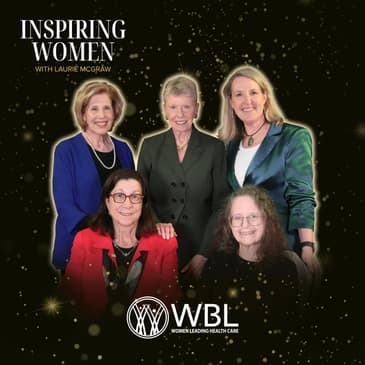
Join us for an intimate conversation with the visionaries who started it all: Lynn Shapiro Snyder, Jeannine Rivet, Carrie Valiant, and Marcia Nusgart. With candor, wisdom, and plenty of laughter, these pioneers share how their initial gathering evolved from a one-time retreat into a powerful network that has elevated thousands of women into leadership positions.
When women lead, we create a more just and equitable society—full stop. And today, WBL's mission remains as vital as ever.
This 200th episode isn't just a milestone; it's a love song to trailblazing women everywhere—those who stand tall, who lift their voices, and who use their power to push, guide, and pull us all forward.
Join us for this celebration of legacy, leadership, and the sisterhood that continues to transform healthcare and beyond.
Chapter Markers
01:09 How WBL Was Born from One Cold Call
04:01 Planning the First Retreat—and Why It Almost Didn’t Happen
10:32 Saying Yes to Something Bigger Than Yourself
17:56 The First Summit: Envelopes, Oprah Moments, and Self-Promotion
29:33 Why WBL Matters Now More Than Ever
34:52 What WBL Has Meant to Us—Founders Reflect
Guest & Host Links
-
Connect with Laurie McGraw on LinkedIn
-
Connect with Lynn Shapiro Snyder on LinkedIn
-
Connect with Carrie Valiant on LinkedIn
-
Connect with Marcia Nusgart on LinkedIn
-
Learn more about Jeannine Rivet, RN, MPH, FAAN
Connect with Inspiring Women
Browse Episodes | LinkedIn | Instagram | Apple | Spotify This episode of Inspiring Women was recorded at the WBL Summit, a leadership, networking, and professional development conference for WBL members that takes place each spring.
WBL is a network of 1500+ senior executive women in healthcare who convene to share ideas, make valuable connections, and solve business challenges. WBL’s mission is to connect and support our members in advancing their careers and impact on our industry.
[00:00:00] What was really interesting is that we realized that you needed to do the work, but once you got there, you exhaled and you looked around the room and you said, oh my goodness, these women are just like me. And they're women business executives that I have a lot in common with. So what was so amazing is that you're working and you just have tunnel vision.
[00:00:22] This is Inspiring Women. I'm Laurie McGraw. I am here with the founding members of Women Business Leaders that was founded by the Lynn Shapiro Snyder. And back in the year 2000, she noticed that she was one of only one women at many important tables and that bothered her.
[00:00:46] She made 60, 6-0 cold calls to other powerful women that she noticed were out there in healthcare. And she asked them, what if we started to bring each other together? And there the idea for Women Business Leaders was formed. I'm here with Janine Rivett. I'm here with Carrie Valiant and Marsha Nuskart. And they are the founding members of WBL. Women, thank you for being on Inspiring Women. Thank you for having us.
[00:01:14] We are so excited for this conversation. It is going to be accurate. You know why? Because Lynn makes us be accurate. She's a stickler in this way. But maybe if we can just go back to that year 2000, the first meeting in 2001. What were you doing then? What were you doing now? Janine?
[00:01:35] Great. Thank you, Lori. And thank you, Lynn, for what you started. I was CEO of UnitedHealthcare at the time in 2000 and 2001. And it was definitely a cold call. I did not know Lynn. And when she said Epstein Becker, I thought, are we in trouble? But I thought, no, I'll learn a little bit more about what's going on here.
[00:02:01] But it was a cold call. And she did indeed have an organized discussion with me. Carrie, what about you? So I was doing exactly what I'm doing now, which is being down the hall from Lynn, practicing health law and just doing my fraud and abuse thing, partner, DC law firm. And Lynn had this idea, which was wonderful, which was just wonderful.
[00:02:31] And here we are today. And Marsha. I've known Lynn for many years, both on a professional level as well as a personal level. And she knew me through my work in being the CEO of the Alliance of Wound Care Stakeholders. And we also collaborated on an alliance for Hicks-Picks Coding Reform. And there we go. There we go.
[00:02:57] I am very lucky in still doing that in this area. So, Lynn, what were you doing then? And what are you doing now? Well, at the time, I had become one of the senior members of the firm. And I'm still at the same law firm practicing health law down the hall from Carrie Valiant. I do reimbursement and the fraud and abuse.
[00:03:24] But I just celebrated my 45th anniversary at Epstein, Becker & Green. And that's what I'm still doing. It's still in strong. Still drives you. Lynn, just take us back. Take us back to the year 2000. It's hard to believe that that was 25 years ago. But take us back to where this idea came from. And that's a lot of effort that you put into something. And it's hard to imagine that this didn't exist.
[00:03:49] But Women Business Leaders is the most prominent organization for senior executive women in health and care. That is a fact. But you created it. What was the idea? Well, thank you for the comment. So, in the year 2000, a group of the leadership of the Epstein-Becker health law practice went off-site to a hotel room to talk about, do we have the right lawyers or do we have the right offices?
[00:04:17] And I said, well, you know, the women are taking over the health care industry. I was the only women lawyer in the meeting. There was a woman staff person, but all the rest of them were my wonderful male colleagues. And Steve Epstein, to his credit, said, I think you're right. What are their needs? What do they need to do? And I said, I'm going to go find a place where I feel comfortable to see if they have the same needs I have, which is to get together and know each other.
[00:04:47] And I went to all these different women's groups. It took a while. And nothing resonated with me. Either the women were only from the hospital industry or it was senior women, but they were not from the health care industry. And I just took a pause button for a second. I just had a bar mitzvah of my middle child. I said, oh, I could throw a party once a year. We'll get together. I have a hotel.
[00:05:17] I have a photographer. I know the DJ. And we were just going to have a party. And then as I was planning this, I said, well, you know, it's a lot of work. And we had an advisor come in to check on what I was doing. I think Steve Epstein was a little nervous, like, what is she doing down there? And she said, if you're going to make all that effort, why don't you incorporate a 501c3? There may be companies that want to support this.
[00:05:47] It sounds like a good idea. And so I created a database of a lot of names and I narrowed it down to about 60. I wanted different sectors. So I had, for example, EDS from the IT side. I had United Health Group from the payer side. I had Pfizer from the life science side. All different sectors.
[00:06:14] And I had the hospital and I just, I created a speech. I wrote it down. And in those days, you wanted to get past the secretaries who would answer the phones. So I chose after five o'clock, I wrote, I said my voice. I left a voicemail message when we used to pay attention to a voicemail.
[00:06:38] And it was like between December 15th and December 20th when maybe I would hit them live. And I reached out to about 60, about 40, said, what a great idea. And about 30 something showed up. And we had a Tuesday night networking dinner. Wednesday was 11 to 4.
[00:07:04] And after that, we had a Wednesday night networking dinner in case the women wanted to stay and talk to each other. And at the steering, that's the steering committee. At the steering committee meeting, when they first walked in, I had the table set up so they could all see each other. And there was an envelope in front of their desk.
[00:07:25] And I had anticipated who should sit next to whom and what the envelope should say they should talk about to each other, not to leave chance that they wouldn't talk about something strategic. It was all business related. Right. I do remember I had Janine sit with the woman from Pfizer. And so they come in. They don't know each other. And I said, open your envelopes. And they open their envelopes and they start to talk to each other.
[00:07:55] And then they keep talking to each other. And then I couldn't shut them up. Yeah. I couldn't get them to stop talking. And then they finally stop. I was in the middle at a little table, like I was Oprah Winfrey in the middle, like an emcee. And I turned to them and I'll never forget. I said, that's the value proposition. Right there. Right there. Day one, envelope one. Right. And then we were going to have this summit.
[00:08:24] I used the Epstein-Becker relationship at a hotel, Lansdown, outside Dallas Airport. We were all set to go for October. And people put on the steering committee were in the margin of the stationery so people could see all the names. And I was faxing U.S. mail, getting the word out. We were going to have, I think it was seven Epstein-Becker partners were the facilitators.
[00:08:52] My daughter in high school was the registration desk with my secretary. Steve Epstein was going to be the closing speaker because I couldn't afford speakers. And 9-11 happened. And I was on the hook for a hotel contract personally.
[00:09:10] And I was so grateful to the Hotel Lansdowne to allow us to move the summit until the airplanes were flying at National Airport again because National closed for a long time. Dulles reopened quickly, but not National Airport. I didn't know that piece of it. I didn't know about that time frame. Yeah. And so it was to our greatest fortune that it became March. And March was the right time to do it.
[00:09:39] The last quarter of the year is not a good time to have these types of meetings. You know, the new year starts, people have their plans, they need a little break before they get into second quarter. It's just the right time of the year for us to invest in ourselves. And it's Women's History Month. So it also happens to be that. Janine, I want to go to you. So in that time, you know, back in the year 2000, you didn't know Lynn. You got the call. You took the call.
[00:10:08] What interested you about this idea? I entered the call. I know. You certainly did. You were also really busy. As a CEO of United, that is an amazing responsibility. We can all imagine how hard it was to be in that position and what that says about you personally and professionally. But you took the call and answered the call. Why? Well, it was compelling. It was trying to bring women together.
[00:10:35] And there weren't a lot of senior women in health care at that time. And you started with pharmacy because you knew a lot of the lawyers, the general counsels. And I happened to do a lot of work with pharma. So when you connected me with Pfizer, we had a lot in common already. So that was really helpful. I had to think about it. One more thing on my plate that takes me away from my family was a choice I had to make.
[00:11:05] And initially, we were talking about doing a lot of things. And I said, I can't do a lot of things, but I can do some things. And if we start with some—well, and I think it was called a retreat, actually, not even a summit at the time. And then you can add into that webinars or whatever, then I can make some of that. But I just can't commit to everything. And I think that was the case for many of the women that were in that advisory meeting.
[00:11:33] It was the same thing, finding time for one more thing, particularly to be in person, because we weren't doing online at that time. Right. So it was a commitment. It was the right purpose. We were talking about networking and women on boards. And that was straight from the very beginning, which I'm all for. So that part was great. And I decided to find the time. And luckily, I was in D.C. a lot for business. So I was able to attend the advisory meeting.
[00:12:02] That was by chance that I was there for a business. And you could see that the room was picking up on the idea that we can make this happen. So it wasn't just an affinity group. Marsha, if you can think back to those original days of taking the call, knowing Lynn, knowing this was a good idea, what did health care look like back then for women business leaders? Not the group, but for you as one of those important leaders.
[00:12:32] There weren't that many women that were in this type of position in senior leadership at all. And so, as Lynn would always say, there weren't that many needles in a haystack. So that's what you wanted to be able to create, more needles in this area. So in the health care area was still like it is today, somewhat chaotic.
[00:12:55] And so it was great to be able to think about how there could be an organization like this. And the way that Lynn and I, it was very funny about the wonderful thing that Lynn relied on me about was being her focus group of one. Okay. So I would look at Friday afternoons when she would finish work at Epstein, Becker & Green. Okay, Marsha, this is what we're going to do. I'm coming over to your place.
[00:13:23] I have all these great ideas. And you're very pragmatic about this. You know kind of what might work in the health care industry. So I'd like to talk to you about who should be in this and what the infrastructure should be. When should we have meetings? And so she would lay it all out and I would say, yes, this makes sense. No, that's not a good idea. Oh, that's wonderful. Let's do that. So it was so much fun. Yes. And we would write it all out. So it was brilliant.
[00:13:52] And I'll be honest, I was very touched and honored that she thought enough of me to be able to ask my opinion on this. So that was kind of the beginning of a fabulous, fabulous organization. And Carrie, for you, so you were right down the hall. And so how many of those hall trips did Lynn make to you? What did she say to you? And what was your first response? Quite a few down the hall trips, as I recall.
[00:14:19] One of which was, do you think you would be the corporate board member on this? Which was my honor to do. And I'm still on the corporate board, which is still my honor to do. I was very happy about that. And I remember thinking that it really resonated with me because I thought there really was a need. And what was interesting to me is that Lynn used a lot of the same words this morning in her speech.
[00:14:47] So going back 20 years, talking about the needles in a haystack and how we had to create our own haystack of needles and who mentors the mentors. You know, we have to mentor each other. Those are still words that resonate today. They resonated with me back then. And so I thought it was a wonderful idea.
[00:15:14] But also I was thrilled at the receptivity that you got when you, you know, kept coming down and saying, I got another phone call back. This one said yes. Janine said yes. She was so happy. So I think, what was it, three phone calls or something? Yeah. Something like that. Hard to get. Hard to get. Hard to, but so worth it. So, yeah.
[00:15:45] So then Lynn, can I talk about the two-team phone call? Please. Please. Was it really three or was it 18? No, actually, I just remember the one, we had one phone call. I think we scheduled it if I'm not, I think we spoke on the phone and then we scheduled it. And I felt like I was in a deposition.
[00:16:08] She was very professional, asked very good questions for the first 45 minutes of this phone call. And then her voice changed a little bit. It got softer. And she said, you can put my name on the stationery. I'll be there. I'll put it on my calendar. But don't you ever lose your enthusiasm. The passion was there. You could feel it on the phone.
[00:16:36] And I did ask a lot of questions because if I'm going to spend my time involved. But I appreciated that you did that because you validated the proposition that this was needed. There's no better way to make a sale than a cold call to someone of her stature. Yep.
[00:16:56] And I'd heard her name from so many different sources that you had already mentored so many women, even before I made that phone call in a more informal way. And this was our opportunity to make a difference way beyond what we ever thought we could do. Really? Yeah. We had no idea that it would influence so many people's lives. It's seemingly obvious now that it would.
[00:17:25] And it's seemingly obvious that an organization of this stature, of this powerhouse that we're in. But I imagine it was a little bit daunting to have made those calls, to have the 40 yeses that they'll be there. So, Lynn, can you go back to that original planning for the summit? And obviously it was postponed until March. But as you were about to head in to summit number one, which was called a retreat, what were you thinking?
[00:17:53] What were you thinking then? Well, I was very confident that we had great content. There was a professor, a linguist, Deborah Tannen from Georgetown University. And I fell in love with her book about men and women in the workplace. And I couldn't afford her to be a speaker. But I found out for nonprofits she would give you a VCR.
[00:18:25] So it's a tape in case people don't know what a VCR is. We remember, Lynn. We remember what a VCR is. We all know what the flashing light means. So, you know, a cartridge. And I had the support of my firm. We had the women partners, even from the employment practice, not just the health practice. I had a training session for them. And we were going to break up into small groups.
[00:18:54] We had about 70 people there. And we were going to talk about, like, how come we made it? What's different? So we watched this video in the little breakouts. We had seven copies of it. And then we went into the, we asked everybody to come back into the plenary session to say, what were some of the ideas? I had a whiteboard. And we were going to come up with the 10 best practices for women in business, which we did. We got this word is like that.
[00:19:24] This one is like that. We got it down to 10. And then we spent another couple of hours talking about the ranking of what should be first, what should be second. Number one is learn how to self-promote. You know, it's very hard for women to promote themselves. All the way down to number 10, which is know your communication style is who your audience is.
[00:19:49] You're not allowed to have your own style until much later in your career. When you're a minority in an environment, you have to really cater to how the majority wants to be spoken to. And for many of us, we remember not only how we spoke, but how we dressed. At the first summit, many of the women had my coach bag, which was a black leather briefcase. Yeah.
[00:20:18] That it shouldn't even look like a pocketbook. And a whole bunch of us had stay-at-home spouses, which, you know, was very unusual back then. And we were able to have camaraderie around what that was like. Because it's different when you're the soul breadwinner than when there's two breadwinners. So it was just a wonderful experience.
[00:20:43] I will tell you, on the way back after the whole summit was over, the retreat was over, my daughter, she played women's ice hockey in high school. And she looked at me. And she saw all these other Lynn Snyders. And it's on the way home. She said to me, Mommy, I get it. They're your hockey teammates for life.
[00:21:10] And I shared that years ago in one of my speeches. And I think that says it all. Marsha, as one of those hockey teammates for life, which you are. I'm very proud of you. I'll be on 14 at any time. So I'm wondering if you could talk about being there at the beginning on this retreat. One of the things that's always impressed me about women business leaders as a member,
[00:21:36] one of the things I get out of this community is to be focused on the camaraderie and support of each other as women executives. But it's also always been focused on the business and the important work that we do in all of our professions. So as you are doing that focus group of one, how did you bring that into the conversation, the formation of WBL? Well, Lynn would always bring her ideas over to me. And then I would be the one saying practically, did this make sense or that didn't make sense.
[00:22:05] But what was interesting, Laurie, was at the summit, when I would talk to a number of the women that were there, they were like, oh, my gosh, I can't believe I made time for this. I have so much work to do. I said, you know, what was really interesting is that we realized that you need to do the work. But once you got there, you exhaled and you looked around the room and you said, oh, my goodness, these women are just like me.
[00:22:30] And they're women business executives that I have a lot in common with. So what was so amazing is that you're working and you just have tunnel vision. And, for instance, if you were a manufacturer or business entity, you only were working with other business entities, you really never had the pleasure to meet Janine Rivett and any of the payers or the providers or the service providers. And this is a way to be able to expand your network.
[00:23:00] And you were able to meet with so many of them. And they not only became business, you know, I could just say professionally you would work with them, but also friends. And I can say even to this day, I look forward to coming to the summit and seeing so many of these women that are, I can really call friends as well as, you know, business partners. Yes, yes. And so, Carrie, just having been a corporate board member for all of this time
[00:23:28] and having many trips down the hall from Lynn for all the ideas of how WBL has changed over the years, what are some of the sayings that have resonated? I mean, WBL, it seems like the original ideas are the same foundational ideas for WBL today. What are the ones that stick out to you the most? So the ones that I had talked about earlier, definitely. But, you know, some of the things for me personally,
[00:23:54] I've always felt that when you walk into the WBL room, there's magic in the room. And I like looking at first-timers when they come in. And you see them start off a little tentatively. A lot of them are a little bit intimidated, right? Because there's a lot of powerful women in the room. And then all of a sudden, their demeanor changes. And by the end of the experience, they see the same magic.
[00:24:24] And it's inspiring. It's life-changing. It really is. And that, to me, is what happens each and every time I come to a summit. And I've been at every single summit. So, yeah. One of my favorites is, there's no such thing as a cold call with WBL. And Lynn, I've heard you say that at every summit that I have been at, which is not nearly as many as Carrie.
[00:24:54] She said it this morning. She did say it this morning. So Lynn, just tell me about some of the fundamental things that haven't changed in terms of what WBL was for and what it is today. It's all about relationship building. It really is. And it's so important to get to know people. When I see the first-time label, I walk up to them. They're sometimes reluctant to walk up to me because they think I'm like this important person.
[00:25:24] But I am a consumer of WBL. I want to be in the audience. I want to go to the sessions. I want to meet the people. And I try and I used to be able to go to everything. I can't go to everything. We have too many things on the calendar. I do have a day job. But I like going to the webinars. And I love seeing the other women engage. And I particularly love to see people take a leadership position.
[00:25:54] Lori, in particular, what you did for The Boundless. I mean, we didn't quite really ask you to do it. But you just, I mean, we didn't formally ask you. But you saw a need. And you have the talent. And you had the time to make it better. I love when that happens. I embrace it. And I look forward to, we're going to make it easier now for women through this portal.
[00:26:25] We're getting more and more institutional so that there will come a time where we make changes. And I have total confidence that this organization, its value proposition will be needed many years to come. And there will be a constituency committed to it. I want to talk and thank you for that, Lynn.
[00:26:54] It has been my honor to be participating in WBL in that way. It's an important organization. You know how I feel about it. But Janine, you answered the call. And you were so senior when you did it. And you have contributed to many people's success, many women you've mentored over many years. Can you just talk about in terms of the WBL that you created when you were with this group of women and the WBL that is today? How has it changed? Bigger.
[00:27:24] I think that's the first thing that comes to mind. Because a lot of it, all the values and the purpose and the mission are the same. I think that's the first thing that you've mentored over the years. Except they've expanded. We get smarter and better at every summit. And feedback is taken well. And suggestions have been made. So I think I always say this is the best. But I'll say that again next year. Because it'll be better.
[00:27:52] The mentoring is, yes, I have done that for many years. But I remember inviting Lynn and Eleanor, actually. I did a wine and cheese event at United, inviting a lot of the United senior or soon-to-be senior women. And then the people that I knew in the community. We didn't do a lot of business, even though we headquartered in Minnesota at that time. But I called people that I knew and I told them to invite women that they knew.
[00:28:22] And so we had about 80 or 90 people. And it was an opportunity for them to hear about WBL. And that was the beginning of creating a Minnesota chapter. And many of those women have been mentored or now are mentoring because they're senior women in WBL. Many of them are here today. Yes. And they start the summit at the airport before they even get on the plane. That's what they told me.
[00:28:49] The summit starts the moment they see each other at the gate before they get on the plane. We had a row of WBLs on the plane. The four of us. Oh, amazing. Amazing. It's hard not to recognize in this year, 2025, that we've seen the progress of women in leadership at the highest levels progress for many years. But we're in a moment in time in 2025.
[00:29:15] And the progress for women in leadership is slowing and in some places reversing. I'd love for each of you to comment on this moment that we're in and the importance of WBL today. Marsha, would you care to start? As Lynn said, that there will always be a need for WBL. And as Jenny mentioned, that we have 270 women at the summit, whereas we started with maybe 75.
[00:29:45] So how wonderful is that? And the lessons that you learn at the summit and the relationships that you make at the summit are extremely, extremely important. And those are something that you will always need. And if it wasn't for WBL, there were so many things that I'm able to do in my business that because the relationships that I made at WBL. Am I able to talk about some of those?
[00:30:15] You may. That would be wonderful to hear. Well, quite frankly, I was able to create a wound care evidence summit. And with that, I wouldn't have been able to do that if I hadn't been able to have relationships with people that really I needed to be able to have medical directors, payers as being the speakers. I didn't know any of them. But some of the women that I met at WBL, that's who they were or that's who they knew.
[00:30:44] So those are my calls. And they said, we're happy to be able to help you. So they called all these people and they were able to be, you know, my speakers for that and organized it. And that that was amazing. You know, plus so many other areas that I've been able to do within my business was because of my relationships with people at WBL. So very, very strong relationships. Carrie, can you just talk about the moment we're in? Yeah.
[00:31:13] Challenging times indeed. I think that from a WBL perspective, there's never been more of a reason for WBL. The value proposition still holds. There's always been a strong business proposition for WBL.
[00:31:29] And my hope, keeping my fingers crossed, is that most of the companies that are our sponsors and that have supported us all these years will continue to do so because of that strong business proposition, even if some of the other attributes are not necessarily sexy anymore. Janine?
[00:31:54] Yes, I think about the moment and some of the conversations I had yesterday and during the day today is I think it's a time for us to be sponsors, not just mentors or networking. I think every woman in the room should take the opportunity to build up and lift up other women in their own organizations.
[00:32:15] And I think we're doing that for some of the people who will do cold calls to me and helping them focus on how they can move up the ladder and support them from a distance. But I do think it's the time for us to step up and really think about formally being intentional about who are the up-and-coming women in our organizations and help them see that and be comfortable with taking next steps.
[00:32:44] And I think this is the perfect group. And I think this is the perfect group to do that. A hundred percent. And? I forgot the question. The question is, the moment we're in, the importance of WBL today. So I know that there are health policy issues and women's issues and women's health issues that are really front and center.
[00:33:12] And we are a platform that allows the women to share their ideas with each other and to find the advocacy groups or the organizations that will, they may want to get involved with if they feel passionately about some of these issues.
[00:33:32] And I'm grateful that we have the platform for them to share those ideas so that those organizations can be stronger. And those people may never have connected with those organizations but for WBL. It's my view that the time for WBL has never been more important than today. I joined this organization several years ago.
[00:34:02] I was, I came to WBL because of a woman executive that I hired who said we needed to sponsor WBL. It was the best decision that I ever had the opportunity to make. I didn't make it. I was told to do it. And I did it. I did it. And it has been a critically important organization to me. And I think for so many women executives who are out there who, if they're not challenged already, there'll be new challenges. It's critical.
[00:34:29] I'm going to close out this Inspiring Women conversation with the founders of WBL. And I'm going to ask every one of you to answer this question. What has WBL meant to you as a founder, as a business leader, and in your life? Janine, could you start?
[00:34:52] So from a personal perspective, the networking has been useful for me and useful, I think, for the people who I could help connect with others in the right time, in the right place. It's a giving back opportunity, which is, since my career has been long and very eclectic, it's an opportunity for me to actually help almost everybody in the room, to be honest with you.
[00:35:21] And it's been fun to share through the years, but also to get to know so many people and to see the younger generation coming up in more numbers every year has been phenomenal to watch. It's still inspiring. The passion is still there. It's a refuge for many women. They do take a deep breath when they walk in the door. That's absolutely right.
[00:35:48] And that is meaningful to help support women for many reasons that we've already discussed. But it's pride. I think we're at the point that we can say this is a success story and it's only going to get better. Marsha? I've been involved in many women's groups throughout the years. But there's nothing like WBL.
[00:36:16] There's never been another organization where there's been my peers. And also a time where I always put this on my calendar. It's a holy week. A holy few days. That I come here. I see people that I absolutely adore and respect. Always meet new people. Always get inspired by them. I just want to tell you, Janine, you were one of them.
[00:36:46] You came here. I didn't know you. And you were so kind and giving and welcoming and willing to be able to share your thoughts on so many different levels. And even open your house up because people probably don't know that you have this wonderful dinner for those in Minneapolis.
[00:37:04] But the fact is that it's also a way to recharge because there's always fabulous speakers that you get very, very motivated by. I would have never met people. For instance, today I met and talked to the CEO of Guidewell. I would have never had that opportunity before until today.
[00:37:30] So this was great for me professionally in this area, but also to be able to meet so many other women and to have those lasting friendships and relationships. Carrie? So I think WBL really has given me over the years a lot of confidence to pursue my goals. You know, I so we're going back 20 years, right? I think 24 years.
[00:37:58] I think I a lot a lot of the women who come to WBL now look at the women and are intimidated by them. Right. I was one of those people back 24 years ago where I couldn't believe all these amazing, accomplished women in the room. And I think over the years, I've had, you know, people react to me in the same way.
[00:38:24] It's sort of a full, you know, coming of age and, you know, circles of life and all of that. I think a lot of us have seen that over the years. And I think every year, Marcia said, you feel recharged. I feel inspired. I feel re-energized. And I've never missed a summit.
[00:38:47] But I feel like if I had like a piece of my, I don't know, of what I do for my well-being would be gone. But not only my like personal well-being, but my business well-being as well.
[00:39:01] I think it, you know, some of the things that are sort of percolating in my head kind of come into focus as I'm sitting here listening to other women tell their stories and other women give their leadership tips and all the other wonderful things that get passed along. I think, you know, in the early days, we were very much about self-improvement. And now we're a little more about improving health care.
[00:39:29] But I think the culture underlying all that is very much the same. It is not a competitive room of women at all. It is a room of women helping other women. And it has just been a wonderful, wonderful experience for me, whatever stage of career development that I have been in. And thank you, Lynn. Thank you for that, Carrie.
[00:39:58] And Lynn, I would just love if you could just close us out. You founded WBL. It was your idea. You made all the calls and people answered the calls. And thousands of women have been impacted by WBL. Health care is better because we have more women leaders in health care at the highest levels. Lynn, what has WBL meant to you?
[00:40:25] It's been a labor of love that I can't talk anymore because I cry. And we thank you for doing that. In that labor of love, Lynn, you're going to have to. I don't know what to tell you. You're going to have to, Lynn. Okay.
[00:40:43] So I think that it has been an opportunity to give back before you have the time and effort to give back.
[00:41:00] To take a risk and do something that in your gut says needs to get done and just roll up your sleeves and find the time to do it. And the women in that room provide me with, I'm usually a very confident person anyway.
[00:41:31] But I love the word recharge. It recharges me so I can go back to the real world out there and realize that I'm not crazy, that I have the confidence to go back and take more risks than I might have otherwise taken, but for WBL. So I don't know what to say.
[00:42:01] It's such a part of who I am now. It's an integral part of my well-being to be a consumer of WBL. I know I'm a leader of WBL, but first and foremost, I am a consumer of WBL, what WBL has to offer.
[00:42:30] And that makes all the difference in the world for my career, for my relationships. And I must tell you that the Boundless campaign in particular, and these women who are doing things that we never could have done in our original time period, to start a company, do the capital raise, take a company from ID.
[00:42:58] I did it for a nonprofit, but I could never have done it for a for-profit healthcare company during the time period 24 years ago. Not at all. So I'm just thrilled that there are more and more women who are eligible to be in WBL,
[00:43:19] and that there is a WBL for them to enjoy and gain the same benefits I get as being a member of WBL. Marcia. So Lynn, I want to thank you with all my heart and soul. You're going to make me cry then too. But one thing that was just so important, that women would come up to me and say, why is this WBL?
[00:43:49] Why are you so passionate about it? I said, I just want to let you know. You go there, and what's the most important thing, you already mentioned that about there not being a cold call. It's always a warm call. So I said, what's so amazing is you have, at least at this summit, 200 and some odd women, that if you give them a call, you look at all the names in the directory and say, oh, I need to know more about X, Y, and Z.
[00:44:13] If you call this person, this person is, I'll say obligated, but they know it's like that secret code. You're a WBL. So you want to call them back because of the fact that you know the commitment that they made to be able to be a member of WBL, attend the summit, and you've just changed so many people's lives.
[00:44:37] And she is so modest, but when you see Lynn enter the room, it's just like, yes, ma'am. She is a rock star, and everybody wants to be able to meet her. So thank you for creating WBL. Thank you for supporting me. Well, I was so glad to be part of it. It takes a community. And if there weren't a need, I would not have been successful, no matter how good I am at executing,
[00:45:05] if there hadn't been a need. I tell the men, not only was there a need, I said, I hit root canal. It was like not just a cavity, but it was like root canal. And I said, there was so much need, and I felt it personally, you felt it,
[00:45:32] that we just needed our own place to rejuvenate and then go back to our day jobs and actually be better and more courageous in some of the things we did in our day job, because we'd hear stories about the other women that they did that, and it worked well for them.
[00:45:57] Or being on a board and having board service, and I just, there's comfort in numbers, and we don't have the benefit of that in our day jobs. We just don't. We still don't. Lynn, just tell us about the mission of WBL and some of the important programs that WBL provides.
[00:46:21] So the mission is to connect and convene senior executive women from all sectors of the entire healthcare spectrum, so they can create strong cross-sector relationships, and so that they can be more visible if there are board opportunities in not only healthcare companies, but companies
[00:46:50] generally, and it's always been the mission to create the network and to increase the visibility of these women so they can serve on corporate boards. Why corporate boards are so important? That creates the culture of a company, and we need to be in the room. Our perspective can be different than the men in the room. There's diversity of thought.
[00:47:19] There's diversity of perspective, how we process information differently, and for many, many years, there were no women in the corporate boardrooms. When I started WBL and created the database to figure out who the 60 were going to be, I saw there was one woman on the board, one woman on the board, one woman on the board.
[00:47:43] And she was usually the dean of the nursing schools, or she was the president of a small liberal arts college, but she did not have the same resume as the men in the room. And so what WBL does, in addition to networking, is we have a tab on the homepage that anybody,
[00:48:09] the public, can drop down and use WBL's form to do search for board members or executive leadership team. We're not the search firm, but we can create the opportunity to get more diverse candidates into the pool of resumes that people will consider.
[00:48:30] But most importantly, we mentor the women on how to ask, because women have to ask to be on boards. It has to make it known to the men who are in the boardrooms that this is a career objective. And very often, once you tell the men that that's one of your objectives, they'll have, I call it the light bulb moment, where they say, you would be great.
[00:48:59] But since we don't look like what's in the room, it doesn't naturally happen that they would think of us in that capacity. And that's one of my famous workarounds, which is not to be confrontational. You just want to be effective. So you also asked what I was able to get out of WBL. Well, I was able to get two WBL women onto my board. We're the Alliance of Women Care Stakeholders.
[00:49:29] Perfect. Because I said to Lynn, okay, these are the qualifications. This is what my needs are. And she goes, go look on our website. Go look and see. And sure enough, there were two absolutely outstanding women. There were many, but two fit the bill at that point in time. So I was very thrilled that they were able to be able to serve on our board. And we also have this wonderful board program, too, to be able to educate women to be able to be on corporate boards. So kudos to Lynn on that.
[00:49:59] I'm a graduate of that program, and it was extraordinarily helpful for me to get onto my first board to have that next to my name. I've appreciated that. I just want to thank Carrie Valiant for her board service at WBL because Carrie has been a rock to me, somebody I can lean on. She's always been very good with things like compensation. We have staff.
[00:50:29] There are certain issues that have come up to run the business side of WBL. Her judgment, I've always appreciated. We've been together 41 years. We just had our 41st anniversary together. And you want someone on the board who's familiar with you but is also willing to challenge you.
[00:50:57] And when Carrie wants to tell me something I don't want to hear, she knows how to send that message to me pretty well. And usually with one hand on the head. I need to talk to you. She always has one hand on the head. But I really think I couldn't have done it without each of these women playing such a critical,
[00:51:25] critical role in the early days but continuing to play a critical role as my personal board of directors to help me do the right thing when it comes to the WBL Foundation. And I can't thank them enough for being there for me. We're part of your hockey team. The hockey team. Hockey teammates for life.
[00:51:54] And that is why it is so important that we have WBL today. This has been an amazing, inspiring women conversation. Marsha, Carrie, Janine, and the Lynn Shapiro-Snyder. I want to thank you all for your work to found, create WBL, this community. It's amazing what you've done for women, for executives, for healthcare is amazing. Thank you so very, very much. Thank you. Thank you. Thank you, Lori.