
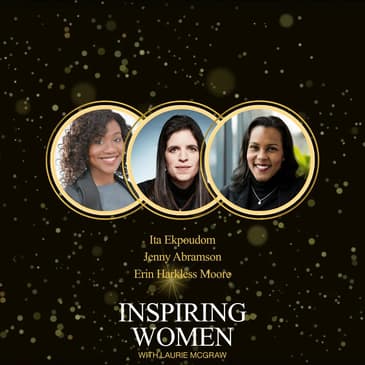

Less than 2% of venture capital goes to female founders. When Laurie McGraw started Inspiring Women five years ago, the number was 2.4%. A few years later it had dropped to 1.8%. Absolute dollars going to women have grown, but the share of total capital has gone the other way, and the gap is now one of the largest unsolved problems in capital allocation.
Laurie sits down with three women working to change that from inside the system.
The guests:
Ita Ekpoudom is a Partner at Gingerbread Capital, a family office fund started by a former co-chair of tech banking at Goldman Sachs who realized after retiring that she had never made a private investment in her entire career. Gingerbread now invests directly into female-founded and co-founded companies, and as an LP into majority women-led funds.
Jenny Abramson is the Founder and Managing Partner of Rethink Impact, the largest fund in the country backing female CEOs across health, education, environment, and economic empowerment. Jenny was a tech CEO herself before founding Rethink in 2015. Her mother had run one of the earliest institutional funds backing women roughly twenty years before that, and the share of VC going to women was higher in her mother's era than in Jenny's.
Erin Harkless Moore leads the investment platform at Pivotal Ventures, the organization founded by Melinda French Gates to advance women's power and influence. Pivotal pulls on three levers: philanthropy, policy and advocacy, and investing. Erin deploys capital both into next-generation fund managers as an LP and directly into early-stage companies across the care economy, women's health, and financial access.
Topics covered:
01. The $648B care economy, larger than the pharmaceutical industry, and why Pivotal partnered with The Holding Company to size it
02. Maternal mental health, childcare infrastructure, elder care, and women's health as one connected market
03. The companies these funds are backing: Midi (the first unicorn in menopause), 7 Starling, Winnie, Wellthy, Bold, Spring Health, and Maven
04. How to spot category-creating founders before the rest of the market catches on
05. April Koh, Spring Health, and what it meant to see her on the cover of Time
06. Why "emerging manager" is the wrong label for funds like Rethink, Magnify Ventures, and Cherry Rock Capital
07. Stacy Brown-Philpot's path from early Google to Task Rabbit CEO to founding Cherry Rock Capital
08. The pattern-matching problem at the heart of venture capital
09. Why nine firms captured 50% of all venture capital raised last year
10. Gender-diverse teams, capital efficiency, and the data on returns
11. Who actually sits on investment committees at endowments, foundations, and pensions, and why many pension funds are already run by women
12. The great wealth transfer heading largely to women and what it means for financial services
13. Why most women change financial advisors after inheriting wealth
14. The Casa Dragones story, Berta Gonzalez, and the speed gap between male and female capital decisions
15. Donna Khan's research on prevention versus promotion questions and how investors interview female founders differently
16. The $5 to $6 trillion gender parity opportunity in entrepreneurship
17. Why women are twice as likely to invest in other women, and why that still is not enough
18. Practical advice for women ready to invest, lead, or fund the next wave
Full episode on Inspiring Women. Subscribe for more conversations with the women shaping business, capital, and leadership.
#InspiringWomen #VentureCapital #FemaleFounders #WomenInBusiness #Investing #CareEconomy #WealthTransfer
[00:00:00] You always ask yourself, how is this person uniquely qualified? When will they run through walls where others will be like, this is too hard? And I think female founders, because they're having to do so much more with so much less, that they really, the why, when I think about Amanda or some of the other founders in our portfolio, there tends to be almost a personal why of why they're founding this that keeps them going. So why are we still here? What is the core issue and will it change in our lifetime?
[00:00:24] One, at its core venture, is a pattern matching business. And so the people who control a lot of the wealth are often founders themselves, who then invest in people who remind them of themselves. I think to your question of what needs to change, we need to change who is allocating the capital in not just family offices, but in other institutional environments, whether that's endowments, that's foundations, that's pension funds, who's on those boards, who's on those investment committees.
[00:00:48] This is inspiring women, and I'm Laurie McGraw. And today I have a special conversation. I'm speaking with three women titans of industry of business. And we have Ida Ekpudam, who is the partner at Gingerbread Capital. We have Jenny Abramson, and she is the founder and managing partner of Rethink Impact.
[00:01:15] And then also Erin Harkless-Moore, and she is at Pivotal Ventures. These are three different funds that look at things with a gender lens. They actually believe that investing in women businesses and women-led companies can have impact. And when we know that 2% or less of the funding goes to those kinds of businesses, these are big jobs that you have all taken. Thank you for being on Inspiring Women. Thank you for having us. Thank you for having us here.
[00:01:41] Well, here we go. So, Ida, why don't we start with you? Tell us what you do. Tell us about your fund. Sure. Well, it's a pleasure to be around these women. By the way, they all know each other. These people are friends. We are, and we enjoy working with each other, and it's great to have a conversation like this. So, I'm Ida Ekpudam. I'm a partner at Gingerbread Capital, and we are a family office fund started by Linnea Roberts, and she is, as both of these ladies well know, she is a longtime seasoned Wall Street professional, former co-chair of tech banking at Goldman Sachs.
[00:02:10] And then when she retired, she had a really interesting realization. Despite the job she had, she realized she'd never made a private investment until after she retired. And so, for her, after working in a very male-dominated industry, which is investment banking, she decided that would be the next stage of her career. And so, she started as just kind of an angel investor, as some people do. But then when she really thought about it, she wanted to lean in in this space, and she wanted to lean in specifically around backing female founders and co-founders.
[00:02:38] And so, what started as angel investing stood up in Gingerbread Capital, and we are doing direct investments into female-founded and co-founded companies. And then we're also limited partners into majority women-led funds. So, we're trying to close the gap at both ends, both at the founders themselves and those writing the checks. And Ida, what about you? What about your special superpower for being- Yes. So, my special superpower, I'd like to say, is the power of convening.
[00:03:01] One of my favorite things is to think about two kinds of problems and who might be the right solution, and bringing them together and making sure they're in the room together. And then when you can do that and add capital on top of it, that's what's needed more than that. Holy moly. She is magical. Awesome. Jenny? So, Rethink Impact is the largest fund in the country backing female CEOs. We just do direct investing into companies, not into funds.
[00:03:28] And we look across health, education, environment, economic empowerment, which we see as very interrelated. And we are incredibly excited to be doing this work now since 2015. So, Jenny, you founded this. You founded Rethink. So, what is your background and where did this idea come from? Well, I was a CEO of a tech company myself, and I was often the only woman on a given stage or in a given room.
[00:03:54] And I had gone to amazing schools with lots of incredible women and wondered where they all were. They were more incredible than I was. And so, I thought, what happened? And I looked up the data and saw that less than the time, 3% of venture dollars were going to women. And my own mom had run a venture capital fund back in women was the first institutional fund back in women at the time about 20 years earlier. And the percentage of dollars going to women was higher when she was doing the work than when I was sitting there as CEO.
[00:04:22] And so, I sort of had this realization that probably the best way to change those numbers for my own daughters was to move to the capital allocation side. And that sort of is what inspired the start of Rethink Impact. Fantastic. Fantastic. Erin? Yeah. So, I lead the investment platform at Pivotal, which is a group of organizations founded by Melinda French Gates.
[00:04:43] Our North Star is to advance social progress and women's power and influence, so to make lives better for women and families here in the U.S. and around the globe. And we want to see a world where women are controlling more resources in the rooms where decisions are happening to control all aspects of their lives. And there's opportunities to do that by pulling on three key levers that we advance through our work and our organizations. One is philanthropy.
[00:05:12] The second is policy and advocacy. And the third is investing. And, again, I'm biased. I think all three of us are. All three levers are important, right? You can't. Philanthropy is needed to address market failures, but you also need capital to drive innovation and to create market solutions. And so I'm excited to deploy capital across really two pillars of our strategy.
[00:05:36] One is a portfolio of fund investments where we invest as a limited partner into what we call overlooked or next generation fund managers across the private markets, predominantly women-led firms. And we also invest as a direct investor into early-stage companies in areas where we are working thematically as an organization. So care economy, women's health, and financial access are three themes that we're actively investing around today.
[00:06:04] Can we talk about that care economy as, like, one of those themes? I mean, Erin, you have actually categorized that as a $648 billion opportunity. Those are big numbers. Can you talk about what that investment thesis is and how you actually came up with that number of billions? Sure, sure. Well, it was not just us alone, actually. My friends and colleagues here at the table were instrumental in partnering and making the case and helping to size that market.
[00:06:33] But Pivotal partnered with an organization called The Holding Company several years ago to do that research to size the care economy, a $648 billion market. It's actually larger than the pharmaceutical industry. I like to pause because people think of the pharmaceutical industry as this huge market. And the care economy- And it is. And it is. It's a huge market. But the care economy is bigger. And we're all caregivers at some point in our lives. That's something I think that resonates with everyone.
[00:07:00] But women often bear a bigger burden of that, particularly unpaid care. So when we are looking at things that are holding women's progress back and holding women back, addressing those critical gaps in our care infrastructure is a huge opportunity. So sizing that market was done in part to help make the case to other commercial investors of you are really missing out on opportunities by overlooking this space.
[00:07:28] That is impacting everyone from the beginning of life to the end of life, as I describe it. Childcare, eldercare, and in between. Do you put women's health in that category as well? I think of women's health as a part of that category broadly in the sense of if you're not caring for yourself, how can you care for those around you too? And so we see opportunities there, you know, maternal health platforms, menopause care, all is a big part and a piece of this care economy opportunity.
[00:07:56] Well, so when you just categorize it, I mean, a lot of these things and women's issues in general and health issues for women or in those different phases that you talked about, it also seems like it's sort of like a moral imperative. These are like important things. Yes, yes, yes. But when you start to put dollars behind it and actually talk about them as being capital investments, that gets really interesting. So, Jenny, what are the types of companies that you look at?
[00:08:20] Yeah, well, in this space alone, I mean, I can give you a few examples that really hit home how massive this opportunity is. So starting at the earliest phase, we have a company, Seven Starlink, that's tackling the women's mental health crisis and started with maternal mental health. And as you probably know, one in five women have postpartum depression and 75% of those get no care.
[00:08:42] And so Seven Starlink went to tackle that and really has partnered with health plans and Medicaid and others and are seeing, you know, 90% of their patients are seeing massive improvement. So I think of that as part of this work. Winnie in the child care space, helping not just the families that need child care in schools, but actually the providers to be able to have websites and to be able to get people into their homes. They're, you know, incredible in what they've built.
[00:09:08] And Winnie in every state in the country, thousands and thousands of providers getting support. And then all the way to the elderly side of things, where two great examples, wealthy, which is concierge caregiving. Now they're doing everything from helping with backup child care to their original work, which was helping with elderly care. So employers have something for their employees so that they don't resign or take a leave of absence, usually women.
[00:09:36] And Lindsay, George Rosner, who runs that company, has done an amazing job building that. So almost every major corporation has wealthy for their employees and makes a massive difference. And then Bold, which is really focused on something we all have worked really closely with. Amanda Reese has focused on increasing health span and really helping with building strength, reducing falls by 46%, really helping people live a better life.
[00:10:03] And that's another example of working both with Medicare, Medicare Advantage, and insurers more broadly. An incredible entrepreneur. I had her on the Inspiring Women pod. She's fantastic. Absolutely. How, Ida, how do you go about spotting these great companies that are doing important things but also make for good investments? Oh, I mean, fantastic. You were talking about the range of companies that you're invested in. We're co-invested in a few of those, including Bold.
[00:10:29] But I think of somebody like Joanna Strober of Mitty, the first unicorn in the menopause space. Yes. And people- We can say the word out loud now. Exactly. Exactly. And I had the pleasure of being with her, Liza and I, on our team in New York when it was the plaque in front of the NASDAQ announcing that round. And it was just so incredible to be sitting in the center of Times Square and you have this billion-dollar announcement of a unicorn around women's health and around menopause care.
[00:10:57] So it is so important because so much has been suffered in silence for so long for a category that every woman identifying person goes through. And for a while, we just thought there was no solution and you just deal with it. But then you realize this is a billion, multi-billion-dollar industry and I think now people are taking note. So you have to think about, well, how do you spot those? Well, you see a founder like Joanna who sees an opportunity, sees that it's underfunded, and then she goes after it doggedly.
[00:11:25] She was working when nobody cared about it. She actually created the conversation around this. And you have to have that kind of relentlessness and you always ask yourself, how is this person uniquely qualified? When will they run through walls where others will be like, this is too hard? And so that's usually what most founders are dealing with. And I think female founders, because they're having to do so much more with so much less, that they really the why, when I think about Amanda or some of the other founders in our portfolio,
[00:11:51] there tends to be almost a personal why of why they're founding this that keeps them going where others would be like, this is too hard. So you need that, and then you need the market to be large enough, right? Like death taxes, menopause. These are the things that we are talking about that are universally undeniable. And so when you size that and you think of underfunded, huge markets, and then you have a founder that is both determined but then able to build relationships so they can build a team around them,
[00:12:21] that's the kind of magic that you're looking for. Well, when you, so Ida, just to stick with you for a second, because like, I mean, so first of all, Mitty, I mean, it's not just, you know, a successful company, but it was like a category creating company. So you've got a founder, you've got somebody who is dogged and relentless and passionate and all of those things. But how do you spot it to be a good investment? I mean, the numbers are staggering. They are, there are not enough female founders. There are not enough female success stories.
[00:12:48] Yet we know that when women lead companies, they're more cash efficient. We know that the returns are better with a number stack up in the right way, but there's fewer sort of like targets, if you will. So how do you go about choosing the ones that are also good investments? Well, this is what I, this is why I love the seat that I sit in, right? So I sit at the intersection where we can do direct investments, but we tend to look later. We came into Mitty, not at the seed round, but I love to be an LP into funds where they are looking at those earliest stages.
[00:13:17] So you need to look at who are the managers that are out here spotting the trends before their pre-consensus, right? That's a talent in and of itself. When you think of the rethinks of the world and when you think of funds that will actually be, they have a thesis and they're going after it kind of the way that you did with the report, the holding company does. You go or build the theme and then you have people that are like really digging deep because there's always multiple players.
[00:13:43] And there are, as Biddy might have created the category, but there are other players in the space and you have to be able to pick a bet of why this one. And so that's one of the things that I love sitting in this seat as an LP is when I'm talking to managers, we were having a conversation around this. I was just saying, I was looking at a manager where they are, they have a different point of view. It's not kind of the consensus and they're looking for something where they're like, I'm looking for this type of founder, which is not what everybody's looking for.
[00:14:10] And usually that person is going to be inevitably successful, but maybe they might not catch the eye of the shiny, you know, big firms. And when you find a fund manager that can spot those talents early, you also want to make sure they have the capital to write the checks. That's right. Back those companies. Can I piggyback on something you just said here, which I think is foundational. And similarly, we invest into funds as well.
[00:14:33] And part of that is I'm trying to, I'm on this mission to abolish the term emerging to describe fund managers that are typically raising their first four funds or have $200 million or less under management. Because that term implies like, well, you haven't arrived. You have no experience. You haven't done anything. You know, Jenny and Rethink have now raised three funds, hundreds of millions of dollars in assets under management. But you brought tremendous experience, again, as a CEO, as an operator, when you were founding that firm with a clear thesis.
[00:15:02] To me, that's next generation is what we're calling it. And those fund managers outperform. These next-gen fund managers over time have consistently been in the top quartile when you look across venture capital. So you're making an allocation misstep by not looking at these opportunities to Ita's point to then go find the most cutting-edge technology. So I get excited about looking for talent that others are overlooking.
[00:15:29] You know, 50% of the capital raised in venture last year went to nine firms. Do you mean to tell me that only nine firms have a monopoly on all of the best ideas, all of the best innovation? No, I don't think so. Now, yes, they are backing many of the founders that we've been sharing here. But you have firms like Rethink, Magnify Ventures, which, you know, another firm that we incubated and anchored out of our office at Pivotal, was very early around this care economy thesis partnering with us in that work.
[00:15:57] And so these are all talented professionals who have very extensive and lived experience as operators, again, as angels, potentially as investors as well that they're bringing to the table as they found these firms to then go and invest in the amazing entrepreneurs that we're all talking about here today. Interestingly, it's sort of a similar trend at the direct investing side, right? Last year was more concentrated than it's ever been.
[00:16:23] About 10 companies got about half of all venture capital dollars last year, which is insane. Crazy. So then you have everyone else pushing. And so when we evaluate the direct investments, there are plenty of women starting companies. It's a myth that there are not women starting. They start half of all companies, right? It's really have an incredible opportunity because there are so many great women who have the background, who have the skills, and there's a perception if they haven't been a CEO before, then they're not fundable.
[00:16:51] And in reality, they often, as Ita talked about, have a lived experience. Someone like Lindsay from Wealthy, you know, she had cared for her mom sort of in sort of hiding while she was in a job. And it was the loneliest experience she ever had. So to see her create something that allows every family member to be able to emotionally be there and have someone else dealing with insurance and everything else, it really takes a company far.
[00:17:14] Or Spring Health that we're both invested in, where we invested really early on in April, let her late seed. You know, it was clear this was a company where she had a passion and a personal experience that made her want to make this succeed. And she was going to make it succeed. And she's grown the company tremendously. Exactly. And it's only at the beginning, as far as I can tell. So just, yeah. I think we all have stories like this over and over when we look across a portfolio.
[00:17:41] I'm thinking about Anu Dugala, Female Founders Fund with Maven. And Kate will talk about, she has four, I think, four children. She doesn't show up to really many things, but she always shows up. She showed up to inspiring women when she was on the pod. Right. Exactly. There you go. But she will talk about how she got rejection after rejection, and Anu was the first yes. And now this is one of those category-creating companies in women's telehealth into employers and now beyond. And you think about that. Female Founders Fund 1 was a small fund.
[00:18:09] And that one, yes, created... It was a catalyst that built a whole kind of segment. And so those managers are not... They might have been emerging, but they also were still spotting talent that nobody else was spotting. So you all know. You have to change the capital. You have to change who's in the room and who's allocating the capital to have a different set of companies getting funded. So that's why it's imperative, I think, to invest in this overlooked and underrepresented talent. And again, women particularly. That's what we're talking about.
[00:18:39] Nothing you can see. 83% of them. We want to have men at the table as well. But if we're backing women, you know, I saw some research recently. If we had gender parity in entrepreneurship, it would add $5 to $6 trillion to the global economy. I mean, these are like real... We're dropping a lot of numbers and stats. Massive numbers. Massive numbers that, again, like you said, Maven wouldn't exist without that early bet of someone who saw things different.
[00:19:06] You're all passionate about the case for change and also the dollars and the metrics that, you know, demonstrate that there is real return to be had from companies that are led by women, founded by women. So let's just talk about sort of like the elephant here, which is like, and why is it still the same?
[00:19:27] I mean, when I started Inspiring Women five years ago, we were at 2.4% of venture dollars going to women, a staggering low number, until it went lower to 1.8% just three years later. So why are we still here? Why are we still here? You are doing all that you can and more. But what is the core issue and will it change in our lifetime? Jenny? It will. Yes. It will. I agree. I think we're here for a few reasons.
[00:19:55] One, at its core, venture is a pattern matching business. And so the people who control a lot of the wealth are often founders themselves who then invest in people who remind them of themselves, whether the person has a hoodie, went to Stanford, I'm going to Stanford. Or otherwise. So some of it is cyclical because then those companies do well and then they move into venture capital. So some of this is it's a cycle that's hard to break. I think COVID and Melinda French Gates has said this very eloquently.
[00:20:23] Really, they bear sort of an underlying issues of people turning to networks they already knew because they were going inward. And I think that took what was progress in the right direction and set us back. I think we've come out of that. And now we have some benefits of COVID, which is Zoom and other things are allowing women who live in not only Silicon Valley and New York to get funded. And I think that will help. And the biggest thing that's helping is probably twofold.
[00:20:52] The data itself is astounding. Yep. And how successful women are. You refer to it more capital efficient, better returns, all exit faster. And you have real live examples that people can see and feel. We were just talking about Spring Health. When she was on the cover of Time Magazine a few months ago, pregnant no less. And everyone's like, oh, wow, that's a really big company. So I think the more examples we were just having a conversation at lunch of who can be the next one that we do.
[00:21:20] And I think the more of those we have, the more real it makes it. Because as powerful as the data is, nothing is more powerful than seeing that CEO at the NASDAQ. Yep. And it matters who decides and who decides or is making decisions at all points on the value chain. So Ida and I both sit in these organizations where we're investing as direct investors, as limited partners. We have, though, female principals who have set the terms for how they want their capital to be deployed.
[00:21:49] You know, I think to your question of what needs to change, we need to change who is allocating the capital in not just family offices, but in other institutional environments. Whether that's endowments, that's foundations, that's pension funds. Who's on those boards? Who's on those investment committees?
[00:22:05] And if you start asking the question, followed, like Jenny said, with bringing the data and the examples of these companies that are growing and scaling in huge markets, exiting and delivering real value back to investors, it becomes even harder to not to say no. Yeah. And it's really interesting in that there is some silver lining. That 2.2 or 1.8, when you look at it in absolute dollars, it has gone up significantly. So while the percentage, not absolute dollars significantly and gone up.
[00:22:35] And then when you expand it to gender diverse teams, it goes up even more so. 43%. We are just hoping for a world where nobody questions an all-male team raising gobs of money. But for some reason, if it's an all-female team, questions start getting asked in weird ways of like, where is there men? So we want to normalize. Either start asking men, where's the women in their all-male teams? Or let's do something the other way. So that's one of the things.
[00:22:59] But then I think one of the other things that, to your point about the capital going, who sets the terms? When you look at the institutional lens, when you look at pensions, there are actually, a lot of them are run by women. It's an interesting conversation that I've had is that, what was it? You won't get fired for investing in IBM, but you might get fired for, there's some kind of hesitancy around the capital allocation that is going then from those into the hands of, say, maybe female fund managers.
[00:23:27] Or there's something being lost there. Because that was actually really encouraging to see that a lot of the key decision makers in some of these pensions and endowments are actually women. So I think a larger conversation needs to be happening because there is no shortage of talent and pipelines. So then what is missing?
[00:23:46] Do we need to be clear about what the terms are so that we can make that an easier yes to write a check into an emerging, you know, these innovative fund managers as we can? Because that's something that feels a little off to me right now. But we don't have to, I've been, I had the maybe luck or misfortune of starting my career in asset management at Goldman Sachs doing fund manager diligence. I've been basically doing the same thing for the last two decades.
[00:24:14] And the process that we have at Pivotal, it's that same playbook that I learned from, I think, some of the best investors underwriting fund managers across asset classes at Goldman Sachs, at Cambridge Associates. You know, it's the same process. I would say we're not lowering the bar, we're reframing the bar. Because you can't expect to get to different outcomes doing the exact same things and processes.
[00:24:38] But to this point of, you know, where the talent is and the experience, it's not discounting and saying, oh, well, I'm just going to allocate and commit, you know, millions of dollars to someone because they're a woman. No, it's what are the questions that I need to ask to understand the risk that this may be first time fund manager is taking to get comfortable with that. So it's reframing and what the problem is you're trying to solve to get to a different solution.
[00:25:02] And one example that I love, I won't use you as an example, but I think Rethink is a great example. But another one in our portfolio, and I know, you know, Eta knows this firm well, too, is Cherry Rock Capital. It was founded by Stacey Brown Philbot, probably one of the most successful African-American women in Silicon Valley in tech. Early at Google, CEO of TaskRabbit, managed their transition from in the sale to Ikea. Super successful board director, you know, HP, big companies, right?
[00:25:32] She was working with SoftBank, General Catalyst, started to make the transition to an investor, wanted to raise a fund, again, focused on overlooked talent at the Series A and B stage. And the refrain to hear, well, you're not an investor. What have you been doing? You don't have any experience. I said, I can help companies with Series A and B understand how to unlock what investors care about because I sat on that side of the table.
[00:25:57] I was a senior director, lead director at some of the biggest companies that scaled in the world. I took a company through that process. And so for us, it was, okay, yes, does she have a typical investment track record that I can underwrite? No, but I can go through her experience and do a ton of references and understand what her thesis is and her ability and her team's ability to add value and to find great founders to do that. Now, does that take a little bit more work? Yes.
[00:26:24] Well, I think you're just pointing out the first, there is no lack of talent, you know, available to do these hard jobs and be successful at them. Let's talk about one of these underlying things. We're all at the WBL conference where you three are all speaking on this topic to a very senior executive audience. Let's talk about the great wealth transfer.
[00:26:47] Let's talk about the $53 trillion that is going to change hands and be in the hands of largely 95% women who have investable capital at a level that they do not currently have today. How is that going to change things? Jenny, why don't you start? I think that will change things a lot. I mean, it's part of why we backed Ellevest, Sally Krawcheck's company originally now run by Sylvia Kwan, which is women controlling wealth changes all of our future.
[00:27:15] Because when women control wealth, good things happen for children, good things happen for society, and it will change who is allocating capital. You know, both of these two here are amazing, shining sort of examples of what's possible and how you can do well and do good at the same time. There's a woman at Georgetown University named Donna Kans, who you've heard, who talks a lot about prevention versus promotion questions.
[00:27:42] And when people interview, and it's probably true at the fund manager level and it's true at the direct level, a woman CEO, they'll often ask, you know, what are you going to do when everything falls apart? What are you going to do? Versus they might say to a male CEO, how big can this be in five years? And so really starting to think about our own biases, but women are twice as likely to invest in other women. And so just having more capital won't change those biases, but it clearly makes them less pervasive.
[00:28:11] But it also means that women need to start investing. So we also know that, you know, there are not, so, you know, just as there aren't enough female founders and female leaders of companies, there's not enough women who are doing the investing. So how do you think about that, Ita? And what do you do to advise women to get out there and put their dollars behind some of your great companies? Absolutely.
[00:28:33] Well, I mean, I shared two really interesting examples that Linnea always talks about of how she, even though sitting in the job she had, she'd never made a private investment until after she retired. There was one where she was at a dinner with her husband and they were having tequila, Casa Dragones Tequila, which is a tequila now a lot of people know about. Berta Gonzalez, the first female tackle era, and Berta was serving the thing. And Linnea was like, oh, wow, I have never had, do you have female investors on your cap table?
[00:29:00] And Berta was like, I have influencers and I have like, you know, celebrities that have like talked about the brand, but no women on my cap table. And so actually one of the things that Linnea was like sitting at the table, she was able to walk away with a check from George and his friends at the table. And Linnea was like, you know what, set aside 500,000 for me. I'm going to go ask 10 of my friends to make an investment as well.
[00:29:24] And she was like, two interesting things were like, first of all, the speed with which men made decisions and said, we are going to, we're going to try it. And then she went and called her 10 friends. And then she started getting the questions, is there a data room? Is there the kind of almost analysis paralysis? And then she was like, you know, sometimes you just have to, she was like, it's tequila. It tastes good. And it's really interesting. This woman is an expert at what she does. Let's go for it.
[00:29:49] And that was one of the things that she realized is that sometimes for women, you need a little bit more education to get them off the, get them started. But that once they start and they actually start experiencing and feeling like, oh, I ask good questions. I know what this, it becomes less demystified. And then one of the other stats that has become glaringly clear, which is why the financial services industry must take note, is that when this wealth transfer happens, most women change financial wealth advisors.
[00:30:16] And so that's about to cause a whole, if these companies and firms are sitting around with all male teams that haven't invested in their own talent, when this money changes hands, they're going to, these, their firms are going to lose a lot of business. So this is really critical that it's coming. So everybody needs to get ready for it. And you're right, which is women do. I mean, my partner, Heidi Patel, who you guys know well, is an investment banker, right? And we are data oriented humans, right?
[00:30:44] Maybe it's because women had to work twice as hard to get where they get, but women often turn to the data. But you have to balance that with sort of gut, with risk, all the things. And I think when you can mirror those together, it's why female investors are probably more successful than anyone, is that the power of those together is magical. Yeah. Well, I want to just, you know, thank you all for the work that you're doing. Obviously, you're capitalists. So let's start there in terms of you're doing this, not for philanthropic reasons.
[00:31:13] You're doing this because it's good business and because it's creating successful companies and because it's making a difference and it's impactful. But you also know that there are challenges ahead. And with this opportunity that you're leading into, many good things can happen.
[00:31:29] As we close out this Inspiring Women conversation, I would like to ask each of you for your best advice to women leaders that are out there, whether it is for them to invest or whether it is for them to innovate and lead companies. What do you advise out there? Why don't we start with you, Erin? Oh, it's a big question. But I'd start with two things.
[00:31:49] I think one is ask questions, sort of interrogate what you, in your own sphere of influence, maybe you sit on a board locally or a nonprofit. What questions can you be asking to open doors for more women in each of your individual seats of influence? And I think the second piece that ties to that is pick up the phone.
[00:32:12] I often say, you know, in our work, investing both into the companies and directly into the companies and into the funds, the check is sort of like the least interesting thing I do. It's me picking up the phone. Not to the one who's receiving it. It's foundational, right? Like writing the check is important, but it's what I do after that. Am I willing to, I know Ita's looking at this company. Do I call and I offer her our investment memo so she can have another data point to get to a decision faster?
[00:32:42] Does she turn and do that for me? So I'd encourage women to, again, share, share broadly, pick up the phone, use your networks, use all the resources that you have to help move the ball forward for yourself and for someone else probably as well. I would say two things. One, collaborate. And women are incredibly good at collaborating. And it's an advantage in this work. And we talk about it all the time. But we believe to really make change, we have to sort of all rise together.
[00:33:12] And I think that will make the difference. And two, I always think of a quote that my boss at the Washington Post had years ago. It says, what would you do if you couldn't fail? I have a plaque on my desk. And I think just remember, if you're out there, whether you want to be an entrepreneur or you want to back companies, you want to be on a board, you're pretty amazing. And I think women often underestimate themselves. And I think if you sort of believe it, it will happen. It's sort of my belief in life. Awesome. Ita?
[00:33:41] And I absolutely, for those that have gotten to the fortunate place where they have excess capital and they can really think about, thinking almost in terms of a legacy, when you look back, what can you do? And there's two ways. If you don't have time to be what Linnea or Melinda have done, where they have set up whole teams, there's the ability to actually not have to go do direct investments and look at deals one-on-one.
[00:34:04] But I would encourage you, if there's an area you care about, a theme you care about, there's likely a fund that will invest in that whose job it is. And that's all they do 24-7. Consider that way as a way to gain access into this world of private investing, especially venture capital. And that way you will get to see a lot of things. And in the reports they do, the convenings that they do give you that opportunity to start dipping your toe in. And maybe it'll spark a fire that has you go down the path of gingerbread or pivotal. But, like, you can start small.
[00:34:33] And it is possible to start really small and then get comfortable and grow from there. So just start. Just get going. Just do it. Just get it. Oh, this has been just an incredible, inspiring women conversation. And so Erin and Jenny and Ita, thank you all so, so much. Thank you for having us. Thank you for having us.