
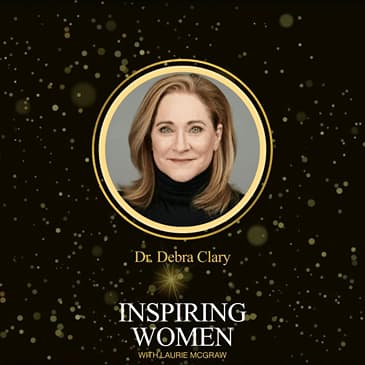

Dr. Debra Clary started her career at 4 a.m. on a Frito-Lay route truck in Detroit. She went on to found and run the Leadership Institute at Humana, and then left to write The Curiosity Curve.
On Inspiring Women, Laurie McGraw talks with Debra about the CEO question that sent her into the research: can curiosity be learned? They cover what a joke on a train in Italy taught her about American conversations, and what the research found about curiosity and leadership performance. She also tells the story of the friends who booked her an off-Broadway show before she had written a word of it.
WHAT YOU'LL LEARN
- Why everyone at Frito-Lay started on a route truck, and what it taught her
- The CEO question that started her research: is curiosity innate or learned?
- What an Italian joke about Americans reveals about how we talk
- The link between curiosity and leadership performance
- Why curiosity is contagious, and a state rather than a trait
- The four parts of the Curiosity Curve framework
- "Unless Tom asks for something three times, take no action"
- Writing and performing A Curious Woman off-Broadway
- Why AI makes asking the right question the real edge
- Her advice for women: ask the question and say your point of view
CHAPTERS
0:00 Trailer
0:56 Introduction
1:36 Starting out on a Frito-Lay route truck
3:26 Why she said yes to the truck
4:16 The CEO's question: can curiosity be learned?
5:07 An Italian joke about Americans
6:09 Record-low engagement and the missing piece
7:09 The research: curiosity and leadership performance
9:24 The four parts of the Curiosity Curve
10:24 Coca-Cola: "Take no action"
11:55 Building the Leadership Institute at Humana
14:38 A Curious Woman: her off-Broadway show
17:49 What performing taught her
19:32 AI and the leaders who ask bolder questions
21:10 Advice for women: ask the question
22:38 Thank you
ABOUT THE GUEST
Dr. Debra Clary is a leadership strategist and the founder and CEO of the Clary Group. She wrote The Curiosity Curve: The Leader's Guide to Growth and Transformation Through Bold Questions. She founded and led the Leadership Institute at Humana, and she holds a doctorate in leader development.
ABOUT THE SHOW
Inspiring Women with Laurie McGraw features conversations with women leaders in health, technology and business.
#InspiringWomen #Curiosity #Leadership #WomenInLeadership #AI #TheCuriosityCurve
[00:00:00] [SPEAKER_01] I did get the job offer, but it was to be a Frito-Lay route driver. I learned more off that truck than I actually did in business school. I was in the boardroom with our CEO, somebody was presenting and he leaned over and softly asked me, do you think curiosity can be learned or is it in a reading the engagement report that Gallup had put up? They've never seen engagement so low. Could curiosity actually be what's missing?
[00:00:28] [SPEAKER_01] I came back to my CEO and said, good news, curiosity can be learned. There is a direct correlation between leadership performance and curiosity. Curiosity is contagious. Curiosity is a state and not a trait. AI levels the playing field. Now, anybody that has a computer or a phone can get the answer. AI is only as good as the questions we put in them.
[00:00:50] [SPEAKER_00] This is Inspiring Women. I'm Laurie McGraw and today I'm speaking with Dr. Deborah Clary and she is a leadership strategist, a best-selling author and the founder and CEO of The Clary Group, a consultancy dedicated to helping executives and organizations unlock growth through the power of curiosity.
[00:01:12] [SPEAKER_00] She's the author of curiosity. She's the author of curiosity curve and we're going to talk about that today. That is the leader's guide to growth and transformation through bold questions. Dr. Deborah Clary believes that curiosity can be learned and we're going to learn more about that. Dr. Clary, thank you for being on Inspiring Women.
[00:01:30] [SPEAKER_01] It's my pleasure. Thank you for having me.
[00:01:32] [SPEAKER_00] Well, it's really great to be speaking with you this morning. And, you know, I want to start off in sort of like the way back a little bit because your curve to get to here is quite unusual. You started your career driving a Frito-Lay route truck at four o'clock in the morning back in Detroit and you ended up founding and running the Leadership Institute at Humana.
[00:01:57] [SPEAKER_00] So in terms of like going from truck driving to being the leadership teacher for 600 leaders of a very, very large organization, how did that happen?
[00:02:11] [SPEAKER_01] Yes. So you are right. Right out of business school, I went to my first interview at Frito-Lay in a suit and a little bow tie. That's what we wore back in the day. And I was thinking I was interviewing for a manager role. So this is going to be my first professional job right out of business school. And I did get the job offer, but it was to be a Frito-Lay route driver, Teamster, Local 337.
[00:02:34] [SPEAKER_01] And what they told me is everybody starts on a route truck, no matter what degree you have, no matter who you know or what you do, it's starting on a route truck because they really believed that you needed to understand the business from the ground up. And I'll tell you, it really became my classroom. It's where I learned how to manage a P&L, how to manage my time, how to build relationship with store managers.
[00:02:57] [SPEAKER_01] And I think I learned more off that truck than I actually did in business school, but it really set me up for understanding the value of hard work and credibility. And I say credibility because after nine months of running a route truck, you know, being up at 4 a.m. cold winters is I was promoted. And then the next day I'm actually leading those route drivers. So that's where I learned the value of hard work and credibility because they knew I did what they did.
[00:03:25] [SPEAKER_00] Well, I mean, many people would not have taken that job. Many people would have said like, thank you. I am ready for a manager's job. Driving a truck is not for me. But you said yes. So what led you to say yes in the moment in those early days?
[00:03:41] [SPEAKER_01] I think it was one of I saw the trajectory that if I worked hard and I wasn't afraid of working hard, that I could envision myself becoming a manager and a regional manager. I could see that I could really learn and grow at such a large organization. And I think it was just that even at that age of 23, I saw the vision of this is a large organization where there is room to grow and to learn.
[00:04:09] [SPEAKER_00] So that's leaning into something that's just like interesting. And we'll come back to that in terms of how that's fueled your work and your research with curiosity. But you talk about just in other talks that you've done about a specific moment back in 2019 that you describe as an important turning point. You were at Humana. You were working with the CEO.
[00:04:33] [SPEAKER_00] So can you just talk about that in terms of like that point where you were curious about curiosity?
[00:04:40] [SPEAKER_01] Yes. So three things happened to me in a matter of about two weeks. So first, I was in the boardroom with our CEO. Somebody was presenting and he leaned over and softly asked me, do you think curiosity can be learned or is it innate? And just by the way he asked the question, it's triggered for me. He doesn't think the person presenting is very curious. And so now he's asking this question. And I said, you know, Bruce, let me go. Let me go check it out. I'll do some research on it.
[00:05:09] [SPEAKER_01] Well, I just happened to be leaving that next week for a trip to Italy. And I was on a train from Rome to Florence. And I'm sitting next to this very handsome Italian man. And he says to me, are you American? And I go, why? Yes, I am. I'm American. Yes, I am. And he says, oh, I have the best American joke for you. He says, what do you get when you ask an American a question? An answer. And he starts laughing. Now, I'm a gracious American.
[00:05:36] [SPEAKER_01] I smile, but I do not get this joke. I don't get it either. What it triggered in me as I went into Florence and I'm sitting in cafes, I'm observing Europeans in conversation. And I began to realize that they have different conversations than Americans. We are quick to answer a question. We're kind of wired for efficiency. And I just noticed that it was this flow of a conversation of almost, why would you ask that question?
[00:06:05] [SPEAKER_01] And it was just a different way of being. And so, like, that's kind of interesting. I flew back and I'm reading the engagement report that Gallup had put up. In the history of measuring engagement for Gallup, they've never seen engagement so low. So I began to wonder, having spent three decades in very complex systems, could curiosity actually be what's missing?
[00:06:31] [SPEAKER_01] Because I was trained as a leader to have all the answers. And I know we train leaders to have all the answers. And that's where I began to think, maybe this is the missing piece. So I started doing some research. I came back to my CEO and said, good news, curiosity can be learned. It's innate, but it also can be learned. And at that point, I realized there wasn't enough data to actually take it further.
[00:06:58] [SPEAKER_01] You know, people had done lots of studies on curiosity or what they would call novelty in the academic world. But nobody had really studied that as it related to performance. And that's when I got super curious about curiosity.
[00:07:12] [SPEAKER_00] Well, you also really dug into it. You commissioned research. You really explored how to go about this question. So just like take us through that because you have done quite a bit. You've written this best-selling book, Curiosity Curve. You've also spoken about it. You have a very, very well-seen TED talk that's out there. So just like take us from the point of research to what you started to learn.
[00:08:06] [SPEAKER_01] Yeah. I came back and said, how'd you know? And I said, three decades in complex systems, right? And so from there, we went a little bit deeper. But the bottom line here is that there is a direct correlation between leadership performance and curiosity. And what that means, Laurie, is that there is if a leader has a high level of curiosity, they generally have higher performance. And they also have higher curiosity on their team.
[00:08:35] [SPEAKER_01] So curiosity is contagious. Curiosity is a state and not a trait, meaning that we can create an environment where people are more curious. And that's when I said, all right, this can be learned. And this is the work I want to go to.
[00:08:50] [SPEAKER_00] Well, I think it's also particularly important in today's environment. We are on some of the steepest learning curves that any company business is going to see. We're being disrupted in ways that could be for the good, could be for the detriment in terms of what we can do with AI.
[00:09:07] [SPEAKER_00] And there are going to be many businesses that thrive in this, and not just the tech businesses, but find new and novel ways to use explosive opportunity and bring it into their companies. So I think this is a really important topic at the leadership level. Can we just dig into some of the main parts? You've got a four-part framework, as I understand, with the curiosity curve. Can you just talk about that?
[00:09:33] [SPEAKER_01] Yes. So once we found out that curiosity can be learned, and then we said, well, wait, then. If it can be learned, we need to be able to measure it. So how do we measure it? So we put together a diagnostic tool. It's validated, and it's 26 questions, and it's broken into four categories. One is exploration, inspirational creativity, focused engagement, and openness to new ideas. And we have found in over 1,000 people that have taken that, that everybody shows up somewhere on that continuum.
[00:10:02] [SPEAKER_01] So you get an overall score, but more importantly is diving down into is how do you naturally show up in those categories. And why it's important is, one, we get a current state, and then we know that we can improve on that. But it's also one is when you take it as a team, you better understand when somebody is trying to solve a problem, where framework are they coming from? And I'll give you an example of this. When I was at Coca-Cola, I had this developmental role called chief of staff, and I was working for the president.
[00:10:33] [SPEAKER_01] You know, this is like, I was young, but I was like, this is so important. I got to get this right. I would go in every Monday, and Tom would just be, you know, exploring this and that. Well, for me, I was taking notes that it's time for me to go execute, because it's all about execution. I need to show that I can get things done. Next week, I would come back with a plan, and he'd say, no, no, no, and he'd go off somewhere else. Now, this goes on for about three weeks, and I'm like, oh, my God. Probably driving you crazy.
[00:11:00] [SPEAKER_01] And I'm like, he's going to fire me, because I am not performing here. So I called the chief of staff that had been in the role before me, and I said, I think he's going to fire me. He'd go, what are you talking about? And I go, well, here's what's happening. And he goes, oh, I should have told you. Unless Tom asks for something three times, take no action. So what I realize now, I have the words, like Tom was an explorer, and I was there just to listen while he was processing information. Now, you can imagine now, I was in focused engagement.
[00:11:28] [SPEAKER_01] Like, I got to go get it done. So there was friction there. And the sense of, what if I knew that about Tom then? What if he knew I was about focused engagement? We'd have a different conversation. I would have been asking questions, what action do you want me to take? Right, that type of thing. And that's the power of doing the curiosity assessment in a team setting. Like any diagnostic tool, know thyself and know others. But when we know how we show up as a team, that's the power.
[00:11:55] [SPEAKER_00] Well, high-performing teams is always sort of like the bellwether of, you know, the best companies in the world. It's never a single person. It's can that single, you know, an important person bring together a team. So you took this curiosity curve framework. And as you were running the Leadership Institute at Humana, training and developing 600 leaders, how did you bring that framework?
[00:12:22] [SPEAKER_00] How did you draw out the parts of the Curia curve that were important to make an entire leadership team work better together?
[00:12:30] [SPEAKER_01] Well, actually, I left that company, Humana, to go write the book. So this learning came after that. Okay. Yes, yes.
[00:12:42] [SPEAKER_00] So, but I have to imagine the training of the 600 leaders fed into the development of the framework.
[00:12:49] [SPEAKER_01] Yes, absolutely. So when I joined Humana in 2005, they were going through a significant transformation. So they were moving away from being a transactional insurance company to being a health company, where they were really focused on the health of their members. And that's what attracted me to Humana. I'd come out of food service and understand the consumers in different ways, you know, having run marketing and sales type operations.
[00:13:17] [SPEAKER_01] And how I got into this is I got so interested in human behavior that why do some leaders, why are they so great and others not so great? So this is when I went back to get my doctorate in leader development, trying to really understand human behavior. And in my mind, I was going back into an operating role. I was just doing this because I was so intrigued by it. And then Humana said, we're starting an institute. When with your academic background and now with your, you know, your business background, you're perfect to lead this.
[00:13:45] [SPEAKER_01] So that's what drew me to Humana was that they were in a phase of transformation. And I really liked what their mission was. So for those first eight years when I was running the Leadership Institute, it was all about helping the leaders think differently. So, you know, here's their current state of having all the answers in terms of claims and data and trying to get costs down to wait. Now we're really trying to understand the consumer and what the consumer needs are.
[00:14:09] [SPEAKER_01] And that's a huge shift for the brain and going from kind of black and white to more of expansive of what might be possible here. So was curiosity a part of that?
[00:14:19] [SPEAKER_00] Most likely. So let's like just talk about like the obvious next steps that you would take writing a book, an award winning book, really leaning into it. And then there's a point, you know, in terms of doing this research, training all of these leaders and then moving on. And then let me just like read this. In 2023, you wrote and performed a solo off-Broadway show called A Curious Woman.
[00:14:50] [SPEAKER_00] Debra, what is that all about?
[00:14:54] [SPEAKER_01] Right. I know. Right. Right. Yeah. Because I told my CEO I was leaving to go write a book. And the next thing he knows, he goes, wait, you're on Broadway. What's happening here? So this is the story of borrowing someone's belief in you until you can own it yourself. So during COVID, I had a mastermind group of women all over the country and we would check in every month. How are you doing? What's your hopes and dreams and all of that. And in August of 2022, now I was getting ready to leave Humana to go write this book. They said, we're coming to Louisville. We have something to celebrate.
[00:15:24] [SPEAKER_01] So great. I like to celebrate. And they raised a glass of champagne and said, we're toasting Deb. And I'm like, I didn't do anything yet. I'm just getting ready to go write the book. And this amazing stuff is going to happen. They go, no, no, no. We forgot to tell you. We took your idea of a one-woman show about curiosity and we pitched it to a producer in New York. And you're booked. Now, I'm like, I go, I have never performed. I've never written a show. And I called them a few names.
[00:15:53] [SPEAKER_01] And they're like, Deb, you are ready for this. This is the perfect time for you to take your story from a teamster to the boardroom. And how did you do that? And so I wrote this story, which is a comedy. And I showed it to a writer who writes for Broadway. And he read it. And he was very gracious. But it was pretty much, this sucks. You wrote a keynote. I go, I know.
[00:16:22] [SPEAKER_01] I know how to write a keynote. He goes, this is not going to play in New York. And that's when I began to learn, like, I need to surround myself with people that know how to do this. I found someone that could adapt it to stage. I found a director. I didn't know any of this stuff. And so we did this show. We did six in Indy. We did a couple in New York, a couple elsewhere. And it was just this story about being a woman in the 80s and 90s and the funny things that happen.
[00:16:52] [SPEAKER_01] And then what do you do with that? Funny things meaning like when I was in a room and I was the one that had to go get the coffee. Like, how do you handle that, right? That kind of thing. And it's like, all right, so you can be angry, mad about it. Or like, all right, how do I figure to get, how do I get out of this situation? And so it's just a comedy about, you know, elevating.
[00:17:13] [SPEAKER_01] But there is a truly inspiring story around that in the sense of we all have the ability to pivot and elevate if we're there for one another.
[00:17:22] [SPEAKER_00] But it's such a remarkable experience. I mean, there are many people who take that, take those issues like me. I've done a podcast and I speak to others about them. But being a performer, being a creative in that kind of way, I mean, that is a very different part of taking a corporate career, knowing how to show up in a boardroom. It is a very different term.
[00:17:50] [SPEAKER_00] What did you learn from that that has come back to fuel your work in terms of being a consultancy, being out advising others? It's just really remarkably different.
[00:18:01] [SPEAKER_01] Yes, thank you. The thing I learned about myself, because I've been asked this question, like, how could you do that? And I began to peel it back. You know, for me, I was the first person in my family to go to college. I was the first in many things, like many women, you're the first in the boardroom or you're first in there. And one of the things that I really honed was I was observant because I didn't know what was to expect in a room, so to speak. And I learned to anticipate.
[00:18:29] [SPEAKER_01] I learned to read body language. And I just became really good at it because I just figured I didn't I didn't have anything else to really go on. I didn't have any experience. And what that translated into is now in any given situation when I'm out and about, I'm observing people. And then I turn it into a story. And it's a it's a funny story. So my life, I looked at things and people say, oh, my gosh, you you were a route driver. That's ridiculous. And I'm like, well, I turned it into something right in the sense of, oh, this is current state. And I have a vision for what could happen.
[00:18:59] [SPEAKER_01] And that's up to me. So the sense of what I learned about myself is that's one of my gifts is observing either people or observing trends and then being able to put it into a story that has levity, but also has a point that they can take away.
[00:19:13] [SPEAKER_00] Well, it's not just an unusual career that you've had in terms of different stops along the way. It's incredibly diverse perspectives. You know, truck driver, route driver, eater, corporate boardroom, creative, being on stage. So I want to sort of close out coming back to this like time that we're in, which is which is AI.
[00:19:39] [SPEAKER_00] And we're taking, you know, what are, you know, management decisions and leadership decisions. And we're able to use tools now that get the answer for us. And for many people, that's sort of like there's almost like a leveling down of like, you know, a lot more people have access to getting things done. Some of the things that you talk about, Dr. Cleary, is you actually view that it's the most important for leaders to have the boldest questions. And you really lean into that.
[00:20:09] [SPEAKER_00] Can you close us out with what's important for leaders now based on all of your research, based on all of your work with leaders and based on all of your very many perspectives?
[00:20:21] [SPEAKER_01] Yeah, I do think there's a significant benefit of AI because AI levels the playing field. Now, anybody that has a computer or a phone can get the answer. So the playing field is we all have the answer. But here's the edge for those leaders that are going to make a difference, have an impact, really stand out. It's the ones that ask the questions such as what are we not asking? What is the signals we're not seeing?
[00:20:48] [SPEAKER_01] It's having having the thoughtful question that puts you ahead of others in terms of we're not asking the right questions. And AI is only as good as the questions we put in them. I mean, it's phenomenal. You get great answers. But did you ask the right question? That's where I come at. Are you asking the right question? One of yourself, but also of others.
[00:21:10] [SPEAKER_00] How do you feel for women? Because this is inspiring women. And in terms and you are passionate also, like I am, about bringing the next generation of women into leadership. So as we close out this inspiring women conversation, can you just provide some advice for women out there how they can be curious enough, how they can lean into asking the best questions so they too can advance into the leadership levels that you envision as possible?
[00:21:39] [SPEAKER_01] So what we found in over a thousand assessments of curiosity is that there is no difference between gender. So men and women are equally curious when they assess themselves. We do know, though, that women don't show up as curious. So they're not the ones particularly asking the questions in the room. So this would be one thing I would encourage women to do is ask more questions when you're in a meeting and have a point of view.
[00:22:06] [SPEAKER_01] Build your confidence that even if you ask a question and it's not people don't respond to it or, you know, it doesn't get any traction. You've gotten your voice out there. Or if you've got a point of view, say your point of view. That's what we're going to need now in executive rooms and in the boardrooms is women speaking up. Our voices are so important right now.
[00:22:28] [SPEAKER_01] And I want to encourage women to hear that, that you can make a different impact and a different contribution because you think differently.
[00:22:38] [SPEAKER_00] That is incredible advice to close out on. I have been having a fantastic, inspiring women conversation. This is Laurie McGraw. I've been speaking with Dr. Deborah Clary. And Dr. Clary, thank you so much. My pleasure.