
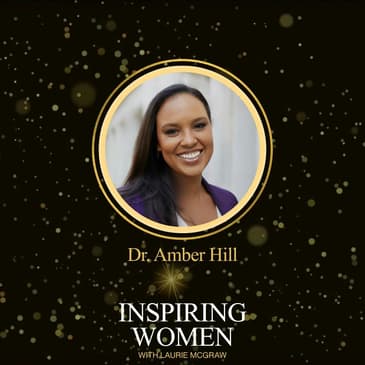
Dr. Amber Michelle Hill spent 14 years inside medical research — as a neuroscientist, in the lab, on the preclinical side, and patient-facing — before she discovered the real reason 90% of clinical trials fail. And it has almost nothing to do with the science.
In this Inspiring Women conversation, host Laurie McGraw sits down with the founder and CEO of Research Grid (R.grid), the London-based, VC-backed company she built to take the administrative burden out of clinical trials, speed them up, and make them more diverse and representative of the people the medicines are meant to serve.
Research Grid didn't start as Research Grid. It grew out of Movement for Hope, a nonprofit Amber founded during her academic years that brought researchers, artists, and patient advocates together to raise awareness for neurological conditions. When COVID shut the events down and investors passed on the idea, she repurposed the technology — and the hard-won community relationships behind it — into two AI products: Inclusive, which automates everything that happens before a trial starts and expands access to underrepresented patients, and Trial Engine, which automates the back office of the trial itself.
Today that network spans 99,000+ communities, 400 million members across 157 countries, and 2,000 health indications — all built by hand, over years, with no bought data, while the company stayed stealth for four years before launching in 2023.
Amber breaks down why a single medicine takes 10 to 14 years to go from bench to bedside, why $400 million per trial is burned on admin alone, and how women were once excluded from drug testing entirely. Then she gets brutally honest about raising money as a woman of color in a world where less than 2% of funding reaches female founders — including the investor-scoring matrix she built to decide who's even worth her time. And through all of it, she stays an artist: every painting in her home, including the giant acrylic pour behind her, is her own.
WHAT WE COVER:
- The art-and-science mind behind the company — and why painting quiets her thinking
- 14 years as an end-to-end researcher, and how Movement for Hope became Research Grid
- Why 90% of clinical trials fail — and why it's an admin problem, not a science one
- The hidden cost of research: $400M per trial and 28,000 hours per person on admin
- Why 84% of trials still don't reach the people who need them in time
- How women were excluded from drug trials, and the fight to diversify research
- Building a 400-million-member network the hard way, with no bought data
- How AI took a six-month site feasibility process down to minutes
- The truth about raising capital when you're "different from the person across the table"
- How she scores and filters investors instead of chasing them
- Repositioning to seed and landing in the top 1% of seed-stage companies globally
- Her golden rule for founders: never assume common sense
GUEST: Dr. Amber Michelle Hill, Founder & CEO, Research Grid (R.grid)
HOST: Laurie McGraw
ABOUT INSPIRING WOMEN:
Inspiring Women with Laurie McGraw features candid conversations with the women leaders, founders, and changemakers reshaping their industries.
🔔 Subscribe for more Inspiring Women conversations.
💬 What hit hardest for you? Tell us in the comments.
#InspiringWomen #FemaleFounders #ClinicalTrials #AIinHealthcare #WomenInTech #StartupFunding #DrAmberHill #ResearchGrid
[00:00:00] I think what's important for I guess founders to take away who are different from the investors that they sit across from. There are a number of reasons why people can tell you no, and some of those reasons are going to be really, really valid and some of them are not. Female founder, we know that less than 2% of investment dollars go to female founders. What allowed you to make that happen? What I ended up doing is figuring out, I had like kind of four core reasons why someone could pass on me legitimately.
[00:00:32] This is Inspiring Women, I'm Laurie McGraw and today I am speaking with Dr. Amber Michelle Hill. Dr. Hill is the founder and CEO of ResearchGrid. She founded this six years ago to bring administrative burden out of the work of clinical trials to speed them up, make them more diverse, inclusive and representative for the people of these innovations and medicines that come out of clinical trials. Dr. Hill is also 14 years old,
[00:01:00] she's a researcher herself and so she understands clinical trials deeply from doing that research. Dr. Hill, thank you for being on Inspiring Women. Thank you so much for having me. So let's get started. I want to talk about ResearchGrid. I want to talk about clinical trials. I want to talk about like why it was so important for you to start this company and you're across over 150 countries in terms of where ResearchGrid and your products are being used. But let's start and talk about art.
[00:01:30] As I am talking to you today, you are sitting in front of one of the most beautiful pieces of art I've ever seen. Dr. Hill, I think you created this yourself. Tell us about your artwork, please. So weirdly enough, I've got most of my degrees are in science, but in undergrad, I had a minor in studio art and I could, well, I could go either studio art or chemistry.
[00:01:59] I had one class to take in either direction. And I chose chemistry because I had absolutely suffered through chemistry classes and decided not to go the studio art route because I knew that I would always have it. And so as a pastime and one of the only things that kind of turns my mind off is DIYing, painting.
[00:02:20] It really quiets my mind and I can kind of recover or, you know, have some time to myself and some peace of mind. And so this is one of my acrylic pours that I've done. And I do all of my flooring, my tiling, I paint every painting in my house has been done by me. And there usually is massive paint. I love it. Yeah. This one is acrylic pour.
[00:02:51] So what does that mean? Just like, you know, like different colors and sort of seeing where it goes? Yeah. So this is acrylic on canvas. I have poured the paint on and kind of manipulated it a bit for it to create this design. And it actually just sort of formed this, what I see as a woman. I see it. I can't really unsee, but it's, yeah, one of my favorite ones that I've done. Well, it is beautiful.
[00:03:20] And I will just say that, you know, the best leaders in the world, the most accomplished people have more than one thing in terms of who they are. You know, I myself spent many years at the American Medical Association. We were just talking about that. And I've always loved and appreciated for the important work of medicine, that it's the art and science of medicine. And that art piece of that with creativity brings out some of the best innovation.
[00:03:50] I'd like to talk about your work. So, Dr. Hill, can you just give us a little bit of your background? 14 years in medical research as a researcher, which led to the founding of Research Grid. Give us a little bit of your backstory. Yeah. So, I started off, I've spent about 14 years in the industry. I kind of consider myself kind of end-to-end medical researcher. And what that means is I've done preclinical. I've done computer science-based work.
[00:04:18] I've done clinical trials. I've been on the lab side of that. I've been patient-facing. I've been on the preclinical side of it. So, every angle of that I've kind of experienced. And before I started Research Grid, I was an academic.
[00:04:38] And during my academia, I had a nonprofit that I founded called Movement for Hope that was targeting, raising awareness for neurological conditions using art and science. And I felt like, I've always felt like that is my toolbox that I use to make an impact in the world. And originally, what I wanted to do was automate the back end of that. So, I found it really tedious and time-consuming to create these events.
[00:05:08] We would create events where researchers, artists, and patient advocates would come together, collaborate, to communicate research or a patient's experience to a lay audience to raise awareness for neurological conditions. And I wanted to kind of take the work out of that to have a bigger impact. Investors were not interested in that idea. And then COVID happened as well.
[00:05:36] So, that company kind of got dissolved because we couldn't do the events anymore. But it was repurposed into what is now Research Grid. And the way that we repurposed it into Research Grid has a product called Inclusive that is aimed at automating everything that happens before a trial starts and expanding access to people who kind of need these medicines the most.
[00:06:05] We also have another product called Trial Engine that automates the back office of trials itself. But that's kind of the back story in a way. There's more to it, obviously. But just moving along the theme of the art and science, Research Grid actually came out of the nonprofit. And, you know, I was sort of told maybe use your edge, which at the time was medical research.
[00:06:33] And I had a bit of tech that I could repurpose in this direction. And so, I was able to... There's so much that, so many skills, but from the research, starting a nonprofit, you know, COVID, going to get investment, not being able to get investment. There's a lot packed into the learnings that came out of it.
[00:06:58] Maybe let's just ground ourselves in the importance of clinical trials and maybe like the time it takes from, you know, early research, clinical trials to bringing life-changing, life-saving medicines and inventions and innovations to market. What is that time horizon? Yeah, so clinical trials is notorious for being taking very long, usually around 10 to sometimes 14 years.
[00:07:28] The fastest we've ever seen it go is during COVID. And that is because they paused some of this back office admin that usually is fundamentally designed to kind of keep us safe, but it's largely bureaucratic. And so, we're starting to see that kind of come back in play, but with artificial intelligence, we can speed that along.
[00:07:49] So, I think, you know, from start to finish, if you're looking kind of bench to bedside, you're looking at anywhere between 10 to 14 years to bring one medicine to life to the public. Around 90% of those fail, though.
[00:08:31] Long accepted as just the price of doing research. Yeah. You've talked about that as being completely broken and just really that those sort of, you know, what that background, back office type of work supposed to be safe and effective, but it's broken from both cost and time, you know, in that, you know, very long time to getting, again, life-saving, life-changing medications to people who need them.
[00:09:00] Yeah, absolutely. I mean, research is the cornerstone of all healthcare. You don't have healthcare without clinical trials. You don't even have medical devices down to, you know, crutches without clinical trials. That's, you know, at some point. It depends on the level of medical intervention, of course.
[00:09:20] I think when you are thinking about the problems and the bottlenecks in clinical trials, we are talking about $400 million spent per trial per year on just the admin alone. Around 28,000 hours per person on just admin. And still around 84% of those don't reach the people that they need to reach in the timeframe that they need it. And so that is all contributing to around 90% of trials failing.
[00:09:48] Most often you'll hear people saying, you know, trials fail because we don't, we weren't able to prove efficacy. We didn't recruit enough people, et cetera, et cetera. And that's all true. But when we really break down the crux of it, it's all administrative issues.
[00:10:10] So when you think about not recruiting enough people, okay, you haven't reached enough people, you haven't engaged them to retain them, et cetera, et cetera. These are all administrative problems. And I think when we start to think about what's slowing down and what the bottlenecks are behind trials kind of not coming full force to public, there's a lot. It's multifactorial.
[00:10:31] But the main thing that we have to consider is the systems that we've been using all this time that we're failing on. And those are administrative. And so now in terms of like diving into this problem and solving it, you're using AI, but you're also using your absolute understanding that in terms of clinical trials, we also know that we oftentimes don't have the right people. You can't get the right people into trials.
[00:11:01] And we all saw this. The public understood this during the course of the pandemic. Those when those vaccines came out and those innovations for testing came out and they didn't work for everybody in ways that were devastating. So just maybe you can talk about the problem that you're solving for at Research Grid to address both the burden of the administrative work,
[00:11:25] taking that out, speeding it up, but then also reaching more people to make sure that the trials, the clinical trials represent the people, all the people that they're meant to serve. Yeah, absolutely. I think the core problem that we are addressing is that trials, the back office of trials is manual and is inaccessible. So as you mentioned, kind of during COVID, we saw everyone had to sort of stop in place. We saw a lot of social movements happening during that time.
[00:11:55] And we also saw the Asian and Black populations had the highest death rate. And again, those the reasonings behind that there is multifactorial. But. And one core thing is that these are populations of people who aren't actively participating in trials at the same rate as kind of. Middle age white men. And this also extends to women, et cetera.
[00:12:25] And so the question then becomes, how do we diversify trials so that the medicines at the end stage are effective for everyone? You need to diversify the types of people that you are treating during trials so that you can catch all of the different symptoms that could happen with different genetic variations, different age ranges, different types of people. And it just makes sense. Right.
[00:12:55] You know, it's we've tested on menopause medicine, for example, for years and years and years and for years and years and years that didn't include women. So. It's like you just like say that and it's just like. Women were actually excluded from those from testing. Interesting. And so, you know, it's it's only been, you know, under a couple of decades that. Right.
[00:13:23] We are still, you know, we're still catching up on research generally. And, you know, that is we're still facing some of those issues today and kind of turn the clock a little bit backwards when it comes to research, particularly with this administration. But I hope that in the future that shapes us into something really robust and aggressive in terms of legislation as we go, that we do need, you know, half the population are women. We do need more research on women.
[00:13:52] We need to involve more people. So what the FDA did around 2022, 2023 is make initially a mandate that has now become a requirement to expand and diversify trials.
[00:14:06] And so we were one of the few people at the forefront of that where we had already started to utilize that challenge as an AI challenge in terms of being able to reach, find and reach a diverse range of people. And we did that by expanding the traditional search where now that is ordinary. So can I just stop you there?
[00:14:35] Because, Dr. Hill, I think, you know, first of all, it's only a few decades, a few decades since in the world of research that it is required to have diverse populations. There are a lot of underlying issues, trust in medicine and other factors due to years of not appropriate sort of like well-designed studies that harm people. There are reasons behind it.
[00:15:05] So now there is legislation. There are mandates in research to be more inclusive. It's not just a light switch issue. There are underlying problems. So now you're taking it at ResearchGrid, you're using AI to take advantage of some of this legislative change and these requirements to include more people. But it's still a challenge. So how at ResearchGrid are you using AI to really attack that problem? Yeah.
[00:15:35] So we have one of the largest proprietary CRMs in the industry with over 99,000 different communities. They have reached to around 400 million members across 157 countries, and they represent about 2,000 different health indications. We've done that incrementally for years and years manually in the back end. And that work came off the back of Movement for Hope, the nonprofit, and building relationships primarily with communities.
[00:16:03] And we get asked every now and again, where have you gotten the data from? Where have you aggregated it or bought it from? And I always respond, but we did it the hard way. You know, behind AI, there's a lot of manual work. There's a lot of labeling, consistency that you've got to just hunker down and do in order to get to a place where all of this is a touch of a button.
[00:16:31] And we were stealth for four years. We didn't commercialize until 2023 and kind of launch this product, which is only just one, you know, it's one product of many of ours. But I think when you think about AI, I think a lot of people think that there's not a lot of human intervention involved. And it's not really the case in some regards.
[00:16:58] So what it looks like essentially is that you can put in any criteria, doesn't matter how difficult to reach the group is. And at the touch of a button, we can tell you what communities these people belong to, the rate of engagement that they have, the infrastructure that they have around them. Like if they're in a rural area, do they have disability services? Is there a pharmacy nearby if they need to pick up medications?
[00:17:22] There's a lot of different features in other data to build out a more holistic report on all the angles that you need to put your resources towards to actually reach this population of people, in addition to kind of how they like to be reached. So it's going to be different for different cultures.
[00:17:45] It's going to be different for different sort of sub-challenges that you might have, for lack of better words, with reaching different communities with different types of needs. You might need a translator. You know, you might need to have your patient information sheets in different languages. Maybe some communities respond better to video. So, and so we, anyway, we build relationships with these communities so that we understand how they like to be engaged with.
[00:18:15] And that is... The results are remarkable. And just like everything that you just talked about in terms of like all of those micro-challenges, which are across instances, you know, in thousands and thousands of people that need to be reached to bring into a clinical trial. I mean, that is this level of complexity that is large and not just solved with technology.
[00:18:43] But I'm looking at, you know, launching something called the new site feasibility tool, which you launched last year. And what I'm seeing here says that that took a six-month process and you're now able to do it in minutes. I mean, that is just absolutely remarkable. Can you talk about that? Yeah, this is, you know, the power of AI.
[00:19:08] So, with that particular product, so what happens is that research teams, even before actually they have to recruit patients, they've got to find where, what labs and where they're going to run the trials.
[00:19:25] And for that, they are looking at the infrastructure that those clinics have, the capabilities, the facilities, what partnerships they have, where they're located, what's around it. So, we've aggregated our proprietary CRM as well as a lot of other data. So, at the touch of a button, they can find all that information. They can compare them to each other.
[00:19:48] They can look down to the level of, you know, things that are in their protocol that they absolutely need for these facilities to have. And, again, that is site-level data. That's not data that we bought from anywhere. That's hard work and relationship building. And so, we've made an infrastructure where they can combine all of that. They can do it at the touch of a button. They can upload their own data, you know, and compare what they need to compare to have an immediate return on investment.
[00:20:17] And make decisions really quickly that are high impact. Well, I'm just so excited about what you're doing at ResearchGrid because those problems are super complex. And you're not just, like, taking the admin workout. You're also making for better clinical trials.
[00:20:34] And the opportunity for, like, just shortening that time window to bring, again, life-saving, life-changing medications, advancements in medicine to people who need them is incredible. I want to just, like, pivot the conversation a little bit as a leader, as a founder, as somebody who has raised money. As a female founder, we know that less than 2% of investment dollars go to female founders.
[00:21:02] If you are a person of color, a woman of color, that number, which is just paltry at 2%, is even less in terms of the opportunity. And yet, you have done it. You are doing it. You are building a company six years now and growing. What's the secret? What allowed you to make that happen? And it started from a place where you didn't originally get investment, Dr. Hill. So what have you learned along the way with this? Oh, gosh.
[00:21:31] So I think if you are different from the person that you are set across from pitching to 99% of the time, and this is getting a little bit better. I see a little bit more women and people of color actually coming to these meetings now. But if you are different from them fundamentally in terms of how you navigate the world, you have to find other commonalities.
[00:21:58] You know, what I've learned is that investment is extremely personal. And there are things that, you know, don't make sense in terms of data, in terms of why the decisions are made. I always say that deals, you'll talk to an investment analyst or partner, but the deal is made at the investment committee where there's people around the table that you haven't actually met.
[00:22:26] And sometimes that means that they get to your team page and it's an immediate no, and that's based on their own biases. Or there's something that, you know, they'll never tell you is the case behind the scenes. And so what I kind of learned is to navigate that, that there's a lot of kind of backstage chatter that happens where the deal is actually made. And you've just got to, and dealmaking is very, is a very human experience and very personal.
[00:22:54] And so you've got to find some way to sort of relate to the person across from you, whether that is by your approach to something, whether it is through education, through, you know, an experience that you share. And in terms of how you are envisioning scaling in order to, to build rapport and make it a little bit more personal.
[00:23:22] I think the other thing that was really interesting this particular round was we, I didn't realize at first how good we were as a company. At the stage that we were at until I, I got ahold of 0.9's investment report that they, I think they do this every year.
[00:23:46] Where they share what investment, kind of like what investment amounts were deployed across the years at what stage and where those companies were in the pipeline or in that funnel. And I realized one, we were trying to kind of skip over a stage, which that was a mistake on my part. So I went backwards and repositioned us.
[00:24:15] And at that repositioning of where we were, cause we were kind of on the border, like we could do either seed or we could do series A. It was only our second round. So I then opted to do seed because we were the top, we were in top 1% of seed stage companies globally. Whereas at series A, we were- Congratulations, by the way. Amazing. Thank you. Yeah. And then, but in terms of series A, we were competing against very good series A companies that had been, you know, existing longer than us.
[00:24:43] Or they, and they also kind of, when investors are looking, they're looking at, you know, you're comparable to, especially if they're generalist investors, which most of them are. You'll be competing against, you know, a fintech company as well. So, and they only have so many deals that they bring to the table. So I think what's important for, I guess, founders to take away who are different from the investors that they sit across from is that there are a number of reasons why people can tell you no. And some of those reasons are going to be really, really valid.
[00:25:12] And some of them are not. And so I think what I ended up doing is figuring out, I had like kind of four core reasons why someone could pass on me legitimately. And the rest was absolute rubbish. And so I, I, I keep extensive notes. And then I developed then a metric for a metric for how I assess the investor.
[00:25:37] And so there are some investors that I wouldn't talk to at all because I knew that they were going to waste my time based on the metric that I had developed. And so that metric kind of looks like, what does that investment funds team look like? Do they have any diversity on their team at all? Like, are there women? Are there people of color? Like the mix? And where do those people sit in their team? And, and, and that's improving as well, but it's still pretty, it's still pretty low in terms of those metrics.
[00:26:06] I think I'd look at that in relation to where they sit as well. So if it's a London based firm and like the most multicultural city and everybody on your investment team is a white man, something's off, you know, and I'm not going to get past whatever that is. And so, you know, so there, there's that metric of like there's why it's happening here and it's obvious. And then the second is have they invested in any diverse founders at all?
[00:26:35] And so I kind of go through and look at that. And then the third is where are they investing? And so sometimes you have, you know, 98% of the time you have people who are doing DD on another company and they need to talk to your company because you're adjacent or, you know, they're trying to understand the market or something like that. And they're, they aren't just, you know, front facing about that. Or, you know, people have sent their analysts to, to, to meet with you just so that they can learn.
[00:27:03] Like there's a number of reasons why you might have an investor meeting and you've got to kind of filter through all of that to understand what is viable, what's going to move and what your chances are when you're, when you're having those conversations.
[00:27:22] As you talk about that, the level of both understanding, I'll just call it maturity in terms of going after funding and taking a control position. Yeah. I know what I'm doing and I'm evaluating you, the investor, in terms of whether you're worth my time because it is a tremendous amount of time to show up, do the presentations, practice the pitch, get better at the pitch.
[00:27:49] And then to remove what you're calling sort of like what those things are that you don't, you know, care to spend time on in terms of where biases might exist is just both practical, but also incredible in terms of, you know, what that can mean for other founders and people who are going for funding. I mean, it's just really remarkable. I think founders have a lot more power than what they think.
[00:28:12] Like the funds need us as much as, you know, we need them and that there's a delicate relationship there and you can tell kind of what relate. It is a marriage. It's one of the most important things that you have got to assess and you should assess it in that way. You don't have to talk to everybody. You don't have to take everyone's money and you don't have to put up with all of their, you know, all the best.
[00:28:39] So, you know, if I'm 51 questions in, which I, you know, I wouldn't ever get into that point, I will call it out. And so I just, I've become a lot more no bullshit to, you know, to, I don't know, sorry.
[00:28:54] But, you know, about fundraising because I think there just is a lot of nonsense in the process and it just leads to, you know, founders being really exhausted at the end of it. And you just can't afford to be exhausted.
[00:29:17] One, your company needs you to, you have to approach each of those meetings with the same amount of energy and the same enthusiasm and the same kind of belief in the vision as you had the meeting where they've rejected you or something like that. So I think it's really important, the mental wellness to protect kind of your own energy and your own mental wellness as much as it is to, you know, align and do due diligence on investors as well.
[00:29:48] This is just incredible. And so as we close out this Inspiring Women conversation, Dr. Hill, would you just mind, you know, as a founder, as a leader, as a researcher, as somebody who's building an important company with research grids, solving incredible problems in the area of clinical trials,
[00:30:05] Can you just close us out with your best advice for other women leaders, other women founders who are finding it hard to raise money, who are dealing with those backroom sort of biases that they're not in the room on? Just your learnings and your advice for others because it's hard to be a founder. It's hard to be a leader. It's incredibly hard to build a successful company and then do beautiful art while you're doing it. You're doing all of those things.
[00:30:34] So close us out with that advice. I think my main advice would probably be my golden rule that I live by, and that is never assume common sense for anything. And that includes for investors, make it stupid simple for them. They're time poor. You need to understand, I guess, the psychology of, you know, what they are, how they're moving as much as what you're pitching to them.
[00:31:01] I think don't assume common sense when it comes to your clients. Don't assume common sense when it comes to your staff. I really live by that notion of let me not assume that they understand what I'm saying or let me not assume that this is straightforward, et cetera. So, you know, ask the questions that you need to ask. Understand that, you know, not everyone is on your same page and they may not say so.
[00:31:29] But just, I would say, as much as possible, try and find ways that you are, I guess, not assuming common sense in anyone that you come by. And then the other thing is just keep going. Like, it's, you're going, this is a part of the journey. And you, the most important thing for a founder is to have grit.
[00:31:58] How quickly are you bouncing back from something that doesn't happen and your self-talk about whatever that is? It's just a lesson. It's nothing, you know, a no means exactly nothing. You know, and so figuring out ways that you can talk positively to yourself to keep moving is, I think, the golden rule as well in terms of being a founder. This has been an incredible Inspiring Women conversation.
[00:32:26] I've been speaking with Dr. Amber Michelle Hill. And Dr. Hill, thank you so much. Thank you so much. It's been a pleasure. Thank you for having me. Thank you. Thank you.