
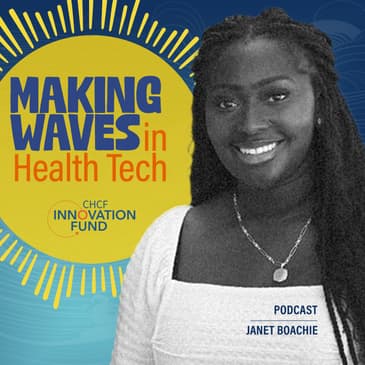
Making Waves in Health Tech is brought to you by California Health Care Foundation’s Innovation Fund. It is created and hosted by Hilda Martinez and Janet Boachie.
Special thanks to Janet Boachie for sharing her story.
Today’s program was produced by Zosha Warpeha and Grace Norman of Mission Boom. Audio engineering is by Zosha Warpeha. Music was composed and performed by Cameron Kinghorn. Art by Moritat and design by Paula Ginsborg. Special thanks to Eric Antebi, Melissa Buckley, Vincent James, the Innovation Fund team, Holly Minch, and Amanda Kim.
The California Health Care Foundation helps Californians with low incomes get the health care they need. Learn more at CHCF.org.
This podcast is a production of the California Health Care Foundation Innovation Fund.
The California Health Care Foundation helps Californians with low incomes get the health care they need. We are an independent, nonprofit philanthropy that works to improve the health care system so that all Californians have the care they need. We focus especially on making sure the system works for Californians with low incomes and for communities who have traditionally faced the greatest barriers to care.
The Innovation Fund partners with emerging companies to bring innovations and technology to California’s health care providers, payers, and patients.
This podcast is a production of the California Health Care Foundation Innovation Fund.
The California Health Care Foundation helps Californians with low incomes get the health care they need. We are an independent, nonprofit philanthropy that works to improve the health care system so that all Californians have the care they need. We focus especially on making sure the system works for Californians with low incomes and for communities who have traditionally faced the greatest barriers to care.
The Innovation Fund partners with emerging companies to bring innovations and technology to California’s health care providers, payers, and patients.
[00:00:00] Making Waves in Health Tech is a podcast about health, equity and innovation
[00:00:06] Today we have a real treat
[00:00:08] My co-host Janet is here to tell the story of her journey as a healthcare professional, tech entrepreneur
[00:00:14] and now is a venture philanthropy leader in the health tech space
[00:00:18] I won't give away her whole story but I'll tell you this about Janet
[00:00:22] She has an innovative and entrepreneurial spirit where she sees problems, she also sees solutions
[00:00:30] While she had the ideas and the talent, the sad truth is that venture backed startups do not have a lot of equal opportunity for women
[00:00:38] and especially for black and brown people
[00:00:41] I'm Hilda Martinez from the California Healthcare Foundation
[00:00:44] Our foundation is a strategic investor in health delivery startups
[00:00:49] We are highlighting innovations that make healthcare accessible and affordable
[00:00:54] Janet's story is the story of why we need purposeful representation
[00:00:59] and why the California Healthcare Foundation's Innovation Fund sought out Janet
[00:01:04] and why we invest in health tech that truly reflects and benefits the communities that we live in
[00:01:10] Let's listen in as Janet tells her story
[00:01:20] While my mom, my sister and I were deplaning
[00:01:22] my mom looked at me with her signature bright and cheesy smile
[00:01:26] Are you excited? She asked
[00:01:28] I looked at her and made a face and I thought to myself
[00:01:31] Mom, after 16 hours, two planes
[00:01:35] and now feeling the suffocating humidity
[00:01:38] would I really be excited?
[00:01:40] To be honest, I was exhausted
[00:01:44] But then I saw a blue sign with the word aquaba on it
[00:01:49] a shanti for welcome
[00:01:51] And that's when it hit me
[00:01:53] I was in Ghana for the first time to visit my dearest grandma Georgina
[00:01:57] At that point, I told my mom
[00:01:59] Actually, I'm excited
[00:02:04] After retrieving her luggage, I heard someone calling my name
[00:02:08] and before I knew what was happening, I was in my grandma's arms
[00:02:11] I was so happy to see her
[00:02:14] After we greeted each other, we made our way through Accra, Kumase
[00:02:18] and finally Wemwase, the village where my family is from
[00:02:22] The road to Wemwase was nothing like the freeways I was used to in the San Fernando Valley
[00:02:26] It was rugged and full of roundabouts
[00:02:29] And despite a lay, I couldn't believe the traffic
[00:02:32] So many trucks, cars and trotros
[00:02:35] which are crowded minibuses jostling with people
[00:02:38] all merged into and emerged out of the somewhat complicated hub safely
[00:02:42] I was fascinated by what looked like controlled chaos
[00:02:46] All the different roads met at a central point
[00:02:49] and then each vehicle exited towards its destination
[00:02:52] In the village, my grandma couldn't wait to introduce us to her friends
[00:02:56] She was very popular
[00:02:58] We were saying hello to what felt like every single person
[00:03:02] But you know, it took me years to realize that to me, she was grandma
[00:03:08] but to the village, she was much more than that
[00:03:12] She was an advocate, a community leader
[00:03:15] and the hub of connection and care
[00:03:17] As just one example of her leadership, she helped open Wemwase's first community bank
[00:03:22] She made sure that resources went to places that mattered most in the community
[00:03:27] I was inspired by her entrepreneurial spirit
[00:03:30] her fierce leadership qualities
[00:03:32] and the respect she had earned
[00:03:34] In many ways, she reminded me of one of those roundabouts
[00:03:38] She was a central point of connection, ideas
[00:03:41] and opportunities for the people of Wemwase to come together and flourish
[00:03:47] Wemwase's first community bank
[00:03:52] Wemwase's first community bank
[00:03:56] Wemwase's first community bank
[00:04:01] Wemwase's first community bank
[00:04:03] After we returned to the US, it was hard for my mom to hear about my grandma's lack of access to healthcare in Ghana
[00:04:10] Because of this, my mom and her siblings brought my grandma back to the US for a much longer stay
[00:04:16] But the family was reminded of a harsh reality
[00:04:20] Here in the US, grandma struggled to find care in our fragmented healthcare system
[00:04:25] A healthcare system that replicates oppressive systems and ideologies
[00:04:29] and hinders vulnerable populations from getting the care that they need
[00:04:33] Every single time my mom would take my grandma to the hospital or doctor's office
[00:04:37] they saw first-hand inequities for people of color and immigrants
[00:04:42] In her frustration, my mom decided to go back to school to become a nurse
[00:04:46] It was her way of contributing to a solution
[00:04:49] I started my own journey into healthcare when I saw a pediatrician who looked like me
[00:04:53] She was the first black woman doctor who cared for me
[00:04:56] and she made me feel seen, comfortable and calm
[00:05:00] It was different from the several doctors visits I had as a kid
[00:05:03] Meeting her unlocked the possibility to dream about how I could be a point of safety and connection for others as well
[00:05:10] As a pre-med student, I interned at a hospital in South LA
[00:05:15] During one shift, I took the vitals of a black woman
[00:05:18] She told me she was in pain and asked me to tell her nurse, which I did
[00:05:22] Now get this
[00:05:24] Four hours later when I went back to take the patient's vitals before leaving my shift
[00:05:29] she said the nurse never came to see her
[00:05:33] She never got pain medication and I found it very odd
[00:05:38] My next rotation was in a busy emergency room
[00:05:41] And the most common statement I heard from patients was
[00:05:44] I've been waiting for several hours
[00:05:47] I could sense a collective feeling of worry, frustration and uncertainty from patients
[00:05:52] On top of that, I saw a hereditary nurse and burnt out doctors who truly wanted to see as many patients as possible
[00:05:58] But too many of the patients simply couldn't wait for hours to be seen
[00:06:02] And for the patients who were able to be seen
[00:06:05] Many ended up returning because their medical needs hadn't been fully resolved the first time
[00:06:10] These experiences bothered me
[00:06:12] So I started brainstorming
[00:06:14] How can I help streamline communication and operations within the healthcare system
[00:06:18] especially for those who were not seen and heard
[00:06:23] During my administrative rotation, I came to my supervisor and asked
[00:06:27] Have you ever thought of using social media to bring the community closer to doctors?
[00:06:32] She hesitated but I could tell the idea resonated
[00:06:36] We had the opportunity to be innovative and think outside the box a little bit
[00:06:40] And we discovered most patients had a cell phone
[00:06:43] So we experimented using social media to offer general health-related information to patients
[00:06:50] The idea was success
[00:06:52] And I realized that if I had the right resources, I could make a big impact with even more tech-based solutions
[00:06:59] I knew I had reached another roundabout in my path
[00:07:02] And my next exit would take me into health tech entrepreneurship
[00:07:05] Definitely not what my mom had imagined as a career for me
[00:07:08] My interest was in merging healthcare and technology to specifically benefit marginalized populations
[00:07:26] I kept asking, how can I enhance the patient experience?
[00:07:30] How can I build sustainable trust between the underserved patient population and the healthcare system?
[00:07:36] Most technology solutions at the time did not focus on underserved communities
[00:07:40] And I wanted to find a way to meet patients where they are
[00:07:43] I founded a startup using voice-enabled technology to alert patients with critical and timely information
[00:07:49] Patients could communicate in real-time and get insights on estimative way times of emergency rooms or urgent cares
[00:07:55] Rather than waiting hours at the hospital
[00:07:58] But it was difficult to find investors who aligned with my mission
[00:08:02] They said things like, why underserve populations? There's no money in this market
[00:08:07] At the same time, friends of mine, other entrepreneurs of color
[00:08:12] Were also building companies that were designed specifically for their communities
[00:08:16] And informed by the wisdom of lived experience
[00:08:19] I watched as they pitched in competitions and accelerators
[00:08:22] And saw their brilliant solutions place last time and again
[00:08:26] And then at those same competitions, a non-person of color would come along with a similar solution
[00:08:32] And they would get funding
[00:08:34] Because their focus was not on diverse populations, money could be made
[00:08:38] And this is what investors want
[00:08:41] Look, I understand that a business needs to make money
[00:08:44] But investors should be asking, what are the outcomes we're really trying to achieve?
[00:08:49] Better yet, what outcomes might we miss?
[00:08:53] I entered yet another career roundabout that led me to the California Healthcare Foundation Innovation Fund
[00:08:59] I saw an opportunity to merge what I had learned as an entrepreneur
[00:09:02] To highlight the barriers of developing community-centered tech-enabled services
[00:09:07] I knew I could influence how investors think and how they interact with entrepreneurs, especially entrepreneurs of color
[00:09:14] I'd be joined in a group of very few black women investors who are working to change the conversation in the investment world
[00:09:21] And you know, I'm realizing how much of a pivot that is
[00:09:25] Going from being the entrepreneur, struggling to make the pitch
[00:09:29] To now being the investor
[00:09:31] Yet an insider who can understand what entrepreneurs experience
[00:09:36] Who can support diverse entrepreneurs, provide capital
[00:09:40] Make connections to potential partners, advisors and mentors
[00:09:43] And also share my insights
[00:09:46] We're seeing a shift where more and more entrepreneurs are leveraging their lived experiences to do two things
[00:09:51] One, design tech solutions that challenge current healthcare barriers and improve quality of care
[00:09:56] And two, achieve both profitability and health equity
[00:10:01] These are the people we want to support because they have ideas that serve our communities
[00:10:06] We should be supporting and elevating these entrepreneurs and their solutions
[00:10:11] In healthcare especially, in addition to evaluating economic risk
[00:10:15] We need to consider the risk of missed opportunity
[00:10:18] We can and should take risks on people with ideas to solve big problems in healthcare
[00:10:23] This demands a support from both investors and delivery system leaders
[00:10:27] We need to connect entrepreneurs with the right partners
[00:10:30] And fuel them with opportunities to bring their solutions to the people who need it the most
[00:10:34] I think about my grandma often because
[00:10:43] Not only do I miss my biggest advocate, I aspire to have the same impact as she did
[00:10:49] My work at California Health Care Foundation Innovation Fund brings together entrepreneurs
[00:10:54] Investors, policymakers, payers and providers
[00:10:58] And aligns them in developing innovative ways to expand access
[00:11:02] And achieve positive health outcomes
[00:11:04] Think of it as its own unique digital health roundabout for providing care
[00:11:08] As one can see, my career path wasn't linear
[00:11:12] But each destination brought me a stronger, more diverse, and more capable network
[00:11:18] And new opportunities have brought me to where I am now
[00:11:22] And in this way, I'm more like my grandma than I ever thought possible
[00:11:33] Yes, yes, yes
[00:11:36] It bears repeating, immigrant families are, by nature, entrepreneurial
[00:11:41] We have to be
[00:11:43] And so many have not only survived but thrived
[00:11:47] Imagine if the health tech sector and every sector honestly
[00:11:51] Didn't have such high barriers for inclusion
[00:11:54] People from all places and all walks of life offer ideas and hard work
[00:11:59] That can strengthen communities and build a more equitable society
[00:12:04] You know, I really want us to get there in being able to really support
[00:12:09] Diverse entrepreneurs who are building such amazing solutions that are impacting the health care space
[00:12:16] To be honest with you, when I was writing my story, it was really hard for me not to cry
[00:12:21] One, because when I think about my grandma and the work that she did
[00:12:26] It was very influential
[00:12:29] And I miss her a lot and it just gave me the fuel that she's there in spirit
[00:12:35] When I think about the work that I did at California Health Care Foundation's Innovation Fund
[00:12:41] I'm so proud of it, right?
[00:12:43] I share a lot of joy that myself and my team accomplish what we accomplished
[00:12:49] But what was frustrating for me is that the work that we've been doing
[00:12:53] Is only a dent in the work that needs to be done
[00:12:57] The health equity and technology space, the intersections of those two spaces
[00:13:01] Is a lot smaller than we think it is
[00:13:03] Connecting entrepreneurs with the right partners and the right advisors
[00:13:08] And the right mentors is so hard, right?
[00:13:11] I'm just really happy that within the last couple of years
[00:13:15] There have been organizations along with CHCF that have come together to provide
[00:13:20] Extended support to entrepreneurs who are looking to build
[00:13:24] An impact and disrupt a health tech space or the health care space overall in general
[00:13:28] I really do believe that we can end inequities if we have a collective will
[00:13:32] And if we put our resources behind it
[00:13:35] So overall, if you are an entrepreneur who is looking to build a solution
[00:13:41] Do not shy away from it, it's difficult
[00:13:44] But don't shy away from it because we need your insights
[00:13:46] We need your passion
[00:13:48] We need your lived experience
[00:13:49] We need you to keep this going because there are organizations out there
[00:13:54] That say they want to focus on DEI
[00:13:56] But it's slowly becoming less of a priority and we need to keep moving forward
[00:14:01] Pursue your purpose
[00:14:03] Be an activist, be an entrepreneur
[00:14:06] Change what needs to be changed
[00:14:08] Because we really do need you
[00:14:10] Thank you Janet
[00:14:12] I agree with your optimism
[00:14:14] And I also agree that there is a whole lot more that we need to do
[00:14:18] And we've just started to make a dent
[00:14:22] And then we just say that I am so grateful that you continue to be a leader in this work
[00:14:27] And my partner on this podcast project
[00:14:30] It's been such a joy, man
[00:14:32] It's been truly a joy to work with you on this podcast
[00:14:37] And spend time with you
[00:14:39] And really be your partner in this
[00:14:42] And honestly, I'm very grateful for CHCF
[00:14:45] Because they've been very supportive of me and the fellows overall
[00:14:49] You know, I think everybody shares the same optimism that we have
[00:14:53] And I'm really truly grateful for it
[00:14:56] That's really kind of you Janet
[00:14:58] I do really appreciate those words
[00:15:00] We have so many entrepreneurs to meet
[00:15:02] And I'm so excited that our listeners get to hear from them directly
[00:15:07] For our listeners, please share this podcast
[00:15:10] I'm sure it will inspire someone
[00:15:14] And thank you again, Janet, for sharing your story
[00:15:17] Thank you, Ildo
[00:15:18] Until next time
[00:15:44] Learn more at CHCF.org