
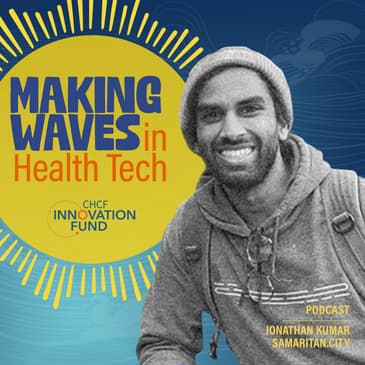

Having benefited from social services and the kindness of community members growing up as a first-gen immigrant, Jonathan had a lot of empathy and drive to build a company that centers around providing resources and hope for those without a home.
California Health Care Foundation invested in his early-stage start-up, which leverages a mobile app, an online community, and financial technology to empower people experiencing homelessness to meet their health care, housing, and other immediate needs.
Over time, Samaritan built a business with multiple funding streams, including corporate philanthropy, health care and social service providers, and Medicaid. Since then, Samaritan has grown to help cities across the nation.
Samaritan shows that purpose and profit coexist in startups. We learn about the company's business model, including the vision, challenges, and opportunities. Jonathan also offers advice for other social entrepreneurs getting started in the healthtech space.
This podcast is a production of the California Health Care Foundation Innovation Fund.
The California Health Care Foundation helps Californians with low incomes get the health care they need. We are an independent, nonprofit philanthropy that works to improve the health care system so that all Californians have the care they need. We focus especially on making sure the system works for Californians with low incomes and for communities who have traditionally faced the greatest barriers to care.
The Innovation Fund partners with emerging companies to bring innovations and technology to California’s health care providers, payers, and patients.
[00:00:00] Making Waves in Health Tech is a podcast about health, equity and innovation.
[00:00:06] The cost of living has skyrocketed, leaving many people unable to afford a place to live.
[00:00:12] Being unhoused can dramatically impact health and well-being. People who experience homelessness
[00:00:18] have higher rates of illness and die on average 12 years sooner than the general US population.
[00:00:25] Today on Making Waves in Health Tech, we meet Jonathan Kumar of Samaritan.
[00:00:30] Samaritan tackles one of the most complex problems that face cities,
[00:00:35] the rising number of people experiencing homelessness and the health problems that arise as a result.
[00:00:43] And I'm Hilda Martinez from the California Healthcare Foundation.
[00:00:46] The Foundation's Innovation Fund is a strategic investor in tech-enabled healthcare
[00:00:51] delivery startups. Everyone is deserving of healthcare, but not everyone has a fair chance at it.
[00:00:57] We are looking for innovations that make healthcare accessible and affordable.
[00:01:02] We want to inspire other health tech entrepreneurs, and on a deeper level,
[00:01:06] we're seeing how tech is solving some of the most complex issues.
[00:01:10] So without further ado, let's get into it.
[00:01:19] Jonathan!
[00:01:20] What up, Janet girl? I'm going to see you or hearing your voice again.
[00:01:24] It's great to hear your voice. Thank you so much for joining us.
[00:01:28] We're super excited to have you talk to us about you, your work with Samaritan,
[00:01:35] the work that you've been doing in California and across the country.
[00:01:38] So tell us a little bit more about your work and tell us a little bit more about Samaritan.
[00:01:44] Samaritan is a support platform that helps people who don't have a stable home access
[00:01:51] the financial capital as well as the social capital needed to enter a stable home as quickly as possible.
[00:01:59] Walk us through the platform, say for example, if I were to be a user of Samaritan,
[00:02:04] what would my journey look like using the platform?
[00:02:07] Yeah, absolutely. So people on the street or near the street will get invited to become a
[00:02:13] Samaritan member and they get invited by our health and human services partners.
[00:02:18] So Samaritan will contract our license, like our financial and social support platform to
[00:02:24] health and human services that are serving this population. Medicaid plans, hospitals, clinics,
[00:02:31] traditional social services who get to use Samaritan to better support last mile populations
[00:02:38] that they're serving that have experienced chronic homelessness and other traumas,
[00:02:42] other conditions. We provide these smart wallets, these physical smart wallets to these
[00:02:47] organizations who then use them as a resource on the street, in street outreach or in case
[00:02:54] management or shelter settings often in hospital and clinic settings to offer as a resource for
[00:02:59] someone who is in great need. I want to make it clear that we're not solving homelessness.
[00:03:06] We don't own any buildings or not constructing any apartments and the solution to homelessness
[00:03:11] is in the name itself. It's a home, it's housing. But we see a couple of things. One,
[00:03:19] if you provide cash and social support to people directly, we think of them as raw materials.
[00:03:28] People often know how to build something for themselves. They have aspirations, they have
[00:03:32] goals, they have families they want to reconnect to, dependents that they want to claim or
[00:03:38] grant children they want to live next to and get ice cream with after school.
[00:03:45] There's regular people. We just want to get behind them and we're excited to be aligning
[00:03:52] massive healthcare industry and the dollars behind that into this population. However, we can.
[00:03:59] I'm going to give you a hypothetical scenario based on a story you told me once.
[00:04:03] Let's say someone is experiencing homelessness. She was recently injured and the injury got
[00:04:08] infected. She did get help. She was admitted to a hospital who treated her, but on discharge,
[00:04:14] didn't know what to do or where to go. Is her stuff where she left it? How would she get there?
[00:04:22] On discharge, someone might invite you or talk about you taking a Samaritan membership card
[00:04:29] or becoming a Samaritan member. They'll show you this fancy looking credit card thing that
[00:04:34] my team designed. It carries $10 on it to start and then if you want, you can get signed up and you
[00:04:41] can basically share some top level goals that you have for your own life and then break those goals
[00:04:46] down into immediate action steps and needs based on your situation, based on maybe
[00:04:53] what that social worker at the hospital is helping you figure out. One of those action
[00:04:59] steps might be for you to establish care at this really awesome community center called St. John's.
[00:05:06] In St. John's case, they offer both ongoing longitudinal care for your wound that you came
[00:05:13] into the hospital with, but they also offer social care, things related to how you're
[00:05:18] connecting to your community, to housing, to employment. You'll get $10 just for
[00:05:25] becoming a member and then you'll get $10 more by checking in with Esther, let's say, at St. John's.
[00:05:32] Once you have a Samaritan card, you start to earn bonuses, five, ten, $20 bonuses for taking
[00:05:39] positive action steps related to your own housing journey, your health journey, your
[00:05:43] journey to access income. If you have needs that are barriers to those action steps,
[00:05:50] you just need to share them with Samaritan and we have a network of philanthropic
[00:05:57] good Samaritans who will often fund those things and provide financial support, but also just
[00:06:04] wards of encouragement that you'll get through text or email or your case manager at St. John's.
[00:06:09] The sum total is that you'll be able to access this financial support and this social support
[00:06:15] connected to your own goals and your weekly or daily journey to reach those goals.
[00:06:24] One of the cool things about having founders here with us is that we get to learn about how
[00:06:29] the companies were founded. For those who are listening, could you please tell us how you
[00:06:34] started your company Samaritan? Was there a particular point in your life that you thought,
[00:06:39] okay, this makes sense or there's a need that I want to address?
[00:06:44] Yeah, definitely. It goes back to even before I was born really. My parents got a chance to
[00:06:52] immigrate to the States from South India in the late 80s and they went to Buffalo, New York
[00:07:00] of all places. Basically my dad was there, a study, my mom wasn't working and I was around so
[00:07:05] the three of us were very much in a position of need. We were living off a student's type
[00:07:09] and of about $600 to $800 a month, we were in public housing or on Medicaid and all of that stuff,
[00:07:14] food stamps. It was a position of vulnerability. We were never homeless, never on the street.
[00:07:21] We basically had a group of people from a local ministry, adopt my parents and they
[00:07:28] sort of brought them in almost like they were their own kids and provided friendship and also
[00:07:34] financial resources, legal support for us and it was just so catalytic for us being able to make it
[00:07:40] and be successful in those first five years or so while my dad was finishing up school and
[00:07:45] applying for jobs, etc. Once my dad got a job, things were mostly on the easy street for my
[00:07:50] family, moved to the Midwest. I studied at the University of Michigan, studied design
[00:07:56] and user experience design specifically but you never really forget what that experience
[00:08:01] was like and so fast forward 25, 30 years I'm in Seattle, Washington at a startup and I'm thinking
[00:08:07] about what my next step might be and as I'm puzzling through that career process just
[00:08:13] notice how pervasive homelessness, human suffering was in this beautiful city around me.
[00:08:20] As someone deep into product and user experience design, wanted to better understand that user
[00:08:25] experience so I just started spending time with people on the street talking to them,
[00:08:29] understanding a couple basic questions like how do you lose your housing, where have you come from,
[00:08:34] where are you trying to go, what's keeping you from getting there. Just learned a ton from these
[00:08:49] conversations and there's one conversation in particular that stood out to me. He was a guy
[00:08:55] flying a sign at a street corner downtown Seattle and the intersection that he was at was about
[00:09:01] 50 yards away from a lunch spot and so I was eating this outdoor, rare sunny day in Seattle
[00:09:07] I was outdoor lunch looking across the street kind of watching this guy while he's eating my
[00:09:11] sandwich or whatever and so I finished the sandwich and 15 minutes later 20 minutes later
[00:09:15] he's still there and as far as I could tell not a single person had even acknowledged that he
[00:09:20] existed. A bunch of cars drove by, a bunch of people walked by and just no one really responded
[00:09:25] with or engaged with him. So I went up to him. I want to again better understand that
[00:09:30] user experience like so I asked him like excuse me do you mind if I ask you what you feel
[00:09:35] your challenges are in terms of raising this money. So he had a sign out that read I need
[00:09:41] medication for the diabetes in my feet. He's standing there gingerly and he's asking for this
[00:09:47] help and I'm asking him what do you feel like quite a few people aren't supporting you.
[00:09:53] And he basically said well I've got the wrong look for this, the wrong clothing,
[00:09:59] the wrong skin color, nobody actually believes me. Nobody actually believes I am who I say I am.
[00:10:07] And you know it was like hard for me to hear for sure when he said that.
[00:10:13] You know my next question after kind of receiving that for a second was if you don't
[00:10:18] have any money you shouldn't have to pay for your medication. Do you have access to a doctor
[00:10:23] or something you know that could give you this for free, this medication? And he said
[00:10:28] yes I have a doctor through the shelter I'm staying at but he only trusts me with about a
[00:10:35] fifth of what I need on a monthly basis to manage the pain. He doesn't want to give me more because
[00:10:46] he thinks I'm either going to sell it or get addicted to it. And so you know just like a really
[00:11:08] stark conversation that showed me the lack of social capital this individual had and you know
[00:11:15] both from a community sense as well as from a professional provider standpoint.
[00:11:19] It wasn't the only conversation I had that led me to want to really take a shot at solving for it but
[00:11:26] it was a critical crucial one. Just started taking steps forward to address not just a
[00:11:31] financial poverty but really the relational poverty that this person had to the extent that he
[00:11:36] had felt like he had to go beg strangers on a street corner for the help that he needed.
[00:11:40] And I don't think we need to have people doing that. I've been working to put teams of
[00:11:47] volunteers as well as professionals around each person, each Samaritan member so that they can
[00:11:53] access the financial and also the in kind resources they need to be healthier, be housed
[00:12:00] and you know be self-sufficient. You mentioned something that really
[00:12:03] cut my interest and that was the relationships connecting people and how that is sometimes
[00:12:10] missing and is really important particularly when you're dealing with people experiencing homelessness.
[00:12:15] I think one thing that gets tragically forgotten around homelessness is just
[00:12:20] you know how isolating and depressing that that state can be and how often you know it's
[00:12:28] reinforced that this is who you are and you're not going to be anything better
[00:12:34] and you might as well accept that. This is how little you matter you know to society.
[00:12:41] You know your stories of people being looked through, sped upon and it's just awful and it's
[00:12:47] really I think hard to keep positive and it's really easy to get kind of shaken off of
[00:12:53] your point and fall into depressive or you know dangerous states. You also look at research that
[00:13:01] shows that for foster youth actually that hopefulness is you know as you're able to measure it is one of
[00:13:09] the greatest predictors of outcomes or success for foster youth. It has the most impact on outcomes
[00:13:15] than the other variables they were testing with idea that hopefulness is an emotional
[00:13:20] well-being is so critical for people to actually make it out of their situation which takes concerted
[00:13:25] effort you know for weeks or months, 26 steps you know to get in this table housing.
[00:13:32] The impact that social support from strangers, from everyday people who are not being paid to be
[00:13:40] their friend or their case manager, it makes such a big difference when we started testing
[00:13:45] this in 2017 long time ago. We were giving people 50 bucks and this 50 wasn't coming from some
[00:13:50] like government office it was coming from 10 people who chose to give that person $5 and
[00:13:57] that had significance you know the fact that it was coming from Martha and Jonathan.
[00:14:02] Our members get text messages or emails or if they don't have a phone or email they get it
[00:14:07] through their case manager they see the names and they see the words of our Samaritans who
[00:14:12] who are giving at least first names. We hear time and time again that that you know makes a difference
[00:14:17] you know the fact that these people want to invest in me makes me want to invest in myself
[00:14:23] that's what I would share to someone who's not sure about the necessity of addressing some of those
[00:14:28] social needs. People need more than their physical needs taken care of they are some
[00:14:32] deep emotional needs as well. The same thing goes for rich people too right it's like
[00:14:38] whether you're rich or poor yeah you need a team you don't have that as a serious problems again it
[00:14:44] applies for both poverty and prosperity you know we see the repercussions of that and it's harder
[00:14:50] hard for people in the street it's harder for people off the street to access that all the time.
[00:14:54] You've talked a little bit about the impact on people who are experiencing homelessness what
[00:14:59] about the impact on the providers those that are providing the care have you seen an impact
[00:15:05] there as well? Yeah I mean would love to be able to have them speak on their own accord but yeah we
[00:15:13] see that in the data we see that you know when you give people a Samaritan membership when they
[00:15:20] start you know receiving these tangible benefits or rewards you know these action step bonuses
[00:15:26] or the dollars or these words of encouragement around meeting you know very real needs like
[00:15:31] people's capacity just increases and people are able to be more proactive around accessing care
[00:15:39] whether it be you know social services or primary care the word proactive has come up
[00:15:43] several times in our work when we hear a back from our the front line partners using Samaritan
[00:15:50] in outreach or hospitals or clinics it's a really cool tool for them to use in their work to
[00:15:58] help you know drive outcomes. It sounds to me that there's something about the words of encouragement
[00:16:07] and also the community support would you say that's one piece of you know the Samaritan platform
[00:16:12] that's very valuable for some of your members? Yeah the message support you know incredibly
[00:16:18] meaningful for some of them and I think it's important yeah to distinguish that it is
[00:16:23] you know a portion but not all of them because you know folks are so different some people they don't
[00:16:28] need words of affirmation. Some people need you know structure and bonuses some people just need
[00:16:35] cash in their hands some people don't really need the money it's about being reminded that they
[00:16:41] matter and are worth something you know to help them choose to take steps forward.
[00:16:47] Curious about what have been some of the biggest challenges that you've faced with Samaritan and
[00:17:06] how have you overcome them? One challenge has been like you know the members themselves they don't
[00:17:12] have a lot of things that are designed for them and so pretty quickly we're able to see like okay
[00:17:16] this is making a difference that they appreciate they want to use and they're engaged with
[00:17:21] but making sure that this is not only a win for the members but a win for the front line
[00:17:26] organizations where they're like seeing a significant value add was you know a challenge for us
[00:17:33] and still is sometimes but learning how to you know deliver a unique value a compelling value
[00:17:39] proposition again not just to the user but like the frontline caregivers to align the intervention
[00:17:48] with their own goals and their own needs and their own initiatives and their existing
[00:17:55] workflows it has been a challenge and is now I would say is an area of strength for us if you talk to
[00:18:01] you know our frontline partners and so that was a big challenge that took you know years to
[00:18:07] that has taken years and will continue to take years to figure out how to do the right way in a
[00:18:11] way that not just benefits again the user but the implementing partner the case managers so forth
[00:18:17] the second big challenge is like we've iterated through a lot of business models again we kind
[00:18:21] of had our user figured out and we knew that we could create value for them and it's just like
[00:18:25] okay how do you get paid for that is it as a nonprofit you know I think most service is targeted
[00:18:30] towards this population of nonprofit we are technology based and so we decided to be a
[00:18:37] benefit corporation that had a social mission but could raise capital to build technology
[00:18:42] it's hard to build technology based nonprofits access to capital is limited when you know
[00:18:47] you're asking donors to pay iPhone developers versus you know provide food or clothing or housing
[00:18:54] directly I guess our mission at the front was you know we want to deeply impact people without a
[00:18:59] home at scale we wanted to reach more than 100,000 lives we needed to find partners that we could
[00:19:06] create incredible value for and and we wanted to do it for more than just you know donors
[00:19:13] we wanted to do it for a customer someone who had a repeatable problem that we could help solve for
[00:19:19] and that we felt we could scale faster through solving customer problems than versus solving
[00:19:26] only donor problems who that customer would be whether it be you know city governments or
[00:19:34] individual nonprofits delivering care or you know downtown I mean we went through a lot of
[00:19:40] business models our target customers you know downtown business associations or real estate groups
[00:19:46] or yeah the city county government like we've been through a lot of things and so
[00:19:51] how did we overcome that you know we were able to survive long enough to get enough you know
[00:19:56] contracts put together with hospitals and and and Medicaid plans to now give us a really good
[00:20:03] shot at scaling to reach that 100,000 number we have served about 2,000 people so far
[00:20:09] who have been on the street you know help them you know take an action step or to meet a need
[00:20:14] and that's something I think I mean yeah 2,000 people it's a lot of people
[00:20:19] you know something we're proud of but also it's just you know a starting point
[00:20:26] let's talk a little bit about your business model how is it that Samaritan gets paid
[00:20:33] so our customers are Medicaid plans and also hospitals like any any
[00:20:39] healthcare entity or government entity that's serving this population or is you know bearing
[00:20:45] financial responsibility for them could be a customer of ours typically when you're on the
[00:20:52] street it's really really hard for you to engage with resources healthcare services social
[00:20:57] services just so many different things that you're supposed to be doing and and and like very
[00:21:02] little capacity to do any of them consistently just because again you're not sleeping well
[00:21:07] you're you're fearing for your safety you may not have a place that's for your belongings
[00:21:12] may feel like you can't go anywhere because you haven't been able to bathe in the last week or
[00:21:19] you don't have clean clothes and there's just so many reasons that can enter a progress
[00:21:25] and so you know our customers have a really tough time getting resources that are available
[00:21:31] adopted by these individuals these these last mile patients or members and so they'll
[00:21:37] essentially contract Samaritan you know hey give us a list of a thousand folks that they're having
[00:21:43] trouble reaching or helping or you know just constantly seeing in the hospital and it's
[00:21:48] sort of this revolving cycle and of you know degrading health and increasing costs and
[00:21:54] they'll just say you know hey see if you can get 200 of these folks off of this list of a thousand to
[00:22:01] you know find a way to get them the Samaritan membership and get them financial social support
[00:22:06] that they can leverage to a survive and b you know make strategic progress towards their goals
[00:22:12] we could pay either monthly fee per person that's using Samaritan or an annual fee
[00:22:17] that covers our costs I think one of the biggest things about creating a solution for people
[00:22:25] experiencing homelessness or Medicaid is that when you try to get funding people get so well
[00:22:31] traditional venture capitalists sometimes they get so weary they're like oh Medicaid ooh you know
[00:22:36] because they're so focused on financial return right I'm hopeful that you know in the future
[00:22:42] that there are more environments created to enable social entrepreneurship I know that like
[00:22:48] venture philanthropy is you know newer and there may be some growth but you know how do we
[00:22:55] help people start nonprofits with capital that you know that grows over time as milestones are
[00:23:01] achieved how do we help you know startups that choose a for-profit tax status to access
[00:23:08] the capital that they need to test their ability to scale for the founders themselves
[00:23:14] spending as little time building as possible and as much time you know selling as possible
[00:23:22] so you know like sticking with the basics around interviewing folks validating problems
[00:23:28] validating markets so less time building 30 page business plans more times spent with
[00:23:34] the user spent with your customer getting pre-orders getting commitments and then as it relates to
[00:23:40] financing and fundraising and stuff just being focused on milestones for your organization and
[00:23:48] trying to show hey you know for us to get to this seed financing where we could raise $2 million
[00:23:57] we need to do these three things or we need to do these five things
[00:24:00] I like to ask this next question of founders that we have on our podcast because I think that
[00:24:07] it gives us insight from founders about what makes them tick and they always provide such
[00:24:13] interesting and motivational responses what excites you about the work that you do
[00:24:21] the things that have excited me most in terms of the work the last couple years I mean I
[00:24:26] remember very distinctly getting our first dollar delivered from a Samaritan to a Samaritan member
[00:24:33] and just how amazing that was and you know seeing it you know not just the dollar a few more you
[00:24:39] know redeem for something meaningful and then seeing our first life changing outcome
[00:24:44] hearing that a member went because of a relationship they built through Samaritan
[00:24:49] they they you know connected like there's so many cool stories on our website of people who
[00:24:54] have taken these action steps and as a result have met people you know develop a relationship
[00:25:00] with a case manager or an employer that ended up leading to a housing entrance or a job or
[00:25:07] something like that like just seeing that first life changing outcome and then the 50th life
[00:25:12] changing outcome and now more those stories as people those situations like truly excite me and
[00:25:19] excited our team and you know we start to see it now not in just Seattle where we started but
[00:25:25] in Baltimore or in Jacksonville or in Louisville or in LA or in you know we're launching in Oakland
[00:25:33] and Sacramento and San Diego and you know seeing the first like the first second city or you
[00:25:40] know the third city or now we're in eight markets that's you know exciting and again
[00:25:46] now having enough proof points enough outcomes to justify these partnerships with national
[00:25:53] organizations that are serving tens of thousands of people that don't have housing that are
[00:25:59] struggling with poverty mental illness substance use the justice system and just seeing like this
[00:26:07] wide sea of people that we can that we can serve and will serve with enough time that is
[00:26:13] exciting so it's like the life changing outcomes for one person and thinking like man we really could
[00:26:19] we could really do this we could really grow to serve 100,000 people and see that type of impact
[00:26:24] multiplied those are exciting things wow oh my goodness thank you so so much Jonathan not
[00:26:34] only for you know joining us today but all of your work because you know for people who
[00:26:39] are experiencing homelessness that is a population that not a lot of people really you know develop
[00:26:45] solutions for and you know you are one of the few entrepreneurs that we've seen that really addresses
[00:26:52] you know how we can be more helpful to them and so you know we're really appreciative again for
[00:26:58] you being really open with us sharing your story and sharing the stories of some of your
[00:27:04] members and sharing the stories of some of you know the partners that you work with and so
[00:27:09] again thank you so much the evidence is pretty clear that social determinants of health like
[00:27:19] safe housing significantly impact health outcomes one of the aspects of Samaritan's work that really
[00:27:26] sticks with me is that we know people are experiencing homelessness and that they're
[00:27:31] struggling with financial poverty but perhaps what we don't think about enough is what Jonathan
[00:27:37] calls relational poverty they lack the connections to people and resources who can provide the help
[00:27:44] and the support that they need and that's really a critical piece in developing hope
[00:27:50] and the structure needed to find a stable home I really appreciated how Jonathan said that we
[00:27:55] all need a team regardless of what our situation looks like and the cool thing is is that with
[00:28:00] all of our founders it's awe inspiring to see how much humanity can exist in tech startups
[00:28:05] that is what's needed another big takeaway for me is how Jonathan is bridging healthcare with the CBOs
[00:28:14] you know one thing I want to emphasize on is that there aren't a lot of tech solutions designed
[00:28:18] for people experiencing homelessness now Samaritan alone cannot solve all the problems but what's
[00:28:24] interesting is that Samaritan is the first mover in the space you know they're building
[00:28:28] the blueprint and another entrepreneur can come in and build on top of that foundation and to
[00:28:34] add to that because Samaritan is centered on health equity the company attracted funding from a wide
[00:28:40] range of sources including venture capital corporate giving and philanthropy in addition to their
[00:28:47] contracts with Medicaid plans and hospitals it could be that diversifying income sources helps
[00:28:52] a purpose-driven company like Samaritan withstand an economic downturn like the one we had during
[00:28:58] the pandemic I invite you to check out Samaritan at samaritan.city and look forward in your favorite
[00:29:05] app marketplace it's an important service and it's a fascinating model that straddles the worlds of
[00:29:11] innovative technology and helping others and that's all we wrote I look forward to our next
[00:29:16] conversation ill-deck igualmente likewise until next time making waves and health tech is
[00:29:25] brought to you by California healthcare foundation's innovation fund it is created
[00:29:29] and hosted by Ilga Martinez and Janet Boatjie today's program was produced by Zosia Warpale
[00:29:35] and Grace Norma of Mission Boom audio engineering by Zosia Warpale music composed and performed
[00:29:41] by Cameron King Horne the California healthcare foundation helps Californians with low incomes
[00:29:46] get the health care they need learn more at chca.org