
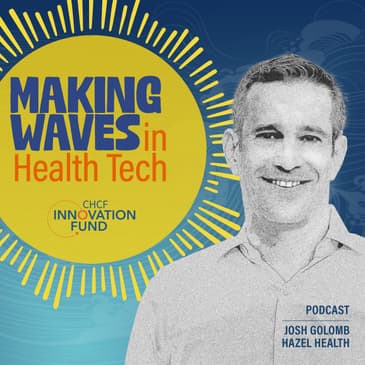

Making Waves in Health Tech is brought to you by California Health Care Foundation’s Innovation Fund. It is created and hosted by Hilda Martinez and Janet Boachie.
Special thanks to Josh Golomb and everyone at Hazel Health.
Today’s program was produced by Zosha Warpeha and Grace Norman of Mission Boom. Audio engineering is by Zosha Warpeha. Music was composed and performed by Cameron Kinghorn. Art by Moritat and design by Paula Ginsborg. Special thanks to Eric Antebi, Melissa Buckley, Vincent James, the Innovation Fund team, Holly Minch, and Amanda Kim.
The California Health Care Foundation helps Californians with low incomes get the health care they need. Learn more at CHCF.org.
This podcast is a production of the California Health Care Foundation Innovation Fund.
The California Health Care Foundation helps Californians with low incomes get the health care they need. We are an independent, nonprofit philanthropy that works to improve the health care system so that all Californians have the care they need. We focus especially on making sure the system works for Californians with low incomes and for communities who have traditionally faced the greatest barriers to care.
The Innovation Fund partners with emerging companies to bring innovations and technology to California’s health care providers, payers, and patients.
[00:00:00] Making Waves in Health Tech is a podcast about health, equity and innovation.
[00:00:06] We all want the best for our kids right?
[00:00:09] But what does that mean when we are facing a mental health crisis that exploded during the pandemic?
[00:00:15] School nurses can traditionally treat, scrape knees, small bumps and headaches.
[00:00:20] Today students increasingly need more serious medical care.
[00:00:25] In California, more than 284,000 youth deal with major depression.
[00:00:30] But 66% don't receive treatment.
[00:00:34] In this podcast we explore pressing problems in healthcare and how it's delivered
[00:00:39] and how innovative founders are tackling these problems with success.
[00:00:43] Making Waves in Health Tech is a limited series podcast that explores health care innovation
[00:00:48] through the lens of diverse entrepreneurs.
[00:00:53] Josh Goulam leads Hazel Health, which is a national leader in school-based telehealth.
[00:00:58] Hazel Health offers high quality care to every child.
[00:01:01] This helps students stay healthy so that they can learn and help them reach their full potential.
[00:01:06] One of the keys to their success is the company purposefully recruits linguistically
[00:01:11] and culturally diverse providers to make sure there are no barriers to care.
[00:01:15] And what's more, Hazel Health services come at no cost to students or their families.
[00:01:21] How do they do it? What is their business model?
[00:01:24] How do they make money doing mission-based work?
[00:01:27] I'm Janet Poachy and I'm Eelda Martinez from the California Healthcare Foundation.
[00:01:31] The Foundations Innovation Fund is a strategic investor in healthcare delivery startups.
[00:01:36] We are highlighting innovations that make healthcare accessible and affordable.
[00:01:40] Everyone is deserving of health, but not everyone has a fair chance at it.
[00:01:45] Get to know Josh to understand this health technique that is making a big impact on youth.
[00:01:51] Josh, welcome to the Making Waves Podcast.
[00:01:54] Now first things first, can you tell us a little bit about Hazel Health and your work?
[00:02:00] So at Hazel Health, we partner with schools to provide access to short-term physical
[00:02:05] and mental healthcare for K-12 students.
[00:02:08] And so that means is whether a student has sore throat or allergies
[00:02:13] or is feeling anxious or depressed, they can go to the school health office
[00:02:17] and get access to one of the amazing and very diverse group of Hazel providers
[00:02:21] trained to provide care virtually while kids are at school or at home.
[00:02:26] And for kids that need longer on to go in care, we'll get them there as well.
[00:02:30] A lot of our work is connecting them to a local provider for ongoing care.
[00:02:33] Today we're working across 14 states, about 3,000 schools, 160 school districts
[00:02:39] and that represents about 4 million kids of access to services via Hazel
[00:02:44] and I have to give a shout out.
[00:02:46] Also, I'm also a parent at the same time of my own three boys.
[00:02:49] So Gabriel, who's 18 and my twins Nico and Mateo, who are 16.
[00:02:55] So Hazel isn't your first startup.
[00:02:57] I know that you had a previous company where you would provide care for adults
[00:03:00] at their workplace making it easier to work and to get care, but something shifted for you.
[00:03:06] So can you tell me a bit about why you started working in schools?
[00:03:09] Gabriel, my oldest, if I go back in time 18 years when we were starting my first company
[00:03:14] when he was born, actually when he was about 18 months old,
[00:03:17] my wife and I found out that he was deaf.
[00:03:19] It turns out we both have a recessive gene for deafness
[00:03:22] and we didn't know about.
[00:03:23] We thought because we were raising a new bilingual that that's why it was delayed
[00:03:26] but we actually found out that he had this existing condition.
[00:03:29] And so it was right while I was working in healthcare building in models
[00:03:33] had this experience of trying to get Gabe everything that he needed
[00:03:37] and a very similar theme of this idea of...
[00:03:41] Every doctor we met was great, but it was so hard to get Gabe all the access to services that he need.
[00:03:47] And here we were, I work in healthcare.
[00:03:50] I have a lot of doctors who are friends now that I work with and collaborate with.
[00:03:54] We have good insurance.
[00:03:55] I speak English in the native language
[00:03:57] and it was still so hard to navigate everything that we needed
[00:04:00] and so many of the parents and families met along that journey
[00:04:04] did not have those same privileges.
[00:04:05] We're immigrant families, did not how to navigate the system,
[00:04:08] did not have insurance or unmedicated.
[00:04:10] So the big vision for us was what would it be like if we could give kids
[00:04:15] and their parents a great experience while they're school age
[00:04:18] where not only could we address whatever that need they would have right then and there
[00:04:23] but could also give them an experience of a healthcare system built around them
[00:04:27] with a provider that looked like them with the healthcare providers
[00:04:30] that could talk to them in their native language.
[00:04:32] Could be both solve that simple...
[00:04:34] Yeah, it might be a simplest pink guy, but also now bring them into the healthcare system
[00:04:38] perhaps in a way they didn't before.
[00:04:40] What we built then and what it looks like is saying
[00:04:42] look if schools are a place of so much trust for families
[00:04:45] and in a place where there's already transportation
[00:04:48] there's adults that care about them.
[00:04:50] If we could bring healthcare to write them in there
[00:04:52] we could make a very different experience.
[00:04:54] So on the medical side, it's literally in the school nurse's office
[00:04:58] typically they have one or their space where there's an iPad,
[00:05:01] a bunch of peripheral equipment and then if with appearance consent
[00:05:04] if a child is not feeling well at school
[00:05:07] they start a process either getting care at school or at home
[00:05:11] because we've learned that flexibility can be really key to making sure
[00:05:15] we close that gap.
[00:05:16] You talked earlier about how healthcare...
[00:05:19] How you bring healthcare into a system that students and family trust
[00:05:23] how has that process been for Hazel Health?
[00:05:27] What have been some of your challenges?
[00:05:29] It's both been an incredible opportunity and challenging at the same time.
[00:05:33] And so I'd say when we started Hazel, we started here in California
[00:05:37] where we all live and we had to learn really early on
[00:05:40] that a lot of the families you're working with,
[00:05:42] particularly a lot of our families were undocumented
[00:05:44] was a lot of the fear of the healthcare system.
[00:05:47] One of the rules that schools are often trying to navigate
[00:05:49] is bringing more and more services to kids
[00:05:51] but also recognizing where the fear may exist
[00:05:54] and the role that they can play.
[00:05:55] And so when we were launching Hazel,
[00:05:56] we began to get learned to get really good at being able to build that trust
[00:05:59] with families going, which means even though our virtual company
[00:06:03] really feeling like we're part of their community
[00:06:05] so whether that's coming to back to school nights,
[00:06:08] coming to during the summer events that they would have for kids and families
[00:06:12] so they would actually see providers and get to know us
[00:06:15] and so they viewed the technology as the way to get connected
[00:06:19] to a Hazel provider but not about telehealth itself.
[00:06:23] One of the stories that I always hold dear is
[00:06:26] I think about a year in, this is before the telehealth boom
[00:06:29] I've really taken off and most of the providers that came to Hazel
[00:06:32] on the medical side had been working in community clinics
[00:06:35] or doctor's offices they'd never really done virtual care before
[00:06:37] and there was a lot of questions like how do you build
[00:06:39] a really robust model virtually because they were used
[00:06:42] to being able to, you know, if a child lets them make pain
[00:06:44] touch them, their abdomen to sort of gauge for different things.
[00:06:49] One of the cases that happened early on I remember a child who came in
[00:06:53] this isn't the Central Valley California.
[00:06:55] A child whose parents were farm workers
[00:06:58] and they were seeing the child she'd had a bunch of headaches
[00:07:01] I'd already gone to the doctor like an urgent care clinic a few days before
[00:07:04] ends up coming in her clinic and actually seeing our provider named Carmen
[00:07:08] Carmen's doing all the different tests because I think the urgent care clinic
[00:07:11] I thought perhaps it was migraines but the child was really having struggle
[00:07:15] and so we had developed our own way to do sort of neurological assessment
[00:07:19] of your Carmen and the team at Build.Proc all say, well how would you do that?
[00:07:23] If you couldn't actually touch a child, you have to have them do a series
[00:07:26] of exercises virtually. We could watch them monitor them
[00:07:29] so she does this and it turns out that she's got reason for alarm.
[00:07:36] So she calls up parent they usually were trying to keep kids out of the emergency room
[00:07:40] and necessarily this time we actually we sent them
[00:07:42] we called ahead to give their emergency room guidance of a Carmen scene
[00:07:46] and it turns out that the child I'm going to surgery that night
[00:07:49] because she had a brain abscess.
[00:07:52] And so I actually didn't hear but this was like a Friday
[00:07:54] it was I was the next morning I was actually coaching my kids
[00:07:57] soccer game and the superintendent called me
[00:08:00] while I was there coaching and when you get a Saturday morning call from a superintendent
[00:08:04] you like stop whatever you're doing.
[00:08:06] So I was super timid about what can I do for you?
[00:08:09] He says to me is a Josh you know our work together we saved the child's life last night
[00:08:14] and I hadn't heard any of the stories so I got to hear from him
[00:08:16] and how appreciative that the parents were in particular
[00:08:19] because tried and gone to another healthcare because they'd already gone
[00:08:22] somewhere and told them everything was okay
[00:08:24] and so they were more feeling they shouldn't do more.
[00:08:26] I think some of the challenge is what we're finding is both this
[00:08:29] there's such a desire from the families you work with
[00:08:32] to be able to engage in the healthcare system
[00:08:34] but there's just there's also been a lot of history
[00:08:36] of not so wonderful experiences and say another just big challenge is
[00:08:40] we we sit between these two amazing systems that support kids
[00:08:44] so we work with both the public school system which tends to think about all
[00:08:48] kids and on the other end we work with health plans
[00:08:50] which again are working really hard to support kids but they tend to think about
[00:08:54] the world through their members and so we're trying to find a way to create
[00:08:57] something to bring these two systems together
[00:09:00] which when it works is sort of magical.
[00:09:14] I think it's really cool that you think about Hazel in a way
[00:09:17] where you're bringing you know different worlds together
[00:09:20] in terms of schools and then also the plans.
[00:09:24] I'm a first gen and you know sometimes when it comes to behavioral health
[00:09:28] it's very taboo you know for the parents that may still have a little bit of
[00:09:32] apprehensions towards behavioral health services like how do you educate them?
[00:09:37] This has actually been really interesting let's say the referral comes in
[00:09:41] from the school side so not a parent that hears about Hazel and wants
[00:09:44] services for their kid but a referral coming in from that school counselor
[00:09:48] maybe a teacher the first thing we're now doing is reaching out to them
[00:09:51] and saying hey listen there's someone from the school has identified
[00:09:54] the potential of your child might benefit and we're explaining that process
[00:09:57] to them and what it means and answering any other questions.
[00:10:00] I would say number one we I've been so incredibly pleasantly surprised
[00:10:05] that when you do that well when you reach out to family with a therapist
[00:10:10] that is culturally competent then again can speak to them in their native language
[00:10:14] and or is it from a background or an understanding of work with folks from different
[00:10:18] backgrounds that the actual level of engagement we get with families is pretty terrific
[00:10:22] and key to this is we're not calling them saying hey we see you know your son Mateo
[00:10:27] he's there's a problem or his behavior issue was upset with him it's say hey
[00:10:31] we're calling because Mateo's 10th grade teacher for chemistry who's been seeing
[00:10:36] him say severly has had concern and we've got this new service
[00:10:39] and so we wanted to share that with you more often than not we find that
[00:10:43] our parents that we talked to have been seeing something they might have
[00:10:47] been concerned about something they might have but they just haven't had the
[00:10:50] language or known where to start and so the vast majority of times folks once
[00:10:55] we get them on the phone engaging in consent and care and the feedback has been fantastic
[00:11:00] but and I should say and there are still real gaps and questions of being able to explain
[00:11:06] this to parents who have very different experiences of it growing up
[00:11:10] and what you know everything from how it played out in their childhood to getting old
[00:11:14] and and I think the key thing that we found is that is we have to go at their own speed
[00:11:19] there on pace but I will just say that I think that it's too often actually
[00:11:23] used as an excuse right now for why there isn't more equity and behavior
[00:11:27] health is because of stigma and again not that that's not true but I think
[00:11:31] we should not allow that to be a reason for us not to drive higher engagement
[00:11:35] across for all you know in our case all K-12 students all kids
[00:11:39] then people may think today.
[00:11:41] Recently you secured a partnership with the L.A. County Office of Education
[00:11:46] and congratulations. We are curious to hear how that came about.
[00:11:50] Typically the way that we worked at Hayes we started our partnerships usually happens
[00:11:54] at a school district level and so we're typically meeting engaging
[00:11:58] with the superintendent or school board or school district leadership that are trying
[00:12:02] to tackle student health in some big way and that's right now behavior health is definitely
[00:12:06] the kind of that feels most urgent thing that a lot of them are trying to tackle
[00:12:10] for which is what we're doing in L.A. County.
[00:12:12] What's been different in California is the governor's office has been
[00:12:16] incredibly innovative to try to put a lot of resources and dollars to support
[00:12:20] youth mental behavior health. One of the programs specifically
[00:12:24] was to get school districts and health plans to collaborate more effectively
[00:12:28] together getting the chance to do something that feels like it's tied
[00:12:32] to the community that I knew and grew up in has been really
[00:12:36] special to me. The majority of students in L.A. County
[00:12:40] are Latino. How has that presented
[00:12:44] challenges? We know that COVID for example had a tremendous impact on Latino families.
[00:12:50] What are some of the challenges that you're seeing?
[00:12:54] One of the things we're particularly proud of is our incredible
[00:12:56] provider group and how diverse they are and so we have
[00:13:00] gosh I think well over 200 clinicians today
[00:13:04] more than half of them identify as people of color
[00:13:08] and they get second language fluently and while Spanish is by far the largest I think there's
[00:13:12] more than 15 languages that they speak today. I think first and foremost
[00:13:16] has been making sure that we can build out a clinical and a broader hazel team
[00:13:20] that reflects the communities that we serve. Far and away
[00:13:24] the largest group of students that we serve today in hazel from
[00:13:28] how they identify demographically is Hispanic Latino students.
[00:13:38] One of the questions we ask
[00:13:42] a family's when they enroll is who's your primary care physician
[00:13:46] and California if your student has Medicaid insurance, medical
[00:13:50] you're typically assigned a primary care physician. I was a bit shocked that almost
[00:13:54] half of the families that were enrolling would say they did not have a primary care
[00:13:58] physician at the time. Doesn't mean they weren't assigned when does it mean that their
[00:14:02] health plan might not have thought they were but if you're a parent and you don't think you have a primary care
[00:14:06] then you don't have a primary care physician. Some of it were families that were worried about
[00:14:10] you know even if they were documented there's just so much fear at the time
[00:14:14] there were a lot of folks that that just didn't trust going into the health care system the same way they were in the schools.
[00:14:18] One of the things that we found was really important those
[00:14:22] social years on medical side was for the a child who we might might be in the office again
[00:14:26] for something as simple as that pink eye example where our provider would treat whatever was needed to be able to get that child healthy
[00:14:32] but then if we saw they did not have a primary care physician we had built into our service to
[00:14:36] see that up and to be able to then refer them into a local
[00:14:40] PCP if they didn't have one. We're very proud of the idea of how do we make sure that we're not just
[00:14:44] solving that immediate need but we really want them to have a local
[00:14:48] community-based provider and if we could help increase that would be incredibly important.
[00:14:56] It's been interesting to see the differences in terms of why kids are referred and I should
[00:15:00] stress that there is a we look at the data from whoever the referring is of what are the reasons that they give
[00:15:06] and then later to be able to say okay what are our providers actually assess
[00:15:10] you do see interesting deltas and some of them uncomfortable including things like boys
[00:15:14] particularly black or brown boys are much more likely to be referred in with the terms being around things like
[00:15:20] anger and fighting and the same on the flip side often seeing girls being referred
[00:15:26] in for things like withdrawal or anxiety and as our providers actually work through those issues with our kids.
[00:15:32] We're seeing particularly for a lot of our boys students that things that have been identified is
[00:15:36] behavior issues maybe tied to suspensions are actually there's underlying
[00:15:40] mental behavior health needs or maybe at first childhood experiences that these things that aren't
[00:15:44] being addressed that are playing out a different way.
[00:15:46] In terms of general depression anxiety those things were not
[00:15:50] we're seeing some differences across communities across geographies but a lot of the things that
[00:15:54] our kids are going through are actually very similar now the language and the best way to connect with kids
[00:15:58] and particularly their parents who may not have the language around it can vary quite a bit
[00:16:02] but the overall outcome we're seeing is not too dissimilar.
[00:16:06] One of the really innovative things is how hazel health gets paid
[00:16:10] I know you're leveraging school and state dollars can you tell us more about that?
[00:16:14] Well we think most schools should have more school counselors
[00:16:18] they typically aren't set up to be able to hire therapists at the scale that they need to
[00:16:22] it's just not their core competency. We're able to say look for a price
[00:16:26] it's actually far less than you trying to tackle that thing yourself
[00:16:30] we can make sure that every single one of your schools has a connection,
[00:16:34] virtual connection to our providers and can dramatically increase capacity for you
[00:16:38] in a way that's affordable.
[00:16:40] The idea is in the beginning that school district is paying some amount
[00:16:44] but a lot of the growth of the services we add later are paid for by the health care system
[00:16:48] and over time with the school district is essentially paying for the kids who are uninsured
[00:16:52] or don't have a benefit
[00:16:54] or there's a set of services that aren't reimbursable today
[00:16:58] so they're sort of making sure that nobody falls through the crack
[00:17:00] and they're excited though that we're getting their students access
[00:17:04] but growing in a way that they don't have to be the one to bear the burden.
[00:17:08] I don't know if you remember this Josh
[00:17:12] but I ran into you at a conference
[00:17:16] and while I was connecting you to a colleague of mine
[00:17:20] instead of plugging your own company
[00:17:22] you raved about great work being done by other digital health entrepreneurs
[00:17:26] I just thought it was really cool of you to lift up other founders.
[00:17:28] Now if you're speaking to others just starting out
[00:17:32] what advice would you offer?
[00:17:34] Hazel's the third company I've been able to help start and lead
[00:17:38] and I feel just so blessed to have had that chance
[00:17:42] and I've made far more mistakes than gotten things right
[00:17:44] but luckily in balance we've also had great teams.
[00:17:46] I've got a lot of things
[00:17:48] I think particularly focus especially with the work that you
[00:17:52] great work you guys do at CHCF is this idea of can we start the model
[00:17:56] for a lot of these new innovations and I'm thinking of the social entrepreneurs here
[00:18:00] where the core day one is building something based around equity
[00:18:04] One of the biggest challenges often in healthcare is that historically
[00:18:08] innovation would typically start with we with folks
[00:18:10] who are building something for people that might be able to pay out of pocket
[00:18:14] or pay for you get a great contract with a commercial health plan
[00:18:18] that pays a really high rate and folks build their models around that.
[00:18:20] What happens it might get going quickly but then it's
[00:18:24] rebuild your cost structure, you build orient everything around that population
[00:18:28] and then years later when folks
[00:18:30] and never know is often says the beginning and they really mean it
[00:18:32] that they want to be able to build something to serve everyone
[00:18:34] fast forward a few years and you're looking at the rates that you would get from Medicaid
[00:18:38] you have built in things that if you really want to drive equity
[00:18:40] are real costs that have to be involved of how do you build up
[00:18:42] being able to be multilingual? How do you make sure your providers have cultural
[00:18:46] competence? These things are very important but they're not
[00:18:50] things so not just something you put out of the slide. The advice I give
[00:18:54] there's always these two things that are just truth that you have to balance
[00:18:58] One is stay true to your mission and then the other is like
[00:19:02] actually having a product market fit model that will work
[00:19:04] and I think it's easy to get too far down one or the other
[00:19:08] and I think there's even a part where I was so mission oriented
[00:19:12] something to be lost a little bit of like we stop
[00:19:14] our job is to make sure that especially to leadership is to make sure
[00:19:18] the business model supports the mission and so that's on me and my team to do that
[00:19:22] and you have to do those two things together to make the model work.
[00:19:26] I appreciate you sharing that because balancing
[00:19:30] also generating revenue some may say that there's some trade-offs
[00:19:34] but I think what I love about Hazel and what I love about you as an entrepreneur
[00:19:38] is that you figure out a way to find that balance. Every time that I've heard you talk
[00:19:42] about Hazel and the work that you do, you always show
[00:19:46] passion. There's a lot of passion that comes through
[00:19:50] you really believe in the work that you're doing and so my question for you
[00:19:54] is what excites you about the work that you do? Gosh, simple switch to describe
[00:19:58] it feels far like more of a calling than a job and
[00:20:02] I feel incredibly lucky to be able to do that. It comes from this amazing family
[00:20:06] we grew up in Southern California and I mix my
[00:20:09] dads inside the families in East Copa, my mom's family, the family I grew up with
[00:20:12] my grandmother and grandfather immigrated here from
[00:20:16] Sacatecas in the early 1940s. They're undocumented, they didn't speak the language
[00:20:20] but 13 children only in 49 of whom survived
[00:20:24] and my grandfather, right? When I used to say, when he was my age, right? When he was
[00:20:28] like two years younger than I am now,
[00:20:30] ended up passing away from a heart attack partly from lack of healthcare access
[00:20:34] leaving my grandmother to raise
[00:20:36] nine kids in the two-bedroom apartment in the San Fernando Valley on her own
[00:20:40] and the story and I feel like so much of the journey from my
[00:20:44] 34 or so first cousins, like this incredibly big family that I'll get to see over
[00:20:49] Christmas time. I've been like, I've both gotten so many gifts from that family
[00:20:53] of both sides. I've driven my empathy and thoughtfulness
[00:20:59] since the community, most of the bad stuff is my fault, almost a good
[00:21:03] stuff. At the same time
[00:21:05] I also saw so much our family, so many of the people I love and cared about
[00:21:11] impacted by different things that we talked about at first childhood events
[00:21:15] whether it was issues around family members with alcoholism or substance abuse
[00:21:19] or other types of abuse. I saw both the beauty of family but also
[00:21:23] the challenges particularly when growing up
[00:21:27] without the same access to means and money and healthcare and services
[00:21:31] and so for me, the calling has always been
[00:21:35] a way that I can build off all the gifts but give back in some way
[00:21:39] that has meaning that if my grandmother was still alive today would be really proud
[00:21:43] of and in honor of what she's done for me and so that's
[00:21:47] the core of the personal reason is that my
[00:21:51] I see my kids and I know how I felt with
[00:21:55] Gabe. I know when Gabe is going through all that stuff with hearing loss
[00:21:59] as a parent, I don't think I'd ever felt
[00:22:03] helpless and hopeless and this idea that I'm not the best
[00:22:07] patient myself but I'll do anything for my kids. That's true for all parents
[00:22:11] and so many of the families and parents we meet along the way. It's not just even the fact that they're getting
[00:22:15] that whatever the immediate need solved but the fact that they could talk to a doctor
[00:22:19] or a mental health professional that can help answer their questions
[00:22:23] and help them feel like they're doing what they need to do as parents
[00:22:27] help tackle their fears. Like that to me is like worth more than
[00:22:31] anything in the world to feel like we're making a small
[00:22:35] difference there and so I'm lucky enough that I get to hear stories like this
[00:22:39] every day.
[00:22:43] There's nothing that feels more special than feeling what you do day-to-day
[00:22:49] matters for people. Spending time in schools you're just
[00:22:53] floored with just how much they care about our kids. I've had to learn a lot of grace even when there's a
[00:22:59] specific thing I might be frustrated with with one my kids teachers just recognize like how
[00:23:03] important of a role they're playing and supporting our kids and they are isn't perfect as
[00:23:07] rest of us but my gosh they're doing things and playing a role where
[00:23:11] other parts of our system are falling down they're stepping in.
[00:23:15] And even when it comes to I'll say school board meetings have attended a ton of
[00:23:18] school board meetings in my life and those don't always make you feel warm and fuzzy
[00:23:21] because you can just hear all the arguing and it feels like two sides
[00:23:25] but this issue of youth health and particularly youth mental behavioral
[00:23:29] is it is so nonpartisan we are finding folks
[00:23:33] all sides the aisle wanting to come together to solve this and in a time where there is so much conflict I actually think
[00:23:39] this is one of the few places that folks across the country are all working because we
[00:23:43] all care so much about our kids and so my hope is that this can actually be
[00:23:47] one of the places whereas as a country becomes stronger too we all just want to see our kids healthy and thrive.
[00:23:53] Thank you for joining us today it was a pleasure getting to know you and learning about
[00:23:59] hazel health and all the fantastic work you are doing to help our youth
[00:24:03] thank you. Thank you both so much it's just I feel so privileged and thankful to get to work
[00:24:09] alongside you in California Healthcare Foundation so we're very appreciative
[00:24:13] and I thank you for the time. Thank you Josh.
[00:24:19] It's remarkable to be Janet that this company surrounded so many big
[00:24:23] challenges like not having insurance, mental health digmas
[00:24:27] and language barriers and they created easy to access opportunities for better health
[00:24:33] for real. You know as an LA native it's amazing to see the work that hazel health is doing
[00:24:39] because you know personally for me it's not something that I've experienced
[00:24:43] as a kid the discussions around mental health are so taboo
[00:24:47] but at a school wide level there's a normal seat to it that I think is really important.
[00:24:52] I look back now and think what a gift it would be to make sure mental health is addressed earlier
[00:24:58] rather than later. I think one of the things that really gets at me is that
[00:25:02] we see so many headlines about the exploding mental health crisis among youth
[00:25:08] and there are several startups out there that are trying to address this issue
[00:25:12] and those startups need to be discovered because we're so used to seeing companies
[00:25:17] that build their core business and they're not centered around equity and impact
[00:25:23] they're mostly focused on generating revenue.
[00:25:27] But the thing is hazel health designed a business around health equity
[00:25:31] and resources followed. So I want you all to marinate with that a little bit
[00:25:35] this can be done.
[00:25:39] There are still so many people who do not have a fair and just chance at health care
[00:25:45] In future episodes we'll talk more about how tech-enabled services are being developed
[00:25:49] to address pressing problems in health care especially in Medicaid.
[00:25:53] To our listeners I hope this podcast inspires you to build purpose into your work.
[00:25:59] Please subscribe and follow us on social. We'd love to connect.
[00:26:03] And Ilda thank you thank you so much. I always enjoy our conversations.
[00:26:07] Iwaal menthe same to you Janet these are important conversations to have
[00:26:11] and I look forward to our next episodes.
[00:26:15] Making waves in health tech is brought to you by California Health Care Foundation's innovation fund.
[00:26:19] It is created and hosted by Ilda Martinez and Janet Bawachi.
[00:26:23] Today's program was produced by Zosia Warpayah and Grace Norman of Mission Boone.
[00:26:27] Audioengineering by Zosia Warpayah, music composed and performed by Cameron Kinghorn.
[00:26:33] The California Health Care Foundation helps Californians with low incomes
[00:26:37] get the health care they need. Learn more at CHCF.org.