
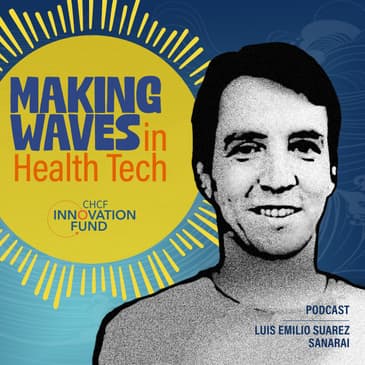

Making Waves in Health Tech is brought to you by California Health Care Foundation’s Innovation Fund. It is created and hosted by Hilda Martinez and Janet Boachie.
Special thanks to Luis Suarez and everyone at Sanarai.
Today’s program was produced by Zosha Warpeha and Grace Norman of Mission Boom. Audio engineering is by Zosha Warpeha. Music was composed and performed by Cameron Kinghorn. Art by Moritat and design by Paula Ginsborg. Special thanks to Eric Antebi, Melissa Buckley, Vincent James, the Innovation Fund team, Holly Minch, and Amanda Kim.
The California Health Care Foundation helps Californians with low incomes get the health care they need. Learn more at CHCF.org.
This podcast is a production of the California Health Care Foundation Innovation Fund.
The California Health Care Foundation helps Californians with low incomes get the health care they need. We are an independent, nonprofit philanthropy that works to improve the health care system so that all Californians have the care they need. We focus especially on making sure the system works for Californians with low incomes and for communities who have traditionally faced the greatest barriers to care.
The Innovation Fund partners with emerging companies to bring innovations and technology to California’s health care providers, payers, and patients.
This podcast is a production of the California Health Care Foundation Innovation Fund.
The California Health Care Foundation helps Californians with low incomes get the health care they need. We are an independent, nonprofit philanthropy that works to improve the health care system so that all Californians have the care they need. We focus especially on making sure the system works for Californians with low incomes and for communities who have traditionally faced the greatest barriers to care.
The Innovation Fund partners with emerging companies to bring innovations and technology to California’s health care providers, payers, and patients.
[00:00:00] Making Waves in Health Tech is a podcast about health, equity and innovation. Since the pandemic, there has been a growing number of adults and children reporting anxiety, depression and other mental health conditions. One aspect of pandemic-era health news that was
[00:00:17] actually good was the rise and effectiveness of telehealth. For example, among seniors, telehealth adoption increased 300%. But gaps still exist. Today we speak with Luis Suarez, a native of Mexico City. Luis sought therapy during the pandemic and learned that it was
[00:00:34] incredibly difficult to find therapists who were offering Spanish language culturally responsive care. In the US, only 5% of mental health care providers speak Spanish, while more than double that number speak Spanish as a native language at home. So he created a Health Tech startup
[00:00:53] to meet the need. He started with a smart design. The end product must be easy to use, affordable, understandable and culturally and linguistically competent. And that is how sounder eye came to be. I'm Janet Boachie and I'm Hilda Martinez from the California
[00:01:09] Health Care Foundation. Our foundation is a strategic investor in health delivery startups. Everyone is deserving of health, but not everyone has a fair chance at it. We are highlighting innovations that make healthcare accessible and affordable.
[00:01:24] Let's listen in and hear from Luis why mental health care is as important as physical health care and learn how healthcare is becoming more accessible and smart and important ways. All right. Hi Luis, thanks so much for being here today. Without further ado, let's just get
[00:01:49] into it. Tell us a little bit about Santa Ray. So we are a mental health platform for Spanish speakers. Our mission is to increase the access of the Latino community to high quality mental health services. Now we work with over 50 mental health professionals across the US,
[00:02:09] Mexico and Argentina to provide culturally sensitive Spanish language emotional support at accessible prices. In how we go to market, we have currently a dual approach where we go direct to consumer, which is a majority of the business now where folks find our
[00:02:27] website, book their sessions there. And then we also work B2B2C where we work with Google as an enterprise customer and the rest of the clients currently are community-based organizations that pay for our sessions and provide them to their stakeholders. So how does a consumer
[00:02:46] utilize your services? Can you walk us through what the experience of a user would be like? Of course. So you would hear about us, hopefully from some of our happy users. Actually we do have a
[00:03:00] lot of word of mouth going on where they'll look for Santa Ray online. They're gonna find our website and then they're gonna go and see the profiles of the providers that we work with. And we
[00:03:16] have a very comprehensive list of things that the providers, their experiences and what they're used to seeing. And then it's very easy to just go ahead and book a session with them. We have
[00:03:30] different types of sessions. We have an initial one which is $20 where you can get to meet one of these providers, see if you're comfortable with them. We have an individual session
[00:03:43] and then that one is going to be $49 for 50 minutes, $50. And then we have a couple's session which is $59. For 50 minutes we have next day availability so you'll see all of their calendars and you can
[00:03:59] find the time that works with your schedule and then just go ahead and book. The payment is going to be done on the platform as well and you're going to receive confirmation links and reminders for your sessions. Wonderful, you mentioned culturally and linguistically appropriate care
[00:04:17] and I think that's fascinating because as a Latina having sought out mental health services myself and for family members it's very difficult to find providers who speak Spanish and who understand the culture and our research at the California Healthcare Foundation has found that
[00:04:37] Latinos have a very difficult time accessing mental health services. They want the services but they have a hard time finding appropriate care, culturally and linguistically appropriate care and finding that type of care that's affordable. Can you talk a little bit about why it's
[00:04:53] important to have this type of appropriate care for Spanish speakers? Totally right, that's why we exist because there's a massive gap to cover the Latino communities needs in terms of mental health and just to put it in perspective and give you some numbers only 5% of mental health
[00:05:11] professionals in the US speak Spanish versus 13% of the population that speaks Spanish at home and then treatment rates are way below the average and then in a context of a mental health crisis with booming demand for services and a shortage of mental health professional the problem is
[00:05:28] exacerbated for the Latino community and it just makes these numbers make it three times as hard to find services in Spanish. It's not only the language piece but also that cultural component when you start with a provider that understands that cultural component it gives both like a
[00:05:48] baseline of understanding those initial matches when you start with your provider we believe is are going to be the best predictors of A better outcomes and B that folks you know can stay longer with their services. One of our clients loved that their provider could understand that their
[00:06:10] mom came from Latin America stayed with them for a month in their apartment and that was not crossing boundaries right because that's you know something that is more normal in the Latino community. Right, right no I appreciate that that anecdote thank you one thing that that I've learned
[00:06:28] in my experiences as I've sought mental health services is that there's such a stigma around saying I have a mental health issue or I suffer with mental illness I suffer from depression or anxiety.
[00:06:45] It's difficult to talk about it with one's own family at times so the fact that you have Latinos that are utilizing your services I think that's very significant. What are your thoughts around
[00:06:58] stigma and is it getting better? Are Latinos making a headway in and dealing with the stigma in their communities? I think it is I think we are I think you know we are a little behind compared to
[00:07:14] other communities but we're riding the same wave right so since 2020 that's one of the positive things I think coming from out of the of the pandemic is that there has been a lot of spot like with
[00:07:28] mental health it's importance and how it should be treated you know on the same level as physical health especially we see younger folks in the Latino community be very interested in working
[00:07:42] in their mental health and finding help and taking care of themselves and not only doing therapy or coaching or one-on-one support but also doing meditation and finding other ways to take care of their mental health. You know I'm very curious to hear a little bit more about you
[00:08:14] know how center I started I'd love to hear a little bit more about you know your personal experiences or any professional experiences that led you to building center I? Of course so I talked
[00:08:24] about you know the problem that we address and that gap to cover the Latino community's needs in terms of mental health so this is something that I realized from personal experience so I'm
[00:08:37] originally from Mexico City came to the US to do my MBA at Duke University and then when I graduated I worked three years in a management consulting firm and then in 2020 I was looking
[00:08:51] for mental health support like other times in life and I was really struggling to find someone that I could speak Spanish with and that could fit in my schedule so that an experience that made
[00:09:03] me realize about this issue and that's when I decided to launch SANA right in the middle of of the pandemic what led me to this to this work I think from a personal standpoint and the type of
[00:09:16] entrepreneur that is building something that they like to see exist in the world and then be able to use it growing up I started going to therapy when my parents were having a divorce
[00:09:29] and I found it very helpful so I continued going at different points in life and I thought it was necessary and then you know in 2020 I think a lot of people realize the importance of mental
[00:09:42] health and I already have been a believer for some years. You know building any startup especially as a first-time founder is it could be challenging and I'm curious if you're experiencing any challenges currently while you are developing SANA rise of platform. Lots and lots of
[00:10:00] challenges building a startup yeah it's a very hard endeavor and I honestly didn't realize how hard it would be on my mental health when I started but you know to put specific challenges
[00:10:15] I mean that go-to market I think is a pretty hard one because you know we can have a product that is working and helping people and that people want and need but then it's you also
[00:10:29] have to find the right channels and how to find folks and you know like startups have super ambitious objectives of growth and it's important to also manage that you need economics so you know we started the business you know in a direct-to-consumer model and then
[00:10:49] like many other startups in the healthcare space you know like the start direct-to-consumer getting a lot of feedback and being able to iterate on the product to eventually be able
[00:11:01] to offer it in a more like B2B fashion and that's you know we're in the middle of making that turn and as you know like you know the partnerships in healthcare can take a long time and be
[00:11:14] challenging. The second one I'd say like the funding we started fundraising in 2021 when the market was really hot I was a solo first-time founder with no startup experience and you know we're able
[00:11:30] to raise our pre-seed eventually but now you know we have a strong team we have the metrics but now the sentiment you know has shifted and it's much harder to fundraise so I think you know like always being networking with investors and being very rigorous in sending
[00:11:50] updates I think is very helpful. And then the last one I'd say when building a team for startups is hard to compete on compensation and other things that like bigger companies are going to be
[00:12:05] offering so for what has worked for us is to find folks that are very aligned on with our mission and that are motivated you know by day to day working on this challenge
[00:12:18] that we have in front of us. So Luis I went onto the website a few weeks ago and you had mentioned that you offer your services, Sanaday offers services at an affordable price and indeed the prices are very affordable. $20 for a 30-minute consultation,
[00:12:54] initial consultation, $49 for a 50-minute session for an individual and you even have couples sessions at $50. My question to you is what is the profile of a customer that comes and seeks your services and would you ever consider entering the Medi-Cal Medicaid market?
[00:13:14] Definitely so currently and just from a demographic standpoint it's going to skew female and younger you know we talked about how younger generations are you know sometimes more open or can get over that stigma faster and are already looking for these services. Then the
[00:13:36] other thing that we see is that so some of them are going to be uninsured, underinsured and looking for an alternative right or just like an option and a lot of our users are first time
[00:13:52] users of mental health services. So that's going to be a big chunk of our users but there are others that have these services or mental health services covered for example by their employer
[00:14:05] or in other ways but they are still not finding what they need and it's that cultural component that they are looking for. So that's also something that we see and folks just coming for that cultural component and specifically for the medical market I think there's a huge opportunity
[00:14:25] for us so there's four million medical members that primarily speak Spanish and these members are often underserved because of the lack of language appropriate culturally sensitive services so we can reach this gap by collaborating with payers and providers
[00:14:47] to serve this population. Are there any licensure requirements that your providers need to have? How is it that they're able to provide services to people who are living in the US? Yeah so how we envision our model working is similar to what other companies
[00:15:04] in the mental health space already do so they have tiers or service levels in which they will have psychiatrists, licensed therapists and coaches on their platform and then users or end users
[00:15:19] will come in they will triage and send the more you know subclinical less complex cases to that coaching area where they can operate with more flexibility around cross-state borders etc. Similarly and we're in conversations already with like providers and for example like it could be a
[00:15:43] hospital group that has a wait list right now of at least two weeks to see one of their clinical staff and so what you know we could start doing is and they could do an initial screening, triage
[00:15:57] their patients and then send some of those more subclinical and less serious cases to us where we can you know collaborate really closely with them and then they can have a set number of sessions
[00:16:11] and then they can come back for another evaluation in the same way we have a very robust escalation protocol so if someone you know turns from being like in that more subclinical space to something more
[00:16:23] more serious and needs a clinical most likely in-person support we could also escalate that we believe that some services are better than no services and currently with that huge demand and those huge wait lists people are just talking those wait list and in the same way like the
[00:16:42] providers and don't know what they have in their wait list and something could escalate and because they don't get the person in in time they could be preventing someone going to the ER or something like that. And many of these providers are in Mexico and other Latin American
[00:17:01] countries correct? Yeah all of our providers and another thing in this you know other platforms to be a coach they ask that you have a master's in psychology or a coaching certificate
[00:17:14] so all of our providers that are based out of the US have at least a master's in psychology and five years experience and then a thousand clinical hours but that's just baseline because we have folks with PhDs and over 30 years experience. What I find super cool about
[00:17:33] the work that you're doing is that one you are part of Google's Google for Startups specifically Latino Founders Fund is that correct? And then you're providing services to your cohort and then you're also going to be providing services to the next cohort is that right? Yes,
[00:17:52] yes that's right. Tell us more about that I think that's so cool. Yeah so we started that relationship with Google actually before the Latino Founders Fund existed and we did another
[00:18:03] program with them got to know the team and honestly they have been super helpful you know like very from very early in our journey they were you know they believed in us and have made a huge
[00:18:16] impact in our journey and yeah once you know that Latino Founders Fund came to be we've got accepted to the program and also were asked to provide services to the other founders in
[00:18:30] the cohort. Yeah so there were things that we had to adapt of course for this new cohort of startup founders and you know we started bringing more US based providers and adjusting our services a little but in the end that's something that we could do and it's
[00:18:50] been going really well and then we got extended our contract got extended for the next cohort and it's been a great experience to work with a Google for Startups team in that way.
[00:19:13] What advice would you say for other entrepreneurs in the health tech space that are seeking to build a platform especially for you know a population that they care about so much like what advice would you want to share? Manage your personal energy so the path of entrepreneurship
[00:19:31] involves a lot of rejection and can easily lead to burnout so it's in my in my case I found that having a strong support network and making time for enjoyable activities helps me manage you know
[00:19:48] and identifying burnout early and then connecting with other founders that are you know the same situation or the ones that are slightly ahead can also be great to connect with. The second thing is being resourceful so there's no playbook for for entrepreneurs and you come across different
[00:20:09] things every day and you don't know how to how to do stuff so yeah once you figure out a road block or like hit a milestone there's going to be the next challenge so just get used to like
[00:20:22] that mindset of trying to be very very resourceful and do a lot with little funding you know as a smaller team and finding those ways to move ahead and be very resourceful. So my question for you
[00:20:37] Luis is what excites you about the work that you do? I hear some of the passion that you have for the work tell us a little bit about what drives the work that you do and why you do it.
[00:20:47] Yeah so it's an impactful work and we're helping a community that I care about when someone hasn't been able to access mental health services and they all of a sudden like realize oh this has been like I didn't even know I could afford this and now this is
[00:21:04] being really helpful in my life just hearing that sort of feedback kind of like helps us and do that very hard work that we do every day. Well Sanadai is definitely feeling a gap
[00:21:19] and I think could be a lifeline for many people who don't have access to mental health services for several reasons we know we're facing a mental health provider shortage we just don't have enough providers to to offer these services particularly in communities of color.
[00:21:37] No and we talked about that the shortage is like overall but then when you're looking for someone that is able to administer services in Spanish then it's going to be three times as
[00:21:48] hard to find someone that can do that. It's gonna take a long time and yeah so we like opening up those alternatives and being able to help where we can. What is your hope for the future
[00:22:04] of Sanadai? Yeah so my hope is that mental health starts being taken as seriously as physical health that we can raise awareness and break down that stigma that we talked about have more mental health being a part of the conversation under their daily lives especially in the
[00:22:24] Latino community. We also talk about health equity right but being you know that Sanadai helps us bring that closer to be a reality and not just like this ideal and means that there's high quality mental health resources available and accessible to folks that speak Spanish you know
[00:22:49] or irrespective of their language cultural backgrounds socioeconomic status. Specifically for the Latino community more you know that we can have better services that are more culturally appropriate and in their language in our language. Yes to serve a community that really is facing a
[00:23:10] mental health crisis and we need these types of alternatives like Sanadai to fill the gaps as you mentioned earlier so thank you appreciate you sharing your thoughts with us. No thank you
[00:23:22] so much for for having me this has been great. What a powerful story Luis really shows us how health tech can solve big problems in healthcare by putting purpose something that was personally
[00:23:41] important to him at the heart of the work. Yeah Sanadai's mission was steady throughout a really tumultuous time on the business side of things by staying true to his core idea as Sanadai was able to develop a successful business model. What's really cool is that it attracted
[00:23:58] individual patients but also attracted partnerships with the likes of Google philanthropic partnerships as well as venture capital and I really love how Sanadai is helping to normalize mental health care among Latino families. I do want to acknowledge how Luis struggled with the challenges and
[00:24:15] costs of building a health tech startup and the bigger takeaway is that he also grappled with the personal and societal costs of doing nothing. There were entire communities struggling in silence and in stigma and he did something about that. Many many thanks to Luis for spending time
[00:24:30] with us and for sharing his passion and his knowledge and mad mad mad respect to Luis and all of our guests in this series. Il de, it's been a joy thank you so much. Gracias a T Janet until next time. Learn more at chcf.org