
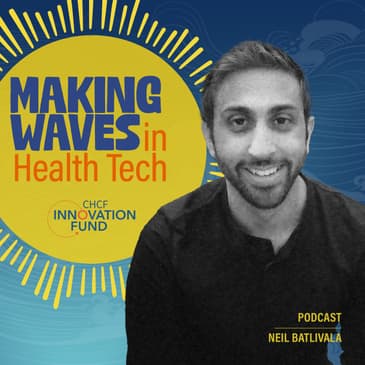

Making Waves in Health Tech is brought to you by California Health Care Foundation’s Innovation Fund. It is created and hosted by Hilda Martinez and Janet Boachie.
Special thanks to Josh Golomb and everyone at Hazel Health.
Today’s program was produced by Zosha Warpeha and Grace Norman of Mission Boom. Audio engineering is by Zosha Warpeha. Music was composed and performed by Cameron Kinghorn. Art by Moritat and design by Paula Ginsborg. Special thanks to Eric Antebi, Melissa Buckley, Vincent James, the Innovation Fund team, Holly Minch, and Amanda Kim.
The California Health Care Foundation helps Californians with low incomes get the health care they need. Learn more at CHCF.org.
This podcast is a production of the California Health Care Foundation Innovation Fund.
The California Health Care Foundation helps Californians with low incomes get the health care they need. We are an independent, nonprofit philanthropy that works to improve the health care system so that all Californians have the care they need. We focus especially on making sure the system works for Californians with low incomes and for communities who have traditionally faced the greatest barriers to care.
The Innovation Fund partners with emerging companies to bring innovations and technology to California’s health care providers, payers, and patients.
[00:00:00] Making Waves in Health Tech is a podcast about health, equity and innovation.
[00:00:06] Getting healthcare is really challenging for so many people.
[00:00:10] For patients with complex healthcare needs, it can be even tougher,
[00:00:14] especially if they are facing difficult life situations like being unhoused or food insecure.
[00:00:20] Today's story is about an entrepreneur who created a digital health startup that meets patients where they're at
[00:00:26] in person at a clinic, in the community or virtually by phone or video chat.
[00:00:31] Neil Batlavala was part of the founding team that launched a tech-enabled healthcare services company called Care Team.
[00:00:37] Care Team partners with primary care providers to provide enhanced care management services,
[00:00:42] ultimately improving access to medical and social services for people enrolled in Medicaid.
[00:00:47] Care Team's service coincides with California's transformational initiative called CalAIM,
[00:00:53] which aims to integrate medical seamlessly with social services.
[00:00:57] And why this is important is because it opens the door for funding the kind of whole person care that Care Team offers.
[00:01:05] I'm Janet Boachie and I'm Hilda Martinez with the California Healthcare Foundation.
[00:01:10] The foundation is a strategic investor in healthcare delivery startups.
[00:01:13] Everyone is deserving of health, but not everyone has a fair chance at it.
[00:01:17] We are highlighting innovations that make healthcare accessible and affordable.
[00:01:21] Listen in as we chat with Neil to hear how Care Team got its start.
[00:01:25] And Neil offers advice to other entrepreneurs who are seeking to transcend the barriers of developing a health tech startup that's designed for marginalized populations.
[00:01:35] Thanks for joining us today, Neil. We're so glad that you're here with us.
[00:01:39] We're here to learn more about your story and what led to the development of Care Team.
[00:01:43] It's a pleasure. Thank you so much.
[00:01:45] California Healthcare Foundation has been a really big supporter from the very beginning, so really excited to dive in with you all.
[00:01:52] So how did you start Care Team? How did you recognize the need for it and what is the problem that you're trying to solve?
[00:02:00] What we do is we partner with shelters, with food pantries, with rehab facilities and other community-based organizations to help turn them into a site of care
[00:02:11] and help provide care capabilities where really high needs individuals go, you know, where they work, live, and play,
[00:02:19] and actually providing care access at these sites.
[00:02:22] So bringing in telemedicine services, behavioral health services, building community health workforces out there, all at these community-based organizations.
[00:02:33] And a nutshell, if you've heard of this trend of social determinants of health and addressing that, has been slowly building momentum in the U.S.
[00:02:42] And what we do is we say instead of when someone goes to a shelter, they say, oh, why don't you go to the PCP?
[00:02:49] Well, these individuals don't have time. They've got a lot of other things on their head that they're thinking about just trying to get their base needs met
[00:02:56] and care for their family. And we say, okay, let's bring the care to them. Let's use technology like text messaging, like phone calls and virtual care to make it really, really easy to get access to care
[00:03:07] so that then you can prioritize it and ultimately improve the well-being of the communities we work in.
[00:03:12] Thanks so much for talking to us a little bit about that, Neil. I'm curious, if I were to be using Pair Team, what would my journey look like through the platform?
[00:03:22] First and foremost, it starts with just access and the ability to engage with a care provider in a way that's convenient to you.
[00:03:30] So imagine you're someone who is on Medicaid living in a community where there just are not a ton of physicians around.
[00:03:39] And if you try to get a PCP appointment, it's going to be a three-week-long wait time to get scheduled.
[00:03:45] And so instead, what do you do? You wait and you don't prioritize going to the doctor's office and then something flares up and then you end up in the ER.
[00:03:54] Or worse, you end up in the ER and then you get admitted into the hospital.
[00:03:58] How it starts is we work and we identify and engage individuals that effectively have to treat the hospital like their primary care provider
[00:04:07] and we engage them at the organizations they're already going to.
[00:04:10] So you're walking into a food pantry and then the front desk of that food pantry is partnered with Pair Team
[00:04:16] and they say, hey, you have clinical needs. Why don't you get connected with our partner Pair Team?
[00:04:22] They'll reach out over phone. If it works for you, I'll just submit this.
[00:04:26] I'll fill out a little form on my phone right now. It then goes to our care team.
[00:04:30] That same day, we will reach out to them. We'll do an intake and a triage, kind of get a sense of what are the goals of that individual?
[00:04:37] What are they trying to do? Usually this starts with social health needs.
[00:04:41] Usually this starts with, you know, it might be couch surfing or having trouble finding housing.
[00:04:46] Let me work to connect you to a set of shelters or other transitioning housing facilities out there.
[00:04:54] From there, once we've identified those goals, we then help coordinate care across our network of partners,
[00:05:01] but then we also layer on the clinical components.
[00:05:05] We try to first meet the initial needs of those individuals which are usually social first
[00:05:11] and then we use that as a bridge and develop through the trust we develop
[00:05:15] to then address their clinical needs and their behavioral health needs
[00:05:19] and really turn it into a longitudinal relationship.
[00:05:22] So, Neil, how did you start Pear Team? I mean, how did you recognize the need for it
[00:05:27] and what is the problem that you're trying to solve?
[00:05:31] Oh, how did I start it? It was such a...
[00:05:35] It's almost such a naive inkling of a thought that then turned into something more complex over time.
[00:05:43] But I'll give you a little bit of backstory on who I am so you know that then leads to how I got to Pear Team.
[00:05:49] So I'm an engineer by trade and before that just a kid from India who thought I'd be a doctor.
[00:05:55] When I grew up in India, that's where my duty to supporting others really came from, particularly from my mom.
[00:06:00] And so when I came over to the US, I thought I'd be a doctor, found bits and bytes
[00:06:04] and fell in love with technology and so said, okay, I'm going to pursue a path in a career in healthcare technology.
[00:06:10] So same mission, different career.
[00:06:12] And that's what got me started at a company called Forward
[00:06:15] where we were building tech-enabled primary care practices.
[00:06:18] It was a great experience to build primary care from the ground up
[00:06:21] from first principles with technology on its backbone to help support all the clinicians in the care team.
[00:06:28] We built out a national network.
[00:06:30] I met my co-founder Cassie who is a registered nurse
[00:06:33] and through that experience learned what high quality care looks like
[00:06:37] and how technology can help provide convenience and access.
[00:06:41] Challenges that we never ended up really working on the pricing point
[00:06:44] and so it was just too expensive for most individuals.
[00:06:47] So left and said, how could we bring that same technology and tooling to underserved communities,
[00:06:53] to Medicaid clinics that were treating really high needs but low income Americans
[00:06:58] and especially in areas with very low access to care.
[00:07:02] That was the inkling of the thought at the beginning.
[00:07:05] Now what we're doing now is a lot more sophisticated to actually make the economics work out
[00:07:10] and this is one thing I'm very upfront about.
[00:07:13] To make this sustainable, you have to make sure that you have the right contracts
[00:07:18] with the managed care plans, with the state departments, all of that.
[00:07:22] And there's a variety of tailwinds that we're following in Medicaid.
[00:07:25] Finally, there's a big spotlight at I call this Medicaid regulatory moment
[00:07:29] but it took a lot of sophistication to take that very inkling of idea
[00:07:34] of how do you enable existing organizations in underserved communities
[00:07:38] to provide better care to where we are now.
[00:07:40] I'm curious because you did say earlier in our conversation that
[00:07:44] you were finding product market fit but I'm curious to hear more about
[00:07:48] the evolution of Parateam from when you first started building to where it is now.
[00:07:53] When we originally went out to build this solution,
[00:07:55] we started with doctors that didn't take insurance and actually high needs individuals
[00:08:00] so patients in more rural areas were willing to spend out of pocket
[00:08:05] because they didn't have access through doctors that did take insurance.
[00:08:09] This was really interesting but ultimately we realized you have to work
[00:08:12] within the insurance company if you ultimately want to have impact at scale.
[00:08:16] And so then we started to work with clinics in California,
[00:08:20] particularly Southern California, with a focus on quality and care gap closure.
[00:08:24] We're continuing to see that momentum build on social drivers of health
[00:08:28] and integrating them into the care delivery system.
[00:08:31] We're starting to see models around truly bringing community-based organizations
[00:08:35] like shelters and food pantries formally into the care delivery network.
[00:08:39] We're starting to see standardization around a community health workforce.
[00:08:43] And so all these things together, we pieced them together
[00:08:47] and we said, you know what?
[00:08:48] We can actually turn community organizations into sites of care
[00:08:53] and instead of sending patients from a shelter or a pantry to the PCP,
[00:08:57] let's just bring the care services directly to them.
[00:09:00] But it wouldn't be possible if the regulatory components weren't in place.
[00:09:04] So that's a rough mile, you know, our rough stepping stone of the journey
[00:09:09] to get to where we are now.
[00:09:11] There's about one and a half million community-based organizations in our country
[00:09:16] and they all have a level of trust with their communities
[00:09:19] that's been building for decades.
[00:09:23] And so our insight was, well, if you can turn those organizations,
[00:09:26] even 1% to 2% of the community-based organizations out there
[00:09:31] into care delivery organizations, you're doubling the number of Medicaid access points in the country.
[00:09:36] It took a little while to get there, but that's ultimate.
[00:09:39] You know, we found it and we are bringing on CBO partners left and right
[00:09:44] and ultimately engaging patients that didn't really have anywhere else to turn to
[00:09:48] or getting these testimonials of patients that are going,
[00:09:51] I wouldn't know what I would be do if I didn't have you
[00:09:53] because some of these folks are just out there on their own.
[00:09:55] They don't have anyone to turn to.
[00:09:57] They don't have their own safety net.
[00:09:58] Just being there for them is what makes it all worth it.
[00:10:05] Neil, for Pear Team to succeed, you've had to partner with a network of providers,
[00:10:17] health plans and CBOs.
[00:10:20] How difficult was that?
[00:10:22] And have there been other challenges that you've had to overcome as well?
[00:10:27] Absolutely. It is challenging, I will say.
[00:10:31] There's a currency of trust that exists in Medicaid,
[00:10:35] not just from patients and their local organizations,
[00:10:38] but also with the managed care plans and the network and their doctors
[00:10:43] and specialists that they've contracted with.
[00:10:45] There's just been trust that's been building for decades upon decades now.
[00:10:50] What we found is I found it to be unintuitive initially,
[00:10:54] but it made sense over time is there's a distrust of new folks coming in.
[00:10:59] There's a distrust because the reality is there have been situations
[00:11:03] where people have been fraught at and these patients especially
[00:11:08] are sometimes lower literacy, lower education, so they can get scammed.
[00:11:13] And coming in and being very gentle to build that trust
[00:11:17] and showing that yes, ultimately we want to do this at scale
[00:11:20] so we're a venture-backed company.
[00:11:22] We've raised about $20 million, which means we're a for-profit entity
[00:11:26] and we're trying to work alongside a lot of nonprofit organizations
[00:11:30] and so that does bring a little bit of skepticism with it.
[00:11:35] And what we found is as long as we act in a way that is high integrity,
[00:11:40] we show folks that we're not trying to do any things like lock you into deals.
[00:11:44] One of the things that got stricken very quickly was I don't believe in lock-in for contracts.
[00:11:49] If you want to work with us, you should work with us
[00:11:51] because we're helping you and you're helping your community.
[00:11:54] That's it. We're not going to sign you in for a year or two years.
[00:11:58] I just don't believe in that.
[00:12:00] And it's actions like those that we kind of litter throughout our operating model
[00:12:04] and our business model in particular that helps to foster that trust
[00:12:08] and then ultimately showing up and doing what we say we're going to do.
[00:12:11] If you let us know that a client walked in the door and needs our support,
[00:12:15] we're going to call them that day for whatever reason.
[00:12:18] We've had not everyone's perfect.
[00:12:19] We've made mistakes.
[00:12:20] You know, something's got dropped.
[00:12:22] We followed immediately, said, I'm so sorry.
[00:12:24] We missed this.
[00:12:25] It's been a couple of days.
[00:12:26] Now we can't reach that client anymore.
[00:12:28] Let's own up to it.
[00:12:29] But it's those sorts of actions that build that trust.
[00:12:32] It's all about trust building.
[00:12:34] You know, I really appreciated what you were talking about in terms of building trust
[00:12:39] because that was actually going to be my follow-up question
[00:12:41] because I know sometimes when it comes to tech-enabled companies,
[00:12:45] the trust building is always going to be a huge question.
[00:12:47] So I appreciated you just really tapping into that.
[00:12:50] Absolutely.
[00:12:51] It's a huge part of it.
[00:12:52] And trust begets trust.
[00:12:54] You got to go in small, like I said earlier, the RVC is no,
[00:12:58] it's not a growth at all costs.
[00:13:00] We're coming in really light.
[00:13:02] We're giving value.
[00:13:03] Over time, people see that we're not someone who's just trying to get in and get out
[00:13:09] and take advantage of any situation.
[00:13:12] We want to be a core part of how this community serves its patients moving forward.
[00:13:20] You know, with all of the partners that you work to build relationships with
[00:13:25] and build trust, what does your economic model look like?
[00:13:29] Tell us a little bit more about how Parateam gets paid.
[00:13:32] Yeah, this is actually one of the things I'm most excited about.
[00:13:36] I'm going to go real macro first,
[00:13:38] and then I'll go micro into how it works.
[00:13:41] If you look at the US versus other countries in the world,
[00:13:45] other countries in the world spend for every dollar that they spend in the healthcare system,
[00:13:49] they spend about $2.90 on social support services.
[00:13:54] Now, you can imagine where I'm going with this
[00:13:56] because in the US for every dollar that we spend in healthcare,
[00:13:59] we spend about 90 cents on social support services.
[00:14:03] And it's no secret that, you know, on a general,
[00:14:07] you know what, when you look at the averages,
[00:14:09] the US healthcare system has some things to improve on.
[00:14:12] We fall in like the 30th to 40th range with respect to other countries internationally.
[00:14:17] Our model is all about contracting with health plans
[00:14:21] and managed care organizations on care management contracts
[00:14:25] or quality contracts there.
[00:14:27] So we're getting paid to address gaps in care
[00:14:30] or we're getting paid to better manage high needs individuals.
[00:14:34] And then we turn around to our partner network
[00:14:37] and we help share that revenue with them.
[00:14:40] We help get healthcare dollars into the hands of these social support organizations
[00:14:45] to provide these care capabilities.
[00:14:47] And in that way, this is one of the things,
[00:14:49] the case studies I'm very excited about for this year
[00:14:52] is they can use those dollars to then reinvest in themselves
[00:14:55] and scale their own social support org.
[00:14:58] So get more beds, more meals, more staff, etc.,
[00:15:02] which then grows their own footprint in the community,
[00:15:05] which means they can get access to more healthcare dollars
[00:15:08] and we can kind of kick off this really positive flywheel
[00:15:12] to scale a supply constrained resource,
[00:15:14] which is social support services in our country.
[00:15:17] And we are the ones who are contracting with the health plans
[00:15:21] to make this all happen.
[00:15:23] Recently, Per team announced its expansion into seven counties in California.
[00:15:28] Some of these counties are in the Central Valley,
[00:15:30] the coastal areas, as well as Los Angeles County.
[00:15:34] How did that happen and why did you choose these counties?
[00:15:38] There are two broad strokes reasons.
[00:15:40] Our first partner was actually in Linda Empire Health Plan out there.
[00:15:43] They've been a fantastic partner.
[00:15:45] They are a beacon in California
[00:15:47] on what a health plan looks like when it really cares.
[00:15:50] I know the leaders out there and they just really care.
[00:15:52] So I have a ton of admiration and respect for them.
[00:15:54] It took a bet on us and we showed good results.
[00:15:57] We are showing that we were able to engage a very hard-to-reach population.
[00:16:01] Those results spoke for themselves
[00:16:03] and when we started to socialize it with other health plans in the country,
[00:16:09] almost all of them have wanted to partner with us.
[00:16:11] So we have contracts in California that cover almost 80% of the state
[00:16:17] in terms of where we then expanded to.
[00:16:19] It was a focus on where are the highest needs
[00:16:22] in terms of density and access.
[00:16:25] So LA, for example, LA has more high needs individuals
[00:16:30] that are experiencing homelessness than almost any county in the entire country.
[00:16:34] So it was an obvious one that we had to go into LA.
[00:16:37] That's where a very high need is.
[00:16:39] And then in some of these other areas, particularly in Central Valley,
[00:16:42] there are access challenges.
[00:16:44] Now, so it made sense for us to go and provide our workforce enablement
[00:16:49] and virtual care model together this hybrid care model
[00:16:53] for those areas.
[00:16:55] And over time, I want to get deeper and deeper into more and more rural areas
[00:16:59] because there's just no good solutions out there.
[00:17:02] And at the end of the day, especially when you're looking out
[00:17:05] in the high desert areas or up north where Partnership Health Plan is,
[00:17:10] you need to upscale folk that are already there to provide care services
[00:17:16] and then make it really easy to get access to virtual care
[00:17:19] because the reality is there's just no doctor within tens of miles of you.
[00:17:23] I'm from the Central Valley and I understand some of those transportation issues
[00:17:27] that you were just talking about.
[00:17:29] And I think that you're absolutely right.
[00:17:32] It can take people up to 45 minutes in the Central Valley
[00:17:35] to get to the nearest hospital.
[00:17:37] So it's a real challenge for folks that live in the area.
[00:17:40] It really, it really is.
[00:17:42] And I'm a strong advocate for our model of upskilling.
[00:17:47] Getting staff at these community organizations
[00:17:50] and helping them provide care by becoming community health workers.
[00:17:54] Not only does it give the individual at the local organization
[00:17:58] a career pathway that they never had before,
[00:18:01] but it also, again, creates an access point for the community.
[00:18:07] So, Neal, one question that comes to mind for us is that
[00:18:21] Pair Team is coming in at a time where CalAIM and ECMs being implemented.
[00:18:27] However, there's a chance that that can evolve over time.
[00:18:31] How do you think Pair Team is going to adapt if it does evolve
[00:18:35] and what do you see the future of Pair Team to look like?
[00:18:38] I'll broadly categorize this as regulatory risk
[00:18:41] and it's a reality of working in Medicaid,
[00:18:45] especially, you know, unlike Medicare, that's all national.
[00:18:48] Medicaid is state by state.
[00:18:50] California is a very, very innovative and caring state.
[00:18:55] You know, they just launched all, you know, any immigrant in the state of California
[00:19:00] automatically gets Medicaid or MediCal coverage.
[00:19:03] Huge news, you know, very great.
[00:19:06] They just launched another program.
[00:19:07] Anyone under the age of 12 gets access to free behavioral health services.
[00:19:12] California did give us this opportunity because it is a vanguard state here.
[00:19:16] That said, there are a lot of other states that look to California as to what to do next.
[00:19:22] The other thing that we're doing and this is just a reality is investing in additional service lines
[00:19:28] and investing in additional ways to contract with the health plans
[00:19:32] so that you get that contractual resilience in case there are some changes
[00:19:37] in one service line like the enhanced care management benefit
[00:19:40] or the community health worker benefit in California,
[00:19:43] then you can still lean on your other service lines in that state.
[00:19:46] And that's just one of the realities of doing business in a highly regulated industry like Medicaid.
[00:19:52] So, Neil, my next question has to do with the impact that you're seeing on patients.
[00:19:57] I recently read that your solution has led to lower emergency department utilization,
[00:20:03] overall increased mental health behavior well-being, and even a reduction in A1C scores.
[00:20:09] Can you talk a little bit about that?
[00:20:12] I'll start with the patient's perspective.
[00:20:14] The majority of our patients, about 80% or more, haven't had a PCP visit in the last two years.
[00:20:20] And it's not because of lack, you know, not because they don't really want to,
[00:20:23] it's because they have other things on their mind or other barriers to care,
[00:20:26] such as transportation, like you mentioned, in the Central Valley.
[00:20:30] And so the first thing we do is we help engage patients to start caring about their health and wellness
[00:20:36] by making it really, really easy for them.
[00:20:38] There's a certain, you know, it's called talk therapy.
[00:20:41] Just being a sounding board, being someone that if our patients are busy,
[00:20:46] they know that every Friday or every Thursday we're going to call them and check in on them.
[00:20:51] And just having them knowing that there's someone looking out for them
[00:20:55] creates a peace of mind that starts having downstream impact across their entire life.
[00:21:00] It gives them confidence to go out to the shelters and start interviewing to get placement there.
[00:21:06] It gives them confidence to look for a job, just knowing that there's someone out there who cares for them.
[00:21:12] That's one of my favorite type of testimonial where you have a single mother with her family
[00:21:16] and she has to do it all.
[00:21:18] And suddenly she has our care team for her to lean on them.
[00:21:21] So that's one side of it.
[00:21:22] And from that we have seen a lot, I believe it was 60% of our patients
[00:21:27] who had suicidal ideation after three months in our program stop having that.
[00:21:33] I believe it's around 70% of our patients had A1C reductions
[00:21:36] because they're just eating healthier, they're going outside more,
[00:21:38] they're walking, they're taking care of themselves.
[00:21:41] And then yes, we also have seen pretty significant reductions in ED utilization,
[00:21:46] emergency department utilization.
[00:21:48] So about one in three emergency department visits are now not happening
[00:21:53] because our patients are calling us first and they're checking with us on their care.
[00:21:58] And so we're able to avoid these really costly visits from a economic standpoint.
[00:22:05] It is those hospital visits and those emergency department visits
[00:22:08] that actually make this model sustainable.
[00:22:10] This is why managed care plans, this is how DHCS is going to fund this all.
[00:22:16] As they're saying let's get more preventative care so that we get fewer hospital visits.
[00:22:19] And we are showing about a one in three reduction there.
[00:22:23] All right, so Neo, I'm curious.
[00:22:35] Now that you have a lot of experience under your belt,
[00:22:38] what advice do you have for social entrepreneurs,
[00:22:41] especially in healthcare who are just starting out in their entrepreneurship journey?
[00:22:46] You have to hold multiple realities in your head at once.
[00:22:50] And what I mean by that is the reality that people do want to see this social good out in the world.
[00:22:57] But the other reality is that from a business perspective,
[00:23:01] health plans look at revenue and gross margin and costs and all of that.
[00:23:07] And so it's very easy to get sucked into the trap of I have a business here
[00:23:14] because the person I spoke to is enthusiastic about it,
[00:23:18] but they're never going to sign that contract.
[00:23:20] You have to be really, really clear and honest with yourself
[00:23:26] do the dollars and cents make sense?
[00:23:29] Is it economically viable?
[00:23:31] I've seen social health entrepreneurs that just wish so much
[00:23:36] that their solution was out in the world.
[00:23:38] And don't get me wrong, it would be very good for the world.
[00:23:41] But if someone's not paying for it, it's a Sisyphean task.
[00:23:44] You're going to be pushing this boulder up the hill
[00:23:46] and you're never going to get to the top
[00:23:48] and you're never going to have that impact that you really want.
[00:23:50] And that's fine.
[00:23:51] You just have to go eyes wide open that that's what you're doing.
[00:23:54] From the very beginning, I've been very clear that we're not going to shy away
[00:23:59] from talking about the dollars here.
[00:24:01] We're not going to be shy to talk about this is how much it costs
[00:24:05] to improve the quality of care.
[00:24:07] This is how the health plan puts a number on it.
[00:24:11] Yes, we want to promote the well-being of our communities
[00:24:13] but there is financial viability that you just have to embrace
[00:24:17] and it can be very enticing to let your quality of thinking there slide.
[00:24:23] Because you're so mission driven.
[00:24:25] And unfortunately, that line of thinking can ultimately hurt you in the end.
[00:24:29] That's real.
[00:24:30] I know when you're building a company that, one,
[00:24:35] you want to generate some sort of profitability revenue.
[00:24:38] It's one of those things where it's just like you want to be mission-driven.
[00:24:41] You want to be mission focused.
[00:24:42] You want to make sure that you are creating impact on the communities
[00:24:46] that you want to serve.
[00:24:47] But then yes, there also has to be that thought of making sure that the dollars flow.
[00:24:52] And so I think that's a very real perspective that you just shared.
[00:24:55] And I think a lot of entrepreneurs would want to hear that.
[00:24:58] I'm going to jump to a vision question.
[00:25:01] Let's look ahead, say 10 years from now.
[00:25:04] What do you envision for Pear Team?
[00:25:06] And specifically what do you hope that Pear Team will accomplish?
[00:25:10] I hope we create by a factor of two, three, four,
[00:25:16] the number of access points to care in low income communities.
[00:25:19] And to do that, we need to create more clinics.
[00:25:23] We want Pear Team to be the one that turns these social support organizations into sites of care.
[00:25:27] I want to see what we're doing now across the country
[00:25:30] and make it easy for folks to see a behavioral health specialist
[00:25:36] to also connect that behavioral health specialist to a housing facility
[00:25:41] or a rehab facility for severe mental illness or substance use.
[00:25:46] And to do that, you need a network.
[00:25:48] You need connected devices.
[00:25:51] For example, we're starting to think about sending our community organizations
[00:25:56] blood pressure cuffs and smart scales and glucometers
[00:25:59] so they can provide more care right then and there on their grounds.
[00:26:04] And so that's what we want to see.
[00:26:06] We want to see more clinics come from social support service organizations.
[00:26:11] I think Pear Team is well on its way to achieving that vision.
[00:26:15] So thank you.
[00:26:16] I'm really happy for Neil.
[00:26:25] Pear Team's story really exemplifies the so-called double bottom line
[00:26:30] where they created a successful company in its own right
[00:26:33] and they did it by doing a whole lot of good for people.
[00:26:37] What came through for me is how important internal and external collaboration is.
[00:26:42] So internally, Pear Team's care team includes a community health worker,
[00:26:46] a nurse, a behavioral health specialist, a nurse practitioner,
[00:26:50] all working together to cover a huge group of patients.
[00:26:54] But on the external side, they're building relationships with primary care providers,
[00:26:58] health plans, and also a network of medical and social care providers.
[00:27:02] So it makes me think about one time where I've said and don't laugh at me listeners,
[00:27:06] the Avengers of healthcare.
[00:27:08] And I say that because the collaboration among like healthcare professionals,
[00:27:13] tech entrepreneurs, and safety net organizations is really so critical
[00:27:17] to seeing changes in the healthcare system.
[00:27:19] And for the investors listening,
[00:27:21] some of the largest companies in the world like Walmart, Amazon, CVS,
[00:27:26] they're all redesigning healthcare delivery as part of their business model.
[00:27:30] Investors shouldn't shy away from startups that work with Medicaid.
[00:27:34] Medicaid spending is really high, especially in California
[00:27:37] and other states are following suit.
[00:27:39] Medicaid funding is such an important revenue source for health tech companies.
[00:27:44] Double tapping on what you just said, Ilda,
[00:27:46] Medicaid is mistaken as being niche and we have to really be careful using the word niche
[00:27:51] because in reality, it can be received as a market being too small,
[00:27:55] whereas for Medicaid that's not the case.
[00:27:57] Pear Team is one innovative example,
[00:28:00] but there are many other ways to close the care gap,
[00:28:02] especially for people with complex and chronic health conditions
[00:28:06] and experiencing homelessness.
[00:28:08] There are important trends that are shaping healthcare in the next decade.
[00:28:11] For example, there is an astonishing growth in the adoption of telehealth technologies
[00:28:16] with no signs of stopping.
[00:28:18] We're also seeing that technology is really doing a lot to improve care coordination
[00:28:23] and healthcare is shifting from treating standalone problems
[00:28:26] to treating really the whole person
[00:28:29] and technology helps to ensure that nothing and no one falls through the cracks
[00:28:34] and that the right care is provided at the right time.
[00:28:37] We're seeing that technology is being leveraged to address the access and affordability of housing,
[00:28:42] the access to healthy food, transportation,
[00:28:45] and other issues that impact our well-being.
[00:28:48] We'll post this research in a show notes if you want to dig deeper.
[00:28:51] I would like to give a big thank you to Neil for being our guest
[00:28:54] and for sharing Pear Team's story.
[00:28:56] There are still so many people who do not have a fair and just chance to live a healthy life.
[00:29:02] I hope this podcast has inspired you to build purpose into your work
[00:29:07] and if it has, please subscribe and follow us on social.
[00:29:10] We'd love to connect.
[00:29:12] I think that's a great place to end it.
[00:29:14] Thanks again, Ilda.
[00:29:15] Thanks, Janet.
[00:29:32] Audio engineering by Zosia Warpah.
[00:29:34] Music composed and performed by Cameron Kinghorn.
[00:29:37] The California Healthcare Foundation helps Californians with low incomes
[00:29:41] get the healthcare they need.
[00:29:43] Learn more at chcf.org.