

ONCE UPON A GENE - EPISODE 214
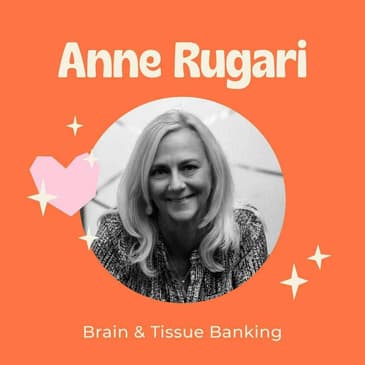
A Courageous Gift - The Power of Brain and Tissue Donation in Rare Disease Research with Anne Rugari
Anne Rugari is an advocating powerhouse, an author of two children's books, a mom, and two of her children have passed away from Krabbe disease. She joins us to share her personal story and also share her knowledge about tissue and organ donation.
EPISODE HIGHLIGHTS
Can you share how you became part of the rare disease world?
In 1986, my second child Nick received a diagnosis of Krabbe disease, or globoid cell leukodystrophy, a terminal disease that took him just after his first birthday. I also had a three year old son who was unaffected and we decided we probably wouldn't have another child with a rare disease if we wanted more children. In 1999, my daughter Gina was born and tested for Krabbe disease, confident the odds were with us. Unfortunately, she tested positive. As a result of an umbilical cord blood transplant she had at three weeks old, she did remarkably well and lived to fifteen years old.
What were your considerations when deciding to donate Gina's brain for research?
It's an emotional, practical and religious decision. There are so many factors that play into the decision. For me personally, I wanted to make sure I was making a sound decision morally and spiritually. I felt we weren't going to learn more about the disease unless there were human tissues and samples to study. It was a decision I felt strongly about to help others. There's a source of comfort knowing that the tissues donated are being used to move research forward.
Why is it important to consider and arrange tissue donation in advance?
It's emotional and you don't want to be making those decisions at a time when you've lost them. There's also some coordination that needs to be planned, ensuring there's a pathologist available at the hospital for the retrieval. Planning in advance allows you time to coordinate the details, like if passing takes place at home instead of the hospital, and notifying the funeral home so they can coordinate with the pathologist. Getting the logistics organized in advance makes the transition when someone passes away easier. Discuss plans in advance with your care team so they can help with arrangements and support you.
LINKS AND RESOURCES MENTIONED
ONCE UPON A GENE - EPISODE 213 - Finding Strength In Every Step
https://effieparks.com/podcast/episode-213-finding-strength-in-every-step
https://effieparks.com/podcast/episode-198-advocating-with-heart
https://courageousparentsnetwork.org/
Just Like Me!: A Book About A Girl with a Rare Disease
https://www.amazon.com/Just-Like-Me-about-Disease/dp/0982218710
https://www.amazon.com/Just-Like-Too-Anne-Rugari/dp/1970063378
CONNECT WITH EFFIE PARKS
https://twitter.com/OnceUponAGene
https://www.instagram.com/onceuponagene.podcast/?hl=en
[00:00:00] I'm Effie Parks.
[00:00:05] Welcome to Once Upon a Gene, a podcast.
[00:00:08] This is a place I created for us to connect and share the stories of our not so typical
[00:00:13] lives.
[00:00:14] Raising kids who are born with rare genetic syndromes and other types of disabilities
[00:00:18] can feel pretty isolating.
[00:00:21] What I know for sure is that when we can hear the triumphs and challenges from others who
[00:00:25] get it, we can find a lot more laughter, day if we can, and we try to meet up in person with people who are local to us,
[00:01:43] and actually see people in real life on the weekends.
[00:01:45] It's books. I think you're going to recognize them. So I'll put them in the show notes for links to them on Amazon. But please, if you have a local bookstore, ask them to order them for you and support those. Those are great, inclusive kids books. Let's see. She's a mom. She's a powerhouse. She has three kids. Nick and Gina are two kids who
[00:03:00] passed away from crab A. And one of her daughters, she went through all the motions to donate talking to her about this subject, let's kind of start a little bit about the beginning. Can you share a little bit about how you entered this rare disease world? Yeah, I think, Sephi, I'll try not to get emotional because as a mother, I'm going to talk about your children and what, or your loved ones that have gone through a rare disease. It's always a little emotional. Sometimes the question might make my voice clever a little bit.
[00:04:22] That just comes out of the great love. see another child with crab-aid disease. It's so rare there'd probably never be any research or treatments or cure. And maybe in my lifetime, I would perhaps meet another family. And the night I buried my son, I said, I'm young. I'm in my late 20s.
[00:05:40] I can't believe that I'll never hear of this again.
[00:05:43] And I just kind of asked God what he wanted me to do We were confident that each pregnancy has a one in four chance of the child being affected with crab A disease. So we felt the odds were with us that 75% chance we wouldn't have an affected child. Unfortunately, the results came back positive for crab A. And at three and a half of age,
[00:07:01] Gina was the fourth newborn in the world to really understand what was happening with the transplant. And even though there were a couple other children who were transplanted before Gina, they weren't as receptive as working with other clinicians and researchers to help advance studies. And I knew during those first five to school. She was cognitively age appropriate because we were following her cognitive development. She was a happy girl. She was about what would ever happen if we wanted to donate tissues from the brain and other parts of the body to study. And how could we know what kind of studies as a parent
[00:11:04] come out of that research? families who have donated their loved ones, brains and tissues. We have other diseases besides crab A disease affected tissues in the bank. And we have a number of researchers kind of want to start by understanding your decision that you decided to make before Gina had passed away when maybe you might otherwise have been consumed with other types of grief or just kind of being in the thick of it. Can you walk us through the journey to the decision of donating Gina's brain and tissue?
[00:13:40] And what were maybe the emotional and practical considerations
[00:13:43] that you had to navigate or were you sort of sure?
[00:13:46] You know, Evie, being in a facility. And it's not all the tissues. It's just some, it's some tissues. And just realizing that, you know, they're going to be somewhere and be looked at and studied.
[00:15:01] And then there was a part of me that kind of just realized I only had neck for a year and could do nothing for him. Even at that time in 86, there wasn't even good palliative care to help him. And watching him decline, watching him being in horrific pain from nerve deterioration, muscle deterioration,
[00:16:20] his muscle spasms, not being able to eat,
[00:16:23] having seizures that if somehow we could find
[00:17:26] out and that their loved ones tissues may be used because we, you know, we're not going to give out that information we can't as protected.
[00:17:30] But there is a sense of relief from families.
[00:17:35] It helps families when they get a copy of the publication to know that their children really, really respecting this for what it is and not just doing science to do science for science purposes, but that it's so much bigger than that and that this was a soul and a human that was loved. It's important that it has an impact on people, right? I feel like, you know, people donate their organs and which is a beautiful thing to do
[00:19:00] because some of those help people to peace to the family. Yeah. I mean, there's a whole podcast episode about that aspect of this for sure. I know. We can go. There's a lot of other branches that this can go on to.
[00:20:20] Sure.
[00:20:21] Yeah.
[00:20:22] Let's talk about early planning.
[00:20:23] Can you explain why it's so important for way to say it. If the paperwork and things are done in advance, because there is some coordination as to making sure there's a pathologist at the local hospital or where your child's been seen that can do the retrieval of the tissues once they have passed or within 24 hours of them passing.
[00:21:40] That's about kind of the timeframe
[00:21:42] we need to collect the tissues.
[00:21:43] So one of the things done in advance, the transition as to when the loved one passes away, it's kind of spelled out and it's clear that it's easier to kind of manage. It doesn't mean, you know, the family always has the choice to decide
[00:23:02] even when the child passes, not to donate. There happen if this is something you desire to do with the donation that it's just kind of planned and it's in there maybe care manual or their care booklet of here's what's going to happen when that time comes.
[00:24:21] Yeah, you touched a little bit on sort that these are probably the intentions of the family. And I've worked with social workers
[00:25:40] that are assigned social worker on the case.
[00:25:43] A lot of families have a main social worker
[00:25:46] and work with them to in this at this point. And I think that that's so important for families, right, to just have that support and to really know that the person alongside them knows what they're going through and it can really
[00:27:02] empower them and also just make them feel so, you know, I stayed with her on that and had contact with the pathology team at their hospital that they worked with that he had been at and just let them know, hey, I'm going
[00:28:21] to need to know every step of the way, you know, and're used to doing feeding tubes, they're used to being hands-on, they're at every moment, maybe suctioning, maybe feeding, maybe just all the medical interventions that happen and then when that ceases, some families just need to know what
[00:29:41] is happening up until the time they arrive back at the body arrives back at the funeral
[00:29:47] home. crab A disease patient versus an untransplanted patient. And before that paper came out, the pathologist at the director of the Alzheimer's Bank, Dr. Julia Koffler, had done some initial research on, you know, two cases. Well, one of them was Genas. I can say that because
[00:31:00] hers is the only transplant in case we have deterioration in the central nervous system from the transplant, it was only in the peripheral, we were able to start getting into gene therapy, looking at more gene therapy type medications for more palliative care, and patients that have not been treated with a transplant. Just to kind of have an idea of how things are like to do. Yeah, so much of what you've said this entire conversation, especially there at the end, reminds me of our friends over at the Courageous Parents Network. I'm not sure if you know them. Just such a hand-in-hand collaboration. I mean, they speak on this and they help kind of guide families through that ahead of time
[00:36:21] if they're open to it to just really empower them as much as possible. Using the talents I've been given to help make a difference for other people, none of us asked for these rare diseases to come into our lives. And we can choose a lot of different paths to go on with, when presented with these difficult challenges of the rare disease community. And.
[00:37:43] I have just really.
[00:37:45] Feel blessed that I can give back. Those are very kind words, F.E. And I do mean everything I say. And just I'm so grateful that you asked me to join your podcast and to speak about this. And I'm available. And you can feel free to give out my contact information because you have that.
[00:39:00] Feel free to give that out.
[00:39:01] And I'd be amiss if I didn't plug my two books about a girl with a rare disease.
[00:39:06] And that's Gina. been my pleasure. Thank you. I hope you've been enjoying this podcast. If you like what you hear, please share the show with your people. And please make sure to rate and review on iTunes or wherever you get your podcasts. You can also head over to Instagram, Facebook and Twitter to connect with me and stay updated on the show. If you're interested in sharing your story, or if you have
[00:40:22] anything you would like to contribute, please submit it to
[00:40:25] my website at Effyparks.com. Thank you so much for listening