
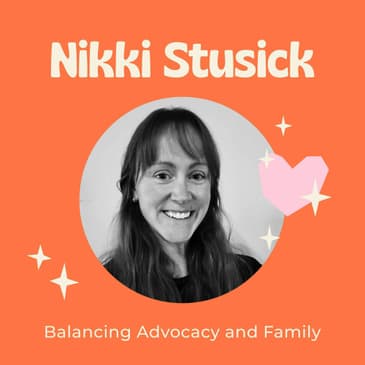

ONCE UPON A GENE - EPISODE 230
Balancing Rare Disease Advocacy and Family - Navigating the Complexities and Embracing Imperfections with Nikki Stusick
Nikki Stusick is the mom of a child with an initial VUS diagnosis and then a different pathogenic diagnosis. We talk about the complexities of balancing advocacy work, family life, when to choose one over the other and when to take a break.
EPISODE HIGHLIGHTS
Can you tell us about yourself and your diagnostic journey?
I am a mom of three children and my oldest, Theo, was diagnosed a month after his first birthday with a rare condition called TBCK Syndrome. We started a foundation to build a community. Then, four years later, we found out that one of the genetic mutations offered a different diagnosis. With the misdiagnosis, we have been at a crossroads because we have built and grew a community for the initial diagnosis, but our advocacy efforts need to shift. We have been working to put the right people in place to carry the foundation forward and I'm still figuring out at what level I want to stay engaged.
How do you navigate and find balance between spending time with family and also your advocacy efforts?
When Theo was diagnosed, I jumped into advocacy to heal and cope and that's how I've learned to channel my emotions into something tangible and taking action helped me. In the last two years, I've felt like I am missing out on time with my kids and I've had to take a step back from advocacy a bit to just be a mom. I have no regrets for outsourcing care to do advocacy work and I'm grateful to be a part of the community, but I want to be clear on what makes sense for this chapter of our lives and what my goals are. I'm figuring it all out as I move through it.
Have you felt societal pressures about how to balance family and advocacy and how do you validate your advocacy commitments?
I feel lucky that everyone around us is supportive and has shown up for us in many ways. If anything, I've been my harshest critic. I push when I can and I don't beat myself up when I have low energy or high emotion days.
What advice do you have for parents trying to balance family and advocacy?
Listen to the touchstones you come back to, your inner voice, because that's your truth. Have self-compassion and don't beat yourself up as you find balance and determine what your family needs are.
LINKS AND RESOURCES MENTIONED
Librarey
https://www.librarey.com/
The TBCK Foundation
https://www.tbckfoundation.org/
CONNECT WITH EFFIE PARKS
Website
https://effieparks.com/
https://twitter.com/OnceUponAGene
https://www.instagram.com/onceuponagene.podcast/?hl=en
Built Ford Tough Facebook Group
https://www.fac
ebook.com/groups/1877643259173346/
[00:00:03] I'm Effie Parks. Welcome to Once Upon A Gene, the podcast.
[00:00:07] This is a place I created for us to connect and share the stories of our not-so-typical lives.
[00:00:14] Raising kids who are born with rare genetic syndromes and other types of disabilities can feel pretty isolating.
[00:00:20] What I know for sure is that when we can hear the triumphs and challenges from others who get it,
[00:00:26] we can find a lot more laughter, a lot more hope, and feel a lot less alone.
[00:00:31] I believe there are some magical healing powers that can happen for all of us through sharing our stories,
[00:00:36] and I'll take all the help I can get.
[00:00:43] Once Upon A Gene is proud to be part of Bloodstream Media.
[00:00:47] Living in a family affected by rare and chronic illness can be isolating, and sometimes the best medicine is
[00:00:53] connecting to the voices of people who share your experience.
[00:00:56] This is why Bloodstream Media produces podcasts, blogs, and other forms of content for patients, families, and clinicians
[00:01:03] impacted by rare and chronic diseases.
[00:01:06] Visit bloodstreammedia.com to learn more.
[00:01:08] Hello, and welcome to the podcast.
[00:01:10] I'm Effie Parks, your host, and I'm so grateful that you are spending a little time listening to this amazing show today.
[00:01:16] It really means a lot to me. If this show has ever given you any hope or ideas or resources or kicked you in gear
[00:01:23] to do something, here's my ask.
[00:01:24] Can you please share this show with someone, anyone that you think needs it? Share it on your social media.
[00:01:30] Please write a review.
[00:01:31] It's the word of mouth by people like you who help this show grow and get it into the ears of people who need it most.
[00:01:36] I thank you so much for all of your support along the way. I want to highlight my friend Sierra today.
[00:01:42] I'm thinking about her. Sierra Phillips created a resource called library, l-i-b-r-a-r-e-y.com,
[00:01:48] along with her two friends, Flanson and Albert from Commend.
[00:01:51] I spoke about it a long time ago on the show, and I put her very first PDF on my website.
[00:01:56] I think it's still there. I need to update it.
[00:01:57] But she was up, like most of us are, just clawing at any type of resource.
[00:02:02] And she couldn't believe that things weren't organized and didn't exist.
[00:02:05] And thank goodness for brains like hers, because she was like, I'm going to change that.
[00:02:08] Kind of like the reason that Once Upon a Gene exists in those hours of desperation.
[00:02:12] So she made library. It's a place that you can go to and find thousands and thousands of personally vetted by her resources.
[00:02:19] Anything from IEP coaching to the best podcasts on the planet.
[00:02:22] And it is just an amazing resource.
[00:02:24] So go there, make an account.
[00:02:25] You can research anything, even in your area or international.
[00:02:29] Like it's all there. And it's also like crowdsourcing style.
[00:02:31] So you can add your own resources to it and Sierra will check it out.
[00:02:34] Today. Oh my gosh. I have the best conversation.
[00:02:36] I love I love this woman so much.
[00:02:38] And I just super connected with her.
[00:02:41] And I hope you really enjoy it.
[00:02:43] So today we're having a pretty deeply personal discussion about her journey from first receiving a VUS,
[00:02:50] a variant of unknown significance diagnosis for her son, and then getting a pathogenic diagnosis.
[00:02:55] And our conversation is just so real and it's so heartfelt and she is so full of wisdom.
[00:03:00] We talk about the complexities of balancing advocacy work and family life and when to choose one over the other, maybe or take breaks.
[00:03:07] We talk about doing this all with a child who's neurotypical watching.
[00:03:11] So I hope you enjoy our chat as much as I did.
[00:03:14] And thank you so much for listening.
[00:03:16] Please enjoy my conversation with Nikki Stusak.
[00:03:19] Hello, Nikki. Welcome to the podcast.
[00:03:21] Hi, thanks for having me.
[00:03:23] Yeah, I'm so happy to chat with you.
[00:03:25] You know, I went back and I was like, man, we've been chatting on Instagram for a little bit, which is the case with most people.
[00:03:30] But I'm so excited when I finally get to just like match a voice and have a conversation for real.
[00:03:35] So thanks for thanks for joining me.
[00:03:37] You messaged me about an interesting topic that you are going through.
[00:03:42] So I was like, maybe we should just talk about that, Nikki.
[00:03:45] So let's kind of get a little base and give give the little lay of the land.
[00:03:50] You have beautiful children and particularly what we're obviously talking about is your little one, Theo.
[00:03:56] Can you share a little bit about your journey?
[00:03:59] I know you received a VUS, a variant of unknown significance in the beginning and then eventually got a pathogenic diagnosis.
[00:04:05] So can you kind of go over that a little bit for us?
[00:04:07] Sure. Yeah.
[00:04:08] And just want to say, you know, being here with you is so exciting.
[00:04:12] The podcast is company company on school pickups and walks for years now.
[00:04:17] So I always feel like I leave learning something or thinking about something in a new way.
[00:04:22] And so just wanted to say to be here is so fun.
[00:04:26] Jumping in to our story.
[00:04:28] So like you said, I have three kids.
[00:04:31] My oldest Theo, who's now seven.
[00:04:34] A month after his first birthday, we got, you know, after a year of going through different genetic panels, nothing coming back.
[00:04:42] We did a whole axon sequencing and results we got were a TBCK gene mutation.
[00:04:48] Mine was pathogenic and my husband was VUS or variant of unknown significance.
[00:04:54] And so after that, we were diagnosed with TBCK syndrome, super rare.
[00:05:01] We did what a lot of rare disease families do.
[00:05:04] We started a foundation because there wasn't an established community.
[00:05:08] And so then doing that fast forward, you know, four years later,
[00:05:13] we found out that one of the de novo mutations on Theo's whole axon report was actually his better diagnosis in terms of he had the science caught up.
[00:05:26] And for that one called CAMK2D, it's another super rare disease.
[00:05:31] And so we entered into the space of trying to balance this misdiagnosis with a community that we helped to build and grow and kind of sort out what that looks like.
[00:05:45] And that's kind of been my last two years is making sense of that.
[00:05:49] Yeah, OK, so there's a lot right there.
[00:05:52] First, I actually think that's really cool that you took that VUS and you made a step toward putting a foundation behind it.
[00:06:01] I think the VUS problem is huge, right?
[00:06:03] And and I don't think it's talked about enough.
[00:06:05] And a lot of the time I've seen the VUS come back as finally the disease causing diagnosis,
[00:06:10] especially if that family with the VUS goes and does something with it, right?
[00:06:15] Like gets a paper going, does whatever, puts something to it so that other people can actually get diagnosed with it for real.
[00:06:21] But in this case, it didn't necessarily turn out that way.
[00:06:25] But who knows? Genetics are complicated and you shared a little bit before.
[00:06:28] So I would be interested personally to continue to sort of follow your genetic story and learn about that VUS maybe in the long run.
[00:06:34] Curious, too, when you did get new information on the disease causing syndrome that he was officially actually diagnosed with,
[00:06:42] did you ask for your genetic report to be reanalyzed or did the company do that on their own and get back to you?
[00:06:49] How did you get someone to look at that again and update update the report?
[00:06:53] It was through our geneticist.
[00:06:55] I know her professionally through doing work with our foundation, but then also just over time have shared little things about Theo's diagnosis.
[00:07:04] So we were really lucky having that direct connection to a geneticist who got information about this paper coming out of his new diagnosis.
[00:07:16] So our route was just pretty unique and lucky.
[00:07:19] It did make us kind of move the conversation forward, at least in our TBCK community.
[00:07:26] You know, go to your geneticist, you know, go back to them.
[00:07:29] Usually people go to a geneticist, a genetic counselor.
[00:07:32] They get their diagnosis and for a lot of them, that's like the extent of their connection.
[00:07:36] Right. Or at least that was in our experience until we had this misdiagnosis.
[00:07:40] So I think it opened up a good conversation.
[00:07:42] I encourage patients and for families to know like that is that is something you can do, you know, to to kind of bring your your kids case to the front and say,
[00:07:53] hey, like what's happening here?
[00:07:55] You know? Yeah, absolutely.
[00:07:56] I mean, if you were lucky enough and motivated enough and empowered enough to advocate to get the genetic diagnosis in the first place and you don't get an answer or you get a VUS,
[00:08:06] don't forget you need to continue to dig and check back every year, every two years.
[00:08:11] Right. Like check back and see if anything is new on that report, because genetics is going so fast and so many of these genes are being discovered every year.
[00:08:18] So if you don't have a diagnosis yet or if you're living in the land of VUS, ask for your report to be reanalyzed.
[00:08:24] All right, Nikki.
[00:08:25] So you started a foundation and you had a community of people who were like looking to you for guidance and for leadership.
[00:08:33] And then you were like, OK, see ya.
[00:08:36] What was that emotional rollercoaster like?
[00:08:38] One, getting a new diagnosis and now having to relearn a whole different disorder, but then also maybe feeling like you kind of are abandoning someone.
[00:08:47] I mean, I'm making those words up.
[00:08:49] Like, I don't know if you felt like you abandoned them, but like what was that like?
[00:08:52] I think all of all of those feelings are our fair game and certainly were part of the rollercoaster of emotions and, you know, processing that I had throughout.
[00:09:06] It's been two years since we got the diagnosis.
[00:09:10] So like just to kind of go back a little bit, we started the foundation.
[00:09:14] Things are going great.
[00:09:15] We're moving along. The community is growing.
[00:09:17] You know, TBCK syndrome is super rare.
[00:09:19] So, you know, when we were diagnosed in 2018, 40 million patients.
[00:09:23] Now we're around like 110.
[00:09:25] And so and then as we were moving forward, we were really lucky.
[00:09:30] We got a huge grant through the Chan Zuckerberg Initiative.
[00:09:34] And then, you know, we're kind of diving into that.
[00:09:37] And then a week after my third daughter was born is when I got the news about Theo's misdiagnosis.
[00:09:43] And I kind of thought the email and was like, yeah, I don't really want to deal with that right now.
[00:09:48] It seems like kind of bad timing.
[00:09:50] And we just have this grant.
[00:09:51] So I'm good.
[00:09:53] So it was kind of like this cycle of denial for a long time.
[00:09:57] And and then it became like, OK, let's sort this out.
[00:10:02] We have this incredible opportunity for the community.
[00:10:04] And it has been, you know, a process of fits and starts of finding the right puzzle pieces of people to step in and carry the foundation into the next chapter.
[00:10:16] And so, yeah, I think if anything, no one probably or hopefully no one feels abandoned.
[00:10:21] If anything, they're probably wondering, isn't didn't she get a misdiagnosis?
[00:10:25] Shouldn't she leave the community?
[00:10:27] You know, like, isn't she moving on?
[00:10:29] Because I'm you know, it's just been a process of finding the puzzle pieces and, you know, just finding that stride of just being like, I don't know, maybe it's like me being like such a true mom, being like, is everyone OK here?
[00:10:43] Are we good? You know, like, are we able to kind of find our footing and move forward and kind of just trusting that?
[00:10:50] So I think it's been it felt like kind of when you get like the wind knocked out of you and for a while you're like immobilized, like I can't you know, you're like diaphragms, like spasming or whatever, you know, and then you kind of get your breath back and you're like, OK, let's figure this out and move forward.
[00:11:07] So it's definitely been a process.
[00:11:11] And, you know, I feel like only now as time went on, it's healed a lot of those feelings of of grief for like a community that we I built alongside, you know, these other parents and advocates and then figuring out what it looks like for me to kind of still always feel connected to this community, you know.
[00:11:33] And but then also make sense of what what are my next steps look like?
[00:11:38] How do I want to engage and, you know, feel new diagnosis community?
[00:11:43] And I think for a while I needed everything kind of like ironed out and like perfectly fit, you know, and I think that kind of didn't serve me in a lot of ways.
[00:11:52] And now, you know, I feel like I have I'm a little more comfortable sitting with like the ambiguity of, OK, you know, it can kind of be both things.
[00:12:01] I can still be part of both communities in some capacity, you know, and like rare disease is so much bigger than just one, you know, one diagnosis.
[00:12:10] Oh, my gosh. She just made me think so much.
[00:12:12] And thanks for explaining that.
[00:12:14] And yeah, abandon is absolutely the incorrect.
[00:12:17] If anything, you set them up for success and you are handing that group everything on a silver platter, especially with that CZI grant.
[00:12:23] By the way, I don't you feel like CZI should maybe just grandfather you in and give CAM K2D a little something there?
[00:12:29] You know, you were already in it to win it.
[00:12:31] So exactly.
[00:12:34] You know, CZI is wonderful and, you know, has been such like a support.
[00:12:38] And I'm just so thankful, you know, they've been able to hold our community through, you know, through this change up.
[00:12:45] You know, you know, when you said you were OK with the ambiguity of it and that things can be both.
[00:12:50] It made me think of my own story in that when Ford was going through the initial process, our geneticist was like, oh, yeah, he totally has albinism.
[00:12:59] In fact, he has HPS.
[00:13:00] It's like a fatal form of albinism.
[00:13:02] And, you know, I connected with the albinism community, obviously, when I went home and they sent me this package and I just felt so welcomed.
[00:13:09] And I got on some calls with them and like I thought I was a part of that community for an entire year while we waited for the results.
[00:13:16] And then when I wasn't, I felt kind of like ripped away.
[00:13:20] And I still like loved so many of those people.
[00:13:22] And I knew those were some of the first kids I had ever known.
[00:13:25] And then, of course, after you get your diagnosis, then you're a part of the rare disease community.
[00:13:30] So I think the whole the whole timeline of everyone's experience just melds together and you stop identifying as one pretty quickly.
[00:13:38] Especially when you realize maybe you are the only one and that there's there's just so much rich richness in in the expanse of of all of the communities and the identities that you pick up.
[00:13:49] Oh, yeah, totally.
[00:13:50] OK, so so why one of the reasons that you're really here today is because I want to talk about a topic that a lot of people think about.
[00:13:56] And a lot of people probably vacillate between no matter what they're doing in their in their rare disease journey, whether it's leadership or advocacy in any other way.
[00:14:04] But is that balance slash what if you choose to just choose one?
[00:14:09] And what if that one is family over fighting?
[00:14:12] So let's dig into it a little bit and talk about like that personal decision making factor, Nikki.
[00:14:18] Like how have you navigated or how are you navigating the difficult choices between spending time with your three beautiful kids and your family and all of that?
[00:14:28] And then dedicating time toward advocacy work and all of the stuff that you've built and, you know, the power of patient advocacy organizations, you know, funding research and raising awareness.
[00:14:40] My whole girl's life, like, you know, has been this like hybrid, like advocacy mom.
[00:14:45] Like, how do I make sense of this balance?
[00:14:47] And I think it became really clear when I was like, it was a touchstone I kept coming back to.
[00:14:55] Like, obviously you always do.
[00:14:57] You always have that like guilt when you're like, I'm going to this thing or I have this call, but they need me there.
[00:15:02] But it was it really became clear in the last two years with the openness diagnosis, me knowing that there was an expiration date to my time at, you know, the TBCK Foundation because it just no longer was the fit.
[00:15:16] I needed to follow CO's diagnosis or I needed to go where my kid needs me, you know, like, and that obviously means my advocacy is going with me.
[00:15:26] And so it just really became clear on the last two years, like when I was really listening to that inner voice or whatever you want to call it of, you know, like, I felt like I was missing out on time with my kids, specifically, you know, my, my daughters.
[00:15:45] Like, you know, was like outsourcing their care to, you know, do advocacy work, which I have no regrets about.
[00:15:53] You know, I'm so thankful for the opportunity and honor that I've been able to, you know, be a part of this community.
[00:15:58] But I think it just became clear that it was like before you dive in Nikki to the next advocacy organization, like let's take a step back and really make sense of what makes sense for you.
[00:16:13] What do you want out of this chapter of your life as it relates to, you know, the time spent with your kids and through conversation with friends and family members, you know, like they're reflecting that same thing back to me.
[00:16:25] So, you know, I don't have it all sorted and I'm moving through it as I'm kind of finally transitioning away from the foundation.
[00:16:33] And it's like, I wonder what it's like to just be a mom, you know, and I, and what that is.
[00:16:40] And I don't say that lightly, you know, I obviously, you know, there's a huge amount of like privilege and access and all of that that I've had.
[00:16:48] And I'm so grateful for, you know, and that's why I felt like I wanted to give back and do so much advocacy because I had, you know, that incredible support.
[00:16:58] TBD, I definitely don't have the answer, but that's kind of the inner workings of what I arrived at in the last two years.
[00:17:07] Oh my gosh.
[00:17:08] Everyone knows exactly how you feel.
[00:17:11] And I think we all go through these like thought processes multiple times a day, especially when we have to make a choice for our other kid.
[00:17:19] Right.
[00:17:20] And I'm constantly like, how am I not going to screw Ezzie up?
[00:17:23] How am I not going to make Ezzie feel excluded?
[00:17:25] How am I going to make her feel like she's important?
[00:17:28] You know, and then some days I'm like, oh, I screwed it up.
[00:17:31] She's, she's gonna be ruined for the rest of her life because of this decision that I made, you know, for Ford or whatever.
[00:17:36] And I think that all we can do, I mean, not all we can do.
[00:17:40] I think one of the important things that we have to continue to do is to talk about it.
[00:17:43] Right.
[00:17:44] And to like consult with some of those siblings and to talk amongst ourselves as parents and caregivers on like how it's going and what's working.
[00:17:55] And it's not something anyone can relate to in any way whatsoever unless they're living this life, especially with the siblings.
[00:18:05] Like it's complicated and it's stupid.
[00:18:08] Really?
[00:18:10] No, I know.
[00:18:10] It's, it's, it's like just a hard balance.
[00:18:14] And obviously as kids like change and their needs change, you know, and all of that, it's always like a little bit of a moving target.
[00:18:21] And what I'm hopeful for with like wherever, you know, I am in the next chapter is just like continuing to find that balance of when Theo was diagnosed and I jumped into this.
[00:18:34] Jumped into advocacy, started the foundation.
[00:18:37] It was so healing and that is how I coped.
[00:18:40] And that's how I learned that I needed to do channel those unruly emotions into something really tangible.
[00:18:48] And it's like, I learned that about myself.
[00:18:50] Like, that's what I needed, you know, in that situation at that time.
[00:18:55] So it's like, I'm so thankful that I know that kind of taking action, you know, helps me individually.
[00:19:03] Like, obviously everyone goes through it so differently.
[00:19:05] Like my husband and I have moved through parenting, you know, a kid with disabilities in vastly different ways.
[00:19:11] And it's so like unique to like your story and what works for you and what works for your family, you know?
[00:19:17] And I think it's always a work in progress.
[00:19:21] Yeah, totally.
[00:19:22] And yeah, we do all handle it differently.
[00:19:24] And I would just, I think there is so many different ways of coping and you can, you can do so many different things, especially in the beginning when you're flailing.
[00:19:31] But I would encourage you to look, you know, like find what makes you feel warm and try it.
[00:19:36] Because again, if you don't try something or leave something better, you can get really stuck and you can get really, really messed up about it.
[00:19:47] And I think that, you know, as David would say, turning hope into action in one way, whether it is small to some people or large to others, it can make the biggest difference for you emotionally and mentally.
[00:20:00] And, you know, the whole well-being of your family, really.
[00:20:02] And it's kind of just a way to check in and find personal growth and, you know, put up boundaries, whatever it is.
[00:20:08] Like, I think that there has to be awareness and you have to make choices.
[00:20:12] You can't just be lost and be upset.
[00:20:15] And, you know, there's something to grab onto.
[00:20:18] And sometimes it's the closest thing.
[00:20:20] For sure.
[00:20:21] Is there anything that like comes top of mind about a specific instance when you had to make a tough decision between your family and your advocacy?
[00:20:31] Yes, definitely.
[00:20:33] Um, let's see.
[00:20:35] Fall, fall of 2022, we were having our first post-COVID convening in person.
[00:20:45] And, um, leading up to the week before Theo had just been like in and out of the doctor's office.
[00:20:51] We went to the ER a couple of times.
[00:20:53] He was just struggling immensely.
[00:20:56] So we were all planning to go.
[00:20:59] I'm in Michigan, conference was in Philadelphia.
[00:21:02] Like it was going to be a whole family thing.
[00:21:04] And then it turned into, okay, it's just me and my husband.
[00:21:09] And at the time my youngest was only like eight months old.
[00:21:12] So baby was coming too, like no Theo, he's going to stay.
[00:21:16] And, you know, it was, I think two in the morning of the day that we're supposed to be leaving.
[00:21:21] No one has slept.
[00:21:22] He is so uncomfortable and just like struggling with, you know, we think it's GI pain.
[00:21:28] And so it just was one of those things, you know, I don't even know what was said.
[00:21:34] It was almost just like a look me and my husband said, like, there is absolutely no way that our family, we can leave him right now.
[00:21:41] You know, like it is like, obviously this is a very like acute and critical example of, you know, like what it means to care for a medically complex kid.
[00:21:51] But that meant, you know, a lot of people were picking up the slack without me being there, you know, to like essentially be one of the main leaders of this conference.
[00:22:00] And that was a really, really tough decision.
[00:22:02] And one that I know that it was the right decision for Theo and our family, but it was so hard because of all, you know, you just don't want to let people down, obviously on either side.
[00:22:16] And I think that was a tough decision for sure, because ultimately got to do what's right for Theo.
[00:22:24] But it was at the expense of a lot of people having to pick up that slack, like I said.
[00:22:29] Okay, well, now I'm going to flip that because I'm intrigued.
[00:22:33] Can you think about a time that you prioritized advocacy over family that still maybe like picks at you?
[00:22:38] Yeah, I think it's almost for me less of like a really specific example like that, that was so like obvious and like almost like framed perfectly.
[00:22:48] I'm like, got to pick your head over advocacy, you know, I think, I think it's actually more in the little moments that I've felt the strain,
[00:22:58] like, I have a call right now.
[00:23:00] So you know, my youngest is entertaining herself, or maybe she'll come over because you know, we'll have to watch TV or it meant my middle child, you know, wanting to do she wanted like some preschool, but not like full time daycare.
[00:23:16] And I think making the decision of just wanting to be with her, but oh, I have this call and you need to do this, but she you know, she wants to go to the kids museum.
[00:23:27] So I think it's less like specific and more those kind of micro decisions you make every day to find the balance of like, I have these commitments towards advocacy.
[00:23:39] But my heart is telling me she's only gonna you know, she's four now she's two now, you know, like, feels doing great.
[00:23:48] He's out of school full time.
[00:23:49] That's a great fit for him.
[00:23:51] I felt like in the last two years, it's really been my daughters that have kind of, you know, I felt the guilt and the strain there and kind of those micro decisions and kind of daily decisions of how do I am I doing the right questioning myself?
[00:24:07] Am I doing right by them?
[00:24:10] And by the time they are at the time I'm spending, you know, and balancing that.
[00:24:16] Oh my gosh, I feel like I'm living a parallel life with you right now in regards to my daughter, you know, especially when they become more sentient.
[00:24:23] And I think it I don't I think for me, it's easier to prioritize, like telling work to get out of my face than it is to tell advocacy to get out of my face in, you know, in place of my daughter.
[00:24:36] I feel less guilty telling my job, you know, my old job or whatever job that I'm too busy, or I have something that's more important.
[00:24:42] And it's my family versus not fighting for Ford and other rare disease families.
[00:24:47] Like I hate that sort of difference.
[00:24:49] And I don't know why there is one.
[00:24:51] One's obviously a job and it's a paycheck, but one's for the greater good and for this and for that.
[00:24:55] And it just feels so much bigger and it feels so much more important.
[00:24:58] And then you're looking at this little person who just wants to go color.
[00:25:02] Yeah, for sure.
[00:25:03] And I think obviously my situation was so unique because feels misdiagnosis, like I'm advocating, you know, I'm advocating in a community and I, you know, families that have become friends and that are meaningful.
[00:25:17] But like the field also no longer has this disease.
[00:25:21] So I think that was even a compounding kind of strain of just like, I need to figure things out here and get these puzzle pieces.
[00:25:29] So like the foundation can move on and I can really like continue to advocate, you know, or feel not that I don't feel good about it.
[00:25:37] I obviously feel great about advocating, you know, and I thought about staying on for a while too, you know?
[00:25:44] So I think it's it is tricky, but I totally relate with that.
[00:25:49] Like everything you're, you know, you're connecting with families.
[00:25:52] You're making plans for like how you're going to get more families to sign up for this research study or to support them with this initiative.
[00:25:59] So it's like all these really incredibly positive things that you're doing and putting into motion.
[00:26:05] But it's also like to your point, like we just got new glitter markers and we can be coloring together, you know?
[00:26:13] Oh, my gosh, totally.
[00:26:14] What about like societal expectations and just family maybe judgment?
[00:26:21] Have you felt pressure from others about how you have chosen to allocate your time between family and advocacy?
[00:26:27] Do you feel like other than you and just the giant dome of rare disease, have you felt that from your peers or your family that maybe you're making the wrong choice or you should do this or you should do that?
[00:26:38] The short answer is that I'm so lucky that everyone that's close to us in our family is just incredibly supportive.
[00:26:49] And you know, it's kind of like has always been like, okay, we're starting a foundation.
[00:26:55] We're right behind you Nikki, like, you know, and so has always like showed up in huge ways.
[00:27:00] You know, I think my husband would say, you know, a little more of a mixed bag experience because he's obviously like closest to me.
[00:27:08] But again, he knows that for all the ways he moved through this differently.
[00:27:14] For me, he knows that advocacy, you know, finding meaning out of, you know, kind of the unknown circumstances of raising a rare disease kid has always kind of been what, you know, has lit me up and made me feel like I were giving feel the best life possible because we're engaging in that.
[00:27:36] So I think everyone's been incredibly supportive in our experience.
[00:27:40] I think anything, I've probably been my harshest critic of, you know, are you moving through this as best as you possibly could?
[00:27:50] And obviously every day is its own animal.
[00:27:53] But that's kind of been my experience.
[00:27:56] How do you how do you validate or reassure yourself that you're making the right choices?
[00:28:00] I think for me, it's just kind of knowing since Theo, I think has been really little like a phrase that's always resonated with me is kind of like push when you can.
[00:28:11] You know, some days I just think you can feel it in yourself, like that's going to be a low, like a low resource, low capacity day and just like acknowledging that and not like shaming or beating yourself up about that.
[00:28:25] And then other days, like knowing, like, all right, like, here we go, you know, and like diving in.
[00:28:32] So I think for me, it's continuing to kind of allow further to be that kind of fluency, you know, and and reading that and knowing that in myself.
[00:28:44] And I think that sometimes there's misreads, obviously.
[00:28:47] That's what I thought of as a full capacity day in turn, turns out emotions and intellectual power would tell me otherwise.
[00:28:55] But that's kind of what what's helped me.
[00:28:58] I mean, it's such an elite power that you open in yourself and you can't turn back from.
[00:29:04] You might not get good at it or better at it, but you'll never not know that you can do that or see that about yourself.
[00:29:09] I don't even know if that makes sense, but it does to me.
[00:29:12] No, for like I don't know if this is exactly what you're saying, but it's just like even if I just look back to the last like five years and the things that you're like, hmm, never done that before.
[00:29:24] Just going to go for it and see how it goes, you know, and there's like there is such like a power in that and that's something, you know, now as a parent, like I hope I can find a way to, you know, share with my kids so like they know they know that feeling.
[00:29:39] I always say that one of my superpowers is that I am not a perfectionist at all and that that's how you have to start to do things.
[00:29:46] You just have to do it and you have to like begin because you're never going to get good at it until you start doing it.
[00:29:52] And if you start doing it and you wait until you're good at it, the impact of like your growth isn't going to happen.
[00:29:57] The impact on other people isn't going to happen.
[00:29:59] You're going to get burnt out.
[00:30:00] You're going to be uninspired.
[00:30:01] Like I say, just go for it and like cafeteria style, whatever you want to try, because like who has time to be perfect right now, especially when you're dealing with all of this stuff?
[00:30:13] I yeah, I agree.
[00:30:14] You've got to just sometimes you've just got to like dive in and you know, sometimes you start a foundation for a rare disease your kid no longer has.
[00:30:22] And you, uh, you know, get a massive grant and you just have to kind of make sense of it.
[00:30:28] But I know you obviously share the like finding humor and, and it all.
[00:30:33] And it's like when we found out, you know, my husband's like, should we put like duct tape on all the sweatshirts now with like K2G?
[00:30:42] You know, and we didn't do that, but it's just like finding that balance of just like, okay.
[00:30:49] Like, and the puzzle, you know, carries on.
[00:30:53] I mean, I find a deep humor in the fact that you got a CZI and that many of us have applied to you're like, okay, see, uh, oopsie.
[00:31:04] I mean, as the very lightest and complete joke, of course, but
[00:31:08] totally.
[00:31:09] Yeah.
[00:31:09] And I think that was like, I will.
[00:31:11] Yeah, I didn't, you know, that's why I think I've like hung around too, because it's just such an amazing opportunity, you know, and, um, has
[00:31:19] done so much for the community, even with us kind of changing our game plan like three times over as a result of my son, you know, the founder, Grant
[00:31:27] lead, like, so there's, there's a lot there, but, um, yeah, humor is huge.
[00:31:34] I mean, for real.
[00:31:35] Talking to a family that's listening or talking to a parent that's listening from what you've gathered in yourself, what sort of advice would you give
[00:31:43] them of what they should maybe recognize in themselves when it's time to step back or refocus from advocacy to family or vice versa?
[00:31:53] Like what, what kind of signs or symptoms or even just feelings should one look out for?
[00:31:58] Just to kind of echo what, you know, things you've mentioned, uh, you know, in this conversation and me, I think it's been, or just to listen, listen to kind of like the
[00:32:10] touchstones, like you're coming back to like, and what that again, not to be like, woo, woo, like, but inner voice, like, listen to that because I think that's, that's your truth.
[00:32:21] And I think that's, you know, where your heart mind, you know, soul is at this point in, in your journey.
[00:32:28] And I think just like listening to that will kind of, well, that's where you'll find your answer or like through conversation.
[00:32:35] If you're a verbal processor like me, I think you'll, um, or however you process, you know, listen to like, you know, what are the, like the themes you're coming back to?
[00:32:46] And I think that's where you'll like find your answer.
[00:32:48] I could talk about this for so long and I'm so glad that you brought the topic up.
[00:32:53] And I think that you're so intelligent and you've clearly really thought about this, right?
[00:32:58] Like you're not just fighting with this idea in your head, uh, solely, right?
[00:33:04] Like all of us really are, but you're thinking about it and I really appreciate that.
[00:33:08] And I, what I'm taking is that it's literally impossible to be perfect, which we all know in general, but especially at both of these roles.
[00:33:17] Um, we're going to do some great stuff.
[00:33:19] We're going to do some not great stuff.
[00:33:20] And I think what, what I hear you saying is to just like have, have that self compassion and you know, what does it look like in your own context, in your own life?
[00:33:30] Yes.
[00:33:31] I think self-compassion.
[00:33:32] I love that term.
[00:33:34] I think it's so important because I think it's also, you know, I'm a work in progress and like identifying what that actually means for me, because I think it's such like an individual thing of where our like pain points are, you know, or the things that, you know, we beat ourselves up most about.
[00:33:50] So I think that is, that's a huge takeaway.
[00:33:54] I want families, you know, and advocates to have when they continue to find that balance that's unique.
[00:33:59] And, um, you know, what, what their individual family needs.
[00:34:05] Well, Nikki, I'm so glad I got to finally meet you and I'm so grateful that you were open to having this conversation on the show.
[00:34:13] I know it's personal and it's, it's brave anytime to talk to someone on a public medium.
[00:34:19] So I really appreciate it.
[00:34:20] And I think you're so smart and I learned stuff today and I hope, I hope our listeners did too.
[00:34:25] So if there's anything else that I should have asked you that I didn't, or that you'd like to leave with anyone listening, let me know.
[00:34:30] This has been such a great conversation as all of yours on the podcast are.
[00:34:35] I was joking with someone like, I just love your pod.
[00:34:38] Like I, if you ever just need like a third party to be in the background, like nodding and saying yes to all the like truth nuggets, you're like gas, like for a VL because it's like, you have like these incredible, like the leaders in rare disease space.
[00:34:54] Like on your podcast.
[00:34:56] And so I got like, just being here today as more of like the everyday mom who started our rare disease foundation.
[00:35:03] Um, not that I'm diminishing my experience.
[00:35:07] I'm just saying if you ever just need like a third party voice in there, just to like cheer people on or just be like, do you guys know that's so important what you say?
[00:35:16] Or they're saying, you know, and kind of just bringing the everyday perspective.
[00:35:20] So, you know, I'll put that in the podcast.
[00:35:23] Oh my gosh.
[00:35:24] That's the best offer I've ever been given.
[00:35:26] Thank you.
[00:35:27] And I love a woo girl.
[00:35:30] You're so funny.
[00:35:31] Oh my gosh.
[00:35:31] Okay, well, thank you, Nikki.
[00:35:33] I can't wait to share this conversation and I'm probably going to ask you back to talk about your whole playground initiative too.
[00:35:41] So yeah, all of us parents are definitely interested in or participate in advocating for it too.
[00:35:47] So stay tuned for that when I rope her back in because she just offered.
[00:35:51] So thanks for being my guest today, Nikki.
[00:35:53] Oh my gosh.
[00:35:54] This was such a pleasure.
[00:35:55] Thanks, Buffy.
[00:35:56] I hope you've been enjoying this podcast.
[00:35:59] If you like what you hear, please share this show with your people and please make sure to rate and review it on iTunes or wherever you get your podcasts.
[00:36:08] You can also head over to Instagram, Facebook and Twitter to connect with me and stay updated on the show.
[00:36:14] If you're interested in sharing your story or if you have anything you would like to contribute, please submit it to my website at effyparks.com.
[00:36:22] Thank you so much for listening to the show and for supporting me along the way.
[00:36:26] I appreciate you all so much.
[00:36:28] I don't know what kind of day you're having, but if you need a little pick me up, Ford's got you.