
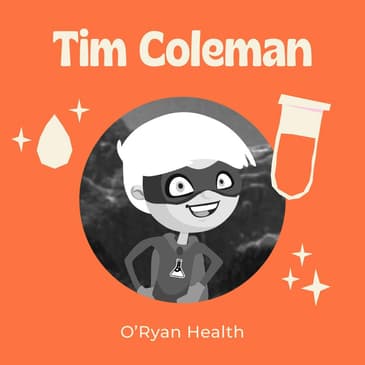

Turning Kids into Superheroes of Science with O’Ryan Health
The world of pediatric autoimmune and rare diseases can feel isolating—especially when answers live behind hospital walls or research centers far from home. But what if science came to you? What if kids could lead the charge in reimagining care?
In this episode, I’m joined by Dr. Tim Coleman, co-founder and COO of O’Ryan Health, a company flipping the script on pediatric research. Their breakthrough Artemis Platform is a child-friendly, at-home blood collection and logistics system that supports autoimmune, rare disease, and routine lab testing—making it possible for families to contribute to science and receive care without ever stepping into a hospital or lab.
Tim and his team are building something extraordinary: a world where kids become superhero scientists, collecting blood samples at home with a virtually painless device, and helping unlock breakthroughs in real time.
Inspired from the lived experience of co-founder Michael Parnell, whose daughter battles juvenile myositis, O’Ryan Health isn’t just a company—it’s a movement, empowering families to drive discovery and rewrite the future of pediatric healthcare.
We talk about:
Why families should lead—not follow—in pediatric research
How at-home blood sampling could power new diagnostics, treatments, and even cures
The vision of a future where all pediatric blood work happens at home
If you’ve ever dreamed of a healthcare system that sees, hears, and respects your child—this conversation is for you.
Learn more and become a superhero family at oryan.health
Follow along on Instagram: @oryan.health
[00:00:03] I'm Effie Parks. Welcome to Once Upon A Gene, the podcast. This is a place I created for us to connect and share the stories of our not-so-typical lives. Raising kids who are born with rare genetic syndromes and other types of disabilities can feel pretty isolating. What I know for sure is that when we can hear the triumphs and challenges from others who get it, we can find a lot more laughter, a lot more hope, and feel a lot less alone.
[00:00:31] I believe there are some magical healing powers that can happen for all of us through sharing our stories, and I'll take all the help I can get. Once Upon A Gene is proud to be part of Bloodstream Media. Living in a family affected by rare and chronic illness can be isolating, and sometimes the best medicine is connecting to the voices of people who share your experience.
[00:00:56] This is why Bloodstream Media produces podcasts, blogs, and other forms of content for patients, families, and clinicians impacted by rare and chronic diseases. Visit BloodstreamMedia.com to learn more. Hello and welcome to the show. This is Once Upon A Gene, and I'm your host Effie Parks. I cannot believe it is already April 2025. What is happening? And I know some of you are in the middle of spring break, which is probably where I'm at too. So please send me a text and check on me.
[00:01:25] I hope that you all have plans. And if you don't, I hope that you get some sleep. I am sending you all my love. Thank you so much again for joining the show. I really appreciate you taking the time to spend it here.
[00:01:38] Me, Once Upon A Gene. I always hope to help you learn something, to make you happy, to make you feel seen, to educate you, whatever it may be. I hope that this podcast is serving you in the way that you need it to. And if you feel compelled to do so, please head over to Apple Podcasts and leave the show a rating and a review. It really helps people decide they want to listen to this show or another one.
[00:02:02] So I would really appreciate it. And also head to my website and join my mailing list. I don't really ever send emails, but man, if I do, I swear it's going to be really good. Okay, I have a really great guest for you today. It's another really amazing service that has popped up in our rare disease world.
[00:02:17] So if you're anything like me, you know, the heartbreak and the hassle of the endless hospital trips, especially for blood draws. That can feel like the longest part of our day sometimes. And I know that many of our children are super traumatized. Ford can hardly even be looked at physically in a room because he knows someone's about to touch him, let alone if it's time for the needles.
[00:02:42] And I think I've talked about this before where I like call it going ice. We have to literally hold Ford down. It's horrible. He's screaming. He's looking at me like, mom, why are you doing this to me? But maybe there's a better way. Okay, I think that there is. I'm talking with a super awesome guy. He's the co-founder of a company in Boston called Orion Health.
[00:03:02] And their idea, I think, is going to change all of that trauma in the blood draw and, you know, help us to skip that stress and trauma and actually do at-home blood draws. Yes, at-home blood draws, like without a professional phlebotomist coming over, if you ever got that lucky. No needles, minimal drama, and real answers about what's going on inside of our kids' bodies.
[00:03:26] So we're going to dig into how the company works, what it all means, and why it matters, perhaps for our rare disease kids, and how it can be a total game changer for families everywhere. So cozy up, drive faster, whatever it is that you're doing, pay attention and settle in. And I hope you enjoy my conversation with Tim Coleman from Orion Health. Hi, Tim. Welcome to the podcast. Hi, Effie. How are you today?
[00:03:52] I'm doing well. Thank you. The sun's out in Seattle, so nothing can go wrong when that happens. All right, Tim, I'm excited to have you on the show and for my audience to hear about Orion Health. So can you give us a little bit of your background and perhaps what led you to co-found Orion Health? Yeah, so I've always been interested in health care.
[00:04:16] And after graduating college, I went on to the Medical College of Virginia, did some graduate work there. And when I graduated my PhD, I went right into startups. And from there, I was just developing all sorts of new technologies since 1997. I spent a little bit of time at PricewaterhouseCoopers running their biomedical strategy group, and then went right back into entrepreneurship again.
[00:04:44] And so I'm probably on my 10th company at this point in time. I've seen a pattern with startup founders continuously reinventing. It's so cool. There's just so many problems out there. There's so many problems to fix. Well, I appreciate brains like yours and that entrepreneurial spirit. Yeah. It's not easy. Tell us about the genesis of the idea. Like how did the concept of offering at-home blood draws come about?
[00:05:12] So maybe give us the whole company vision and the overarching mission of Orion Health. Yeah. So Orion Health really gets started because my co-founder, Mike Parnell, and I got together. And he was looking for a solution for juvenile myositis, which is something that his daughter has and was diagnosed when she was three years old. And as we went through a lot of iterations of what this company could become to actually figure out, you know, how do you cure juvenile myositis?
[00:05:41] What we realized was that the ability to take a blood sample in the house and really empowering parents to take those blood samples in the house so that they could be, you know, really interrogated by the most advanced systems out there right now. So like single cell RNA-seq and proteomics and metabolomics. You know, that just isn't something that normal households have access to.
[00:06:07] You have to live in one of those areas that has a great academic medical center. And so we wanted to really decentralize it and be able to allow every household in the United States to participate in research. Yeah. So can you explain the home blood draw service in a nutshell for families hearing about your company for the first time?
[00:06:27] Yeah. So what we've done is we've created an umbrella protocol that allows us to survey, consent, assent parents and children into a study protocol that allows them to take their child's blood sample at the home for the first time. And we use something called the TAP-2, which is produced by Your Bio.
[00:06:53] And the TAP-2 is just a small device that you attach either to the leg or to the arm. And it has a few microneedles in it that only go in 30 cells deep. And so it's a painless capillary blood draw that happens in about 90 seconds. And after that, we teach the parents how to package the blood sample. And then FedEx or UPS comes and picks it up and ships it off to the lab. So is this a product that families can purchase for themselves?
[00:07:22] Or does everything that they utilize through using the TAP-2 product have to do with a study that Orion Health is involved in? Yeah. So right now we are the only source of the TAP-2 device for parents and kids in the United States. And so we're rapidly like we we took our first blood sample on July 8th of 2024.
[00:07:46] So just a few months ago and have now gone from New Jersey and Massachusetts to 25 different states and households across the United States. And so for us, what we're really doing is working with a number of groups that want to see, you know, brand new at-home blood sampling brought to their disease state.
[00:08:09] So we have groups with autism that we're working with, food allergies, congenital heart defects, meduloblastoma, DIBG cancers. So there's a number of different studies that we're actually putting together so that groups can really get access to these blood samples and not have to deal with traditional academic medical centers. They can deal with just the patients and the parents.
[00:08:38] Can you talk about some of the benefits for the families and the kids themselves who have been poked and prodded their entire life? I know my own son is deathly afraid of those moments in the office because of his experience. So can you talk about these kids sort of being empowered and maybe how this calms their fears and the parents as well? Yeah. Yeah.
[00:09:03] So Orion Health, if you go to our website, you'll see that it's completely dedicated to children. We have superhero characters that are dressed up as superheroes on the webpage. But when the children actually take a blood sample, they see those superhero characters with little white lab coats on them. So they become superhero secret scientists, right? And they're incognito.
[00:09:32] And those same superhero scientists actually are allowed. We have a comic book that brings the results back to the kids. And so we've created this entire environment that our architect of imagination, David Olson, has put together that really empowers the children to feel that this is very safe. And then the device in and of itself, it's so simple. It's like putting on a bandaid.
[00:10:00] And then you press down a lever and 90 seconds later you take it off. And so we have a set of twin girls in New York who, when their mom says, hey, we've got to get blood work today, they go, the easy one or the hard one? And the hard one for them is the hour and 15 minutes they get to spend in the car to go get their veins popped.
[00:10:23] And so that's the real empowerment here of it. It's twofold. It's being able to bring back data to the kids in the form of comic book, right? So they're participating in their own health care and they're in their own understanding the research behind the disorder they may have. But it's also empowering for the parents because now the blood test is done.
[00:10:51] It's out on the back porch waiting for UPS to come and get it. Yeah, it's life changing. I mean, I remember one time we even just like had a phlebotomist come to us at one point because we couldn't get forward anywhere. And that was even life changing, but obviously, you know, a little different of a situation. But not having to cart your child somewhere, especially when the anxiety and the fear is high for probably both of you, is life changing.
[00:11:19] Is this something that's covered by insurance? Like what options do the families have for these in-home blood draws? So right now it's self-pay. It's not covered by insurance. But like I said, it didn't even exist 12 months ago.
[00:11:35] And so we're moving quickly to get us to a point where we'll be able to, you know, really offer it to a lot of different children with disorders, special needs who get poked, quote unquote, all the time. About 5% of the children in the United States account for 75 million blood draws. That's about half of the blood draws.
[00:12:04] And so done annually in pediatrics. And so for us, we're really looking at this saying, you know, we can fundamentally change this so that those children don't have to leave the home. We can get the, you know, use the existing infrastructure from UPS and FedEx to get these blood samples to where they need to go. And so certainly we're hoping that within the next 36 to 60 months that will definitely be insured. Awesome. Awesome.
[00:12:31] I mean, you can't beat the privacy and the comfort and the emotional benefit that you get from being able to stay home and do that blood draw rather than having to visit a clinical setting. Oh, yeah. The parents absolutely love it. And so do the kids, 100%. And, you know, you mentioned the website earlier and your – I forgot that awesome title that Mr. Olsen has.
[00:12:58] But the superhero vibe and the comic book that the kids get back from, you know, their journey through this whole independent sort of blood draw situation is not even remotely kitschy. It's amazing. I love it. I can tell that you spent a lot of time really thinking about it, and I think kids think that's pretty cool.
[00:13:19] And it's also really easy to help translate that stuff to their siblings if there are any siblings in the home to kind of just, you know, make it a whole family system thing because everything is. So I love all the thought that you put into that sort of human touch piece for the kids. Yeah, I'm actually glad you mentioned the siblings because when we had the initial study put together, it was really about, you know, how do we study autoimmunity?
[00:13:47] And so we actually have what's known as our Healthy Kids Study and our JDM Study. And the Healthy Kids is for all the siblings. And so the siblings not only get to see their siblings take their blood, but they can participate in the Healthy Kids Study.
[00:14:02] And that way we've built up a real nice understanding of what an immune system looks like from someone who has an autoimmune disorder and children who don't have an autoimmune disorder, which is important because that data just doesn't exist right now.
[00:14:19] So if there's a diagnostic company out there, if there's a big pharmaceutical company out there that really wants to get into these data sets and see if any of their assets or diagnostics that they have could play a role in helping to improve the diagnostic capacity for these kids, they just don't have the data sets.
[00:14:37] And so the ability to empower these parents to take the blood samples and convert them into data sets that are actually usable by, you know, the medical industrial complex is super important because otherwise we're just going to continue to progress in an environment where, you know, if you're older, over the age of 18, you know, you can get all the drugs you want.
[00:15:01] Right. So, so, so yeah, so I think it's super important for our entire team to really help build out this ecosystem so that data is definitely available for all of these companies. Yeah. Speaking of that data, how do you bring it back to the families or how do you collaborate with the patient advocacy organizations themselves with, with that information?
[00:15:24] Yeah, no, great question. So with, so like I said, with the comic books, we give really an overview of what's going on in the immune system for those kids and where they are compared to healthy kids or even their siblings. And then for the advocacy groups and the things that we're doing with our own studies, each one of those blood samples for what we do is about 110 gigabytes of data.
[00:15:52] Okay. And so we typically take 11 blood samples in our oral immune study and 10 samples in our healthy kids study. So you're collecting over a terabyte of data on each one of these kids. And so now it's kind of like turning the James Webb telescope on this kid's immune system and finally being able to say, oh, this is, this is the pathway that's wrong.
[00:16:18] This is the pathway that we really should focus on from a diagnostic perspective, or this is the pathway from a, from a therapeutic perspective. So, you know, our hope is to work with, you know, all sorts of organizations to really get that level of data back to them so that they can, you know, take their own scientific hypotheses and have the data sets to now actually interrogate them.
[00:16:42] Very cool. I mean, I can see this being super beneficial for our kids in general, but I wonder specifically for ultra rare disorders, like I know you're, you're probably familiar with combined brain, which many of us, uh, rare disease patient advocacy orgs are a part of and have a biobank there. But it's my understanding that the blood samples that they need are, would you call it venous blood, um, to store their samples.
[00:17:09] And the tap two does just capillary blood. Am I right? Yeah. So, um, so if you're a vampire, uh, blood is blood. Okay. I've definitely thought about being a vampire. Okay. Blood is blood. So, so if you think about it, your, your skin is the highly, the most highly vascularized organ in your body. We just call it the capillary system. Right. And even if you're going to pull a venous blood, where do you go?
[00:17:38] You go into your arm right here. Right. So the capillary blood and the venous blood for all intents and purposes is identical. There's been plenty of correlative studies that show both on the protein side, the cellular population side, the RNA side, the genome side, that, you know, what you draw from the skin is the same as what you draw from a vein.
[00:18:00] A vein is just like, we can get a lot more of it very quickly, but you have to go someplace where they can draw it and store it and all these other things. The wonderful thing with capillary blood draws is that it's like putting a bandaid on and then you take it off after 90 seconds and you've got a tube full of blood and then you can ship it to whatever lab you want to ship it to. Yeah. And the nice thing about it is because it's capillary and you're taking it from your skin.
[00:18:28] Well, you have a lot of skin on you. Right. So you can take it from your arm. You can take it from your legs. You know, infants, we take it from their buttocks. Right. And so there's there's a lot of different places that we can, you know, draw blood from. And so for a lot of kids that are, you know, having lots of needle sticks and are deathly afraid of needles, you know, you really need a good phlebotomist or nurse to pull that venous blood.
[00:18:55] What we've shown in the last nine months is that we can empower parents to take their own children's blood sample. Right. No health care training needed. We send you watch a 10 minute video and you're able to take your kid's blood. I think that's incredibly empowering. Yeah. A hundred percent. So the blood itself from capillary blood versus venous blood is not different. Like the plasma and the oxygen, it's the same. It's the same thing. It's the same thing. OK.
[00:19:25] And can you get enough of a sample from the capillary from the tap two that you would need for like a biobank? Like how much volume can you get? So so that's the thing that we we think about the blood samples a little bit differently is that we want to take the blood samples and get them into a digital format as quickly as possible.
[00:19:48] So we don't want to put them in a freezer bank and let someone come come back, you know, three years later and say, oh, I want to interrogate all these blood samples. Our goal, if it's going to be whole genome sequencing or single cell RNA seq or even protein analysis is to get it to the lab, convert it from that blood format. Right. Or that cellular format into a digital format that then we can store on a hard drive.
[00:20:18] Or in the cloud. And so right now we work with Simplified Genomics, which is run by my good friend, Travis Lacey, to store all our data there. And what's really nice about Simplified Genomics, which was spun off by Craig Benter's Longevity Institute, is that they have what's known as simple search.
[00:20:40] And we can actually load all our single cell RNA seq data in there, load all our whole genome data in there, and we can find any variants that we're looking for. And it's a wonderful IT system that they spent about 15 years building, and it's now finally taking fruition where it's – think about it as the Google of the genome.
[00:21:04] We can actually go in and just interrogate the genome right down to the last nucleotide. Wow. That's very cool. Yeah. Can you tell me, like, what projects or maybe what sort of partnerships that you're excited about right now or even, like, studies that you have some of these kids in? Like, what are you guys, like, really buzzing about right now?
[00:21:28] Yeah. So our seminal study is really around juvenile myositis and healthy kids and really starting to understand, you know, what are those things that we can understand around these immune systems so that these children don't have to stay on glucocorticoid steroids for six to nine months out of the year after they have a flare, right? Can we actually interrogate the immune system when they're on those high-dose steroids and know when we should take them off?
[00:21:58] Because right now it's just, you know, the clinical evidence says let it taper. But is there a time when you can be like, oh, no, they don't have this biomarker anymore, so let's take them off the drugs, which is super important for these young kids to grow and to have their vasculatures. So that's one that I'm really excited.
[00:22:19] Hopefully be working with Kids Join the Fight and Carson Leslie Foundation is to really take some wonderful science out of Texas that has shown that medulloblastoma might be something that we can detect in children from the ages of six to 18 months, right? So if we can detect it that early versus at, you know, four to seven years,
[00:22:45] there's a good chance that we can go in and just take out that small amount of cells that could be a medulloblastoma. So really excited about putting together, you know, national study with them where we're going to be sampling probably over 2,000 children. Wow. Yeah, that's awesome. And shout out to Kids Join the Fight. We'll have Taylor Beery on the show in the next week or two, so they'll learn more about what you're talking about there with Imagine Pediatrics. That's very cool.
[00:23:15] What are you looking forward to sort of evolution-wise in the next year or two? Evolution-wise is like we've built this wonderful service and tool, and we want to work with as many rare indications out there as possible. You know, a while back with Amanda and Todd Crowley,
[00:23:38] we actually started the Mending Minds Foundation to really start to interrogate and investigate, you know, what are the causes for pandas and pans? And so really excited to, you know, work with that group and really figure out, you know, how can we actually bring some real solid research to that indication? Because I think it's one that needs a lot of help.
[00:24:05] And I think we now have the tools to really move from, you know, the children being at the house, hating going to the hospital. We can keep them comfortable. We can get a blood sample. We can really start to interrogate and understand, you know, why is their immune system attacking their brain? So, yeah. So I think for the entire team, I know David Olsen, like you mentioned,
[00:24:31] our architect of imagination is super excited about getting his cartoon characters to as many kids as possible. I love working with all the parents when they're taking their first blood sample. It's amazing. You know, they're all nervous. And I'm like, it's just like putting a Band-Aid on. And then the second one, they're like, yep, just took three minutes. We're all done. Yeah. Speaking of those parents, do you have like a standout story or a meaningful moment that you got to witness or hear about from a family?
[00:25:01] Yeah. So we have this young lady down in Alabama and she was diagnosed when she was seven with juvenile myositis. And she was one of our first homes that signed up to be in the study. And she was able to take her blood sample. She's 14 now. Take her blood sample, sitting on her bed with her three-year-old sister playing at her feet and her mom videotaping it.
[00:25:31] And later on that day, mom shared the video on Instagram. And it just got so many likes and hits and everything. But the mom called me and said, you know, this is amazing. For seven years, and she was crying, you know, for seven years I've had to hold down my child to get blood drawn, give her shots of IVIG infusions, methotrexate infusions, and other
[00:25:59] things that had to be in high-dose glucocorticoid steroids that had to be IV infused. Her daughter absolutely hated it and it broke her heart that she had to actually go through that. And so when she was, she's like, Tim, you lifted the weight of the world from my shoulders. I was able to sit there and watch my daughter take her blood sample. And I know she's going to be okay. Okay.
[00:26:25] So I got a whole bunch of little anecdotal stories like that. But, you know, our team just loves everybody in the rare disease community. And, you know, now we can make rare unrare because we can finally go out there and get the information from these kids' blood that no one else has been trying to get. And, you know, our team was like, this should not be hard. And quite frankly, we prove to people it doesn't have to be hard.
[00:26:55] You just have to be a little bit innovative to get it done. I love that so much. And I know that myself and all of my friends listening completely resonate with that story of holding your kid down. It's a horrible thing that we all have to do. So I'm super excited about this product and this service and the vision that you have. And I just have so many ideas every time I think about what you all are doing on how we can really help push this forward in our rare community.
[00:27:26] So I think it's super valuable and it's really interesting. And you're doing a lot of things that are very cool. So I'm excited for people to learn about you and for you to meet more patient advocacy orgs in our world here. So maybe this, maybe how can families, caregivers or the advocacy groups learn more about your services? How can they reach you? And also if they remember one thing about Orion Health, what should it be?
[00:27:56] So to reach us is pretty easy. We have an interest form on Orion.health that people can just fill out and we'll get back to you. You leave your name, email and, you know, what disease state or disorder you're thinking about. So, and we'll get back to you there. And then our core mission is to empower parents to take their kids' blood samples at home.
[00:28:24] And so if, if you were to think about Orion Health, the one thing that you should think about is that, you know, we want to be your trusted brand for at-home pediatric blood sampling. And right now we're the only one out there that's doing it. So, so yeah, we're looking forward to working as many groups as possible and as many, you know, even the hospitals are very interested.
[00:28:50] You know, once a child finishes being treated for lupus or cancer and then has to go home and have blood samples, you know, every two to three weeks, why does that child have to leave the house? All of a sudden we can change that paradigm. So, so yeah, we're looking for a whole bunch of innovative people to help us really understand how they could use the tool that we've built to create a brand new world for kids' pediatric healthcare. Awesome.
[00:29:19] Is there anything that I didn't ask you, Tim, that I should have? No, I kind of got into the flow there. I think, I hope it sounded good. Of course it did. No, I really appreciate it. I'm super excited about Orion Health, really. And so I'm genuinely gonna, gonna like figure out how I can help fit you in where we can in the rare community, because I think this would be a huge asset for so many families and what we're, what we're doing in research and development in general.
[00:29:48] So thank you for being my guest today, Tim. Thank you for having me today. And I know that, um, two people I mentioned to Gina and I'm going to forget Gina's last name. Uh, she, she's the president of run rare and undiagnosed network. Oh, in Utah? Yeah. In Utah. Yeah. Absolutely.
[00:30:16] Big fan of you and can't wait to hear her with this podcast. She's doing good work. Cool. And she said that she, she's waiting to actually hear this one come out so that she can, um, uh, put it on all of her social media channels and spread the word as much as possible. And then, um, yeah, the gentleman was, what was Josh's last name? Reznikoff.
[00:30:46] Josh Reznikoff. You know, I just, I just met him in person finally in, at the Broad. Oh yeah. Yeah. So he's up here. Cool. Yeah. He's doing awesome stuff too. I got to get him on the podcast. So, so we'll be working with Josh. Um, and he's, you know, when I said that I was going to be doing the podcast with you, he's like, that's incredible. That's, and he's, he's got a whole bunch of people in the rare community. He wants us to meet too. Yes. Yes. Yeah.
[00:31:14] We got to bring you in Tim and you just got to start, start coming to our events. I mean, you're in Boston, so you're around so many of them already. Yeah. But yeah, we'll get you all plugged in. Was there any other questions that you had before we? I don't think so. I think that's all good. Yeah. Okay. That'll be it. And then, um, just housekeeping. If you could send me a photo that you want me to use. Um, have you seen the tiles that I sort of have just for the episode release? Yeah. How they look? Yeah. Okay. So whatever photo you want in there.
[00:31:43] And then, um, does it have to be of me or can it be one of our superheroes? It can totally be one of your superheroes or you as your superhero. Did he make you one? It can be that. We actually only have one superhero who's named and his name is Jason. And he's, uh, the gentleman that's in the wheelchair because he is actually a three-time, uh, Kona Ironman champion. Nice. And so he was competing for his fourth championship this last year.
[00:32:12] And so we made a superhero just for him. And we were actually on his bike. Both of us. And so we were totally representing the rare community out there. And, um, yeah, Jason's fantastic. Right on. Well, I think all the employees need their own, um, superhero. So. Yeah, we should. You can get on that. That'd be great. We'll let David do that. Yeah. Tell David, I want a superhero of you for the cover of this episode. I gotcha. Um, yeah, great.
[00:32:41] And then show notes will obviously include your website. Um, but if there's anything else that you want sort of in the details of, um, like links and things, you know, like just in the podcast episode area, let me know. Um, and then we'll have this episode out in a couple of weeks. Okay. Yeah. So, uh, Chip Bergstrom, who's, um. I hope you've been enjoying this podcast. If you like what you hear, please share this show with your people and please make sure to
[00:33:09] rate and review it on iTunes or wherever you get your podcasts. You can also head over to Instagram, Facebook, and Twitter to connect with me and stay updated on the show. If you're interested in sharing your story or if you have anything you would like to contribute, please submit it to my website at effieparks.com. Thank you so much for listening to the show and for supporting me along the way. I appreciate you all so much. I don't know what kind of day you're having, but if you need a little pick me up, Ford's got you.
[00:33:38] Ha ha ha ha ha!