
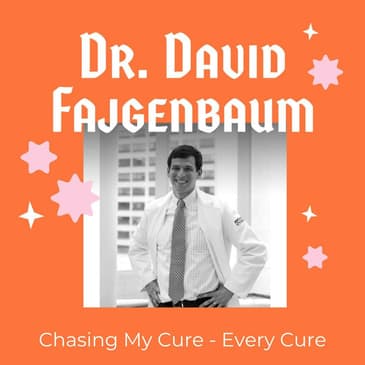

ONCE UPON A GENE - EPISODE 228
Strength In Unity - The Power of Consolidated Rare Disease Advocacy, Collaborative Breathroughs, and the Every Cure Initiative with Dr. David Fajgenbaum
Dr. David Fajgenbaum is is a groundbreaking physician-scientist, disease hunter, speaker, and national bestselling author of Chasing My Cure: A Doctor's Race to Turn Hope Into Action. He joins me to discuss the critical role of unity among our rare disease patient advocacy organizations and why it's important to stick together. We'll also talk about the transformative potential of everycare initiative.
EPISODE HIGHLIGHTS
Why is it critical for rare disease advocacy organizations to strive for unity?
When there's splintering of fracturing among disease groups, there are less resources within each effort and there's a risk of duplicating efforts. There are also only so many experts to participate in a scientific advisory board and there may be competition for those experts among groups.
What is your best advice for organizations who may be experiencing competition or friction?
Friction happens because we care so much and we're driven to find treatments and solutions. When you want rapid solutions, it's important to recognize that the objectively best and fastest way to make an impact is working together collaboratively and consolidating resources.
What advice do you have for ultra-rare disease organizations that are worldwide and have a unique issue of centralizing patients and financial strength?
In the past I've seen this done well where existing organizations support new organizations starting in new regions of the world by sharing resources and materials and being a supportive partner. It's critical for disease organizations to work together on a global scale.
Can you tell us about Every Cure and how it aims to revolutionize treatments for rare diseases?
Every Cure is on a mission to unlock the full potential of every approved drug to treat every disease possible. When a drug is approved for one condition, there's often dozens of other diseases that the drug might be effective in. Every Cure was launched when learning that there was an incredible untapped opportunity to treat more diseases than approved drugs were originally intended for. There are also systemic barriers that prevent the untapped potential from being tapped into. I'm alive, along with thousands of other patients, because of drugs not intended for a disease that we re-purposed.
LINKS AND RESOURCES MENTIONED
Chasing My Cure: A Doctor's Race to Turn Hope into Action; A Memoir
https://chasingmycure.com/books/
Every Cure
https://everycure.org/
ONCE UPON A GENE - EPISODE 043 - David Fajgenbaum - Chasing My Cure - A Doctor's Race to Turn Hope into Action
https://effieparks.com/podcast/episode-43-david-fajgenbaum
Share Your Drug Repurposing Insights
https://everycure.org/insights/
CONNECT WITH EFFIE PARKS
Website
https://effieparks.com/
https://twitter.com/OnceUponAGene
https://www.instagram.com/onceuponagene.podcast/?hl=en
Built Ford Tough Facebook Group
https://ww
w.facebook.com/groups/1877643259173346/
[00:00:03] I'm Effie Parks. Welcome to Once Upon A Gene, the podcast. This is a place I created for us to connect and share the stories of our not so typical lives.
[00:00:14] Raising kids who are born with rare genetic syndromes and other types of disabilities can feel pretty isolating.
[00:00:21] What I know for sure is that when we can hear the triumphs and challenges from others who get it, we can find a lot more laughter, a lot more hope and feel a lot less alone.
[00:00:30] I believe there are some magical healing powers that can happen for all of us through sharing our stories and I'll take all the help I can get.
[00:00:43] Once Upon A Gene is proud to be part of Bloodstream Media. Living in a family affected by rare and chronic illness can be isolating and sometimes the best medicine is connecting to the voices of people who share your experience.
[00:00:55] This is why Bloodstream Media produces podcast, blogs and other forms of content for patients, families and clinicians impacted by rare and chronic diseases. Visit Bloodstreammedia.com to learn more.
[00:01:08] Hi there and welcome to the show. This is Once Upon A Gene and I'm your host Effie Parks and I'm so grateful that you are taking the time out of your busy day to spend a little bit of it with me. Thank you so much.
[00:01:18] If there's a topic that you're looking for, please send me a message and I'll either point you in the direction of the episode in the library or I'll make it happen on the show. Also, the only way this show grows is by word of mouth.
[00:01:30] So please send this episode or this podcast to someone who you think would benefit from it.
[00:01:34] So I just got back from World Orphan Drug in Boston, Massachusetts where I was so grateful to sit on a panel with the Marvelous Gene DX team and the night before the conference.
[00:01:45] Shout out to my beautiful, kind, sweet, funny, adorable polypocket friend, Madeline Oden, Margot's mom who made it happen. She made a little tile. She said let's have a meet up. There's lots of local people here.
[00:01:56] We posted it a few days before and dozens and dozens and dozens and dozens of you showed up. It was so beautiful. We had so much fun, so many hugs and so many people made new friends and connections.
[00:02:07] So thank you all who came and don't worry. We'll have a couple more of those in the future.
[00:02:10] Today I'm so excited to share this conversation with you. I'm sure many of you know the name Dr. David Faganbaum. You know, he was on episode 43 back when I was a wee little podcaster where we talked about his amazing book, Chasing My Cure.
[00:02:26] If you have not read that book, go get it immediately. Download it. David reads it. If you have too foggy of eyes to look at a book, you must know his story. It is just its own reel.
[00:02:36] So today we are having a very in-depth conversation. We're diving into the critical role of unity among our rare disease patient advocacy orgs and why it's so important for us to stick together and not fragment.
[00:02:50] We're also talking a little bit about the transformative potential of every cure initiative.
[00:02:55] So I asked David a lot of tough questions and I hope you get some answers and I hope you learn something. And I most of all hope that you come away from this conversation feeling so hopeful and have an action item list.
[00:03:08] So thank you so much for listening and please enjoy my wonderful conversation with Dr. David Faganbaum.
[00:03:15] Hello, David. Welcome back to the podcast.
[00:03:18] Thanks so much for having me back.
[00:03:19] Yeah, I'm so thrilled. I had you on so long ago like in my very first little baby era of starting this podcast and I appreciate you taking the time again to come on the show.
[00:03:31] Oh, I loved it. It was so fun to connect then and I'm so excited to connect now.
[00:03:35] Yeah, last time you only had one little girl. Now you're a parent of two so congratulations. They're both so cute.
[00:03:42] Thank you. That's right. Yeah, I've got a five and a half year old and a two year old and it's just awesome.
[00:03:46] Yeah. Okay, well we have lots to talk about David. You're a busy, busy man.
[00:03:50] We're going to touch on two two subjects.
[00:03:52] A few months ago you posted a video on LinkedIn that really resonated with me.
[00:03:57] You brought up the subject of patient advocacy organizations, importance of being united and the hazards and just pitfalls of the splintering and the recreation of numerous patient advocacy orgs.
[00:04:10] So I wanted to talk about that because as we know this can be a huge problem for reasons that make sense and reasons that don't.
[00:04:17] And I get lots of questions too from people weekly about starting new organizations, right? Because things aren't working.
[00:04:23] So kind of want to just dive into that a little bit and get your perspective and your opinions and can you share your thoughts on why it's so critical for our especially our ultra rare disease patient advocacy orgs to strive for unity rather than fragmentation.
[00:04:36] I'd love to, you know, as given, you know, both of our connections to the rare disease space, we just care so much about patients being able to receive therapies and as much progress being made as possible.
[00:04:48] And just as you said, when there's splintering or fracturing within diseases by definition they're now going to be less resources within each effort and there's going to be the risk of duplicating reinventing the wheel.
[00:04:59] And so there are these problems when you start splintering within a particular disease that are really clear.
[00:05:06] You know, as I mentioned, there's issues of limited resources being spread then there's issues of maybe going after the same problem when maybe there's other problems that should be addressed.
[00:05:15] And then also really major one is that there are only so many experts to put on a scientific advisory board and now you're potentially, you know, asking the same people to be a part of different advisory boards and you create competition between groups.
[00:05:26] And so for all those reasons, it's a problem. But I think that it's important for us to talk a little about the root cause. Why is there splintering within rare diseases?
[00:05:35] And I think it just comes down to the fact that we all just care so much, right? You know, we just, we don't care as far as kids, curious for ourselves and because we care so much, it means that if we have an idea for what's going to be the most impactful path forward for my disease or for Ford's disease,
[00:05:51] we might have a pay an idea, but once someone else has an idea or plan that's even just 1% off of what our plan is, there's immediately so much friction because we all care so much and we just, we want solutions that are going to help people so badly.
[00:06:07] So when there is friction, I think that oftentimes leads us to splinter and say, well, we're not aligned. They want to do research and we want to do advocacy or they want to, they're split between research and advocacy isn't exactly how I see it split.
[00:06:19] And so as soon as that happens within our rare disease space, we just often splinter and we set up new organizations. And like I said at the beginning, I think it's just, it's really problematic for the field.
[00:06:30] But I think it's important to recognize that no one is splintering and creating the 17th disease organization for their disease because they want to create a 17th disease organization, right?
[00:06:39] You know, all of us are very reluctant when we go about creating an organization for rare disease. None of us want to do it. We all wish we weren't starting rare disease organizations, but we do it because we want to make a difference.
[00:06:49] So I think it's important to recognize that splintering is not a result of people doing the wrong thing or having the wrong intent. It's really just because we all just want to help people.
[00:06:59] Yeah, and I appreciate that. And I totally agree with you. I don't believe that there are like so many bad actors that are doing this, you know, for reasons that aren't about caring for their kids.
[00:07:10] Unfortunately, probably in every area of everything that's happening, but I think in this it is. It's like it's such a passionate desire to help these kids.
[00:07:18] But I feel like there's also this sense of urgency, right? And almost panic. And you're you're so sleep deprived in any way and you're working so hard in so many areas.
[00:07:26] And so you just want to get it done. And I don't think necessarily that families and leaders understand the impact of, yeah, just kind of what you mentioned like future funding, future resources and research and all these awareness efforts that get splintered off.
[00:07:44] And just like human level, how would you explain this to this group who might have some some tension or some families who don't necessarily understand why an org is going one way or another?
[00:07:57] Like how would you base level speak to a family to kind of stick together and try to make this work without any sort of power dynamic or someone caring more or anything like that.
[00:08:08] I think I would just start out by saying, listen, the reason that there's a little bit of friction is just because you all care so much. You want solutions for your kids. You want solutions for yourselves.
[00:08:18] So let's not assume that when there's friction, it's because there's personalities that are and it's because people don't like one another. Let's just start by realizing the only reason there's friction is because we just care and we want solutions so badly.
[00:08:30] And so if we recognize that the next question is, okay, if we want solutions so badly as rapidly as possible, what is the objectively best and fastest way to make an impact? Well, the objectively best and fastest way to make an impact is working together.
[00:08:45] So though I know that it feels like there's friction and it feels like you might want to go separately, the best way to make an impact is by consolidating resources working together, rowing in the same direction.
[00:08:55] You are going to get to the finish line faster. If you have four people rowing the same direction on one rowboat, then if you have four people separately going their own ways, right?
[00:09:05] And so I think that recognize that the underlying reason for the tension is because of passion for impact and then start getting really into the nitty-gritty.
[00:09:14] Okay, if we all care about impact, what's the best way to make the most impact? I think that's really important.
[00:09:18] And I also maybe just share the anecdote from the Castleman's field. When I was first diagnosed with Castleman disease, there were two organizations that existed.
[00:09:26] A group called CARE, Castleman's Warrant Research Effort and a group called ICDO. And I went to both groups and I said, you know, we're starting a third group, Castleman Disease Collaborative Network.
[00:09:34] ICDO, you're very focused on supporting patients. CARE, you're very focused on raising awareness. We want to focus on research. And so we're going to start a third organization.
[00:09:45] And ICDO group said that's great because like, you know, I don't want anything to do with research. Like I want to stay focused on navigating and I, you know, you guys do research. That sounds great.
[00:09:53] But the CARE group said, well, we're raising awareness, but we would love to do more research. And actually I love your vision for the kind of research that you want to do.
[00:10:02] I think there's something here and I love that it was so exciting because I didn't want to have to create some separate initiative.
[00:10:10] I didn't want us to have to go out and do our own thing. The fact that the CARE group was so excited to work together meant that we created this incredible partnership and bond where we've been working together ever since.
[00:10:20] In fact, CARE and CDCN merged. We became the same organization after just a couple years. And so I highlight it because I want to point out a few things.
[00:10:30] One, the leader of CARE I think really demonstrates the kind of qualities that we all want in the rare disease space. His name is Greg Pacheco.
[00:10:39] And he just said, you know, I don't know anything about research. That's why we haven't really been going into research. But that's why we raise awareness. It's like to advance research.
[00:10:48] So this makes sense. He just was sort of humble enough to be like, I don't know it, but focused enough to say like, but it's good for the field. So let's work together.
[00:10:57] And then I think that once he was demonstrated those incredible qualities, I was so excited at partners in crime for this stuff.
[00:11:07] You know, working together with people that are like-minded and bring different perspectives and backgrounds. You're just going to get better solutions that way.
[00:11:15] So I hope highlighting that is helpful because even within our castmen's field where we're quite unified, the ICDO group said, no, we're going to keep doing our own thing.
[00:11:24] And frankly, you know, this join together CARE CDCN effort has just really been transformative. And I really believe a main ingredient in the impact we've been able to make is because we partner so closely with CARE.
[00:11:37] Thank you so much for that example of where like collaboration between organizations not only led to breakthroughs, but significant advances and really just an opportunity to collect your efforts there with positivity.
[00:11:50] I love that so much.
[00:11:52] Yeah. And you know, the other thing I'd also mentioned is that, you know, as we sort of joked about at the beginning, none of us want to start rare disease organizations, right?
[00:11:58] You know, all of us have more than enough things to do, whether it's our professional lives or families or loved ones with rare diseases.
[00:12:03] And when you go about these things together, you're able to have, you know, one accountant, you know, handling finances, you know, one attorney dealing with this sort of legal stuff, you know, one set of operational efforts as opposed to when we splinter, all of us are doing these things that aren't really mission critical.
[00:12:21] I mean, they are mission critical. You have to do them well, but they're not necessarily getting us closer to our finish line.
[00:12:25] So let's work together so that we can all pull our resources to deal with the stuff that isn't going to get us to a cure. That way, we can all focus our attention on getting our diseases to cures.
[00:12:35] Yeah. So when it comes down to these ultra rare disorders, all you see Tina and B1 as an example.
[00:12:41] So we have 438 patients worldwide. What is your take on the matter of, you know, all of these patient advocacy orgs in other countries needing to start, you know, to because of this whole tax reason, right?
[00:12:51] Like nobody is going to want to give their donor dollars necessarily to this place if they can't use that as like a tax write off and like a double matching thing.
[00:13:00] If it's not USA, so we all have to kind of band together. We have some really special orgs that are all across the world.
[00:13:05] But then again, it's that problem of, you know, academia not wanting to share with them and money going this way and that way.
[00:13:11] So like what advice do you have for us small rare diseases who need every single one of these patients yet they're all over the world?
[00:13:17] And it doesn't make sense financially or does it? And how can they kind of pool that together with all of those barriers of just bureaucracy and money?
[00:13:27] Such a great question because you're exactly right in some cases, especially when there's, you know, geography at play.
[00:13:33] It actually does make sense to have different entities because to your point, if you live in the UK, you want to be able to have benefits for giving money that you can actually benefit from as opposed to if you give to a US based organization may not be able to actually
[00:13:47] reap the benefits of donating to a nonprofit. And so I totally agree with you.
[00:13:52] I think that what I've seen done really well and what we've done in the castman's community is to really support when new organizations are getting set up in different regions of the world.
[00:14:01] Make sure that the founders know that they have all the resources that you have that are accessible to them, share all the materials on the websites, make sure they can feel free to translate them into whatever languages they may like to just be that supportive partner
[00:14:14] and recognizing that there are things about this disease that are going to be different in your part of the world than in another part of the world.
[00:14:22] And then there really is value from you leading this effort in another part of the world.
[00:14:27] But we have to figure out a way to make this a coalition where we're all working together because it's not helpful for anyone for there to be in the castman's case.
[00:14:37] There's an amazing group in China and a great group in Japan, a great group in Italy and the US in France.
[00:14:44] It's not helpful for any of us if we're all working on our own.
[00:14:48] So it's critical at the highest level that we have the leaders of each one of these organizations that we're working very closely with one another.
[00:14:55] And for castlemen's the castlemen's cloud network, we've taken a global scope from the very beginning.
[00:14:59] So actually, our scientific advisory board is actually made up of physicians and researchers from all over the world.
[00:15:06] Every continent except for Antarctica is represented on our SAP.
[00:15:09] And so from the beginning we wanted to be global, but when a group in Italy or China or Japan or France says that we want to set up something locally,
[00:15:17] we've completely embraced it because there's so much more they can do in their countries than we can do when we have the whole world as part of our scope.
[00:15:24] But again, the key is embrace them starting up within their region of the world, but make sure that there's incredibly close communication.
[00:15:33] So that way we're not funding the same researcher to do the same thing or that we're being thoughtful about how we're distributing our limited funding.
[00:15:41] Thank you. Thank you so much for that.
[00:15:43] And then just, I guess we don't have to really go deep into this, but it made me think of obviously some of the issues around our rare diseases and dealing with certain academia institutions not wanting to share anything,
[00:15:57] not wanting to talk about anything.
[00:15:59] So how do we get, and I understand their whole career path in the way that the system works,
[00:16:03] but how do we sort of collect that idea and circle them in as well to help progress us forward?
[00:16:09] Oh, it's such an important point because I do think, and you made this point a little bit earlier.
[00:16:15] I do think that some of the competition within the rare disease community and some of the us versus them within a given rare disease,
[00:16:22] I think is sometimes stoked in some ways by the fact that there is so much academic competition that occurs.
[00:16:29] So, you know, I've seen in a particular neurodegenerative disorder where one rare disease group aligns itself with researchers at Columbia and another one aligns themselves as researchers at Harvard.
[00:16:43] And another one lines them with researchers at Duke and none of those three academic groups share anything.
[00:16:49] So, of course, that means that the advocacy organizations aren't sharing anything because they now have like sort of an ally that's not being very interested in sharing.
[00:16:59] And I think that's a really big problem in our community.
[00:17:03] So it's not just that parents and disease organizations are saying we're not going to work together, we're going to fracture.
[00:17:09] But of course, we all know that within academia there's a lot of protection of data, a lot of you know, we're working on this, you can work on that,
[00:17:15] which is really tragic because at the end of the day, the only people that suffer from that are patients that just aren't getting treatments fast enough.
[00:17:23] So I think you're right to connect the two and to say if we're going to try to solve this problem of disease organization fracturing,
[00:17:30] we also just solve the problem of academic groups not wanting to share, not being willing to share.
[00:17:35] And so I can tell you in the castle in space some of the ways that we've helped to get around some of these, some of the competition within between these groups.
[00:17:42] So one is to create a really globally representative scientific advisory board.
[00:17:48] So it doesn't, you know, I've seen in some disease groups where one org is the US based one and one other ones Europe and and there's competition between researchers because for those reasons,
[00:17:57] but really being global in our representation on the advisory board.
[00:18:00] And secondly, always having patients that are part of our scientific advisory board meetings, you know when there's a patient in the room whose head is bald because they just got seven rounds of chemotherapy that can sometimes prevent researchers and physicians from getting to the
[00:18:12] room arguing about who's the first author or the second author because it helps to ground them and like that stuff doesn't matter.
[00:18:19] Right. The thing that matters is helping this patient in front of you and helping patients like them.
[00:18:23] So I think including patients in those meetings is really important or family members, of course, I think in addition to that, I would say that doing as many following as many consensus based exercises as possible is really important.
[00:18:36] So what I mean by that is getting members from all over the world to work together on a particular thing.
[00:18:43] So for Castleman's it's diagnostic criteria and then it was treatment guidelines and it was treatment guidelines for another subtype of Castleman's.
[00:18:49] And now we're refining them so it's efforts that require all of us to work together and all of us to throw in data.
[00:18:55] And so what we say is the more data you include in this project where we come up with guidelines, the more likely you'll be either the first author or the last author which within academics as silly as it is.
[00:19:06] That's sort of the most important thing either way the first or the last author.
[00:19:10] And so if you put more data in, if you share more data, you're going to be closer to the front or you're going to be closer to the last author.
[00:19:15] And so things like that where we can get everyone working together and they're actually incentivized to put more data in and they get rewarded for it.
[00:19:21] They get a publication out of it and the more data they put in the better the publication is for them.
[00:19:25] I think those are the kinds of things that get us working together.
[00:19:28] And then frankly, the last thing I should also mention though this is a bit unfortunate is that money is actually sometimes the way you can get groups to work together.
[00:19:36] And by that I mean you say we are only giving you this grant funding if you agree to share it pre publication with at least three other institutions.
[00:19:46] And these are the three institutions, for example, where the money doesn't get to their institution unless they're willing to agree to share data.
[00:19:54] Those are some of the things that we've done that I think have been really helpful.
[00:19:56] So much of that gave me chills of what you said.
[00:19:57] I love that really like hammering down on the global representation and then the patient in the room.
[00:20:03] And then also, yeah, maybe patient advocacy works coming to the table super armed with these open minded requests.
[00:20:11] And I wonder if we can make a magical template for new orgs.
[00:20:14] I love that idea.
[00:20:16] Maybe orgs that aren't necessarily as well connected to know this going in when there's because I think that they finally get these donor dollars and they're so excited.
[00:20:22] And they take the first person who says yes to them and they miss those opportunities to really make sure that it's going to be collaborative throughout.
[00:20:30] And so we should make something for those people because I don't think everyone knows unless you're on a wonderful email chain of people who share their homework, right?
[00:20:38] I agree. And I think we may even want to just visit that point a little bit too, just in terms of like, you're an early org.
[00:20:44] You just had your first fundraising event and you were so thankful for these donors who have who basically trusted in you their dollars because they believe you're going to get a grant.
[00:20:52] They're going to get a disease closer to a cure.
[00:20:55] And so just as you said, you're so excited.
[00:20:57] Basically the first researcher who comes to you with any idea, you're like, yes, yes, yes, I just want to cure it as quickly as possible.
[00:21:03] And so that's exactly how I felt in the early days with castleman's and maybe I'll just share some lessons today is actually my 39th birthday.
[00:21:10] So in my in my old age, my wisdom, I'll share.
[00:21:13] Thank you.
[00:21:15] I'll share some of the things I've learned that have made me a little bit less the really excited.
[00:21:19] We just got our first dollars into, you know, this, this old and wise rare disease advocate or maybe wise, certainly trying to be.
[00:21:28] And that's that I realized that though we want to fund, you know, sometimes it's the doctor who took care of us or our loved one, though we want to fund maybe the first researcher who proactively reaches out to us because oh my gosh, if they're emailing me, that's a really good sign.
[00:21:45] They're going to work really hard.
[00:21:46] I sort of want to encourage people to not do that, to not fund your child's doctor or to not fund the sort of first researcher who's really proactive and reaches out to you.
[00:21:59] And I'm sharing that from from experience and lessons learned.
[00:22:03] I think that much more effective than that is actually to sit tight with your new dollars for just a little bit of time as hard as that is because all of us we either have a rare disease or we have a love on the disease.
[00:22:12] We don't want it just to sit in a bank account, but I would really encourage you to sit tight for just just a bit.
[00:22:18] And during that time where you're sitting tight with the funding, I think it's really important that you spend time talking to physicians, researchers and patients to understand what do we know about this disease?
[00:22:28] What don't we know about this disease?
[00:22:30] Help me draw out on a single piece of paper how this disease works like what's our best understanding and help me in a really simple way to understand like, where do we need to fill in the gaps?
[00:22:39] You know what parts of the puzzle have not been filled in?
[00:22:42] Before anyone starts telling me about a research study that they want to do or that they're the best people to do, just let me understand the landscape.
[00:22:48] Like where are the gaps here?
[00:22:50] Okay now that we're on the same page about what we know, what we don't know, the next question to all those groups, physicians, researchers and patients is what sort of research questions could be asked that could help to fill those gaps and maybe even what studies could be done to fill them.
[00:23:04] And then that's a separate question again from who should do it.
[00:23:07] And so again try your best to not let them tell you, oh and by the way I'm the best person to do that.
[00:23:10] Just understand what should be done.
[00:23:13] And then the third question is okay who's the best person in the world to do this study, to fill this gap so we can move things forward.
[00:23:20] And just by random chance alone or based on statistics it's very unlikely that your child's doctor is the best person in the world to do that study to fill in that gap.
[00:23:32] And for all of the doctors of patients that are listening in and like wait a minute why is he telling groups not to fund me?
[00:23:38] It's possible you might be the best person in the world to do that study but it's also possible that you're not the best person in the world to do that study.
[00:23:45] And I think it's really important for us in the rare disease community to understand where the gaps are, understand how we fill the gaps and then figure out who is the best person in the world to fill that gap because as much as we want to spend those dollars, we need to spend those dollars as efficiently and as effectively as possible.
[00:24:04] That's the way we're going to cure our kids or ourselves.
[00:24:06] And so anyway I wanted to point that out.
[00:24:09] I don't mean to be on a soapbox and for all the doctors listening in, I apologize for my opinions on this but I'm interested to hear your thoughts on that and sort of your experiences.
[00:24:19] First of all I love a soapbox so thank you for that.
[00:24:22] And I really deeply appreciate your honest advice for desperate people to take pause and make sure that they are making the right choices and educating themselves enough because it can be really difficult to not feel like you have to do it yesterday and to also feel a little less than and that you have to take what you can get, right?
[00:24:42] Yes. We all feel that right?
[00:24:44] Yeah.
[00:24:46] Because we feel like who's going to want to study our rare disease?
[00:24:48] You know we're so rare totally.
[00:24:49] Yeah.
[00:24:51] And to assume that the first person that you Google who may have had something to do with your gene is the right person to fund.
[00:24:57] So to really go around into your homework and think about it thoughtfully is a very good piece of advice.
[00:25:02] And honestly I don't think I've ever really heard families talking about waiting a second after you have that big funding burst in the beginning and you're so excited and you want to make an impact to really think about it.
[00:25:16] Like I don't think families are necessarily taking that TLC and not because they don't care.
[00:25:22] It's because they care so much.
[00:25:24] It's because they care so much, right?
[00:25:26] And it's sort of the same thing as we were talking about with splintering.
[00:25:28] Splintering isn't happening because people don't care.
[00:25:30] It's happening because they care so much and potentially you know around the way that dollars are distributed.
[00:25:36] I think that there's some inefficiencies because we all care so much.
[00:25:38] And so yes for families with a rare disease that are involved in research, I just would really encourage you to dissociate and separate what research needs to be done from who should do it.
[00:25:49] And I think you want to objectively figure out what should be done and then you want to objectively determine who's the best person in the world to do it.
[00:25:56] And it's not always your child's doctor and it's not always the researcher in your field who sort of is the person.
[00:26:04] What we found in Castleman disease, we've made the most breakthroughs by determining what should be done and then going to a researcher who actually will then ask me what is Castleman's?
[00:26:15] And I'm like, oh gosh, this isn't going to be an easy conversation.
[00:26:18] But it turns out that those people who say what is Castleman's?
[00:26:22] Well, the last 10 years they've been busy doing the exact type of study I need them to do for Castleman's but for another disease.
[00:26:28] So they've already been there.
[00:26:30] They've done that.
[00:26:32] They've learned from all the mistakes from doing it for another disease.
[00:26:34] They've learned from doing it for Castleman's.
[00:26:36] They're not a Castleman's research that's doing some new type of research.
[00:26:39] They're the right person to do that kind of research.
[00:26:41] They're just newly doing it for Castleman's and they're going to bring all their experiences from other diseases to make them really good at it.
[00:26:47] And the other thing I'll mention, those are some of the best researchers we've had again have started out the conversation with what's Castleman's?
[00:26:53] And then some of the other major breakthroughs we've had have come from working with companies.
[00:26:57] And so biotech companies like Somalogic, 10 X genomics where they develop these incredible platforms and they're the best people in the world for understanding how their platforms are utilized.
[00:27:09] Adaptive bioscience is another example.
[00:27:11] So you don't actually always have to work with academics.
[00:27:14] My dear friend Josh Summer really, in my opinion, has led the rare disease field towards this idea of working with contract research organizations.
[00:27:22] So, okay, we need to develop a mouse model for Cordoma.
[00:27:26] The typical route is let's go work with five different academic groups to figure out how to do this.
[00:27:32] His approach is I'm going to go work with five companies.
[00:27:34] I'm going to pay them and at the end of it, I'm going to get a solution as opposed to working with academics.
[00:27:40] Sometimes the timelines don't always align.
[00:27:43] And by the way, I should disclose to everyone that's listening.
[00:27:46] I am an academic so I work in the University of Pennsylvania.
[00:27:49] So me being negative about academics, I'm literally one and academic.
[00:27:55] But I just think that there are cases and of course there are cases where academics are the right people and there are cases where your child's doctor is the right person.
[00:28:02] But my experience has just been that we need to give companies a chance too because oftentimes you pay a specific amount and you know what you're going to get out of it.
[00:28:11] I love all that so much, especially like thinking about plugging those people into your disease because of their experience and not necessarily exactly what they were studying.
[00:28:19] And I want to talk to your friend Josh because I would love to have that conversation about how families can do sort of like that contract and pay companies instead of necessarily getting into academia or in conjunction with it.
[00:28:31] So hook me up.
[00:28:33] And something else that you said just made me think that there's this guy on LinkedIn, Brian Krueger.
[00:28:38] I don't know if you know him, but he always posts really interesting and thoughtful things.
[00:28:43] And the other day he posted a big story about how do you know if you're dealing with a good scientist?
[00:28:47] And he kind of just went over the fact of you ask you ask them why and you ask them why and you keep pushing them and the good scientists will always end up like being skeptical at all points of what their opinion is.
[00:29:01] Right.
[00:29:02] And I thought that was really interesting because I'm not sure many people always meet those types of brains where they're not sure and they're not making promises, especially for small rare disease orgs.
[00:29:13] So I love that like find the people who will still question themselves.
[00:29:17] It just made me think of that from what you said.
[00:29:19] Well, I love it because it's so counterintuitive to how we do everything else in life.
[00:29:23] Like if you were to go to a car dealership and be like why is your car better than another car?
[00:29:27] And if they're like, you know, I'm not really sure. It's a good question.
[00:29:30] You're like, all right, I'm going to go to another car.
[00:29:34] But you're right in research. That's actually the answer you want.
[00:29:37] You want to know, well, like, you know, why does this happen?
[00:29:40] And it's like, well, we're not sure but we're going to study it for this reason.
[00:29:42] Well, why does that happen?
[00:29:44] Well, we're not sure what we're going to do this other thing and being skeptical of like, I think my approach is the right way.
[00:29:48] But the reality is, it's like none of us know the right approach because like if we did know the right approach, I mean, if we did know the answer, we would already have the answer.
[00:29:55] We're just trying our best as scientists.
[00:29:58] And so I think that that is so counterintuitive to like the rest of life.
[00:30:03] And I think frankly, also when you have a child with a rare disease or you have a rare disease, you kind of want someone who seems really confident.
[00:30:11] Like, oh, I know exactly what's going to happen.
[00:30:13] Like, oh yeah, I want confidence, right?
[00:30:15] But the reality is I actually am a firm believer that you actually don't want, you certainly don't want overconfidence, but you also want skepticism.
[00:30:20] You want your researcher to say, I'm not really sure if my approach is the best, but I think it is for XYZ reason.
[00:30:27] Yeah, yeah, cool. Oh my gosh, this is very full and I've learned a lot already and I appreciate it.
[00:30:32] But we also have another pillar of what we obviously want to talk about is every care and congratulations on your new R-BH grant.
[00:30:40] And you've come so far and everyone knows, you know, a little bit about what you're doing because you're doing a really good job of sharing it on social media.
[00:30:46] But for anyone who doesn't know or needs a little bit more of a background, can you please explain the concept behind every cure and, you know, how it aims to revolutionize treatments for rare diseases?
[00:30:58] Sure. So every cure is on a mission to unlock the full potential of every approved drug to treat every disease possible.
[00:31:04] And so this is based on the realization that when a drug gets approved for one condition, there are oftentimes dozens of additional diseases that drug companies and researchers considered that that drug might be effective in.
[00:31:16] But they had to make really tough decisions and say, even though it might be effective in these other dozens of diseases, we have to pick the one or two that we're going to pursue this drug in.
[00:31:25] And so we launched every cure because we learned that, A, there's this incredible opportunity.
[00:31:33] There are all of these drugs. There's 3000 approved drugs.
[00:31:36] Those 3000 approved drugs have this incredible potential that's currently untapped to treat more diseases than they initially were intended for.
[00:31:42] And at the same time, the reason we started every cure is because there are these incredible systemic barriers that prevent the untapped potential from being tapped into.
[00:31:51] And so what are those barriers? Well, first off, 80% of drugs are already generic, which by definition means that no drug company is studying those drugs to find new uses for them.
[00:32:01] So 80% of the cures, the treatments that are sitting at your neighborhood pharmacy that are literally a prescription away from you or your loved one, no one is doing any research on.
[00:32:09] So we felt like that should be fixed. Secondly, drug companies oftentimes have information within the company, academic groups, oftentimes information within research labs about other uses for drugs.
[00:32:23] But that information is sort of separated into all these different places. It's either within a company or it's within some place like Penn.
[00:32:30] The data is sort of sparse. It's all over the place.
[00:32:32] So when I want to go about repurposing a drug for Castleman disease, I've got to sort of piece together this giant set of data from all these different places.
[00:32:42] And then someone wants to do it for Cordo more you name the rare disease, we're all reinventing the wheel.
[00:32:47] And then the third, third major barrier is that there's no one in our whole healthcare system that's responsible for ensuring that approved drugs are used for all the diseases possible, which is sort of kind of crazy, right?
[00:32:57] Because as a society, we spend billions of dollars for every single drug that we get approved. And humans then benefit from those drugs.
[00:33:07] But the fact that there are many more humans that could benefit from those drugs if we just expanded the use to more diseases, it's sort of like mind blowing that we have never had an initiative that said, hey, wait a minute,
[00:33:17] I'm going to take responsibility for making sure that drugs are fully utilized.
[00:33:19] So that sort of tells you why we're doing what we're doing. But maybe even more importantly, why is that me personally and thousands of other patients that we've been working with over the last 10 years are alive today because of drugs that weren't intended for their disease,
[00:33:36] that we repurposed, we found a new use for that drug and it saved their lives. And of course, many people have done this across many other diseases as well.
[00:33:44] They're great examples like thalidomide going from being a drug for leprosy to being a life saving drug for multomyeloma and Viagra going from its very well known use to also being a life saving drug for pediatric or paediatric pulmonary hypertension.
[00:33:59] And so there are examples of this happening already. But the problem is, is that they only happen by random chance alone. And when a drug typically when a drug is still on patent when there's actually a commercial incentive to do it.
[00:34:12] So every cure has decided to take on this huge problem and that's that there are patients suffering on one side, and there are drugs that could treat them that are at their neighborhood pharmacy on the other side.
[00:34:22] And our job is to match them together. And so we are utilizing artificial intelligence to use the world's medical knowledge to say, okay, among everything that the world knows about drugs diseases genes targets.
[00:34:35] What is the likelihood that every single drug would be able to treat every single disease so all 3000 drugs against all 20,000 diseases and so I would never be able to and will never be able to perform 60 million calculations simultaneously based on the world's
[00:34:52] knowledge. But AI can do that. And so the algorithms we use apply machine learning and also we like to use what are called random forest models but but others as well to come up with a score from zero to one for how likely every drug is to be able to treat every disease that you've ever thought of.
[00:35:09] So your son's disease, Castleman disease, you get 3000 rank ordered scores for it and that serves as a great starting place. So when we run it for Castlemans.
[00:35:17] And we did the number one hit was a drug that had never been used before for Castlemans. But based on that information and based on the fact that there was a patient who was getting ready to go into hospice care, we repurpose that drug for this patient and it turned out that it was able to save his life
[00:35:30] it's now been over a year that he's been doing well on this drug that had never been used before for Castleman disease. And so this is the future that we're working towards is one where no matter what your disease is, we use AI to say what are the most likely drugs to treat your disease.
[00:35:47] And then importantly as an organization, we then do the work to validate that that drug really makes sense for that disease, and then even run the clinical trials to prove that that drug really works for that disease.
[00:35:58] It's so invigorating and exciting, right. And especially like, I mean, if you haven't read Chasing Your Cure and listened to Dave's other episode, you must because our community has clearly taken a page out of your book in knowing that we can kind of design the course for our communities.
[00:36:13] I wonder, with the RPH grant that you got, do you have some sort of prioritization strategy of like allocating funds for these ultra rare diseases that are underfunded? Like are you going to make a landing spot for sort of this ultra rare community?
[00:36:28] Oh, it's such a great question. So as an organization, we're starting with all 22,000 diseases and all 3000 drugs. So we are looking across the most common to the least common.
[00:36:40] Everything is within this matrix that we're building every drug versus every disease 60 million scores. However, once we generate these scores, the next step there's two things that we do with these scores.
[00:36:51] One is we're going to make them publicly available to the world. So within 18 to 24 months from now, every one of the world will be able to go online or any one of the world will go online and see a rank order listing of all the drugs for their disease of interest for all 22,000 diseases.
[00:37:05] And so we're really excited to be able to share that with the world. But secondly, and equally as importantly, we're using those 60 million scores to decide which ones do we want to pursue ourselves?
[00:37:15] Which of these drugs for specific diseases in our opinion, and based on our review of the data have the strongest likelihood of being effective, have the greatest potential for impact, and could be studied for a reasonable amount of dollars.
[00:37:32] So it's, you know, somewhat feasible. And so you can imagine when you think about those three things. What are the diseases and drugs that are most likely to rise to the top? Well, the diseases that are most likely to rise at the top are the rarest most neglected diseases because no one is taking a cheap inexpensive drug and studying it in a rare disease
[00:37:51] because there's just it's a math problem. There's just no money to be made. If it's an inexpensive drug for rare disease and so as we said 80% of drugs are generic and inexpensive. So 80% of drugs have sort of already been off the table for every ultra rare disease.
[00:38:04] So we want to put those drugs back on the table, we want to make sure all 3000 possible drugs are on the table for every single rare disease so ultra rare diseases by definition are going to be in the sweet spot of the kinds of diseases where there's a great opportunity to repurpose a drug and then and then of course the drugs that
[00:38:19] are in the sweet spot are those drugs that are very inexpensive because we can do the trial for less if the drug is inexpensive. We also have more data on the drug because that means it's been around longer if it's now generic so you have more data on how the drug works how it doesn't work the side effect profiles and then also if
[00:38:36] you prove that it works, you're much more likely that it insurers going to pay for that drug if it's an inexpensive drug. You know there's been some really great work recently with a number of drugs where a repurpose indication has been found a new disease for that drug, but the drug is extremely expensive.
[00:38:53] So it's still very hard to persuade the insurance company to cover it, because either the a the drug is is just too expensive or be not enough clinical trials have been done or studies have been done to really prove the insurance company that it's actually going to be worthwhile.
[00:39:08] Yeah, you know I know there's there's a bit of concern to for like prescribing right so not even just the payer but as a physician what advice would you give or how would you help support patient advocacy orgs moving forward in getting these drugs prescribed when they have this list or when
[00:39:23] they know you know what they're doing. How do they get them off label and access them obviously you mentioned the high price tag but what about the what about the concern from the provider in giving these drugs to the patients and not knowing the outcomes and not wanting to give these drugs to families.
[00:39:37] Yeah, it's such a great question so when you think about anything anytime you give a medicine to any drug to anyone in medicine you have to think about the cost benefit that could come from that you have to weigh in and factor in how devastating is the disease.
[00:39:52] If you don't treat it.
[00:39:54] And you also have to weigh in how likely is this drug to be helpful against how devastating the disease is and then insurance companies then weigh in how much is the drug cost so you sort of have to like be weighing these three things at all times even doctors have to think about the
[00:40:08] cost of the drug because that's going to affect whether the insurance company will will cover it and so I say that to basically say that like there's no one answer for that's true across every disease.
[00:40:20] So in Castleman disease where you where you will die unless you're treated in the hospital with a drug the alternative of not giving a repurposed drug if nothing else is working or an off label drug is certain death which means that doctors are more willing to try something
[00:40:37] because you know there's imminent death if you don't try something on top of that castments is a disease where you can get an answer quite quickly in terms of whether it's working or not so you're like in the ICU all your organs are shutting down.
[00:40:48] You give someone a drug and then they like walk out of ICU two weeks later.
[00:40:52] So you like wow that drug worked so so that's the kind of drug where repurposing can happen fairly easily you're hospitalized you're going to die.
[00:41:00] And you can get a quick answer in terms of whether the drug works.
[00:41:03] The diseases that are harder to repurpose drugs for are going to be diseases that have a have a slow more chronic natural history so maybe it's slow decline over years because if you give someone a repurposed drug off label.
[00:41:19] You don't really know if it's working or helping maybe for months or years and so doctors are going to be more hesitant to give something where they can get an answer really quickly because you don't want to ever increase the risk of harm because every time you give someone a drug there's a risk of harm.
[00:41:33] You don't ever want to increase someone's risk of harm if you can't get a sense for if it's actually you know helping.
[00:41:38] And so part of it is sort of the natural history is it slow progressive.
[00:41:41] Is it acute and urgent that affects how doctors feel about about prescribing drugs off label and then of course the cost plays into that.
[00:41:49] So I that's my answer is very complicated and it's a long answer because it's a complicated one, and it also really differs on not just the type of doctor but the specific doctor you're dealing with.
[00:42:04] So in Castleman's you might see one doctor where they say I'm absolutely not going to try that because that drugs not approved for Castleman's and there's just too limited data.
[00:42:12] And another one may say, Hey, I don't know what else to try so I'm going to try it.
[00:42:16] And I think that that's the other very well things worth putting in here is a doctor no matter where they are or what they do a doctor will be more likely to prescribe a drug if there's more data in support of it right so if all of the data if the only data that supports a drug for your risk of harm.
[00:42:34] And the other rare disease of interest is an AI algorithm like every cures and it's purely just based on the algorithm making connections across the world's knowledge.
[00:42:44] That is going to be a harder sell for your doctor than if the drug has gone through a clinical trial and it's been proven to be effective in a clinical trial even if it's still off label because remember doing a clinical trial does not does not mean that it's going to
[00:42:57] be a good idea to add to the label it's still off label until the FDA puts it on the label. And then there's this whole spectrum where like in the middle it might be that there's some patients that were given the drug and there's anecdotal success, where you know their reports that
[00:43:09] are not really good for the medical but it's just anecdotal and so there's this huge spectrum of like, Okay, how horrible is the disease. How quickly can I expect someone to get better if I treat them. How much data exists already on on this drug for this disease and how expensive is it going to be,
[00:43:27] how much sort of score you can imagine or a number for your disease that that number might be too low for some doctors or it might be high enough for other doctors and and that doctors can say sure I'm going to prescribe it but so those are the factors that doctors are keeping in mind.
[00:43:42] Yeah, I mean it is really complicated right and you know I think about the risk tolerance and the quality of life and obviously with horrible devastating disorders you know like baton and San Felipe where these kids are just declining and rapidly and they are going to die.
[00:43:55] And then I also think about you know, the rest of us who have different sort of neuro neurodevelopmental disorders where we're going to be taking care of these kids for the rest of our lives and little bits of quality of life enhancements are absolutely life changing.
[00:44:10] But it might not sound like that in the room with your clinician so I really just pray that there's room to expand that conversation and allow the other side to realize what small things make such a big difference in the home life.
[00:44:22] Oh, absolutely. And I couldn't agree with you more about about as you describe the diseases that are slow and progressive and quality of life limiting how important it is that these drugs are advanced and I think that every cure has has an opportunity
[00:44:38] to make a difference in those diseases not just the quote unquote devastating ones from a life or death perspective, because at the end of the day we're we don't have to make an argument to an insurance company that they need to charge some high price and oftentimes insurance companies will only allow a drug company to charge a high price if it's
[00:44:58] quote unquote devastating and so there's no profit involved we're nonprofit here so so we can go after places where maybe it doesn't fit the typical mold of what a drug company would need in order to be able to charge a high price to be able to make it a drug profitable because we don't have to worry about that
[00:45:14] so I think that we as an organization are very much aligned with it. I think that as a community, it's a very it's just difficult to hear like wait there might be a drug that could help my child, but a doctor doesn't want to prescribe it.
[00:45:26] And I think it's important for us to continue to have these conversations and to realize and to sort of understand everyone's perspective on this because the reason that a doctor may not prescribe a drug that might help your child is because maybe
[00:45:38] there's just very, very limited data and so the drug actually might cause more harm than good. And I think just having these conversations and being open to these perspective I think is really important.
[00:45:47] So from your perspective David what actions can patient advocacy or groups take to support you every or you know every cure or just the whole idea of repurposed drugs and sort of overcoming these existing barriers before maybe it gets really good and opportunistic for us like
[00:46:05] what sort of things should we be engaging in because we're obviously intrigued and excited and hopeful. So is this like policy and regulators or like what are the things that patient advocacy or could be sort of putting in place now to help for this future outcome?
[00:46:20] Well I love that you asked that question because this effort to every cure we named the organization every cure and we put every in it because we literally want everyone working together on this we don't see this as you know we're this nonprofit is going to do this work and you know we're doing it on our own.
[00:46:34] We're every cure because we want to work with every group and every patient out there to find every cure and we're not going to be able to unlock every cure and we're not going to unlock any cures frankly unless we're able to work really closely with patient groups, patient advocates, loved ones of patients of course.
[00:46:49] In terms of how patient groups and patients can help I think the first thing that I would really encourage anyone listening that either has a rare disease or connected to a rare disease in some way is to connect directly with every cure.
[00:47:02] So go to every cure dot org sign up for our newsletter start following us on social media. We really want you to be connected to us.
[00:47:11] A so you know once you're connected to us be what else can you do on the next one would be if you're aware of a drug that's been repurposed or that's been used off label for your rare disease. Share it with us you can go to every cure dot org slash insights.
[00:47:25] That will share it you know when you share with us that will now flag it as a potential promising and exciting opportunity you can share how long you've been on the drug why you believe the drug might be working or not working.
[00:47:36] So share with us these specific examples of repurposing an off label use that you are someone in your community has had.
[00:47:43] And then third is something that we're building out and that's the ability for rare disease patients and rare disease groups to share their data with us.
[00:47:50] So one way that we can repurpose a drug for your disease if you tell us this drug looks really promising. Another way is if we tell you based on our algorithms we think this drug is promising.
[00:47:59] But a third way is by you sharing data on your disease on other patients with your disease with us and then that strengthening our artificial intelligence algorithms and helping our algorithms to be able to make even better predictions.
[00:48:13] So if I were to sort of boil that down again it's go to every cure dot org join our newsletter and follow us on social media.
[00:48:19] Good every cure dot org slash insights to share any repurposing ideas are off label use that you're aware of. And then third be on the lookout now that you're part of our newsletter be in the lookout for when we're ready for you as a patient to share your medical data with us or you as a disease organization to share your registry data for example with us so that can be integrated into our biomedical knowledge graphs so that our AI algorithms can
[00:48:42] not just run on the world's data that's publicly available but actually run our algorithms on top of data that is specific to your disease because the more data we have for your disease the more likely we're going to identify a really promising hit for your disease and then be able to push that forward through clinical trials.
[00:48:59] Thanks David I think you answered a lot of questions that were still pinging some people in the back of their minds so I really appreciate that and we'll have all of those links in the show notes as well.
[00:49:07] I'm so glad you're healthy I know your recent scan was clear so congratulations.
[00:49:12] Yeah it's been over 10 years thank you I just it you know think about the title of this podcast once upon a gene a gene it just it feels like a dream I mean it's like how am I here 13 years after diagnosis how am I here 10 years after my last relapse and and how can I
[00:49:29] given that I'm here thankfully how can I do everything in my power to make sure that everyone else who is battling a disease where there might be a treatment that's already sitting on the on the pharmaceutical counter to make sure that we get those drugs to those people.
[00:49:44] I just feel this like I owe the universe it's like I'm not supposed to be here like I need to do everything again while I'm here to unlock as many of these drugs as I possibly can.
[00:49:53] Oh my gosh yes and you are and read chasing my cure and hear more about that story and thank you for remembering that we are not too rare to care and you nailed also a little side point I actually named once upon a gene after the song once upon a dream and sleeping beauty.
[00:50:08] So I love that you can make that connection to happy birthday David thanks for spending time with me and explaining so much important stuff for our families who are listening and out there like charging on and making a difference so thank you for being on our team and
[00:50:22] thank you for helping to leave this place better than you found it.
[00:50:26] Thanks so much for having me and sending hugs to all the families out there that are dealing with rare diseases and just hope you all know that we're doing everything we can through every cure and we're so excited to be building out these scores and making predictions over the next 12 to 18 months.
[00:50:41] As I said earlier we can't do it without you so really are looking to all of you to partner with us so that we can identify drugs and cures that are hiding in plain sight.
[00:50:50] Awesome thanks David. I hope you've been enjoying this podcast. If you like what you hear please share the show with your people and please make sure to rate and review it on iTunes or wherever you get your podcasts.
[00:51:03] You can also head over to Instagram Facebook and Twitter to connect with me and stay updated on the show.
[00:51:09] If you're interested in sharing your story or if you have anything you would like to contribute please submit it to my website at effieparks.com.
[00:51:17] Thank you so much for listening to the show and for supporting me along the way. I appreciate you all so much.
[00:51:23] I don't know what kind of day you're having but if you need a little pick me up, Ford's got you.