

ONCE UPON A GENE - EPISODE 210
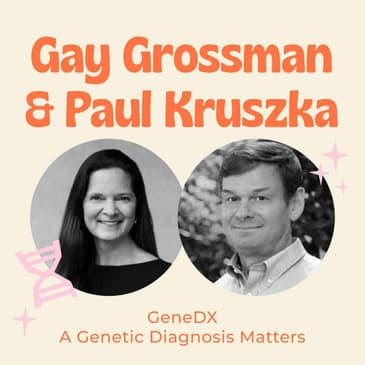
GeneDX - A Genetic Diagnosis Matters with Gay Grossman and Paul Kruszka
If you're passionate about the evolving landscape of genetic testing, this episode is for you. Gay Grossman, Patient Advocacy & Engagement Lead, and Paul Kruszka, Chief Medical Officer, are a wealth of knowledge and bring so much experience, shedding light on the crucial work being done at GeneDX.
EPISODE HIGHLIGHTS
What is the importance and benefits of genetic testing?
The most obvious benefit is knowing and understanding the why. Also, it's finding other individuals affected so you can get access to resources and support. Families can then come together to move treatment efforts forward. Without a diagnosis, you don't have a plan and you can get ahead of treatment options and treatment potential.
What are the differences in the genetic panels and tests?
Panels are tests with a limited amount of genes— genes that are known to be associated with the condition you're looking for. Panels are obsolete almost as quickly as they're developed because new genes are associated with diseases and syndromes so often and so much can be missed. The advantage of using broader exome or genome testing is that it's always up-to-date with a higher likelihood of diagnosis. Genome testing is the more comprehensive test.
What is GeneDX doing to educate clinicians and reach families about WES test over a panel?
We have the resources and medical literature that supports using exome and genome testing. We have guidelines from the American College of Medical Genetics, the National Society of Genetic Counselors and The American Epilepsy Society. Everything is in our corner to decrease the diagnostic odyssey, but people are still using lesser testing. We do a lot of implementation science and education to get the message out there through our GeneDX Medical Science Liaison Team. This group goes out and educates clinicians, leads webinars and attends conferences. We also partner with advocacy groups to help test their community and find more patients.
What is the insurance coverage for testing?
You're a customer of your insurance company, so you can call and ask why something wasn't covered if that's your experience. Request your certificate of benefits— the booklet that tells you what is covered. Read it and highlight what you may need so you are educated about what's covered and what's not and what the requirements are.
What is your advice for families who have a long wait time for genetic testing?
You need to build your team with multiple clinicians. If you're hitting walls, add someone to your team, like a geneticist or other specialty. A specialist doesn't have to order testing, it can be your primary physician or pediatrician. Ask for support to get testing, access the resources from our website, print them and take them to your appointment and advocate for yourself to get genetic testing.
LINKS AND RESOURCES MENTIONED
https://effieparks.com/podcast/episode-166-a-focus-on-patient-advocacy
Epilepsy Awareness Day at Disney
https://epilepsyawarenessday.org/
https://www.genedx.com/provider-billing/
CONNECT WITH EFFIE PARKS
https://twitter.com/OnceUponAGene
https://www.instagram.com/onceuponagene.podcast/?hl=en
[00:00:00] I'm Effie Parks. Welcome to Once Upon A Gene, the podcast. This is a place I created for us to connect and share the stories of our not-so-typical lives. Raising kids who are born with rare genetic syndromes and other types of disabilities can feel pretty isolating.
[00:00:20] What I know for sure is that when we can hear the triumphs and challenges from others who get it, we can find a lot more laughter, a lot more hope, and feel a lot less alone.
[00:00:31] I believe there are some magical healing powers that can happen for all of us through sharing our stories, and I'll take all the help I can get.
[00:00:39] Once Upon A Gene is proud to be part of Bloodstream Media. Living in a family affected by rare and chronic illness can be isolating, and sometimes the best medicine is connecting to the voices of people who share your experience.
[00:00:56] This is why Bloodstream Media produces podcasts, blogs, and other forms of content for patients, families, and clinicians impacted by rare and chronic diseases. Visit bloodstreammedia.com to learn more. Hello and welcome to another episode of Once Upon A Gene. I'm your host, Effie Parks.
[00:01:13] I'm so glad you're here. If you're new here, please take a look at the back catalog. Send me a message if you have any questions. This is your home base for rare disease, and I'm so glad you're here.
[00:01:22] Today I have an extra special episode for all of you who are passionate about the evolving landscape of genetic testing and its profound impact on health care and our rare disease community.
[00:01:32] So joining us are two distinguished guests from GeneDx, and they're a wealth of knowledge, and they bring so much experience to the table. And they're here to shed some light on the crucial work being done at GeneDx, exploring the intricacies of genetic testing,
[00:01:47] from understanding its significance in modern health care to navigating the complex world of rare disease. So we're going to dive into a lot of the nuances and hopefully answer a lot of your questions.
[00:01:57] I'm so excited for you to meet them. If you already know them, you know what I mean. Please enjoy my conversation with Gay Grossman and Paul Kruska. Hello, Gay and Paul from GeneDx. Welcome to the podcast. Thanks, Effie. We're super happy to be here.
[00:02:12] Yes, thanks so much for inviting us. We're big fans. Oh my gosh, you guys know I'm obsessed with y'all. So thank you very much for taking the time. I know you're so busy, but we're going to talk about one of my favorite subjects today, which is genetic testing.
[00:02:24] I'm so excited. OK, both of y'all, could you introduce yourselves a little bit and elaborate kind of on, you know, your primary mission at GeneDx and the range of services that they offer our community?
[00:02:37] My name is Gay Grossman, and I currently have the role of leading patient advocacy and engagement at GeneDx. I joined GeneDx this past August, and it's my primary goal to get GeneDx full exome sequencing to as many families who have the desire to get genetic testing
[00:02:55] to make sure that they understand what it is and how it can benefit them.
[00:02:59] And I do that a lot by sharing the story of my daughter not having a diagnosis for the first 15 years and the difference it made in her life to get genetic testing and thus our families.
[00:03:10] Thank you, Gay. And it's an honor to work with you, by the way. My name is Paul Kruska. I am a rare disease physician. I'm the chief medical officer at GeneDx.
[00:03:21] I've been here two and a half years. Prior to this, I was at the NIH studying birth defects for many years and retired from the government and was really happy to come over to GeneDx.
[00:03:34] And I think, you know, to describe what we do as a company and certainly what Gay and I do is that we start out with the patient and the family being at the top of our ladder or the top of our pyramid.
[00:03:49] And when I first got to GeneDx, there was a lot of decisions to make. I wasn't sure what to do. Industry was very new to me.
[00:03:57] I'd been a simple research doctor at the NIH taking care of, as you can imagine, mouse models and zebrafish models in rare disease families. But I thought to myself, how do I make decisions?
[00:04:09] And the way to do it was in the morning to remind myself who's the most important person or who should guide all decisions.
[00:04:16] And certainly it's the families and patients. It's really cool that our CEO has really enforced this and really grasped this concept that we are in service of the patients and the families first.
[00:04:32] And then everything kind of falls there because really what we want is what patients and families want in the first part of their journey is a diagnosis.
[00:04:41] So it all starts with the diagnosis. And then from there, there's a lot of different types of things that start like trying to find therapies and organizing.
[00:04:52] And there's a lot of things that stop. And that's the diagnostic odyssey stops the traveling around looking for diagnoses, different specialties, different types of tests.
[00:05:04] So that's a summary of myself in GeneDx. Like Gay said, we are interested in broad testing, whole genome sequencing, whole exome sequencing in families affected by rare disease.
[00:05:17] Thanks, Gay and Paul. Both of you bring so much past experience, rich experience to the table. GeneDx is so lucky to have you. But something you said that was so important there that I really want to highlight is who's the most important person in this equation?
[00:05:32] And I can't stress that enough for all stakeholders to remember who they're working for when they leave their home every day and how important these families are.
[00:05:42] So I appreciate that mission so much. I want to talk about the importance of genetic testing and why it's becoming increasingly important just in modern health care.
[00:05:51] And also, what are the benefits? I'm sure you can name 1000 of them. What are the benefits for families who are considering getting tested or who maybe haven't considered it?
[00:06:02] The benefits are wide and almost that I don't know where to start. I mean, the first benefit is just knowing why. And when you talk to a lot of mothers, they tend to, for starters, blame themselves for whatever reason. That's maybe our society.
[00:06:18] Hey, was it my fault? Did I do something? Was it that candy bar or was it the beer I drank or was I exposed to this? Did I do this, this or this?
[00:06:25] That's the first benefit, knowing why. Then it's finding other families, people, individuals who are affected in your group. As you know, as everyone, as you two know much more than I do, there is an incredible benefit to this.
[00:06:43] You start getting ideas. Hey, how do I do this? How do I do that? What happens after this? Where can I get this resources?
[00:06:52] And then these groups, Gay and I were just at the rare disease bootcamp out in Novato. Certainly talking to these families, then you get into this type of scenario at the bootcamp where families are getting together and trying to figure out how can we improve our child's condition?
[00:07:09] Is there a treatment out there? Or if there isn't one, how would we go about starting to look for one?
[00:07:16] So these are all the benefits that come top of my mind when we're talking about starting with a genetic test. I'm sure Gay can add a few to that.
[00:07:27] Yeah. So I think from the parent perspective, you know, when you don't have a diagnosis for your child and you're trying to do the best you can every single day to take care of them.
[00:07:37] I mean, I remember so clearly Effie, you know, at night when I'd be sitting with my daughter and I would think, you know, I tried this new thing today and I'm really hoping it helps her.
[00:07:46] And then of course your immediate thought is, well, gosh, I hope I'm not hurting her. And you just don't know, you're grasping at straws when you don't have a diagnosis.
[00:07:55] And I wasn't able to set a plan to help her if I didn't know what the plan was around. And the plan had to focus around what was causing all these challenges for her.
[00:08:04] So that was my first thing. And, you know, so much I would hear as she got older and she was starting to get into her teenage years, you know, Gay, maybe we just need to stop looking.
[00:08:13] Maybe we just need to focus on the symptoms and try to alleviate the symptoms for her. And we were really trying to do that at the same time.
[00:08:19] But the problem was when we ended up getting the diagnosis, many of the pharmaceutical products that we put her on were actually hurting her.
[00:08:28] And we didn't know, nobody knew. And we were doing this at a time when whole exome and whole genome sequencing wasn't available to the general public.
[00:08:36] And, you know, it wasn't at the fault of any physician. It wasn't at the fault of anyone who was trying to help us. We just didn't have the science yet.
[00:08:43] But now we do. Like now you can get a diagnosis for someone has a disorder that Lily does and find out within the first year of when they have these movements that are just starting to affect them.
[00:08:56] And if I had known, I would have been able to know the treatments that have been identified, you know, small molecules that patients and families do have access to.
[00:09:05] And Lily was the first one in the world with this. And so many times I hear, you know, why test if there's nothing to change the treatment or why test if there's not a treatment that we can help them with?
[00:09:18] Well, just knowing what not to treat them with can really be helpful and knowing how much to push your child and what really the potential can be. And you know what Paul said about meeting other families? I didn't have other families for 15 years.
[00:09:31] And it took another couple to find one. But, you know, very soon we learned that if we wanted to start research, we had to find 100 patients.
[00:09:38] So we needed 99 more. And that was our mission. And my husband and I set out to do everything that we could to find those 99 other families so we could start basic research, learn the basic biology, find researchers and find a treatment.
[00:09:51] And that's what we did. It's not a simple process, but you can't start it unless you have a genetic diagnosis.
[00:09:57] Powerful testimony. Thank you both for sharing that. I do want to maybe expand on that just a little because there is a common narrative that families can't handle the answer if there isn't a treatment option available. So that limits, you know, people to about 495 diagnoses.
[00:10:13] What would you say to those families who are too afraid to get a test because they've been told that having an answer with no definitive treatment or cure is only going to harm them more?
[00:10:25] And then maybe that question to you, Paul, would be like when you were practicing in maybe the clinic, how has your sort of perspective changed on a family's capability to kind of digest this information?
[00:10:38] I think that's for the most part a myth. And that's often we hear people raise those questions, will testing increase your anxiety? Are there negatives? Are there harms?
[00:10:50] And study after study, we don't find that. We find that families are, and this is well documented in the medical literature, that families do fine with the information.
[00:11:02] It doesn't cause increased anxiety. It's helpful. And survey after survey, most parents are happy they went through this type of testing.
[00:11:11] And some of the studies we're conducting at GeneVx, and when I say conducting, obviously working with others, and you look at the Guardian study, this is a study in New York City.
[00:11:21] The principal investigator is Wendy Chong, who has now moved on to Boston Children's, but still running the show. We did surveys of the families that had genetic testing and the vast majority of people were very happy with that.
[00:11:36] Very few people reported harms. We're doing another study out at Seattle Children's and then NICU with critically ill infants. Same thing. We are not getting the feedback that people are disappointed, upset, scared of these results.
[00:11:53] We're finding an overwhelming majority are happy and satisfied that they did have the testing done.
[00:12:01] You know, Effie, we took part in a study, Lily and I did, when we were going through the process because this was so new. And we were evaluated by a psychologist before we had our blood drawn, when we had our blood drawn, after we had our blood drawn, when we were waiting for the results, after we got the results, different points along the process.
[00:12:23] And I'll never forget this one day where we went in and we had had our blood drawn and Lily and I were asked certain questions. And she said, you know, Lily, what would be the worst result, knowing that you could find out that you have a fatal disease?
[00:12:39] And, you know, she's 15 years old and she's being asked these questions. And she looked at me and she was unable to verbalize, but she, you know, she turned her head, it was leaning on her headrest of her wheelchair. And she looked at me and tears just started going down her face. And I said to the woman, I know what she wants to say.
[00:12:54] And she said, you know, she's thinking that maybe it would be the worst result and it would be something fatal. And I said, no, that's not what she's thinking. And I said, she is thinking if she finds out nothing, like she's had years of going through invasive tests to try to find out what was wrong and nothing came up with an abnormality. And her not knowing was actually more painful. And, you know, this woman confirmed it with Lily, like, is that what you're thinking? And she said, yes.
[00:13:22] She said, I just need to know. I just want to know. And it really, it changed all of our outlook as a family when we finally knew and we can completely pivot and refocus on, okay, now we know, what do we do moving forward? What how can we act on this? What can we do? What do we have? What can we learn? Who can we meet? And how can we start moving forward towards something that is a plan?
[00:13:47] Amen. Thank you both for such thoughtful answers there. And Paul mentioned the Guardian study, if you want to learn more about that, it's on episode 166. Okay, so let's talk about genetic testing then. Let's talk about the differences between these panels and the whole exome sequencing. And can you explain the differences and the scenarios in each of these approach and why one or the other may be more beneficial or not?
[00:14:09] I can start with this one. So that your question is, is the difference between panels and a more broad based testing like an exome or genome. So panels are, are, are test with a limited amount of genes. And these are genes that are known to be associated with the condition you're looking for. So let's say your child has epilepsy. So you get that epilepsy panel.
[00:14:36] And these would be genes known to cause epilepsy at the time the panel is designed. The drawback to that approach is that our field is changing so quickly. There are new genes being associated with, with diseases and syndromes almost every day. And as soon as a panel is developed, it's, it's obsolete.
[00:14:59] And the best example of this is going back to my days at, at the National Institutes of Health. I studied a brain malformation or birth defect called holoprosencephaly. And the panels at the time I was at the NIH haven't changed at all in years because no one's updated them.
[00:15:15] And during our time at the NIH, we, we associated a number of new genes using exome sequencing. We discovered a number of new genes that were associated with, with this, this brain malformation condition. And to this day, the panels, you pick a lab, including our lab or another lab, another commercial lab, they aren't, they have not been updated.
[00:15:37] We just wrote a book chapter on holoprosencephaly. Some of my former colleagues and pointed that out in the book chapter that we just don't update them. And so that's, that's one disadvantage. The other disadvantage is we don't learn anything new.
[00:16:08] So, two advantages of a more broad based exome or genome approach is, is A, it'll always be up to date because if you think about it, we have over 20,000 genes and I like to call the exome or genome the 20,000 gene panel. So it's going to much higher likelihood of, of diagnosing a certain condition.
[00:16:33] And then the audience probably has a question between exome and genome as well. I kind of lump those together. An exome is the coding regions, the exons of our genomes. So that would be about one to 2% of our genetic code. And then the genome is everything.
[00:16:52] The DNA that we once thought was junk DNA in between genes, in between exons, it covers all that. And as time goes on, we're starting to learn more about the genome and it's a more comprehensive test. And to our delight, some of the insurance companies such as United Healthcare and Cigna are starting to cover these tests, the whole genome test.
[00:17:13] That's the difference really between the panel versus the exome genome. Certainly the payers are realizing this too and kind of moving more to exome and genome as well.
[00:17:23] Yeah, I was thinking time lost, money lost. Gay, do you have anything to add on to perhaps choosing a panel or a WES or getting offered that?
[00:17:33] Well, I always say back in my day, we didn't have all these things. But I think that in my experience of talking to families, so much can be missed on a panel. And I think that a panel was great when a panel was great. But now we've come farther in this journey of discovering science and research and we have better tools.
[00:17:53] And as Paul was saying, these tools are now covered by insurance like whole exome sequencing. We actually have a whole page on our website at gndx.com where you can go and look at the billing and see the insurance companies that are covering.
[00:18:09] We have an email there that you can ask questions about billing. And we have a lot of other resources on that website that people should reference. But it's really being recommended as first line. American Epilepsy Society is recommending it first line. This is something that is the research of today and this is how we diagnose today and it should be used first today.
[00:18:33] Dave brings up a good point. She says my day. Well, I can say that too, Gabe, because I was in medical school 30 years ago when we didn't know how many genes or we only knew a few genes and we had really unusual tests back then. And yes, things change. And certainly this is a progression. There will always be something better because this is a changing field. And that's the interesting part of it.
[00:18:59] And you have to remember that if you look at the medical literature, that, you know, and talking just about GDX, but just about in general, only 20 to 40 percent of people get an answer with a genetic test. And that depends on what disease you're looking at or what group of people, how old they are. So 80 to 60 to 80 percent of people do that still don't get an answer.
[00:19:22] And so this will continually evolve. It's what's next. How do we, you know, we're trying to get people answers ending the diagnostic odyssey. So it will continue to change and we're already starting to use the next technology. It's not commercially available, but there's long read sequencing next. So there will always be something next.
[00:19:43] We just announced a project with PacBio and Google at GDX where we're going to look at long read sequencing and try and explore the next phase of this technology journey where we're trying to get more answers to people.
[00:19:57] That's awesome. Congratulations on that partnership. You know, there's this there's this Facebook group. It's one of the only ones I'm still in and it's huge. It's a hypotonia Facebook group and Gay knows how much this group boils my blood. I send her snapshots from it every day.
[00:20:10] But there's thousands and thousands of families in there who are all asking the same questions every day about how they just went and got this panel and nothing showed up or families will say we've done all the testing and we still have no answers. And 99.9 percent of the time when I go in and ask them one what test did you have and did you have a West? Almost never do they know the answer to that.
[00:20:30] So what is GDX doing to perhaps educate the clinicians in offering a West test over a panel? And also, what is GDX doing and maybe reaching these families to let them know the questions that they should be asking in the clinic?
[00:20:44] That's something we think about all the time. And to start that thought, if you think about it, we have the medical literature behind us to use exome genome. We have guidelines. The American College of Medical Genetics in 2021 came up with guidelines for congenital anomalies, development delay, intellectual disability.
[00:21:06] And there's been subsequent guidelines from NSGC, the National Society of Genetic Counselors, supported by AES, the American Epilepsy Society on epilepsy. So we have guidelines. We have everything in our corner to decrease the diagnostic odyssey. But people like you said, are still using microarray or panel or lesser test.
[00:21:26] And so at GDX, we're doing a lot of what I would call implementation science or education to really get the message out there. What you're saying to talk to the folks like you're mentioning in the Facebook group with hypotonia. And so one of the things we've done is we've started this group at GDX called the Medical Science Liaison Team.
[00:21:51] And we've hired nine so far. And this group is going out and doing exactly what you said, educating clinicians. A lot of the clinicians are non-geneticists such as pediatric neurologists, developmental pediatricians, neonatologists and educating them or helping one by one going around the country, traveling on the difference between microarray panels, exomes and genomes.
[00:22:14] We're also doing larger events from the bottom down. We're doing webinars, going back to one of our favorites, Dr. Chung with Guardian. We just had a webinar on the NICU with her that was moderated by Dr. Rebecca Burke at Hershey. And there was also a mom of a rare disease on that webinar.
[00:22:34] We're doing CME events, industry sponsored events at some of the major conferences. So we're attending a lot of the small regional conferences throughout the US. So we are full force trying to educate people. And we have recently just hired, of course, the one and only Gay Grossman who's on this.
[00:22:55] And I'll let her talk about our patient advocacy group. But again, we see that as a very important piece. We would go to the Boot Camp Global Genes Conference where we met up Effie and Gay. So yeah, I think there's so many different ways to approach this to answer your question from an educational perspective.
[00:23:12] We're doing a lot of different things, Effie, to help families and the advocacy organization. So just to follow up on what Paul was saying, we recently were at the Epilepsy Awareness Day and Expo. And if your listeners haven't heard of that event that happens every year at Disneyland, they should Google that and look it up. It's a great event for families who have a diagnosis of epilepsy.
[00:23:32] And they learn all kinds of things about genetic testing, about they have information about medical equipment, they have information about they have genetic counselors there. They've all kinds of people there speaking. I think they've over like 40 speakers. But one of the speakers was an MSL, like Paul mentioned, that came from GeneDx. And she spoke to families about genes and what are genes and what's DNA? And what are genetic tests? And what does it mean?
[00:23:59] And one of the things that they brought up to me, which I hadn't really thought about is we need to talk more about the fact that a whole exome sequencing is a saliva swab. This is not a blood test. I talked to a little girl there who was too afraid to get genetic testing. And her mom brought us up to, she brought her up to the booth and I was talking to the little girl and she said, I'm afraid to get the testing.
[00:24:23] And I was talking to her mom with her and I said, what are you afraid of? And she said, I don't like needles. And I said, it's a saliva test. Could you do that? You know, they just wipe the inside of your mouth. And she's like, oh, mom, I want to do it now. People don't know that. So this is an easy test to do. But we're working a lot with patient advocacy groups to help them grow their communities.
[00:24:42] So the first thing that I wanted to do when I joined GeneDx was to make sure that genetic reports that have a positive result can get parents and patients to an advocacy organization right away, like immediately.
[00:24:55] So this kind of kills two birds with one stone. You have clinicians who are unfamiliar, which is rightly so. There's so many rare diseases, over 7,000. They can't know about all of them. So there's a reluctance to use genetic testing if you don't have information to get back to every patient and family.
[00:25:13] What we're doing at GeneDx is we're partnering with advocacy organizations. They can send an email, they can let me know about their advocacy organization, their 501c3, and we will include it on positive results of genetic tests.
[00:25:26] So we're helping the clinician by giving them a resource in their hand right away when they deliver this diagnosis. And we're helping the family so that when they get this diagnosis, they have a resource to call. They can do it right there in the waiting room. They can do it in the car.
[00:25:40] And they can connect with an advocacy organization that's a registered 501c3 to get more information. But beyond that, Effie, what it does is it helps grow the community. And advocacy organizations need patients. They need patients in order to do natural history studies. If they get to the point to do a clinical trial, they need patients.
[00:26:00] They need as many as they can get to learn more about the disorder, to have conversations with pharma companies. And GeneDx is partnering with them to help make that happen.
[00:26:09] Oh my gosh, yes. And you just reminded me of a fact that I preach often here on Once Upon a Gene, that a patient advocacy organization is a form of a treatment, period. And it has so much value for so many reasons.
[00:26:24] Oh, Effie, I can't even imagine how my life would be different if I had someone to talk to when Lily was a baby. And you and I talk about that all the time. I'm 20 years ahead of you at this game. And there's nothing that gives me greater joy than to be able to help you with your adventure with Ford and your family.
[00:26:45] I mean, if I can share what we learned in schools and with durable medical equipment and just traveling and different things, if I can help you with the 20 years I have on you.
[00:26:56] Yeah, Gay's not just saying that. She cold called me a couple of years ago, and that was one of the first sentences that she said to me personally. So thank you, Gay.
[00:27:05] Okay, both of you have kind of mentioned this umbrella term and you've said epilepsy and we talked about hypotonia. So can we talk about the umbrella diagnoses? You know, the epilepsy, cerebral palsy, the autism, the mitochondrial, and then, you know, those random symptoms like hypotonia.
[00:27:19] Can we talk about the broad overlapping conditions and the genetic audiologies that can be found from genetic testing? And also to your point about patient advocacy orgs needing more patients, how do we find them? And also, why is it so important to go beyond the umbrella bucket that you're in?
[00:27:38] These were things that were really helpful years ago, right? I mean, I guess we can relate them to the panels versus whole exome, right? We used to be able to get a diagnosis like cerebral palsy. We had that diagnosis too. And it would get us access to different therapies with insurance. And it was really a diagnosis. But today, it's a symptom.
[00:27:59] And the symptoms of cerebral palsy, the symptoms of epilepsy, you know, if there hasn't been an accident or injury, there is a genetic component likely that you can find that will lead you to things like the disorder that my own daughter was diagnosed with. You know, Paul can speak more from the medical perspective.
[00:28:19] You know, if you're an infant in a NICU and you're having seizures, you're more likely to have a genetic condition than not. So, you know, epilepsy is often a symptom or hypotonia or autism. Often there is a genetic basis of that. And like you said, Effie, it's a grouping or an umbrella term, but within that umbrella are a lot of rare diseases.
[00:28:43] And in a way, I think it's okay though to have the umbrella terms. If you look at cancer in the funding and the education and the awareness around cancer, because there's so many cancers kind of lumped into this big umbrella.
[00:29:02] There are very rare cancers caused by genetic conditions, but it's in that big umbrella. You know, these national cancer organizations and funding and everyone understands it and gets behind it. Sometimes I wonder if rare scares people off. Hey, that's too rare. If I'm a clinician, that's too rare. Why should I be concerned about that?
[00:29:26] I've got a clinic full of common things like, you know, flu and upper respiratory infections and asthma, those types of things. So I've often thought about, do we need an umbrella term for rare disease in general? How do we put this all together for one force?
[00:29:43] And so I've often thought about this concept of the umbrella term, but then also certainly breaking it down into different types of genes that are associated with this because the root cause, why is my child having epilepsy could be due to a lot of different reasons, different genes. And then to get to the therapy for that particular gene, you have to address what's going on.
[00:30:06] Yeah. Can we talk a little bit about insurance coverage and accessibility for families? I know, again, in all these Facebook groups I read so often that they've been denied or they don't know how to go about getting it. So I wonder, how does GeneDx assist patients and caregivers in this process? And are there any efforts being made by you specifically to make it more accessible and approachable and easily digestible for families to understand and feel empowered to bring to their clinicians?
[00:30:36] Yes. I think the insurance piece of it, the payer piece is one area of rare disease that's going in the right direction. So let's start out with the most common insurer of children in the U.S. is Medicaid. So Medicaid insures a high percentage of children in the U.S. We're seeing state by state that Medicaid is covering exome sequencing. And the last number that I was aware of was 28 states. It seems to change every day.
[00:31:06] So we have a Medicaid group, a market access group that is going state to state. We're writing letters. We're talking to physicians. We're talking to Medicaid groups, chief medical officers in various states. And certainly, we would like to get paid, obviously, for when we do exome sequencing. We don't turn away families that have Medicaid regardless of whether that state pays or not. So we do not do that. But we are very interested in every state adopting policies that cover exome and eventually genome sequencing.
[00:31:36] And I think, you know, Effie, we need to divide the conversation also into inpatient, whether the child is in the hospital or is an outpatient, because those are two different ways of being paid. So I was just talking about Medicaid and talking about states adopting exome sequencing. That's the outpatient, right? The child is in an outpatient clinic.
[00:32:06] And that is being paid for outside the DRG. The system isn't perfect yet, but we're starting to see states adopt that. The first state I'm very proud to say was my home state of Michigan. This type of testing and certainly kudos to my friends in Michigan, Kayla Bup, who's a geneticist at Spectrum Health and Andrea Scherer, a neonatologist at Bronson Children's. They were the architects of this and worked on it for many years. So we're starting to see that as well.
[00:32:36] And then the public, the public payers, Medicaid and broken up in an inpatient outpatient. Certainly we're starting to see movement in the private payers as well. There's very few private payers that I'm aware of that doesn't cover exome sequencing.
[00:32:51] And also, Effie, just to add to that, one of the things that I would like to do is help families better understand communicating with insurance companies. You know, we're customers of these companies and you can pick up the phone and ask them, you know, why wasn't this covered? And you might be surprised that it might be changed.
[00:33:08] The other thing that I recommend that families do is request your certificate of benefits. The certificate of benefits is actually the booklet that tells you what your coverage covers and you can request that in paperback. So I know that they'll, if you call your 800 number, they'll say, oh, look on the website, but you can request that it be mailed to you in a booklet format, which is much easier to use.
[00:33:32] And they have to supply that with you to you. But what you can do is read it and you can understand it and you read it and you highlight the different things that your child might need or your family might need. And you can find in there what their coverage is. So if it's not covered, and I love to say I've never lost a insurance battle yet in 26 years, but I have been known to call the insurance company and say, I know you say you don't cover this, but on page 26 in the second paragraph, it says you don't cover this.
[00:34:02] So know your policy. This is something that Gaye is so good at. And she's very good at breaking down the tasks and then also annoyingly making sure you follow through. So just listen to her.
[00:34:35] This is about building your team. So you have multiple clinicians on your team. So if you are seeing a clinician that is maybe giving you some of those answers we've talked about, like we've tried other things, it's not time to do genetic testing or we've tried that or there's not a treatment so there's no reason to test.
[00:34:59] If you're getting that answer, I'm not saying you need to get rid of that doctor, but add someone to your team. So if that's your primary care, then maybe add a geneticist or neurologist or some other specialty, but keep adding to your team and anybody who is a doctor can order this genetic testing.
[00:35:21] It doesn't need to be a specialist. It can be your pediatrician, it can be your family practice clinician. So add to your team, ask a lot of people for the support to get it, use the resources that we have on Genedx.com, print out those pages and take them to them and show them that there are benefits to genetic testing and why to get tested and start advocating for yourself so that you can get it.
[00:35:42] It is challenging to get into a doctor today. It is challenging to get to a genetic counselor, but I think if people build their teams and get more people on there, you'll have more luck.
[00:35:52] Yeah, I would consider this a crisis, a genetic crisis that it takes a year in many clinics to get in to see a geneticist. Until recently, the state of Mississippi did not have a practicing geneticist outside of the military base there.
[00:36:07] We're having an industry-sponsored session at the American College of Medical Genetics in Toronto, and we're going to have a debate, discussion about non-geneticists wearing genetic testing because really, like Gay said, the only path forward is for non-geneticists to take the baton and do this.
[00:36:25] There simply isn't enough geneticists. There was a report recently by the National Academy of Science at Engineering and Medicine that identifies clinical geneticists as having the longest line of any pediatric subspecialty, 21 weeks, most likely longer than that. At least that's what we're seeing at GNDX.
[00:36:42] This is a crisis and something we are attempting to address and certainly jumping up and making a lot of noise about this. Others need to make a lot of noise about this too. The American College of Medical Genetics, the American Academy of Pediatrics, these organizations need to realize this crisis because the people that are suffering, again, going back, who is at the top of our pyramid? Our families.
[00:37:09] The diagnostic odyssey is eight years in many cases, and this is completely unacceptable.
[00:37:16] Yes. Oh my gosh, genetic crisis. Make noise and build your teams. I really look forward to more information on the outcome of that meeting in Toronto. That's very intriguing. I think one of the other reasons that perhaps make people pause is the question around privacy and data, right? So I wonder with the advancement in all these genetic tests, what are the growing concerns around privacy that you see and how is GNDX addressing them?
[00:37:41] Privacy is a number one concern and it should be. GNDX, certainly we take measures to protect people's data because you write it as privacy, but this is also a bigger question for the entire medical field. It's not only your genetic testing, but think about maybe you've had some mental health visits, you don't want public, it's in your insurance company or hospital system on the cloud somewhere. Yes, we take that really seriously.
[00:38:11] I want to touch back on the relationship and the collaboration that GNDX can provide hand in hand with patient advocacy orgs and maybe what advocacy orgs listening to this episode now can think about coming to you for with their questions or thinking about how they can work together.
[00:38:30] Well, so Effie, we want advocacy organizations to reach out to us. Anybody who emails me when I reply to them, they'll be getting my personal cell phone. So I'm very accessible to people and their questions. And what I like to do is think of myself as, you know, like at the front door of GNDX. So if people have questions that maybe I don't have the answers to, I'm going to refer to somebody inside GNDX to help them answer those questions.
[00:38:56] And then outside of GNDX, you'll be hearing more from us about some educational programming that we're going to be developing to share with advocacy organizations because we want to make sure that the parents who are leading these groups or the volunteers who are leading these advocacy organizations, we want to make sure that they're armed with the information to talk about genetic testing.
[00:39:15] We want to give them the tools to have the conversations with people in their community and families in their community or other people that don't have a diagnosis that might be coming to them. So we see it as part of our responsibility to help advocacy organizations have these conversations, to get the information to families, to go to their doctors and ask the questions that they have about genetic testing.
[00:39:36] Love that. Can you both share maybe either a vision for the future you have with genetic testing in the rare disease community or perhaps maybe a lasting impact that you're hoping to leave?
[00:39:51] I don't want to see kids that are age 10 diagnosed anymore when they could have been diagnosed as an infant. I just don't want to see that. And I'm really proud of Guardian and just being a very small part of that, being a small part of a really bigger thing.
[00:40:07] And it's just really exciting. We recently diagnosed a baby with immune deficiency and they were missed on the normal traditional newborn screen. There's a test called TREC. It's a T-cell receptor excision circle test that most states are doing now, and it was missed. And we picked it up on Guardian and the infant has had a bone marrow transplant.
[00:40:31] So these are the type of things I want to see. I want to see kids, infants diagnosed earlier. That's the legacy I want to see or I would like to see GNDX be a part of.
[00:40:42] I don't want people to have to go through what we went through as a family. I don't want parents to be sitting up all night thinking about what the heck is going on with my child and why can't I help them? We all know how isolating it is to have a rare disease in your family, but not to know what it is, I would argue is worse. For me, it was worse. And I don't want anyone to do that.
[00:41:08] And that's why I do what I do, Effie. I mean, I was in a completely different profession before I started this, but I am so committed to having people not live the way that we had to live for all those years. And I feel like there are things in life where you say to yourself, gosh, I wish this was possible. I wish X was possible. Well, this is possible now.
[00:41:29] We actually have the ability and the science to make an absolute change in people's lives. And it trickles past the patient. My daughter being able to sleep, well, now my husband and I can sleep and we can travel. We've been able to take her places. She could go to college. There are things that she was able to do that she could not have done before.
[00:41:49] And yes, she needs a lot of support, but she would not have been able to do it without having a diagnosis. And I don't want other kids to have their life limited because they don't know what the challenges are and we don't know how to help them either access support for those or treatment.
[00:42:05] Amen. Thank you both so much.
[00:42:07] What would you say to those families who maybe feel like they haven't been supported once they got the diagnosis? How does GeneDx kind of embrace families upon a diagnosis that perhaps doesn't have a patient advocacy org behind it or if they get a VUS or something like that? How do those families get some sort of follow through?
[00:42:27] This is my first project at GeneDx FE was going back to those genetic reports. We have been attaching an advocacy organization letter to genetic reports, which is great when there is an advocacy group. But my goal is to have every single genetic test go out with a resource on it. And that's going to happen in the next few months.
[00:42:51] So every single genetic report that goes out, even if it is a VUS or we don't find something, we are going to be able to give the family at least three resources, if not more. So they'll get the resources for NORD, Child Neurology Foundation, Global Gene, so that they can connect with an advocacy organization that does work with families that do not have a diagnosis yet.
[00:43:14] The other thing is they can come back to us for a year. And one time we will relook at it at no charge to see if perhaps something's changed and there is a diagnosis. And Paul, thanks for being available so fast to do this.
[00:43:48] Hey, if FE calls, I'm there. Like once upon a Gene, it's on my bucket list. I was ready instantly.
[00:43:55] See, Paul knows. It's gay that I have to hammer down all the time. Jeez. You too. It's not Friday, so I know you have a lot of work to get back to. Thank you so much. And thanks for remembering the faces of our kids when you go to work.
[00:44:08] Yes. Thanks, FE. Thank you. Bye. Bye.
[00:44:13] I hope you've been enjoying this podcast. If you like what you hear, please share this show with your people. And please make sure to rate and review on iTunes or wherever you get your podcasts. You can also head over to Instagram, Facebook and Twitter to connect with me and stay updated on the show.
[00:44:31] If you're interested in sharing your story or if you have anything you would like to contribute, please submit it to my website at FEParks.com. Thank you so much for listening to the show and for supporting me along the way. I appreciate y'all so much.
[00:44:45] I don't know what kind of day you're having, but if you need a little pick-me-up, Ford's got you.