
ONCE UPON A GENE - EPISODE 219
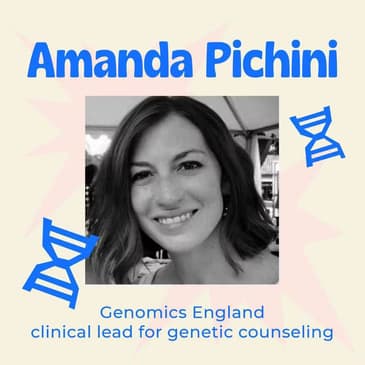
Genomics England Clinical Lead for Genetic Counseling - Amanda Pichini
Amanda Pichini is a genetic counselor from Genomics England, here to share their initiatives and mission.
EPISODE HIGHLIGHTS
What is your role at Genomics England and how did your career develop?
I work at Genomics England as the Director of Clinical Implementation and I'm responsible for the strategic clinical leadership for our products and services, ensuring research, diagnostics and clinical programs we support are in line with the latest healthcare standards and research. Prior to joining Genomics England, I worked as a genetic counselor, a profession I was interested in for a long time. When I started studying biology, I was keen to do something that allowed me to communicate and speak to people, but still be immersed in science. While my role isn't patient-facing now, I bring my genetic counselor skills to understand the complexities of genetics in healthcare and how we communicate to various audiences to design and deliver our programs.
What are the current initiatives at Genomics England?
Since the 100,000 Genomes Project, we are focused on working with the NHS to provide genome sequencing as a standard clinical test. We've worked hard to ensure healthcare professionals understand how to help families through the process, manage their expectations and potential results of genome sequencing. We're also focused on looking at different types of sequencing technology we can use to enhance the testing and care for cancer patients, and also a newborn genomes program which is part of a large-scale national research study called the Generation Study. This study will sequence the genomes of 100,000 newborn babies with a goal of understanding if sequencing in the newborn period can help identify rare conditions earlier in life, with the ideal goal of improving the quality of life and outcomes for the babies identified as having a rare condition.
Can you talk more about the newborn screening?
Like in the US, we do a heel prick when a baby is about 5 days old at the parent's discretion. We recommend it as public health and to look for rare conditions that could be treated if found early. We currently test for 9 conditions, but the Generation Study is an optional screening in addition to standard newborn screening. It will be available to parents at different hospital sites, a baby doesn't already need to be ill and parents don't have to have a known history to participate. At birth, a small amount of cord blood will be taken and that sample used to carry out genome sequencing and to look for around 200 rare conditions that we feel would have an early intervention option if found through screening. We will follow up on every test, with much closer monitoring and follow-up where a condition may be positive.
LINKS AND RESOURCES MENTIONED
https://www.genomicsengland.co.uk/
https://geneticalliance.org.uk/
CONNECT WITH EFFIE PARKS
https://twitter.com/OnceUponAGene
https://www.instagram.com/onceuponagene.podcast/?hl=en
[00:00:00] I'm Effie Parks. Welcome to Once Upon a Gene, the podcast. This is a place I created for
[00:00:09] us to connect and share the stories of our not so typical lives. Raising kids who are
[00:00:15] born with rare genetics and drones and other types of disabilities can feel pretty isolating.
[00:00:21] What I know for sure is that when we can hear the triumphs and challenges from others who to real life stories from people affected by rare conditions and cancer. Each week we'll bring you an extraordinary lineup of guests, not to mention we also have a back cut log for you to choose from. Listen now wherever you get your podcasts. Hi friends and welcome to the show. This is Once Upon a Gene and I'm your host, Effie Parks.
[00:01:40] And the day this episode comes out is Rare Disease Day 2024.
[00:01:45] As probably all of you know, Rare Disease Day is always the last day of February. fiercely and we are all just rocking it. And so I want you to be happy that you are not alone today and I hope that you feel some sort of connection and that you feel some sort of inspiration to keep it up, to get up, to contribute, to take action, whatever it is for you. Thank you for being here.
[00:03:00] And speaking of Rare Disease Day and across the world, I'm really looking forward to our conversation. Everybody in my world adores a genetic counselor, and it's been a while since I've had one on this show, so I'm excited to welcome one, and one from like, what do they say, across the pond. So yeah, Amanda, you're a genetic counselor in the UK, and you're on staff at Genomics England,
[00:04:20] so I'm really excited to learn more about
[00:04:22] what you're doing and all of your initiatives,
[00:04:24] and really speak to some of our listeners here
[00:04:27] that are over there, so that this will be helpful too. And prior to joining Genomics England, I worked as a genetic counsellor in the health service after being trained in Canada. It's actually a profession that I've been interested in for quite a long time. Ever since I started studying biology, I was really keen to do something that allowed me to communicate and speak to people, but also do something that was quite sciency.
[00:05:42] And I wasn't quite drawn to being a doctor or a lab researcher. my role now at Genomics England, whilst it's not a patient facing role, I bring a lot of those skills that genetic counsellors have in understanding the complexities of genetics in healthcare and how we communicate that verbally in writing in various ways to different audiences to how we design and deliver a lot of our programs. So that includes how we approach
[00:07:01] consent, how we approach returning results, the Prime Minister at the time, announced about
[00:08:24] starting Genomics England. really show the value that genomic testing could bring to patient care, particularly to patients who have rare conditions that aren't yet diagnosed or where there isn't a treatment available, and to patients with cancer where more rapid testing or greater knowledge of our genome can help us to find out more about how cancers are diagnosed and
[00:09:40] treated in a more rapid way.
[00:09:43] So the flagship project that Genomics and Lin was set up to deliver was called the 100,000
[00:09:48] Genomes Project. participants, say, with a rare condition, which, although that still means there's a large number of people still without a diagnosis, that was a much more significant jump in being able to give a diagnosis than other tests that came before it. But we were also able to really kind of stimulate research around genomic testing. So again, all of those participants,
[00:11:01] their data, their genome and health data continue to be so exciting to come to work with the speed that genetics is moving. That's such a cool story. Thanks for sharing that. I was recently at the Precision World Med Conference and Genomics England got a shout
[00:12:22] out in one of the panels.
[00:12:24] So I was hoping maybe you could talk to understanding what some of the potential results could be, but also what some of the limitations are of doing
[00:13:42] genome sequencing.
[00:13:44] And that's really important because, you know called the Generation Study, which will see us sequence the genomes of around 100,000 newborn babies with consent from their parents. And that study really aims to help us understand
[00:15:02] whether genome sequencing in the newborn period
[00:15:05] can help us to identify a larger number consent. So parents are asked when the child is around five days old, whether this is something that they are happy for their babies to have and that it's recommended because as public health that would look for rare conditions that could be treated if found early and that we know could really improve the lives of those children if we found them. So in the UK at the moment, we test for nine rare but serious conditions. And there's a
[00:16:24] couple of others that are being evaluated to become part of that program at the moment. a very research active large hospital in London. We also wanted to make sure that hospitals throughout England, with diversity and geography in the communities of people who use those hospitals could have access to a study like this and also to help us understand whether this kind of approach worked in a range of settings. You don't have to be a parent who has a known history of
[00:17:41] a rare condition or a baby who might already be
[00:17:43] ill to take part because we really want to try us understand if that approach worked or not. Because these conditions are so rare, we think that only around 1% of the 100,000 babies in the study will be flagged as a potential of having one of those conditions that require following up to confirm that diagnosis. But for those 1000 of the 100,000, we think the benefits could potentially
[00:19:02] be enormous, which is the same choosing to take part in the study, most of them won't have knowledge or experience of a rare condition themselves. So we really felt it was important to get their perspectives too, as well as those families that have had experience living with one of these rare conditions. And also healthcare professionals and scientists who
[00:20:23] have experience managing many of these conditions in the to sunlight. So that early awareness to avoid sunlight exposure and build on those practices as soon as possible can help to improve outcomes. So there can be a wide range of interventions that might be considered. All that being said though,
[00:21:40] we know there's many, many more conditions
[00:21:42] that could be diagnosed in childhood
[00:21:45] and where there isn't necessarily any kind of and a lot of the ways that maybe your child's medical treatment is leading up to that. But anyways, that's very cool. Thanks for going in depth with that. Do the families get back that data too? Do they get the copies of this report or do they get any information back from you other than if they were positive?
[00:23:00] Yeah.
[00:23:01] So we'll return a result on every participant.
[00:23:03] And so for those thousands that we suspect might have a condition, we will be informing them of that either by email or letter, depending on their preference. And it was almost just as important that we carefully worded what that communication looked like because we wanted to make sure that we were being really clear about what that result means. We're not giving baby a clean bill of
[00:24:21] health. We're really just saying that we haven't done everything perfectly remotely at all, but it's been really, I think, something that's been really core to us from the beginning, that kind of principle of co-design, that we can't necessarily just design this study completely unilaterally and we couldn't do it without the healthcare professionals and the patient groups that play such a collecting data along the way. So from the moment when the study starts, hopefully very soon this year, then we'll be collecting data about uptake on consent rates. Are we finding that there's a lot more people declining maybe than we might expect? It's perfectly normal and expected that people choose not to take
[00:27:01] part in a research study, but we want to the key elements of our role is to really help act as an advocate for patients and families with rare conditions, because again, that journey can be a very isolating one. And often it's difficult to
[00:28:21] come across a healthcare professional or anyone else that can be really challenging or somewhat complex day-to-day things that patient organizations are so crucial at providing. And they're also really helpful at providing information. So again, as a genetic counselor, if I was seeing a patient with a condition that I'd maybe never come across before, one of the first places I would go to,
[00:29:40] as well as looking at kind of academic literature
[00:29:42] was what kind of patient information is out there
[00:29:45] and what kind of language is being used
[00:29:48] to describe that condition UK to help make sure that their member organisations are aware of the study, that we can communicate key aspects of the study to answer some of the questions that they have because many of those patient organisations are very used to supporting questions from families that have been newly diagnosed, but they're also conscious that this might be a new, slightly new territory for them too because they may be contacted by families who have been diagnosed
[00:31:03] before their child's showing any symptoms. And that can be a different kind of journey sources of information as part of that process. I really appreciate the thoughtful collaboration that has gone into that, especially with the patient advocacy arcs. Just out of curiosity, does Genomics England have any interest or is maybe one of the projects potentially going to be looking at sequencing umbrella groups like people who have a cerebral
[00:32:20] palsy diagnosis and epilepsy diagnosis and autism diagnosis?
[00:32:24] Because I know as someone who's very involved in this rare disease community here in the some other research studies that are looking into that. It's not something that we're specifically doing in genomics England at the moment. That being said, a lot of the indications to have whole genome sequencing can be quite broad. One example is intellectual disability. So if there's a child or an adult that has a significant intellectual disability, and particularly if
[00:33:41] they have had other developmental or growth or to get those tests offered to them or to even maybe know that they should consider it? Oh, that is a huge question. The best way to think about this is just the different levels at which that awareness is really important and in a way that kind of starts with general public awareness.
[00:35:03] And I think there's some, like there be done. So often it starts sometimes in unexpected ways or through broad media that helps people
[00:36:23] think about when they might want to ask whether there's other members of their family that have had cancer and if it turns out that many of them have, it's knowing when to raise the red flag to say this is something that's less usual than I would normally see in my practice. I need to phone a friend to sort of get some support. So listen to information that might be relevant to genetics and health. And sometimes that's what might trigger them to ask more questions and go speak to someone else about it. Yeah, no, I mean, so thoughtful and thorough and the epitome of GC's response. I feel like we all need one of you and our DMs are on a text when we have questions.
[00:39:02] I really appreciate it.
[00:39:03] And I'm so grateful that I got to learn more about Genomics England.
[00:39:06] You all have such a great reputation. as part of other specific gene therapies or treatments and how we do that, especially when those might be therapies or gene treatments that could have an impact on the next generation. So a lot of these questions I think are also ones that, I mean, it's Genomics England, we're just one organization that's trying to do some of that public engagement to help answer.
[00:40:20] And I think having, again, having healthcare professionals like genetic counselors are England in general, the patient advocacy groups or the patients themselves, if they have more questions. Yes. Genomics England, we have a website and that's the best sort of landing place to go to, to find out more about some of the work that we're doing. That's just www.genomicsingland.co.uk. And then I mentioned Genetic Alliance UK are an organization that includes a lot
[00:41:42] of patient organization members and that's on the show. If you're interested in sharing your story or if you have anything you would like to contribute please submit it to my website at Fe Parks dot com. Thank you so much for listening to the show and for supporting me along the way. I appreciate you all so much. I don't know what kind of day you're having but if you need a little
[00:43:00] pick me up, Ford's got you.