
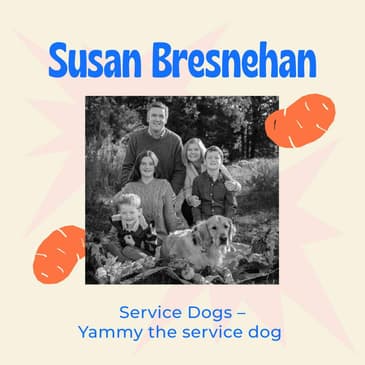

Service dogs are often associated with guiding the blind or assisting with mobility, but their impact goes far beyond traditional roles. In this episode, I’m joined by Sue Bresnahan, a pediatric nurse and rare mom, whose son has CACNA1C-related disorder (Timothy Syndrome). When they welcomed Yammy, his service dog, into their family, everything changed. Yammy didn’t just provide companionship—he unlocked a level of independence and confidence that Sue never imagined possible for her son.
Sue shares their journey, the process of getting a service dog, and why families of kids with disabilities should consider this life-changing support. If you’ve ever wondered how a service dog could help a child beyond the traditional reasons, this episode is for you.
In This Episode, We Discuss:
✔️ Sue’s journey as a rare mom and navigating CACNA1C-related disorder (Timothy Syndrome)
✔️ The unexpected ways service dogs can support kids with disabilities
✔️ How Yammy transformed her son’s independence and confidence
✔️ The process of getting and training a service dog
✔️ What families should know before pursuing a service dog
✔️ Overcoming challenges and misconceptions about service dogs
✔️ Advice for families considering a service dog
Resources & Links:
📌 Learn more about CACNA1C-related disorder (Timothy Syndrome)
📌 Service Dog Organizations & Resources - ECAD
📌 Connect with Sue Bresnahan - Instagram
📌 Want to support Once Upon a Gene? Leave a review on Apple Podcasts & share this episode!
[00:00:03] I'm Effie Parks. Welcome to Once Upon A Gene, the podcast. This is a place I created for us to connect and share the stories of our not-so-typical lives. Raising kids who are born with rare genetic syndromes and other types of disabilities can feel pretty isolating. What I know for sure is that when we can hear the triumphs and challenges from others who get it, we can find a lot more laughter, a lot more hope, and feel a lot less alone.
[00:00:31] I believe there are some magical healing powers that can happen for all of us through sharing our stories, and I'll take all the help I can get. Once Upon A Gene is proud to be part of Bloodstream Media. Living in a family affected by rare and chronic illness can be isolating, and sometimes the best medicine is connecting to the voices of people who share your experience.
[00:00:56] This is why Bloodstream Media produces podcasts, blogs, and other forms of content for patients, families, and clinicians impacted by rare and chronic diseases. Visit bloodstreammedia.com to learn more. Hello, and welcome back to the show. I'm your host, Effie Parks. This is Once Upon A Gene, one of my favorite podcasts on the planet. Thank you for joining me. Thank you for supporting me. If you're new here, I am so glad that you found this show.
[00:01:23] There are hundreds of episodes and stories and wonderful human beings who have shared their wisdom and their insight and their resources, so please comb through them. Pick and choose by the titles. Send me a message if you're looking for something specific. I hope something in here helps you. And, you know, if you're thinking, man, I just love Once Upon A Gene. It's helped me so much. I wish I could do something.
[00:01:44] You can, you know, you can head to Apple Podcasts and write a review for the show, and you can share your favorite episode with someone. You can post it on your social media. You can speak about it at your school or at a conference. It's the small things that can make a huge difference in helping more families find this community. So today's episode I'm so excited about, and I've been meaning to get to this topic for so long, talking with an awesome mom in New York about service dogs for our kids.
[00:02:14] And I know most people, when they think of service dog, they think of guide dogs for the blind or maybe for epilepsy. But we all know that there is so much more that can be done with these amazing animals. So my client today, she's a pediatric nurse in New York City. I wish I could have got into the pediatric nurse stuff part as a rare mom, but I didn't have time because we were talking about this amazing dog. She has a son with CACNA 1C, also known as Timothy syndrome.
[00:02:41] And she brought home a service dog named Yammy. And she had no idea just how much independence and confidence and joy that it would unlock for her son. And today she's here to share that story and break down the process of getting a service dog and answering so many questions that you didn't even know that you had. So I hope you get something from this. I've been thinking about a dog now for the last 24 hours. It was such a game changer for her family. And it's just a lovely story. And she's amazing.
[00:03:09] Please enjoy my conversation with Susan Bresnahan. Hello, Sue. Welcome to the podcast. Hi. Thanks for having me. Yes, it's my pleasure. Happy to have another rare mom on the podcast. Can you start by introducing yourself and telling us a little bit about your son's journey? Sure, of course. My name's Sue. I've been a pediatric nurse in New York City for almost 20 years. Patrick's my third. And pretty much right away, close to three months, you could see signs of him not developing so typically.
[00:03:39] Just really not moving. As he continued to grow, we just saw no sounds from him. Again, no movement. Always smiling, always happy. And it was just seeing a million doctors, honestly, and finally hitting genetics. First test came back. Everything was fine. So it was another year after. So when he was about two and a half, he was diagnosed with something called CACNA 1C related disorder,
[00:04:02] which is almost like a global motor planning problem for Patrick, where he, you could see the things aren't clicking. I'm trying to think how to describe it. It's like a global motor planning delay for Patrick. Every kid's very different. There's always a risk of cardiac problems and seizures that we look for. But getting that diagnosis was super important to me. And once we got it, I just started exploring what else can we do with something so rare and thinking of other options a little outside the box. How old is Patrick now?
[00:04:32] He is now four and a half. Oh, little buddy. You're so lucky. He's so great. So this episode, we're not going to talk about CACNA 1C. We're going to talk about service dogs, which I'm really excited about. I've been meaning to have this topic on the podcast forever. And you are my loving guest for it. So I'm really excited to learn all about it and help share some resources surrounding it for our families listening. So I guess maybe just start with how did you first come to the decision to explore a service dog for Patrick? Sure.
[00:05:02] Yeah. Once we got the diagnosis and they said there were first, there were 26 people in the world. Then the next week I get a call. Oh, I found an article of 43. I'm like, I feel like we really have to explore all options. This is obviously something that I'm not going to be able to Google and find a treatment for. And so it just started. I think I was talking to actually a very good friend of mine, the PT. He suggested a dog just being motivation for Patrick to move because he really wasn't moving at all. Brought it up to neurologists. She said, you know what? It can't hurt. Let's see what happens.
[00:05:32] So maybe around three, we went to ECAD in Torrington, Connecticut and had an interview. They did amazing matchmaking. They see the personality of your child. They think about the dogs they have. And it's an amazing process watching how the trainers, they really are matchmakers. So it was about a year later that we went for the training and came home with YAMI about a year ago, last July. It's been a really amazing experience. YAMI, what a cute name. Yeah.
[00:06:02] She said ECAD and that stands for Educated Canine Assisting with Disabilities, correct? Exactly. Yep. Okay. ECAD1.org is where she found little YAMI. So did you have any initial hesitations around a service dog? Because I know for me, I am just like, I don't know how I could add on one more thing. I've had a lab before. He had to go swimming and chasing a ball at least two hours a day. I'm so overloaded with what I have to take care of already for my son. Those are my thoughts.
[00:06:31] Did you have any hesitations? It's so funny. I think I would actually probably have those thoughts now. I think at that time, everything was happening so quickly. It was like diagnosis. Let me see every doctor in the whole world. Let's get EEGs. Let's get EKGs. Like, I feel like I was just in the motion of what can I do? What can I do? And it's so funny you say that because I really do think now I would say to myself, am I crazy? Like, you know, but I don't know.
[00:06:58] It was kind of just, I really was in this like viral of what can I, you know, let me keep going and let's try this new speech, right? Like you just get in that shock period of this is something so rare. And I, I don't know if it's because I'm a nurse. I don't know a mom, but the feeling that I couldn't Google my child's diagnosis was so overwhelming to me. I couldn't believe that I couldn't easily talk to people. You know, this is before I found the support group.
[00:07:26] And I just remember saying, I just got to do anything I can because what is this? You know, and when I friend the PT kind of brought up, you know, maybe that will get him to move because he truly wasn't moving. I said, you know what, how could that not be a great motivation? And we, we love dogs. I said, it can only be a positive thing for the family. But now it's funny when you are already established a little bit with your diagnosis and how busy it is.
[00:07:52] I think now I would probably say, am I out of my mind to add a family member into this household, even if it's an animal. But it's been a really positive thing for the whole family. He's, he's an unbelievable. I can't even call him a dog. He's kind of a half human. He's so amazing. Oh, that's so funny that you think that now. And you just like brought me back to like a place where I remember that time, right? Where you're just kind of spiraling and trying to do anything to figure things out and to
[00:08:19] fix things and putting them in all the therapies and trying all the contraptions and lighting all of your money on fire for this or for that. That doesn't work for your kid. Gave me a little heart palpitation remembering that. Yeah. Yeah. I remember going on Amazon searching, help, you know, making a child move and walk. And it was an UNO card that got Patrick to take his first step. He saw the UNO card I went for. And I'll never forget laughing at all the money and all the time and the research of how to get him to move.
[00:08:48] And it was an UNO card. Oh my gosh. I love that. So I know most people think service dogs, they think super traditional roles like for vision and mobility. Can you explain any sort of non-traditional ways that Yammy helps Patrick out and how these dogs can support kids like ours? Yeah, that's exactly it. I think that's what I'm trying to really explain to people that this is a absolutely not traditional way of using a service dog.
[00:09:15] To be quite honest, Patrick really doesn't suffer for a lot of anxiety issues or he's very happy and pleasant. But to be honest with you, for Patrick, it's a physical therapy session all the time. So he was not using his right hand before getting the dog. And as soon as we got home, I put that ball in Patrick's right hand and he just started throwing that ball to the Yammy over and over. And the way the dog's trained, he's so delicate and he just drops it right in front of Patrick waiting for Patrick to throw again.
[00:09:45] And so it was unbelievable. He started using his right hand pretty soon after getting Yammy. He almost uses his hands equally now since Yam. So just that alone was so exciting. That's what it's all been like. I never saw Patrick attempt to climb something and me and him were in the backyard playing a little hide and go seek with Yammy. All of a sudden I turn around, Patrick is attempting to climb a bench. It was like all these new things. He used to sit before hitting a different surface.
[00:10:12] So when we walk on like a wood floor, he would see carpet. And for some reason, Patrick would just always sit and then get up and go to the next area of floor and let's go follow Yammy. That all stopped. So it's definitely not a traditional way of using a dog, but it has helped Patrick so much. And it just continues to feel he feels safe when the dogs near him. I see him doing new things like a little, you know, his normal, you know, comfort zone. He's not an impulsive kid at all.
[00:10:42] I guess he gets very nervous. And I see him be a little more adventurous when the dogs close by, which is really amazing to watch. And Yammy knows. Yammy knows it's his person. The first month, you really have to take it seriously that your other children in the house, everyone kind of knows to stand a little away and let them bond and let Yammy know that Patrick is his person. And everyone wakes up in the morning and Yammy looks when Patrick gets up. Yammy's getting up.
[00:11:09] He knows that's his person awake and he goes close to him. So it's an amazing thing to watch. Wow. I'd love to know a little more about how that relationship sort of works, but especially how it started and how Patrick even understood that Yammy was there for him and like how they built that bond and maybe like, what do you all see on the outside of it? Yeah. So Patrick was one of the, he was the youngest to get a dog at ECAD. So there are pros and cons to that because Patrick, I don't know if, I guess Patrick is
[00:11:38] starting to understand now that this is his dog, but being that he's only four and a half with a disability, you know, I don't know how much he completely understands this is his dog, but we say it all the time. He definitely knows Yammy is part of our family, but it is hard when you're that young to get a dog. But the bond and connection is there a hundred percent. What they do is it's very, it's awesome. You stay for two weeks. The parents stay for the first 11 days in the dorm and you meet the dog and you get trained. So the dog's been trained.
[00:12:08] The dogs are amazing. Now the parents have to be trained or the handlers, who's going to have the dog. Once we're done, then the child comes and meets us. And then depending on the age level of the child, now they have to get trained. And then we go to restaurants together. We go to stores. The people are amazing. The trainers come with you. Any questions you have the whole time. I mean, you're living there. It's all you're doing. There's nothing else around. So you are literally like, that's all you're thinking about. Classroom for the first week.
[00:12:37] It's like 40, 50 hours of classroom. And then the second week is all going out into the community. And we went to TJ Maxx and Staples and restaurants. And it's amazing. You leave there feeling so confident with this dog. It's amazing. But the bond doesn't end there. It actually not even started until you're home. And that's when you really have to give that time for them to really have that bonding time together and really let that dog understand who he's working for, which is a challenge when you have.
[00:13:05] I have two older children, so that's a little difficult. But, you know, you make it work. The other kids are great with it. And now that Yemi knows, it's not as strict in that department. We have, when the vest is on, only me and Patrick can touch the dog. But when the dog's home with us, you know, I let my other kids pet the dog a little bit. I know you said that he learned to throw a ball and took some steps. Did you notice any emotional or cognitive changes in Patrick from getting Yemi?
[00:13:34] Not right away. Now I'm seeing him. I mean, what's very cool is Patrick is able to give the commands now to the dog. And he does the appropriate ones, which I was shocked. Yeah, that's very cool. Especially because there's some commands I don't use all the time. And I hear Patrick saying it to Yam. If the dog goes to eat food, the dog cannot eat any regular food. So you say to the dog is, leave it. And fortunately, Yemi doesn't really go for food. But the other day, he was looking at Patrick's food.
[00:14:03] And I hear Patrick go, Yammy, leave it. I couldn't believe it. I was like, wow, that was really appropriate. And, you know, so even the speech, I mean, it's amazing. I think, I don't know if he's distracted or he's not, he's so relaxed. I don't know what happens when he's around the dog. But there's something good. You can see the, you know, sensory wise. I could see a lot of children with major anxiety really benefiting. We have some kids with us that are elopers. And they stopped running. It's amazing.
[00:14:33] The parents got a vest that they're attached to the dog. So some of these families had never gone to zoos before, Walmart, anywhere. And once the child was attached to the dog, they felt so safe that they stopped running. And that has changed the family's lives. So talk about an untraditional, you know, reason to get a service dog right there. But it has changed their whole life. Yeah. Wow. How has it impacted like your daily routines as a family having a dog?
[00:15:02] You know, they're so trained that it really, I mean it. It's not that different. I wake up. I feed him. He goes out. We have a fenced in yard. And then I get the kids going. I mean, he's so easy. It really hasn't affected us at all. It's unbelievable. And then when the weather is nice, it's great. When Patrick comes home from school, we go out in the backyard. That's when we do the ball. And again, there's Patrick going to PT with Yemi. And then as far as Patrick's regular services, Yemi was always coming. He goes to every doctor's appointment with Patrick.
[00:15:32] It's really funny how quickly it feels normal in the house. I don't know if it's because he's so trained, you know. But it really wasn't this crazy adjustment that I was expecting to have. I can think of a hundred things that I would like help for that maybe a dog could do. So you're sort of influencing me, Sue. Yeah. You're getting me past that scooping and dog hair and all of that. Yeah. No. I mean, it really, it's, I don't know. It really is like I have a human. That's honestly what I feel. And that's such a positive thing in our house.
[00:16:02] I mean, we just, we just all watch it. He's a beautiful dog. And then they see the two of them together and it's pretty amazing. You know, it just, it almost looks like Patrick's always had him because he was so young. You know, I don't think Patrick even thinks, he probably doesn't remember life without Yam at this point, you know. Okay. Well, let's get into the nitty gritty. What is the process like getting a service dog? I've heard it can be extremely long, extremely expensive. Yes. So it depends on the agency you go with. So a lot of agencies do not take children before five years old.
[00:16:30] And because I really wanted to help with the walking and the moving, I did not want to wait because once you hit five is when you go on the wait list for a lot of these places. So for me, I really, I'm very fortunate. My friends and family in three weeks, we got the money to fundraise for this dog. It was unbelievable. So once you get the money, then you, you wait till it's your turn. So the whole process of that was about a year and a half until we got Yam. So some people wait a lot longer, I've heard wait lists,
[00:16:59] but I think the other places that you do not pay for the wait lists are obviously a little bit longer as well. But I, I think the traditional thing is you wait till the child is five and then it could be free of charge at some places, but the wait list is about two, three years at that point. So do we as families need to really like do our due diligence? Are there any red flags in sort of what agencies or organizations to seek out or not? That's a great question. I definitely did a lot of research.
[00:17:29] I called, I wish I could remember. There is, if you look it up, there are places to make sure they're all legit. I looked for reviews. I talked to other families that got dogs from them. And then I do think you get a good gut when you meet them in person and you know that this is, you know, just meeting the trainers that are, it's amazing. You watch the training facility. There's people that are, they're kind of acting out as the client's disability with the dog.
[00:17:54] So some of the dogs are able to do laundry, turn off the lights, go on treadmills. I'm sold. Laundry, I'm done. I know. I'm in. I was thinking to myself, oh, that's another perk. But you go to this training facility, you could just like cry of what they're doing for all age people, all different disabilities. It's truly, we graduated with a woman with cerebral palsy. She falls a lot. She, I mean, her whole life is changed.
[00:18:20] We talk, we talk almost every day, the people that were in the dorm together, you find this bond. All of us had kids, but one and the one that she has children, but it was for her, for her dog. And we got so close. We really do text almost every day. It's so nice, but everybody's had the most positive experiences. It's really our little, I shouldn't say little girl. She's in middle school, but she got a dog and the dog comes with her to school. The dog gets the books out of her locker, gets the elevator for her. It's amazing.
[00:18:48] It's really, they're incredible. Oh my gosh, that's so special. Yammy. Yeah. So what was Yammy's training like? And is there like continued education that families need to be responsible for, for the dogs later on? Exactly. So as soon as they're born, they are going to different houses of people to get them used to all these new environments, new sounds, children. As soon as they see red flags of anxiety or they won't go into a car, they will definitely
[00:19:17] give them to family members that are without a disability throughout the process. So they're very strict on who's going to graduate as far as the dogs. What they do is after about 18 months, they go back to the facility for strict training. Again, on weekends, always going to different people's houses just to keep getting them used to the different environments and make sure they're very, you know, they're always looking for anxiety with the dogs. They want to make sure the dogs have no anxiety. And then depending on how they, if they're like these dogs, they're the potatoes.
[00:19:47] So basically when the dogs have the puppies, they have a theme. So it's very smart. So if something ever happens to Yammy when he's eight and I call the facility, they know right away that Yammy is a potato, Yam, and the potato parents who they are. So they know the genetics of the dogs. The second you call to know what's going on with the genetics health wise of the dogs. It's amazing.
[00:20:11] So we have French fry, tater tot, Yam, Purple Majesty. They're all brothers. Yukon, Yukon potato. And we got lucky that our potatoes all like kids. So we're all close and now all our dogs are brothers. It's really funny. They're just always making sure that the dogs right away were being used to babies and fans and vacuums and all these different things.
[00:20:39] It's because you see it when you take the dog to places, the dog just doesn't even jump at other dogs or anything. We go to petting zoos. Yammy's not even looking at the animals. It's all because of what they did before to get the dog so used to being in these environments. Oh my gosh. It's even better than I thought. Oh yeah. No, it's really amazing. Yeah. Yeah. The potatoes. It makes me just want to like do a deep dive and learn all about these dogs. This sounds like the most heartwarming sort of journey ever. It's making me smile a lot.
[00:21:09] Have you faced any sort of barriers or challenges with Yammy out in public or anything like that? You know what's funny? I think that what happened to me once I got my little Patrick with this very rare genetic disorder, I stopped caring. Honestly, I used to care a lot about what people think. And I think that you see the perspective, like you have a perspective of what the real problems are in life.
[00:21:36] And you know, you look at Patrick quickly, you wouldn't know he has a disability. And so I definitely get a lot of looks and a lot of like, huh. Yeah. And then a lot of people say things that are crazy to me all the time, but I just don't care anymore. You know, like I really, I just say, oh, this helps my son. And I keep going. And some people keep asking and I kind of ignore it. Even my daughter, she's gotten used to, you know, I just can't care anymore. You know what I mean by that? Like you just go through so much that the last thing I care about now is people caring about the dog for my son.
[00:22:05] I don't know. Sue, you're speaking my language. Absolutely. You get so good at letting things go in one area and out the other. Yeah. Or just like choosing to interpret it differently. Right. Exactly. And giving people the grace of them just like not knowing how to say it. Right. I can't explain enough how tired I am of people getting offended by how someone explains it in your own interpretation. I'm just, I want to give people that grace or just not care and let it go because exactly like you said, there's bigger fish to fry.
[00:22:35] And I genuinely believe that most people are being kind and curious. Yes. Yes. And I think that's one really great thing after having Patrick. I wish I had this, I'm going to be 45 years old and I wish I realized this when I was 12 that who cares, right? Like who cares? I don't know why I can't for so long. It's so bloody and raw in the beginning and everything hurts so bad. Right. And it's different, but coming to that place where you can realize and where you can take
[00:23:03] a breath and come up for air and choose your path, I think is, is really liberating for that. I'm glad you brought that up. But I think I was more looking toward like, has anybody ever denied Yammy or given you fuss about Yammy? Like, do you feel super confident taking him anywhere and not having to deal with any sort of bureaucracy or stuff like that? Yeah. I think now in 2025, it's so much more common. He has the vest and I have an ID. No one's even asked for the real ID.
[00:23:32] So no, I've never had any pushback at all. It's just the looks of the public. That's the only time it's like the funny stuff. But no, we've gone any like so many places and we've never had any problems at all, especially because the vest looks very official. Like I have seen some knockoffs on Amazon. I've seen some dogs in Target that I'm pretty sure are not real service dogs. But he definitely and he's so well trained that I just haven't had anybody even question anything because we really do follow the rules.
[00:24:00] And going back, sorry, you had asked me about the continuous training. Every year we do have to get our public access test. We have to pass that. So that's why this place is so legit. You have to do a pretty good test before you leave. There's actually it's like an outdoor mall with spies and they're watching you that you are doing everything correct because this is the safety of the public. This is the safety of the dog, safety of your own child, me. And they want to make sure that you are, you know, you have to treat this dog well and the public.
[00:24:30] So, you know, even the way you open a door in a store, something you don't think about, you have to put your whole body at that door. So that tail doesn't get or an elevator. They watch you go in and out of elevators because if you do this incorrectly, you could really hurt your child, the dog. So it's strict, but it should be. So after the spies, then you have like a structured test that you're doing in public as well. And then you get you find out if you pass or fail. We're all the parents going crazy.
[00:24:58] Oh, my gosh, we just did this for two weeks. Like I was freaking out. And then we go back a year later, which we did. And now we go back this summer again and do the same thing. But I mean, I love it because it should be that way. If you're going to bring a dog on a plane, you know, you should be very safe. Oh, my gosh. This story just gets more exciting. I love it so much. Have you got on a plane? How is that? No, we haven't done a plane yet. Yeah, but my friends have and it's been fine. I mean, they're a little large.
[00:25:26] So it's kind of funny because they're right in your foot, you know, area. But no, they've been I'm telling you, these dogs are like they're easier than your kids. I always joke that the dog's easier than anyone in my house. I believe that 100%. What advice would you give to families who are considering it? Because I'm considering it. Yeah, I mean, I really I think that you should have your child exposed to dogs for a little while and see how they react around different animals. You know, that's number one check.
[00:25:54] And then you can go for an interview because that's the interview, too. They'll give you so much more specific things for your own child and what they could see benefiting them. But I think that if your family likes dogs and you have a person in the family with a disability that could benefit from, you know, obviously all the traditional things. And then like Patrick using it as a totally non-traditional way with just getting him to move and throwing balls and, you know, climbing around looking for Yemi in the back.
[00:26:22] I mean, it's all amazing. You know, it's just it all works for everybody. Yeah. Do you have any resources, orgs, books, sort of, I don't know, online communities or anything that you recommend families exploring? I mean, of course, I love ECAD where I got the dog from. And to be honest, there's also Canine Companions in Long Island, New York. And I think they have other locations, Canine Companions. But it's so funny now that you're like bringing me back to the beginning.
[00:26:48] I certainly didn't read books about dogs because I was going bananas trying to figure everything out. So I it's funny, like how I really was in that crazy state of mind because, nope, I didn't read any books. I really just went with my gut. That's honestly I went with my gut. I asked a neurologist and my PT friend. And that's what we did. And it really worked out. I love that so much. What's been all of this clearly?
[00:27:16] And again, my cheeks are so pink right now because you're just making me smile thinking about him and Yammy together. What are some of the most surprising things perhaps or rewarding parts of having Yammy in your family? I think the very beginning, I'll never forget because of how slow Patrick's progress was. It was 12 new things in 14 days. And I couldn't believe it. It was just like I was in a state of shock when we came home just in awe of all these new things.
[00:27:45] And then now it's just the nice surprises of when I hear Patrick doing the commands to him. Or Patrick had to get an EEG recently. And there's so much equipment, you know, when you're leaving that place. I don't know if you've done it. You have the cameras. You have Patrick. And I couldn't bring Yammy. And the whole time Patrick's going, where is Yammy? Where is Yammy? And it was so nice to see how much he appreciates having the dog at these appointments with us and him looking for him.
[00:28:11] And just honestly, it's like just a positive, good feeling having the dog around our family. Like we have the fire going and there's Yammy in front of the fireplace with Patrick. And they're playing a little bit on the floor. And it's just nice. It just feels good. He's a great dog. I mean, I fully can understand how it can be so therapeutic for everyone in the room. Yeah. No matter what. Yeah. Yeah. Well, oh my gosh. I love Yammy and Patrick so much. Can people follow your journey somewhere?
[00:28:41] Do you post a lot about this? I know. I have to get started. I know you're wanting to get the word out about service dogs for our little kids. So I want people to be able to keep tabs on this. Yes. Maybe I will definitely. I have to get better at social media. So maybe I'll start posting some things. I know people have said this to me and I should because it really is awesome. I mean, just the video of when we came home and Patrick throwing the ball with his right hand when he never used his right hand right there is like, wow. You know, it was really a crazy experience to watch.
[00:29:11] Yeah. I mean, that's huge. And just a minute ago, you said he did 14 things in 12 days or something. Yeah. Yeah. They're all new things. Many of our kids don't do 14 things in 14 years. Exactly. So. Exactly. No, it was. Yeah. His progress was. I mean, still is very, very slow. And to have those new things just pop up. And, you know, as a mom with a rare disease, it could be the smallest thing that regular people would never notice. Right. And you are like, what? So it was very exciting.
[00:29:39] I kept turning around, just freaking out of excitement of like something new that Patrick did because of Yemi. Oh, my gosh. I love it so much. Okay. Well, I'm going to leave this resource of the company you used and then any other ones that you send me. So find those in the show notes. So is there anything else that I didn't ask you that I should have? Or do you have any lasting advice for families? No, I feel like, you know, I just I always say you just got to go with your gut with your kid.
[00:30:07] And I definitely went with my gut on this one. And it was the right move. And I think that most things for Patrick, he's benefiting because I always stick with my gut. Even if the doctors don't agree, I really at least I research a lot before. You know, I just don't take no and make sure I have good research behind my thoughts. But you just got to stick with your gut with your kid. And this was a great gut decision. And I know it's going to help him. So I hope that other people can hear this and and just say, you know what, maybe I got
[00:30:37] to start thinking outside the box. I have something a little different over here. And, you know, it's not something I'm going to Google and we got to try new things. And even if it's not the dog, it's something untraditional. Just try it. That's what I would I would want people to think of that. But yes, I mean, it's it's unlocking so much independence and confidence. And I think we would all just love love that even the tiniest of bits. Yeah. You know, and then it all also comes with another family members making everyone so happy. Yeah. Oh, man. Okay.
[00:31:07] Well, thank you so much for sharing about that. You've given me so much to think about. I'm seriously going to talk to my husband tonight and my family about it because I think that it could help forward in so many ways. Yeah, it's exciting. All right. So thank you so much for being my guest. Yeah, thank you so much for having me. I really appreciate it. I hope you've been enjoying this podcast. If you like what you hear, please share this show with your people. And please make sure to rate and review it on iTunes or wherever you get your podcasts.
[00:31:33] You can also head over to Instagram, Facebook and Twitter to connect with me and stay updated on the show. If you're interested in sharing your story or if you have anything you would like to contribute, please submit it to my website at effieparks.com. Thank you so much for listening to the show and for supporting me along the way. I appreciate you all so much. I don't know what kind of day you're having, but if you need a little pick me up, Ford's got you.