
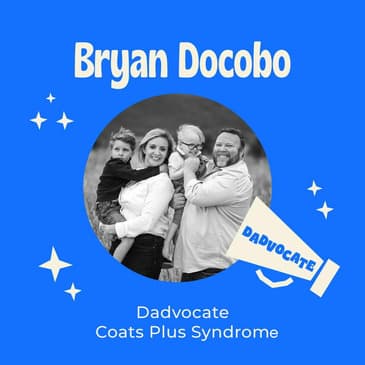

Bryan Docobo — attorney, father, rare disease advocate, and founder of the Coats Plus Foundation. Bryan opens up about the devastating journey of losing his four-year-old son Ethan to Coats Plus Syndrome (a rare telomere disorder caused by a CTC1 gene mutation) in June 2024, while fiercely fighting for his older son Liam, who is also battling the same condition. Bryan shares the pre-diagnosis struggles, the shocking moment of Liam’s grand mal seizure that led to the diagnosis, the science behind the disease (telomere dysfunction affecting blood vessels, brain, eyes, and GI tract), and the proactive steps his family has taken. These include pushing for Avastin (anti-VEGF) treatment that has stopped brain calcifications and leukodystrophy progression in Liam, stem cell infusions showing clinical improvements, and an ambitious push for personalized gene therapy (requiring $3–5 million in funding).He also discusses the profound grief that transformed into purpose, including losing 80 pounds, deepening his spirituality, and founding the Luminary Tribe — a growing men’s support community in South Florida (with plans to expand) focused on vulnerability, connection, and helping high-achieving men show up stronger for their families. This episode is a masterclass in resilience, advocacy, fatherhood, and turning unimaginable pain into meaningful action that could help not just Coats Plus families but the broader rare disease and longevity communities.
Links:
[00:00:03] I'm Effie Parks. Welcome to Once Upon A Gene, the podcast. This is a place I created for us to connect and share the stories of our not-so-typical lives. Raising kids who are born with rare genetic syndromes and other types of disabilities can feel pretty isolating. What I know for sure is that when we can hear the triumphs and challenges from others who get it, we can find a lot more laughter, a lot more hope, and feel a lot less alone.
[00:00:31] I believe there are some magical healing powers that can happen for all of us through sharing our stories, and I'll take all the help I can get. Once Upon A Gene is proud to be part of Bloodstream Media. Living in a family affected by rare and chronic illness can be isolating, and sometimes the best medicine is connecting to the voices of people who share your experience.
[00:00:56] This is why Bloodstream Media produces podcasts, blogs, and other forms of content for patients, families, and clinicians impacted by rare and chronic diseases. Visit BloodstreamMedia.com to learn more. Hi there, and welcome to the show. This is Once Upon A Gene, and I'm your host, Effie Parks. And today I'm so happy to be introducing you to another dad, another dadvocate, who has clearly learned how to tell his story with real honesty and strength.
[00:01:24] And he has also gone on to create something beautiful in addition to his rare disease advocacy that you'll learn about along the way. And I'll also include links in the show notes, of course. So Brian and his wife, unfortunately, lost their four-year-old son, Ethan, to Coates Plus Syndrome, which is a rare telomere disorder caused by a CTC1 gene mutation. Their older son, Liam, is also bravely fighting the same condition.
[00:01:52] So in our conversation, Brian opens up about their journey and the treatments that they're chasing and why he started a men's group called the Luminary Tribe to find connection and support for the dads and for men in general. And he's created a really supportive community, and I'm really excited to share that with you two a little bit here at the end. I think you're going to be hooked like I was. I was just listening like I was listening to a podcast the entire time while Brian was talking.
[00:02:21] He really made a mark on me, and his family is so beautiful, and they're working so hard. And I'm so excited to introduce them to you. Please enjoy my conversation with Bryan Docobo. Brian, welcome to the podcast. Thank you for having me. I always welcome the perspective of a dad. As you've probably realized, there's not as many dads out there doing the forward-front-facing rare disease advocacy.
[00:02:46] Not because they don't want to, but because it's just sort of how the home life usually ends up happening with parents having to stay home and choosing between careers and all of those things. So when there's a dad out there sort of leading the charge forward-facing, it's always really great because I know a lot of dads are also uncomfortable to go on shows, but they really are super grateful when they hear these stories and they tell me privately. So it's really valuable, so I appreciate it.
[00:03:16] Proud to be here representing the fathers out there. That's an interesting lead-in because you're not the first person to tell me that it's a little bit rare, more rare, the path that I'm walking and being more of a vocal-style advocate.
[00:03:33] What's interesting is even if you look at divorce rates when it comes to these types of really earth-shaking experiences when you have a child diagnosed with a rare disease, I mean, we actually had two that were diagnosed with a life-shortening rare disease. And what I come to understand, especially when I recently went to the National Organization of Rare Disease Summit in D.C. a few months back, I noticed the same thing.
[00:04:02] There was a lot of mothers there. There was a lot of women, but there was less men in the room. And I believe that the path that I was able to walk in my experience, I believe it's very important for other fathers to hear.
[00:04:19] Because I think that if the fathers knew out there that they are not alone and that there is actually a strategy in place where you could become a warrior and fighter for your child in this space, I think that's something I would love to connect with other men out there that may be listening. Thank you. That's very generous. And you'll probably be getting some messages. So I'll make sure to leave your contact information in the show notes. And also, I'll post some links to some dad networks.
[00:04:48] There's a couple of fathers' podcasts out there and some great stuff some dudes are doing. So it's growing. And I know that that sense of community is so important. I would love that. And you don't always want it to be out there in front of everybody like girls are more comfortable with. So there you go. Anyways, Brian, can you paint the picture for us? What was life like as an attorney, as a husband, as a dad before this rare disease showed up in your life? Well, yeah.
[00:05:15] Going back, I mean, all I ever wanted to be in my life was a t-ball coach. You know, I just had this vision of having something that other families, other couples, you know, from a perspective seems so easy. You know, I went to undergrad. I went to law school. I picked somebody that I believed to be a great spouse and great mother, perfect school district, became an attorney.
[00:05:42] Everything I did in my life was to have a family. And of course, as Mike Tyson says, everyone's got to plan until you get punched in the face. And that's what happened to us. And, you know, we were blessed with two children. Unfortunately, both those children are diagnosed with a life shortening rare disease called Coates Plus Syndrome. Our four-year-old son, Ethan, died in June of 2024.
[00:06:08] Before we knew about the disease and before we had the diagnosis, we knew something was just off. Something just wasn't right. Both of my wife's pregnancies were pretty uneventful until the very end. And all of a sudden, it was this dramatic entry into the world. Liam, my oldest son, was born at 34 weeks, 2 pounds, 12 ounces.
[00:06:33] My youngest son, Ethan, was born at 27 weeks, 1 pound, 7 ounces. And when we had Liam, we were told by the doctors, oh, these things happen from time to time. It's an aberration. It will never happen again. They really didn't really understand kind of the origin source of this premature birth. And then, of course, we had Ethan and where we're told it would never happen again. And it was an aberration. Happened again. And at that point, we just kind of felt this odd feeling of what's going on here.
[00:07:03] It was almost a feeling of there's a boogeyman out there to get us, but we just can't define this boogeyman. And we just started going on. Liam was developing normally. Ethan had some more complications from birth, but he was a happy kid. Ethan was progressing. We just were noticing changes in him. Refusing the bottle. Ultimately, we had to get a GI2 put in him. Started having difficulty sitting up. And, you know, we were wondering, is it cerebral palsy or something else going on here?
[00:07:32] And we always just had this feeling of something's out to get us. In fact, we were so focused on Ethan that we felt kicked in the gut when we were called into Liam's, my oldest child's primary school. Or it's a, you know, pre-kindergarten class. And we were told, you know, every day we go to teach him something and it's like starting over again. And we felt, oh goodness, we've been so focused on Ethan. Did we take our eye off of Liam? And we were just trying to be the best parents we could be. Just, you know, how do we get educational programs in place?
[00:08:02] How do we further their development? And we're so focused on this. And then one day, Liam and I were wrestling around a little bit. And Liam hit his head. And it's the kind of thing where kids hit their head all the time, you know. And it's like, all right, you know, he's going to be okay. But I could tell this time it was just affecting him a little bit more. And it was time for bed. It was around 7 o'clock or so. And, of course, I'm in the other room looking up, you know, concussions with kids, this and that. And I said, why don't we, instead of going to bed, why don't we sit out here on the couch with mommy?
[00:08:32] Why don't we lay next to mommy? And I'm in the other room doing all this research, you know, just because you care about your kid. Do I take him to the hospital? What do we do in this moment? And then I just hear this yell from the other room saying, Brian, Brian, come here. Something's happening. And I go over there and Liam was having a full-on grand mal seizure. And it was one of the most terrifying things, probably the most terrifying thing I've ever seen in my life. Called an ambulance. They came. We go to the hospital.
[00:08:57] And as far as a routine care or protocol, they took an MRI of Liam's brain. And what they saw was different than they expected. And what they observed was calcifications and cysts all over his brain. And we kind of knew something was off about this. And it was just, all of a sudden, it was just like a fire alarm went off. And we were giving him all these tests and just trying to figure this out.
[00:09:21] And reading that MRI report, I just will never forget these words that are just seared into my consciousness. Reading the report, it discussed an ongoing, longstanding, destructive process in my child's brain. And a few weeks later, we get a call from the doctor. And by the way, my wife is a pediatric nurse at the same institution where we get our care. And the doctor, Monica Arroyo, said, hey, Brian, we think you should come in. And my wife was working that day.
[00:09:50] And I said, you know, Danielle's working today. Is this the kind of thing that maybe she should have the rest of the day off for? Or is this something she could go back to work? And Dr. Arroyo, to her credit, said, I think you should make arrangements. And then I asked her, I said, do we have a diagnosis? And she just said, I think you should come in. So I made arrangements with Danielle's managers to where she could go in and take the rest of the day off. And we went in to see our doctor and the doctor read the diagnosis.
[00:10:19] And Danielle just hit the floor. And I'm there as a father, just trying to be the strong one to keep it all together. And because there's responsibility with being a dad. And there's this responsibility in being a father that not everyone fully understands. We're designed to be the strong one. We're designed, we understand that the family feeds on our energy. And while we feel things internally, we know that how we perform and put ourselves out there for others has to be calculated.
[00:10:50] When you want to crumble, you understand that you have to be the rock and you have to have a different energy. And in that moment, just the weight of the world was on my shoulders. But I knew I had to be the strong one in that moment and all the moments after. Every next day, we had a decision to make. And we made a decision pretty quickly that we, I told Danielle this, I said, you know what? Yes, this isn't the diagnosis. This isn't what we envisioned. But we could define it. We can attack it. Let's go.
[00:11:15] Of course, in that moment when we're reading Liam's diagnosis, we'd looked at each other and we said, well, what about Ethan? And in our hearts, we already knew. And it was confirmed just a couple weeks after that Ethan 2 had the very same disease. And also, so a little bit about the disease is that it's a telomere disease. Forgive me if this is some stuff you may already know, but I'm going to give kind of really a glossed over version of it because it's, you know, it's important to kind of understand the little bit of the pathology.
[00:11:44] In the nucleus of every cell in your body, you have DNA strands wrapped around proteins called chromosomes. These chromosomes are not circular in nature. They have endpoints. Similar to the plastic tip on the shoelace of your gym shoes to maintain the integrity of the shoelace, likewise, that's the role of the telomere that caps the chromosomes to maintain the integrity of the DNA. Now, in a healthy person, every day we have millions of cells that die off.
[00:12:13] The reason we're still here is because of cellular division. Your cells divide. The integrity of the telomere becomes shorter and shorter. Eventually, as a lifespan of these cells keeps going to the next generations, the DNA is not as good getting passed down life cycle to life cycle. And that's why we get white hair. It's why we get wrinkles. It's why we age.
[00:12:34] Now, my children have a genetic mutation in the CTC1 gene that plays an important role in the maintenance of telomeres. And because of that mutation, it affects every cell in their body. And depending on what cells are dysfunctioning, you're going to see certain outputs. So the endothelial cells outline all the veins in your body. And these cells in the system provides some important functions.
[00:13:02] One process is called angiogenesis, the creation of new blood vessels in the body. And these newer blood vessels in the patient's body are small. And because of the mutation, they are fracturing and bleeding. So in the eyes, it leads to swelling, retinal detachment, and blindness. And the brain causes calcifications and cysts. And eventually leads to GI tract bleeding, which becomes fatal. And that's how we lost Ethan.
[00:13:30] These cells also create and maintain what's called the brain-blood barrier. The brain-blood barrier is designed to protect the brain. So when our body gets sick, the brain doesn't get sick. And when that brain-blood barrier begins to collapse, it leads to what's called a leukodystrophy. And that's the destruction of the myelin in the brain. Leads to motor skill decline, cognitive decline, and yeah.
[00:13:56] So it's a pretty awful disease, especially when you see what you believe to be healthy children declining in front of you. It's a pretty rough path. The very next day after we got the diagnosis, I just said, you know what? We got to go to the mountaintop if we have a chance here. And I just put it on Facebook. I told the world. I said, this is what we're battling. This is what we're up against. And we need help.
[00:14:19] The feeling was, it's almost similar to the movie Apollo 13, which was based on a real event where these astronauts, you know, they're in outer space. Something goes wrong. And they only have these few items to work with on this spaceship. They have communication with ground control. But they have to figure it out to find their way home. And that's how we felt. And at the time, it's just, you're just doing. And, you know, you always wonder, am I missing something here? This can't be up to us.
[00:14:49] This can't all fall on our shoulders. Like, is there a resource? Are there people that are studying this? And what we learned was, yeah, it's up to us. It's up to us. And with that energy, we said, all right, let's figure this out. We go to Boston's Children, Children's Hospital of Philadelphia, National Institute of Health. We've talked to it. We've been everywhere. And just the best they could do is say, hey, we could put your kid in this observational study. So what's interesting, and this was before ChatGPT. And I'm an attorney by trade. I'm not a doctor.
[00:15:17] But, you know, I could figure things out. So I said, you know what? Let me start trying to do some reading here. And so we ended up going online, pulling from all these medical journals. And I came across a case study of not the same disease, but it had similar manifestations. It was called LeBrun syndrome. And in LeBrun syndrome, it had calcifications as a phenomenon in the brain. And there was a study showing an anti-VEGF drug, which they used actually Avastin.
[00:15:44] And utilizing that drug got rid of the bad blood vessels. And the calcifications in the patient's brain stopped that process. And even some of the cysts started going away. So I was like, hmm, that seems very interesting. So I started pushing this with our doctors. And also in this process, we started trying to find other families. We started the very first Facebook group.
[00:16:08] And through our oncologist, we were able to link with the very first family that had the same very rare disease. And we just happened to have the same oncologist. It was kind of a miracle that we were in that space. And I'll never forget the moment, making contact with that parent. And it was a moment. And every parent I've talked to, every parent that we've come across with our foundation said, I thought we were the only ones. And it turns out that we're understanding that our group is much larger. So we finally were put in touch.
[00:16:37] And we came into contact with another parent. And we met through our ophthalmologist, which was just incredible that we had the same ophthalmologist, in fact. And making that call and speaking to all the other parents that we've met through our Facebook group and everything else, every parent said, I thought we were the only ones. And we're learning that our community is much larger.
[00:17:02] There's many kids out there that are undiagnosed and misdiagnosed with this very newly understood rare disease. The disease, this genetic mutation, this disease has only been linked since 2012 by Dr. Yannick Crowe out of Etterberg, United Kingdom. And this disease wasn't even tested for until after my second son was born. We ended up with this study. And we were able to push along. And we were able to get the Avastin for our children.
[00:17:29] We ended up getting a doctor, Dr. Monica Arroyo, out of Joe DiMaggio's Children's Hospital, who's been an absolute warrior for us. She's the head of our medical board of the foundation now. And we were able to get it done. Through this process, we were able to stop the calcification process in our children's brains. The cysts were even starting to retreat a little bit.
[00:17:50] And we've recently learned that this drug is doing even better than we thought it was because the leukodystrophy has stopped. There's no more brain damage that's occurring right now in Liam's head. Now, what we are, yeah, it's crazy. We got to win. And when you're out there and you're battling a rare disease, you're trying to find anything. And then just you get something and you get a win. It's a big one at that. We now have a standard procedure now for every child that comes after him.
[00:18:18] And ultimately, what we're seeing in Liam, unfortunately, is we are seeing motor decline and some issues with him now. And of course, we were freaking out. And we're like, hey, we thought, you know, we were doing okay. And this is what we learned about leukodystrophy and cerebral palsy and other types of brain damage is that the damage occurs, but it doesn't fully reveal itself until later on. So right now, what we're observing is the bill coming due on damage. But we also know that that decline will eventually stop.
[00:18:48] And ultimately, we'll see what we're working within and then, you know, try to do battle from there. The bad blood vessels in the eyes cleared up. So his eyes are perfect now. We do have other challenges throughout the body. And as we get into a little bit more of the gene therapy and stuff like that that's being developed, we'll talk a little bit about those gaps and how we have to figure that out. Beyond the Avastin, we also are utilizing stem cells as a cell replacement therapy. And stem cells are wonderful.
[00:19:16] And quite candidly, I would love to push for legislation where stem cells, without going through this full FDA ridiculous process that never gets anywhere, without spending millions and millions of dollars and wasting a ton of time for parents like ours that are just battling for their children, stem cells should be a standard operating procedure, standard care for, I believe, all rare disease.
[00:19:39] I mean, in theory, you take a cell with a healthy structure outside the body that can differentiate, meaning change into any other cell in your body. And you put it into children's bodies or patients' bodies that have dysfunctioning cells and replaces those cells and creates some healthy expression in those bodies. It seems like it should be a standard treatment that is covered by insurance. We have to expend a lot of money out of pocket.
[00:20:08] And the facility we're working with is working with us on payment and trying to keep costs down. But it's expensive. And it just seems like a no-brainer. And every time we give my child an infusion of stem cells, all of a sudden he starts walking a little bit better. He starts getting things a little bit better. It's obvious, you know, clinically that there is improvements. It's just, it just speaks for itself. That's something I would love to push for. And the third, the third thing that we're working on now is the biggest.
[00:20:38] You know, when you're dealing with the Avastin, down the pathology, it's a way of treating certain, you know, certain elements of the expression of the disease. But the cure is with the gene. And we've recently had a doctor say yes to creating a gene therapy for my child to save his life. Dr. Mustafa Tekin at a University of Miami. We also have other wonderful collaborators on this project. Dr. Patricia Mussolino out of Harvard. Dr. Patricia Mussolino out of Harvard.
[00:21:06] As well as Dr. Hillary Longhurst, who's a telomere scientist and other doctors out of Boston Children's. So we formulated a pretty great team of people to create this gene therapy and strategy. Now we're in a position where we have to raise between $3 and $5 million. And it's likely on the higher end of that to try to save my kid's life. So in our foundation, we've been having a lot of local events.
[00:21:34] We've been having casino nights and golf tournaments and a lot of different things to push it forward. And while that's great for awareness, while that's great to keep our administrative costs, you know, to keep the foundation going, ultimately what it's going to rest on is really finding those donors that are out there that are looking for real meaningful science to be pushed forward in the form of the Coats Plus Foundation and this particular project.
[00:22:02] So what's interesting with this particular project and this rare disease is that the technology that needs to be developed could be applicable not only to this one child or this rare disease. It could be applicable to all rare disease, age-related diseases, and also longevity interests. So when it comes to gene therapy, it's twofold.
[00:22:29] The first component is, okay, what's the actual therapy? Is it a gene edit? Is it a gene addition? Is there manipulations to get the gene expressed a different way? Sure, that's one of two most important things. The second component to this is the vector delivery system. And, you know, your muscle mass is different than your bone mass, which is different than the blood, which is different than the various organs.
[00:22:52] And how to get the edit into the different areas of the body could be a challenge depending on where you're trying to get the edit into. So what we're targeting here, what needs to be developed is to get a gene edit into the GI tract, also the endothelial system in particular, as well as the brain. So these are the components we're working on.
[00:23:18] And I'm putting myself in places to get a better understanding of what doctors are working on what. And unfortunately, a lot of doctors are kind of siloed off. And yes, there's other investments and other things that are involved. But part of my goal is to reach out to doctors, understand what people are working on, and maybe even get a contract in place.
[00:23:38] But open this up to where there's more of a collaborative effort, almost similar to the Human Genome Project, which was a collaborative effort to map the entire human genome, which gives us an understanding of these diseases today. There should be a vector project, you know, basically finding a collaborative space for doctors. Because the technology of getting this into different areas of the body, this could cure all rare disease once we have this technology in place.
[00:24:04] And I feel like that's something important, especially for parents like us and families like ours that really would like to save their kid. Thank you for sharing all of that. And great job doing your homework. And I'm really impressed. I'm really deeply sorry about Ethan, every parent's nightmare. I very much appreciate how you're carrying your grief to save Liam every single day. The stem cell thing is very interesting.
[00:24:33] And I know some people who have infusions for it now, and like you said, like you'll notice things that are instantly better. And telomeres in general, right? Like we joke in my house that we have to take care of ourselves because our telomeres are burning on both ends as caregivers. But you're right. I mean, thinking about technology in terms of telomeres too, which affects not just people with diseases, but health in general and longevity, there's like a huge market there for that.
[00:24:59] So you'd think that maybe somebody would have a great desire to work on that aspect. And that's absolutely something we're working on. Because when you're dealing with rare disease, you know, how do we broaden the base and ultimately include additional aligned interests? So that's definitely a big component, especially with nowadays where longevity is thankfully in the forefront of a lot of people's minds now. And so there's a real opportunity there. And another thing that you touched upon is this, which I'd like to address.
[00:25:28] It's about grief and pushing forward. And believe me, this has been an evolution of the soul. And this could have gone, quite frankly, a very dark path when both your children are diagnosed with a life-shortening rare disease. Your mind could go to some very dark places. And looking back at how far we've come, we're reminded each day in that decision to fight and to move forward.
[00:25:55] And I think there's a lot of parents out there and people out there that are grieving. And when we talk about grief, it's not just grieving a loved one. There's grief and loss of identity. There's a grief when you see your child that's healthy and then all of a sudden they can't do something as well. And maybe their life is going to have a different outlook. And there's grief in the expectations or hopes for our child. And there's another grieving process when something else happens.
[00:26:23] And I believe that this grieving process, perfectly candidly, has opened a deep sense of spirituality within it. And I, in a way, feel that we were chosen, just like the many other people listening in right now, were chosen. Because in that grief, if you know how to listen, it could also be an invitation. When everything was happening and when you're grieving, there's times where you feel like you're losing your mind. And what is going on with me?
[00:26:50] And when you really start to understand that process, you realize, hmm, okay, there's cortisol shooting through my veins. There's hormones that are being triggered. What can I do? You know, look, I'm tough. I got grit. But grit alone is not going to get you through this. You have to be smart. So, what I did was, you know, I lost, you know, I was carrying a lot of weight. I was severely depressed. And maybe, perfectly candidly, maybe I was trying to kill myself with food.
[00:27:16] And when I decided to change and fight, you know, I lost 80 pounds. You know, I feel great. I look great. But I'm able to control more. The cortisol shooting through my veins now. I'm able to get into a happier state of mind. I'm able to get a more focused state of mind to take on the challenges. I didn't have a community around me of men. So, what did I do? Myself and a few other founders, we started a men's group locally of high-functioning, high-achieving men.
[00:27:44] We started with one group of 20 men less than a year ago. Today, we have five groups of over 100 men. And we're about to have another five by the end of the year. 200 men local here in South Florida, which we're looking to adapt across the country. Because there is a lot of power in men being there for men. And ironing, sharpening iron. And there's power in vulnerability, especially with men.
[00:28:08] Because, you know, correct me if I'm wrong, but, you know, women have a way of opening up where men have to be the strong one. They have to be this anchor. And who's there for us? And it's got to be other men. And this isn't something new. It's the oldest way made new again. You know, they're around fires, you know, around, you know, tribes. It was men being there for each other. Being that support system. And in modern society, we have lost that. And we're actually called, the name of our group is Luminary Tribe, where we are the light.
[00:28:39] Where when our light is dim, it's got to be filled with other light of the men around us. So we could bring it to the people we care about most. If you care about being the best father, the best husband, the best business owner, the best in your community. You know, it's a place for you. And I believe that that would not exist today if it wasn't for a lot of the pain that I personally walked. I'm starting to get a better understanding of what my life's calling is.
[00:29:04] Not just in the rare disease, this fight for my child, which is the most important thing to me. Don't get me wrong. But also in the greater rare disease space. Within also the healing of men. And like my grandfather used to say, go as far as the eye could see. And once you get there, see further. You know, what are ways that we could help support each other? When you make those jokes in the family about the caregivers, we're burning the telomeres at both ends. You better believe it.
[00:29:32] Because, you know, there's so many organizations, so much focus on the patients, which yes, is the most important thing. But let me tell you something. The caregivers got to be there for each other too. There's so much healing and so much can be done in this space. And what's interesting, especially when we talk about rare disease, rare disease affects 7% of the population. But I don't have a rare disease. My wife doesn't have a rare disease. My children's grandparents don't have a rare disease. But you better believe this affects them too.
[00:30:01] And when we think about this battle and this mission that we are collectively on, and you're a voice for our mission, Effie, and thank you for all that you do. But there's so many other of us out there that could fill so many other needs that are desperately needed. So if there's anybody that's listening right now that wants to become more involved, reach out to the National Organization of Rare Disease. Reach out to other people in your community, in your specific rare disease community.
[00:30:30] If you're looking for a way of like, hey, you know what, how do I level up here? How do I keep me to my bone as the caretaker and this warrior? You're not just a caretaker, but trying to find a cure to a rare disease while you're battling the onslaught of its output. Find other people in your community. Talk about it. If you're spiritual, great. If you're religious, great. Lean into that. Because there's power there. And if anybody wants to reach out to me and, you know, I could walk you through about how to create a community of your own, I'd love to have that conversation.
[00:30:59] Especially for the fathers out there. Because when I was there at the National Organization of Rare Disease and I was learning about these divorce rates, a lot of times the men are scared. They don't know what to do. And they leave. And there is a better way. And there's a higher evolution of your soul out there. If you turn and confront it and you choose to fight. And the more warriors we have out there fighting for this collective mission. And the more ways that we can support more warriors so they're more inclined to step into the arena.
[00:31:29] That's how movements are made. That's how change is made. We've been called at this time in human history to make this particular change when it comes to rare diseases, to genetic conditions. We're here to save our kids. And that's what I believe with it. And that's what I fight for every day in that mission. Brian, I'm so glad I met you. And I have so many things to say about all of the things you've said. But I'm really just more enjoying listening to you. And I don't want to make this episode a million years long.
[00:31:59] So I'm going to invite you back. Thank you so much for creating the Luminary Tribe and for telling me about it. I didn't know it existed. I am putting it under my wing. And I'm going to blast it out as far as the eye can see. And help you in any way possible in that area as well as the rare disease mission. And I know for sure, even sure, fighting for the rare disease and saving our kids and making this a better place for the kids that come after. But all of the other stuff, right?
[00:32:27] The shrapnel and the journeys that you go on to make other parts of this world better. Whether it's spiritual, whether it's building a space for men, whether it's making accessible playgrounds. Whatever it is, when you also find that soul connection to that other type of advocacy that makes this community service sort of like a self-serving energy, really.
[00:32:50] I mean, I think it fills us up and makes us stronger humans and stronger advocates when we're doing something for others. Right. And it gives us that sustainability and and also that really great perspective that can see all above it. But then also just hone in so so perfectly carefully to appreciate every little speck of it. So good job.
[00:33:11] And it's hard to even wrap around like how many things a person can do right in a day as as an employee, as a business owner, as a family member, as a parent, as a parent to someone who's also lost a child, as a foundation leader, as like all of the things that you can be. It's just bananas. It's nuts. It is absolutely nuts. What a person can hold.
[00:33:32] The way the words that you you use just now with intention tells me that we have a lot more to discuss because it is quite literally an evolution of the soul. And I do believe that there's ways of making our vessel or correcting our vessel or building our vessel in such a way to hold more light to live through us. And yeah, diamonds are formed under pressure. And when I said this is a very painful, yes, but it could be an invitation if you know how to listen.
[00:34:01] I really mean that. And I would love to come back and talk more particularly about that next time around. Also, Luminary Tribe is spelled instead of M-I-N in the middle. It's M-E-N for men. It's misspelled on purpose, the body men. So luminarytribe.com. Our local chapters are in South Florida. And as we're building the design, eventually we would love to create a framework to bring this to other cities. And it's not limited to rare disease fathers. It's really just for men being there for men.
[00:34:28] But it has been a profound, it has had a profound impact on a positive effect on my well-being and being able to carry on this mission. Yeah, absolutely. Amazing. I can't wait to learn more about it and help you share it and share all of this. And just to go back to the very beginning, just because I'm not sure if I heard it, but I'm curious. The kids who are born with this genetic mutation, is there a better way for them to get diagnosed earlier that you know of now?
[00:34:56] Are there any signs that parents should look at? I'm not sure if I caught that part. Yeah, so the best way to, something to cue you people into this, just as the telomeres affect and there's, you know, the cells are dying quicker in the body of the patient. When a woman is pregnant, she's not creating just a baby, but also the placenta.
[00:35:19] So if there is, and that placenta ends up reaching a point of failure in and of itself, and that's what leads to the premature birth and the low birth weight. So if anybody has a pregnancy that seems to be going fine, but then all of a sudden there's low amniotic fluid and there's, you know, growth restriction and kind of a dramatic entry into the earth, then that should put on your radar that maybe something's going on here with COTS+.
[00:35:46] Also, if there is any type of eye problems where it's appearing as retinopathy of prematurity, but it's not that, and they actually have to look at the back of the eyes. It's not as apparent, but if there's some eye problems, it should trigger a question of this is, whether this is a COTS plus disease. And then also if there's, there's ever a seizure, you know, then that would be a clue as well. So hopefully we do just get to the point, you know, when a baby has IUGR that there's a genetic test right away. Correct.
[00:36:15] Hopefully for the beginning of anything. Yes. Yeah. Okay. And then how many, how many patients do you have involved at this point that you know of? It's so tough to answer that question because it's so newly understood. It's not fully tested. And the problem is also this, and it's a painful cycle, but we find a child, we lose a child. We find a child, we lose a child.
[00:36:40] And, you know, the children typically expire in the second decade of life, typically around, you know, 16 years old. Because obviously through puberty, there's a rapid, more rapid division of cells and the telomeres takes a toll on them. So if you could live till 40 or 50 years old, we would have much larger patient population. But right now, 20 maybe, you know, that we can identify. But we know for certain there is more out there.
[00:37:07] We know for that to be a fact just based on the studies we're coming across. But we're trying to find a better way to link with those patients and also discover younger patients as early intervention is key. Yeah. Okay. So main mission right now, on top of all the other ones that we all know so well, is raising money. Yep. Three to five million dollars. So if you got anything in your seat cushions, couch cushions, love to hear about it. And where do people go to?
[00:37:36] You could go to coatsplus.org and there's a donation tab there. It's spelled C-O-A-T-S and then P-L-U-S dot org. And just click the donation tab. You'll see a little bit about our family. Anybody wants to reach out to us directly, you could contact us at info at coatsplusfoundation.com or contact at coatsplusfoundation.
[00:38:04] If anybody wants to learn more about the disease or just wants to talk rare disease or fathers that want to connect or maybe they're interested in the tribe, don't hesitate. I would love to love to connect with those people. And I guess just one last question as someone who's obviously such a dad, such a dad advocate,
[00:38:22] and as one who's lost one son already and is fighting for the other one, Liam, how has the journey completely rewritten with what you thought being a good father was or meant to you to now? You know, we talk about grief. It's like this, sorry, this vision of what you thought your life was going to be. It's just about understanding that it was always going to be this way. It was always meant to be this way.
[00:38:51] That's what I believe. And the way that it's rewritten it is it has given me a really deep understanding of unconditional love. It's given me a deep understanding of the limits or limitlessness, I should say, of the degree that you'll go for your children. As a matter of fact, I think what kind of embodies it is this. It's something that actually one of my brothers said to me, and I will never forget it.
[00:39:17] And he said, so many people say, I will die for my child. But that's the easy part. How are you willing to live for them? Who are you willing to become for them? That's the test. And for me, that's rewritten everything. Really beautiful. All of it. I really enjoyed learning from you today and talking to you. And now you're going to be one of my prisoners.
[00:39:41] So thanks for spending the time to give us a little bit of the overview of what you're doing and what you're dealing with and what you've dealt with. I think you're really important, Brian, and I'm really glad to have met you. So thank you for being on the show. I feel blessed to have met you too. And Effie, your platform is wonderful and you're somebody that's doing something. And that is so important. Keep it going. I'll be honored to be your prisoner on this podcast. I'd love to return numerous times or how many times you'll have me.
[00:40:09] And thank you for being such an important force in our collective mission. Yes. You understand why. Thank you. I appreciate it. Absolutely. I hope you've been enjoying this podcast. If you like what you hear, please share this show with your people. And please make sure to rate and review it on iTunes or wherever you get your podcasts. You can also head over to Instagram, Facebook, and Twitter to connect with me and stay updated on the show.
[00:40:36] If you're interested in sharing your story or if you have anything you would like to contribute, please submit it to my website at effieparks.com. Thank you so much for listening to the show and for supporting me along the way. I appreciate you all so much. I don't know what kind of day you're having, but if you need a little pick me up, Ford's got you. I appreciate you.
[00:41:10] Thank you.