
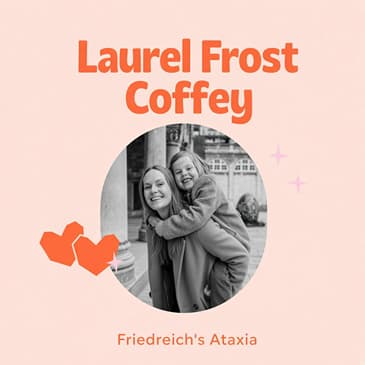

Laurel on Amelia, Friedrich’s Ataxia, and Choosing Joy in the Face of ProgressionLaurel shares her family’s experience raising Amelia, who was diagnosed with Friedrich’s ataxia at age 8 after early signs showed up around age 5. This conversation covers the path to diagnosis, the emotional reality of progressive illness, and how Laurel stays present with Amelia while making memories now.We discuss Laurel’s perspective as a mom, the impact on Amelia’s brothers, the role of community, and the hope she sees in current research and clinical trials. Effie Parks and Laurel also talk openly about grief, joy, sibling dynamics, and what it means to keep moving forward when the future feels uncertain.Key topics
- In this episode, Laurel introduces Amelia as a creative, funny, and spirited 10-year-old who lives with Friedrich’s ataxia and still brings a lot of joy into the family.
- Laurel walks through the early signs that something was wrong, from leg pain and exhaustion on a family trip to France to frequent falls, clumsiness, and coordination issues at school.
- She describes the diagnosis process: physical therapy noticing neurological symptoms like nystagmus, head tilt, scoliosis, and difficulty standing with eyes closed, followed by an ER visit and later genetic confirmation.
- We discuss the genetic side of Friedrich’s ataxia, including FXN gene mutations, GAA repeat expansions, and why early-onset cases like Amelia’s tend to progress much faster.
- Laurel shares the emotional weight of learning that both parents are carriers and that Amelia’s diagnosis is life shortening, which brought a deep grieving process for the future they expected.
- The conversation explores grief in waves and how Laurel experiences it in “installments” as Amelia loses abilities, while still trying not to get stuck in future fear.
- Laurel talks about staying present by focusing on Amelia herself, saying that time with her is the best therapy and the biggest source of joy.
- Effie and Laurel compare notes on parenting through disability, including the pain of seeing other kids move freely and the challenge of not letting comparison take over.
- They dig into one especially hard moment involving a denied disability pass for a Disney trip, which became a reminder that small logistical battles can hit harder than they seem.
- Laurel describes how she tries to make memories now, including a hand and footprint art project for Amelia’s “last steps,” and why she’s pushing to travel while Amelia can still navigate more easily.
- The episode highlights sibling dynamics, including the so-called glass child experience, how her two boys respond differently, and how Laurel tries not to turn them into caregivers.
- They close on hope, including community support, rare disease connection, a clinical trial Amelia is participating in, and the broader progress in research for FA.
- Stay present, not predictive
- Grief and joy can coexist
- Memory-making as resistance
- Community as therapy
- If you’re parenting through a rare or progressive diagnosis, look for community connection rather than carrying it alone.
- Make room for joy now, even if it feels awkward or premature.
- Capture moments while your child can still participate, whether that means travel, art, or simple family rituals.
- Be honest about sibling dynamics and protect children from unnecessary caregiving pressure.
Timestamps00:00 - Warm welcome and catching up after Rare Disease Day Cruise
02:07 - Amelia’s upcoming Make-A-Wish trip to Santorini
03:20 - Who Amelia is and what Laurel wants listeners to know
04:03 - First signs something was wrong during a family trip to France
05:30 - School concerns, PT referral, and neurological symptoms
06:29 - ER visit and the first time they heard hereditary ataxias
07:48 - Genetic confirmation of Friedrich’s ataxia
08:16 - Processing a life shortening diagnosis
09:48 - Why children can be diagnosed with FA while many people meet adults with it first
10:06 - FXN gene, GAA repeats, and why early onset is more severe
11:27 - Grieving as the parent who knew Amelia before the diagnosis
13:00 - Grief in waves and “installment plan” losses
14:03 - Amelia’s personality and why the diagnosis has not fully hit her yet
15:02 - Watching other kids move and feeling the contrast
16:17 - Redirecting away from future fear
17:20 - Staying present with Amelia as the best way to find joy
18:18 - Signs of slipping into a harder grief day
19:08 - The Disney disability pass denial and why it hit so hard
21:39 - Making memories now while Amelia can still do more
23:06 - Amelia’s “last steps” art project and the emotion around it
25:08 - Where the artwork lives and sharing it with family
26:08 - Amelia’s creativity and the impact on her brothers
26:41 - The boys learning about FA and the family’s different sibling dynamics
27:30 - Balancing fairness, safety, and caregiving boundaries
31:13 - Why Laurel avoids making the younger son a caregiver
33:16 - What joy FA has unexpectedly brought into Laurel’s life
34:10 - Finding family, belonging, and empowerment in the FA community
36:18 - Community as therapy and the value of diagnosis
37:31 - Different ways people may connect with rare disease communities
38:20 - Rare at Sea and the leaders who helped shape the community
38:49 - Fear of regret and Laurel’s desire to use time well
40:02 - Wanting Amelia’s story to be about love and adventure, not just diagnosis
41:04 - Hope in approved treatment, clinical trials, and gene therapy research
42:21 - Gratitude for community leaders and shared support
43:01 - Closing thoughts, brain fog, and wrapping upKey frameworksNotable quotesCopy“I have to be conscious, constantly conscious about staying present with her.”Copy“My love is greater than the fear that I have.”Copy“I want her to just think about a life that was experienced with love and adventure.”Action items
[00:00:03] [SPEAKER_05] I'm Effie Parks. Welcome to Once Upon A Gene, the podcast. This is a place I created for us to connect and share the stories of our not-so-typical lives. Raising kids who are born with rare genetic syndromes and other types of disabilities can feel pretty isolating. What I know for sure is that when we can hear the triumphs and challenges from others who get it, we can find a lot more laughter, a lot more hope, and feel a lot less alone.
[00:00:31] [SPEAKER_05] I believe there are some magical healing powers that can happen for all of us through sharing our stories, and I'll take all the help I can get.
[00:00:43] [SPEAKER_00] Once Upon A Gene is proud to be part of Bloodstream Media. Living in a family affected by rare and chronic illness can be isolating, and sometimes the best medicine is connecting to the voices of people who share your experience. This is why Bloodstream Media produces podcasts, blogs, and other forms of content for patients, families, and clinicians impacted by rare and chronic diseases. Visit BloodstreamMedia.com to learn more.
[00:01:08] [SPEAKER_05] Hi there, and welcome to the show. This is Once Upon A Gene, and I'm your host, Effie Parks. I'm really excited about my guest today. She's such a beautiful mom. I got to meet her in person at our rare sea cruise for Rare Disease Day, and I've been thinking about her ever since because she just spread so much beauty on the internet about her family. And recently she did that trend, you know, where parents dip their baby's feet in paint to capture their first steps. She did that with her daughter, who has Friedrich's ataxia, which is a progressive disease that's actually taking her mobility.
[00:01:38] [SPEAKER_05] So this time it wasn't a child's first steps, but maybe some of her last. She calls her daughter's diagnosis what it is, fatal, and then goes out and fills their life with as much life-giving as she can possibly fit in, with trips and memories and art on the floor. We also talk a little bit about her two sons and the glass children and how they get overlooked in families and what that is like in her home.
[00:02:05] [SPEAKER_05] And we talk about the grief that keeps showing up and chasing joy on purpose and not wanting to look back, wishing that we had lived more. So I hope you enjoy my conversation with Laurel Frost Coffey. Hi, Laurel. Welcome to the podcast.
[00:02:20] [SPEAKER_03] All right. Hi. Hi. Thanks for having me. I'm so excited to be here.
[00:02:25] [SPEAKER_05] Yes. I'm so excited you're here, too. I had the ultimate pleasure of meeting you and your family on our Rare Disease Day cruise 2025 in the Bahamas, and it was so much fun.
[00:02:37] [SPEAKER_03] Yes. Oh, my gosh. It was so much fun. I can't wait for it again next year. It's going to be great. It's one of the highlights of our year. Yeah. Yeah. We'll be there. Yep. Amelia and I are going to go this year. My mom is having surgery at the end of the month and can't really commit to anything at this point. So it's just going to be us. And then actually, Amelia has her Make-A-Wish trip coming up like right after Rare at Sea.
[00:03:02] [SPEAKER_03] So my boys aren't going to go on Rare at Sea this year because they're going to be going on that trip. Right after. Tell me about the Make-A-Wish trip. Yeah. We're going to go to Santorini. Oh, my gosh. Yeah. We're super excited. Amelia is really into Greek mythology and she loves the water. And so I think it's just going to be a great spot for her.
[00:03:24] [SPEAKER_05] That's amazing.
[00:03:25] [SPEAKER_03] Yeah.
[00:03:25] [SPEAKER_05] Everybody needs to go and follow Laurel on Instagram. I'll have it linked in the show notes.
[00:03:30] [SPEAKER_03] Oh, you're so funny.
[00:03:30] [SPEAKER_05] It's the most beautiful Instagram that exists. She's like a super talented photographer and videographer and it is just absolutely stunning.
[00:03:41] [SPEAKER_03] Oh, you're so sweet. Thank you. I have a lot of fun doing it. It's really pretty. Thank you so much.
[00:03:48] [SPEAKER_05] Yeah. So can you tell us a little bit about Amelia?
[00:03:50] [SPEAKER_03] Yeah. So Amelia, she's my 10-year-old daughter who was diagnosed with Friedrich's ataxia when she was eight. And she's just the most fun loving spark of joy that you will ever meet in your life. She's like spunky, quick to make you laugh, a little mischievous, full of opinions in her preteens, super creative and imaginative. And she's just she's just the best.
[00:04:16] [SPEAKER_03] So do you want me to do I'm going to tell you like a little bit about our story early on, like how we got to where we are?
[00:04:22] [SPEAKER_05] Yeah, sure. Maybe there was like a moment looking back when you knew something was off before you heard Friedrich's ataxia.
[00:04:28] [SPEAKER_03] Yeah, because who's heard of Friedrich's ataxia except for you because you have other friends in the community. But yeah, I mean, it's something I had never heard of. But yeah, when Amelia was about five, we took our first big family vacation that involved a lot of walking. We went to France and we didn't bring a stroller because we were like, oh, she's five. Like she should be able to keep up at this point. Like we knew it was kind of going to be a push, but we got there and she just needed to be held every second of every day.
[00:04:56] [SPEAKER_03] She was complaining about leg pain. And it was kind of hard at that point to determine if if she was just like the baby of the family and used to being pampered or if something was actually going on. So that was like the first seed that was planted in my mind, like the first little whisper of worry. So then fast forward about a year, she tripped at the playground when she was in kindergarten and broke her hand. And I just remember thinking in that moment, like, wow, I'm surprised that's the first bone she's ever broken, considering how frequently she falls.
[00:05:26] [SPEAKER_03] Because she was tripping all the time, just super uncoordinated and and just seemed clumsy. But I had brought it up to her pediatrician a couple of times and she had her like stand in place and stand on one foot. She just fell over immediately and she kind of laughed it off and just thought it was something that she'd grow out of. But then the next year she was just getting increasingly less coordinated. Her teachers were bringing it up. They were saying she was tripping in the classroom, falling over the trash can and like other kids.
[00:05:55] [SPEAKER_03] So this is when I like kind of insisted that she be seen for an evaluation for physical therapy. Because, I mean, at this point, I had never heard of ataxia. I didn't know what was going on. So we had that evaluation to see if we qualified for physical therapy. And they noticed some neurological symptoms that I hadn't seen or like even knew what they were at that point. So they noticed some nystagmus. They noticed a head tilt, scoliosis, high arches.
[00:06:25] [SPEAKER_03] They noticed that when she closed her eyes, she would fall over immediately. Just all these little things that were painting a bigger picture of like a more serious diagnosis. So they sent in a referral to neurology. And we couldn't. This was November of 2024. And we couldn't be seen until January by neurology of 2025. So we went to PT. We qualified for PT. And we went for like our first weekly visit the next week.
[00:06:53] [SPEAKER_03] And they were like, no, you can't wait till January. You need to be seen right now. Like you need to rule out anything that's putting her in immediate danger, like a brain bleed or a tumor or a stroke. So they sent us to the ER that night. And that was the first night we had heard of hereditary ataxias, like a group of diseases where one of the biggest symptoms is ataxia.
[00:07:15] [SPEAKER_03] And actually, the doctor on call that night thought that she had a form of spina cerebellar ataxia because my dad had developed ataxia later in life, though we didn't have a term for it. And he never had a formal diagnosis. But he, around age 60, we actually just thought he was drinking when he wasn't. He just became like quite clumsy, actually developed some nystagmus or flickering of his eyes as well.
[00:07:41] [SPEAKER_03] So they had seen that written in her chart. And then they were suspicious that it was maybe a form of ataxia that came from just my side of the family. So Friedrich's ataxia ended up being on the same panel with all the other hereditary ataxias that they were testing for. So 12 weeks later, we received that diagnosis. So that is something she inherited from both my husband and myself.
[00:08:05] [SPEAKER_03] And it is a progressive neuromuscular disease that causes uncoordination, can cause and has caused in Amelia a severe heart condition called hypertrophic cardiomyopathy, severe scoliosis. Usually, and it's life shortening. So usually these individuals, when they're diagnosed at a typical time frame, usually the average life expectancy is 37.
[00:08:34] [SPEAKER_03] Amelia actually was diagnosed and has early onset. So those kids usually live to like mid-20s. So that was the hardest part. And I'm going to cry during this just to warn you. Just grappling with the, you know, just grieving the future that we expected to have with our daughter. So that is our story in a nutshell.
[00:08:55] [SPEAKER_05] Yeah. And I can only imagine like what extra stuff comes when you find out that both parents are carriers.
[00:09:00] [SPEAKER_03] Yeah. I mean, and you never, you just, it's something you, you would never know because they have no symptoms. And we have no family history because it's so rare for two people that are carriers to link up and have a child. So it's just something, it's just one of those freak things, you know, which I know a lot of your listeners can relate because a lot of these rare diseases are, it's just wild. Yeah.
[00:09:25] [SPEAKER_05] I was actually going to ask you about this because everyone I knew with Friedrich's ataxia was an adult.
[00:09:31] [SPEAKER_03] Yeah.
[00:09:31] [SPEAKER_05] And, you know, started getting symptoms, you know, after 18 years old. And on the rare at sea cruise was the first time I had ever seen or met any children with FA. And I wondered why.
[00:09:43] [SPEAKER_03] Yeah. Yeah. So it has to do, so Friedrich's ataxia is caused by something, by a mutation on the FXN gene. And it's caused by something called a trinucleotide repeat expansion or like a GAA repeat. So usually the more GAA repeats you have, the more significant your disease is, the earlier the onset and more symptoms you develop. So it really just has to do with that GAA repeat number. So Amelia's are like sky high on both sides.
[00:10:12] [SPEAKER_03] She has like 1100 on one and like, gosh, 960 on the other. So I think like these people that are diagnosed later in life, they later in life, they might have like, you know, 300, 400 repeats on each gene. So that's what determines that. And yeah, I mean, it's almost like they're two different diseases.
[00:10:31] [SPEAKER_03] Now, I know they have like similar symptoms, but just the rate of progression when you're diagnosed younger is so much faster and so much more severe for these younger kids than these older, you know, teens and young adults that are diagnosed. That is very annoying. It's so annoying. It's so annoying. Like who, these stupid, these stupid genes. Who knew how important they were? I guess everybody did.
[00:10:54] [SPEAKER_05] I guess so. I guess so. Yeah. I mean, you got to know Amelia before F.A. did. Yeah. Does that make, does that make grief like harder or easier or weirder?
[00:11:05] [SPEAKER_03] I guess it's, it's all weird. It's all weird. I don't know because, you know, I think about this and I don't really know the answer. It's like part of me is like, I'm so glad I was like ignorant to this for five years and I just got to experience her with, you know, with none of this associated with her. And then part of me is like, I wonder how it feels when you know, like even when you're pregnant, that something like this is going to happen and you prepare for it mentally. So I don't, I don't know what's harder. It's all hard.
[00:11:34] [SPEAKER_03] It's all, it's all awful. Yeah. I do know. I mean, it's just, it's very strange going from being a perfectly typical child to having this, you know, life altering, life limiting disease. It was just kind of came out of nowhere because I mean, she had a perfectly normal early childhood, like pregnancy, birth, met all her milestones on time. No indication of an issue until about five when she started stumbling around and complaining of leg pain.
[00:12:02] [SPEAKER_03] So just very, just very strange. Just life. Life is, life is crazy.
[00:12:07] [SPEAKER_05] Yeah. And I think all of us parents know that like grief doesn't just happen once, right? Like it's a, right? And it shows up every time a skill slips.
[00:12:18] [SPEAKER_03] Yeah. Or even in a happy moment, sometimes it's like, you feel like a dull ache with the happy moment. It's like, oh, I like, I want this forever, you know?
[00:12:27] [SPEAKER_05] Yeah.
[00:12:29] [SPEAKER_03] Yeah.
[00:12:29] [SPEAKER_05] Do you feel like with it being a progressive disease that like you sort of grieve in like installment plans?
[00:12:35] [SPEAKER_03] Yeah. No, definitely. And I like kind of set myself up for like the next time I'm going to grieve. Like, oh, when she loses this, that's going to be really sad. When she loses this, you know? Yeah, definitely. But like you said, it is, it just comes in waves and I never know when it's going to hit me. Like something can trigger it that I was like, wow, I was not expecting to have the day that I'm having today.
[00:12:56] [SPEAKER_05] So far, what's something that Amelia's lost that you've grieved harder than maybe she did?
[00:13:02] [SPEAKER_03] Yeah. I mean, I think everything. She's not grieving. It's hilarious. I mean, it's not hilarious. It's just, I keep thinking she's such a happy, like go lucky, funny girl. And it does not seem to face her at this point. Now, I'm sure like later on when the teen years hit and she becomes more self-conscious, she will experience the grief. But right now she just has such a positive attitude that everything seems just fine with her. Now, she doesn't know the complete story of F.A.
[00:13:31] [SPEAKER_03] She doesn't know that it's life shortening. She does know everything that's going to happen to her and has met people with F.A., you know, that are in all different stages of their progression. So she knows what the future will look like, but she does not know that it's life shortening. And I think that's just like, that's the punch in the gut. Like I can handle anything in life except for that. But yeah, like I see her trying to walk. She doesn't walk well at all. Like she needs assistance. She has a wheelchair and a walker.
[00:14:00] [SPEAKER_03] But like when she's trying to catch up with her friends at the playground, it's just it's hard to not compare her to the other kids that are moving around. And it's actually I don't know if this happens to you, but when I see kids Amelia's age and I see them moving around, I'm like, how are you walking so well? Like it doesn't compute in my brain that they should be moving how they're moving. And I have two boys, older boys that like don't have F.A.
[00:14:26] [SPEAKER_03] So like they move perfectly normally and it's just a bizarre thing to witness when it just doesn't compute in my head how they're moving around.
[00:14:33] [SPEAKER_05] Oh, my gosh. I totally relate to that. Yeah. Sometimes I'll just be in a moment where we're out and I see Ford will see kids from his class and they're just like these boys like doing boy things and wearing boy shirts and boy hats. And, you know, maybe they're on a team of some sort. And I'm just like, what would that be like? What would he look like if he did that? What would that feeling be like as a mom? Yeah. I think that's just something that's probably never going to stop.
[00:14:59] [SPEAKER_03] No, I don't think so. I don't think so. Yeah. I mean, once I go there, I try to redirect like pretty quickly because I'm like, that's not a healthy place to be in my mind right now. Totally. You know, and I think that's kind of the key to like surviving this. It's like, OK, let's redirect because I'm so used to like living in the future and planning and like, you know, like helping manifest my expectations. And that's not what's happening here.
[00:15:25] [SPEAKER_03] It's like we are not in control at all of how our future is going to unfold. I mean, nobody is. But we're like, you know, reminded of that a little more than the average person. Yeah.
[00:15:37] [SPEAKER_05] Yeah. You and I have a similar mindset on this of the grief and the joy aspect and obviously letting us have our feelings, but really not letting them take up more space than sort of chasing the joy aspect of it. So how would you say that you look at it and perform that way?
[00:15:55] [SPEAKER_03] Yeah, I think the best way to focus on the joy is to just be present with Amelia. You know, it's so easy when you have a child that's diagnosed with these life-changing conditions to think like what's next? What's going to happen? What's the next symptom? The next loss? The next challenge? But, you know, that's not a healthy place to live in our mind. So I have to be conscious, constantly conscious about staying present with her. Like she is the best therapy in all of this.
[00:16:24] [SPEAKER_03] Just being with her and experiencing her. Like I'm always happy with her. It's like when I'm not with her, that's when the grief hits, you know?
[00:16:31] [SPEAKER_05] Oh my gosh, yes, I totally know.
[00:16:33] [SPEAKER_03] Yeah.
[00:16:34] [SPEAKER_05] I feel like sometimes there can be like warning signs for me if maybe I'm off that day or maybe Ford is being extra. Do you have any of those like signs that's like, wait, you're sliding from just feeling your grief to maybe getting a little stuck? And what do you do for yourself when you notice that?
[00:16:51] [SPEAKER_03] Yeah, let me think. Gosh, I mean, I don't know if I really have a warning. Like I always think that I like, I mean, unless it's like hormone related, then I'm like, okay. Maybe that's my problem. I'm going to have a bad day today and there's nothing I can do about it. When it's, you know, that definitely, that's when I feel my worst. But no, like two days ago, I had the worst day ever. And I was, I know we were supposed to get on here and talk about how to be joyful. And how I'm just like dumping on you all the negative.
[00:17:21] [SPEAKER_03] No, we said both.
[00:17:22] [SPEAKER_04] We said both.
[00:17:23] [SPEAKER_03] Okay, both, both. Good. It's always both. It's, we have to find balance. So, but the other day I was, Amelia and I are going to Disney in October just for like a quick, I mean, just like for one day. Okay, so I was trying to get the disability pass through Disney and you have to do an in-person interview with the child. So I was talking with them, giving them all her symptoms, like telling them why it's important. Like she, you know, has heat intolerance and this heart condition that leads to incredible fatigue.
[00:17:51] [SPEAKER_03] And this is why she'd benefit from this disability pass and blah, blah, blah. And they denied us. And I was like, wait, what? Like I like freaked out. I was like, are you kidding me? Like, like what? I was like, do you, do I need to like explain more about this diagnosis to you? Like this is a pretty bad one. And they were like, I know it's like a pretty bad one. So I was, I was just blown away.
[00:18:17] [SPEAKER_03] And then when I was trying to ask questions after they denied us, they were cutting me off, talking over me, like just incredibly insensitive and uncompassionate. And I had just the worst day. Like that was like the straw that broke the camel's back. Like it was just something like that, that like, that's silly. Like who cares if she gets a pass at Disney? Like that shouldn't really make a difference in my life. Like it's one day we can manage, we'll be fine. But like, I don't know why that just threw me for like the biggest loop that day.
[00:18:47] [SPEAKER_05] Are you kidding me? Those are the most frustrating of arguments that we have to have.
[00:18:51] [SPEAKER_03] I was so frustrated. Yeah. But it's like, why am I allowing that to take my happiness away? Like why am I allowing it to affect me at the level that it did? Like in the grand scheme of things, that is not important. But it is incredibly frustrating. But it's like another thing where I have to like talk myself out of, redirect, move on, you know.
[00:19:10] [SPEAKER_05] Shame on Disney. And shame on every person who has ruined the process for the people who actually have disabilities and need that pass. Shame on Disney.
[00:19:18] [SPEAKER_02] I like, I don't even want to go now. I'm like, can we go to Universal instead?
[00:19:23] [SPEAKER_05] That makes me not want to go. I'm too afraid to take Ford to most places. I'm always like in awe of your bravery and just like ability to get it done. It's very inspiring to me.
[00:19:34] [SPEAKER_03] I feel like I'm a little bit manic in that sense. I'm like manically trying to make memories. Well, we can't. And that's like another thing with the progressive disease. It's like now is our time. Now it's not going to get better. Like we got to jump on this opportunity to do as much as we can right now. So I think that's the way I am the way I am. Yeah.
[00:19:53] [SPEAKER_05] Yeah. That's definitely one thing I would tell parents too is like go do all that stuff while you're in the thick of it. And I know it's like impossible to think about. But before they're too big for you to really, really manage it, like go do the things.
[00:20:05] [SPEAKER_03] I know. I know. That's where we're at. And I mean, she can still get around a bit. And so I'm like, that's why I'm like pushing to go on her Make-A-Wish trip now while she can still kind of navigate the stairs a bit, you know, with help while we're there. So yeah, I have a lot of plans. My husband's always trying to slow me down. And I'm like, nope, it's not happening yet. We will be forced to slow down eventually. But like right now, no, we're going to go full force.
[00:20:32] [SPEAKER_05] And it's so important for us too, Laurel. Like again, the stuff that you share and the way you share it is just so incredibly moving. And it makes me feel so good. Good. And it's for other people too.
[00:20:46] [SPEAKER_02] Oh, good.
[00:20:47] [SPEAKER_05] Know that. Okay. And the other day, like, oh my gosh, you made a post about last steps. And you like had this big, long butcher paper and you put your feet in black paint. And it was like you flipped it into something that was both like a celebration and a goodbye. And what was that like when you were doing it and when you posted it?
[00:21:08] [SPEAKER_03] It wasn't nearly as sad doing it. It was like, it was fun. And actually, she had, this was her idea, which like made it that much sweeter. Because we watch reels together. I probably shouldn't with a 10-year-old daughter, but whatever. We'll watch Instagram reels. And it's mostly like babies and animals. But we saw somebody do that with their first steps. Painting the bottom of their feet and having them walk across like a big canvas. Just to document that moment. And then she was like, can we do that with me?
[00:21:36] [SPEAKER_03] Because like who knows when my last steps are going to be.
[00:21:38] [SPEAKER_02] And I'm like, my gosh, like stop.
[00:21:41] [SPEAKER_03] I know. She can, she will just gut you. Like just with her innocence and like, you know, she's so sweet. So actually when we were making it, it was a lot of fun. Like, you know, we were just kind of in the moment making a mess, being silly. She's so silly. So it's hard to be upset when you're with her. Because she just, I mean, it's like a comedy show when you're with her. But then when people started commenting once I posted it, I was like, oh my gosh, this is really sad. But yeah, both.
[00:22:10] [SPEAKER_03] Both happy and sad, you know. We had fun in the moment. But it's gut-wrenching too. And I love your idea of doing the same thing in concrete. And now I'm like trying to figure out where I can do that. Yes. In my house.
[00:22:22] [SPEAKER_05] Even if you just like have a couple tiles or something.
[00:22:24] [SPEAKER_03] I love that. That's so much more permanent.
[00:22:27] [SPEAKER_05] It would be so beautiful. Yeah. And you can do it with the boys too all together. Like holding hands. Get it done for us.
[00:22:33] [SPEAKER_03] I know. I was even thinking like could the dogs go through? Yeah. I was almost going to have the dogs put paint on their paws. But then I was like, what if they got loose in our house? That would be just awful.
[00:22:44] [SPEAKER_02] Oh my gosh. With black paint all over the paw.
[00:22:46] [SPEAKER_03] I cut out a little portion that I have framed. It's just in my room right now. I don't have it hung up anywhere yet. And then I cut out some little footprints for like my mom and my brother and my husband's family just so they could have each have a little piece of it. That is so beautiful. I love it so much. Oh my gosh. Aw. Amelia loves, like she's super creative and she loves to craft and she loves to create art. So it's like this was something that was really fun for her. She's just, she's creating all day.
[00:23:16] [SPEAKER_05] I could tell she was definitely an artist when I met her. She just totally gives off that vibe. She's so vivacious. Her joy like literally bounces off of her body like flubber. And she always has like a costume or something, like a headband of something. She's just, you can tell she's, she's whimsy. Okay. She knows her whimsy.
[00:23:36] [SPEAKER_03] She likes to express herself and I am here for it. Yeah. I love it. Yeah.
[00:23:41] [SPEAKER_05] I'd love to hear about your boys, you know, watching their sister lose, lose her abilities in real time and, and what they've said or asked. These poor boys. Mm-hmm.
[00:23:51] [SPEAKER_03] I know. I mean, and that's like the glass child syndrome. Like, you know, the siblings are often overlooked, you know, unintentionally because the, you know, the sibling that needs extra care is, is the focus of the family. And I think they experienced that very much. So my oldest son is 15, going to be 16 in November. He was born a little man. I relate to him since day one, like related to him as an adult.
[00:24:16] [SPEAKER_03] Like he is just so sympathetic and helpful and, and wonderful. And he, I mean, it's obviously it's been hard for them. They do know everything about Friedrich's ataxia. They're able to Google. So they looked everything up, like the moment she was diagnosed. So they know like how this is going to pan out for her. So obviously that was really hard and emotional in the beginning, but I'd say they're both faring pretty well.
[00:24:41] [SPEAKER_03] My younger son is 12 and he has a little more jealousy for like the attention that she's getting or, and it's, it's just so hard just to parent. You want to give Amelia everything, but also create like a human being that's like compassionate and respectful. And it's, it's just hard to find that balance when, you know, especially when, when she's having little sibling spats. I feel like he's the one that kind of gets the short end of the stick because like she'll
[00:25:10] [SPEAKER_03] push him, he'll push her back. But if he pushes her, that could, you know, cause a catastrophic injury. So like, that's not okay, but it's also not okay if she pushes him. So it's just, it's hard to parent that and make it feel fair.
[00:25:22] [SPEAKER_05] Yeah. A hundred percent. I think once a week, I at least say to Ezzie back, I know it's not fair.
[00:25:28] [SPEAKER_03] It's not fair. It's not fair. And it's like, he just doesn't get it. He just, maybe someday he will. But right now he's, he's like super ADHD. I think they're about like mentally and emotionally the same age. So it's like, they almost like act like they're like twins rather than three years apart. So it's hard for him. It's hard for him. And he's more of an emotional love bug, my middle son.
[00:25:52] [SPEAKER_03] So he will get into kind of depressive episodes where he's thinking about Amelia and kind of talking through it. Yeah. He is the best. They're all the best. I have the best kids. I have the best kids. It's like that's, and I have to focus on that because it's like my life right now is so beautiful. You know, I just need to stay right here right now.
[00:26:16] [SPEAKER_05] Yeah. I think that's the only problem that I've discovered from social media because I think it's the best thing ever on planet earth for parents like us. But the only thing that has made me really detest it is sort of the validation loop that it seems to have put a lot of parents like us in. And you have to actively resist that, right? Because it's kind of, it's clearly addictive to people to have sort of that, I don't know, that input like that because it clinically does something with your brain, I guess. I don't know, man. Yeah.
[00:26:44] [SPEAKER_01] It's easy.
[00:26:45] [SPEAKER_05] It's easy to get caught up in that loop and that cycle and not stand sturdy in, you know, changing your direction or changing your thoughts or whatever it is.
[00:26:53] [SPEAKER_03] And maybe it'll get better over time as we, you know, retrain our brains. But I mean, I think we've just lived our whole life in that forward motion mentality that it's hard to just, especially in this country, in this culture, like that's how we're conditioned to live. So it's hard for us to take a step back and just be present with ourselves and our family.
[00:27:15] [SPEAKER_05] Yeah. Yeah. It's a skill for sure that you have to practice all the time.
[00:27:18] [SPEAKER_03] Yes. Yes.
[00:27:19] [SPEAKER_05] All the time. And it really maximizes the day. Like simple little things that you can really just decide to sort of ingest and sit in is, I mean, it's really life-giving when you really make it happen.
[00:27:32] [SPEAKER_03] Yeah. I agree. Totally.
[00:27:35] [SPEAKER_05] Real quick back to the sibling situation. Yeah. I wonder if you feel like I do, where I like never ask Esme to really help do anything with Ford because I don't want her to feel like a caregiver.
[00:27:48] [SPEAKER_03] Yeah.
[00:27:49] [SPEAKER_05] But then I'm also like, but she needs to know how to put his tube on, right? And like, or whatever. Do you sort of wrestle with like making sure the boys don't feel like they're caregivers in training? Yeah. Or do they like helping? What's it like there?
[00:28:02] [SPEAKER_03] Well, they're very different people. So Wyatt, the younger one, I don't ask him to do anything. Like, I feel like it's not clicking in his brain that she has like a serious condition. Like to him, she's just a sister and she can fend for herself, honestly. Like, I love that for him. Then other days he's like crying about what she's going through. So it's like, he's very kind of like all or nothing one way or the other. But Ethan, the older one, he's very helpful.
[00:28:32] [SPEAKER_03] And you know, I don't, I don't think about that. I probably should. I don't want them to feel like they are being like conditioned to be caregivers. But Ethan is always just so, he just volunteers his help. So, and he's strong. Like, so he's, you know, almost a 16 year old boy. So like, sometimes I'm like, I need to save my back. Can you help her? Can you help her down? Because mama's not going to last much longer doing this. Amelia is 85 pounds now. I'm like, oh my goodness.
[00:29:01] [SPEAKER_03] I don't know about this. But yeah, I don't ask Wyatt for help. And probably for that reason, I just don't want him to feel worse than he already does. Like she's getting more attention. The world and our family revolves around her because I feel like he is already feeling a sense of that. So I try as much as possible to not let it seem that way. Yeah. Yeah. Yeah. But also we're like in our groove of how we get around and how we do things that it's just like,
[00:29:28] [SPEAKER_03] everyone will kind of just take, you know, a little piece of what we need to do and just get it done. I really rarely have to ask anybody for help. We all just kind of like Ethan will chime in and notice she needs help and just help her on her own. That's a blessing having an emotionally mature teenager in the home. Yeah. Wow. That's so cool.
[00:29:45] [SPEAKER_05] I love that.
[00:29:46] [SPEAKER_03] Yeah.
[00:29:47] [SPEAKER_05] What would you say is the joy that you found because of F.A. that maybe you wouldn't have found before?
[00:29:54] [SPEAKER_03] Yeah. I mean, being present with her. I feel like everything I worried about prior to this diagnosis just kind of disappeared. Like weight was kind of lifted. I mean, like a much heavier one was put on my back, but one was also lifted. Like the everyday struggles just don't seem to carry the weight that they once did. Also, you know, the community is such a silver lining in this experience that we've had. I've never felt so close with so many people so fast.
[00:30:23] [SPEAKER_03] And everybody is so, like we call each other family and the Friedrichsataxia community. And it truly feels like that. Like I feel like our first event that we went to within the community, I felt like I was meeting a bunch of long lost cousins. Because we truly, I mean, we see each other, we understand each other without saying a darn thing. Like, you know, we just get it. So that's been incredibly joyful in our life to have, to have that. And then also there's kind of this strange sense of empowerment.
[00:30:51] [SPEAKER_03] Like when you face your greatest fear, it's like I can do anything. There's like sky's the limit. If I can do this, I can do anything. Which is like a strange feeling to have when, you know, your kid has an awful diagnosis. But it's like it does. Like that's not a bad thing. One of the not bad things that have come from this.
[00:31:09] [SPEAKER_05] I totally agree. It really just strips away a lot of fear that you probably would have had or used to have about things.
[00:31:16] [SPEAKER_03] Yeah. And I remember you saying something once and it really hit me. It was like my love is greater than the fear that I have. And that's kind of been my mantra lately.
[00:31:27] [SPEAKER_05] It's going to make me cry. It's so true. And you notice it continuously, really. There's a lot of good reminders.
[00:31:33] [SPEAKER_03] Yeah. Yeah.
[00:31:34] [SPEAKER_05] And a lot of bad ones.
[00:31:35] [SPEAKER_03] No, I know. I know. We just got to retrain our brain to focus on the good.
[00:31:39] [SPEAKER_05] Exactly. Exactly. It works. And yeah, I would say to anyone, especially those who think that getting a diagnosis won't change anything. Yes, it will. Because having a community, like you said, who gets it, who knows what you're going through, who looks like you, who looks like your family is a form of therapy. And it is a therapeutic modality. And finding that is it's life changing.
[00:32:00] [SPEAKER_05] And I encourage everyone, even just for that reason, to get a diagnosis, to search for a diagnosis, or to just even if you haven't met them yet and you have it, go look for them. Go find them because something good is going to happen from it.
[00:32:13] [SPEAKER_03] Yeah. I mean, I feel that so hard. Like, I feel like I would be so lost. And I'm so grateful we have such a close community because I think about these ultra rare diseases that don't have that. And I'm just like, oh, my gosh. I just don't even know what I'd do without them. But then I remember I was listening to another podcast with your friends, the two disabled dudes. And they were talking about, because I've never thought about it from this perspective, that sometimes it's painful to connect with others that are going through a similar situation.
[00:32:43] [SPEAKER_03] Like, and I've never thought about it from that perspective. I've always been like, oh, my gosh, this is the greatest part of this. Like, having these wonderful new people who just understand me to my core. So I've always been so encouraging of connecting with the community. But I'm like, am I causing harm to anybody? And like that encouragement? I don't know. It's hard. Not everybody's like me, you know? Yeah.
[00:33:05] [SPEAKER_05] I've found it very helpful to make friends with other diseases, right? Yeah. Yeah. So I'm not always sitting in CT and MB1 and seeing my son's life in front of my face all the time and having the same questions about our kids. Like, it's kind of a relief to have friends with kids with other rare diseases. Yeah. Where it's more la-di-da because, you know, it's me getting a little bit out of my existence.
[00:33:29] [SPEAKER_05] And maybe helping someone else with advice or maybe just being a listener or maybe just not talking about rare disease at all because that's all we do and live in it. And finding those people that are definitely living the same life as you but aren't living the exact same symptomatology is also kind of a relief valve.
[00:33:49] [SPEAKER_03] I agree. And that was rare at sea.
[00:33:52] [SPEAKER_05] Yes. Oh, my gosh. Everybody, rare at sea was epic. It was epic. And, yes, shout out to Sean and Kyle, the two disabled dudes, the two dudes who inspired me to change my direction and to find the joy in this many, many years ago.
[00:34:09] [SPEAKER_03] They're the best.
[00:34:10] [SPEAKER_05] I love them. And they're such amazing leaders for your community. You're so lucky to have them.
[00:34:15] [SPEAKER_03] We are incredibly grateful. They are wonderful guys.
[00:34:19] [SPEAKER_05] Yeah. Not wanting to look back with regret I think is something we all really think about. And I get that sort of essence from sort of the storytelling that you put on your Instagram. So I guess what's the regret you're most afraid of and what are you doing about it?
[00:34:35] [SPEAKER_03] I don't want to look back on this time and think that I didn't do enough with her. You know, I don't want to regret not taking advantage of the time that we have with her. And I want to spend every waking moment doing everything fun, showing her the most incredible life. And I don't want her to just see a diagnosis when she looks back on her life. I want her to just, you know, think about a life that was experienced with love and adventure.
[00:35:04] [SPEAKER_03] And I think that's maybe my biggest regret if I didn't foster those things. So beautiful.
[00:35:10] [SPEAKER_05] Well, I feel like I go on an adventure when I see her videos. I'm telling you guys, it's crazy. Her Instagram is crazy. It's so beautiful. It'll make you feel good. It's so funny. Go watch her videos. Oh, my gosh. Feel your cup. Oh. You can see that you're intentionally living this way, Laurel. And it's just really, really empowering. Thank you so much. I think that it's such a beautiful example of the word my friend Brittany likes to use, surrender, if you will. Mm-hmm. And there's just so much beauty here that you've captured. Thank you.
[00:35:40] [SPEAKER_05] It's important.
[00:35:41] [SPEAKER_03] Yeah. It is important.
[00:35:43] [SPEAKER_05] There's an approved drug for FA, so...
[00:35:45] [SPEAKER_03] There's an approved drug, yes. Yes. For 16 and up. 16 and up. 16 and up. Okay. Yes, yes, yes. But we... There's some, you know, clinical trials. Amelia's involved in a clinical trial right now. I'm not allowed to say which clinical trial. But she is in a clinical trial, and I am allowed to say that. So, yeah, there is a lot of hope, a lot of good things that are happening in, you know, the world of science right now in FA. There's a couple of gene therapies in trial. There's...
[00:36:10] [SPEAKER_03] So, she doesn't produce a protein called frotaxin, which, you know, affects every cell. It helps the mitochondria do what it needs to do. So, there's frotaxin replacement therapy that's in the works. So, all sorts of, like, really exciting things. It's just, like, time is of the essence. We just need to... Research doesn't move very quickly. So, we just need to get... We need to get there. But everyone tells me this is the best time to be diagnosed with FA.
[00:36:37] [SPEAKER_03] Like, there's so much more hope right now than there ever has been. So, we try to prioritize thinking, you know, about that hope. Yeah.
[00:36:45] [SPEAKER_05] Amazing. And another testament to community and what they can push forward. And I've met your leader, Ron. What a beautiful man.
[00:36:51] [SPEAKER_03] Oh, my gosh, Ron.
[00:36:53] [SPEAKER_05] You still want to hug him the whole time you're in his presence, don't you?
[00:36:55] [SPEAKER_03] You just want to scoop him up and rock him. I do. Oh, my God. I just, when I look at him, I just cry. Like, he just... I know, me too. My God, you can just see his soul in his eyes. I'm just like, you are a beautiful human being. And I love him.
[00:37:10] [SPEAKER_05] You need to take pictures of him. I will. You need to take some pictures of him.
[00:37:12] [SPEAKER_03] I'm just going to have a photo shoot with just Ron. Yes. 100%. In a few weeks.
[00:37:17] [SPEAKER_05] Well, Laurel, is there anything that I didn't ask that I should have or anything that you'd like to leave for our friends listening?
[00:37:23] [SPEAKER_03] I don't know.
[00:37:24] [SPEAKER_05] Not that I can think of right now.
[00:37:26] [SPEAKER_03] I feel like I'm, like, brain fogged today. Brain melting? Yeah. That's been happening to me for, like, a year. I know. I'm like, where's my brain? I'm not sure. Not that I can think of.
[00:37:34] [SPEAKER_05] I think moving forward, I'll just let Rare Moms send me voice messages and I'll look them all together in a podcast episode.
[00:37:41] [SPEAKER_03] Hey, that's not a bad idea. It's not a bad idea.
[00:37:44] [SPEAKER_05] I do have a voicemail on my website. So if you ever have a profound thought or question, you can go there and record it. And I can save it. Cool. Okay. You could do that. Yeah, you totally could. All right, Laurel. Well, thanks for joining me. And bless your beautiful family. Thank you so much. Cheers, too. And I can't wait to see Amelia again at Rare at Sea. Yes. It's going to be so fun. We can't wait. I hope you've been enjoying this podcast. If you like what you hear, please share this show with your people.
[00:38:10] [SPEAKER_05] And please make sure to rate and review it on iTunes or wherever you get your podcasts. You can also head over to Instagram, Facebook and Twitter to connect with me and stay updated on the show. If you're interested in sharing your story or if you have anything you would like to contribute, please submit it to my website at effieparks.com. Thank you so much for listening to the show and for supporting me along the way. I appreciate you all so much. I don't know what kind of day you're having, but if you need a little pick-me-up, Ford's got you.
[00:38:44] [SPEAKER_01] I appreciate you. I appreciate you. I appreciate you. I appreciate you. Ha-ha-ha.