
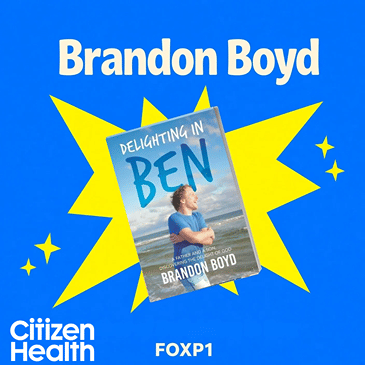

In this episode of Once Upon a Gene, Effie talks with Brandon Boyd, father of two and author of Delighting in Ben, about raising his son Ben, who lives with FOXP1 syndrome, and the shift from trying to change his son's future to learning to appreciate the person right in front of him.
Brandon shares the grief he experienced in the early years, the pressure to pursue every therapy, and the loneliness of navigating disability as a dad before genetic testing and online communities were widely available. He also shares a turning point during an ordinary trip to McDonald's that changed how he connected with Ben.
Together, Effie and Brandon talk about the different ways parents carry grief, the importance of emotional support for fathers, the realities of dividing and conquering as a family, and the unexpected places where connection and joy can be found. From garage doors and car rides to football games and family holidays, this conversation explores what it means to let go of the life you imagined without losing sight of the life you're living.
Resources & Links
-
Delighting in Ben by Brandon Boyd — Available on Amazon or through your local bookstore
Dads on Special Assignment (DOSA) — A support community for fathers raising children with disabilities
Special Fathers Network — Resources and connections for fathers of children with special needs
A note from our sponsor
This episode is sponsored by Citizen Health, creator of Ari, an AI teammate for rare disease families. Ari helps families track symptoms, recognize patterns, organize medical information, and draft insurance appeals using supporting records, all through text.
Learn more at citizenhealth.com.
[00:00:03] [SPEAKER_01] I'm Effie Parks. Welcome to Once Upon A Gene, the podcast. This is a place I created for us to connect and share the stories of our not-so-typical lives. Raising kids who are born with rare genetic syndromes and other types of disabilities can feel pretty isolating. What I know for sure is that when we can hear the triumphs and challenges from others who get it, we can find a lot more laughter, a lot more hope, and feel a lot less alone.
[00:00:31] [SPEAKER_01] I believe there are some magical healing powers that can happen for all of us through sharing our stories, and I'll take all the help I can get.
[00:00:43] [SPEAKER_00] Once Upon A Gene is proud to be part of Bloodstream Media. Living in a family affected by rare and chronic illness can be isolating, and sometimes the best medicine is connecting to the voices of people who share your experience. This is why Bloodstream Media produces podcasts, blogs, and other forms of content for patients, families, and clinicians impacted by rare and chronic diseases. Visit BloodstreamMedia.com to learn more.
[00:01:08] [SPEAKER_02] This episode is sponsored by Citizen Health, and I'm really excited about their new product, Ari. Quick question. How many nights did your child wake up last week? How many times were they constipated? Most of us couldn't tell you. Ari is an AI teammate for rare disease families that does the legwork for you. You text it what's happening, like a seizure or a rough night, and it keeps track so it has the full picture.
[00:01:34] [SPEAKER_02] Then it spots patterns that you might even be missing, and gives you tips and ideas before you think to ask. Families text it most in the evening, after the house goes quiet. There's a link in the show notes, or go to CitizenHealth.com. Hi there, and welcome to the show. This is Once Upon a Gene, and I'm your host, Effie Parks. And I have a really special dadvocate on the show with me today.
[00:01:57] [SPEAKER_02] He's worked in collegiate ministry for nearly three decades in Oklahoma, and he has two adult sons, Ethan and Ben. Ben lives with FOXP1, a neurodevelopmental disorder, and he's recently written a new beautiful Christian memoir that traces his journey from the grief and disappointment of raising a child that did not match the life you had imagined, which I know you can all understand, through the years of focusing on fixing,
[00:02:26] [SPEAKER_02] to learning to be present with and delight in his son Ben, just as he is. This book is really amazing, and it includes contributions from his wife Jennifer and the sibling Ethan, and it also proceeds talking about Ben's ongoing care. I think you're really going to like this guy, and I hope you can all go get his book. His book is called Delighting in Ben. You can get it on Amazon, or call your local bookstore and ask them to order it for you.
[00:02:55] [SPEAKER_02] Delighting in Ben, and I'm so excited to bring you my conversation with Brandon Boyd. Hi, Brandon. Welcome to the podcast.
[00:03:03] [SPEAKER_03] So excited to be here with you, Effie.
[00:03:04] [SPEAKER_02] Yes, I'm really looking forward to our chat and to sharing our conversation. I recently just met you. You reached out to me, and you let me know that you have two beautiful sons, and you've just written a book about your experience being a dad. The book is called Delighting in Ben. So, Brandon, please introduce yourself.
[00:03:22] [SPEAKER_03] Sure. So, I grew up in Oklahoma City, had a pretty charmed life growing up, lived near a country club, spent lots of time up there, was always out in the neighborhood playing football, or basketball with my buddies. But my parents were very present, always felt cared for by them. I have a younger sister who's two years younger. And so, life was pretty good growing up. Now, my parents later divorced, which wasn't good. So, things weren't always good.
[00:03:52] [SPEAKER_03] Then I went to college, went to Oklahoma State, and pledged a paternity, and had lots of fun there. And God did a real special work in my life in college. And that's how I got connected to the ministry I serve with today, which is called Crew, where I just try to help college students, give them opportunities to know Jesus Christ, and take next steps towards Him if they're interested, or if they're not, that's okay too, and to help them grow in their faith.
[00:04:18] [SPEAKER_03] I met my wife in our ministry after I graduated, and joined with Crew, and served at TCU for a while. And I've been at Oklahoma State now 25 years where I went to school. And it's been such a treat, such a delight to be here. We have two boys, Ben, who's 22. And then I have a younger son named Ethan, who's 20. And Ethan's a sophomore at Baylor. I just really gifted academically, and I think he got that from his mom's side for sure.
[00:04:47] [SPEAKER_03] I barely made it through school, and was grateful just to get the degree. And that Ben is kind of who we're talking about today, and what I really could have called the book, or named the book, A Blessing, Not a Burden. That's really what I could have called the book, A Blessing, Not a Burden. But Delighting in Ben was the most appropriate title.
[00:05:07] [SPEAKER_02] I actually love the title so much, and it really resonated with me in general, because I feel like, especially over the last few years, that we've really had that kind of breakthrough ourselves with our son, Ford. And so I really loved the way that you positioned that. So this book is deeply shaped by your Christian faith, obviously. Yeah. And so for listeners who maybe aren't religious, or find spiritual framing hard to get past, what are some of the lessons in your book,
[00:05:36] [SPEAKER_02] and maybe the shifts in perspective that can land for them through reading this book, or even just hearing us talk about it?
[00:05:45] [SPEAKER_03] For sure. I respect where anybody is on their spiritual journey, and that's just part of my story, my faith in Christ. And so I would say just in their early years, when Ben was first diagnosed at age two with autism, that from that really before even that, around age one, when our pediatrician was first just concerned about milestones he wasn't meeting, wasn't reaching, that we started to see specialists and kind of explore what might be contributing to his delays.
[00:06:15] [SPEAKER_03] And of course, as any parent would hear that news, you begin to worry. You begin to worry about what kind of life was he going to experience, what kind of life are we going to experience as a family. So I was certainly hyper-focused on that, began to just feel sad, a lot of grief. And even as a person of faith, a lot of disappointment with God that then was nonverbal then, is nonverbal today at age 22. And that's been the hardest thing, probably the hardest thing in my life,
[00:06:44] [SPEAKER_03] not being able to communicate verbally with my son. And at that time, I thought when I was really in the thick of it, his early years, I just thought, boy, if we can't have speech, it's impossible to have connection with Ben. And by God's grace, I was wrong. I was thankfully very wrong on that, but that's what I thought. And in those early years, because he couldn't communicate verbally, that I was hyper-focused on fixing them.
[00:07:11] [SPEAKER_03] Whatever it took to help give my son speech, every time he uttered a syllable, I just would hang on that syllable, any utterance of anything, hoping that meant he's getting close to saying some words. And those words never came. But I was always focused on the next therapy appointment, the next doctor's appointment, and I was missing the person who was right in front of me. I was missing just enjoying my son, getting to know my son, loving him really for who he is in the moment.
[00:07:40] [SPEAKER_03] I was always focused on a future, hopeful version of them. And so I really regret that. And that's a big reason why I wrote the book, is this thing I've learned, that God's taught me, I want to share with others. Things I wish I knew and been with, that I know now, that would have rolled up. And I didn't have someone to process those things with, the grief. So I wish I had. Now there's online groups for dads who just need to build a process with men who understand their journey, who also have a child with disabilities.
[00:08:09] [SPEAKER_03] I didn't have that. And I was afraid to share those things with my wife. So that's why I felt so depressed. And so I just avoided going there. Part of it was also out of fear of, wow, I just, I didn't want to, you know, if Jennifer was having a really hard day as well, then man, now we're both feeling terrible. And so I just thought it'd be better just to not go there. And so that was, the early years were by far the hardest, a lot of grief. And over time,
[00:08:38] [SPEAKER_03] there was a McDonald's experience that we had when Ben was five or six. I don't remember which age. And still hyper-focused on fixing Ben, wasn't really enjoying Ben. But at this McDonald's, as parents know, with kids with disabilities, you're always scanning the crowd, scanning the room to look for possible, just challenges your family might experience, whether your child's being too loud. I didn't like eyeballs on us all the time because Ben would make awkward noises. It looks different than most people.
[00:09:08] [SPEAKER_03] And so I didn't like that. And so usually it was stressful. But this day, I'm sitting across from Ben at McDonald's and not worried about others' experience of us, just enjoying being with my son, sitting across the table from him. And, you know, Ben is nonverbal. So there's no communication. There's nothing I'm doing for him. There's nothing that he's doing for me. I'm just enjoying being with my son and delighting in him.
[00:09:37] [SPEAKER_03] And that's when God brought to mind that moment, Brandon, this is how I feel about you, that I enjoy being with you. I want you to enjoy being with me and being a person of faith that really encouraged me, that made God even more attractive. If he likes me and delights in me, I want to enjoy him more and be intentional with him. And I certainly want to delight and connect more deeply with my son. So from that point on, Effie, I would say that was a turning point. It didn't change everything overnight.
[00:10:05] [SPEAKER_03] It was a turning point in my relationship with Ben where I began to really pay attention to the things that he likes, he enjoys, and not trying to get him to jump on board with all of dad's activities that I'd love to do. Going to football games and playing golf and maybe going on a bird hunt. Those things are, you know, were things that Ben was not going to be able to do. He had no interest in those things. And so I had to get down really at his level and pay attention to the things that he loves, discovering life through his eyes.
[00:10:36] [SPEAKER_03] And that's what began to really radically change our relationship. I began to focus, stay more present and just enjoy Ben in the moment where before, again, I was always focused on the next therapy moment, the next doctor's visit, and so forth.
[00:10:51] [SPEAKER_02] Yeah, I think it's hard for some people to go there, but like, you didn't have social media when Ben was born. You didn't have Facebook groups. You didn't have videos of families teaching you how to use an AADC device. You didn't have genetic testing. So Ben wasn't even properly diagnosed until, I'm not sure how old he was exactly. Well,
[00:11:12] [SPEAKER_03] he was about 12.
[00:11:13] [SPEAKER_02] 12. He was 12 when he was diagnosed with FOXP1. And so not having that answer and continuously being told to wait and see and also just thinking that the therapies were going to be the answer, right? The therapies were going to quote-unquote fix Ben. And there's so much pressure for families in the beginning, but I can only imagine, especially before a proper genetic diagnosis and social media in general of other families talking about this, that must have been an extreme level of isolation also
[00:11:43] [SPEAKER_02] as a new family.
[00:11:44] [SPEAKER_03] For sure. And I think I'm grateful that families have social media now, can follow different people to learn from others, hopefully to connect with others. I think that's one of the greatest needs. I think, I know moms do a far better job than us men, but for any dads who are listening to this, that it is not weak to express emotion. That's just a typical human activity. We all have emotions, need to process those and need to have a release valve for those. And for me, it was just over time
[00:12:14] [SPEAKER_03] as I had other dads that also have children with disabilities to process with, it was so life-giving and just freeing to know that these guys understand me. They know my story, they can relate, and I'm not alone in this thing. I'm not alone. And just to get to articulate, just to get to share what I was feeling provided most of the healing for me. That was very healing just to get a chance to share my thoughts and our experience as a family.
[00:12:43] [SPEAKER_02] In the book, you talked about eventually getting on medication. And I know some dads listening still bottle it up and have to be the strong leader in the family and that's very normal. Can you talk about how you used medication when you decided that you needed another form of support and how it was like not the whole answer but a stepping stone?
[00:13:06] [SPEAKER_03] Yeah, for sure. I've got an anxiety disorder and so anxiety comes very easy to me, usually over excitement but during that season it was also depression and so I took Paxil that was helpful to me to take the edge off emotionally, just kind of even me out a little bit where I could function better at work, function better at home and so gosh, if a person needs that for a season or for several years, nothing wrong with that
[00:13:35] [SPEAKER_03] when we need something to help us to stay, you know, to engage emotionally, mentally, to take care of all the things that we are expected to take care of and especially for dads who want to provide for our families and protect our families and we all, most of us nowadays have things, husbands and wives have jobs and so we want to be able to do those things well and be present and medicine sometimes can be a great help that's taking the edge off the emotions and to help you kind of normalize a little bit, just enough to function well
[00:14:05] [SPEAKER_03] at home and at work.
[00:14:06] [SPEAKER_02] Yeah, kind of frees up space while you're in the thick of it. Mm-hmm. Yeah. So, obviously I'm sure you probably talk to a lot of dads on a regular basis and I'm wondering if there are maybe some common threads that you hear from dads that like these men wish that their spouses knew, you know, like, because there is a lot of stress, right? Both of you are living through this very extreme sort of form of parenting
[00:14:35] [SPEAKER_02] and the grief that goes with it and we don't always understand each other and we also want to support each other and not stress each other out but if we could learn something from some of the input that you hear a lot of the time from the dads, what do they really wish that their wives knew?
[00:14:54] Yeah.
[00:14:55] [SPEAKER_03] Great question. I think that just to be patient with us just because we're not talking much about the situation and how we're feeling about our child with disabilities doesn't mean we're not feeling it, feeling it deeply and so just to be patient with them because for a while I didn't even know what I was feeling, why I felt so sad. I couldn't really put a finger on it. It took me a while to recognize looking back two, three, four years later was I was grieving the death of a dream I didn't know I had as a dad
[00:15:25] [SPEAKER_03] that I envisioned doing things with Ben that we've had to pivot and find other things to do to connect like I shared earlier and so that was heavy and so just because your husband's not sharing these things right now doesn't mean he's not feeling it and I think for a mom maybe take advantage of mealtimes for you know off and on to engage him a little bit take advantage of those meals where you're sitting across the table face to face to ask more maybe just how's life? How are things at work? How are they experiencing
[00:15:54] [SPEAKER_03] your family situation? What's been challenging lately and just trying to connect with your son or daughter? What are they feeling just about your family situation? So I think just asking questions being curious and giving them the space to say no they don't want to go there right now but to give them opportunity just from time to time to process that see if they won't share a bit but I would try to look for more incremental sharing than I would looking for an hour long two hour long conversation where they share
[00:16:24] [SPEAKER_03] all all the things they're wrestling with and feeling regarding your family situation
[00:16:31] [SPEAKER_02] Yeah yeah a lot of everything you said in your book just really reminded me of my own life and I think it's going to do the same for others but even this part right like you you mentioned in the book that you would come home from a really stressful day at work and you'd walk in the door and you could tell that Jennifer had also had a really stressful day at work at home with Ben and she had been dealing with it all day and I know from experience too with my husband's life and his very stressful job he would come home and see that exact
[00:17:00] [SPEAKER_02] same stressed out mom right and wife and then didn't feel like he could have a release either and had to be there for both of us yeah
[00:17:10] [SPEAKER_03] no that's really good I think Jennifer did most of the therapy appointments I was still working more full time she was working more just very very part time and so but yeah she carried the grief much differently than I did was always thinking about the family schedule thinking about the next doctor's appointment therapy appointment which there were several each week and we had to drive over to Tulsa an hour away from where we live for these therapy appointments so that was challenging keeping all of that straight and also keeping up with our
[00:17:39] [SPEAKER_03] younger son so those were all that was a really challenging season from when Ben was two or three until gosh until probably age 13 or 14 would begin to finally kind of mature a bit more emotionally physically and we didn't do quite as many therapy appointments but during that whole stretch of 10 plus years he was really weighty on Jen and I think that's right Epi I think that the husband comes home maybe things have been stressful for him at work but he can just tell by looking at his wife
[00:18:08] [SPEAKER_03] the look on her face and the exhaustion that she didn't have the energy really to go there right now and just needed the husband to come home and just relieve her from the kids you know for the next several hours or at least even just an hour to let her curl up with a good book or do something maybe just get outside of the house for a little while take a break and kind of retool to come back and able to engage able to think about dinner and able to think about life it's so so important
[00:18:38] [SPEAKER_03] and I think and not all of us men unfortunately ladies us men aren't always that observant and don't always notice these things like we should so a lot of times we need some help just for moms to kind of communicate maybe what they're thinking what's been challenging that day because a lot of times we have a hard time we're not very intuitive figuring this stuff out and some guys are better than others but it helps to just to be helped out a little bit there
[00:19:07] [SPEAKER_03] just to know more what they're feeling what the mom is thinking or feeling and how we can better serve and encourage our wives
[00:19:15] [SPEAKER_02] yeah and it's such a team effort and it's such a practice like all of this is really so obviously the book is called delighting in Ben but I wonder if Ben was typically developing you know the boy that you had originally pictured throwing the football and going to the games and all the ordinary milestones what moments of joy that you've had now or points of connection would you have completely missed entirely that would have left an empty little spot in your life do you think
[00:19:44] [SPEAKER_03] yeah I think just pivoting from football games and golf and things like that that I love doing my younger son loves doing those things with me which has been nice but I'm so grateful I began to you know God helped me begin to pay attention to the things that he likes he enjoys and that has helped Ben and I find all kinds of joy and delight together and so from playing with our garage door I go from
[00:20:13] [SPEAKER_03] throwing footballs in the backyard to playing with garage doors so it's pretty funny we can laugh about this garage doors and I have to be careful because if Ben sees other garage doors going up in the neighborhood he may dash off and want to go engage with that neighbor in their garage door so that's happened several times and so I've got to pay a lot of attention the garage doors bouncing racquetballs going to the fire station just to walk around the trucks Ben loves we have a
[00:20:42] [SPEAKER_03] swimming pool which is a whole other story I tell the story in the book that we had a pool company we wrote a letter to several companies and asked that they would consider donating a pool or giving us 50% off to make it affordable for us and one company responded and so I would always encourage your family to advocate for your son or daughter don't be afraid to ask you know for big things we have not because we ask not oftentimes don't be afraid to ask they can always tell you know I got told several
[00:21:12] [SPEAKER_03] times until I got a yes and this company basically about 40% off they gave us for an in ground pool for Ben that we spent a lot of time in the summertime and that's the place as you all know with kids with autism or genetic disorders that they usually don't like being around people very often so if you can insert them in a place where it's confined y'all can enjoy being together to interact and have fun as a family man there's nothing better than that so the pool has been that for us
[00:21:42] [SPEAKER_03] and if you don't have a pool maybe it's going to the splash pad or for a while we
[00:22:12] [SPEAKER_03] when I come home from work one of the things he wants to do now especially when the pool season is wrapping up here in Oklahoma it's getting too cold that he just loves to go for a car ride across town and we'll just drive across town and then come back it's like a 30 minute drive and that guy loves just looking at trucks on the highway on the road it's really a road and just loves looking at buses and trucks and we'll point these things out along the way it wants me to enjoy them with them and so that's how we bonded and I'm so grateful that
[00:22:42] [SPEAKER_03] God really helped me to slow down and pay attention and I'm still slowing down a lot of times I think our
[00:23:36] [SPEAKER_02] love
[00:24:06] [SPEAKER_03] but I think like I said the biggest thing is I have slowed down more because of that slow down because that's the best way to connect with him and engage with him and there is so much joy to be found so much enjoyment of our families if we'll just pay more attention to our kids with disabilities and the rest of our families not just our child with disabilities or genetic disorder it's to all of them and kind of be curious about what they like what they enjoy
[00:24:36] [SPEAKER_03] what makes them come alive and choose to love those things with them to bond and connect
[00:24:40] [SPEAKER_02] yeah and a lot of the book does lean into the beauty and the good which I love and you definitely don't gloss over the fact that it's hard we all know the hard parts are real and they're there but when you keep returning to the good is that a conscious decision that you still have to make or has it become kind of natural and
[00:25:05] in
[00:25:05] [SPEAKER_02] the trenches how would you suggest beginning that shift without it feeling forced or like you're in denial yeah
[00:25:13] [SPEAKER_03] I think it takes time it took time to get there I think give yourself a lot of grace show each other a lot of grace you know husband wife because we're all hurting and we're all processing these things at different speeds and in different ways and to be really patient with one another beginning to accept more this new reality that you weren't expecting nobody was expecting this a child with disabilities and you're adjusting
[00:25:43] [SPEAKER_03] it may take you several years to adjust and you never grow to love it but there are lots of moments along this hard road where there are plenty moments of delight and fun to be had as a family and I think God has helped me shift with that perspective but I
[00:26:02] [SPEAKER_03] still battle it I just gotta be honest I still battle like I was walking to a live here in Stillwater Oklahoma went to the Oklahoma State football game recently and I'm walking to the stadium by myself and that's a lonely walk. my younger son's in college at baylor and then Ben has no interest in those things. and so he's at home with my wife. and so now my dad's there at the stadium but it's a long walk. I envision those walks with Ben. and we all have envisioned different things with our kids that we all have envisioned different things with our kids that we all have envisioned different things with our kids that we all have envisioned.
[00:26:32] [SPEAKER_03] We all have envisioned.
[00:26:43] [SPEAKER_03] Ben is nowhere near these neurotypical individuals and so yeah you grieve that. you grieve that along the way. so there's still grief in moments and we have to allow ourselves to grieve it to feel it. I think it's good not to stuff it and even to process it and then to circle back to I think even that football game moment I grieved it I felt it. I felt sad honestly walking to the game.
[00:27:07] [SPEAKER_03] Then I thought you know but I'm so grateful that Ben does love. I know the things that Ben loves to do. We do those things together. Maybe football's not one of them but we have several other things that he enjoys that he and I can enjoy together. And let's focus on that. Let's focus on what he can do not what he can't do.
[00:27:29] [SPEAKER_03] And that has been really transformative for me and I think helping me stay at a healthier place mentally and emotionally and just to stay positive and to stay hopeful that I still think there's lots of good days in front of us. But I've got to stay I've got to stay I've got to have a heart of gratitude and try to focus on the good and focus on what he can do not what he can't.
[00:27:51] [SPEAKER_02] I love how you put that. Amen. Yeah I think I think for us or for me in any way two of like the things I think they're going to be prolonged and kind of a consistent dip back into that grief is those moments of walking to the game without your boy and also the dividing and conquering aspect of our lives right.
[00:28:10] [SPEAKER_02] Like how you can do this with this part of the family or you know this child or go somewhere with your wife with only one of the kids like all that rigmarole go to the same place but someone has to peel off and take care of Ben you know those things. But I do think you get better at it right you realize what situations to actually just not put yourself in anymore which can be sad too but you also take that blow away right like you kind of learn you learn how to find your strength and boundaries there too.
[00:28:42] [SPEAKER_03] Yeah and I tell you that one of the hardest things for us is coming up Thanksgiving for a lot of families that's one of the hardest things Thanksgiving Christmas the holidays you know with your extended family and we have to take two cars we take two cars and my wife will come home early with Ben or I'll come home early it's about an hour from our family where we live and those are hard I've never I still have not gotten used to that I still feel sad on the holidays to be honest.
[00:29:10] [SPEAKER_03] I feel sad because I want to get more time with my family usually Jennifer and I are trading off on who gets to eat real quickly who gets to hang with Ben outside the house on the patio away from all the people. And it is just a rotation and it is just a rotation and divide and conquer like you said and even youth sports with your other kids it is not easy and it's painful.
[00:29:31] [SPEAKER_03] You're reminded when you see your other friends you're not angry they get to experience a more simplistic life but it grieves you like boy wouldn't that be nice. Wouldn't that be nice to do some of the things that typical families do. And so I try to catch myself doing that and be quick to recenter okay but here's our story and this can be a great story if I'll choose to focus on the positive the good and again what Ben can do not what it can't.
[00:30:01] [SPEAKER_03] And that helps me to recenter that really helps me to recenter for me my faith is a big piece in that a big piece. And so but also spend a time with other people who share my values and also share the optimism to encourage me because I need the encouragement. I'm now part of a group that's a virtual group with other dads called DOSA dads on special assignment with dads with kids with disabilities. And we talk every other week on Tuesday evenings for an hour.
[00:30:28] [SPEAKER_03] And that's been so life-giving for me to get to process our situation with our kids with older dads younger dads and to know you're not alone and to learn from each other and encourage each other.
[00:30:40] [SPEAKER_02] Is that a group anyone listening can join any of the dads right?
[00:30:44] [SPEAKER_03] That's right. It's called dads on special assignment. And there's another group out of Chicago that a friend of mine named David Hirsch has started call us the special father's network. And so you can look both those up.
[00:30:55] [SPEAKER_02] Oh, David. Okay. Yeah. I'll put both of those links in the show notes if anyone wants to go and explore that. That's very cool. I'm so glad you have that. So before I let you go. Yes. I definitely want to touch on Ethan, the super sibling. You know, the person in your house that you explained sort of who was always cup half full kind of person. Yeah. He was born into this as a younger child, obviously. So nothing was different for him. Until he realized it was different.
[00:31:24] [SPEAKER_02] And he has a really beautiful letter that he writes in your book that you'll get to read or listen to when you order Delighting in Ben. But can you talk about Ethan and sort of how he moves through the world because of Ben?
[00:31:37] [SPEAKER_03] Boy, great question. So all our families have, a lot of us have siblings that are affected by this. And so I think Ethan has handled it really well. As you all know, I think kids, we were siblings of kids with disabilities. They're more empathetic. They've had to learn to be more patient and tolerate a lot, tolerate lots of noise, potentially. And that's not easy. And Ethan has been really gracious with Ben. Not always. We've had our moments of conflict.
[00:32:06] [SPEAKER_03] For sure, they've had moments of conflict, which you want to see as brothers, that there's some conflict. That's normal. And so, but Ethan has really managed things well. He's even chose to go serve at a special needs camp in Missouri called Camp Barnabas to go to do that. He chose to do that. He chose to write a chapter in the book to want to share his journey, his story with Ben. And so we're so proud of him for that. And he talks about this idea is we all don't get to choose our story. This is the life we've been given.
[00:32:35] [SPEAKER_03] So let's focus on the life we've been given and just make the most of it. Let's make the most of it. So I would say he's got more maturity than probably most kids his age because of growing up with an older brother with disabilities, pretty profound disabilities. And so I'm so proud of him.
[00:32:52] [SPEAKER_03] He's, I know, an inspiration to, I think, many others, siblings who can just even read the book and read his chapter, if nothing else, that really will encourage your other kids who are trying to navigate this life with a brother or sister with disabilities.
[00:33:07] [SPEAKER_02] Yeah. Okay. Well, is there anything else that you want to share, Brandon, that I didn't ask you yet? I really hope everyone goes and gets this book. It's really beautiful. And it made me feel really good. And it brought back just a lot of important reminders in my own life. I also liked how you sort of matched it with journal questions. Even if you just say those answers out loud, I think it's good for your body to hear that, right? That's processing stuff. But yeah, it has a lot of practical hope in there. So I hope you go and order it.
[00:33:35] [SPEAKER_02] But yeah, is there anything else that you sort of want to leave with the families, not just the dads, but everyone listening?
[00:33:41] [SPEAKER_03] I would say don't let the future steal the moment. Don't let the future steal the moment. Meaning be present. Be present. Don't be focused on the next therapy appointment, the next doctor's appointment. Those are coming up. And I know it's hard not to think about those, but try to stay present and just enjoy your child in the moment for who they are. Love them for who they are.
[00:34:03] [SPEAKER_03] And not love them for a future hope for version that you will love down the road, but love the person that's right in front of you. And so that would be my two cents, my thought there.
[00:34:14] [SPEAKER_02] Yes. Okay, great. Well, Brandon, thank you so much for joining me on the show today. It was really a pleasure to meet you and learn a little bit more about your story. And I hope you continue to spread it everywhere you go. So thank you so much for being my guest today.
[00:34:28] [SPEAKER_03] Thanks, Effie.
[00:34:29] [SPEAKER_02] This episode is sponsored by Citizen Health, and I'm really excited to share about their new product, Ari, that I personally use. Ever opened up an insurance denial, set it on the counter, and told yourself you'd deal with it later? Yeah, I'm sure probably about a thousand times, just like me. Later usually means never, and they just keep bowing up and I keep stuffing them under another book that's on the counter. Sure. Well, Ari is an AI teammate for rare disease families that does the legwork for you.
[00:34:57] [SPEAKER_02] It drafts the appeal letter and pulls together the records that back it up. Families are using it to appeal in-home care hours, request therapy coverage, and push back on equipment denials. All by text. There's a link in the show notes or go to citizenhealth.com.
[00:35:13] [SPEAKER_01] I hope you've been enjoying this podcast. If you like what you hear, please share this show with your people, and please make sure to rate and review it on iTunes or wherever you get your podcasts. You can also head over to Instagram, Facebook, and Twitter to connect with me and stay updated on the show. If you're interested in sharing your story, or if you have anything you would like to contribute, please submit it to my website at effieparks.com.
[00:35:40] [SPEAKER_01] Thank you so much for listening to the show and for supporting me along the way. I appreciate you all so much. I don't know what kind of day you're having, but if you need a little pick-me-up, Ford's got you.