
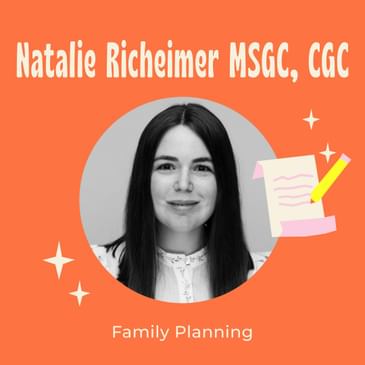

In this episode, I sit down with Natalie Richheimer, a genetic counselor at JScreen, to dig into the world of preconception and prenatal genetic testing. We explore the basics of carrier screening, how to interpret results, and the importance of genetic counseling for both new and experienced parents—especially those who already have a child with a rare disease. Natalie also sheds light on Variants of Uncertain Significance (VUS) and offers insight into talking with family members about genetic risks and results.
Throughout our chat, Natalie emphasizes that knowledge truly is power when it comes to family planning and navigating the complexities of genetic information. We discuss strategies for deciding between natural pregnancy, IVF with genetic screening, and other alternatives, helping you feel more confident and informed about your options.
Whether you’re just beginning your journey or seeking clarity in the midst of it, this episode offers valuable perspectives and heartfelt advice. Join us as we learn how to take charge of our genetic health and family-planning decisions with compassion and confidence.
Finally, don’t forget about the Once Upon a Gene Revival—an uplifting event designed to support, educate, and connect rare disease caregivers. Registration is open now on my website.
Links:
[00:00:03] I'm Effie Parks. Welcome to Once Upon A Gene, the podcast. This is a place I created for us to connect and share the stories of our not-so-typical lives. Raising kids who are born with rare genetic syndromes and other types of disabilities can feel pretty isolating. What I know for sure is that when we can hear the triumphs and challenges from others who get it, we can find a lot more laughter, a lot more hope, and feel a lot less alone.
[00:00:31] I believe there are some magical healing powers that can happen for all of us through sharing our stories, and I'll take all the help I can get. Once Upon A Gene is proud to be part of Bloodstream Media. Living in a family affected by rare and chronic illness can be isolating, and sometimes the best medicine is connecting to the voices of people who share your experience.
[00:00:56] This is why Bloodstream Media produces podcasts, blogs, and other forms of content for patients, families, and clinicians impacted by rare and chronic diseases. Visit BloodstreamMedia.com to learn more. Hello, and welcome to the show. This is Once Upon A Gene, and I'm your host Effie Parks. Thank you so much for being here. I love getting to hang out with you. I don't know where you are right now. You could be on a walk, or in your shower, or in your car, or in the waiting room. I don't care.
[00:01:25] I'm grateful you're here, and we're going to have fun. If you do not know yet about the Once Upon A Gene Wellness Revival, where have you been? And welcome, because we're going to have so much fun.
[00:01:38] On January 25th at 12 p.m. Eastern Standard Time, we are having a revival, ladies and gentlemen. It's three hours. It's a three-hour agenda. There's a dress code, okay? We're going to be moving our bodies. We're going to be lifting some weights. We're going to be taking a walk. We're going to be in our kitchen.
[00:01:56] Put on some yoga pants. Put on some comfy clothes, whatever you have. Have your tennies handy. Have some headphones. That'd be great, too. We're going to have so much fun. It's an out-of-the-box idea. I want to do it in person soon. We're doing this virtually first, and it's going to be awesome. There's a chat room. You're going to hang out with your friends. We're going to be giving away prizes. I can't wait to see you there. Head to effieparks.com slash events. Get registered.
[00:02:22] There's already people in the chat room talking now, and it's very sweet, and it warms my heart. So I hope to see thousands of you there. We're going to have the best time. So lock the door. Have someone else take care of your children and do what you got to do because this is going to be epic. So today's episode, I'm excited for you to meet my new guest. We're talking about a very important topic, family planning and genetic testing, right?
[00:02:46] Preconception and prenatal genetic testing. We even take a few turns and talk about VUSs and De Novo and Mosaic. So we're just kind of getting a big run through on some of this stuff from our friend. And you know we all love a genetic counselor. Anyways, we're going to be talking about carrier screening and touching on all of those things, including the emotional side of genetic testing and IVF.
[00:03:11] So much stuff chalked up into this episode, so I hope you learned something, and I hope it makes you think. Please enjoy my conversation with Natalie Richheimer. Hello, Natalie. Welcome to the podcast. Hi. Thank you so much for having me, Abby. Always love having a genetic counselor, and so do all of my listeners. Why don't you introduce yourself and tell us a little bit about you, Natalie?
[00:03:36] So my name is Natalie. I am a genetic counselor originally from Toronto, Canada, but moved out to sunny Los Angeles, California, going on over 10 years, which is kind of crazy. My specialty before I moved into the nonprofit space was reproductive genetic counseling, so really working with people who were pregnant or trying to get pregnant, whether that was a first or a future pregnancy or even a donor pregnancy. And right now I'm working with people who were pregnant or not, and I'm working with people who were pregnant or not.
[00:04:05] And right now I'm working at an amazing nonprofit called J-Screen, which provides accessible and affordable genetic testing really to anyone throughout the United States of America. Awesome. Well, today we're going to talk about preconception genetic testing. Is that what it's called? It can be preconception or prenatal. Both are good. Okay. Twofold, right?
[00:04:27] So we're going to be talking to the families who want to get that testing before they have any children and what that means and who want to get testing for their next child that they might have after they've had a child who was affected by a rare genetic diagnosis. So let's dig into that. And we'll maybe start with parents who are planning for their first child, who maybe know that there's something running in their family.
[00:04:55] Maybe they don't and they get this genetic testing offered. Maybe it turns out to not be super comprehensive like we think stuff is before we have like the world blow up in our faces. So can you kind of just start there for me, Natalie, and just tell us how this sort of genetic testing works, how carrier screening works, and what the process looks like? Absolutely. Absolutely. And so I would say like to start off with, everybody's journey looks different.
[00:05:22] And we all throughout this country have very different healthcare systems. And so what I'm going to talk about may not be something that you have locally, but it's something you can definitely look into and advocate for. So I would say typically, let's say, let's go with a scenario where the couple themselves or the person and whoever they're having a child with are themselves unaffected, meaning they don't have a particular disorder. But there's a family history of something.
[00:05:50] A really, really great thing to be doing is to review that family history with a provider, preferably a genetic counselor, but whoever is managing your care is really good. Because certain conditions will lead us to different types of testing. So there's standard run-of-the-mill testing we offer everyone. So, for example, we offer everyone carrier screening.
[00:06:15] That's going to look for conditions where some of them are recessive, meaning the parents themselves may be carriers and unaffected. Should they carry, you know, as their two genes and non-working copy? And they may just not know that they're carriers because it's never come up before. And some of them are X-linked related to the X chromosome. Those are kind of standard run-of-the-mills.
[00:06:37] We'll also check like hemoglobin levels because that can be related to some conditions called hemoglobinopathies, which are, you know, things to do with, I like to think of them as inherited kinds of like blood conditions. And those are standard run-of-the-mill before someone is pregnant. But if there's a very specific family history or something, so people have come to me and said, well, you know, my great uncle had this really rare genetic condition.
[00:07:06] Do you think I should be tested for it? That's not on the standard panel. We may run extra testing for you so that you can learn about the chances or the risk of you having a child with that disorder. So that's kind of the preconception route. And so if there's something really specific coming on, really important to bring it up to your provider. And don't assume that your provider will bring it up with you. I always say like the people that are working in the healthcare industry are often really short on time.
[00:07:34] And so something that may be really significant, they just may not remember to ask you. And they may just not know to ask you. So it's really important to advocate for yourself and bring up that information. And if the provider isn't sure, you know, saying like, can I talk to a genetic specialist about that is going to be really key. If you can think of it off the top of your head, like I wonder for the families who aren't in this world yet, but maybe they think, you know, there's a carrier issue or there's a condition running in their family.
[00:08:04] And they maybe know a little bit. What are maybe two top sort of advocacy, self-advocacy questions that you should go into your provider with to ensure that you're going to get either the testing or the referral that you need? Just so you're better armed when you're going in the clinic. I would say to really, and I hate the word demand, but sometimes we have to, to demand to see a genetics professional. Like I'll give an example.
[00:08:30] You know, I saw a patient once, their family was from Latin America. And the partner had described, again, they were there for different reasons. But the partner had described like a really serious kind of sounding muscular dystrophy. And again, they didn't have testing or whatever, but that's really important for us to learn about. And the provider hadn't mentioned it at all. We just went through family history. So I would say I am, and I would like say it like this. I'm concerned about particular family history.
[00:08:59] I'd love to speak to a genetics professional, like a genetic counselor, so that I can learn about our individualized risk for this pregnancy. Saying it like that makes it really clear. If there are no genetics professionals in your area, that happens sometimes in rural areas.
[00:09:16] I would definitely advocate about potentially speaking to an MSM, which is a maternal fetal medicine specialist, even before a pregnancy, because they have a lot of great connections with genetic counselors and genetic specialists. So I would say that as well. So either of those things, you know, saying like, I would like to meet with a genetic counselor. Can I be referred to an MSM for further evaluation? Because I have these concerns. I want to talk about that with them. And it would say really, really important.
[00:09:45] Thank you. I love those good takeaways. So I hear a lot of stories from families from every part of this journey that you can imagine. And unfortunately, I've heard several stories from parents who are still just deeply, deeply broken and really confused about their genetic testing that they had prenatally. They thought they were being proactive. They thought they were doing all the things. And I think there's really some misconceptions about the genetic testing that's happening before.
[00:10:14] I don't know if it's the difference between preconception or prenatal. So maybe you can go over those two things for me, too. But they thought that everything was fine. They thought that they had the testing. And then lo and behold, their child comes out with a rare genetic disease. And they feel gutted. And they feel lied to. So what exactly are most people getting when they get this test? And what do they still need to make sure that they follow up with if they really want to dig as deep as possible? Yeah, absolutely.
[00:10:42] And I think it's really, really important to understand that genetic testing isn't perfect. And I think providers sometimes will do a disservice saying, like, you know, you did your NIPT that screens for chromosome aneuploidies, like, you know, trisomy 21, trisomy 18, trisomy 13. Your carrier screening was negative. We're guaranteeing you a child with no health issues. Nobody on this earth can guarantee a parent a child with no health issues. We just can't. We don't have that type of crystal ball.
[00:11:11] And I think when we talk about it like that, it's like, oh, okay. Okay, this makes more sense. So to any parent who is feeling that guilt, I'm a parent myself, we are sometimes really, really unkind to ourselves, even though we're so kind to everyone else. You can do everything right and still not have advanced warning for a rare genetic condition. Some things are just out of our control.
[00:11:35] What I would say is making sure you're doing the standard testing is great, but understanding that the standard testing in a pregnancy or before a pregnancy is just that it's standard. So it's there to pick up more common genetic conditions that we know about. So I give an example like cystic fibrosis. That's something that's very common in people who have white ancestry. You know, something like a rare disease, they're not typically doing that at this stage in genetic testing. It's not saying that we won't later.
[00:12:04] I think we will move to a place where every child is screened much more comprehensively. But I think that's really, really important to understand that in a standard pregnancy that's low risk, if all of your screening tests, not diagnostic, but screening tests come back negative and your ultrasounds look good, the doctors are going to typically say everything looks great. There's no need for further testing. What I think is huge about what you're doing.
[00:12:30] What I think is huge about what you're doing is giving parents tools after a baby is born to be great advocates and look for things that may feel like they're not on track and bring that up to a pediatrician. And I would say, or whoever is the child's care provider, that's going to be the most important as a parent to really knowing what is developmentally expected and picking up those subtle signs of the maybe something is a little different.
[00:13:00] And the reality is not all of our providers are really versed in genetic disorders and may not pick them up. And you as parent are going to need to advocate. The other thing I will say to any parent who's listening, unfortunately, sometimes seeing genetic doctors is really, really gatecapped. Being a geneticist is a gatecapped thing. Some providers will really steer away from that. And I don't fully understand why.
[00:13:28] I think it's nervous that, you know, it's a long wait period, et cetera. But like I've seen so many patients myself who as parents been on such a diagnostic odysseys going from specialist to specialist and really not finding an answer to what's going on with their child and ends up in genetics after years. If you feel like there's something not right here, ask to be referred to genetics. So the wait is six months. You'll wait six months.
[00:13:56] But understanding that not everyone will get referred and understanding that you may need to advocate is really, really important. Yeah, let's actually dig into this a little and see if you have any hot tips. Because I know that technically you don't have to be referred to genetics to have someone order a genetic test, right? Even your pediatrician could technically order that test. Or could you perhaps get referred to a beautiful genetic counselor sooner?
[00:14:25] Like I know the genetics waiting list here in Seattle right now. I just saw someone post. They said they can't get an appointment for 18 months, which is unacceptable. So what are maybe some sneaky cowboy ways of getting through the bureaucracy to have someone order you the test? I would say the ordering of the test isn't the problem. And I stand by this with all the time. The ordering of testing, anyone can order a test. Your OB can order your test. Your pediatrician, your endocrinologist.
[00:14:55] What's the real value of seeing a geneticist, like an MD genetics doctor, and a genetic counselor is the interpretation of those results. So what I would say is if you have a pediatrician that's super confident about the genetic testing they're ordering, you may be able to do that. And like I said, get put on that 18-month wait list, get some answers. But I do think it's really important to make sure a genetics professional is reviewing those test results.
[00:15:22] So maybe making sure that you made up an appointment with a genetic counselor in addition to that to review those results, feeling like you're empowered and what those mean. And if there were gaps, maybe ordering other testing. The second thing that I would say is, and this is where I am a little bit of a purist, and I would say yes, and. Like, yes, try and get that help sooner. But I would say a physical evaluation, especially in pediatrics for genetics, is really important.
[00:15:50] Because in the world of genetics, we're looking for needles and haystacks. We're looking for our zebras. Having the right set of glasses can help direct us which haystack to look at. And sometimes the physical exam is super duper informative. Like, we're seeing certain things that the symptoms on paper are just not elaborating, and their eyes are trained to look for those things.
[00:16:16] So I would definitely recommend, even if testing happens first, to make sure that that genetics evaluation is good. And maybe that happens later. But there is importance to that for sure. Yeah, totally. So obviously we have a spectrum of parents and siblings who are listening to this show. Some are told they're carriers, and some are told that it was a de novo mutation.
[00:16:40] So can you kind of just go into what those both mean, and then also maybe talk about next steps for both of them when they decide, if they decide, to have children? Absolutely. So just reminding what a carrier versus a de novo mutation is, and those are really, really important terms to differentiate. When we talk about being a carrier, it means we're talking typically about a condition where there's two copies of the gene.
[00:17:07] We typically get one from our egg source and one from our sperm source, and that one of those gene pairs is not working because there's a genetic change or a mutation that's causing it not to work. And so typically, with a lot of genes, having one working copy is enough or sufficient enough for the body to have what it needs to function. There are exceptions to that, but typically that's what happens.
[00:17:33] And so we call them a carrier because they appear to be unaffected, and when they have a child with someone else who's a carrier for the same condition, there's a 25% chance each parent will pass on the non-working copy of the gene. Baby gets no working copies, and baby has a disorder. So those, when we talk about carriers, we're usually talking about what we call inherited disorders.
[00:17:58] Even though the parents appear to be healthy, they've gotten those non-working copies from their parents. De novo is really what we call a new mutation or a new genetic change that we've never seen before. So meaning we search both of the parents, they don't have this genetic change, and it seems like it's a new thing in the child. That means that this change happens potentially after sperm and egg met.
[00:18:26] There was a change when baby's DNA was being copied over and formed, and that's where this comes from for the child. However, we always have a little asterisk next to de novo. De novo could be a situation, like we said, where it really is a truly new change in the child. But there's something called germline mosaicism. Have you ever heard of that? Yes, yes. And that's my huge asterisk. It's less than 1%.
[00:18:54] It's not common, but it happens where our bodies are made up of thousands, of millions, trillions of cells. And some of those are germline cells or egg in our sperm cells. And sometimes, like a mosaic, like a beautiful mosaic tile, we can have different pieces that look a little different. And so while majority of our body could have working copies of a gene, it may be that in the sperm or the egg, there's actually a non-working copy of that gene.
[00:19:22] And so it is being inherited from parent to child. We just don't know about it because we can't see it in the other cells. But we can suspect that when we have people who are parents that have multiple children with a genetic disorder that is, quote unquote, de novo, it's clearly not a de novo situation. So what I do think is important, bringing it back to the prenatal, even if you've been told, hey, my kiddo has a de novo mutation.
[00:19:50] If you are interested in a future pregnancy and you are interested in learning about your risk, I would highly recommend either doing IVF with PGT-M to test the embryo prior to conception. Or I would recommend doing a diagnostic test like an amnio or CVS where we look for the genetic change in that new baby or the new pregnancy. Because like I said, it's rare, but it does happen.
[00:20:19] And we are talking about the world of rare. Yeah. Mm-hmm. Yeah. Mosaicism, I learned pretty quickly because Ford tested positive for the BRCA1 gene and my husband and I don't. And like top tier Claire King Labs called and they're like, that's almost literally impossible. There's no way one of you don't have BRCA1.
[00:20:41] And it's got to be like, yeah, I think that's when they brought up mosaic and they were like, we have to test other parts of like your body or your skin or I don't even know what it was to see which one of you has it because it would be like lightning if just Ford has it and neither of you have it. Is that when I heard about mosaicism? That could definitely be and that does happen. So like I said, like our tests aren't perfect. And the reality is probably a lot of us are mosaic for things that we just don't know about. But yeah, it would be really, really rare.
[00:21:11] And we never say never in genetics. We say like very unlikely that you guys weren't a mosaic and that he had a brand new de novo BRCA1 or 2 mutation. That's really rare. But yep, absolutely. It's a great example. Okay. Well, I'll deal with that later. Let's talk about IVF since you just brought it up. One, I know that most insurance companies are covering that now. So it's not like this thing where you're going to have to save up for like a down payment on a house necessarily anymore.
[00:21:39] But can you talk about maybe the ethical and the emotional considerations that parents should think about when they're deciding to use some sort of technology to assist? Yeah. And I will say like I start off by saying like I'm an IVF mom myself for different reasons. You know, I went through infertility. So I've been through IVF and it is a really, really hard process.
[00:22:04] And to any parents out there who are hearing from like friends or family, well, you could just do IVF for your next baby. It's not a just IVF. Like money aside, it's really, really a tremendous undertaking. And I'm sending a lot of love. The process of IVF, we'll just go through it for those who are not really aware of it. It's a process where, again, if you're using your own eggs for sperm, I'm going to use that scenario. But obviously, you can use a donor as well.
[00:22:31] If you were using your own eggs, you would go through a process where you would meet with a reproductive endocrinologist, fertility doctor, who would stimulate ovaries to produce not just one egg per cycle, but many eggs per cycle. Those would be retrieved with a surgical egg retrieval. And then the sperm would be put together with those eggs in the lab. We would create, instead of one embryo, we'd create multiple embryos. We'd grow them to a certain stage.
[00:22:58] And then we would pluck out some of the cells and test them to see if they carried a particular, in this case, a particular genetic change that we were trying to screen for. And then assess whether we would put the embryos back in the uterus to result hopefully in a pregnancy or not. There's a couple things I think are really important, especially in the rare community. Not every lab will test for every genetic change.
[00:23:25] So before anyone starts that process, it's so important when you're meeting with the IVF specialist, if that's the path you want to go down, to say this is the genetic change we're interested in learning about in our embryos. Can you reach out to the lab and make sure that they will test for this? Off the bat, if the lab they work with doesn't, then this isn't the right place for you. Or maybe there's a different lab that they can use. That's the first thing I would say.
[00:23:51] I would say, ethically, I have friends who has a child with a genetic disorder. And this is the love of her life. This is her babes. She loves her. But it's hard. It's hard being a parent with a child who has really particular needs that are maybe different than other kids her age. And she is grappling with IVF because if she had done IVF and she had known about this condition her and her partner carried, maybe they wouldn't have had her daughter.
[00:24:20] And I will say that ethically, I hear that and I empathize with that. Every couple, every person needs to do what they want and what they feel comfortable with. The flip to that is, you know, as parents, if you have a child with a particular condition, knowing your bandwidth,
[00:24:40] like knowing I really want more kids and I don't know if I can manage having a child who has significant needs while I'm taking care of another child who has pretty significant needs. And I'm sure you kind of grappled with this as well, but it's a really hard question to be thinking about. And I would say make that decision with a support system. Make sure you feel comfortable. Yeah. Yeah. Yeah. I mean, that could be an entire podcast series, really.
[00:25:09] It's so complicado, right? Because after you have a child like mine, you realize so many beautiful things, right? And you still have joy and you have this ridiculously awesome person in your life that teaches you so much. And then again, it's super hard. And would you have chose this? But then you would also never necessarily like trade it because of all of the light that is there, right?
[00:25:32] So it goes both ways too in thinking like, well, I guess I wouldn't have had Ford if I could have had the choice and I would have known ahead of time. Because now if I was given that choice, I'm not sure I would not make it because he's amazing. So I think it's always going to be this weird tug and pull and there's no right answer. And like you said, it's deeply personal and to really have a lot of conversations and deep thoughts around it. Yeah.
[00:26:00] And like the flip to that, you know, when we're internet accounts, we talk about like, I want you to play out both scenarios. So you choose not to do IVF. You choose to get pregnant on your own. Are you comfortable with the chances of having another child like your first child? And do you think you have the bandwidth to like manage that in the support system? And it's so, like you said, it's so deeply personal. I was funny.
[00:26:22] This reminds me of a conversation I had actually with a friend of mine who carries this particular cancer genetic change that she found out later because her mom had had, you know, colon cancer. Her mom passed away and she was like, you know, it's crazy. If my mom was born now and we knew now she would have done IVF and like, I wouldn't be here. So like, I don't know how I feel about that.
[00:26:45] And I was like, so she's like, it's a crazy thought because, you know, her children, this woman's children, my friend, they're adult kiddos in their thirties and forties. And her brother is, you know, in a relationship thinking about having kids and is like, I'm totally going to do IVF. And she was like, you realize we wouldn't exist if mom did IVF. So it's, it's a really, really great technology.
[00:27:12] But with every amazing technology comes so many personal ethical questions that I don't think we have answers to. Yeah. And I don't think we necessarily need them. I think even just having the conversations and being honest and really thinking through it for our own families is, is all we can really do to come to the end point. How can someone prepare for that conversation that you were just talking about?
[00:27:37] Like with their relatives, if they know they're a carrier for something, like how do you tell your family that this thing might be in their family too? And that your niece and nephew might be born with something. Like how do you bring this information to your family? And in your experience, I don't know if you ever get the peripheral, but like, do the families hear it? Do they go and get checked? Do they think, oh, that's not going to be me? How does that typically work? Oh my gosh. It's so, family is complicated.
[00:28:06] We just did Thanksgiving, Effie. Family is complicated. That's what I always start off with. And no two families are the same. And I always like to use my, my own family as an example. Cause you know, I have a, I'm one of five and every person feels really differently about genetic information. Like I always joke, like I've updated my carrier screening because the panels get bigger. So I'm like, some people get new iPhones. I update my carrier screening. That's who I am. Genetic counselor through and through.
[00:28:33] But a tip I always give families is before they do any genetic testing, whether it's a carrier screening, they're doing a whole genome, whole exome with their kiddo. Is having the conversation preemptively with family members, like siblings or parents and saying, hey mom, hey dad, hey brother, hey sister, I'm about to do this genetic testing. The information that I find out could impact you. Do you feel like this is information you want or do you not want me to share this with you?
[00:29:00] And this really could impact your healthcare and your management. So for example, like people will do cancer genetic testing, right? If we found, you brought up BRCA, right? If we found out that me, I was a BRCA carrier. My siblings would be at 50% chance if they're full siblings of also being a carrier. You know, I would say to them like this could impact your care and management for preventing cancer. If I was positive, you want to know.
[00:29:25] And I think having that honest conversation before it's the hot seat, before you have the information, it's hypothetical. Everyone's calm, hopefully. And like with my own siblings, it was really 50-50. Like some of them were like, please do not tell me. I don't want to know. This will make me anxious. And some of them were like, please do tell me. I think I had one who was like, I want to know if it would impact my health, but I don't really care otherwise. Like I'm not having kids, so like if it would impact my health, sure.
[00:29:55] But like if it's related to like reproductive, I don't really care. So I think really having that honest conversation is important. Is it always as beautiful and, you know, together after the fact? No. People think they want and what happens afterwards can be different, myself included. But I do think it's so important to give people the choice and the option, right? Just because genetic testing was right for you and your family doesn't mean it was for your siblings and your parents.
[00:30:23] I'm really, really about informed consent with that. Thank you. That was such a good answer. I love that idea of having the conversation before so you can sort of even laugh about it or whatever. And really kind of just get the air of the room. It's such a good idea. So you mentioned you update your carrier screening. Can you tell me what that means? Because I know like when families don't get an answer from their WEST test, I'm always like, get it reanalyzed next year. Oh my gosh, yes. What does that mean, the carrier screening being updated? First of all, yes, families.
[00:30:53] Just because your whole exome or your whole genome didn't come back, wait and get it reanalyzed is usually one free. So that's like pro tip for sure for any of my rare families out there. And we're learning more and we do find stuff out. Back to carrier screening. Carrier screening panels are getting bigger and bigger. It's just like we're screening for more. We're learning for more like about genetics. And so, for example, I did my carrier screening, I would say, in my early 20s.
[00:31:18] The panel went from like that I did initially for like under 100 to like hundreds. And then I updated it again because, again, for me, I wanted a really big solid panel, especially in terms of IBS, because it would change my management. If I found out I was a carrier for something, we might do PGT-M for embryos. That wasn't the case, but that was really important for me to go into that with that knowledge.
[00:31:46] I would say to anyone who's done carrier screening and is thinking of a future pregnancy, updating it every three to five years is really important. Even if your OBGYN is like, oh, but you did that already. You can say, okay, have they come out with a bigger panel? I'd like to screen for more things. If that is what your choice is. You know, some things are tests like whole axiom, whole genome. You know, reanalysis is important, but that test doesn't have to be necessarily updated every year.
[00:32:15] Like that wouldn't make sense. Your genetics or your genetics. But the carrier panels do get bigger. And then just very quickly, like something like an NIPT test that tests the pregnancy for high risk, low risk for tritomies like 21, 18, 13. They now do micro-insultation syndromes sometimes. That's each pregnancy would need its own because each baby has its own DNA, its own risk. Does that make sense? Yeah, totally. Should we bring up a bus? Oh, my favorite. Of course.
[00:32:45] Let's do it. Because even just in the last couple years, I've seen so many of my friends' buses turn into an actual diagnosis. Sometimes it's things that they helped push forward. Sometimes, obviously, just the, you know, knowledge getting put in the bank there. So talk to me about a bus and what a family should have in the back of their mind when their child gets that. The first and foremost thing is just, I'm going to go back for families who are like, what is, what are we talking about?
[00:33:13] And when we look at genetic changes or mutations, they're rated on a scale. Anything from benign or likely benign all the way up to pathogenic, which is what we call disease path-causing. And under that is likely pathogenic, which is probably going to cause disease, meaning it's probably causing the gene not to work. And then we get this kind of rating in the middle, which is called a variant of uncertain significance with the U.S. And it's something that parents don't love.
[00:33:42] It's something that, to be fair, your providers don't love either. Because it says, there's definitely a genetic change here. But based on the research and where we're at right now, we're not sure that it's causing the gene not to work. And more generally, is it causing what we're seeing in your child or in you? We're not sure. So it's a wait and see.
[00:34:04] Some of the U.S.'s are, and I learned this in my training, like one of my colleagues says, I love it, like are trending hot. Meaning like, we know that we're pretty close to operating in this dynamic system to like likely pathogenic based on what we're seeing. Some are trending down, like the opposite. Like we know that based on our evidence, it's trending cold. Like it's trending that's probably benign.
[00:34:29] It is so, so, so important to understand that the rating systems for mutations or turn out of changes is really, really dynamic. It changes monthly, yearly. And so the way that that changes is really seeing kids in clinics, like seeing more patients with it, research, et cetera. And that can help us learn of like, oh, we've seen a lot of ineffective people with this particular change. It's probably benign.
[00:34:55] Versus we're seeing a lot of kiddos or a lot of grownups with, you know, conditions that say this is probably pathogenic. And so it's, it's a real wait and see, but you as a parent should be checking in on the yearly, if there's nothing else that has been found and saying like, hey, just checking in. Has anything changed with us? Your genetics professional will know and will let you know if it's changed.
[00:35:22] But, you know, people will dismiss that as being like, oh, it doesn't mean anything. And that's not quite true either. It is a really wait and see. And to know as a parent that it's a wait and see. The other thing I will say is just the way our data works in this country. A lot of people who've had like historically access to genetic testing were people who were white, who were not people of color.
[00:35:45] So when we see, you know, more diverse populations getting tested, we don't have as much data. And therefore, you're more likely to get into that uncertain category. And that's an important thing to think about with your provider. If you're somebody who is from a diverse background, you're a person of color. Like that U.S. should be thought of in that, in that context. And to bring that up to your provider.
[00:36:11] There's a kind of interesting thing, though, where we have certain variants of unknown certain significance. It's very specific scenarios where it hasn't been upgraded yet, but we're pretty sure that that's going to be the answer. And so like the doctors may be treating based on that. It doesn't happen often, but it does happen. So that's why I say your genetics test results need to be analyzed by somebody who is a genetics provider.
[00:36:39] Because that can really be the difference of, hey, this is actually something we should watch about. Versus, yeah, I mean, it definitely is a very different certain significance, but it doesn't relate to your child's particular condition. So we definitely can watch it, but it's not something that would impact management or care. So basically a bus is like Bitcoin. Oh my gosh. All I heard was Bitcoin. I've never heard that analogy.
[00:37:07] I don't know if I'll take it. But I love it. It's like, to me, a VUS is a wait and see. It's not a no. And I think that's so important for parents to know that. It's a wait and see. Which is the worst thing to hear when you're a parent who's gone into that stage. We all have emails that have schedule signed up at this point. Schedule send an email from a year from the day to the result and say, hey, man, how do we have any more data on this? I think that's really, really important to do.
[00:37:37] And oftentimes, like you said, we do learn new things. Like it's not a, like we will have more information a year later, typically. Not always, but typically. Yeah. Well, thank you for being so thorough on that. I know of us who drive everyone crazy for a million different reasons. And it's very confusing. Amazing. So really, the more info, the better. So thank you for that. Of course.
[00:37:56] Natalie, what is one piece of advice that you would give to parents who are feeling super overwhelmed about the idea of genetic testing slash more genetic testing? I will give you the advice that I think is the most important, which is love yourself. Like if you are feeling overwhelmed, it doesn't need to be now. Like it doesn't. You have to do what works for you. Make sure you're taking care of yourself. And make sure you're getting the good information that you need.
[00:38:26] Like what you choose to do with that information is important for you, but it doesn't have to be now. It can be later, depending on the situation. Make sure you're getting really good information. And make sure you're getting your questions answered. Like if somebody brings up a term that you've just like never heard before, because like I swear sometimes genetics professionals, we talk in tongues. Like, you know, this, that, that. And you're like, what? I have no idea what the doctor said or the counselor.
[00:38:55] Make sure that you are coming out and understanding. And know that any provider wants your questions answered, like you are not bothering anyone. Make sure you're getting those questions answered so you can make those decisions and take your time. Feel better as a parent, knowing like I thought about it. It was for me. It wasn't for me. As opposed to rushing into something, especially when you're dealing with so many other things going on. That is such a good reminder for so many things. I agree. Thank you.
[00:39:25] What is one way that we don't know, that we don't necessarily know of like how we can utilize the powers of a genetic counselor? Like what are some of the secret tricks or tips or offerings that genetic counselors have that maybe parents don't necessarily know about? Oh my gosh. We are your advocates of we are your kiddos advocates. So that is what I'm going to say. Like we are really, really good at communicating with providers what needs to get done. And providers, usually they love us.
[00:39:54] They appreciate that. And we're usually really good at working with patients. And I would say that is the strength of having a counselor on your team is that we're going to be a really good personal liaison for you and for your kiddo or your family, depending on that situation, making sure you're getting your good care. And so I have situations where doctors are super busy. They don't have the time. Their appointments are 15 minutes. Your appointment with the counselor is at like the shortest, 45 minutes typically. So we're going to be there for you.
[00:40:23] We're also really, really good at connecting patients with support, especially in our kids' world. You know, if you're in the world of rare, it can feel so scary and so lonely. And after your podcast is an amazing place for people to meet and really hear from stories of other parents. But we as genetic counselors are really good at making connections for families as well, which is something that in a medical setting, unfortunately gets overlooked.
[00:40:51] You know, the support that we need that comes with a genetic condition. I think that is kind of a secret to us and making sure that we're giving you everything that you need is going to be important as well. Love that. Well, hey, leave any resources or next steps and let people know how they can find you, follow you, get in touch with you. I will. I will definitely leave that. My name is Natalie.
[00:41:14] Like I said, I work at an amazing company for JScreen, which offers testing that's really affordable, takes insurance for carrier screening, cancer genetic testing. You don't need to wait for a doctor to do it. You can order it from your house. So that's a really, really great resource. And if you want to get in contact with me, please feel free to reach out to Effie and she can go ahead and send over my email so that we can definitely connect. And just thank you so much for having me on the podcast. Awesome.
[00:41:44] My pleasure. Natalie, thanks for being my guest. And thanks to all of the genetic counselors for, again, being a warm hug to families like mine, especially in the diagnosis room. So thank you for what you do. And thanks for being here. Of course. Thank you so much. I hope you've been enjoying this podcast. If you like what you hear, please share this show with your people and please make sure to rate and review it on iTunes or wherever you get your podcasts.
[00:42:09] You can also head over to Instagram, Facebook and Twitter to connect with me and stay updated on the show. If you're interested in sharing your story or if you have anything you would like to contribute, please submit it to my website at effieparks.com. Thank you so much for listening to the show and for supporting me along the way. I appreciate you all so much. I don't know what kind of day you're having, but if you need a little pick me up, Ford's got you.