
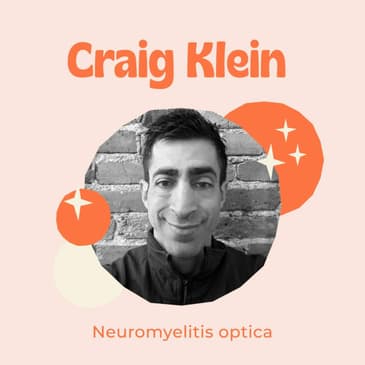

ONCE UPON A GENE - EPISODE 235
Rare Connections in NMOSD (Neuromyelitis Optics) - Finding Strength in Community and the Power in Asking for Help with Craig Klein
My guest, Craig Klein, has been living with Neuromyelitis Optics Spectrum Disorder (NMOSD) for 8 years. He shares his challenges, strengths and about his journey of resilience.
EPISODE HIGHLIGHTS
What has your diagnostic journey been like?
The first few years were difficult. In 2015, I began a transition from working at a gym, running marathons and burning the candle at both ends. I developed sensitivity to food, I was fatigued and had an ongoing migraine. I went to an urgent care facility for what I thought was just a headache, but the doctor took a lot of time trying to uncover details about my health. After a routine exam, he referred me to a specialist, who referred me to a sub-specialist. Testing revealed that I had NMOSD, but despite the diagnosis, I received the good news that I would live a healthy, happy life.
How did you connect with others in the NMOSD community?
I was initially connected through a clinical researcher who informed me of an upcoming patient community day. I went to the patient community day and met other patients who really inspired me. I was fortunate to connect with this community such a short time after receiving my diagnosis.
Do you have any advice for someone who's newly diagnosed?
It takes time to feel like you understand everything and have a handle on it. It's helpful to be involved with advocacy groups as early on as possible to learn. Give yourself the grace and permission to cry, to suck, to experience negative emotions— not because they're bad, but because they're human emotions. It's up to you to choose what you're going to do everyday, to choose what you put out in the universe, how you treat yourself and how you treat others.
LINKS AND RESOURCES MENTIONED
https://www.amazon.com/Permission-Feel-Unlocking-Emotions-Ourselves/dp/1250212847
Emotional Agility: Get Unstuck, Embrace Change, and Thrive in Work and Life
https://www.amazon.com/Emotional-Agility-Unstuck-Embrace-Change/dp/1592409490/
Rare Connections in NMOSD, Alexion Pharmaceuticals, Inc.
https://www.youtube.com/watch?v=cfnE7cxfY3s
CONNECT WITH EFFIE PARKS
https://twitter.com/OnceUponAGene
https://www.instagram.com/onceuponagene.podcast/?hl=en
Built Ford Tough Facebook Group
https://www.facebook.com/groups/1877643259173346/
[00:00:03] I'm Effie Parks. Welcome to Once Upon a Gene, the podcast. This is a place I created for us to connect and share the stories of our not-so-typical lives. Raising kids who are born with rare genetic
[00:00:16] syndromes and other types of disabilities can feel pretty isolating. What I know for sure is that when we can hear the triumphs and challenges from others who get it, we can find a lot more laughter,
[00:00:28] a lot more hope, and feel a lot less alone. I believe there are some magical healing powers that can happen for all of us through sharing our stories, and I'll take all the help I can get.
[00:00:43] Once Upon a Gene is proud to be part of Bloodstream Media. Living in a family affected by rare and chronic illness can be isolating, and sometimes the best medicine is connecting to the voices of people who share your experience. This is why Bloodstream Media produces podcast,
[00:00:59] blogs, and other forms of content for patients, families, and clinicians impacted by rare and chronic diseases. Visit bloodstreammedia.com to learn more. Hey friends, welcome to the show. This is Once Upon a Gene, and I'm your host Effie Parks. It is hot. It is smoking hot in Seattle,
[00:01:15] and I hope you can't hear all of my fans that I have on in my house right now. If you missed last week's episode, please go back and listen to this when you have a moment. Episode 234 with my
[00:01:26] girlfriend Katie Lloyd. We've started a new series called Chasing the Glimmers, and we'd love to hear one of yours. So after you listen to the episode, please head to my website and go to contact. You
[00:01:35] can leave me a voicemail that will record, and maybe we'll play it on the show, or just go comment on the social media post that it follows and share some of your glimmers with us.
[00:01:44] I have a great guest for you today. He's been living with neuromyelitis optica spectrum disorder, NMOSD, for eight years now. And his story is really amazing. He shares a lot of his strengths
[00:01:57] and all of the challenges that he's faced along the way, and his journey to finding resilience. And we'll also touch a little bit on his relationship with the amazing company Alexion
[00:02:08] and how it has supported his advocacy work so far. So thank you so much for joining me. I hope you enjoy our conversations. Definitely share this episode with the dudes in your life. Please welcome Craig Klein. Hi, Craig. Welcome to the podcast.
[00:02:21] Hi, Effie. Thank you for having me. Yeah, it's my pleasure. My friends over at Alexion shared the video that you were just a part of, which was so beautiful, by the way. I will have the link in the show notes. And even though I'm
[00:02:34] not like the best to respond, sorry, Michaela, I do always do what my friends at Alexion ask me to if I can. So welcome to the show. I'm looking forward to getting to know you a little
[00:02:44] better and hear your story. I know you're kind of fresh on the advocacy scene, so I'm happy to be the first person to interview in this way. So Craig, can you just share a little bit about your
[00:02:53] initial diagnosis and what it is and perhaps what the first few years of your journey were like? Yeah, Effie, I love the question. And just to remark, I love the friendships that have developed in the advocacy space and companies like Alexion. I always think about just my
[00:03:10] five closest friends and that being a good reflection on what I'm capable of. And when I have people like Alexion in my corner and, hey, Effie, maybe you're one of my friends now,
[00:03:19] I'm inspired to just live up to that expectation. To your question, so the first few years, I think with any life-changing diagnosis can be quite the transition. I think with my kids, which I'm sure I could touch upon later on, transitions from bed to breakfast to school
[00:03:40] are difficult. And in 2015, my transition was going from working at a gym, running marathons, being extreme, burning the candle at both ends to, again, in 2015, just starting to get weird, weird sensitivities to food, to always just being fatigued and then ultimately starting a wicked,
[00:04:08] for the best explanation, a cluster headache or a migraine over my left eye. And I don't mean to generalize in describing men as not being the best at taking care of themselves. I think moms are
[00:04:22] actually worse at taking care of themselves. But as a guy, we're pretty close second place. And I refused to go see a doctor. And really, it was only at the urging of my girlfriend at the time
[00:04:38] that it was unacceptable, the amount of pain and how not unbearable, but just like how much I complained really was really what it came down to. I just became a bit of a curmudgeon and went to
[00:04:50] the local urgent care clinic that was right outside of Washington DC. And I probably should have geo-tagged where I was. So I was in downtown Silver Spring and the urgent care doctor was kind
[00:05:02] enough. And I'm blessed in this regard. And I think my first few encounters are just like a series of just miraculous blessings. And that first doctor at urgent care that is accustomed to people coming in with, I don't know, cuts and weird infections, right? They're just triaging on
[00:05:20] the fly. He was asking me questions, like how like just asking me questions, asking about like not just why I think I'm there because I thought I just had a migraine or a headache. It's like,
[00:05:30] when did it start? Describe it to me. Like is it sharp? And spent time asking me questions. And what I remember most vividly is one of those questions and just not being in a hurry to see
[00:05:42] the next person. But then, and this is roughly the February timeframe of 2015. And then he took out a retinoscope. So those are those little, there's like a flashlight, like a vertical flashlight that
[00:05:54] has like a little edge, you know, look into your ear with the light. And he had me kind of fixate on that light and he's like, follow it. So he'd bring it up to the top left corner, top right,
[00:06:05] bottom left, bottom right. And each time I moved my eye, it was, my left eye was in just absolutely excruciating pain. Anytime I had to move my eye to fixate, to follow that light, he didn't need
[00:06:17] to do it more than once or twice to say, Craig, you're not at the right place. And I'm sorry to say you don't have a migraine. That was the best thing. I mean, in addition to the doctor getting
[00:06:29] to know me, it was the most, I'm incredibly thankful that the doctor didn't just give me what I wanted, which was a tryptin to help alleviate a migraine that I had never experienced before up until that point. And he immediately referred me to a specialist, an ophthalmologist,
[00:06:45] an eye surgeon, an eye doctor also in Silver Spring. And they were able to get me in, I mean, quite literally the next day. And that ophthalmologist didn't need more than 30 seconds
[00:06:59] when he got that first picture back in the back of my eye to realize something more serious is going on. At that point, when I saw that ophthalmologist about the day after I went to urgent care,
[00:07:12] my sight and the best way to describe it went from, I don't know, just being very light sensitive and in a lot of pain to just flashing in and out as if I were like looking at the sun and
[00:07:25] just trying to concentrate. So very much like whitewashing. But mostly I'd have vision. But between the picture of the back of my eye and just like my description of visual disturbance, that ophthalmologist was like, and I'm glad he didn't tell me what he thought.
[00:07:42] But he said, he's like, you need not just to see an eye specialist, you need to see a neuro eye specialist. And funny thing happens when you're living in the DC metro, and this is another
[00:07:55] blessing. There are a lot of opportunities they get in front of one of these subspecialties. In this case, it was a neuro ophthalmologist in Bethesda, Maryland. So just outside of Silver
[00:08:06] Spring. And I was blessed to be able to get in to see that doctor rather quickly about a week later. The problem with subspecialists is you never want to graduate to a subspecialist.
[00:08:19] It's just one of those designations and you see a PhD next to their name, you're like, oh no, I am something that people have done a case study on or there's something that's not
[00:08:29] as simple as like a quick triage at the urgent, like I failed urgent care, I failed ophthalmology. And they're like, we're not going to treat you until you see this subspecialist. Not because they're trying to do the most thorough job, because they are concerned that something more
[00:08:46] awry is brewing. And they easily could have just thrown steroids at me, they easily could have just given me a tryptin. They listened, they had the bandwidth and I went to see a neuro
[00:08:59] ophthalmologist. Once I got referred to that neuro ophthalmologist, that's when the fear and of just the unknown. I had a problem. Initially, I thought it was a migraine. It became more apparent that
[00:09:13] it was a visual, that it was vision loss, still with pain. And I'm like, I just want a solution. I don't care about what the name is, just like give me some relief. And when I went to
[00:09:26] the neuro ophthalmologist, I wanted an answer and I was hoping for an intervention. The doctor, big workup, tell me about yourself, family history, history of autoimmune conditions, cancer. And my family kind of checks a lot of those boxes. A lot of autoimmune conditions, including multiple
[00:09:45] sclerosis. And a funny thing happens when you say multiple sclerosis, it is people's antennas pop up and they say, hmm, mom's side or dad's side? You say mom's side, they lean in even more. And you're
[00:10:00] like, interesting. And he gave me what he thought was the diagnosis of multiple sclerosis. And he's like, this is the most likely reason for your eye pain called optic neuritis. And based off your
[00:10:15] family history, even though it's not a genetic disorder, this would make the most sense from your mom's side with like a family history of other autoimmune conditions, but particularly multiple sclerosis. He's like, however, he's like, I'd be remiss. And this is another blessing. He's
[00:10:31] like, I would be remiss if I didn't rule out potential red herrings, including, but not limited to syphilis, Lyme disease. Maybe I stroked out my eye from like lifting heavy weights and a barrage of other antibody tests, including what will ultimately be my diagnosis of neuromyelitis
[00:10:53] optica or NMO. And I left that office thinking, I'm like, I have a diagnosis of MS. Aren't I lucky? I mean, unlucky, but lucky. Like I know what I'm facing, even though that's quite daunting.
[00:11:08] I know there's a name to it and there's a lot of confidence behind what the next steps are. However, my doctor didn't want to start me on therapy until he got these blood results back.
[00:11:20] And because of like the dysregulation in my body, everything was a myth, like Lyme disease. So I mean, like anything that they were testing for was just like all sorts of on the outskirts
[00:11:33] of like what a normal, what a normal range should be. But he's like, it's like, Craig, you have NMO. He's like, disregard all these other abnormal findings. When you have that NMO antibody, that Trump, like that is your Trump card. And that is with unequivocally
[00:11:51] your primary diagnosis. He's like, there might be secondary diagnoses attached to an autoimmune condition, which is quite common to have comorbidities. But you, that is like our, that is our bullseye in terms of what we're going to focus on. And I was like, okay,
[00:12:07] is that, what the hell's NMO? And that's when it got serious. It's really hard when you hear something new for the first time. And the first thing you hear about something new is a really poor outcome in terms of probability and very little experience. My girlfriend at the
[00:12:25] time gutted, she's with me and is just gutted about what my future could look like with this diagnosis. And then not a matter of if it will get worse, but a function of how severe will the next attack
[00:12:40] be? I got to giddy up and figure out what that left foot, right foot sequence is. And in an acute time, and I'm sure everyone, when they're going through an acute period in their life, just grabbing
[00:12:55] at straws, just trying to figure out like, give me stability. My earth, I'm standing on a freaking wakeboard in a choppy ocean. I don't want to fall. Like, I don't want to drown again. And I,
[00:13:09] I looked at, I was like asking him, like, we have the diagnosis, what's next? He's like, well, this is what you're going to do. You're going to go on these therapies. You're going to get a
[00:13:20] spinal tap just to confirm stuff. And he's like, you'll be my fifth patient with this disease. By the grace of God, I was able to get in front of the esteemed doctor at Johns Hopkins.
[00:13:34] And again, like my girlfriend at the time and I were like beyond thankful. I go to Johns Hopkins, doctor looks at my clinicals. At this point, the spinal tap results that come through is roughly
[00:13:50] a month later. So we're kind of in that like middle of March time period when I was at Johns Hopkins. The doctor walks in, is like reading my papers as he's coming in. It's like seeing how messed up my
[00:14:02] vision was on my eye, the pain, like my clinical workup and all these photos. And he stops on a page. He stops on one page and it's the page that shows the antibody for NMO. And he's like,
[00:14:17] you have NMO? Like, well, I'm in the right place. Right? He's like, yes. And he's like, I'm going to tell you something good, Craig. And this is what I needed to hear. Like,
[00:14:26] this was like the genie in the bottle. And I had one wish to make. I wanted to, I wanted to stand on land. I wanted to get out of that choppy water. And he's like, Craig,
[00:14:36] you're going to live a happy, healthy, and as normal of a life as you can have. This is what I recommend for that outcome. There's always a hint of it in the water, but man, I'm eight years
[00:14:50] in three beautiful kids. I wake up, I wake up every day in the back of my mind thinking, is this going to be my day? But I have confidence that whatever comes in front of me is going to be okay.
[00:15:03] And that's not just by positive aspirations or being Pollyannish. Like my girlfriend who became my wife and my friends and my like care support team. They have my damn back. They have a plan
[00:15:18] for me. And it's not because I rely on them. It's because I insist upon it. And I glossed over the last handful of years, but it was those early years that really just had that indelible mark.
[00:15:32] Thanks for sharing all that, Craig. You know, we were joking earlier and well, I guess you weren't joking about this, but you said that recently you've had a lot of wins and successes
[00:15:41] and I'm here going, sounds like you've had them since the beginning. You know, because I could cringe when you say that you first went to urgent care, because I think all of us in the rare disease
[00:15:51] community, whoever went to an urgent care immediately got kicked out. But I just love so much that you went to the one where someone actually decided to dive deep into what was wrong with you rather than kick you out like they normally would. And then having another doctor,
[00:16:07] your neuro-ophthalmologist, you know, really want to find a red herring and not just give you maybe the easiest blanketed answer that could be, you know, could be it for a while and just go on
[00:16:20] with their day. And there were actually case studies, you know, five patients that one doctor has seen is monumental in this world. So I feel like maybe some of those successes kind of did
[00:16:32] help you push along and dilute some of that fear that you were talking about, because those are some pretty big deals. And then being told that you're going to be happy and live a full life. I'm really happy that was part of your experience.
[00:16:45] I had an extremely lucky experience. And I have this like survivor's guilt in terms of what I need to do to get back and just kind of pay the piper because I'm forever in debt. But what amazes me
[00:17:00] is that how common that like survivor's guilt mentality, no matter the level of impact, like that person, that patient, that mom, that son, that cousin has been impacted in such a positive manner from the patient or maybe again, the patient themself has a tinge of survivor's
[00:17:21] guilt and is like compelled to give back despite any limitation that's thrust upon them or the quote unquote inconvenience required from the family. I think I deserve to have survivor's guilt,
[00:17:34] but I'm amazed by all the people that take it upon themselves to give back because of a similar feeling. Yeah, and I think you should noodle on that a little more because I'm not sure that
[00:17:44] survivor's guilt is actually the term, but I hear you. You put a better word to it. I'm going to think about it because see when you say that you have survivor's guilt about your experience and
[00:17:54] that you got so lucky. I think I'm so glad that we can hear stories like this, where people can be empowered to ask questions and keep looking and stay focused or positive if they can, but also
[00:18:07] to the other stakeholders, right? Like the clinicians that are in the room to maybe go, I'm going to make sure that I always just ask one more question instead of trying to make my visit
[00:18:15] quick and easy and just run through the mill. Like what if I could make a difference because of that person's story? So I think that it is like a beacon for families coming after you to know that
[00:18:27] this can be a possibility to have this experience and that's what we're all hoping for, right? By telling our stories is that these visits and these questions being answered and the support around you
[00:18:37] is so strong because they've seen it happen and because it works. And you can make a difference by digging deeper. I think that it is inspirational for a lack of a better term. Yeah, I'll use your
[00:18:50] word and noodle on the label. What I think about a lot is you don't know what effort, including what I'm doing right now and talking to you Effie, what one person is going to hear a story, see a smile,
[00:19:07] think a thought, imagine a friend that's going to inspire them to smile at someone else and then smile at someone else and then create this ripple of unforgettable positivity. And it could just be
[00:19:22] one person, right? It could be one action thought iota of a belief that can inspire someone. And when you have that, you got to give it man. Like don't hold on to joy and keep it for yourself.
[00:19:34] Give it to someone else. Craig, you basically just did a commercial for Once Upon a Gene. Yes, that is exactly why we're here. And I think if you can, one of the most important mantras in our
[00:19:46] community is you must leave this place better than you found it. And you never know who you can reach. Yeah, absolutely. So tell me about finding your community. So you go back to the car,
[00:19:58] you know, numerous times, dozens of times with a different diagnosis or a question and you feel, you know, whatever way that you feel. But what about when you find your NMOSD community? Like
[00:20:10] how did you first connect with others? That's a great question, Effie. The way I was initially connected with ultra rare disease, you tend to find yourself funneled up to an academic institution and academic institutions love their research. And every so often you'll find the researcher
[00:20:27] that is connected to an advocacy group. And it was that clinical researcher that had ties to advocacy group, the Guthrie Jackson Foundation out of California that was doing a research study. And that woman, her name is Ruth, like the clinical researcher, Ruth said to me, Craig,
[00:20:46] in Baltimore, quite literally where I was standing, there will be a patient day, an opportunity for people up and down the Eastern seaboard to come together, build community and hear from experts in their foremost categories. Right. And that was the first time. And
[00:21:04] this wasn't more than a few months after my diagnosis. Like think about that. I went from headache to diagnosis within about a month and a half to then meeting an ultra rare community
[00:21:14] a couple of months later that may like, how does that happen? I just compressed most people's 20 year long story into six months. That's bananas. So I went to that. I went to that patient
[00:21:29] day in Baltimore in that May, June time period, met other patients, like inspired, inspired by their damn grit, like their tenacity. They're like hunger to learn meeting someone that you
[00:21:44] don't have to explain what those letters stand for. They tell me they have NMO. First thing I say is I am so, so sorry. And I look at their loved one, if it's a sister, if it's a son, if it's a parent
[00:22:01] and Jesus Christ, when it's a parent, I look at them and I'm like, I could only imagine, like I can't even imagine for a, for my girlfriend at the time, what it was like for her to go through.
[00:22:13] And I asked her over and over again, but as a parent to be able to see how many people are impacted by one person's diagnosis is humbling. And when I met these parents at this, at this
[00:22:28] patient day in that May, June time period at Johns Hopkins, I knew what pain, like I knew, like in my bones, like I knew how much pain that they had and that they still have.
[00:22:42] And they're looking around, weird thing happens. We're talking about, it's easy to compare, right? Like in terms of expectations and what other people have and how my experience was like you see people
[00:22:53] and you're comparing yourself against them. And I don't think they do it in a negative manner, but they're like, who's in a wheelchair? Who has a walking stick? Who has a guide dog? Who looks normal? They look at me and they're like, Craig, where's your, where's the patient?
[00:23:04] I'm like, sorry, bro. I'm the patient. And like, literally they stop in their tracks and you're like, he's doing better than I am. And you see, and they don't mean to,
[00:23:14] but like everyone's stacking themselves up and not in a sense to like make them feel bad. It's just instinctively naturally happens. You know, the saying it's like could have been worse.
[00:23:25] And I think people hang their hat on that to like, just put a little more water in their cup to feel a little more positive. But there's a lot of guilt that comes along with that, even though it's not
[00:23:37] intended to do so. However, at these events, like everyone got freaking hugs. Everyone got hugs, man. Because for the first time for a lot of these people, they got to be raw. They got to
[00:23:49] be emotional. They got to share their feelings and they didn't really have to explain why. I love that. Yeah. I mean, I think we could talk for a long time about the comparison situation, right? Cause it's across, it's across in your own disease specific community and then across
[00:24:05] rare diseases. And I think pretty early on, especially for the ones in the trenches, you really just can't go there because it's, it's kind of like a, it's just kind of like a cycle of
[00:24:17] doom, right? One is where you're minimizing your own struggles to, to what's going on to then. Yeah. Just constantly like feeling why me, you know? So it's not a very good circle to be in, but it's
[00:24:30] also so natural. And I think that nobody should feel shamed for ever visiting that space. May I ask you a question? With your journey and with your son, like when did you find, like when did you become okay with taking care of yourself?
[00:24:45] You know, I grew up with like the woo-woo-est mother on the planet, like who taught me how to deep breathe when I was four years old. So I, I grew up with a really great role model about that
[00:24:59] in eating and what I put on my body and you know, what thoughts I have and what music I tolerate. So I feel like I had this really great foundation that really saved me when I noticed like
[00:25:11] everything was awful. So I was lucky in that I knew that I could draw upon like this, this reservoir that was my childhood and my, and my mom and my sister. So I feel like I did it a
[00:25:23] little sooner than I might have otherwise and alongside my peers. And I definitely don't take that for granted, but I would say sooner than later, honestly. I struggle when people ask you like, how are you doing? And like, there's a mental health check
[00:25:38] and like everyone wants to hear good. And if you say you're bad and you're making me reflect on it because you had that like deep kind of like, or like armamentarium to like what you could tap into
[00:25:48] to kind of help ground yourself. But you didn't say you didn't feel bad. You just said you had tools. And I love that because I think when people do those mental health checkups,
[00:25:58] they think there's something wrong if you're not good. But bad is okay. Like bad is human. Bad is an emotion. Like I know it's not, it's not exalted as like, hey, this is a normal emotion
[00:26:11] that we strive for, but it's a very human emotion. And it's ultimately about the tools that you're able to employ to help keep everything in range in a timely fashion. And I really like how you
[00:26:23] answered that. Yeah, totally. Thank you. There's two books that I always recommend to people for whatever reason of whatever conversation we have, but especially men, I always recommend this book called Permission to Feel. And for all rare parents and you know, whomever is feeling guilt
[00:26:38] or depression and all of that stuff. There's another book called Emotional Agility. And I found both of those to be really good sources of kind of like how to put your emotional baseline
[00:26:49] somewhere where it actually is and makes sense. And I think there's such good tools for families like ours who are living this life that is completely different in a different galaxy than the people we're encountering every day on our day-to-day basis and our neighbors and
[00:27:06] our friends, because it talks about that exactly, right? Like moving through things rather than getting stuck in them and letting them push you down. But really just noticing them and letting
[00:27:16] them be a part of your journey without sucking the light out of their room. Because I feel I genuinely believe that we do have a choice in how we take ourselves day-to-day. And sometimes
[00:27:29] we're not the best at it, but there's always another chance. And I think that we can get so much more aware of where we're at and check in just like you said, if we have tools like that.
[00:27:43] I love what you're saying with just being kind to yourself and like being okay with false starts on the choices you make and appreciating the next opportunity. I don't know if I would have
[00:27:54] heard that really up until recent. Like I don't know if that would have made sense to me. This is where I'm not lucky. I wish I was more receptive to like caring feedback. And I think
[00:28:06] giving myself permission to not just feel, but permission to hear advice is really at the heart of what probably slowed me down. And partly you're asking about the patient day is one of the
[00:28:20] considerations is that I felt, and I know we're going to noodle on the survivor's guilt remark, but like I felt so compelled to give that I did not want to receive. I just didn't. Like that wasn't
[00:28:31] my place. That wasn't the space. That wasn't the face I wanted to give. Like the world's the stage, Effie, right? The stage performer I am in front of my kids is fearless Superman that's going to
[00:28:44] play in the ground and give them ice cream. And in front of other patients that like are grabbing at straws, I'm going to be the most stable, reliable, available, and accessible person you're ever going
[00:28:56] to meet, even if it directly offends you. And that does not give me permission to feel. It gives me permission to be empathetic, but it does not give me permission to feel for myself. It's more
[00:29:08] to empathize and understand them. I'm better at it because I'm more self-aware and self-conscious in a way. But that theatric performance, I think a lot of us wear a different outfit when it's not in our best interest.
[00:29:23] Yeah, totally. Spoken like a true man too. I mean, I love that you see it that way. That's so cool. And I think that is one of like the shiny things that can come from adversity, right? Is so many
[00:29:37] things, but like one of them for you is that awareness that you have now that receiving is part of this process and it is part of your whole family system, right? Because when you do that for
[00:29:47] yourself, think about how that's falling onto your now wife and your three kids and your five best friends around you because you're feeding the whole system. And another reason that I wanted
[00:29:58] you to be on the show is because yeah, you're a dude and Craig, not many men in the rare disease community are as active for whatever reason, not just because men are typically not sharing and
[00:30:11] being vulnerable, but also because a lot of the time the females are the caregivers. The man has to stay at the job. He has the insurance. I mean, it's complex, right? But there is a stark blank
[00:30:21] space where there are not a lot of men talking about their feelings. It is. That is not what people say. People aren't like, Craig, tell me how vulnerable you were today.
[00:30:30] Like I want to praise you for being expressive. They say, Craig, what job do you got? Hey man, what's that next promotion looking like? Your boss like you? How much money you make? I mean,
[00:30:40] not quite that direct, but like in effect, it's what I provide that people praise. It's not what I'm able to like empathize. It's not what I'm able to connect on. It's production. Like quite
[00:30:54] literally, if there's a KPI for a lot of like the tapestry that is like adult normal or adult male expectation, it's production. And like for women, it's communication, it's nurturing, it's beauty.
[00:31:07] And like, I'm just not, I think men, I don't want to say we're bad at it because this is the environment. Like I would never say men are bad at anything. It's just, nor would I say women are
[00:31:16] bad at anything. It's just the environment that we're in, the expectations that are kind of like impressed upon us. And like, I'm doing my damn best not to like repeat the boys don't cry mantra
[00:31:27] that I hope to God people listen to this and know my family. I hope to God the boys don't cry mantra. It freaking needs to end, man. It needs to end. And you know what the hardest part is? Everyone's
[00:31:41] like, oh, the next generation will be better. I'm like, bro, look in the mirror. It doesn't start with the next generation. It starts with the modeling that you're like you're 60 and 70 year old
[00:31:52] dad. Like if I'm 40 years old, it starts with me, right? Like I can't control what my kids do. I can't control F you what you do. I can't control what I believe. And if I want to model crying,
[00:32:03] I'm going to, I'm going to cry. And I bet you there's one person that will, one guy, one woman will be like that resonates with me and expecting someone else to do something you want is I think
[00:32:18] it's disappointing. You know what? Here's my, here's my call to action. I love a good CTA. Yeah. Here's a good call to action. My bet is there's not many guys on this call. I bet there's
[00:32:28] a lot of women that know guys. My call to action is these women that could think of a guy, get them to listen to this podcast. My name is Craig Klein. They can reach out to me. I am a dude's dude.
[00:32:41] I box. I am a dude and I cry. I'm on antidepressants. I run further than pretty much anyone on this podcast. I'm in phenomenal physical shape. I don't just listen to the podcast and nod your head,
[00:32:55] listen to this damn podcast and give it to a guy, like give it to a guy, give it to two guys and make them listen to it. And don't ask me how they feel because you know, that's taboo.
[00:33:07] Ask him a follow-up, maybe over a pizza and a beer. Thank you for my second commercial. I really appreciate it. Dudes, you hear that? And we actually have a lot of marathon runners here who might
[00:33:18] challenge your, your strength and stamina and endurance there. Just so you know. Thank you, Craig. I really appreciate that call to action. It's so important. And I know, and the men that I know in the rare disease community are unmatched because they've, they've torn open that,
[00:33:34] that wound and they've just let it get some air. You know what I mean? And I think that it's so important, uh, not just for y'all and for the next generation that you're molding, but again,
[00:33:44] for everyone around you. Thank you for voicing that. For today, Craig, is there anything that I didn't ask you that perhaps I should have, or do you have any advice for either a newly diagnosed
[00:33:57] family or Hey, maybe one of the dudes that just showed up who might be a little afraid to talk about it? I guess to start with like, you can't see the forest through the trees in the early days,
[00:34:09] months and years. And you think you got a bearing on how things are going, but man, it's more common than it's not for take three, four or five years to really feel like you have
[00:34:22] your arms around, not whether or not you're going to be healthy, but just understanding kind of what a little bit more of the routine looks like. And it's normal. It's healthy. It's productive to do
[00:34:33] as much as you can be involved in advocacy groups early on, learn as much as you can about genetics and become like scientists, but give yourself the grace and permission to cry, to suck, to like experience negative motions, not because they're bad, but because it's a human emotion,
[00:34:54] right? Like don't be brave. When someone asks you how your day is, tell them it sucks. Tell them it's great. I like to tell people, someone, someone has asked me, am I good on my job? And
[00:35:04] I'm like, it's situation dependent. It's up to you to choose every day what you're going to do. And just because you choose something good or negative today doesn't mean that that's the last
[00:35:17] choice you're going to make. So don't feel that once a choice is made, the inertia or the, the opportunity to turn back is any different than your first choice. You choose what you put out in
[00:35:30] the universe, how you look at yourself, how you treat others. And I always love to think about just that one smile, that one modicum of happiness that I can bestow on someone else just by being a
[00:35:44] little bit more pleasant in my world and what sort of ripple effect that can make. But for a guy, you're not that special for crying. You're not special for being emotional. Just be human. That's what people want you to do. I love that answer from top to bottom,
[00:36:00] Craig. He said what he said. Thank you so much. I really appreciate you being my guest today. It was really fun hearing, hearing about your story and I'm really excited for your future advocacy rampages that you may go on. I'm excited to share our conversation. Thank you.
[00:36:16] I hope you've been enjoying this podcast. If you like what you hear, please share this show with your people and please make sure to rate and review it on iTunes or wherever you get your
[00:36:26] podcasts. You can also head over to Instagram, Facebook, and Twitter to connect with me and stay updated on the show. If you're interested in sharing your story or if you have anything
[00:36:37] you would like to contribute, please submit it to my website at effyparks.com. Thank you so much for listening to the show and for supporting me along the way. I appreciate you all so much.
[00:36:47] I don't know what kind of day you're having, but if you need a little pick me up, Ford's got you.