ONCE UPON A GENE - EPISODE 236
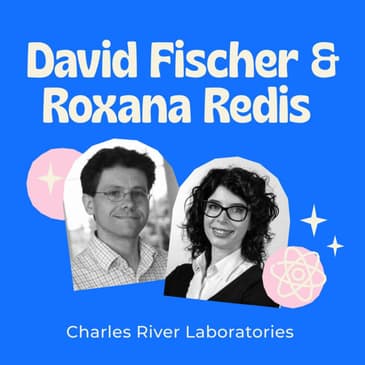
Rare Disease Research - Insights from Charles River Labs with Roxana Redis and David Fischer
Charles River Labs is a rare disease research and drug development powerhouse and their work leads to life-changing treatments. I'm joined by Roxana Redis and David Fischer to talk about Charles River Labs’ support, rare disease research and how patient advocacy organizations can team up with them to make a big impact.
EPISODE HIGHLIGHTS
What does Charles River Labs do?
We are a global research organization that supports biotech companies and pharmaceutical companies to get drugs in front of the FDA and other regulators so they can initiate clinical studies.
What do patient advocacy groups need to have in place to contract with you?
When they come to us, we will need at least the genetic testing done already, but from there we can guide them and provide supporting resources.
Are patient advocacy group roles in research and drug development evolving?
I've clearly seen the power of the network and families reaching out to other families. They find each other, refer each other to stakeholders that can help them along the way and genetic diagnosis is happening sooner.
LINKS AND RESOURCES MENTIONED
CONNECT WITH EFFIE PARKS
https://twitter.com/OnceUponAGene
https://www.instagram.com/onceuponagene.podcast/?hl=en
[00:00:03] I'm Effie Parks. Welcome to Once Upon A Gene, the podcast. This is a place I created for us to connect and share the stories of our not so typical lives. Raising kids who are born with rare genetic syndromes and other types of disabilities can feel pretty isolating.
[00:00:21] What I know for sure is that when we can hear the triumphs and challenges from others who get it, we can find a lot more laughter, a lot more hope, and feel a lot less alone.
[00:00:31] I believe there are some magical healing powers that can happen for all of us through sharing our stories, and I'll take all the help I can get.
[00:00:43] Once Upon A Gene is proud to be part of Bloodstream Media. Living in a family affected by rare and chronic illness can be isolating, and sometimes the best medicine is connecting to the voices of people who share your experience.
[00:00:55] This is why Bloodstream Media produces podcast, blogs, and other forms of content for patients, families, and clinicians impacted by rare and chronic diseases. Visit bloodstreammedia.com to learn more. Hey friends, welcome back to the show. This is Once Upon A Gene, and I'm your host Effie Parks.
[00:01:13] Hey, if you love this show or if this show has ever made you feel less alone, helped you find community, helped you learn something about what to do next, please head to Apple Podcasts and leave the show a rating and review.
[00:01:25] I'm on your social media so someone else can find this show. Word of mouth is the absolute best recommendation that anyone can get, and I really appreciate all of your support.
[00:01:35] You know what I love about Once Upon A Gene? I like to kind of call it like a cafeteria. You can take some and you can leave some, but there's definitely something for everyone here along their rare disease journey.
[00:01:45] And another thing is I do like to help provide some of the answers that you need without making you have to go through all of the efforts of making email connections first, trying to figure out if something is helpful.
[00:01:57] Instead, you can just go over to Once Upon A Gene and get a sense for yourself directly from the source. So today I have two amazing guests from Charles River Labs with us today.
[00:02:06] And if you haven't heard of Charles River Labs, they're a powerhouse in the rare disease world for research and drug development, especially when it comes to rare disease. And their work helps turn groundbreaking research into real life changing treatments.
[00:02:20] So my guests and I chat about Charles River Lab supports rare disease research and how patient advocacy organizations can team up with them to make a real impact.
[00:02:27] Whether you're a part of a patient advocacy group, a caregiver or just someone who cares about advancing rare disease research, this episode is full of insights. Please welcome my guests Roxanna Redis and David Fisher. Hello Roxanna and David. Welcome to the podcast.
[00:02:44] Hi, I'm so happy to have you here. We have so many patient advocacy org leaders that listen to this podcast and also some very highly motivated families and some who are thinking about dipping their toe into it for further disease groups.
[00:02:58] So hopefully there's a lot that they can learn from this and we'll give them a bunch of information and keep it as digestible as possible.
[00:03:04] So can you both tell us a little bit about your roles at Charles River Labs and maybe a little bit about your journey to these positions and what inspired you to work in the field of rare diseases and drug development?
[00:03:16] I'm from the start. So yeah, I've been at Charles River for 20 years and throughout that entire period I've been working on rare diseases, not exclusively on rare diseases, but it's always a common theme was that it would be at least one rare disease program I would be working on.
[00:03:32] Charles River is a drug discovery and development organization. So we run these programs on behalf of other organizations and very often those rare disease programs are on behalf of a not-for-profit, a foundation.
[00:03:47] And 20 years ago it would be organizations like the Cystic Verbose Foundation and Cure Hunting's Disease Initiative. So some of the more common rare diseases and what we've seen in the last five, six years is actually a lot of ultra rare organizations.
[00:04:06] Very small groups of families come together because they of course share a common disease and a very rare disease very often.
[00:04:16] So it's this passion for drug discovery and now with the possibilities that we have with the greater toolbox to our disposal in drug discovery like the use of gene therapy, oligonucleotides, cell therapy.
[00:04:32] It's a very rewarding journey over those years to move from very common rare diseases to very rare, rare diseases. And how about you, Roxanna?
[00:04:43] Well, I haven't been with Charles River as long as David. I've only joined about four and a half years. Prior to that I worked for a company that also developed therapies for rare diseases which was the first time that I had contact with rare diseases.
[00:04:57] And that was because I'm specialized in anti-sensitolic oligonucleotides and that's one of the most common personalized therapies nowadays for rare and ultra rare diseases.
[00:05:08] And coming from the oncology field, I thought it was quite different in a way especially because I got to hear about patients that were very young, some children. And that's quite emotional at the beginning because you don't expect children to be sick.
[00:05:26] And then when I joined Charles River four and a half years ago, I started having contact with his families that were developing therapies for their children.
[00:05:37] Similar to David, it's the most rewarding part of my job to be able to help them find the treatment for their loved ones.
[00:05:45] I love that. For those who need maybe a little bit of a refresher or for our families who aren't familiar with you at all, company overview wise, can you give us sort of an idea of what Charles River Labs does in particularly in relation to our rare diseases?
[00:06:01] So we are a contact research organization so we don't develop our own assets, our own drugs. This is all on behalf of our clients, whether they're small or large. And this is across different drug modalities from small molecules to oligos, up to genus cell therapies.
[00:06:21] Obviously the largest number of our clients are biotechs and big pharma. We support the entire industry all the way up to IND enabling safety studies.
[00:06:33] So we don't run any clinical studies on behalf of our clients. Everything is preclinical, but we support all of our clients to get these drugs in front of the FDA or other regulators so that they can initiate clinical studies.
[00:06:48] And we are about 20,000 plus people across Charles River. We're a global organization.
[00:06:54] That's funny I was talking to Roxana before recording and I had looked up Charles River a while ago and saw that there used to be a location here in Seattle, Washington. But it's gone now. You left us. Yes, sorry.
[00:07:08] Okay so can you tell us how Charles River Labs, your CRO differentiates itself from competitors? So we try to have a very broad offering. So as I already mentioned, we're not locked to one particular type of drug, whether it's a small molecule or a gene therapy.
[00:07:30] We try to consider what is the best option for the particular indication, the root of administration, the age of the patient and the scientific likelihood of being able to find such a drug.
[00:07:45] And what also plays a role is cost. It is more expensive to develop a gene therapy compared to an oligonucleotide. Those are just some basic economics.
[00:08:00] And what we find, it can also take much longer to develop a novel small molecule. So that is a root that we typically advise against for smaller organizations, especially those that are trying to find a therapy relatively quickly because of progressive nature of disease or developmental
[00:08:19] disease, which the patient is at. So we try to find the best potential root for these organizations or families. And of course we have a very deep experience in the discovery and development of drugs.
[00:08:35] We've seen all kinds of weirds and wonderfuls. So yeah, these organizations can benefit from the scientific prowess that we have within the organization.
[00:08:44] Just to add to what David was saying, I fully agree with him. I think our strength also lies in the fact that we try to advise and think about the disease and the gene and the family in the whole context.
[00:09:00] And we're not committed to one single modality. So we can try any modality. And also sometimes it happens that we have to tell them that a certain approach is not going to work.
[00:09:11] And in the experience, exactly the experience that we've had in this field is something that probably puts us apart from the other zeroes.
[00:09:20] So what do you think that patient advocacy organizations should be considering when they approach you? Like what ducks do they need to like line up if they want to do contract work?
[00:09:31] We've seen for the years, we've seen families and foundations come to us with different amount of information. It used to be that they had everything figured out and they knew exactly the direction that they wanted to take.
[00:09:46] Nowadays we have families that really don't know much and that's fine. So we advise them on what should be the first steps. As long as they have the genetic testing done so we know what is the disease causing mutation, then this is our starting point.
[00:10:04] And we know about the phenotype from there we can guide them what they need to be doing and we also provide them resources. So I mean, we know that rare disease organizations are not wealthy. They're not rich. They're families typically raising money from bake sales and lemonade stands.
[00:10:21] And you know, so if there's a patient advocacy org with say like $200,000 in the bank for tiers, like what could you provide or what do you recommend or what best serves a group at that stage so they can best use their dollars?
[00:10:36] Yeah, of course we also try to support these organizations if they're trying to raise funds to support them with any kind of material they need to go out.
[00:10:48] So for instance that could be a plan how to develop a drug, tell them what kind of cost they would be looking at because that kind of information also helps these families focus the attention and explain to people they are their contact.
[00:11:05] They're raising money from what it is that they want to do how much they actually need to raise $200,000 actually that could be a drug repurposing program in which you look for marketer drugs, small molecule marketer drugs that could potentially
[00:11:23] through some kind of mechanism where there's an off target mechanism or the pathway they're in interact with have a potential positive their duty benefit for those patients. So even with a relatively modest sum you can still achieve quite a lot.
[00:11:40] Have you seen the role of patient advocacy groups evolving over the last couple years in research and drug development with your work with them? That's exciting or do you still see a lot of roadblocks there? What have you seen sort of transpire in the last couple of years?
[00:11:56] So what I've clearly seen is the power of the network. So families reaching out to other families and that could be a family with a completely different mutation so unrelated from a molecular or clinical field point but having the same issues to a very rare disease.
[00:12:21] How do you handle this? How do you try to identify key opinion leaders, the best hospital that has expertise in this area or indeed how to develop a potential novel therapy for the indication.
[00:12:36] So what we've really seen is that these families find each other they refer each other to different stakeholders that can help them on their way. I think what is also of a benefit is that certainly getting the whole genome sequencing is more straightforward in some areas.
[00:12:55] It's not universal even across the US but we've seen that families get this genetic diagnosis much earlier. Sometimes the interpretation of that genetic diagnosis is still difficult and they sometimes need additional help there.
[00:13:14] So the primary physician that has prescribed the diagnosis may actually not be able to interpret this so that is still a bottleneck sometimes. Yeah, I've been seeing that a lot with families who are getting genetic tests recently for some reason.
[00:13:28] There will be so many things that have pinged on their reports but they still don't get a diagnosis because it's not even necessarily a bus.
[00:13:36] It's just like there and it's not even understood enough yet and it's frustrating but it's also exciting because they are coming so quickly and I think that they will be understood sooner than later. Absolutely.
[00:13:49] And there are more and more resources now just because of the wealth of genetic information that's out there.
[00:13:56] But it's also the predictive models that organizations like DeepMind have put out into the public domain for researchers to understand if a verse is actually pathogenic or truly just a variant that may be less important for the diagnosis of the disease.
[00:14:16] Yeah. Can you walk us through the process of how a new treatment for rare disease goes from concept to clinical trial at Charles River? Can you kind of give us that visual?
[00:14:26] So perhaps a good example and perhaps Roxana can highlight this example is a family that recently started to work so we're not in a state that we have a molecule in hand but it shows the thought process that we go through to understand which is the best.
[00:14:46] So what is drug modernity should we actually pursue and what should go into that type of drug? Roxana, do you want to pick this up?
[00:14:56] Sure. So exactly as I was saying, sometimes we just get a family that they know their child has a particular mutation in the gene and in this case the patient has a very large division and in that region where their division occurs there are three different genes.
[00:15:13] So they came to us with looking for an ASO treatment and we said first we need to understand exactly the biology behind it and the genetics.
[00:15:24] So we start the project by investigating the relationship between those genes to really narrow down what is the disease causing mutation and the gene that is driving the phenotype so we don't embark on a journey that is taking us to another region.
[00:15:43] So we started in the wrong direction and once we've figured that out, the idea is that we have one single team that is going to pursue in parallel three approaches. One of them is the drug repurposing.
[00:15:55] The aim of that is that if we usually drug repurposing takes about six months and at the end of these six months we hope to be successful in finding a drug that could at least stop the progression of the disease and can alleviate some of the symptoms.
[00:16:10] While in parallel we're pursuing the other two approaches, one of them is an antisense oligopolythide and the other one is gene therapy.
[00:16:18] So all three of these approaches are run in parallel and then we've implemented different decision points so we're not aiming to continue with all of them of course because of the cost but really looking at different time points what are the benefits and disadvantages of either of those
[00:16:38] and hoping to drop one of them as soon as possible.
[00:16:42] And normally, and I've seen that other, there are other foundations and families that are pursuing these modalities but not as one single project rather in parallel with different institutions and we feel that if you do this in parallel at the same time it's on one hand
[00:17:01] the saving a lot of time and it's also sending a lot of cost because we make use of the same resources.
[00:17:07] So once we know which is the therapy that we're going to continue then this has passed on to our colleagues in safety which are anyway involved really from the beginning of the program so every single program that we start at Charles River or even start talking about at Charles River
[00:17:25] it always involves a team where there's someone from Discovery, there's someone from Safety Assessments and there's someone from that will support with regulatory filing because we want to ensure that everything is in place and there's going to be a smooth transition through all the steps.
[00:17:41] There's no lack of time knowing that it's very important for not losing more time than was already lost.
[00:17:49] Love keeping that communication open. Curious if it is the same for the patient advocacy org do you stay in super close collaborative sort of contact with them and explain this along the way with them or are there like more quarterly updates? No, no, sometimes it's every week.
[00:18:08] I would figure they would be like banging on your email at least yeah okay.
[00:18:11] No, it's from our side so we update them by email weekly we have every two to three weeks or four weeks we have calls with them to explain where we are in the process where we show the data we explain what the data means what are the next steps there's always they have monthly meetings with the entire team so even though we are in Discovery at the moment and really just starting to do this the screening or the molecular.
[00:18:41] Testings already with our colleagues from the in vivo and from safety are involved and once a month we all meet together and we explain where we are so they know that let's say we'll be finishing in September our work and then immediately after they will start theirs so everything is aligned and they're always involved I mean they want to know right it's very close to their heart.
[00:19:07] Yeah, I love that. So what are some of the biggest challenges that you face in developing treatments for rare diseases and maybe what creative solutions have you been noodling around or figured out or trying to change?
[00:19:20] I think one of the biggest challenges that we have is that what I mentioned earlier is that there is this expanding toolbox of a V gene therapy all the nucleotides even crisper but we also have to realize that that we're still limited by our knowledge on how to target particular organs.
[00:19:45] So for instance all the nucleotides we actually have a very good handle on how to get these to the brain deliver but beyond those two organs we just face it we would struggle to develop a drug even though molecularly we can design a drug that targets the mutation if it needs to go to muscle which is given an example or skin.
[00:20:11] We would struggle because as a whole the industry, drug discovery industry hasn't really figured out a well-trodden path to deliver a drug of that type to those organs.
[00:20:25] So I think those are the biggest hurdles. I think we will also see crisper, so gene editing type drugs. The first ones have now been approved but we also have to realize that the ones that are approved are ex vivo gene editing.
[00:20:42] So you take blood cells, you edit them, you put them back and again to deliver those drugs to particular organs if you can't just edit the blood cells of the patient we would struggle.
[00:20:55] So we have high hopes that industry will solve those problems as well collectively so we're keeping an eye out of course for any drugs that are in late-stage clinical trials that are approved.
[00:21:10] Can we learn from those to target those organs and those diseases that at the moment we can't really serve because delivery is a problem.
[00:21:21] So I think that is still one of the biggest hurdles that even though molecularly we have the tools, the scissors to manipulate mutations but you just can't get it through the right organ in some cases.
[00:21:34] So my fellow CTNMB1 mom friend and the CTNMB1 foundation in Slovenia contracted with you which was a very good decision. You prepared an amazing protocol for us and showed efficacy on our leading construct which is going to go to clinical trial so we're really excited about that
[00:21:51] and I was just wondering if you can share any other success stories that are top of mind where Charles River Labs involvement made a significant impact on the development of a treatment for a rare disease.
[00:22:02] Absolutely. So I wanted to just mention the first couple of true personalized antisense oligonucleotide drugs that reach patients and this was a truly collaborative effort. The first one was Mielecyn. This was an effort between Boston Children's Hospital and Charles River Boston Children's Hospital.
[00:22:24] The designed screening and Charles River Wendie the safety study but most importantly I think as well our colleague Lauren Black she designed the safety program, the preclinical safety program for that drug which was accepted by the FDA.
[00:22:42] And actually it set the tone for all the following ultra rare antisense oligotide programs that followed in the years after to do a very concise single species stocks program for those aficionados.
[00:23:00] So yeah Mielecyn of course it reached the clinic one patient obviously Mielecyn and she was treated for three years with that drug.
[00:23:11] So I think that that's the one drug that we always look at as an example of how to do a single patient drug discovery and development program as quickly as possible as well.
[00:23:25] I don't think we've reached those very aggressive timelines again, because we've always had other problems that we needed to solve in subsequent programs, but that that was clearly a marker for us that that we always look back to as as an inspiration at what is possible if you have everything
[00:23:45] aligned, but also as a learning point that actually you can change a paradigm in direct development that is accepted by the FDA as well.
[00:23:56] Yeah Mielecyn is definitely the bright shining star that completely changed the landscape for drug development and our rare disease families and just even motivation in general for for us. So very cool to have been a part of that.
[00:24:09] So what advice would you give to patient advocacy organizations looking to engage with research institutions like you? To definitely reach out and don't be shy to ask any questions.
[00:24:20] So we're always open to have a conversation and advise and as David said, prepare a plan on how we would see the development of a certain drug. So I would say just contact us or contact any other company or lab that works in this field.
[00:24:43] And we are also very happy to refer families to other organizations that actually may have a program, active program or are willing to take on these programs.
[00:24:55] For instance, we work very closely with and Lauren who are developing single patient and these are all like look at that for different families.
[00:25:06] So so any family that comes to us if we think this could be an ASO drugable indication that we also reach out to and Lauren get get submitted to do that organization because of course if they accept the program. They'll run it at their cost.
[00:25:26] Very cool. That's important. That makes me think too. So if a patient advocacy org is contracted with you, is that collaboration across the board in sharing data?
[00:25:36] Would you offer what you're learning in real time to the families to offer to someone else to do something in parallel as well? That's only if the first family allows us to do that.
[00:25:47] We clearly would advocate in favor of that and we're working together with the end of one collaborative which are doing just that.
[00:25:58] This of course was founded by Julia Vitalello and Mila's mom together with others to form a as a repository of all the learnings that the different organizations have made over the years working on these programs so that you don't have to reinvent the wheel.
[00:26:14] You can benefit from understanding what worked, what didn't work. Yeah, I'm excited to get Julia on the show to talk about that when she's ready because that's very cool. So are you working on any exciting projects or initiatives that you can share about with us?
[00:26:29] So we're working currently on three projects for three families. One of them was the one that I already told you about which is the most exciting one for us since it's the first time that we are pursuing three different approaches in parallel with one single team.
[00:26:47] And the other two are also quite exciting. One in particular because we will have to rely on organoid data to show that the drug is really working so we won't be able to show that in animals but we have to do that in actually in organoids.
[00:27:05] And the third one is one of those where we've learned through the experience on previous projects how to run it faster and what to look out for so we're implementing all the learnings in that one as well. So what has been the most rewarding aspect of your work?
[00:27:24] Like what puts the pep in your step when you go home from work from a big win? For me because I mean really at the beginning in the discovery it's seeing that it works.
[00:27:33] So we have the first signs that we have a molecule and I had actually today for one of those projects I had some very exciting data that I looked at together with the team. So saying that there's hope.
[00:27:46] There is of course the problem of delivery as David mentioned and we do stress that out at the beginning of the conversation with the foundation or the family that it might sometimes be difficult to deliver depending on the target organ.
[00:28:01] But when you see that first glimpse of hope that we might get somewhere then to me that's really exciting. How about you David?
[00:28:10] I think there's certainly the feedback we've received over the years from parents how important it has been to at the very least have hope to identify therapy but also sometimes to see the benefits to the patients even though we have to be clear.
[00:28:30] None of the drugs that we've worked on collectively within Tosivir for these these other rare indications you can really label as a cure.
[00:28:40] They will not cure the indication at least we haven't yet found one that does but they alleviate symptoms and improve quality of life of the child which is so important for us to understand that. And also from a practical perspective.
[00:28:59] Of course we all live with by zoom call and teams call every day but to actually have a call with with the parents and sometimes the child that we're trying to develop a drug for that that's incredible you.
[00:29:14] I never thought I would do that of course when I started in this industry. Oh my gosh, I love that I love that so much.
[00:29:20] I'll definitely have all the links to Charles River labs in the show notes so if you're a family or a patient advocacy org looking to contact them they'll be in there.
[00:29:29] Well thank you so much for being my guests and thank you for all the work you're doing in rare diseases, and I look forward to hearing about more future progress. You're welcome. This was great. Thank you for inviting us. Thank you as well.
[00:29:41] I hope you've been enjoying this podcast. If you like what you hear, please share the show with your people and please make sure to rate and review on iTunes or wherever you get your podcasts.
[00:29:52] You can also head over to Instagram, Facebook and Twitter to connect with me and stay updated on the show. If you're interested in sharing your story, or if you have anything you would like to contribute, please submit it to my website at EffieParks.com.
[00:30:07] Thank you so much for listening to the show and for supporting me along the way. I appreciate y'all so much. I don't know what kind of day you're having, but if you need a little pick me up, Ford's got you.