
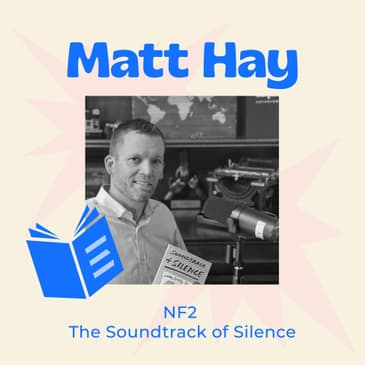

ONCE UPON A GENE - EPISODE 216
Soundtrack of Silence - Love, Loss, and a Playlist for Life with Neurofibromatosis Type 2 (NF2) Patient Advocate - Matt Hay
Matt Hay has a disorder called Neurofibromatosis type 2 (NF2) and how he has more than overcome the challenges that came with it— he has thrived because of it. He is the author of a new book, Soundtrack of Silence: Love, Loss, and a Playlist for Life.
EPISODE HIGHLIGHTS
Can you talk about the inspiration for your book?
NF2 causes tumors to grow on nerves and I have benign tumors on my hearing nerves. So while my ears work, the nerve that connects my hearing and my brain has been damaged and I'm deaf as a result. I felt a responsibility to put into words what I've been through because I once felt like I didn't have anyone to turn to.
Can you tell us about the soundtrack and collecting the songs on the playlist?
When I came face-to-face with losing my hearing, I knew I wanted to hold on to music and the memories associated with specific songs. The soundtrack is a collection of songs associated with my experiences with rare disease. I started listening to songs with intention and considered the songs I wanted stuck in my head for the rest of my life, the ones I wanted to reflect back on in sorrow and joy.
Can you talk about your mindset to thrive?
I spent a lot of time when I was younger, pretending my NF2 challenges didn't exist, hiding symptoms from others, putting so much energy into trying to exist as a person in spite of my disease. I realized later that through my challenges, I had learned to be a better listener because of my hearing loss. I became more empathetic because I have experienced in my own life that it doesn't matter how hard you try, some things are out of reach. I wouldn't have developed these skills without having NF2 and I'm proud of how it has shaped me and what I've learned from it.
What is your advice for others who want to tell their story?
Having spent a lot of time advocating for myself and others, I notice this belief that someone has to be a polished speaker to tell their story. When it comes to sharing your story about rare disease, the more real and authentic, the more impactful. Your story is absolutely worth telling. And sometimes if you don't feel capable, just existing is enough.
LINKS AND RESOURCES MENTIONED
Soundtrack of Silence: Love, Loss, and a Playlist for Life
https://bookshop.org/p/books/soundtrack-of-silence-matt-hay/19995432?ean=9781250280220
Soundtrack of Silence on Spotify
https://open.spotify.com/playlist/1GCTtdXb5zzJO0OMMZbcfv?si=0a9c377b237d4675
https://effieparks.com/podcast/episode-215-beyond-the-crossroads
https://effieparks.com/podcast/episode-209-a-leap-of-faith
https://www.instagram.com/hearmatthay/
CONNECT WITH EFFIE PARKS
https://twitter.com/OnceUponAGene
https://www.instagram.com/onceuponagene.podcast/?hl=en
[00:00:00] I'm Effie Parks.
[00:00:05] Welcome to Once Upon a Gene, a podcast.
[00:00:08] This is a place I created for us to connect and share the stories of our not so typical
[00:00:13] lives.
[00:00:14] Raising kids who are born with rare genetic syndromes and other types of disabilities
[00:00:18] can feel pretty isolating.
[00:00:21] What I know for sure is that when we can hear the triumphs and challenges from others who
[00:00:25] get it, we can find a lot more laughter, a couple episodes that have just been published in the last couple weeks. Please go check it out. There is so much conversation around them. Last week with Emily Crawford, she's talking about author of an awesome book that's available now everywhere. Go first to your local bookshop if you can and ask them to order it. Otherwise, of course, you can get it at the usual places. The title of the book is called The Soundtrack of Silence. And the book's all about his journey through NF and losing his hearing and having
[00:03:02] brain surgeries and matching the songs of his life to Matt Hay. Welcome to the podcast. Thank you, it's good to be here. Yeah, I'm so excited. You know, I had the absolute privilege of meeting you in person for the first time. I don't know, while back. And we just had a really instant connection. And I'm so
[00:04:21] grateful that I got to meet you.
[00:04:23] I feel the same way. I was lucky enough to hear you speak and
[00:04:27] share a little bit of your story. goodness. Okay. Well, I know that not everyone has heard about your book yet, but I'm excited because I'm even going to give away a copy. Hopefully I can get you to sign it. But can you talk about the inspiration behind the book that is so beautifully titled, The Soundtrack of Silence? Well, thank you. And it really goes back to I mentioned the tumors
[00:05:42] growing on your nerves for whatever reason with NF2 tumors really like you are hearing been hopefully one day be a dad and I had nowhere to turn. I had nobody who had been through what I was going through and so I ultimately now having been through that for several decades but I had somewhat of a responsibility to put down in words what I was going through
[00:07:01] and to write the book that 23 year old me then. So it wasn't just the song I wanted to hold on to it was the memory and feeling associated with that song. So the book really has a soundtrack associated with all of my experiences with rare disease and dealing with rare disease because I
[00:08:24] started listening to those songs of intention own memories of, you know, actually being in a car on the snowy icy road in Montana. And we were listening to Tom Petty. And we were listening to Dave Matthews. And then we actually drove off the road listening to the song Crash. And I was like, I was having these memories come back to me just by listening to you talk about songs and memories.
[00:09:40] And it was very cool.
[00:09:41] What became unexpectedly special about that why don't I start listening to those same songs
[00:11:01] that I listened to right before I lost my hearing?
[00:11:03] And maybe instead of my brain processing sounds important to me in that moment it became, it took a whole new level. That's so beautiful. Something else everyone is going to love in this book is traveling through you and Nora falling in love and just how warm and touching that relationship was as you were waiting for this steamroller was your metaphor in your book of knowing that one day you weren't
[00:12:21] going to be able to hear. So I can in a more Simple to understand way. So instead of talking about the theory or account idea of inevitability
[00:13:43] It was easier for me to say I felt like I was gonna get run over by a steam roller the steam rollers move slow
[00:14:46] disease. I have failed a lot at trying to live a fulfilling life with rare disease. And it seemed a little bit selfish to not share some of those things that I learned. And that
[00:14:51] was another motivation I had of putting this on paper. And one of the reasons I wanted
[00:14:55] to talk with you, Effie, and with the network that you have is so many of the people that
[00:15:00] you know, and that I know, and's another thing about you is how you thrive, right?
[00:16:20] Something you've said a couple times is that one that didn't exist, or not letting people know about that, or putting out a lot of energy and then making sure people didn't know.
[00:17:40] I have a 20-year window where nobody's seen a photo
[00:17:42] of the left side of my face.
[00:17:44] I was always positioning myself
[00:17:45] so you could only see my quote unquote good side. We're not hiring you in spite of those things. We're hiring you because of those things. It's because of your understanding of people with rare disease. It's because of your understanding of what it's like to live with hearing loss. Because you know how it's annoying when your hearing aid battery dies and you forgot to bring a replacement.
[00:19:00] It's because of those things that we want you good pattern to it. But in my 20s, I was embarrassed of my disease. In my 30s, I came to terms with my disease. And in my 40s, I've been become very proud of it. I'm proud of how it to the time I was diagnosed with a very rare neurological disorder, took me four days. That there is a level of privilege that I enjoyed because I had parents who took me there.
[00:21:40] I had parents with great insurance.
[00:21:41] I had parents who were able to follow up about this dinner, and I don't know if it was a real life dinner that you had, or if you were just using an example in the book, but you were saying you were explaining what it was like to be deaf and say that you were at a table with eight people that you loved, and you were
[00:23:01] having a conversation with Jimmy. And Jimmy was like thing about hearing loss and probably with a number of different rare diseases is some of the things people deal with are invisible or even like mental health. Some of the things people deal with are invisible and so other people can't see that. And so if you don't respond, quote, unquote, normally or as they would expect, they think
[00:24:24] you're maybe being rude or inconsiderate or just not a very nice person. mechanisms, but I really, this is probably just a life lesson in general, is I make a point of seeking out the people that accept me and for what I have, but then also people that push me to do more and be better. And I guess that goes back to wanting to thrive with rare diseases. Who are the people that are going to say, okay, Matt,
[00:25:42] it's pretty cool that you wrote a book. I can't wait to see what you're going to do next.
[00:26:46] experience or their experience, that's okay too. I'm not trying to tell anybody how to act or how to respond.
[00:26:53] I just know it's been very healthy for me to do things like find the small wins and stuff. Just celebrate those small wins.
[00:27:01] If I find myself really struggling with something or something's particularly difficult, trying to reframe that as instead of a problem, how can I turn this into an opportunity? Those are just little things that I do every day, just like finding the quietest spot in a restaurant
[00:28:00] to one of my children. I try very hard not to tell people what to do.
[00:28:03] I'm very comfortable sharing my experience,
[00:28:05] but again, everybody's dealing with their own things.
[00:28:09] So it seems a little bit presumptuous
[00:28:10] for me to ever tell somebody else,
[00:28:12] but I can share that I mentioned small wins just now.
[00:28:17] It took me about 20 years to really define that
[00:28:20] and recognize, hey, the times where I was able to go
[00:28:24] from being deaf and paralyzed, How did I end up here or that this is just the beginning of the end? I wasn't okay with that. I just I refused to accept that and Decided you know what I can just reframe this as sure I had to have somebody carry me into the bathroom But I have progressed to a point where I'm now in here alone
[00:29:41] And I don't have somebody standing in here watching me if I can find that as a win
[00:29:45] I mean, I know this sounds like a maybe a silly or a crude example
[00:30:44] two physical therapists helping me navigate these cones. Instead of thinking, this is so silly,
[00:30:47] how is this ever gonna help me?
[00:30:48] I started thinking today's my first day
[00:30:51] toward being a marathon runner.
[00:30:53] And then a week later, a month later, nine months later,
[00:30:57] I was running and ended up running 26.2 miles.
[00:31:02] So reframing that just became necessary,
[00:31:05] coping mechanism for me,
[00:31:06] but it doesn't have to be that big. I can't even celebrate even though I can't eat without still in food down my face because I can't feel it. At the time I was in a wheelchair, I had an eye patch on and I couldn't hear being able to celebrate something like, you know, today I was able to roll myself to the kitchen by myself. Those winds start showing up everywhere. Yes, I love that so much.
[00:32:20] Okay, Matt, I wanna talk just a little bit
[00:32:22] about storytelling, something you're very good at
[00:32:25] and that we talk about a your experience with rare disease, the more real and the word authentic gets thrown around all the time. But the more just real and personal
[00:33:40] your story is, the more impactful it can be. And she came as I turned around to leave, she was behind me and she looked right at me. I mean, five steps into the door and said, do you have NF? And I said, yeah, I have NF too. And she was there with her little boy where presumably her son. And she said, I'm so glad you exist.
[00:35:02] And man, she wasn't saying I like you.
[00:35:05] She wasn't saying, thank you for sharing
[00:35:07] or you did a great job telling your story. be there and exist. And that was, I thought about that moment a lot in my own advocacy group, or I wonder, or my own advocacy efforts when I've wondered, am I doing enough? Or am I saying the right things or doing the right things? And so I would encourage anybody else, if you're thinking, am I capable of doing this? Or do I have, can I say the right things?
[00:36:23] Sometimes you just need to exist.
[00:36:24] I think that's one of my favorite stories I never said thank you. I never recognized and they weren't looking for that but I still think
[00:37:43] when people sacrifice on your behalf they stick really over all human. I want to say thank you on their behalf because maybe they can't now but they want to or maybe they can't now because they're not old enough yet to formulate that thought. So that's what I would say is thank you. Well the NF community and the greater disease community in the entire world is so I'm working with. I mean, really none of we do, but none of us do. But if there's anybody out there that can read this or story or hear my story and it makes their life a little bit better, I think that's the kind of legacy I would be pretty satisfied working towards. So thank you for sharing that. And before I go, I want everyone, anyone listening
[00:40:21] to know one of the gifts that Effie Gibbs,
[00:40:24] one of the reasons I was honored to be a part
[00:40:26] of this conversation is at some point, on Amazon or Barnes and Noble online or local bookstore. Hopefully I post most of the things about what I have going on here on an Instagram account, which is called here, Matt, Hey.com, A T A R M A T T H A Y. I guess it doesn't have.com. That's what happens when you're 47 is you forget how Instagram works.
[00:41:41] Awesome.
[00:41:42] I'm sure they'll be seeing a TED talk from you soon.