
In December 2024, a Guidehealth customer needed blood pressure readings from thousands of seniors — fast. Over 200 people making calls for 20 straight days was the traditional answer. Guidehealth deployed an AI voice concierge instead. It collected over 2,000 readings in days, and about 15% came back elevated — undiagnosed hypertension cases that needed escalation. That was the proof of concept. Now it's the operating model.
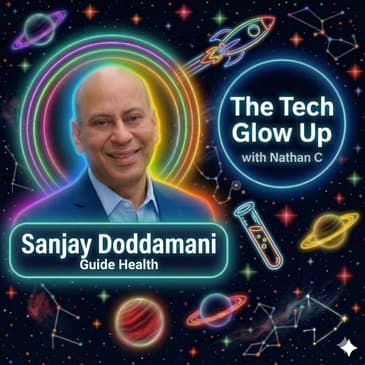
The Tech Glow Up from Vive continues with another experienced leader in Health IT sharing their journey in innovation.
Sanjay Doddamani, founder and CEO of Guidehealth, is a physician who spent two decades running population health at Geisinger and UT Southwestern before building the company he wished existed. Guidehealth works across benefits administration and value-based care with one stated mission: make great healthcare affordable for all. Since 2023, the company has grown from 200,000 patients to over 800,000, while headcount grew from 200 to just 262 people.
[00:00:54] Making healthcare affordable for all: why dramatically lower operating costs are the only path to sustainable patient care.
[00:05:07] Brain, voice, and touch: the three-layer model that balances AI efficiency with human escalation across every patient interaction.
[00:08:07] The blood pressure call: one AI campaign, 2,000-plus home readings, 15% elevated cases caught — and the proof of concept for agentic AI in healthcare.
[00:11:24] Garbage in, garbage out: why rich, accurate data context is the prerequisite for responsible AI deployment.
[00:23:04] The hot take: every routine administrative task is sitting on top of a clinical signal most companies never look for.
Sanjay's frame is the tortoise and the hare applied to healthcare AI: moving fast but responsibly — building in human escalation, earning URAC accreditation, and starting with the lowest-risk use cases. The 30-plus strategic advisors and a C-suite he calls a "council of ministers" are the infrastructure that lets a physician founder scale without losing sight of the patient.
Watch the full conversation on YouTube → https://youtu.be/kQdmpeuxxl8
Join the Tech Glow Up newsletter on Substack → https://substack.com/@mxnathanc
About Sanya Doddamani:
Dr. Sanjay Doddamani is a practicing cardiologist and founder and CEO of Guidehealth. He handpicked a team of nationally recognized technology, operational and clinical leaders who are elevating performance for leading health systems, payers, and self-funded employers.
He previously served as a Senior Advisor at the Center for Medicare and Medicaid Innovation (CMMI), helping develop alternative payment models focused on quality and cost across the U.S. healthcare system.
He clinically led two large health system–led accountable care organizations and pioneered innovative delivery models including Geisinger at Home.
A "glow up" signifies a positive transformation, reflecting the journey of becoming a better, more successful version of oneself.
At The Tech Glow Up, we humanize the startup and innovation landscape by focusing on the essential aspects of the entrepreneurial journey. Groundbreaking ideas are often ahead of their time, making resilience and perseverance vital for founders and product leaders.
In our podcast, we engage with innovators to discuss their transformative ideas, the challenges they face, and how they create value for future success.
If you're a founder or product leader seeking your own glow up, or a seasoned entrepreneur with stories to share, we invite you to join our guest list via this link.
You're gonna notice some things pretty quickly when you listen to this episode with Sanjay Doddamani of Guidehealth. The first of which is how many times he says the word"guide." This principle that his AI enabled company is here to guide you through every inch of your care journey that they touch is like core to the innovation and growth that Doddamani is seeing at Guidehealth. They're focused on the backend administration of benefits and value-based care. They're using data in a really smart way that ideally is using AI as a brain to do the busy, do the hard, do the repetitive work and ensure that when there is a moment for human touch and connection, that the health guides are really there to deliver above and beyond and to make sure that patients are getting what they need out of these services. Sanjay tells a fascinating case study where using AI not only saves literally hundreds and hundreds of staff hours, but uncovered some important diagnostic information in remote blood pressure monitoring. This entire workflow was AI enabled not only reached 2000 people faster, they identified 15% of these 2000 people who needed escalation with the hospital? So in this case, AI makes it easier for staff to do their job. It makes it easier for patients to follow through on regular data collection, and it made it faster to identify when patients needed more help or needed to be in touch with their care team faster. Fascinating stuff and kind of pushing against the idea that AI is out here to take jobs or to take away the human parts of care. This model is not only gaining excitement and approval with payers and providers but with more and more patients involved in these kinds of workflows. Like any AI company, especially in healthcare in 2026, Doddamani is hyper-focused on building trust and delivering values to his partners and to his. Patients solving for both of these audiences. Solving problems, not just talking about innovation is the path to their hearts and purse strings. Learn about how this focus on a human touch accelerated accelerated by AI data is really driving some significant growth for the folks at Guidehealth. His hot take is that boring Admin tasks are actually a wealth of data and information about what works and what isn't working in healthcare practices, hospitals and programs. By better understanding the economics hidden in back office data, Sanjay's looking to transform even further the results and the economics of delivering great value based care. I hope you enjoy this episode with Sanjay Doddamani of Guidehealth on the Tech Glow Up from Vive. so you ready?
SanjayReady.
Nathan C1, 2, 3. Amazing. Hello and welcome to The Tech Glow Up from the VIVE event today I am talking with Sanjay Doddamani of Guidehealth. Sanjay, it's so great to talk with you. Thank you for joining me on the Tech Glow Up.
SanjayI am having so much fun on this conversation already.
Nathan CTell me a little bit and the audience at home, about the work that you do as founder and CEO at Guidehealth.
SanjayYeah. Well, first and foremost, I'm a physician by background, and so that stays very deep in me in terms of trying to improve healthcare more broadly and take it down to the level of how would this be for the next patient that I see or don't see behind the four walls that I'm in. And so that. Barometer, if you like, has been the litmus test for so many things in my life.
Nathan CHmm.
SanjayGuidehealth was founded on a very strong principle. Our vision was to make great healthcare affordable for all. In order to do that, we had to have dramatically low operating costs in order to drive savings or drive operational efficiencies for our customers and ultimately to patients. If we don't go down this road, and we are already seeing how unsustainable healthcare inflationary costs are. I don't think we'll be able to truly support patient care in the way that we want. Both towards better health, but also towards reducing all of the administrative burden, that's placed on both physicians and patients.
Nathan CCan you talk a little bit about how you approach that, that sort of burden and that gap, with the work that you're doing at Guidehealth?
SanjayFirst and foremost, we are an AI enabled healthcare services company that supports benefits administration and value-based care. Mm-hmm. And what I mean by that is that a lot of the work before a patient ever sees a provider or access as a resource is governed by their underlying insurance. Mm-hmm. And so to make that easy in order to help with their benefits eligibility or their benefits design, or some kind of a member approval. All the way from just auto adjudicating things to prior auths. Mm-hmm. Any barrier On the administrative side, we have a services company. We've steadily improved operations, improved margins, improved scalability, especially with ai. And helped expand that to touching things like quality and access and patient navigation and even patient education as well as, scaling up work like care management, which has always been narrow and restricted to a very small patient population of high cost, high needs patients. Yeah. My point is if your needs change from one day to the other or one month to the other. Then how do we like support you at every level where you are. Mm-hmm. And that's what the fundamental principles of affordability for all means. We don't restrict it only to Medicare or Medicare Advantage. We do uninsured, we do Medicaid. We do any number of commercial insurance plans as well. And we support this. So both, working with health systems and their network physicians
Nathan Cmm-hmm.
SanjayWe work with payers.
Nathan CI hope I can ask this in an open-minded way,
Sanjayplease.
Nathan CI think when a lot of people think about, benefits management and approvals, sometimes the like, rubber stamp from a doctor that I don't even see is like. One of the, the frustrations and time consuming parts that a patient might be experiencing, but you're also, in addition to the work that you have around plan management, you're talking about being able to impact the care and access. So I'm, I'm interested, how do you, how does your approach, help to keep costs low with efficiency while also enabling people? To get the kind of care that they need. How do you balance Yeah. those parts of it and, and maybe it's a, a presumption on my side of the
SanjayIt's an excellent question in terms of how you avoid conflicts of interest and really drive towards the patient at the center of the equation.
Nathan CAlright.
SanjayThe first and foremost is that the, the legacy business that we acquired, supported provider organizations that were in capitated risk contracts. And what that means is that the physicians themselves need to have an overall approach of high quality at a lower cost. Not just lower cost. And so by integrating these important tenets, we could focus on things like removing the barriers, appropriateness, reducing certainly waste, potentially abuse.
Nathan CYeah.
SanjayAnd identifying things earlier because we have surveillance on the population. I actually have a simpler analogy for this. We have brain.
Nathan CMm-hmm.
SanjayWe have voice now with ai, agent, voice and text, and we have touch, which is our medical assistants. Mm-hmm. They are called health guides if they work directly with patients who are, you know, in need.
Nathan CMm-hmm.
SanjayThey're called quality guides, if they're closing quality gaps, or they're called customer guides if they're on the phone with the patient. So it's a very, consumer focused business, but our work is with the enterprise B2B level. Mm-hmm. so we're balancing a number of constituents and stakeholders. First and foremost, the fiduciary responsibility to the patient. Then I would say to the provider, because of the healthcare delivery and then to the payer, because we're following a plan benefit design.
Nathan CYep.
SanjayIf we need to do an approval, an appeal, you know, we have to have very good justification for that. Mm-hmm. You need to be digitally forward and to be able to make this very smooth and scalable.
Nathan COoh, I love it. And also thank you for calling out, right, that like some of the things that, patients might be frustrated with in some of the interactions that I was describing might have been decided way before somebody's ever even coming into your services or, and so, I shouldn't be putting that directly on track.
SanjayCan I also add that part of the job then, if you're taking this responsibility on, is on education? Sometimes a patient may see. Oh, I want this procedure or I want this drug. Mm-hmm. Not realizing the consequences. So it's a balance between actually having a clinically led organization. Yeah. Where we have medical directors whose jobs aren't just to, you know, process things by road to. Or focus on the denial aspects of healthcare, but really on the access navigation and appropriateness.
Nathan CMm-hmm.
SanjayWe did receive URAC accreditation, which is a national certification in addition to several other technology, certifications, and I think that's a responsibility that we then bear mm-hmm. Towards the, ultimately the beneficiary, the patient.
Nathan CIt's only just a few hours since the Vive event has started, and this idea of we need AI tools that can be certified. We need frameworks that we can trust. We need like governing bodies and, you know, licensing bodies to kind of sign off and like build some agreement about these standards of how we're using AI moving forward. So it's super cool to hear that you're already, in some of those certifications. I'm, I'm curious. In, in today, like in 20, in February, 2026. Is there, effective responsible revenue driving AI that's like here and in the world today? I feel like a lot of the AI here about is like gonna solve a problem soon.
Sanjay100%.
Nathan COkay.
SanjayI'm gonna take us back to December of 2024.
Nathan CMm-hmm.
SanjayWhen we were days away, maybe about 25 days away from the end of the year. Mm-hmm. One of our customers required to, confirm with their patients their most updated blood pressure. If the blood pressure was out of whack, needed, escalation so that there was appropriate treatment Yeah. And management to get their blood pressures under control.
Nathan CYeah.
SanjayAnd we would've needed over 200 people to drive calls for 20 days straight in order to get all of these patients phoned, have them self-report their blood pressure with a monitor at home. Instead, we had AI call the patient. We had these voice agentic phone calls that, you know, introduced that the person was an AI concierge. Mm-hmm. That they were talking on behalf of the provider, that they were trying to get an updated blood pressure. And then, you know, ask the patient if they had a monitor, would tell them to uncross their legs, straighten their arms, slap on the cuff, and read the numbers. That one task mm-hmm. Picked up over 2000 readings. Mm-hmm. Okay. That were then processed, submitted. About 15% of those patients had elevated readings that would've been gone undiagnosed, some of them very high. And that was an opportunity to, get patients with living with this chronic condition. Hypertension. Almost 50% of seniors have high blood pressure. Mm-hmm. So imagine the potential now. So fast forward,
Nathan Cthat's wow.
SanjayWe've had a whole year now, right? Mm-hmm. And, and a few months to be developing many, many use cases. We recently launched Rose Connect our own AI voice, LLM, integrating that into our call center, integrating that into our Quality Gaps program, integrating that into our care management programs, so the immediate reductions. In opex mm-hmm. That we can ultimately drive better savings to our customers by not charging so much. Yeah. So that we can actually scale something much faster. Means we've gone from 200,000 patients in 2023
Nathan Cmm-hmm.
SanjayTo today, over 800,000 patients, but we've gone from 200 employees in 2023 to 2 62 humans. Human guides, if you like, in the company. Yeah. So we're already seeing the dramatic impact of integrating AI into an existing services business, and that's why I have tremendous hope from a practicing physician standpoint of our ability, not just us as one company, but this industry. Mm-hmm. This is the big unlock. The great unlock in healthcare. We're seeing it right now.
Nathan CThe Glow Up that you would like to see in the healthcare industry this year, and a Glow Up is right, a transformation or a notable rebirth. And so I'm curious seeing what, AI workflows has been able to empower in your own team. I'm curious, what's the Glow Up? you wanna see healthcare make, in 2020.
SanjayWe all know colloquially, garbage in, garbage out. What does that mean when it comes to healthcare? It means poor data, bad data, bad ai. Mm. And so take that a next level. If you want to truly help patients more accurately, more scalably, more responsibly, then you need to somehow build more context into any ai. So that's why I started with brain. Voice touch, touch, meaning human escalation. Mm-hmm. But if the brain ain't functioning, if we don't have very, you know, robust, actionable data with true insights, then we can't translate those insights into action. So if more AI companies recognize that fundamentally that there's a little bit of hard work on the front end, it will pay dividends on the back end.
Nathan CMm-hmm.
SanjayWe have really amazing customers out of Chicago, in Georgia, in Connecticut now in the southern US in in Louisiana. And that's kind of huge scaling is because we have, and in Pennsylvania we have, I think taken those extra steps in safeguarding one patients. In integrating human escalation. Mm-hmm. My company would probably be way more valuable if I didn't have 200 employees and we plus employees and we were a pure tech company. Mm-hmm. But the truth is that wasn't going to solve what we needed to solve in healthcare. And I think that's why we've taken this approach. If you think of the tortoise and the hare, my hope is that Guidehealth is viewed as the, as the tortoise. Well, in some ways, and maybe the hare in others. But yeah, certainly we're moving fast, but we're moving responsibly.
Nathan Cthe idea that like taking the time to do the research and to really understand the nuance of the problem space, rather than just rushing for a solution that solves the space in name, but like might cause churn underneath the surface.
Sanjayan easy explanation for it.
Nathan CYeah.
SanjayOne arm is twisted by our customers. Mm-hmm. We're extremely cautious. Yeah. And the other arm, because we're in a hugely regulated. Space working with Medicare? Mm-hmm. And Medicaid beneficiaries?
Nathan CYeah,
Sanjaywe are making sure that this is something that everyone can feel very comfortable. That's why I started with the low risk use case of just calling somebody and asking them to self-report their blood pressure. What's the worst thing that could happen? and so you take that and then you start saying, okay, the next thing is, could we get them to, identify those medications that they're taking for chronic conditions and have a call with an AI agent and help those, medications, get them, into 90 day scripts so that they're more regularly. So focusing on quality was a really good place to start because it force function, the take something really low risk, ensure you can deliver it. And now we're starting to do things like high risk care management integrated into our workflows.
Nathan CI love it. You're, you're sort of teasing at this, the next question that I have for you, which is around the Glow Up that you see for Guidehealth. You, you've mentioned, right, like we've sort of already highlighted this, this pressure to be trusted yet, go quickly. how are you, how are you thinking about your own Glow Up, in the next year
Sanjaywhen patients struggle? It's usually around affordability. It's around access. They can't get an appointment and they end up then really suffering. And that struggle, if it stays central to everything we're trying to work through, actually extends further than just the patients, the doctors themselves, you know. Took their, on their hippocratic oath ultimately to do good. Mm-hmm. But in this current system that's so fragmented that everybody acknowledges is, you know, has a, a way to go to become unbroken,
Nathan Cit's very gentle
SanjayBringing that to customers. So as we improve our margins, we actually want to be very transparent with our customers. So that we can ultimately have the long sustainable journey with them and obviously come to a floor of understanding. So if I can build a 50% gross margin business at three years and sustain to that level and continue that level for health services company, you know, we don't need to whittle down our employees. What we need to do is scale up and improve access. And deliver the empathy that goes with ai. So what would be my Glow Up?
Nathan CYeah,
Sanjayit would be to become the most trusted name. I think we're almost all already there, certainly with existing customers. The second would be to not lose sight of the patient, and the third would be to, extend beyond. Serving provider organizations to being as successful with payers and employers.
Nathan CHow do you, how do you at the speed and scale that you're moving toward, keeping up with all of those demands can. Can be pretty daunting. And, you can, you know, the kinds of deals and the kinds of conversations you're having are big, right? You're, you're talking about the thousand enterprise
Sanjaylevel,
Nathan CHow do you balance, all of those pressures, against the vision of the idea that like inspired you to start Guidehealth?
SanjayOne is, none of this is possible without an incredible management team and, and hundreds of extremely dedicated employees. You can tell how dedicated, because you see it in our, employee experience, in their commitment, even on metrics. The second is, very early on we decided that in addition to. Creating a board for the company with really, experienced leaders that could help support our company, both in its terms of its growth, in terms of its path to profitability as well as its overall governance. We also created a strategic advisory board, and to date, we have 30 plus strategic advisors at our company who genuinely give up their time. Guiding us through, whether it's a new CMMI model, whether it's new technology, whether it's better integration, whether it's beta testing, And so we've really been fortunate to bring along an entire group of very experienced healthcare operators and leaders mm-hmm. Who are already successful saying, Sanjay, you and your team need to do this, or take a pause on this. Wait, because there's something better coming. And so we've been good listeners and that has really helped us, I think, scale up this fast.
Nathan CAmazing. This might be a softball, since you just talked about having like multiple groups of advisors.
Sanjayearned a
Nathan Cthe question really is about how, especially I have seen for doctor founders. The role of mentors and coaches is like indescribably important in their journey as an entrepreneur. I, I'm curious, how have your mentors and coaches and guides, helped you get to where you are today?
SanjayMy C-suite is actually my coach, my team coach team rather, and they're very hard. There's some reverse psychology going on in this C-suite. But it's great one, it's an environment of transparency. Mm-hmm. We're super transparent. The second is we've created psychological safety, and the third is we've got this incredible trust because of that. And so I really feel that my responsibility was to create that atmosphere, but ultimately it's paid dividends.
Nathan CYo.
SanjayNow I do have a communications consultant since. I need to find way better ways of like shortening things and being to the point which I'm learning. So plug in for Ariana there and help me.
Nathan CI need Ariana's help.
Sanjayand then our strategic advisors and our board have been very generous with their time in, guiding the broader business. The personal note, I think I learned through both, successes. But I think my hardest lessons have been through failure, and I cannot underscore how that has helped me bring the kind of maturity, the kind of learnings, the speed at which we created our company and its, impact in the healthcare industry is because of that long list of both successes and failure. So that's some advice that I would give to fellow founders and fellow partners. You don't need to know it all, but you need to have the right people on the bus. And you need to have a very strong, straightforward, direction and agenda.
Nathan CThis anytime I've ever built a team, that idea of I want you to be the eyes and ears for the things that I don't see, but that doesn't mean you have to have all the answers. You just have to know where we're supposed to go. And have the questions and, and the, you know, be the person who helps me see, helps the rest of us see the gaps that, you know, we're not gonna be able to see. You need to own the questions we should be asking, but you don't have to answer them yourself. And this idea that like you have advisors within the C-Suite, that can help you understand what's important.
SanjayI call them the council of ministers. Because they each have a portfolio and yet they, they're also truly, experienced in their own right. It's really because I think having the physician executive lens has given me a lot of, not just credibility, but a lot of depth of understanding the kinds of problems that surface across a wide portfolio of responsibilities. Having worked in health systems for two decades and run population health at large places like Geisinger and, and Southwestern in, in, Dallas really exposed me to the, the extent of the kinds of problems and challenges to, that if we were doing something that can accelerate the progress, now is the time. It's all about like in real estate. There is location, location, location. I think in, in a healthcare business, especially as an entrepreneur, it's timing, timing, timing. You'd think it's timing team, right?
Nathan CMm-hmm.
SanjayYou have to go find the problem. Mm-hmm. But I think really we have to emphasize that this is the time that I sense that you can really do something great and AI. Plus advancements in analytics and, and machine learning have really all converged to this moment. So this is the time, this is the place, and it's been great to do this together.
Nathan CAmazing. Sanjay, I have one last question for you. do you have a spicy hot take to share? Maybe, a strong opinion about healthcare, technology, AI culture,
SanjayI have a strong belief. That behind every administrative task, no matter how boring or how you know, routine that is, that there's actually some very interesting data that sits on the other side. And if you take that and pull it together, whether it's ambient listening, whether it's the fact that who's actually responding to a phone call for the six people that don't respond, I'm super interested in that population of non-responder. Is something else going on that we need to unlock? Do they have social determinants? Are there, is there literacy issues? Are there other things that, you know, we just don't see today? And so it gives me, I think the ability to focus on what's going on behind the veil or behind the administrative block. There is actually not just a human being, but there's also a clinical opportunity. To unlock,
Nathan CYou're always gonna win me over with, there's hidden data that can help you learn about your customers and patients." I honestly share that fascination. Anytime I can get a signal, I'm just, I'm all for it.
SanjayAnd by the way, those signals can also come from our own employees.
Nathan CMm-hmm.
SanjayI'll give you a tiny example.
Nathan CGive it, yeah.
SanjayWe had some fairly routine work being done by nurses. Think of things like depression screening and after the 15th call, people are getting a little bit, you know, fairly sort of like doing things just by, because they had to use AI to do something and then elevate where the human comes into it, say, let's say the people who are testing positive and now you have to do something and engage with the patient, whether it's. You know, these are the highest fall risk patients. So you've gotta talk to them about, you know, a shower rail or walker or some kind of DME equipment, or in the case of depression, actually engage with them to find a solution, whether it's access to a provider, et cetera. And the same people become incredibly empathic. So if you ever using that analogy, hit a wall, don't just take it on face value. Try to find something that's actually, you know, creating that atmosphere that's resulting in the effect,
Nathan Cyo.
SanjaySo I'll stop there, but I think those are the two that would come to mind.
Nathan CThe fantastic advice, and especially for anybody who's trying to put a patient first. Sanjay, we're basically at time, if folks wanna learn more, how can they follow up and, try keep track of the work that you do.
SanjayIt gives me an opportunity to evangelize the approach we take, which is to integrate AI and other technology into healthcare services. The services in healthcare has language behind every other business, and that to me means more burden, more administrative tasks, more suffering, lack of access. So that's why we focus on quality, cost, access and, and, and healthcare enablement. Mm-hmm. And I'd say that, you know, Guidehealth. We, we, we shouldn't be the only company doing this because there's so much to be done, especially across all the types of, you know, patients that we have in this country. Well, I want to make sure that it's really deconstructing what needs to get done in healthcare and if we can focus on those problems. Scale together, there's a real opportunity to crack the code here.
Nathan CAmazing.
SanjayDoddamani.
Nathan CSanjay Doddamani, it has been so lovely to learn about how your entrepreneurial journey as a physician founder has given you more problems and more data that you can put. This curious, analytical mind too. I love that you're finding ways to make a difference in people's lives. Not just the patients, but these guides and caregivers that you're bringing on to, to help you build these, solutions. I'm really, thrilled to learn about your advisory approach and, congrats on being one of those founders who, Proves the adage that ideas fail sometimes, but founders don't. So it's been so good to have you on The Tech Glow Up
SanjayThank you very much. And I think that's a wrap.
Nathan CYep. Perfect. Can I ask you a favor? If you really enjoyed this episode, could you share it on your Instagram stories or maybe post the link with what you enjoyed on LinkedIn? The sort of sharing and engaging really helps small podcasters like me reach the audience that I know really cares about these kinds of conversations. If you've made it this far in the podcast, I really appreciate you. Thanks for listening. Please make sure to like and subscribe so that you never miss an episode of the Tech Glow Up. And hey, can I ask you a favor? If you really enjoyed this episode, could you share it on your Instagram stories or maybe post the link with what you enjoyed on LinkedIn? The sort of sharing and engaging really helps small podcasters like me reach the audience that I know really cares about these kinds of conversations.