
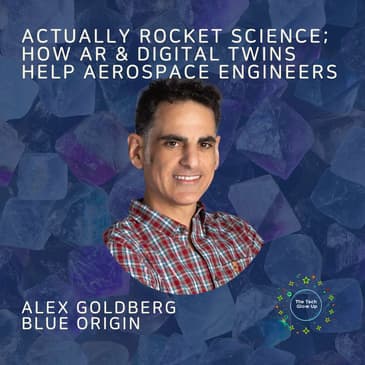

Most of the time spatail computing isn't rocket science, but for this conversation, it is. Alex Goldberg leads augmented reality at Blue Origin. He helps rocket scientists and manufacturing engineers work faster, collaborate better, and solve problems that require precision at the edge of what's possible.
His tools include AR glasses for remote assistance, digital twins built from reality capture, and spatial data that tells the story of how a component travels through a manufacturing lifecycle from fabrication to launch.
Alex's work is about giving engineers infographics on steroids; helpful tips in their field of view when they need them. It's about capturing the physical environment as digital twins so teams can see what actually got built versus what was designed. And it's about giving people the freedom to discover uses for the technology that even he didn't expect.
Episode Highlights:
- A VR arcade job at 19 led to game testing at Rocket Science Games, years later at Blue Origin actual rocket scientists call Alex a wizard when they see what AR does for manufacturing.
- AR for manufacturing works best as contextual infographics right now; helpful tips in engineers' field of view—because rapid iteration cycles outpace documentation updates.
- Remote assist delivers a massive win; factory floor workers put on AR glasses, call offsite experts, get unblocked in real time, and can create annotations for asynchronous training without an expert present.
- People who have access to actual spatial data stop thinking of information as living on a server and start thinking of it as living in that physical location—they've built a new mental model for data organization.
- The best moments in innovation happen six months after launch when someone in the team discovers a novel application that solves a problem Alex wasn't even aware existed.
Alex Goldberg builds for the moment when an engineer looks at spatial data overlaid on reality and understands something they couldn't have grasped from a flat screen. His focus is on getting out of the way and listening to how teams actually work.
Watch the full conversation on YouTube to hear why mixed reality is fading and why see-through AR glasses are the inevitable future within three to five years.
About Alex Goldberg:
Alex’s work bridges storytelling and cutting-edge technology and empowers teams across the education, retail, and manufacturing sectors to maximize the full potential of spatial computing.
Alex brings a unique blend of creativity and technical expertise to the world of interactive technology. Leveraging a broad background in mobile game and app production, Alex has produced many top-ranking enterprise and consumer applications for iOS and Android platforms.
Since 2015, Alex has stood at the forefront of spatial computing: designing innovative augmented reality experiences that focus on training for complex tasks and procedures.
A "glow up" signifies a positive transformation, reflecting the journey of becoming a better, more successful version of oneself.
At The Tech Glow Up, we humanize the startup and innovation landscape by focusing on the essential aspects of the entrepreneurial journey. Groundbreaking ideas are often ahead of their time, making resilience and perseverance vital for founders and product leaders.
In our podcast, we engage with innovators to discuss their transformative ideas, the challenges they face, and how they create value for future success.
If you're a founder or product leader seeking your own glow up, or a seasoned entrepreneur with stories to share, we invite you to join our guest list via this link.
Hey, it's Nathan. Welcome to the Tech Glow Up. Most of the time when I talk with people on this show, they have the opportunity to say, well, you know, like we're building disruptive, deep technologies, but at least we're not. You know, at least it's not rocket science. Well, my guest this week is actually using tools like augmented reality 3D scanning digital twins, and so much more to actually build rockets and to help engineers and scientists who are working. On space locomotion. My guest this week is Alex Goldberg, who is a technical product manager at Blue Origin. If you are a nerd about Smart Glasses, digital twins. IOT and some of the amazing ways that you can build business tools with 3D data and sensors. You are going to love this episode. Now, Alex works at the Rocket. And Space Technology Company, Blue Origin. This conversation isn't directly about his work there, but Alex talks about a number of the different kinds of projects and technologies that he uses to help some of the smartest, most capable people in the world work better, work faster, collaborate together. While most of the time working in deep tech and startups and technology innovation. Isn't rocket science. I'm super thrilled to share an episode where we start to touch a little bit on the rocket science part of how far these technologies can go. I hope you enjoy listening to Alex Goldberg from Blue Origin. Awesome. Hello and welcome to The Tech Glow Up. I'm Nathan C and today I'm talking with Alex Goldberg, senior Technical Product manager of XR at Blue Origin. Oh my gosh, Alex, it is so great to talk to you. I have been wanting to deep dive with you for quite a while. Thank you for joining me on the Tech Glow Up.
Alex Goldberg:My pleasure. I was flattered to receive a message from you that you wanted me on your podcast. I've been a fan of yours for years, a fan of you personally seeing you at events through the years, and I've also been a fan of the show. Your podcast as well. Do you remember,
Nathan C:were?
Alex Goldberg:I was a huge fanboy of Torch
Nathan C:Yes. Oh my goodness.
Alex Goldberg:to work
Nathan C:for.
Alex Goldberg:Audience.
Nathan C:Ah, thank you for that. Torch was my first XR marketing director role. And I was thrilled that a Portland company working in augmented reality was ready to go to market and needed marketing leadership. And I have to tell you, our early customers made everything we did worth it. It was like we were so fired up every single day'cause of the notes and like projects that people would share with us. It was the best time for that kind of relationship with a user base was just fantastic.
Alex Goldberg:Yeah. I dunno if we're jumping ahead by bringing that up. Maybe we could save that for later on. My journey Story here.
Nathan C:genius of editing. We'll just put it where it flows.
Alex Goldberg:Okay,
Nathan C:Alex, thank you for the compliments, but. This is, this show is all about you. For those who haven't been following your work could you please introduce yourself and the work that you do in innovation at Blue Origin?
Alex Goldberg:Sure. So I'm Alex Goldberg product manager at Blue Origin, which I think we covered when Nathan introduced me. I've been passionate about spatial computing. My entire life before there was a name XR or Spatial Computing I dreamt I fantasized about these types of technologies. This is just intuitively where things should go the way that experiences can be anchored to reality. In a manner that is intuitive and provides utility is the future.
Nathan C:Amazing. So can you and as much or as little as you're able can you talk a little bit about the kinds of things that you do with XR in an organization like Blue?
Alex Goldberg:Sure. So at Blue I lead what we call AR for M, augmented Reality for Manufacturing, and another initiative called Reality Capture, which is creating digital twins. I can see you're excited about that which is awesome. I should also disclaim before we get too far into the interview, that this isn't a Blue Origin interview. This is an interview with Alex Goldberg. So I'm gonna, I need to keep it very high level at Blue. They keep us on a short leash with what we can discuss, but I think I can do a good job. Keeping the, stuff in reference of Blue Origin at a high level and have it still be very useful and interesting to your audience. Yeah. So I lead AR for M and reality capture. There's a through line there with the digital twins and the spatial data then being leveraged to build AR scenes. There's a lot of other consumption channels of reality capture. Technology that we could socialize and disseminate throughout Blue. And even for contractors that need to come on site and have an understanding of what the space looks like for work that is going to be done, like construction type of people. There's a, there is a really strong and totally rad through line of taking my as-built environment and designing AR experiences around that type of data.
Nathan C:On the, topic of taking it up just a little bit high level and the idea of using augmented reality for manufacturing imagine a couple different ways that this might show up, right? Like maybe I am, somebody who's like a fabricator or a line worker with a headset that's like giving overlays and assistive. I could also imagine there's a lot of talk about AI smart assistance. Where are you
Alex Goldberg:Sure. Lemme talk a little bit about the program because I know you're dying to know, and I know people find it interesting and I'll have to keep it high level as I disclaimed. Remote assist. The ability for somebody on the shop floor who is stuck at something who is blocked to invoke a call to subject matter expert that is offsite and then get unblocked is a huge win. AR glasses have forward facing cameras on them. All of these six off slam enabled. Or anything AR rather.'cause there are now AI devices that don't have cameras on and, we'll, I'll talk about those in a second. But anyway the AR devices that offer remote assist, huge win in heavy manufacturing. As I said, to have an SME offsite be remoted in to unblock you as well as. Training somebody who isn't familiar with a space and letting them jump in and see from your first person perspective. There's also really neat odd wins with those types of solutions. Like for instance somebody can put a headset on kickoff a remote assist client, and then create annotation sets of their workspace and then. Using the image capture or full motion video capture of the device on their own without invoking a call to, an SME offsite, just in a so experience. Create notes and instructions for the work that's around them because you see the space through their point of view. And then the tools in remote assist solutions that lets you draw and add images. It's a great way to extract still images and full motion video from a solo session using that type of a service. So it's hidden in plain sight that you can do that. That's a really exciting way to leverage that type of technology. Remote assist for what it's designed to do. Remote assist for some of the other sort of sneaky unexpected wins. Work instructions and augmented reality. There are a number of SaaS solutions out there. Scope AR solution work link Tactile, I think has manifest. My buddy Finn has a company called Sphere. These are all great AR work instruction solutions. So the spirit of those is for heavy manufacturing to take instructions from what in heavy manufacturing, we co we, we refer to as an MES. A manufacturing execution system, which is where work is articulated and tracked at companies like Blue Origin and SpaceX and Toyota. And so they all have mes and the goal of AR work instruction solutions the North Star rather and we're getting there collectively speaking is to seamlessly. Convert what lives in an MES to be a granular step-by-step work instructions, and ideally tell you when you're not doing something right. Don't think we're there yet on the correction on the ability to correct a user on if they're doing something right or wrong. But we're, I think we're finally there for converting wholesale MES work, instructions to be AR work instructions. What I'm a fan of right now and with the kind of team that we have at Blue is. Isn't granular work instructions? I, think for people in my role at companies like Blue, providing an AR like an infographic on steroids, I think right now is the big win. And let me tell you why because. The rate of for most items that are being worked on at cutting edge aerospace heavy manufacturing companies things are changing so quickly in the backend that it's hard to keep an AR solution. That's a couple steps removed. From where those check-ins occur, and those check-ins happen in A PLM, which is a content management system. It's called product lifecycle management, and it's where all the CAD models live. Those check-ins happen faster than solutions can usually keep up with, and the end, in the end environment that. Where that manufacturing's conducted isn't typically the same work cell in every location, but if you have a mature product. That's being developed and a standalone work cell that, that one product and a specific team that's working on it that is then perhaps ripe to do the MES conversion to granular work instructions with some of those solutions that I rattled off a second ago from some of those amazing vendors like Scope Sphere and Tactile for instance. But you don't usually have those affordances, especially at a company like Blue where. We're iterating rapidly. So I like to put helpful tips in AR for the, things that people are trying to do. Not really spoonfeeding them the instructions, although I think we will get there. So that's a little bit about,
Nathan C:i, yeah.
Alex Goldberg:It's a little bit about what I do in AR specific to he heavy manufacture. Actually that's just a, sliver of it'cause there's so many different flavors of all those things and how I go about building them. I'm just gonna jump to reality capture and then you could perhaps interrogate me on AR and reality capture. If I can say you how to be a host or something like that but I think that might be a good flow for us. So for reality capture we are at blue, we are learning our way into what type of refresh cadence, how often we need to update those models. What does it, what is a digital twin? Does it need to have iot? Does it need to have physics? Does it need to be a one for one with what that place looks like right now? Or can we do scans every six months? And does that provide enough utility? So figuring out where that needle sits on the refresh capture and the types of customers that we have at Blue. Is very, important to defining what a reality capture program is. We did have scan techs that were able to perform captures, and we had a white glove service. We're set up a little bit differently now where I and in a think tank and designing solutions with a, like the old adage to teach a, person to fish. So instead of showing up, doing white glove service. Both for AR and reality capture. I'm deploying technologies and then creating a documentation in a wiki for people to take the ball and run with it. I'm still doing a lot of the white glove service'cause it wasn't as easy as a transition into this newer think tank model. That's a little bit about
Nathan C:it.
Alex Goldberg:my two areas of focus.
Nathan C:Yeah. Thank you. And.
Alex Goldberg:I, also have teammates that focus on virtual reality as well, which I don't focus on too much, but every now and then I will moonlight on a VR session. We have virtual reality design reviews with VR labs set up in our manufacturing centers and offices for people to collaborate and do human factors type of assessments in VR.
Nathan C:Yo. I love it. One of these, one of the very interesting challenges that you present. That I honestly was not expecting was. How hard it can be to keep up the documentation for a team that's constantly innovating, right? I bet you know, any listener out there has some software tool that they're using whether it's like a Jira for project management or a design tool or a like where you're constantly having to refresh because there's an update when you're working. of the things that I love about your applications of these deep technologies, like augmented reality, capture, and scanning, is that they are in service of the thing that almost everybody else gets to claim,"at least we are not building rockets." And your actual job is at the complexity, at the the demands for safety, for accuracy. There's so many things driving that. Like you're actually enabling rocket science in some cases with the things that you're doing and, building not just. New communication modes, but building the future of locomotion
Alex Goldberg:Sure.
Nathan C:really enabling this top tier science with it. How oh, gosh. In our earlier conversations like I asked you this question, how frequently do you launch? And you were like, Nathan. launch rocket ships, we're not launching like marketing campaigns. I'm curious, like how do you approach your work when you're working on these cutting edge technologies, like that balance between speed of learning and like quality of experience or like utility? Like how do you balance like speed learning and like the high stakes that you're often around?
Alex Goldberg:I have so much to say there, and I love the way you positioned all of that. I think earlier on you asked me about my career path and I said a bunch of things about fantasizing, about XR that I've been my whole life. I've been so actually my first, so I didn't really answer the question the first time. I said some cute, fun stuff, but I don't think I did a great job answering. I think it might have made decent content fingers crossed. But actually my first job, second job actually, it's interesting, my f. I moved to California for skateboarding. As a kid, I was really into skateboarding. And I was struggling and I was to make ends meet.'cause I lived in San Francisco and even in the nineties I was incredibly expensive. I had a, my first job was at a video arcade. Virtual reality arcade in the San Francisco's Embarcadero Center working on like Amigo Towers that were stacked together. A company called Virtuality, a British company you might remember. Virtuality was a company, you might have seen them from Johnny Menon, where Keanu Res, where that big clunky headset. And so I had an in introduction to a single controller, big clunky VR headset, flat shaded Poly's. Dactyl Nightmare was. Was an exciting multiplayer game. In fact there was, no ai, you had to play with an opponent human opponent. And often when people showed up by themselves as an employee, I would go in there and be their opponent. Yeah, that was cool to get to do that for my job when I was 19. And then my, where I was going with this, but I, and I thought I would talk about VR for a second'cause I was technically my first job at the VR arcade. My, and that was a brief. Essentially a retail job in a mall. Have you my first real software development job at a game company was at a, game studio called Rocket Science Games in San Francisco, south of Market Neighborhood. And I was assistant lead tester on Rocket Jockey a Windows 95. Game you could probably, there's a Wikipedia page for it somewhere. And we had a Mist clone. If you guys remember the graphic adventure mist, many of you do. There was one called Obsidian that rocket science made as well. So my first software development job was at Rocket Science Games. So it's a little bit about my career arc where I started as a Windows 95 game tester. But the thing that I, the interesting thing about that story that I was compelled to share with you was the name of the company. And now I guess perhaps I've come full circle by being surrounded by actual rocket scientists, not just a play on words. There are times. That. When I show up at a build stand where we're building a, component for a space vehicle and these brilliant manufacturing engineers from all walks of life at Blue ex-military, top school educated people people that grew up turning wrenches with their dad in their garage, building hot rods that weren't formally educated but are amazing engineers nonetheless. That's just the kind of the people that I sit and work with. That kind of group that I just tried to describe some, there's been a few occasions where they've called me a wizard or the rocket scientist and that's just mind blowing. When you get to see the stuff that we built at Blue and there's a there for guys like us, Nathan, we understand. What's involved with building these solutions? So it's step by step. It makes sense how we took a model and we use computer vision and we have slam to recognize where you are. But it seems amazing to somebody, to the uninitiated. Yes, I wanted to cover that regarding the, kinds of people that I work with. I think people in XR would get a kick out of actual rocket scientists finding one of us to be a wizard.
Nathan C:XR is magic. Yeah. That I, hope everyone working at XR feels a little bit cooler about their work as a result. This idea of thinking about your customers, right? I often think about who is the customer? What's the use of the technology? How are we actually like making people's days better? in your. Case it really sounds like helping these engineers, these rocket scientists these fabricators working in like very, technical niche, like high level places that these are the customers that you're introducing technologies too. And while I worked on an augmented reality app for like mobile designers, right? You have a very different audience that than I was trying to serve at Torch. How do you like to learn from and understand how these tools can impact machinists and manufacturers and, engineers like. do we have the same kinds of inputs and like feedback cycles?
Alex Goldberg:Yeah. I think it's very similar to my advantage. I, so here's a little bit of insight into my process. I find out what team members are mo the most excited about the technology which is many of'em, but you'll find some people hesitant because of the camera. They might feel like they're being spied on or they're very happy with the way that they do things, and they're hesitant to embrace change. That's wherever you go, you're gonna encounter the latter of those two. And. I try to find the people that are most excited and that understand the workflow of what it, takes to build these types of solutions. So a little bit of onboarding there. So I like to find boots on the ground that, that are stoked on the technology. And then I like to meet with leadership for those respective groups, the stakeholders, and let them know the wins that this technology provides. So I have smooth sailing throughout that group I have leadership asking them to move forward and the guys on the shop floor super stoked to move, forward. I think that there's important aspects like I mentioned regarding the maturity and the amount of check-in. You want something so you're not playing a game of whack-a-mole where you can't keep parody of the model that they'll be experiencing. And then figuring out what solution works best. Is it deploying something on a tablet? Is it deploying an app that is native on a headset or should we use an edge compute paradigm to stream it? That's usually poly count and slow down coming into play there to do a, streaming solution. There's also a major manufacturer that is ceasing production of the, one of the headsets of the largest user installed base. I'm cryptically I guess talking about the HoloLens 2. Audience members, before the call started, I was telling Nathan that I can't get into details on some products some technologies we use, but that cat was al already out of the bag. So from other talks where I let the cat out how are we go? Am I going to invest bespoke development into a hardware unit that is being discontinued? Or should I have stuff running in the background that can run on that unit and then onto device X once we start to bring that on? Or is this gonna be an ephemeral experience that's gonna be a one-off for a team? So maybe that hardware unit would be good for that. So there's a number of factors. Specific to AR is it gonna be passive where you just have that infographic on steroid or they're gonna be interactions where they're activating and deactivating assets. And having different types of tool tips appear. So all of these things are key for my requirements gathering. To then build something, I usually build a rapid prototype and then I have smarter, better developers on my team than me. That then I'm able to, with the rapid prototype and a couple meetings, articulate what that is and then. Have somebody build something that is productized that, yeah.
Nathan C:Amazing. I the ability to pro, right? So much of spatial computing is like a show don't tell right? Like you can tell somebody as much as you want about a thing, but until they actually see it and understand it in space it's very hard. So I, love that inclusion of, prototyping and that always collaborating methodology, right? Like that you have developers, you have stakeholder leadership, and you have boots on the ground that
Alex Goldberg:There's one, one more thing I wanted to mention that is when you're doing proof of concepts, how to make sure that has the legs and doesn't stay in POC purgatory, because I think that's a huge, that's a huge component. And before we, Dr. Drifted onto another subject, I wanted to wrap up. I think that's an important aspect to,
Nathan C:no, goodness. Proof of concept purgatory. This idea that in a large enter. Rise. There can be these like blips of innovation that get initial investment and then they lose interest, they lose the thread, they lose the importance. Maybe a stakeholder moves on. And so there's this super cool project that maybe that's probably defined some really amazing value or a great opportunity, but like how it gets out to the rest of the org, how it starts to actually live its full potential can be so difficult.
Alex Goldberg:hundred percent.
Nathan C:Even when you're worth a bunch of technologists who are trying to build spaceships what's the best use of our time to get there Is that's a hard choice to make. Like how do you, negotiate those conversations?
Alex Goldberg:I bring them along for the ride, as my manager likes to say. I find who those respective figures in our in leadership are, and I make sure that they're stoked on this thing that's in POC and get them chomp, chomping at the bit to use that technology. So there's a groundswell of interest in the C-suite around this. And then they're just dying to get their hands on it. I think it really comes down to, having more people stoked on what you're trying to do and bringing them along for the ride. Showing prepared for the customer to understand what you're building and them taking the ball in a direction that you didn't even expect. as a product manager and the different ways that they view this solution. because after it's out in the wild, people start doing things differently. I love the surprises, that happen the way that people will, do something that I didn't expect, but yet is intuitive for what that team needs to do that I might not have even been aware of, when I originally built the solution for them. Often I will, meet with them. feel like batted out of the park and then six months later, somebody in that team's using that tool in a wild and novel way. and I love giving yourself the room for that to happen not showing up prescriptive, is a key to success I think.
Nathan C (2):A couple times you've noted, right? We launched a thing and there was this additional value because we were able to test and learn about it, right? We put a training out there and now, this technician's making a lot of great resources or, that folks are using tools in brand new ways. if you're so focused on perfecting, just the thing you set out to build those signals of Hey, there's other value here." There's this whole untapped idea that we haven't even, touched, aren't as easy to find. I love that. I think of Rocket Building as something that's pretty planful, you know where you're going, you know the timeline, you know the budgets, but that idea that there's flexibility and creativity along the way, is super cool to hear.
Alex Goldberg:great.
Nathan C (3):yeah,
Alex Goldberg:I wanna mention something else, regarding giving people the room and being a good listener. I think the spatial computing community will find it exciting that, On their own. my exposure is to blue, but I think that this could happen anywhere. I built a solution. I can't get into details about the solution that I built, but, it involved the QR codes being placed, and then the QR code invoking an experience that involves, Somebody being locked into that physical position and a perspective right next to where the QR code is in their world space. so if, there was a QR code here, I scan it and then have information that's provided about my desk, for instance,'cause that's here next to this QR code. And the point I'm getting at here is because I know that's very basic stuff, what I just said, but it's, there's a mind shift,
Nathan C (3):Spatial data.
Alex Goldberg:Which is that, the information that is being accessed via the QR code, even though that information lives on a server, which could just be a computer at somebody else's desk or a Wiki. A Wiki page or something like that, is now, being invoked from scanning that QR code. There's a very fun, and what I think is exciting disconnect that's happening on the shop floor, which is the people that are scanning those QR codes and getting the information, that is, attached to that QR code. They're not viewing that info as something that lives on a server, or information that could have been got from different websites that they would've had to drill down to. they actually view that information as living in that Space. let's say a compliance officer needed to get. compliance information for machinery instead of going, to look up the machinery in a suite of services for compliance, and then to that part ID, or instead of, going, to that specific. Part and then seeing if there's a compliance tag hanging off of it or some kind of closeout that might have physically left. Something on that part. You can go to these locations, these stations, these perspectives and scan that, QR code, and then get the information. That is associated with spot that they're standing and people are looking at those locations as the home of that info. So they're saying, and I don't need to keep another bookmark a tab on my computer and I don't need to go to the website. I know I could just have my mobile device or headset and go and scan the QR code, and the information lives there. So it's true spatial computing information is now living where that QR code lives. Even though we all know that data lives elsewhere and that there's other ways you can get to those
Nathan C (3):That's, yeah. Introducing, these different perspectives, these locations where you can get information that you've actually started to build a new like reference model for. For how and where data is stored. And so much we're talking on flat computers and that was based off of like a flat file model. And, I can think of instances where having a bunch of data, in a specific location might be. A challenge or a limit, but what I'm hearing you say is that the, frame for how people are approaching their work is based on the floor. It's based on moving between stations, it's based on physical objects, and so the relationship between the data being spatial and the work that they're doing, being spatial has like a very innate connection that like they're drawing on their own without you having to explain it.
Alex Goldberg:Bookmark tab is overloaded. Gives me the info.
Nathan C (3):Yeah.
Alex Goldberg:over here,
Nathan C (3):And it's very much like the promise of always on smart AI glasses, right? Is that you have information that relates to where you are and what you're doing. I love it that you have it built for the right. Space for the right kind of information on the shop floor. So Alex, I think it's time to talk about a glow up. Some deep ideas around using Augmented reality for heavy machinery and manufacturing. Some very interesting ideas about how data can be used and activated, in space, especially with heads up and. AR displays. As somebody who is building new technologies, trying to empower teams using the latest and greatest, do you have, a glow up or, six month short term goals that you're working on, to transform or, bring to the work that you're doing?
Alex Goldberg:Gosh, how can I do this in a safe way where I don't violate any, super top secret
Nathan C (3):Or if you need to, is there a glow up that you hope to see, in the field of AR in heavy, manufacturing or, even just like the field of Augmented reality itself?
Alex Goldberg:I think there's a few obvious, glow ups. That word is now my lexicon. We're glowing up the scene. I think a game changer is going to be a spatial temporal analytics. So the ability to debug manufacturing, think is going to be one of the biggest game changers over the next five years maybe. I think it's gonna kick into high gear soon. instead of having static freeze frames of time, where the reality capture digital twin is, the change that I'm, trying to describe is going to be capturing an array of sensors that are indexing temporally, the physical, space. there's gonna be some short tail winds and some long tail winds this type of a technology that I'm excited about in this glow up of sorts, think you'll be able to embed IOT sensors, into that solution. you'll be able to have browser-based, point clouds that people could jump into and see real-time feeds of the activity occurring in that space as opposed to 2D video. You'll have, depending on your array of sensors, the ability to move around X, y, z access points that fly around the space Of a stream of a capture, the reporting analytics the training data that you'll be able to capture to then be able to conduct a root cause analysis is going to be, significantly improved, due to the amount of data and the way that it. chronological capturing, of all the work cells and a flow of products, starting from the additive manufacturing level where a part is created however it is fabricated in a, foundry or in a 3D printer. and then where it's moved to a development stand and then where it's then moved to be manufactured, and then. incorporated into the part that is being built and then that part, being assembled and then stacked in blues case stacked, as rocket components, and then upright and, stood up and flown. If we can capture, with, the type of capture technology, that array of sensors, There are experts in each one of those work cells in theory, but there isn't an expert that has knowledge of what happened to that part, the entire lifecycle of it. And I think that AI is gonna be a big win for understanding the lifecycle of a component and being able to execute a root cause analysis. to get to the bottom of a query that is being thrown at, this thing.
Nathan C (3):That's amazing.
Alex Goldberg:That is going to be a major game changer in, manufacturing. I think that data, so I talked about some of the short tail, long tail ways to leverage that is those point clouds could be converted into, photorealistic, gau and splats. The, spatial geometry can be used, for Augmented reality. solution design, having the understanding of the physical space, hyper relevant'cause it's real time, of what the shop four looks like, that you're then leveraging to do that. something I'm very excited about. is what I refer to as model reconciliation. In manufacturing there's this, as built versus as design paradigm, in which, something that is built rarely matches what is designed, mostly for good reasons. You could catch something or it should have matched it, or you can understand why it changed to something else. the reconciliation that I'm referring to is, capturing the as-built version, sending a backup stream to the CAD PLM and making sure anybody at the respective, manufacturer. Could jump into the PLM and see not just the as design model, but to see what this thing actually looks like after it's deployed so you could build, something that is gonna to be attached to it properly. Believe it or not, that's not happening in most manufacturers. I think having real time captures that, spatial temporal analytics, for the short and long tail and wins like model reconciliation are just gonna be a game changer.
Nathan C (3):this idea of spatial temporal understanding. My brain immediately went to it's an MRI for problem solving, right? Like you can zoom in and out in the process and understand, how things took a turn. absolutely amazing. Gaussian Splatting just got to this fantastic, 3D sort of space where 3D environments are so easy and I'm just blown away Can we do them over time? It blows me away.
Alex Goldberg:we're making great headway in
Nathan C (3):Oh
Alex Goldberg:and workflows where you can bring them into, development environments like Unity and Unreal.
Nathan C (3):the.
Alex Goldberg:go ahead.
Nathan C (3):the heavy manufacturing, facilities feels like a great place where like sensor arrays, all of that, like real time data feed in like a studio environment, or in a cinematic environment. Those start to be limits. But I, when I think about them applied on. a manufacturing floor, like you probably already have sensors. You probably already have observability. And so taking use of those, preexisting systems or standards,
Alex Goldberg:there are some, vendors out there that have solutions. are trying to leverage like security cameras and what can be inferred from those video feeds. And we've already seen a lot of AI inference against a full motion video. and then there are other solutions that involve updating, capture devices with LIDAR sensors. depends on your environment, depends On what you wanna do But, there are vendor solutions I could take the ball and run with, like security camera feeds, as I just
Nathan C (3):Yeah.
Alex Goldberg:then there's other ones that are requiring new sensors to be installed.
Nathan C (3):Yeah. Amazing. Alex, one of the questions that I've just been loving. To ask, innovators is about the role of mentors. Sometimes it can be fans or coaches or even family members, but, when you're doing hard things on the edge of what's possible, sometimes having somebody say I see what you're trying to do, I believe you keep going, can just be. Transformational. Can you share a moment, of how a mentor coach fan has helped you, level up in the work that you do?
Alex Goldberg:Gosh I've had great mentors, throughout my life. My uncle, uncle Eric, I'll send you this link. Uncle Lee, He is always been a great inspiration to me. He was a, an anesthesiologist and then went on to be, an attorney, specializing in medical malpractice and. was into video games. Took me to video arcades when I was a kid, and just has always been amazing. and my stepfather, Allen, who's always been, an inspiration. my good friend in my teens and twenties, jt, who's no longer with us. And I miss you, jt. What did all those people have in common? They were awesome. They were fun to hang out with, and, they were creative and also into technology. It's funny, Alan, my stepfather got me to buy the iPhone right when it came out in 2007. he was more into it than me, at the start. But one of these to your point, I think people that are just stoked, that wanna listen to you, and that are able to give you feedback, and steer you in the right direction. I feel like when we're out folks like me that are, I feel like we're really out there, like on the bleeding edge. So we're getting inspiration from everywhere. Like my LinkedIn feed, I love to see the stuff that people are doing with like Arduinos and Raspberry Pie, microcontrollers and, guys like Caden and, Bow back, Caden at Mantra Bow back at Brilliant Labs, where they're going with assisted reality devices. guys like Alan Smithson and Julie who always bring the stoke to me. Alan is a mentor and a buddy. Paul Reynolds and Josh and all the guys at Torch.
Nathan C (3):I love it.
Alex Goldberg:partner at REI,
Nathan C (3):Amazing.
Alex Goldberg:just people that will listen to you and, I think specific to us, understand the technology and maybe call us out on a blind spot. My teammate Ivan, is great at that Brilliant, spatial computing technologists, and sometimes I start moving too fast. And he calls me out on something that I might have missed,
Nathan C (3):It's important.
Alex Goldberg:and
Nathan C (3):Having a collaborator that can center is so important, Alex. I so appreciate that. It's time for the speed round. Are you ready?
Alex Goldberg:let's do it.
Nathan C (3):Awesome. So if there were one takeaway that listeners should walk away from our chat today with, what should it be?
Alex Goldberg:I think the thing of the thing that I was mentioning before of giving people room to experiment with your spatial computing solutions and listening and watching the way that they do things, and using that for inspiration to provide customer solutions, is a big takeaway. understanding the requirements and giving yourself the personal latitude get creative in the way that you build a solution. I built something using reality capture that is seemingly an AR solution. if you're able, are lots of different ways to provide people with the data that they're looking for. Don't pigeonhole yourself into one type of an approach. I think that's important.
Nathan C (3):Oh my gosh. That's fantastic. I think it's at least two takeaways, but we will take It. So Alex, totally optional, but do you have a spicy soundbite to share a hot take on trends, technology, culture, otherwise?
Alex Goldberg:Oh boy. I have one. It is spicy. How do I say it without being jerkish? The audience could know that I really didn't want to. I don't believe I. Virtual reality is awesome and I play tons of games on my quest, and I think VR is very niche. gamers will like it. And there is utility for the average person as well, I think. we're inexorably racing towards lightweight wear all day, glasses. First we'll have the assisted reality from vendors like, meadow, with the Ray Band displays, Mentra and brilliant labs, companies like that, that are, releasing those types of devices. But soon we're gonna have that form factor with slam 6DOF enabled AR. I think that's the future. I think in three to five years we're gonna have that, type of a device. I'm knocking on wood. I don't give a flying bleep about. Project moan pass through VR devices and mixed reality devices. I think Varrio XR four and the Enterprise and the amazing pass through for doing flight simulations and. Awesome. And, vi HCC vibes and other VR devices for collaborative design, reviews, and Quest for gaming. Awesome. But I think mixed reality right now is going to shift to see-through AR and then as an afterthought to the immersive VR devices. so that's my hot take.
Nathan C (3):Getting close to veering out of the speed round. So I'm gonna keep it, super focused. But Alex, the last question is simply, how can people follow up or learn more?
Alex Goldberg:you can follow me on LinkedIn. I don't post that often. Lots of heart symbols and thumbs up and I enjoy having a curated feed. so if you wanna see the stuff I like Maybe make a comment to occasionally,
Nathan C (3):Amazing
Alex Goldberg:but you can
Nathan C (3):catch you at all the spatial computing events and the, enterprise panels.
Alex Goldberg:I saw you at the MIT reality hack last year, and I
Nathan C (3):So good.
Alex Goldberg:I did a ES this year and I also am active in the reality capture community. Matthew Bird, runs a web portal called Reality Capture Network and also has a conference series that I'm very active in. so yeah, I am active in those things and people like you keep reaching out to me to do these kinds of things.
Nathan C (3):catch Alex on the circuit. Building XR tools that rocket engineers and scientists can use to be more effective, more collaborative, more measured and even start to use predictive, analysis to improve the kind of things that they're doing. thank you so much for sharing your perspective and, different parts of the work that you do. It's been such a pleasure.
Alex Goldberg:It has been a pleasure. thank you for everything. Thank you for doing these interviews. Thank you for all your support, raising the bar, in XR Nathan.
Nathan C (3):Yes. If that's what I'm gonna be known for, I will take it.