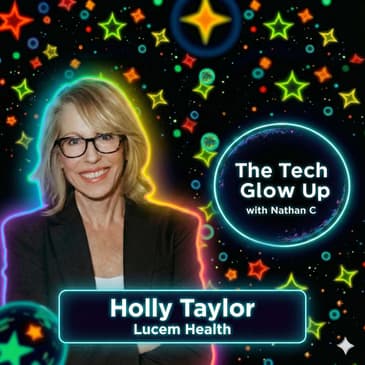
Holly Taylor was diagnosed with stage three ovarian cancer after selling her last company. Her rare form usually gets caught at stage one—99% survivable. Stage three? Different story.
That personal experience drives everything she does at Lucem Health, where she's general manager of strategic partnerships focused on early disease detection using AI to find patterns in patient data before symptoms even start.
Cervical cancer went from deadly to 99% survivable once pap smears became normal preventative care. Same approach could work for pancreatic cancer, lung cancer, type one diabetes—if we catch them early. But Holly's not just throwing AI at the problem.
Episode Highlights:
- Clinical research background spanning 15 years taught Holly to measure what matters and use data to make ruthless decisions without emotional attachment to ideas that aren't working.
- Cervical cancer survival jumped to 99% once pap smears became standard preventative care, proving early detection transforms outcomes for diseases like pancreatic cancer and type one diabetes.
- Healthcare represents 20% of GDP and employs more people than any other industry, which means disruption requires purpose and partnership with overwhelmed physicians and health systems.
- Keet Health scaled from 11 engineers fresh out of UT to 6 million patients and 30-40% of physical therapists nationwide by protecting innovation culture even as the company grew fast.
- Type one diabetes screening using BERT transformer models aims to prevent 60% of kids from ending up in life-threatening diabetic ketoacidosis before diagnosis.
Holly cuts through complexity with data-driven decisions and refuses to waste time on solutions that don't work. At Lucem she's focused on contracting that 17-year medical adoption timeline by building programs that educate patients and physicians while respecting the reality of stretched-thin healthcare teams.
Her magic wand wish? Fix healthcare reimbursement chaos so systems can focus on patient outcomes instead of survival mode.
Watch the full episode on YouTube https://youtu.be/oQpYlp35zmk
About Holly Taylor
Holly Taylor is a healthcare entrepreneur and executive with more than 30 years of experience at the intersection of patient care, healthcare delivery, and technology innovation.
She has founded and led multiple startups to successful commercialization in population health, clinical research, and digital health. Her ventures have delivered innovative solutions reaching millions of patients and tens of thousands of providers. Her career is guided by the belief that meaningful innovation uses technology to improve both clinical outcomes and the human experience.
Holly currently serves as General Manager of Strategic Partnerships at Lucem Health, where she stewards the commercial success of the company’s early disease detection programs.
A "glow up" signifies a positive transformation, reflecting the journey of becoming a better, more successful version of oneself.
At The Tech Glow Up, we humanize the startup and innovation landscape by focusing on the essential aspects of the entrepreneurial journey. Groundbreaking ideas are often ahead of their time, making resilience and perseverance vital for founders and product leaders.
In our podcast, we engage with innovators to discuss their transformative ideas, the challenges they face, and how they create value for future success.
If you're a founder or product leader seeking your own glow up, or a seasoned entrepreneur with stories to share, we invite you to join our guest list via this link.
Hey, it's Nathan. Today on the show. I'm thrilled to talk with Holly Taylor, VP of partnerships at Lucem Health. At Lucem. Holly's tackling the difficult problem of early disease detection, in many cases, finding a disease like type one diabetes before it gives you symptoms and makes you go to the hospital can be the difference between being able to predictively take charge of your health trajectory or having. Organ damage and traumatic experiences by going into shock and waking up, in the hospital under duress. The kind of work that Holly is doing is driven by her person first and patient first approach to solving some of the biggest problems in one of the biggest industries. Some things that she notes. Early detection and great data alone will not get us there as the pace in adoption of new innovation in the healthcare industry has historically been. Incredibly slow up to 17 years from idea being ready for market to being adopted by doctors, health systems and hospitals around the industry. How do we disrupt problems as big? As Type one diabetes and a monolithically slow healthcare institution. Listen in to my conversation with Holly Taylor at Lucin Health. And see you at Vive, the Vive event coming up February 22nd through 25th in Los Angeles, California. The tech Glow Up is going for live conversations with CEOs and go to market leaders of some of the most innovative health and digital health technologies out there. See you at the Vive event. And now here's Holly Taylor from Lucem Health. Awesome. Hello and welcome to The Tech Glow Up. Nathan C and today I am talking with Holly Taylor, general Manager of Strategic partnerships at Lucem Health. Holly. welcome to the Tech Glow Up. Thanks for joining.
Holly Taylor:Thank you for having me. I'm excited for this conversation.
Nathan C:Oh my gosh. Such a good way to start the day. can you start us off by just introducing yourself, and the innovative work that you do at Lucem Health?
Holly Taylor:Sure. my name is Holly Taylor, as you mentioned. I am the general manager of strategic partnerships at Lucem Health and at Lucem we are focused on accelerating early disease detection. By leveraging new technologies and I'm really excited to have joined the team about six months ago. They've been around for four years and I joined the party to really help. hopefully contribute to their success in this next phase of their development, which is, as you know, as an entrepreneur and somebody on the edge of so many startups that I always say, this is the most dynamic time they found product market fit. Now they're growing so fast. And how do you keep that spirit of innovation as you're growing and beginning to. Scale the company. it's so it's, a sweet spot for me. So, and I'm surrounded by super smart people doing really important things. So very excited to be here and, be a part of this.
Nathan C:Oh my goodness. you just said like, all of my favorite topics of discussion. so I really can't wait. can we get a little bit more specific about, what are some of the core problems and healthcare applications that you're looking to solve, with these dynamic applications of technology? who are you helping?
Holly Taylor:Yeah, so we're helping patients, we are helping patients, first and foremost by taking all of the data that you and I have from all of our encounters with healthcare providers and through other sources and. Deploying very sophisticated AI models to identify patterns that may indicate, the presence of early stage disease. And that's, a big nut that I just described. But very specifically what we focus on at Lucem, what the team has done is narrow down their scope to diseases where early disease detection can make an enormous difference. So I'm gonna give you two examples, Nathan. when I was younger and our doctors, as young women were telling us, go in and get your pap smear, the idea of cervical cancer was not, a real problem. It wasn't like we're hearing about breast cancer and lung cancer, but in my lifetime, essentially cervical cancer has been cured because. We have over decades made getting your pap smear a very normal part of your healthcare preventative care. And by doing that. 99% of cervical cancers are survivable. So now translate to if you, I'm sure you're already thinking of so many other diseases, that if my aunt had caught her lung cancer early, stage one, if, we could do these things in pancreatic cancer. We all know how Deadly pancreatic cancer is, but most of that is because we're not diagnosing the patients until they're in advanced stages where our options to intervene are very limited. I myself after, selling, my last company was diagnosed with ovarian cancer, a rare form of ovarian cancer that is generally highly survivable with great statistics because. If this particular cancer, you get symptomatic early, so most people are diagnosed stage one. I was diagnosed stage three, and so that brought me more in line with the traditional epithelial ovarian cancer as far as the mortality rates. But for me, early detection is personal, and I know firsthand. The difference about getting the news head, Hey, you're stationed now to be clear, I'm doing great. It was over three years ago. Haven't had a problem since my original surgery, et cetera, but this is very personal to me, and having spent the first half of my career working directly with patients, this just brings in all my experience, all my passions in my last 15 years in tech. To figure out how do we do this? So we've gotten now the AI models that can do this and the computing power and all those things that I know you understand so well, but you can present that. But then can you successfully deploy it? Can you help develop. A program around these technologies that helps us to educate patients, to educate physicians on the importance and to really, create an environment where patients have more options. so it's a worthy goal. And again, patients are at the top of it. There are North Star. Everything we do is to improve patient outcomes, but that also has a benefit. For our life science partners who are developing therapies for our health system clients, we have a really unique, multi-layered value proposition for all of these stakeholders. But the star on the Christmas tree is the patient.
Nathan C:The star. If every Christmas, if every health tech Christmas tree had a patient star on top, Holly, this I am. I'm so inspired by this story. There's five directions I wanna go in, but just there are two things that really stand out and one was when I was just at health, in October, Theme of, now have the computing power to start to be way more proactive and way further upstream. And when we identify and catch and diagnose, these horrible diseases. And how crucial that preventative healthcare that like focus on the basics can really be, to having a baseline and understanding when you need that extra level of help. And then again, this like personal connection to why early detection is so key. I, literally last night was celebrating with a dear friend who. Had an anomalous early detection of a really nasty, like colon cancer and had her surgeon saying usually people have symptoms when they come to see me. And usually this would be really scary, but because we caught it so early, like you might
Holly Taylor:It might just be okay.
Nathan C:minimal. and so like I've got goosebumps hearing. And just being that reminder of how important detection and screenings and, socializing, which kind of brings me right. You, you called out that it's really tricky. It's tricky to get patients to want to share their data. It's tricky to get doctors to try new things at all. what's, but it, this seems like the kind of problem that you're really excited to solve. So what's. What's your secret sauce or how do you approach introducing new technological ideas into the healthcare system in a way that it provides that patient value and is also, easy to implement and adopt,
Holly Taylor:I think it, for me, it's a confluence of my life experiences and my professional experiences, and that at my early career, it was direct patient care, worked in cardiology with interventional cardiologists. Then in research, at the provider level, so directly interfacing with clients, patients. I still pull out my Christmas cards for my beloved patients that I, worked with. I have that background and I also know how. Strained providers, physicians are what their limitations are. If you haven't worked in frontline patient care in a health system or an ER or an ICU, it's very hard to understand that it's not reticence for these, clinicians to adopt technology. It is just. Overwhelming amount of responsibility and then trying to incorporate these things into these kind of ingrained cultures and workflows. And so I think that's helpful and I think, we can't be cavalier about disrupting that. Operational or just the reality of healthcare. We have to be very pointed and, and really consider everybody, the patient, the provider, the nurse, the health system, how much more can they take on with all the other things that are happening? A lot of that, is also, deeply influenced by regulatory pressures, reimbursement pressures, federal. Guidelines around healthcare. There's just, it's very complex. It's 20% of our economy, it's 20% of GDP. Healthcare is the largest employer in the country. So if you think about true disruption, healthcare's too big to fail. So we can't just go in and start blowing things up. We have to do it purposefully. And the way I think about the work that we're doing at Luum is we're starting very targeted focus on certain diseases, early disease detection, and if we can prove this out. Then you can start to open the aperture about, okay, we can do more of this in these other areas. And some of our early clients are always already asking, we wanna do more, help us do more. And that is, that is such a affirmation that we are on the right track. so I lost my thought a little bit there, Nathan, but that's kind of the, those pieces of bringing it together. And again, it's not just, Hey, we've got. Technology and AI computing power. We are trying to fundamentally change ingrained cultures and behaviors among all the humans that make up healthcare.
Nathan C:Yeah, that. mindfulness, right? I was actually shocked by the number of healthcare leaders I heard saying, we're on a chasm. I'm ready for a paradigm shift. the level of change that practitioner innovators are ready for is quite large, This understanding, right? That these professionals are, and they're professionals, y'all,
Holly Taylor:Yeah.
Nathan C:that these professionals, are burdened by so many tasks, so many things to do that even asking for an extra two minutes in their day could really impact a lot of different threads and a lot of different patients. So Holly, I actually have two questions. Should I be, I love to call people by their proper titles. Should you, should I be referring to you as Dr. Holly
Holly Taylor:I am not a physician.
Nathan C:Okay.
Holly Taylor:I slept at a Holiday Inn last night, Nathan.
Nathan C:You've teased, this entrepreneurial background. So I'd love to know, how did you get here, right? Like you haven't been, a serial entrepreneur in excited about these health problems, your whole career. what was your journey, to where you are now, with Lucem?
Holly Taylor:So I started actually, my very first job in high school was working for a cardiologist. Just it was a good paying job and I ended up, by the time I got outta high school, I was doing all kinds of clinical stuff. But I liked it. but never expected to make a career in healthcare. You know, in my mind I was on my way to a PhD in literature and I was gonna be a professor, and that was like what I had in my mind. but ended up working in, cardiology and my twenties and I happened and what I would call it now as a startup. We didn't have that vernacular back then, but it was a couple of docs and 10 employees, and we grew that practice. Over the next 10 years into multiple service lines, huge business up and down the coast of, west Florida. And so I was in a startup and fast growing environment all those years, which was well suited for me because I was able to do a lot of different things from frontline patient care to administration, to strategy, to growing the business. I ended up seeing an opportunity for us to conduct clinical research. In these private practice community hospital settings and outside of the ivory towers of academia, and there's was an enormous value in bringing cutting edge research to our patients. Also where we were in Florida is where the cardiology patients lived. So it was also the, from a business value perspective where you could enroll the patients where you could, you know, be successful and, accelerate, the ability to get the research done faster, which has enormous value to, you know, life science partners. So I started an effort there and then, after about three years, had great success. I couldn't stop. Looking at the bigger problems. So I started my first company at 30 as a single mom with two dying parents at the time, which in retrospect was nuts. But you know how it is when you're an entrepreneur and you see, you see it so clearly that you can't not do it. So I did that. I partnered with, just, An unbelievable world class, team of interventional cardiologists around Florida, and we did that for 10 years. and our premise was to bring more research into their communities, their hospitals, but also to conduct our own. research because we wanted to understand our elderly patient population in Florida, and that was not something that was currently being done. So there was a real, heartfelt effort among the physicians to, we need to do better because I wanna know how I'm gonna treat the 85-year-old that still, he looks like a 60-year-old. He is playing, you know, golf five days a week. And I don't know, I don't have the research. So we built a homegrown registry. So that was my first foray. We grew the business. Every year I found a Niche rather working with, pharma companies in early stage, like phase two research. That was a great fit for us and we got to do a lot of really cool stuff left. That moved into the business side of medicine again for about six or seven years. And that was at the advent we were making this shift in healthcare from fee for service to value-based care. I had a CEO that I had worked with early in my career, recruit me to a portfolio company that had a, large physician group, a Medicare Advantage plan, an a CO, and I got to really understand what population health was. How are we going to transition our current operational model to these value-based care reimbursement models? And I loved it. I always say I learned more in that it was almost two years that I thought I knew a lot of things in healthcare by then, but I didn't know squat till I tried to do that. And then I, where I ended up and what took me to the dark side, Nathan, which is technology was. I don't have the tools I need. This is inadequate. I'm gonna go over there and try to influence what they're building. And boy was that when I got exposed to product development, all the things we could build, I was just enamored. Two weeks later he comes back with a prototype. I'm gonna change the world, but with my experience, these smart minds. So that's how I got stuck. And then, I had a run at a company called Zum Med that had an exit. They were now Waystar, went public last year and they had built up like a population health business. Left that, and then my real, Success on technology was I went to a company called Keet Health that was, acquired early on in, or, you know, I ca they brought me in really as a consultant. it was a early stage pre-revenue, you know, literally 11 engineers fresh outta University of Texas, two founders whip smart. I absolutely fell in love with this team and I finally said, I think I wanna run this ship. I've got a vision. let me take it there. but let me keep it as a separate, independently operating entity so it doesn't lose all the innovation. So I stayed for three and a half years. It was musculoskeletal health mobile patient app. We went from nothing to 6 million patients. About 30 to 40% of the physical therapists in the country were using it. And we had a very successful exit after that. to be honest with you, we were acquired by the largest physical therapy EMR, and I was a little heartbroken because I had bigger vision. but went on, you know, learned so much from those young people. Then went on and then, had my little dance with cancer, and then now I met loose.
Nathan C:Holly, I had such a hard time not jumping in four different times. I love that you kind of answered one of my next questions, Which is, how do you learn what's effective? How do you understand how you're impacting your customers? And your answer is I'm on the front lines. Like we took it out and that's where we found the opportunity. So Bravo like to discover and maybe this is like the benefit to being in healthcare first and product second is that you went direct to the audience, right? To the population you're trying to serve, literally to where they are, and learned about them, and then brought those ideas and insights back. this sort of like 10 person fast moving innovation unit, uh, is a hot topic right now, right? Like Reid Hoffman, Evan, the leaders at Snapchat,
Holly Taylor:Yep.
Nathan C:others are talking about these new. Less than 12 person teams and how one of the bloats in a large corporate apparatus is just all the meetings it takes to keep people informed and together and Right, one of the best times in any startup is in that like 10 to 15 person space where you're hand in the trenches seeing the real impact of the things that you do. So I love that you're sort of an earlier adopter of this very trendy, approach to innovation. And honestly, it feels so good to be, I had a client. respond back to me, send some feedback to me once. And it was so much fun where we could just test things, ship frequently, and learn as fast as possible. And it seems like you have a similar bug, as I do there. I am curious, one of the questions I always like, to ask is how people respond, when you hear new information or whether it's opportunity or a challenge. and how do especially when you're being so careful to be hand in hand with patients and, to not be disruptive, to caregivers and patients. How do you, how do you like to adapt or re. Excuse me, I'm gonna try this question again. I keep running. Holly, I your, focus on research has me very interested in this next question, which is, can you share some instances where you've adapted or refocused when, your work, when you've had new information, whether it was about opportunities or, or challenges in the kinds of, products you're building.
Holly Taylor:Yeah, that's a great question. I think when you live in that research world, which I did for almost 15 years, it's all based on data, right? you know, we've democratized how we use data to the entire world now with all of our technology adoption. but always going back to what is the actual value. So if you think about clinical research and developing a new pharmaceutical or a new therapy, it is very. Objective. and so I carry that with me. in looking at what is the information we need to look at? What are we measuring, right? We talk about measure what matters, all of those things. But in real, that's important. If you're not measuring those things, you will go off the rails in. In a month a quarter or two, and there's no recovering. And so if you're watching the right information, and by the way, gathering the right information, you should be using that consistently. And that forces you to be very pragmatic. There's no arguing with good, solid data. So you're not doing that internal debate about. we'll give a little more time. We'll see if this happens. No, no, no. The data's telling you very clearly this is not going to work long term. So that's number one. Number two is I do think. to be honest, one of my strengths is I can be very tactical and in the now, but I'm always thinking three, five years ahead and all the other factors that are gonna impact what we're doing, the decisions we're making now and how's that gonna pick impact our success in a year or two or three years. The last thing I'll say is you gotta use that data to cut the cord. One of the things that I learned at KE from that young team was don't be so emotionally and invested in a decision that you made and that you wanna be right. That you're not gonna say, this isn't working. We're scrapping six weeks worth. Six weeks worth of work and we're gonna pivot. they really helped me to get ruthless about that. And I think ruthless decisions as a leader is the only way you can meet success, especially in healthcare.
Nathan C:There's, this follow up question about like, how do you bring like a leader. It who has to manage both the long term vision and these short term strategic decisions, is often the person who is most comfortable kind of living in multitudes, living in a duality and product teams. So often want to get it right, often want to win on the first time. And even though they're very open to iterating and growing, and so there can be a little bit of a clinging to the original plan was this. Or our short term is this, like why are we talking? How do you as a leader, this is a little off script, so take it as you will,
Holly Taylor:Yes.
Nathan C:a leader, how do you approach communicating and keeping people on board for both that sort of long term and the short term needs of the, kind of work that, disruptive technology requires?
Holly Taylor:I think it's it's say you gotta have the right team, and then it's, a matter of that cul we talk about culture. Culture isn't so important, but I think it requires some core ingredients in the individuals that you're working with, which is. Do they have intellectual curiosity? Are they humble enough? We just talked about the ego of saying, yeah, we called that one wrong. do and do we have that culture to support that person when I'm still bought into the original vision we have. And then you come to a meeting, you go, Holly, I think we're off the rails. Can I sit back and go, well, tell me about what you're thinking and that culture requires so much care and feeding. It's very easy to let go of that. And I had to tell you, if I was 20 years old again, I think I would study organizational behavior.'cause I'm so fascinated about those success ingredients that I know you see all the time and the work you're doing. Like you see pockets of it. But I honestly, in my past at KE, I said. Hey, we need to lower our standards and we're hiring the engineers. We're not going to get 10 A players like you guys, darn it, if they didn't prove me wrong. And we kept that spirit of innovation, even as we got bigger and bigger. And I was convinced we were gonna start losing it. And somehow we kept it glued together. And that was more about the team than it was about me, in my opinion.
Nathan C:the culture definitely sets your path, time and time again. Oh, I could dive deep on this with you all day, Holly. but the next. Question starts to look at goals, right? And the show is the tech Glow Up. A Glow Up is a notable transformation or a rebirth even, in the next six months. How are you looking to elevate your work at Lucem?
Holly Taylor:So I'm currently focused on, a project that is a difficult one. that is, it's our first rare disease, which is type one diabetes. which most people my age referred to as juvenile diabetes, but in reality, there's a higher prevalence and growing prevalence in the adult population. And so going back to our technology, we're using our most sophisticated model. It's a Burt Transformer model to deliver. Lists of patients that should probably be screened for type one diabetes. But what I'm focusing on as we finished our first implementation, we're just now starting, patient outreach to understand are we doing what we think we're gonna be able to do, and how do we continue to improve the support that we provide our clients and expanding our solution offering. Some of this is gonna be. Partnerships to help health systems implement this. And then some of this is, you know, continued refinement of technology offerings and expansion of technology. So we have a lot, it's a very dynamic period for the next six months. And then I would also say the big picture. that I wanna carry forward is, there's a problem in healthcare. You may have heard this, that after a new therapy or a new discovery is introduced and proven through research, let's say it takes on average 17 years for that to be broadly adopted within the medical community. And if, if you put that out on a timeline and explain that. It is additional real, world experience. So here's an example that you can probably identify with. A physician says, I'm not gonna use that drug just got approved. I'm gonna wait a couple years to make sure nothing happens, even though there's been 10 years of research on it. Right? I get it. Whatever. but, you know, so there's a, that's a piece. And then the, continued collection of real world data experience and culture change. And you always have your early adopters, your doctors who are willing to use that new device or things like that. But that takes 17 years before your doctor in rural, you know, Nebraska. Says, oh yeah, of course you have to take an aspirin. You've had a heart attack. That needs to be what you have. It takes so long. So I'm really big picture figuring out what are we doing at Luum to contract that 17 year period and what does that mean for improving patient lives? How do we do that no matter what the disease focus? and that comes into that scalability and value impact over time. First and foremost, make T 1D identification successful because let me tell you, you talk about making the hair on the back of your neck stand up and goosebumps these stories of children. 60% of kids with type one diabetes end up in diabetic ketoacidosis, which is life threatening. They have medical trauma from it. If we can prevent that, my work on this planet will have been worth it.
Nathan C:That, when you talk about like preventative care, right? But when you put it in terms of like when you don't know you have type one diabetes and you have an incident, you often pass out and have to go to
Holly Taylor:Yes.
Nathan C:and wake up surrounded by doctors with like scary, right? And if you can avoid that and the, injury that can happen from going into the keto the acidosis. many benefits for people that we really wanna be caring for. so Holly, you're working, like you, you admittedly go for the hard, juicy problems. If there were one magic wand, if there were a magic wand that you could wave and remove the biggest blocker from your team's path what would it be?
Holly Taylor:It's a meaty question. to be honest with you, at a macro level, it's challenging to make big shifts in healthcare because of our reimbursement models are so bizarre, frankly, and inconsistent you know, the health systems. have to keep the lights on and they have to make ongoing difficult decisions every year based on regulations out of Washington, how commercial insurance payers are paying, is there Medicaid funding? And that's just slowing everything down. So probably not the answer you expected, but if I could wave my wand, it would be to have some consistency and predictability. How healthcare is paid for. for many years I resisted the idea of single payer or even universal, but single payer reduces that Complexity. I think that's the first time I've ever said that out loud, that I think that is the only logical, into this, or we're just gonna continue to Lose people unnecessarily because our health system is so dysfunctional.
Nathan C:Yeah, on public radio news on my drive home last night, the yearly increase of cost, is driving us toward of our GDP being spent
Holly Taylor:Yeah.
Nathan C:healthcare, and that's just not sustainable. so Holly, you've actually dived, quite deep into the next question that I had, which is like, how do you like to approach difficult problems, right? your focus on data and customers was just so Clear. I think I'm gonna just jump, one more over and, I know that almost every entrepreneur has had at least one mentor, coach or guide who has just been transformative, in their journey. And usually it can be as simple as just saying I see what you're doing. Don't stop. can you share a moment where a mentor or a fan or a coach helped you level up?
Holly Taylor:I think I've been blessed by so many, collaborators and CEOs in my career, and I mentioned earlier that the, first large cardiology practice I worked in, we did amazing things 25 years ago. And I think just everybody I worked with and when we all went on to work other places, we would call each other and go. Nobody else works like we did. Like, well I don't get it. You know? And so I think, but also the leaders that as a young woman that saw something in me that was different and gave me the opportunity to implement a large scale research program, all those things, I don't think at the time I fully appreciated how amazing that was. And then, That grace continued on in so many of my other endeavors, people that believed in me and gave me an opportunity and mentored me cardiologist partners in my first business. Were the most wonderful mentors. They were all brilliant, all polymath, you know, like sleeping four hours a night. They were so I couldn't keep up with them, but I just sucked it in like a sponge, and they just fed the beast. so many of them continue to inspire me today. And then I would say our team at KET was just. They taught me so much, and inspired me. and the last, actually, I'm just gonna keep going on Nathan. My last one is my current CEO at Lucem Sean Cassidy is the only other person on the planet that I would work for, and he absolutely gives me the grace and the bandwidth to think things through and support me, and he's such a good human. He's measured and he's kind. but he has a big vision too. So I've just been, I mean, honestly, I've been very blessed.
Nathan C:love it.
Holly Taylor:that is my father. My father was a naval aviator, navy, you know, officer and a intelligence officer later in his career. And he had, there's five kids in my family, four girls. A younger brother, he had high expectations for us. He, but it was never, we had to live to our fullest, capabilities. The biggest sin in my family was to not live up to your potential. If you couldn't do it, you couldn't do it. But I remember as a child saying, I can't tie my shoe. And he would say, wait a minute, we don't use the word can't. You can say, you can ask for help. Show me how to time my shoe. I can't time my shoe yet, but I will. And that was ingrained in the way I thought and saw the world. So I think it all begins with that. That was a long-winded answer, Nathan.
Nathan C:Where you got us, Holly is having a leader. Who trusts you enough to give you the opportunity to grow. And having the curiosity to always be adding and learning can do outrageous things, for an innovator's Career. bravo. I love the journey. It's time for the speed round. Are you ready?
Holly Taylor:I guess break it on
Nathan C:So if there was one key takeaway, that our listeners should walk away from our chat today, in one sentence, what would it be?
Holly Taylor:healthcare is hard,
Nathan C:Yes. what quarter is your brain currently focused on?
Holly Taylor:Definitely Q1, followed by 2027.
Nathan C:Yes. Awesome. that foot in the soon and the foot in the far, I love it. And, do you have a spicy soundbite to share? Maybe a hot take on technology, trends, culture, or otherwise?
Holly Taylor:My mind just went blank.
Nathan C:You can pass.
Holly Taylor:Necessity is the mother of invention. It's old, but it's so applicable in healthcare. we have to solve these problems and be forced to do it. before any major disruption's gonna happen.
Nathan C:That was pretty good, Holly. how can people follow up and learn more about the work that you're doing?
Holly Taylor:Please follow OME Health on, LinkedIn. We don't have a real presence on social media. I have. In recent years been a little social media adverse just because I get distracted and, you know, there's a lot going on in the world that I like to manage. but I'm trying to do better about getting out onto, LinkedIn and sharing some of the great work we're doing. So I'd ask that you follow both me and ome. On LinkedIn and reach out to me. It's simple. holly@lucemhealth.com. Always interested in engaging with innovators, people working in the healthcare space. And Nathan, I hope we'll get to stay in touch'cause I've loved every minute of this. And the next time in Portland, I'm gonna take you out for a coffee or a drink if we can make it happen.
Nathan C:Oh, I am always down for a Portland coffee and, we can customize based on your personal preferences.
Holly Taylor:That sounds great.
Nathan C:I'll have to look you up when I'm in Austin
Holly Taylor:Please do.
Nathan C:Amazing. Holly Taylor General. strategic partnerships at Lucem Health, bringing high quality predictive medicine to patients that can change their lives and hopefully making, hopefully helping anyone with type one diabetes avoid, a scary emergency to learn about their diagnosis. Holly, I'm so thrilled to learn about your patient centric, team focused, approach to innovation. really just a lovely inspirational story. couldn't think of a better way to start met Tuesday. Thank you.
Holly Taylor:Thank you so much.
Nathan C:If you've made it this far in the podcast, I really appreciate you. Thanks for listening. Please make sure to like and subscribe so that you never miss an episode of the Tech Glow Up. And hey, can I ask you a favor? If you really enjoyed this episode, could you share it on your Instagram stories or maybe post the link with what you enjoyed on LinkedIn? The sort of sharing and engaging really helps small podcasters like me reach the audience that I know really cares about these kinds of conversations. If you've made it this far in the podcast, I really appreciate you. Thanks for listening. Please make sure to like and subscribe so that you never miss an episode of the Tech Glow Up. And hey, can I ask you a favor? If you really enjoyed this episode, could you share it on your Instagram stories or maybe post the link with what you enjoyed on LinkedIn? The sort of sharing and engaging really helps small podcasters like me reach the audience that I know really cares about these kinds of conversations.