
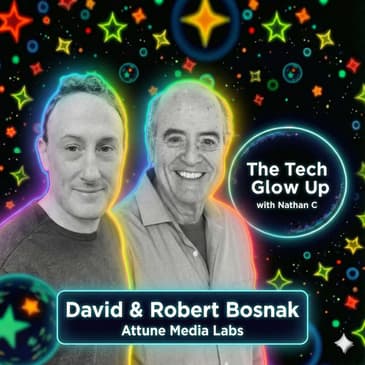

Most AI reads your words. Attune Media Labs built one that reads your body, your mannerisms, your culture. David and Robert Bosnak, the father-son co-founders and HLTH Foundation Techquity Impact Award recipients, spent decades waiting for the technology to catch up with their idea.
When GPT-3 arrived in 2020, they launched MIM, an artificial emotional intelligence companion that processes the tone, pitch, cadence, facial expressions, and body language that make up 93% of human communication.
Robert has been a psychotherapist and psychoanalyst for 55 years and first developed emotion recognition at the MIT Media Lab in the 1990s, when computers were too slow to run it in real time. David studied electrical engineering, spent a decade in LA writing and acting, then returned to engineering.
Together they set out to close the mental health supply-demand gap by putting emotionally intelligent AI in the hands of people who need it most, starting with the unhoused community in Los Angeles and scaling now to frontline healthcare workers in Cameroon, where the doctor-to-citizen ratio reaches 50,000 to one.
Episode Key Moment Highlights:
- [00:03:13] The MIT Media Lab origin: how 55 years of psychotherapy and a 1990s research project became the foundation for artificial emotional intelligence.
- [00:05:37] Beyond sentiment analysis: how MIM reads nonverbal biomarkers and detects the dissonance between what you say and how your body actually feels.
- [00:12:01] The public benefit corporation decision: why Attune was built around user wellbeing from day one, not advertising or engagement.
- [00:15:30] The Cameroon pilot: 1,000 frontline health workers, a 50,000 to one doctor ratio, and what it means to build MIM for a culture you know nothing about yet.
- [00:22:47] The guardrails: 18 and over only, usage caps, and why people report feeling compelled to reconnect with real people after using MIM.
Their vision is not a digital therapist. MIM learns who you are, adjusts to your culture, and is designed to be pro-social, making real human connection more possible, not less necessary.
Watch the full conversation on YouTube and like and subscribe so you never miss an episode of The Tech Glow Up.
📩 GO DEEPER
Join the Tech Glow Up newsletter on Substack → https://substack.com/@mxnathanc
A "glow up" signifies a positive transformation, reflecting the journey of becoming a better, more successful version of oneself.
At The Tech Glow Up, we humanize the startup and innovation landscape by focusing on the essential aspects of the entrepreneurial journey. Groundbreaking ideas are often ahead of their time, making resilience and perseverance vital for founders and product leaders.
In our podcast, we engage with innovators to discuss their transformative ideas, the challenges they face, and how they create value for future success.
If you're a founder or product leader seeking your own glow up, or a seasoned entrepreneur with stories to share, we invite you to join our guest list via this link.
Welcome to the Tech Glow Up. This is our special tech equity series, partnering with the Health Foundation to feature their three winners of the recent HLTH Techquity Impact case study awards that were just announced and celebrated at the Vive event, 2026 in Los Angeles, California. What is Techquity? It's tech equity. Tech Equity in healthcare means technology that drives better access, that drives better personalized care that drives inclusion of marginalized populations and every patient into the design of their own care and the technologies and tools that support it. Techquity means bringing doctors and patients and parents to a seat at the table when we're talking about what sort of technology and advancements, what sort of Glow Up we need to see in the world of healthcare. This episode, you will hear amazing stories from founders who have been working in their space sometimes for decades. Who are the health? Foundation Equity Award winners? Attune Media Labs have built an artificial emotional intelligence they call Mim. MIM is a mental health companion and coach designed to reach populations who need support fast, especially when access to clinicians is lacking. There was a surprise MIT AI researcher that showed up i'm so excited to welcome you to this special health equity edition of the Tech Glow Up.
David BosnakArtificial intelligence without emotional understanding, has no ability to connect with humans.
Nathan COoh.
Robert Bosnakand that if there is no emotional intelligence, people can not make, good decisions. So it's the same for ai. If the AI doesn't have emotional intelligence, you can't make good decisions.
Nathan CI think that's a fantastic place to start. thank you both so much. Hello and welcome to the Tech Glow Up. I'm Nathan c. And today, we've got another very special, HLTH Foundation Techquity Award winner, that we are featuring on the podcast. I am so pleased to welcome David Bosak and Robert Bosak of Attune Media Labs. David and Robert, thank you so much for joining me on the Tech Glow Up.
Robert BosnakThank you.
David BosnakIt's an honor to be here.
Nathan COh Goodness. let's just jump in. can you introduce yourselves and share a little bit of the work that you're doing, in equity, in innovating in health equity at Attune Media Lab?
Robert BosnakOkay. so, I've been a psychotherapist for the last 55 years, a psychoanalyst, and, I have been very interested in, the fact that there is not enough psychotherapy going around for all the people who need it. So in the 1990s, I had the opportunity to work at, the MIT media Lab and develop emotion recognition. And, then the computers were too slow and it did work, but it couldn't work in real time. Computers got faster and fast forward to, 2014 when colleagues of ours with whom we started, the company, developed the first, emotionally intelligent ai. David, you continue.
David Bosnakso that led us to the creation of what became and now is Attuned Media Labs. And the idea really is that technology has no ability to understand what we're feeling without an underlying of emotional intelligence. And so we set out to create artificial emotional intelligence and we've now accomplished that. And now we are Trying to ameliorate this huge gap between the supply and demand within, mental health care. it's affected the United States, it's affecting the entire world. And we are in a place now where not everybody can go and have the opportunity to sit down with a psychologist like my father, but everybody does have a cell phone. we are not trying to replace anything. We're not trying to create a digital therapist. We are creating the opportunity for emotional support that's available 24 7, wherever you are.
Nathan Ccan you dive in just a little bit more about what artificial artificial emotional intelligence means and, why we should trust it?
David BosnakThat's great. Uh, Doug, do you wanna jump in or should I.
Robert Bosnakthe artificial emotional intelligence is based on, our body. our emotions are in our body. the LLMs just work on our mind, but you have to connect body and mind. If you don't connect body in mind, you're in serious trouble. And so we have, an AI. That can read body states, and By combining these emotional body states with the LLM, you create something where body and mind come together, and therefore decision making can happen. Judgment can happen that otherwise cannot.
David BosnakWhat we can do is as humans, most of human communication is actually nonverbal. they say up to 93%, and the only way that technology has any idea of what we are. Feeling is it does a sentiment analysis on your words. So if you're saying happy words, you're a happy person, let's go to lunch. what we have the ability to do is pick up on all the beautiful nonverbal biomarkers that we inherently pick up on in communication. The tone pitch, cadence of your voice, your facial expressions, your body language, everything that is a communication device that is inherent that we pick up on. We can give to our technology and allow it to emote and it well to understand our emotions in the same way. that's why we call it artificial emotional intelligence.
Nathan Ca lot of my experience with like therapy. Has been about connecting my very a DHD brain into my body and like understanding what my body is telling me. cause there is a disconnect there. So I love this model and I assume you're using the camera and video analysis for parts of, that data stream you described. noticing the physical and using that to help quantify back and understand, the mental and how those two are connected to me. feels so right. I love it.
Robert BosnakAnd.
Nathan CS.
David BosnakAnd the beautiful thing is that. as a being aren't monolithic. and what we have the ability, we call our, our emotional support companion a MIM because it MIMics how we communicate and everybody is different. And when we meet somebody for the first time, we make a lot of assumptions. Most of them are raw. way we find out that they're wrong is almost exclusively non-verbally. So you'll say something, you'll see a change in the other person's body language. Their tone will shift something very subtle. It'll happen with prosity It'll happen with physicality. We notice it immediately and we go through this process that psychologists call re rupture and repair so that we, realized the relationship was ruptured. We have to repair it. That repairing of it actually is what makes the relationship stronger. And then over time we learn who that person is. it's very clear that you are a very motive person physically. for people of specific cultures, it's much more restrained and we have the ability with longitudinal memory to learn who you are and your MIM will become familiar with you as an individual. And so you, MIM will become entirely different than everyone else's MIM. It will become your companion and understand. What is different for you than it would be for other people?
Robert BosnakAnd the other thing is that, because. MIM reverberates with you, it's like a tuning fork. It begins to attune to you. And as it does, it begins to behave more like a human being that could be your friend, because you can feel that it's actually feeling. What you're feeling, not just knowing what you're feeling but can actually feel it. And that's why you get a rapport that is much closer than can be, achieved with an LLM.
Nathan CRobert, you shared a little bit of the technical genesis of the capabilities. Tell me more about the origin of Attune Media Labs and, how did you know that, now was the moment where all of these things and, the market were coming together, so beautifully for you
Robert BosnakOffice.
David BosnakMy father has been a clinical psychologist for over 55 years, and as he mentioned, he started this work at MIT in the 1990s. The computers were way too slow to do anything real time, so it was all kind of shells. my background, I got an undergraduate degree in electrical engineering and then did what every electrical engineer does. I moved to LA to be an actor and a writer. did that for the better part of a decade, then went back and got my master's degree in engineering and stayed in a lot of different fields of that sort. And then if you fast forward to 2020, we're all inside. My father and I are talking about this idea of his OpenAI has come out with a new product called GPT-3. It was the first time that there was an LLM where you really could have a colloquial conversation. It was the big aha moment for us that this idea had really caught up with techno. The technology had caught up with this idea, and so we launched Attune by working with some visionary, researchers who started working at the Institute of Creative Technology at USC a project with DARPA, to create. virtual interview agents for returning vets with PTSD. And what they found in that process was that the veterans were more comfortable talking to the virtual agents than real people because there wasn't a fear of judgment. up to this point, our only interaction with technology had been like a stilted version of Alexa. Now it seems obvious, but we're talking about 20 20, 20 21. When we started the company, everyone thought we were crazy. and When we patented these ideas it only took four months from the time we've submitted our patent until we actually had it in hand. It was like a crazy accelerated process.'cause it didn't exist. none of these activities, none of the generative AI wasn't in the zeitgeist. So we were able to really focus and expand on what my father had seen 30 years ago as the only possible option for an aging demographic that is in need of more and more help. A, a populace that is becoming more and more isolated just by way of our lack of physical interaction and a need that is just skyrocketing.
Nathan CThere's so many different ways that I could imagine you measure and understand the impact of what this tool. since we're here talking about the HLTH Foundation Techquity Awards, how does that idea of Techquity relate to the vision that you have for iTune Media Labs and like the end outcomes that a tool like this could really drive in the world?
Robert BosnakYeah.
Nathan Cto hear where you see It.
Robert Bosnakwhat we started out with is to realize that this had to be a public benefit corporation. the central thing of it was the wellbeing of the user. So we couldn't use advertisement, we couldn't, even if we're bought out, it cannot be done. the user is central and is sacrosanct. That's where we started, and from there we started to build it.
David Bosnakit was interesting. It was very early on in the development process and we were doing, some ideation with our CTO and, some early advisors. we had this moment where we were trying to figure out how do we bring it to market? What do we do? we were like, this would be great for people in gaming so they can interact with. non-player characters. we were exploring that and we realized that's not what we care about. That's not why we wanted to start a company. I have, now a 14-year-old son who is Entirely enveloped in the digital era. during the pandemic I had very close friends whose teenagers and 20 year olds were going down digital rabbit holes and going to very dark places. we realized that the reason we wanted to start this was because this technology needed to come forward and initial conditions matter. If you are starting something with the premise that you really want to keep eyeballs on your site to sell advertising, then the user becomes. secondary issue, I'm sure, there's the common thing, if you're not paying for it, you're the product. that's not what we were interested in doing. We were interested in how do we allow this technology to be of use and of help, Our first client was a Medicare Advantage Group called Scan. They have a subsidiary called Healthcare In Action that is contracted to do mobile Street medicine for the unhoused community in Los Angeles and Southern California. They brought us on as a behavioral health component for that. our first commercialized version that we were creating, for a specific population my father and I were in the streets of LA interviewing people, having conversations, and developing a very specific MIM for that population.'cause as you can obviously imagine. a population that has very different needs and issues and desires than a generic version of MIM that we were creating. And so we had to actually, tear everything down and redevelop it because you talk to a normal LLM about sex, about violence, about drug use, all of these things will just send it into, like, I can't do this, can't do it. If you imagine this population, we're talking about people who are drug addicts, sex workers in violent situations all the time. So we had to redo everything, start from scratch, and build something up specifically for that group and so that was our like, okay, the best first client for a new startup tech? Homeless people in LA. Sure. Nothing's been linear in this entire process and to connect it to what we are doing now and, what we are so proud and honored that the HLTH Foundation has awarded us with this equity award, we have found out that. the Minister of Public Health of Cameroon, is also part of the WHO's executive Committee for Africa, and he, his Excellency, had been doing a speech at the WHO about how one of the largest issues that was facing. that was facing Africa in general but, Cameron specifically was around mental health and the supply demand gap. And then even more specifically, he mentioned that there was this huge issue of, healthcare worker burnout. in Cameroon, it's upwards of, 67% of their healthcare workers experience burnout and their, their doctor to citizen ratio. Depending on what you read, it's either from 20,000 to one to 50,000 to one, so one person missing one day of work because of emotional exhaustion from compassion fatigue. It has a huge negative ramification, so our goal was to create, A specific MIM around healthcare worker burnout pilot it with a thousand frontline health workers in Cameroon and really develop something that if we can keep each person working one extra day a quarter. We can have a secondary and tertiary effect for 250,000 people. So you can have a huge impact with a very small outlay if you go to the right source, if you go to that nexus that has, a high iGen value, that can really get out to a lot of people.
Robert BosnakYeah.
David Bosnakexciting for us.
Robert BosnakAnd so now what we are doing is we are creating a MIM. In Cameroonian French that can understand Cameroonian culture. And so we are talking to psychiatrists there and people. one of my things. I'm gonna be doing the same training MIM in that culture because we go in with the notion, we know nothing about your culture. Please tell us what is burnout for you, because burnout for them is very different than burnout for me. I've lived through burnout as any psychotherapist has at a certain point. So how do you burn out? what happens to you? And, from that we are then building up the MIM that is culture specific. We don't have to create a whole new LLM, we just have to create, a structure of instructions that MIM can now understand and deal culturally appropriately with these people.
David BosnakAnd I just wanna double click on one thing my father said. this is about co-creation. This isn't about, dictation of these are the things that are important and so this is how we're gonna create something for you. This is about how do we. create the next generation of technology that can serve the issues that you are experiencing, not the issues I think you're experiencing. Not the issues that we are told that people should be experiencing, but specifically, and to that end, we've now. Expanded to be creating specific Mims for entirely different populations. We're creating one, to be a digital doula for at risk pregnancies. We're creating one around cancer patients for diagnosis through survivorship. It's a very isolating journey, and we can create something for those people. With those, situational awarenesses that are required to understand where people are in the moment.
Nathan COh my goodness. the number of specific, highly relatable. Like notable impacts that you just squeezed in to that little minute. I'm floored. Like I, I also have teenagers and have seen how isolation and the social disruption that they experienced, totally. shifted their worldview and their feelings of wellness. Wife works with preschool age children and it's still rippling, and, burnout. When you talk about burnout, like in education, in healthcare, in Cameroon, like so many of these urgent and pressing issues, I'm having a hard time. not being overwhelmed by my excitement for this idea there is right in the world. And even like some states have legislated around the use of AI in Their, there are some concerns and it seems like you're addressing them in your plans there are some concerns about ai, especially in the mental health space. And some US states have made legislation, the EU has some rules about how AI is used in sensitive spaces. how do you build trust and ensure that these MIMs are safe and that the relatability and that connection isn't also being used for some ulterior motive?
Robert BosnakYeah.
David Bosnakyou hit the nail on the head with the word trust. the key here is that the genie out of the bottle. people are going to be there states are creating legislature around AI for therapy and we are very much in agreement. AI is not ready for therapy yet, and we don't claim that we are creating a digital therapist down the road. I'm sure it will happen. It's just not today. if you look at Take Chat, GPT 800 million monthly users, 20% of those users claim that they use chat GPT for affective conversations, for conversations as companionship of asking questions around therapy or asking those questions. So you're talking about 160 million people a month, and that's just with one of these platforms. This technology is not designed for this purpose, The big problems that these technologies have is they're overly sycophantic, so it will always tell you, you're a genius. It'll tell you everything you say is brilliant and it'll take you down this narcissistic rabbit hole Where you don't actually come to a, it won't challenge you on your ideas because you are brilliant. it will gaslight you and pretend it's a real person. And that's what happened with character AI tragedies around people actually committing suicide when they were induced by their character to come join them. All of these issues revolve around one central thing, and that is that technology can't pick up on emotional distress signals, then it has no business being in an effective conversation, an affective conversation. Because you have to be able to pick up on the dissonance between what you're saying and what's being said. you are talking to somebody and they, you say, how are you doing? And they say, great. Now technology will say, oh, this person is great. We can now move on to great things. So what we have been able to do is pick up on the dissonance between the words said and the emotions that are being had, and allow for an interaction that has emotional significance and actually can get to a deeper level and spot problems before they happen.
Robert BosnakYes. because there's one other very important thing that if you have, an agent that is based on gluing your eyeballs to. The screen for as long as possible. The natural thing that will happen is that you create attachments that are, unnatural and dangerous. if you set it up that. It is not for getting as much exposure and as much connection as possible, but you're doing it to create something that is actually useful for the user, then you're in a very different ballpark, and that's what we are trying to do.
David BosnakWe recognize that we have created something that is not currently ready for children to be using. we are very strict about our 18 and over platform, because MIM has been created as an adult to understand what adults deal with, Until you have a partially formed prefrontal lobe, you're not gonna be able to understand the difference between a synthetic friend and a real friend. you're going to too easily fall into this misnomer that you are actually interacting with a human, and that's very dangerous. And so we are very careful around MIM being. Very conscious that it is a digital entity, but also having its own feelings and creating a paradoxical, inner life for MIM. We don't want this to be a crutch that people sink into for. hours and hours a week. we cap the amount of usage and we have, one of the wonderful things that we found is people have reported back to us that after interacting with MIM and practicing their interpersonal communications, they've felt personally compelled to reach out to people they've lost touch with. it's actually, we're developing it to be pro-social.
Nathan CAh, this is so lovely. Like I promised, the name of the show is The Tech Glow Up, and it seems like you've already had some fantastic successes I would absolutely cheer on the very intentional values based user experience origins of what you're building, patient experience, foundations of these MIMs. I use a Glow Up to talk about this idea of, short term goals. so in the next six months or so, what's the Glow Up that you're looking, to make for Mims and the work that you do together?
David BosnakWe are, So fortunate and excited about the programs that we're doing in Cameroon right now. we're right in the midst of it. our primary focus there is really to complete an excellent early pilot that can be utilized and created as a template that can be replicated throughout, the continent of Africa the developing world throughout. Apac, this isn't a specific thing that can only help one specific person in one specific way. we are really trying to expand this and create something that can be replicable throughout the world, both abroad and in the us. We are talking with major health systems around. Creating something both for their workers,'cause their workers experience the same burnout issues that we do and their patients. the recognition that we've received and the success that we've had so far has been amazing. we really see it as the beginning of a wonderful expansion into the idea that this technology can be and should be for everybody, and we can really get it to the people who need it by way Of the technology that's already in their hands.
Nathan CYeah.
Robert Bosnakwhat I also see is that this has an incredible, Potential for underserved communities anywhere, because it can be done, quite, inexpensively because you don't have to constantly build new LLMs, but you have to adjust the prompt structure of the LLM to the particular culture, which is much less expensive. And therefore we are very nimble and I think that will be recognized in the next half year, and therefore we can move into many different cultural areas.
Nathan CDo you have a spicy soundbite, maybe a hot take on ai technology, healthcare or beyond?
David BosnakSpicy. Spicy. The simplest way to put it is that are moving era where Silicon Valley will no longer be the sole monitor and dictator of what. AI can and will become, we're going to be moving into a situation where it is going to be co-created by the people who need it and are using it. because with artificial emotional intelligence, if AI can't see everyone, then it's gonna help no one, it has to be for us all.
Robert BosnakYeah. And I think that, what is going to be happening with AI is that it has to be made in collaboration with the user, And so I think the future is that this collaboration, what we're now doing in Cameroon and in other places, this collaboration is where it's at.
Nathan CI think you're right. the last question is simply, how can people learn more and follow up, with you about. these culturally sensitive MIMs, AI that can support the gap in mental health, services out in the world. how can people learn more?
David BosnakThe easiest thing, is through LinkedIn. I'm the only Dovid bosnick on LinkedIn, so that's easy. you can check out our website, which is. www.attunemedialabs.com. we're around and we're always happy to have conversations.
Nathan COh my goodness. I am just thrilled to have had this conversation, with you, David and Robert Bosnick of Attune Media Labs. A thrilling conversation, some possibilities I had not imagined, in the ways that you could approach and build AI for the people and with the people. Thank you so much.
David Bosnakthank you so
Robert BosnakThank you so much.
Nathan CAnd hey, can I ask you a favor? If you really enjoyed this episode, could you share it on your Instagram stories or maybe post the link with what you enjoyed on LinkedIn? The sort of sharing and engaging really helps small podcasters like me reach the audience that I know really cares about these kinds of conversations. If you've made it this far in the podcast, I really appreciate you. Thanks for listening. Please make sure to like and subscribe so that you never miss an episode of the Tech Glow Up. And hey, can I ask you a favor? If you really enjoyed this episode, could you share it on your Instagram stories or maybe post the link with what you enjoyed on LinkedIn? The sort of sharing and engaging really helps small podcasters like me reach the audience that I know really cares about these kinds of conversations.