
Get a front row seat to the conversations about AI, AR smartglasses, and the future of enterprise technology from Augmented World Expo 2026.
For six or seven years, the XR industry has been selling upgrades to people who already believe. Better resolution, more compute, a sleeker strap — for the same early-adopter audience already wearing a headset. I kept waiting for someone to answer the obvious question: when does this technology reach anyone else?
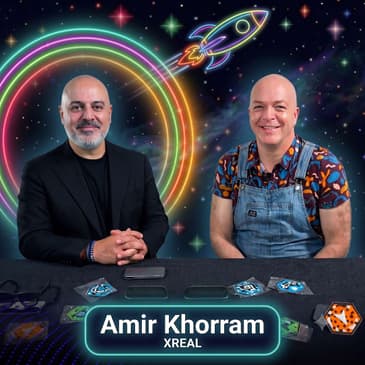
Amir Khorram, Head of Enterprise at XREAL, is back on The Tech Glow Up — we recorded this one live at AWE in Long Beach — and he had the most concrete answer I have heard. XREAL Aura is a full AR device built in collaboration with Google (Android XR operating system) and Qualcomm (Snapdragon Reality Elite Platform). Lightweight, wearable, designed for multi-use deployment, and enterprise-ready: MDM integration, kiosk mode, custom app stores, and the data privacy track record of Android — a platform with hundreds of millions of devices deployed globally. Seventy percent of the XR industry already works on Android. Aura meets enterprise buyers where they already are.
Episode Key Moment Highlights:
- [00:00:00] Aura explained: what the device is, who built it, and why it clears healthcare and financial services data standards on day one.
- [00:00:28] Beyond the believers: why Aura is the first device Amir genuinely expects to pull new audiences into XR — lighter, multi-use, and comfortable enough to wear all day.
- [00:00:22] Global XR reach: developers in Germany, schools in Latin America, healthcare in Asia — the industry is bigger and more global than it gets credit for.
- [00:00:00] Enterprise readiness: the Android track record that means enterprise buyers don't have to make a new bet — just extend one they already made.
- [00:00:00] The industry's next glow up: Amir's case that the development community needs real investment — not just launches — to make XR sustainable.
I walked away with four people in mind to connect with Amir. If you work in health, education, spatial computing, or enterprise tech, this conversation is for you.
Watch the full episode on YouTube → https://youtu.be/Vvh_XWE_gig — like and subscribe to catch every episode of The Tech Glow Up.
Join the Tech Glow Up newsletter on Substack → https://substack.com/@mxnathanc
Wardrobe provided by: Wildfang.
A "glow up" signifies a positive transformation, reflecting the journey of becoming a better, more successful version of oneself.
At The Tech Glow Up, we humanize the startup and innovation landscape by focusing on the essential aspects of the entrepreneurial journey. Groundbreaking ideas are often ahead of their time, making resilience and perseverance vital for founders and product leaders.
In our podcast, we engage with innovators to discuss their transformative ideas, the challenges they face, and how they create value for future success.
If you're a founder or product leader seeking your own glow up, or a seasoned entrepreneur with stories to share, we invite you to join our guest list via this link.
Hello, and welcome to The Tech Glow Up. I'm Nathan C, i'm here at Augmented World Expo 2026, and I'm here for a catch-up with Amir Khorram of XREAL. Amir, it's great to see you in person.
Amir KhorramGreat to see you in person as well.
Nathan CAnd it's great to see what I believe is Project Aura on the table. You are seeing...
Amir KhorramI, I made this mistake yesterday. Mm. It is now just Aura.
Nathan CWell, thank you.
Amir KhorramXREAL Aura, no more project.
Nathan CThere's an aura about you,
Amir KhorramAmir. It's, it's, it's, it's evolved out of the project phase- Yeah and now it is just Aura.
Nathan CHeck yeah. Yeah. Well, that's a glow up on its own.
Amir KhorramAbsolutely.
Nathan CHow have you been, since we talked last?
Amir KhorramWell, all has been great. Thank you for asking. It's been an amazing... Jeez, when was it that, that we spoke? A couple of months ago? Yeah. Yeah, a few months ago, but a lot has happened in the last few months. Yeah. You're the first person who always messages me and says, "You're announcing something new?" Mm-hmm. Another, another new announcement. Mm-hmm. XREAL is definitely not short on exciting announcements- Mm-hmm and just product rollouts, and we have some of those here on the table. Obviously, we're gonna talk probably mostly about Project Aura, but we do have a couple of our latest and greatest devices, like our xBX here-
Nathan CAmazing
Amir Khorramwhich is kind of an entry level consumer device. Mm-hmm. And our very, very slick and polished, uh, collaboration with Asus, which is called the R1. Mm-hmm. So those are, those are out in the wild now. They're, they're available for people to try out and experience. But most importantly this is Aura, and it is here. And as you mentioned, we're here at AWE, and we have it on full display and demo at our booth with Qualcomm- Amazing in collaboration with Qualcomm. And maybe for some of the viewers that don't know, Aura is a really impressive collaboration between XREAL, Google and their Android XR operating system- Mm-hmm and ecosystem, and Qualcomm So everyone has come together for this amazingly impressive lightweight wearable that is a full AR 6DoF device. And for me, selfishly, it is a phenomenal enterprise device. Ooh. It is an enterprise-ready product, right? I could talk, and we've got amazing talking points and highlights on the consumer stuff and all the exciting apps and experiences that are coming- Mm-hmm to Aura. But for me, I, I really try to stay focused on the enterprise side of things and how this device, I think, will make big leaps and bounds in use cases across the business world, education, healthcare- Yeah you name it, so.
Nathan CWhat parts of Aura- Mm-hmm are really unlocking spatial computing- Yeah for enterprise?
Amir KhorramSo it's a great question. So some of the cool things about Aura, Aura has two SLAM cameras here for mapping the room- Mm-hmm for spatial anchoring. So when you're talking about, um, maybe a remote assistance scenario where somebody's wearing it and they're working on their car, they're repairing a refrigerator, they're, uh, working on an jet engine in a, in a factory, these cameras can actually map the space and can allow either themselves or somebody who's remoting in to help them to anchor and position markers and directions and different things like that- Mm-hmm around the environment that they're working on. Has an RGB camera here. Because it's an Android XR device, it has Gemini. It has a full suite of development tools for developers to bring their content over to Aura. And I'd say some of the things... And I talked about this yesterday in a little panel that we did with Google and Qualcomm. End-to-end Aura is a phenomenal device for the enterprise in that it has MDM integration already. Mm-hmm. So some of our close friends here that are at the conference, like ManageXR and ArborXR, we know and we love those guys and work very closely with their, their teams. It has MDM integration so that companies can bring Aura into their organization and scale it and manage it appropriately like you would- Mm-hmm your laptops and your tablets and other devices.
Nathan CYeah.
Amir KhorramIt has enterprise-ready features like kiosk mode and creating custom app stores only for the employee experience. So it c- it allows devices not to kind of get, you know, used too far outside of what maybe the intention is within the organization. And then I would say even most importantly is the gold standard Android data privacy, security, safety record, right? Mm-hmm. This is an Android device essentially. And so for- industries like financial services, healthcare, you name it, where there's an extremely high bar to get your device in there because they wanna make sure the data is being handled appropriately. Well, there's hundreds of millions of Android devices being used around the world, and significant percentage of that in those industries. So Project Aura is enterprise ready.
Nathan C70% of this industry typically- Yeah uses an Android device. Yes.
Amir KhorramYes, it's true. Very true. Yeah.
Nathan CI love it! The ability to craft, to package, to remove those, like, onboarding gaps and barriers- Yeah right? So the joke about introducing new technologies is often, like, before you can use the training you have to train- how to use the new technology. Right, right. And like having a dedicated store where you can only, you know, access the business apps- Yeah that you need, knowing that you can control and manage your data like you need to, being able to deploy, multiple devices at a time- Yeah rather than, like, going to a s- an app store on hundreds of different phones. Exactly, yeah, yeah. It's just like- Absolutely uh, those are, like, the things that if you're not working in enterprise maybe doesn't come to mind in an everyday- It's true.
Amir KhorramYeah,
Nathan Cvery true like product mind. Uh, but those are like immediate deal breakers- Yeah, spot on uh, when you're trying to talk to-
Amir KhorramAbsolutely you know. We, we've seen in our industry and others, you know, cool tech that tries to make a pivot into the enterprise- Mm-hmm but they skip over those steps, and those are steps you cannot skip when it comes to deployment and scale and management of devices.
Nathan Cone of the things that's striking just from looking at it is- Yeah uh, a lot of the, the sort of industrial heads up use cases- Mm-hmm that you described I'm used to seeing as like very dedicated almo- you know, like helmet computers. Helmets, yeah. Absolutely. And, and this is starting to get into that form factor where, like, the hardware is blending in more than it's, like, something you have to strap on. Uh...
Amir KhorramYou're, you're, you're spot on, and I think, this topic has come up a little bit in the last few weeks. I think where we're at as an industry is a really exciting moment because it's not just us, right? There's Meta Ray-Bans and Snap, you know, Specs have launched, and there's Aura, on the market now. But, the lightweight form factor, I, I truly believe what it's doing is bringing more users into our industry. I feel like over the last six, seven years a lot of companies have just been kind of rolling out updated devices to the same audience. Mm-hmm. We've been kind of entertaining the same believers who already believe in XR, whereas this, this right here, what you're seeing, should and will expand the audience and bring more people into this world, in the enterprise with a lighter weight form factor, something they can wear more comfortably, something they can do more with than maybe just a, a one application type of helmet.
Nathan COoh.
Amir KhorramYeah.
Nathan CI love that. the slightly pointed opinion there, reminds me that, we're on The Tech Glow Up.
Amir KhorramYes.
Nathan CAnd, I've been asking everyone I've been chatting with about the glow up that they want to see the spatial industry-
Amir KhorramYeah
Nathan Ctake in the next six to 12 months. And this focus on enterprise- Yeah maybe we continue there, for the industry as a whole, right? Like, there's some options, there's some good partners.
Amir KhorramAbsolutely.
Nathan CBut it's still early in many regards. So to get to this connected AR smart glasses and wearables era in the enterprise, what else does the industry need to be doing? How should spatial leaders step up- Yeah to meet the enterprise?
Amir KhorramThat's a great question. I think across the board, more serious support and investment in the development community is critical. I think, you know, we all see and understand the, the partnerships and the expertise and the creativity that the developers bring to our space, but I don't know if across the industry there is the same level of, like, support and investment in not only launching that content, but helping that content grow and flourish. Mm-hmm. Right? So I think that's important. I think the other important thing to, to remember is that our industry, there's a huge pie to be carved up, and I don't think it... anyone succeeding in this industry needs to be at the detriment of others. Mm-hmm. Meaning there's lots of opportunity for development for multiple developers in each vertical. There's lots of opportunity for hardware players in this space to win and grow. So I don't think we're at the point yet where, you know, there needs to be one lead developer in one industry, one, one expert in one space or use case. There's a lot of exciting development going on. Mm-hmm. And it's also going on globally. Mm-hmm. That's the really cool thing that I come back around to this often. I, in my role, I get to work with developers and distributors and buyers and, and people deploying and innovating literally from every corner of the world, and I think we have such an amazing global community, that I don't think we stop enough and, like, look around and think, wow, we're working with customers in India. We're working with developers in Germany. We're working with schools in Latin America. We're working with healthcare providers in Asia. It's, it's, it's, it's mind-blowing- Mm-hmm the, the, the global reach of our industry. I think that also, we need to, we need to, you know, support that and promote that more.
Nathan COh, my goodness. You said two of the things that are, like, founding principles for what I do, which is, right, that you have to support creators- Yeah and the makers who help translate what is possible to, like, what is delightful and- Right usable and impactful.
Amir KhorramMm-hmm.
Nathan CAnd that's, like, the creators, the developers- Yeah the designers who really get that connection. Right? And then the community is really everything.
Amir KhorramAbsolutely.
Nathan CAnd I love that even for enterprise- Yeah right, if you wanna see spatial computing win- Yeah if you want to, like, see that version of connected experiences that we've been talking about, that there is plenty of room to come together- Yes, absolutely to approach those hard problems- Yeah and to, like, push it forward. So, like, if you're maybe feeling down about the moment or, like, confused about where it's going- Yeah it's a great time to get together and, like, build and deliver. I'm,
Amir KhorramI'm trying more and more right now to bring together developers who can solve problems together. And I'm not saying this as though this is some, like, big initiative I'm- Mm-hmm working on, but there's been some scenarios and some opportunities where bringing developers together to go win a deal has actually been the best path forward. And I think to your point that you were just making, if there's somebody who is maybe looking at an industry, or I'm, I, I want to build or I'm trying to build classroom curriculum and it's so hard 'cause these other players in the space are so much bigger, there's still opportunity. There's massive opportunity. There's massive space left in these verticals. And maybe there's even space for people to go in and collaborate together and go win deals together and fill maybe some of the design or innovation gaps that one team has that the other team doesn't, and they can kind of, uh, collaborate on these ops, so.
Nathan CYou don't have to do enterprise innovation alone.
Amir KhorramExactly. You really don't. You really don't. Yeah.
Nathan CYou know, in some of the industries that you talk about, like healthcare being one- Yeah like, it's, it's outrageous to think that there would be a two-player deal.
Amir KhorramRight.
Nathan CRight? There's usually seven or 10- Yeah or
Amir Khorrammore. Absolutely. Absolutely.
Nathan CWhat is the glow up that you're working on in your work, today? Or, you know- in the next 6 to 12 months-
Amir KhorramYeah
Nathan Cwhat are we gonna be catching up on, uh, the next time I- S- I celebrate another big announcement?
Amir KhorramSo listen, right now the stage that we're at with Aura is we are in this catalyst program, like laser-focused drive right now, which is... And it's open to everybody. Mm-hmm. And the, the doors close essentially on the catalyst program at the end of June. If you go online and Google Android XR catalyst program, you'll find it. But right now, anybody who wants to develop on Aura, anybody who wants to develop on Android XR, I highly recommend jumping in there. And the reason I say this is the glow up stage right now, because this is everybody's chance to get into this group and get access to Aura, be able to develop on Galaxy XR across the Android XR ecosystem. And start to get access and support from Google and Qualcomm and Xreal so that when we do revisit in six months, in nine months- Mm-hmm we can say, "Look at all these amazing experiences that are now available on Aura." Right? Look at all these amazing developers that have come from all over the world to build and, and develop and create and enhance the experiences for, for the people that are gonna be buying this, uh, device.
Nathan CI can't wait to see what happens from this Catalyst program. the idea that, like, let's make development and distribution and collaboration easier- Right right, like- That's the goal
Amir Khorramlet's
Nathan Chelp people build where they are. Like, I thought of four people I wanna send your way.
Amir KhorramPlease do.
Nathan CUh, absolutely. Amir, it's always a treat to check in with you.
Amir KhorramThank you. Likewise.
Nathan CI love that we're in person, full fidelity, with real things to talk about- Exactly. Very real in the market.
Amir KhorramYep.
Nathan CUh, thank you so much for giving us a peek into the work that you're doing and how you're building collaboration, partnerships, and a fertile environment for developers to, uh, take us to the next level of spatial computing.
Amir KhorramIt's always a pleasure. Thanks for having me on, Nathan. Appreciate
Nathan Cit. Amazing.
Amir KhorramYeah.