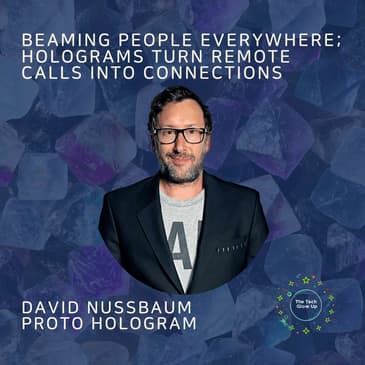
David Nussbaum started Proto Hologram in his living room in 2018 to answer a simple question: what if instead of using holograms to bring back dead musicians, you used them to connect the living? The result is a seven-foot-tall holographic display that lets people beam into rooms across the world—live, prerecorded, or as interactive AI avatars that speak more than 300 languages and dialects.
His background is broadcasting. As a kid, David sat in his dad's Volkswagen listening to talk radio, fascinated by communicating with someone who wasn’t physically there.
That turned into an obsession with connection across distance—first as a radio broadcaster, then as one of the first 1000 podcasters on Apple, where he eventually met his wife. Proto is the next evolution of that obsession: instead of talking into a phone, you broadcast yourself as a hologram.
Episode Highlights:
- Broadcasting obsession started in a Volkswagen listening to talk radio, led to a Howard Stern fixation at 14, turned into 25–30 years in radio and one of the first 1000 podcasts on Apple—where David met his wife.
- William Shatner beams into Sydney for a keynote and calls Proto a time machine because it saved him two weeks of travel—he gave his speech and was home having breakfast with his wife in LA the same morning.
- Christie’s beams multi-million-dollar sculptures and paintings globally instead of physically shipping them, protecting priceless works while giving collectors intimate previews before auction.
- Healthcare is the next frontier: oncologists beam into rural clinics, HIPAA compliance is live, and David’s goal is to replace flat Zoom calls and virtual doctor visits with the presence of holographic physicians for cancer patients receiving sensitive news.
David Nussbaum has spent his life obsessed with connection across distance. Proto is the latest evolution of that mission. His favorite part: he still sells through experience—visitors create their own AI avatar in the office and walk out with a piece of the technology.
Watch the full conversation on YouTube to hear why David believes AI isn’t something to fear, but something to embrace—and how using it well can create connection instead of replacement.
About David Nussbaum
An award-winning An award-winning writer and producer, Nussbaum founded Proto after 20 years in the entertainment industry, having spent time in sports radio, television, podcasting and live events.
David was named to TIME’s Healthcare100 List for 2025 and has spoken at the UC Berkeley Haas School of Business, USC, the Infinity Festival, CES, Christie's Art + Tech Conference, and at L.A.’s Museum of Contemporary Art.
With the slogan, “If you can’t BE there, BEAM there!” David walks the walk, beaming from company headquarters in Los Angeles to meetings on multiple continents every week to save on business travel time and expense & carbon impact.
A "glow up" signifies a positive transformation, reflecting the journey of becoming a better, more successful version of oneself.
At The Tech Glow Up, we humanize the startup and innovation landscape by focusing on the essential aspects of the entrepreneurial journey. Groundbreaking ideas are often ahead of their time, making resilience and perseverance vital for founders and product leaders.
In our podcast, we engage with innovators to discuss their transformative ideas, the challenges they face, and how they create value for future success.
If you're a founder or product leader seeking your own glow up, or a seasoned entrepreneur with stories to share, we invite you to join our guest list via this link.
What's up? Hey, welcome to the Tech Glow Up. It's Nathan. Today I'm a little starstruck with having David Nussbaum of Proto Hologram on the show. David is an early innovator in all kinds of storytelling mediums from early broadcast mediums to celebrity holograms. And yes, that celebrity hologram that you are thinking of, which, maybe the most notorious hologram ever made, but now David is working. With holograms, beaming people all over the world to build connections in real time with real people and real conversations. How can you create. Remote conversations and connections with holograms. How can you leverage the best of today's and yesterday's communication technologies to really connect with your audience and tell a story? These are all the questions and so many others that David gets into. I hope you enjoy. you ready to do this?
David Nussbaum:I am ready to go.
Nathan C:Hello and welcome to The Tech Glow Up. I'm Nathan C, and today I have the distinct pleasure of chatting with David Nussbaum, chairman and founder of Proto Hologram. David, thank you for joining me today.
David Nussbaum:Thanks for having me. I've been listening to your show, for quite some time, and, when I heard that you, had asked me to be on your show, I all of a sudden became, I got a little nervous. I typically don't get nervous before a podcast, but when you listen to a show that you. Admire and set a weekly reminder to listen to. Then it becomes, a big deal.
Nathan C:Okay. Talk about trying to take somebody off their game. I love it. wow. What a generous, open. I, I, I so appreciate that. David, you've got some very interesting things going on behind you. for those who don't have the benefit of watching the video part of the Glow Up, could you introduce, yourself and the work that you do at Proto Hologram? And talk a little bit about, the amazing, holograms you got going on behind you.
David Nussbaum:I started proto hologram in my living room. in 2018 and prior to that, I was a co-founder and a pretty large and well-known holographic entertainment company, mostly known for bringing back dead musicians to posthumously perform on big, giant hologram stages all over the world. prior to that I was a broadcaster with communications and journalism and connecting with people, What if instead of using holograms to bring back the dead, I used holograms to connect the living. So instead of talking into a microphone and hearing your voice come out of a speaker, I thought, what if I could broadcast you? What if I could send a person from wherever to wherever? And so I built these hologram telephone booths. then I just started beaming people places. behind me you're looking at seven foot tall, four foot wide, two foot deep holographic displays that make it look like a person or a thing is there, even though they're not really there. whether it's a person beaming in live or a person or a thing being prerecorded and played back like a holographic movie or maybe it's a part of, artificial intelligence, so it could be an interactive, multilingual, conversational avatar. All of these things are, happening over my shoulder right now. It's retail, it's healthcare, it's people and places. that's what we're gonna talk about here today, all the different use cases of proto and why it's important.
Nathan C:Alright, David. this is amazing. I love that. you mentioned a somewhat notorious, experiment in holograms, bringing the dead artists back to life, and as a marketer, I. The new approach of building connections, with the proto hologram boxes feels like it would be such an easier thing, to position, to introduce to new brands to really engage with, stars and even like ip. Can you talk about, the origins in innovation and in holograms? What, as a broadcaster, got you excited about, 3D representations of famous people?
David Nussbaum:Yeah.
Nathan C:That was the question.
David Nussbaum:Broadcasting has just always been. A part of my life, I remember vividly just sitting in the back of my dad's Volkswagen Rabbit while he was driving his car. He would go on business trips and he would take me from city to city. I'd sit in the back seat and he would always listen to the radio. sometimes it was the Mamas and the Papas and we'd listen to music, but most of the time he was, listening to talk radio and I found it fascinating. His attention on that, information on that interview was. Fascinating to me. the idea of communication with somebody who's not there, the idea of communicating with somebody in a way, that just didn't feel real, and then making it real. And so what we're doing right now, we're talking to an audience of people that we're not. engaged with, but we're communicating with them in such a way. So I've always really been fascinated with that. my parents tell me that when I was, six years old, I used to turn, the volume down while watching Mets games on tv and my buddies and I would call a play by play. I didn't realize that at the time that we were doing a job, you know, we were broadcasting. And forward to high school. I was a sophomore in high school and I was sitting in the parking lot, prior to opening Bell, and I was listening to the Howard Stern Show for the first time in 1990 and I couldn't believe the words I was hearing. I missed the first 20 minutes of school that morning because I needed to know what Howard was going to say. so for me, it was obvious to me that I was gonna be a broadcaster.
Nathan C:Oh, the feelings that you're describing are so much, those kinds of broadcasters and those kinds of shows for that time was. It was really notable for how much they felt like it was a one to many personal conversation, right? That like Howard was talking to you and you were hanging out in his, parlor or whatever.
David Nussbaum:out
Nathan C:yep.
David Nussbaum:studio. Same thing with David Letterman at night. I was always watching Saturday Night Live on Saturdays. I was watching David Letterman Monday through Friday, and this is, I'm 12 years old, 13 years old, 14 years old. I'm impressionable. This is where I'm getting all my information from. There was no social media yet. there were no podcasts yet. this was my world. I became obsessed with radio and broadcasting and communications. in the late nineties, I moved to Los Angeles and I got a job on the radio. for the last, 25, 30 years, that's all I've ever thought about was having my voice heard by as many people as possible. whether it was sports radio talk, or even just talking up a record, I've always just been fascinated with communicating with a person, or people, whether they were 10 feet away from me or, thousands of miles away. So I started a podcast in 2006. I'm told it was one of the first 1000 podcasts on the Apple platform. It was boring and nobody was listening to it. It was essentially me once a month just talking for 30 minutes and uploading it. And three years later, most of those, podcasts still had zero listeners. But in, 2009, I started interviewing celebrities. Sam Simon came over to my house. he rest in peace now, but Sam Simon was the co-creator of The Simpsons, and he later became more well known for being an animal rights activist and a human rights activist, and he had all that Simpsons money. He put billions of dollars into animal and human rights just fell in love with that guy and everything that he was about and the fact that he said yes to me. he was my first podcast guest in 2009, made it very easy for me to have a podcast that people would say yes to when I would say, Hey, I've had Sam Simon on the podcast. Would you like to be on my podcast? and then all of a sudden I got to meet all of my heroes. Hundreds and hundreds of celebrities and comedy writers and movie directors, came over from Gilbert Godfrey to James Gunn. I even met my wife a podcast in, 2010. We got married five years later.
Nathan C:That's such a.
David Nussbaum:and communications have just. I have completely been the focus of my entire life.
Nathan C:that podcast era is such an interesting time for people figuring out a new medium, which is like, I think really influential, to how you were able to show up, in the XR in the 3D and hologram space. I've always noted that proto holograms. it seems like, at least from my perspective, you have these multiple modes that allow people to connect real time, that you can have recorded content or you've been able to enable these AI avatars for a very, I feel like you've been early on, almost every single one of those. So like how, you know, you must have had some learnings from catching a wave early in one medium that could help with this, new medium in XR, The question I'm actually really trying to get to is very notable that you have all three of those use cases. That you're early with them, but that it is also seems like it has always been an all in one kind of package and service that makes it very easy for people to engage with, to start up, to be successful with incredibly quickly. can you talk about how That takes a lot of investment. That takes a lot of time and development and testing, but it must have been worth it on the business case. Can you talk about how you uncovered that need to be a sort of a platform play and what sort of, data and influences drove you to take that approach?
David Nussbaum:Absolutely. Being really great at one thing is terrific. I believe Proto is really great at being a communications device, whether it is with prerecorded content, communicating with a customer, whether it's, a holographic, live agent beaming in to do some concierge or, something of that nature, or whether it's an AI avatar communicating in 300 different languages and dialects. at the end of the day, it's communication between, the subject matter and the receiver, the presenter, and the viewer. And that's all that is. and it'll continue to evolve. this has become an evolution. when I started the podcast, that was the evolution of traditional radio. the hologram company, proto is the evolution of the podcast. instead of talking into a phone and talking to somebody, through speaker, you're now just broadcasting yourself. I am grateful that I haven't done this alone, so I came up with the idea and luckily it was a pretty good one. so good in fact that a dozen or more people. I'm with you. I'm gonna, If it's okay with you, I'd like to work at this company with you. Even when I didn't have any money at all, I'd spent all my money on failed prototypes, one by one wor becoming worse than the one before it. Finally, I made it just good enough to get a little bit of investment money and then to start attracting, my partners who I'm still with today. So I've got, if I could give a bit of advice to anybody who's maybe starting out a new venture that hasn't done this before. Surround yourself with people who have done this before. and so I'm fortunate. I have a great, chief Operating Officer, chief Technology Officer. Chief Product Officer, the sales department, the operators, the producers and everybody who work at Proto. I couldn't have done any of this without them. when you ask. How did you know, or how did you combine all three or more of these elements into one? I didn't do any of this. I am the first person to admit the only thing I did was come up with a good enough idea to attract people who could work at Amazon and Meta and Netflix. They all work here. They're the ones who come up with some of these great ideas and then I'm just glad to, get to work with them every day.
Nathan C:I love it. that leads in really nicely, to this next question, which is, how, you know, as you're now like, goodness, eight years into, this timeline with proto holograms. Can you talk about how you like to learn about, the impact of your work, how it's resonating with customers and how that influences your planning and roadmap. and how that influences your, your planning and, and, and pipeline, or excuse me, uh, your planning and roadmap.
David Nussbaum:Absolutely. proto has been documented to save partners time, money, and the environment. save time so proto can beam people places. So I have, like William Shatner for example, 94 years old. He calls me up and he says, I hear you're beaming people, places, and it's not me. And I made beaming people, places famous. So he says, I took a job in Sydney, Australia. I'm supposed to talk in front of a room full of advertising and marketing executives. He says, but I'm not gonna fly all the way to Sydney, Australia. Beam me up. David. And I sent him to, we beamed him to Sydney. He gave an incredible keynote speech, and then he started talking to people in the audience. He goes you with the green sweater? And the, and people one by one would say, wait a sec, you could see me. Yes, I could see you. I could hear you. I'm here. And so that was really great. So save time. He says to me afterwards. calling yourself a hologram. Start calling yourself a time machine. You just saved me two weeks of travel. I gave my speech in Sydney, Australia. And I was home having breakfast with my wife in Los Angeles the same morning. And so saving the environment is also really important because that is, to a lot of people. Saving the environment is the most important thing because you are no longer spreading jet fuel all over the earth, and you are, allowing people to appear everywhere without getting on an airplane, Christie's not a person, but artwork, billions of dollars worth of artwork, in fact per year, are being beamed from their individual. Showrooms and museums into all Christie's locations prior to auction. and they're not only saving a ton of time and money, doing that, but saving the environment, seeing their global carbon footprint shrink significantly because they no longer have to send a$50 million giacometti, sculpture on a 12 city, roadshow prior to auction.
Nathan C:I love that there is this theme of things that shouldn't really be traveling, but that you can allow them to travel, right? with Captain Kirk, you made him get up early one morning instead of taking, two weeks worth of travel. honestly, I'm somebody whose first dream job was in art galleries and museums. Right, like the insurance costs, the costs of like, all of that, The shipping and facilitation that goes into that can be enormous, and it's dangerous. It's not great for the art. And so if you can limit those sorts of things, but still build connections at the same time, it really starts, you know, in my brain, one of the questions that I've always had is like, these boxes are really big. They seem high tech and fragile, like that takes a lot to move them around. Like what are the use cases, what are the applications that are gonna be worth, like that investment in hardware and what I'm seeing, right? Like for Christie's, you know, for, even, you know, like a, a hotel concierge that might, have a, an all night fact in that smaller sort of desktop model. you know, I'm starting to see how like. The one to many, the one to personalized the one to your language, or your, your showcase, your atelier, to the Christie's main floor. That starts to be a lot of scale, in many different dimensions. I love it.
David Nussbaum:Thank you. Yeah, totally. It's from Mike Milken owns a, a museum that just opened up in Washington, DC across from the White House. It focuses on, creating the American dream and in his. Museum on the first floor, four proto devices, Serena Williams, Dr. Sanjay Gupta, SA Khan, and Sora Blakely, and each one are hooked up to an ai, data endpoint. So you could talk to Serena Williams about sports and entrepreneurship. You could talk to Dr. Sanjay Gupta about healthcare and medicine. You could talk, it's really wild. So it allows people to answer questions. Be a subject matter expert and allows museums to ship. One of a kind works of art and then we're also using it, Andy Jassy and several industry big shots at over at Amazon or Nvidia. To do keynote speeches and to show new product and services remotely in multiple countries, in the language of those countries. So it becomes, a way for a customer to, receive information in a new way that, is interesting to them and, welcoming.
Nathan C:that like, gl a global CEO message that is both like real time and personalized or is wow, starts to get pretty fun. are you able to share, an instance where you've. Had to, I'm always interested in how people, approach challenges new information, new opportunities. can you share any instances where you've adapted or refocused your work in response to new information?
David Nussbaum:It happens every day when you start a company and you have your business model, Be open to pivoting and learning what the customer wants. Sometimes I believe I know what this company is going to be, and then, I'm having a meeting and the customer tells me, well, this is really how we plan on using it. What happened early on was, I'd have a customer who would say, I want your proto to do this. And so I'd say, Hey, everybody, let's make the proto do this. And so we'd all run over here and make the proto do this. And somebody over here would say, Hey, I want one too, but it's gotta do this. And yes, we would run over everybody. Let's go, make the protos do this. my brain had us doing. But again, I'm gonna give credit back to the team. Team says, we're really. Not using our time. They say work smarter, not harder. Why don't we open up, the ability, so that any, app developer, can create or bespoke their own custom for themselves. So instead of chasing every single opportunity, we sell the display, we have an operating system, a content management platform, and essentially create the ecosystem that would allow any. You could even be a very amateur web app developer, but you can completely customize the application. So I think one of the first main pivots was we were a hologram in a box company. You saw us at Comic Cons and at trade shows. And at live events. But then. COVID made it impossible to do any of that ever again. So for those one or two years while we were trying to figure things out, I raised several million dollars. Tim Draper, famously invested in a lot of Elon Musk's startups. SpaceX Tesla. he's got a huge high winning percentage. He invested into proto and now I knew that we had a little bit of time. We didn't have to just take every single gig we could put that money into the company, and we started, building out the operating system. Proto iss more of a software company now than a hardware company. What started out as a hologram and a box company is more. It's closer to an Apple operating system company rather than the hardware itself. Although the hardware, is still currently required to create the effect, it's the software that powers everything. So I think the Glow Up from startup to now was becoming less of a reliant on the hardware and more on allowing the customer to choose their own adventure. By creating a set of APIs that would allow anybody to, create their own
Nathan C:Is, one of my favorite things is hanging out with 3D creators and the sort of lack of channels for augmented reality creation or like the dramatically shrinking world of AR creation tools. plus a lot of The interest in 3D scanning, and dimensional displays, got me very excited about the idea of a software platform for hologram interactions.
David Nussbaum:people too.
Nathan C:you mentioned, have you done, this is total sidebar. have you done like, direct to hologram projects with creators? in the proto holograms?
David Nussbaum:How
Nathan C:I was being very open-minded. have you created like original 3D artworks for display in proto, or is that
David Nussbaum:we do work with creators often. when NFTs were a thing, When you bought a very expensive piece of digital artwork, the last thing you want to do is spend hundreds of thousands of dollars on this NFT and then show it to everybody on your phone. So people started putting them, they were buying up protos and they were, so we worked with a lot of artists. We were at Art Basel, and we even were in the NFT and Metaverse Museum in New York for a while. I work with artists all the time. In fact, AWS does some incredible work, with ai. you could create anything, with artificial intelligence. So a lot of artists were starting to create AI pieces of artwork. and then we would watch them come to life. you would be able to almost compose the story and the piece of artwork just with your words, and with some prompts. And then the piece of artwork would come to life. But look, if for anybody watching this thing, I've got Billy Morrison over one shoulder. I've got Jewel over the other. these are two musicians who are both incredible. One's a folk star, one's a rock star, and. they are artists. they can, talk and interact and perform for all over the world and be seen in a way that they've never been seen before. So I think collaborating with artists, whether you're an artwork, museum, or whether you're a, comedian or musician or, a poet or an author, anybody with anything to say. Or, composed and create, a compelling piece of artwork inside of proto.
Nathan C:Yeah, that idea that any creative, any founder could benefit, from having. either an AI version, a live version or a recorded version of themselves that starts to open up that one to many channel, for communication. just makes so much sense. I would have a really hard time if I had that much content in my offices, to not just always be playing lunchtime concerts.
David Nussbaum:See,
Nathan C:I love it. David, you mentioned.
David Nussbaum:this is why we're a popular attraction. people don't have zooms with me. They like to come to my work and see this for themselves in person.
Nathan C:You are like the one person who, most people wanna have an in-person first, and then they'll talk to you on the phone.
David Nussbaum:And then they all want to become a hologram while they're here. And so I get to do that for them. Everybody leaves, with their own AI avatar, speaking multiple languages, and it's so easy to do.
Nathan C:Talk about selling through experience. Wow. Just don't even tell'em any, like show don't tell you. Put them in the box, show them, speak in Mandarin. So David, you mentioned the Glow Up already. and I so appreciate you, you sort of tracking this theme of, of, you know, the, of transformation of dramatic improvement. On the show, I love to talk about Glow Up in terms of like your six month audacious goals. So you've, you've made it through some big challenges. You're getting close to a decade, in the game with proto. What are the big goals that you're looking at, in the next six months, especially given, you know that ai, physical ai, embodied AI is like such a big trend and topic these days.
David Nussbaum:Yeah. I'd like for us to Up more into the space of healthcare and education. we're HIPAA compliant now. we were just named to the time 100 This year. oncologists are using proto to beam into rural clinics from big cities. I'd like to really expand into that space. I think it's important. I don't think this is just for, musicians and celebrities and comedians and public speakers. I think this is a healthcare tool. So I think the Glow Up in the next six months to a year is, be the number I wanna replace. zoom calls, and. Doctor visits through virtual means, with proto, I think in person, makes it feel more real when you're a cancer patient and you're receiving some pretty sensitive news. The last thing you want. To do is get that over the phone or through a two dimensional screen on your laptop. You want to feel the presence of the doctor in the room with you. And you know what? That doctor is very busy. That doctor, can also be saving lives in a, in where in, elsewhere. So this gives the doctor and the patient the feeling that they're there. But still able to, interact, consult with, even treat and diagnose patients, remotely. I think the other. Glow Up is on the hardware, so on the software side, obviously get getting, faster and more sophisticated on the hardware side. I'd like to see the hardware get thinner, cheaper far as cost. see the, so those are my two areas on the proto side. I could keep going. I
Nathan C:All.
David Nussbaum:I'll give you even one more. I think, because Proto is an operating system, I think self-service, AI avatars. Something in the next six months to a year. I think, anybody with a proto account will be able to have a self-service avatar and create AI content for themselves. I don't think that you should have to have a web app developer. I want AI lifelike avatars of people for themselves or of their, business partners or loved ones, and I think that's a huge Glow Up for accessibility and scale.
Nathan C:Yeah, this is my angry dog. The idea of accessibility, David, I think is outstanding and in so many places. In so many places, workforce for certain frontline jobs is just scarce, right? There's not a lot of people in Japan, you know, populations are aging. I spoke to somebody who was in a utilities company and they were exploring ai. Avatars and I was like, why is this utility company exploring AI avatars? It's like we don't have people to staff our rural offices. And so if we can have avatars who can answer those questions about your billing and can know everything about the business and the plan and can, you know, give those responses and that personal connection, It can be transformative for folks who just, you know, it can be a wealth of resources, for folks who are facing scarcity.
David Nussbaum:with you more than me. In fact, A RP is one of our great investors and partners and customers. They believe that proto is a way to combat loneliness for seniors. imagine having holographic. Avatars of, of your doctor, of your loved one, or. Beaming them in live from wherever you know, you only need an iPhone or any 4K camera to appear like you're physically there. So maybe the first step in, whether you're in a retail setting or a hospitality or travel area, maybe the first step is talking to an AI avatar. And then once you get to a certain point where only a human can, a human will do, then all of a sudden a person can just beam in and finish off the sale or complete the conversation. And make that final connection before the is has ended.
Nathan C:I love, then a human beams in is like the beginning to so many good stories. I'm so certain Di David, we've been diving deep.
David Nussbaum:beams end.
Nathan C:And then a human types in, as you're looking about these pretty audacious goals on the software, on the hardware and, the healthcare use case, I have to say, I just finished, about 20 interviews at the health conference, and one of the big conversations that we had was. How like 10 to 20% of cancer patients are bankrupted by the cost of going to where care is, right? So this idea of bringing doctors to them, beaming doctors in, just warms my heart from this very, recent, anecdote. you have many big goals and. If you could take a magic wand and, magically remove the biggest, most pressing blocker, for these goals, what would be the thing that you would, get out of the way of your team and this technology?
David Nussbaum:That's an interesting question. I have wished for many roadblocks to be removed. Because it is aging me. I didn't have a single gray hair on my face when I started this company, maybe it's my kids that have done that to me too. I don't know. Maybe it's a combination of both. I gotta be straight with you. I like that. This is really hard. I like that there. Our challenges because it makes proto better. the fact that there are challenges we have to address each challenge. If there wasn't a challenge and it was just easy, then I feel like we'd be missing something we wouldn't be as we wouldn't be doing the job that we are doing if there were no challenges in the way. And, but yeah, there are so many. Issues that are facing us. These are not light. So putting one of these on an airplane and sending it somewhere can be, time consuming, and challenging. So I don't wanna remove that challenge because that challenge exists for a lot of people. Shipping is a challenge. So what are we gonna do about that? I think that we have the next installment of Glow Up. Maybe we can talk about what. We are doing to address those issues also cost. This company, I was selling one of these boxes for a hundred thousand dollars. Now they're under$30,000. So if I just removed the fact that there was nobody's buying these because I'm charging a hundred thousand dollars. I needed that challenge of figuring out how to make a similar looking display at a price point where I can start driving the price way down. So I do appreciate all the challenges and all of the roadblocks that I've experienced over the years.
Nathan C:I love it. You're the first person who said, I'll keep'em. but hey, right? Like what entrepreneur, isn't in it? Because the problems are interesting and juicy, right? people don't start businesses.
David Nussbaum:Hey, I just lost your audio.
Nathan C:I totally transitioned. Amazing.
David Nussbaum:oh, I thought
Nathan C:I'm so excited to talk with you. Nope, David, this is amazing. are you ready to get into the speed round?
David Nussbaum:Yeah.
Nathan C:No.
David Nussbaum:a sip of water.
Nathan C:no pressure, but it is a speed round. So a little bit of pressure. first question. if there was one key takeaway from our conversation today that listeners of the Glow Up should leave with, in one or two sentences, what should that be?
David Nussbaum:surround yourself with people who have been there before. It'll make your job a lot easier as an entrepreneur.
Nathan C:Yes. such good advice. I feel like a lot of times entrepreneurs feel like they should just figure everything out and then bring people on. And as you've alluded to several times, the quicker you get other peo.
David Nussbaum:second answer to that is, don't wait for it to be perfect. just start doing it and learn from your mistakes.
Nathan C:Oh, yes. Thank you. It's December, 2025. What, quarter is your brain in, is your strategic brain in right now?
David Nussbaum:It's tough because. it is all over the place. I'm thinking because look, we're in the final month of the final quarter of the year, so it's about trying to generate as much, end of the year capital. And I'm raising money. I'm also generating revenue. So I'm here in this month. but as the chairman of proto, I'm also thinking, three to five years out as well.
Nathan C:I may.
David Nussbaum:days for three to five years. it's a little
Nathan C:three to five minutes. Is there a favorite star that you've been able to work with or maybe like a, a star story, an anecdote that, you could, just share super quickly?
David Nussbaum:I have so many, I've met some of my greatest friends here. but I have to give a lot of credit. I'm literally sitting in the production building of Mr. Howie Mandel. in February of 2022. I was three or four years into my proto. Journey. at the end of a very long day, I checked my dms on Instagram, and I noticed that Howie Mandel, was commenting on every single video. then he dropped his number into my, direct message, said, call me. I'm fascinated by this. I want to be everywhere without leaving my house. I came over here to this building and it was just an empty warehouse. Two or three months later, I moved in this became our global headquarters. Howie's become one of my best friends I like to tell people I've met two people on the internet. My, my wife and Howie Mandel and I, and I moved in with both of them. Howie's been incredible. he's introduced me to everybody from, Chris Jenner and Mr. Beast, to, you know, we just did a Netflix show that hasn't aired yet. There are so many things that are because of Howie that, I would have to say out of all the celebrities. Howie has been my favorite and probably the most influential by a long stretch of the imagination. he's just been incredible.
Nathan C:That's amazing.
David Nussbaum:come on out. He's
Nathan C:as somebody who grew up on Howie Mandel comedy, I'm pretty starstruck, by that. Thank you. I knew I had to ask David. Last question is simply, Do you have a spicy soundbite to share a hot take on trends, technology, culture, or beyond? It's totally optional.
David Nussbaum:I'm a big fan of artificial intelligence as it is combined with. The person itself. I don't think that AI is something to be worried about. I think it is something that we ought to be embracing. I believe that if AI is handled by the right person, it won't replace you. It'll enhance you. and so that's what proto hologram, is doing. So whether you're beaming in live or whether your AI takes over where you're live, person can't be for whatever reason. There's a nice mixture of communication and AI to turn that interaction into a connection.
Nathan C:I love it. David Nussbaum founder and chairman at Proto Hologram. I'm, having a hard. Time not being starstruck with this, entrepreneurial journey that you've had. balancing, being very early, in all kinds of communications technologies as well as holographic technologies. And hopefully, empowering a whole new, more personal way of communicating and connecting at scale. Thank you for joining me on the Tech Glow Up. Before I say a full goodbye, how can folks, follow up and learn more about the great work that you're doing?
David Nussbaum:We are on the internet@protohologram.com, or at proto hologram on everything. Follow me. I'm David Nussbaum. On LinkedIn at@thenuzzy is my personal Instagram or whatever, but just at Proto Hologram is a one-stop shop for everything.
Nathan C:Amazing. It has been such a treat, to get to talk to you and get this insider peek This very cool technology. thank you so much.
David Nussbaum:it.
Nathan C:Amazing.