
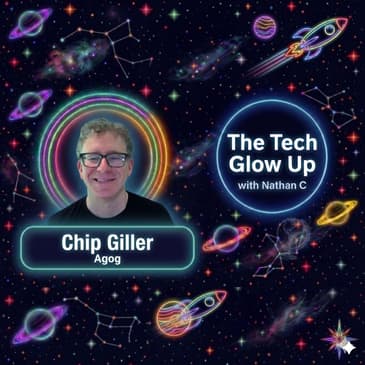

Most climate communication talks at people. It delivers facts, projections, timelines — and wonders why nothing changes. Facts land in the head, not the gut. Immersive media like XR, AR, VR changes that. When you're standing inside a story, it stops being abstract. You feel it. That's the conviction behind Agog, the Immersive Media Institute, and why co-founder Chip Giller believes XR is one of the most important tools the climate movement hasn't fully picked up yet.
Chip didn't arrive here in a straight line. He founded Grist.org in the late 1990s — one of the first digital-only nonprofit news organizations — chasing every new platform: desktop publishing, the web, podcasting before it had a name, video, social.
Around 2014–2015, he put on an Oculus DK1. "This is f@cking amazing — this feeling of presence." During COVID he spent time in AltspaceVR and VRChat with people from India, Brazil, and beyond; and saw that XR shows not just what is, but what was and what could be. He co-founded Agog with Wendy Schmidt to build the field that could make that vision real.
Key Moments:
- [00:08:15] The climate communication gap: why facts don't move people — and why XR does
- [00:21:40] Grist to Agog: chasing platforms for 25 years and what the DK1 moment revealed
- [00:35:10] Field building: why Agog moved beyond grants to train creators and activate cultural institutions
- [00:48:55] "Postcards from Our Climate Resilient Future": AR at Portland bus stops bringing Metro's climate plans to life
- [01:02:30] Open call: $1 million for immersive climate storytelling and what judges are looking for
Agog has distributed $6.5 million in grants in its first two years. Now there's an open call for $1 million in new funding — not for the flashiest tech, but where immersive genuinely adds value.
The 15-person team is growing, the peer-reviewed Immersive Impact Review is underway, and Chip's philosophy says it all: building toward "a future that doesn't suck."
Watch the full episode on YouTube: https://youtu.be/igFUkSJ36IU
About Chip Giller
Chip Giller is the executive director and a co-founder of Agog. He has been a visionary in the climate space and media field for 30 years, leading creative storytelling teams and partnering with nonprofits, philanthropists, and other leaders to accelerate progress to a better, more just world.
In 2024, Chip joined forces with Wendy Schmidt to launch Agog: The Immersive Media Institute, bringing their shared passion for innovation and social change to the forefront of the immersive media landscape. Agog helps people use emerging media like XR to imagine and build better futures.
In 1999, Chip founded one of the first digital news organizations and first nonprofit newsrooms, Grist, to engage the next generation on climate change and other environmental issues. Grist reaches millions and has been recognized in many ways for its impact, including as a recipient of the National Magazine Award for General Excellence.
In 2017, Chip launched Grist’s solutions lab to identify, celebrate, and connect a diverse array of climate solutions leaders, collectively known as the Grist 50; and to tell unexpected stories in creative new formats about justice and progress. Among other honors, Chip has received a Heinz Award and been named a TIME “Hero of the Environment.” Follow Chip on Threads and LinkedIn.
A "glow up" signifies a positive transformation, reflecting the journey of becoming a better, more successful version of oneself.
At The Tech Glow Up, we humanize the startup and innovation landscape by focusing on the essential aspects of the entrepreneurial journey. Groundbreaking ideas are often ahead of their time, making resilience and perseverance vital for founders and product leaders.
In our podcast, we engage with innovators to discuss their transformative ideas, the challenges they face, and how they create value for future success.
If you're a founder or product leader seeking your own glow up, or a seasoned entrepreneur with stories to share, we invite you to join our guest list via this link.
Hopefully this episode of The Tech Glow Up is going to have you filled with awe and wonder. You might be agog at the insights that executive director and co-founder Chip Giller brings to our conversation about AGOG. Agog, the Immersive Media Institute, sits at the center of like four or five of my favorite topics. We've got art and storytelling. We've got immersive media, spatial computing, climate data and storytelling, building community, going to where consumers are, and like building new categories, and helping to educate and facilitate and foster whole new modes of communications. Chip Giller, who is an OG in climate advocacy and media, going nearly 30 years back. Chip is one of those serial entrepreneurs who has been at the forefront of communications for a very long time, And I'm excited for you to see how his mission and focus on telling climate stories has not only helped him be at the forefront of many of these conversations, has built this innovative practice of always testing, learning, growing, and pushing to find where are your customers, where are the customers and connections, where's the community that you're going to need 10 years from now? Social entrepreneurism is a little of a new topic, for the Tech Glow Up. We're looking at when you believe in an idea so deeply, when you can see the future outcomes, right? What are you willing to invest in time and money, resources, and knowledge share, to make those futures happen? Agog is not only spreading the word about climate, but is helping people become XR climate storytellers. Chip tells us about the open call for proposals where they're giving away cash grants for teams, telling stories of climate change, telling stories of resilience, showing people, new possible futures. So if you are a creator, if, you care about the climate, if you've always wondered if XR could help you tell that story better, check out the links in the show notes, and make sure you can join that open call. Such a treat to get a peek behind the scenes at this enigmatic, social venture that is driving some of my favorite topics: art, storytelling, immersive media, and climate, and building community all the while. Super cool to connect with Chip Giller of Agog. Hi, i'm Nathan C, and welcome to The Tech Glow Up. Today we have a very special conversation with Chip Giller, Co-founder and Executive Director of Agog. Chip, I have been so excited for this conversation. It is such a treat to meet you, in person. thanks for joining me on The Tech Glow Up.
Chip GillerNathan I'm thrilled to be here I'm an admirer of the show and I'm just so grateful that you had me on
Nathan CAmazing. So to start us off, could you introduce yourself and the work that you do at Agog?
Chip GillerSure thing I'm Chip Giller I'm the executive director and co-founder of Agog and the founder about a quarter century ago of the climate news organization Grist Agog is a philanthropic organization that helps people use immersive media to imagine and build a better world on the surface it might seem like a leap from climate journalism to immersive media but to me the through line's pretty direct Nathan I've spent more than three decades thinking about how we communicate about urgent issues in ways that actually reach people and get people to act And one of the hardest things about climate communications is that people can sometimes understand something intellectually but still feel pretty distant from it emotionally and so I had my first experience with immersive media when the first Oculus headset came out I don't know that was twenty fourteen or fifteen But then during COVID My family potted up with another family and whom we were staying with he had a company He was a former game exec a game company executive and was going deep into XR And I began to spend time in social social VR time with people from other cultures other geographies and really began to see that these tools have the real opportunity I think to reshape how we go about experiencing things and I you know you Nathan know more than anyone that like XR it's a form of experiential communications where you're really in the story And as such I think these tools have the opportunity to awaken a different type of concern a different type of passion around issues like climate change It's more visceral it's more guttural It's not just heady So that's like that's the origin story what originally led me down this path
Nathan CI love a good DK1 story. there's, there's these waves of, like, when and how people get into the spatial computing space, and, DK1 is, like, is, is maybe one of the most common keywords, when we're talking about XR on this show. one of the reasons... You know, to be completely transparent, one of the reasons that I was so excited to talk with you is on The Tech Glow Up, is that you sort of sit at a very high level on three things that I'm incredibly passionate about, right? Which is climate, which is storytelling, and which is immersive media. can you dive in a little bit? you mentioned, right, like, the jump from telling climate stories to telling XR stories. I'm so curious, as somebody who's been telling stories about climate for the last 30 years, like, what has that journey been like? What keeps you going, and, like, what inspires you to keep innovating, throughout those decades? can you give us a little bit of the, like, how you got here?
Chip GillerOh my gosh On the climate side I had a peculiar childhood I had these two obsessions One was around journalism and the other was around the environment and climate change One of my first babysitters is a well-known environmental climate writer named Bill McKibben he So he I think around four or five he was my babysitter when I was four or five and so you know you could say I was learning about climate change at his knee and then he wr went on to write for The New Yorker the first popular book about j for cl first book for a general audience about climate change and now he's a prominent activist my dad was really into he's a communicator as well and we got maybe ten periodicals that as a kid we would come to my home and so I'd be reading all these publications And then I went on to become the editor of our high school newspaper And one c one through line Nathan is I've always been interested in sort of these transition moments for technology So this will date me but when I was the editor of that newspaper I transitioned it from old kinda paste up production to desktop publishing If you remember PageMaker and QuarkXPress So that was a big shift and then I went on and did stuff in college majored in environmental studies again with communications at the core of what I did went to a publication in DC and helped transition that publication from fax so again like just like I think I'm someone who kinda connects the dots and sees thing where things are heading and that was a trade publication in DC that only reached a privileged few and I wanted to start something that spoke to a much wider audience which led me in the mid and late nineties to start something called Grist which was one of the first digital-only news organizations certainly one of the first nonprofit news organizations And it believe me it was weird People at the time were like Chip why would you start a news organization online and it proved to be a prescient a good bet so that's Grist.org It still exists It's about a sixty-person team now reporting on climate change and rode that wave You know we started just when search was getting going and then social came on the scene How do you tack How do you adjust to that we were podcasting before the term podcasting was a word and then began doing video so I think to some degree have been I don't wanna say like an early adopter for early adopter's sake but someone who's trying to bring new forms of communication to wider audiences to broader audiences And the climate topic can be a sobering one it can be a tough one I'm as I'm sure your audience knows we're up against it now we need to make big shifts big adjustments as a world in terms of how we produce energy how we consume energy But the good news Nathan is that at this point costs of renewables the cheapest energy now is the cleanest energy and that's so fucking amazing That So the only thing standing between us and progress is the fossil fuel lobby fossil fuel buying politicians and so my last chapter at Grist I'm still on the board but as a staff member was really beginning to paint the story of what's possible What would it look like if we were to live in a world that was a climate-friendly world if we were to live in a just world where XR comes into this is during COVID I spent a good deal of time if you can believe it on platforms like Altspace VR in platforms like Engage early VRChat meeting up with different people around the world you know I'd go into a space and someone from India would be next to me or someone from Brazil and it was just like This is fucking amazing this feeling of presence being with other people and having experiences I began to feel like you know in really ways that that weren't fathomable with other forms of media can you can experience not only what is but also what was and what could be You can use these tools to step into the future to time travel And so that just got my mind whirling And so I've stayed in the climate fight because w for civilization to endure we gotta address this challenge but I believe we can get to a future that doesn't suck and I think XR in a unique way can depict that future and allow people to feel it to allow people to get a sense of it viscerally gutturally and I think it's often that sort of heart feeling that causes people to change their behavior It's not just facts It's not just headiness
Nathan CMm. I think y- you just made the, the title for the show here. And this... The, There's, there's this through line, that, that I was catching in your work, right? That, the, the exploration of technology is... does not seem like technology for technology's sake, but like, hey, this seems to be where the users are. Hey, this seems to be how we could reach more people. Hey, people are communicating digitally now. We should probably be there too if we're trying to make that impact. So I, I, it's rare, I think a lot of fans of spatial computing, a lot of builders who have been working in XR, you know, even some of the platforms that you mentioned, like, have seen major changes or maybe don't exist five or six years later. it's a time where a lot of trends in XR have been sort of moving away from, some of the big hype that we heard about even three or four years ago. Why is this a moment that you're continuing to double down on XR storytelling? I mean, you've just announced some, like, major initiatives. Like, you're building a team. you've already funded and, and led with so... a, a, a several dozen impact projects. W- w- why are you... It, it feels like you're, you're swimming upstream in about three different ways. w- I guess, can you tell me...
Chip GillerSo the question is
Nathan CWhat's...
Chip GillerI guess
Nathan Cyeah, the question is why now? What do you see that Meta doesn't see that, you know, that, some of these big corporations are missing?
Chip GillerFirst of all Nathan I guess I'd say we're platform agnostic and techno technologies go in waves when I when I when I started Grist com was ascending and then there was the com bust then there was Web 2.0 each wave lays some of the groundwork for the next wave and yeah so we're platform agnostic we don't know what these tools are ultimately gonna be called When I started when I was out of college the internet was referred to as the information superhighway That's no longer what people It's like a vestige of the past And so I'm excited about you know in May at the Google I/O conference they unveiled with Samsung two in They're calling them intelligent glasses they talked about their partnership with XREAL with the Project Aura AR glasses I think the form factor everyone's aiming for is something like this with not only video not only cameras not only AI but also an immersive layer and so I think we're like in this transition moment and for us it's a really int exciting time and an important time to be in this space because w-we're not interested in how these tools can like merely entertain or how they can be used to increase productivity with ten windows in front of me where I can be manipulating shit We're interested in how these tools can spur social change can build compassion can build human connection you know you know so much Nathan you know more than most about how you can use these tools to step into other people's realities experience some moments like like they have we sponsor a a prize at South by Southwest an immersive impact prize and the winner of it this year chosen by an independent pan panel of judges was something called The Long Goodbye where you could step in This is like I'm almost just getting goosebumps thinking about step into the world of a woman experiencing dementia I mean it's just so powerful and it's a really important tool for caregivers for family members to get a sense of what a loved one might be experiencing And that's just something only these tools can allow when my co-founder Wendy Schmidt and let me just spend a moment on Wendy is has a background in journalism and she and I met in the mid-aughts mid to I guess around two thousand and seven two thousand and eight She had been convening a lot of important discussions around the documentary An Inconvenient Truth Was really concerned about the climate challenge she she's a dot connector She breaks down silos and I think of myself as somewhat similarly And so sh-she joined the GRIST board and ever since then we've been on many adventures together when Wendy and I got into this got interested in XR and saw the power of it I think we felt at the beginning it would be important for us to fund a series of XR experiences But as we've as we dove into this more we quickly learned that really our work is about field building training up people on how to use these tools introducing the whole mission-based space the whole nonprofit world to the opportunities of these tools focusing not just on the creation of experiences but also how do these experiences how do XR experiences find audiences What are the distribution plans Can we activate museums and libraries and other cultural institutions civic spaces to begin displaying and showing XR works And so is a really exciting time because there's such an opportunity to shape a field And I think some of the early hope you know the Zuckerberg vision of everyone spending hours and hours of a day in the Metaverse that was pretty cheesy I think that was ridiculous but the real the question for us is how can these tools be used for purpose and good And so it's just the right time for us to be in this arena
Nathan CThank you for that One of the things that you touched on is that the kinds of empathy, the kinds of stories, the kinds of perspective shift that you can deliver with an immersive digital experience can be transcendental or transformative to people in sort of a plane of existence that, or just, like, in places that we don't measure in business terms, Nobody has the ROI for, like, understanding your child's gender dysphoria, right? But, like, Body of Mine. Thank you. Right? Like, Body of Mine, like, does things that, like, a conversation between a parent and a child, is very fraught. But, like, a moment of understanding from a shared perspective, and, like, things change. Similar to, you know, the, the story that you described of, diving into somebody's, dementia experience. The reason why I'm still in XR is I had one of those discovery moments, and I think more people, you know, the, the industry itself would benefit, from a mix of both those very personal connections and, you know, actually understanding where these things show up in a meaningful way when we are doing business. You know, when you do want 12 screens in front of you.
Chip GillerRight
Nathan CAnd also thank you for, like, pulling the curtain back. this idea of, like, a social entrepreneur or an impact entrepreneur, I think is, is, is a newer idea to me, and sort of seeing how you approach both of those sides and your mission, is incredibly illustrative. So, thank you.
Chip Gillertouch on that for a moment more I think we measure things differently from how the corporate world does We're focused on impact and it's not always an easy thing to measure Impact is rarely something you can like gauge qualita quantitatively So like back at Grist over time as the internet evolved we developed a framework for how our work influenced the conversation culturally and politically how people's language changes after they experience an XR piece if we see policy discussions shifting based on stories we're supporting in an XR How many young people came to our events So we have metrics but they're different It's not around revenue and some of it y it's hard to gauge quarterly you know another just thing that I wanted to touch on is that there's a there's an amazing consortium of universities that have come together to form something I think it's IXA the Immersive Experience Alliance and it cu includes University of Texas UT Austin Georgia State University bunches of universities And they've they're cr they've created a whole peer-reviewed journal called the Immersive Impact Review to look at the full life cycle of XR projects from conception to production through distribution and then assessment around impact and so w-we provide the support to bring that journal to life and I think that's gonna help to define this whole field Its first edition so it's working on its second edition was rich with information for the field And right now they're focused on like how do we think about distribution How do we think about audience and so yeah So we're as I said earlier we're really about building this whole field And part of it is okay if we're about impact how are we measuring impact let's have discussions about that
Nathan COh my goodness. the I- you said it was IXA?
Chip GillerIXA Yeah
Nathan CAmazing. this is a new resource for me, but it's, the thing I'm gonna go check out right away. I think it... the conversation around distribution is absolutely, like, one of the huge pain points that most people, when they're working in this space, only discover after they've shipped one or two projects. Right? Like, we often start from an idea or a platform or an interaction that, like, focuses us into, like, a tech, us being, you know, storytellers, developers, innovators, and you, you build from that sort of core kernel, and often the distribution then becomes a, a result of, whatever tech choices you made. I used to, you know, represent a pretty large XR community, and, in XR a lot of things are driven, you know, especially in the mobile space, in iOS environments and Apple environments. But 70% of the guest audience at those events that I was throwing were Android users. And so I, I was watching time and time again where people who were, like, trying to reach their audience were building in tools that their audience wasn't in, because it was convenient for them. Missing, like, literally missing 70% of who they're trying to reach just because of some, you know, personal preferences on tech. so distribution and how you actually make an impact with your ideas.
Chip Gillerfor WebXR to continue to evolve So like our website you know I think it's one of the early websites not in the game space that has an XR layer and if you come to it in any headset or with any Android-powered phone the website becomes an object with which you can interact You step into the website And so I guess if I could dream for a moment I'm seeing My vision is that XR becomes a layer over time of responsive design so when I was running Grist I lived through the transition to mobile and it was like at the start I was like Does everyone need a fucking app And apps are important and apps are cool but not everyone needs an app And so I You know what Right now m most websites if you're coming on if you come on desktop th it knows It serves up one thing if it come if you come on a tablet if you come on mobile just on a phone And so our vision is that at some point in the relatively near future websites will have spatial layers and they'll recognize if you're coming with a spatial hardware or not but I totally agree Like interoperability is essential
Nathan CI was part of a team, where one of our lead designers, Keith, actually presented, I think it was in 2018, at AWE, a model for responsive design in, in augmented reality that would know whether or not you were standing and something needed to be room scale, or if you were sitting and something needed to be tabletop scale. so this idea of, a responsive immersive site that, like, knows not only your device, but, like, how you're trying to view it, gorgeous. The, the show is called The Tech Glow Up, and I use a glow up to talk about big goals, audacious goals with, big things that you're gonna be doing, transformations even, in the next six months or so. What are you working on at Agog, to glow up, in the rest of the year?
Chip GillerOh my gosh I'm so excited to talk about this so this month marks two important milestones for a God first we've now hit six point five million dollars in grants distributed over our first two years supporting creators nonprofits projects across the XR for Good ecosystem but the second thing and this gets to the next six months is we just launched our first open call for proposals committing up to a million dollars in new funding for immersive climate storytelling So you know we need more perspectives more storytellers more nonprofits more communities helping shape what immersive media becomes We need more people telling their stories with immersive media So this open call is really an invitation We wanna hear from creators mission-based organizations and importantly also from people who are new to XR but have a hunch that these tools can be powerful and have powerful ideas about climate storytelling. So we're not only looking for isn't about the most technologically sophisticated projects but really where can immersive add value And so this is the first time we've had an open call and so we're going to be receiving applications and then the team's gonna be distilling them We have a really formidable panel of outside climate experts Tony Leiserowitz he runs climate a whole climate communications department at Yale University Jackie Patterson is a climate justice OG organizer She has a group the Chisholm Legacy Project we have Miriam who at Phi in Montreal is she is such a leader in XR And then we have a young man Jerome Foster who within the Biden administration was playing a lead role on on climate justice he's twenty-four and sort of has his finger on the pulse of where communications are going and how people experience stuff and so they're gonna be helping us choose finalists But we're super excited about this It's a little bit of of a coming out party for us and so yeah I I I think and as you mentioned Our team is around 15 folks now I think we'll grow we'll approach 20 by the end of the year We're a team of technologists communications experts we have folks who have expertise in XR folks who have an expertise in grant making so we're gonna be expanding the team cause none of this work could happen without all the awesome folks on the team and so yeah so this next six months is really about our broadening our reach and welcoming new folks into the fold
Nathan COh my goodness. you're gonna win me over with that strategy every time. Amazing. Oh my goodness. Always
Chip Gillerjust on the climate front y you know the climate challenge can s often seem both very real as well as maybe distant or a little abstract And what I think immersive can allow for is to make this challenge and the paths out of the planetary pickle seem really be really visceral and very real So for example I've had the huge the great fortune of visiting Greenland and standing on top of ice sheets so beautiful but also so sad that's like ground zero You're experiencing the ice sheets melting Most people aren't gonna have that opportunity to travel there but through immersive you can approximate it Maybe it's only seventy or eighty percent but you can bring more people there You can bring more people to the Amazon But it's not only about lifting up the challenges I think XR can begin to make really real really visceral what it would feel like if we lived in a world where climate change had been addressed where there we weren't living surrounded by toxic pollution where we were living in a more just world I think it's not rational how separate we often are from the planet or how fearful we are honestly of differences in others And so I don't think it's just reason and rationality are that are the way forward I think it's through experiences that there's more moments of plasticity where people are open to new ideas and new possibilities And for me XR is it's it What's so wonderful about it's like experiential storytelling You step into the story we live in a three-D world obviously so why can't our communications be three-dimensional as well And so that's what we're trying to get at here and that's what this open call is all about
Nathan CRight, one of the questions that I ask all the time when I'm talking about, like, the future of the metaverse or spatial data or s- you know, spatial computing, XR, is like this is all great, but if everything can catch on fire and anywhere can flood in the current state of our climate, like where are we gonna put all those data centers? Where are we gonna keep all of those power plants, you know, to make it all run? so I love one, this ability to really tell stories and address what is in the moment. The thing, I think especially under the pressures that you called out, where, like, disinformation or information is either being suppressed or disinformation is being elevated, that very soon there is going to be the need for telling stories about what could be possible, right? And I'm, as an ADHD person, like, somebody who sometimes cannot see a new idea until there's some ki- like, i- if it's something I haven't experienced already. And so telling a climate success future story, telling the story of what, like, a world driven by renewables could look and feel like, I think might be some of the most important content that comes out, you know, in the next five or 10 years. Because the really, like, doom and gloom, get everything, you know, we gotta fix, everything by 2030, 2035, right? Like, Al Gore's, the, the, un- Inconvenient Truth was talking about things that we are very, very close to, you know, milestones that we are about to hit. so, if we've, if we haven't succeeded on that very analytical, you know, foreboding future approach, right, maybe it's time to tell
Chip GillerYeah
Nathan Cfutures approach.
Chip GillerIn your city in PDX we've funded a project called Postcards from Our Climate Resilient Future And it's a project with an organization called CETI I'm trying I think CETI stands for a Creative and Emergent Technology Institute or something like that Anyway they are bringing to life Metro's cli Metro is your government agency overseeing I think it's three counties I'm s I can nerd out in Portland It's weird I can nerd out in Portland
Nathan Cnailing it.
Chip Gillerit's bringing Metro's climate plans to life through a augmented reality So it's visualizing community-designed actions and future visions for I think they're describing it as a just joyful resilient climate future through dynamic artwork So it's 3D interactive immersive XR experiences vignettes augmented postcards artifacts So if you go to a bus stop in Portland you would be there'd be a QR code and then up would pop trees and even more buses and and so people can really s using AR step into what that future could be And so I think this is a cool tool You could envision over time more and more governmental agencies using these tools to give people a sense of the possible and I'm really excited for it
Nathan COh my gosh, same. same, same, same. And Nandini is doing, amazing things with CETI.
Chip GillerOh great
Nathan Cthey've got, quarterly like exhibitions that happen in the old Lloyd Center Mall right now, or at least, have been for the last couple years. It's just been,
Chip GillerOkay
Nathan CChip, I think the, the last sort of question that I wanna throw at you, is if there were one takeaway, that our listeners today should walk away from our conversation with, what is it?
Chip GillerI would love for all of your amazing listeners and viewers just to know that there's a huge opportunity to use immersive tools to build human connection and to give people a sense of what's possible think these tools can give us a sense of what if we stepped into a future that doesn't suck you can use these tools to build empathy and compassion you know let's embrace that possibility Let's move forward in that way I'm so excited about it my partner Wendy is we're just so thrilled to help build this field of XR for good So we just encourage people to join us on this journey and help to define this field with us
Nathan CAnd if folks wanna learn more about, the, the grants, the open call for grants, the work that you do at AGOG, environmental media, how can they follow up or where should they go to learn more?
Chip GillerPeople can learn more about Agog and our open call at agog.org A-G-O-G.O-R-G And of course the word agog to be agog about something is to be wowed by something to be full of awe and wonder and so that's why Wendy and I chose the name Agog because that's how we feel about these tools So please visit agog.org We also encourage people to sign up for our newsletter You can follow us on social media You can join our Discord channel if you have questions about our open call join the community we hold monthly events in our Agog House space in VRChat we just wanna be in touch with people who are curious So you don't need to be an XR expert to be part of this conversation it's the early days in this space so just come on board We're we're excited to have you
Nathan CIt's still the early days in XR. There's space for everybody. I love it.
Chip GillerIt's early man
Nathan CIt's still, yeah, it's still so early. Keiichi Matsuda actually just today was, in my feed celebrating 10 years of his, like, seminal video, kind of proving or, like, showing the antithesis of the future that you're building, right? His, dystopian layers.
Chip GillerYeah
Nathan CChip Giller, Co-founder and executive director at Agog, a social entrepreneur focused on impact, finding new ways to measure how new mediums make an impact and help change people's minds about important topics like climate change. it has been such a delight to finally get to chat with you. Thanks for making time in your day, and congrats on, so many millions in grants awarded and your, your current open call. I can't wait to see what the rest of the year provides, for the work you're doing at Agog
Chip GillerThank you so much, Nathan. It's been a real pleasure to be with you
Nathan CAwesome. Can I ask you a favor? If you really enjoyed this episode, could you share it on your Instagram stories or maybe post the link with what you enjoyed on LinkedIn? The sort of sharing and engaging really helps small podcasters like me reach the audience that I know really cares about these kinds of conversations. If you've made it this far in the podcast, I really appreciate you. Thanks for listening. Please make sure to like and subscribe so that you never miss an episode of the Tech Glow Up. And hey, can I ask you a favor? If you really enjoyed this episode, could you share it on your Instagram stories or maybe post the link with what you enjoyed on LinkedIn? The sort of sharing and engaging really helps small podcasters like me reach the audience that I know really cares about these kinds of conversations.