
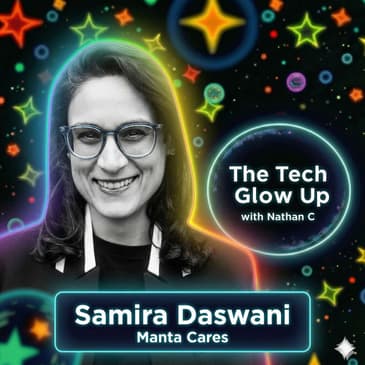
Live from The VIVE Event, powered by HLTH and CHIME: The average cancer patient makes 500 decisions during their treatment journey, often in rushed, 10-minute appointments, feeling lost without a map. Samira Daswani, CEO of Manta Cares, turned her own frustration with a broken system into a mission to build a platform that puts the patient first, full stop.
On this episode of The Tech Glow Up, live from the Vive Event, Samira shares how she's redefining the healthcare industry by creating an "objective fourth pillar" that drives patient incentives, starting with breast and lung cancer.
Samira's unique approach blends human-centered design with rigorous research, starting with a paper planner based on over a hundred peer-reviewed papers to help patients manage their 63 appointments in the first year.
Now, her AI partner, Hope, provides contextually relevant, personalized support, mapping out the 500 decisions so patients have confidence they are getting the right care. For Samira, if you lose sight of the patient story, there's no point in building the product, even while acknowledging the need for business growth and scale.
Episode Key Highlights:
- [00:06:06] Paper Planner Success: How a paper product based on clinical research still serves a population of patients aged 70+ who find digital tools difficult
- [00:07:24] AI Partner Hope: The use of Hope AI to detect and help grade symptoms like pain or nausea using the P-R-O-C-D-C-A standard to ensure patients know when to call their doctor.
- [00:11:54] Patient-Driven Gravity: Samira's goal is to create a place for patients so powerful that the economic gravity of the system (payers, providers) is forced to realign to patient needs.
- [00:12:40] Financial Toxicity: Why removing the high likelihood of cancer patients going bankrupt is the one blocker Samira would erase with a magic wand.
- [00:19:39] The Patient from Hell: The philosophy behind the name of Samira's other podcast, arguing that a patient must go against the system's "cohort" structure as an imperative for survival.
By prioritizing the patient's needs and leveraging purpose-built, narrow AI tools—like Hope, which handles 90% of its use cases around treatment decision-making—Manta Cares is forcing a necessary Glow Up in healthcare. It's a fundamental shift away from simply being "patient-centered" to being truly "patient-first," creating a better system for everyone.
Watch and subscribe to the full episode on YouTube and hit that like button to help other people find these essential conversations.
Samira Daswani is the founder and CEO of Manta Cares, the most comprehensive platform for cancer patients, care partners, and clinicians. A stage 2B breast
cancer survivor diagnosed at 30, Samira transformed her firsthand experience of the fragmented and chaotic cancer experience into a mission to revolutionize cancer care.
A "glow up" signifies a positive transformation, reflecting the journey of becoming a better, more successful version of oneself.
At The Tech Glow Up, we humanize the startup and innovation landscape by focusing on the essential aspects of the entrepreneurial journey. Groundbreaking ideas are often ahead of their time, making resilience and perseverance vital for founders and product leaders.
In our podcast, we engage with innovators to discuss their transformative ideas, the challenges they face, and how they create value for future success.
If you're a founder or product leader seeking your own glow up, or a seasoned entrepreneur with stories to share, we invite you to join our guest list via this link.
Hey, it's Nathan. Welcome to another special episode of the Tech Glow Up from the Vive Event. This was an amazing way to kick off the show for me. Talking with Samira Daswani CEO of Manta Cares was a fantastic way to start my event. We were both ramping up for this 5,000 person event at the Los Angeles Convention Center, but quickly united around our passion for putting users, not just in our thinking about innovative products, but putting them first in everything that we do. This cancer survivor turned founder story is one you will not want to miss, and if you have ever had to navigate the 500 complex, difficult, life changing decisions that are part of a cancer diagnosis, you understand that the work that Samira is doing at Manta Cares is life changing when you only have a few minutes with your doctor to understand these monumental changes and choices that you're making it can feel like every moment is go time. And so her AI powered innovation is there supporting other cancer patients on their journey, helping them understand what to expect, know how to plan their days, and go through this very complex, nerve wracking process with a little more confidence. A little more ease and a little more peace. It's a fantastic conversation. I can't wait for you to hear everything, that Samira has to say. Take a listen. Samira Daswani of Manta Cares live from the Vive Event 2026 on The Tech Glow Up.
Nathan CI'm gonna have all of the surprise questions.
SamiraThank you. Phenomenal.
Nathan CYeah.
SamiraExcellent, excellent. First way to go. Done.
Nathan CAmazing. I do this silly thing to sync the microphones. Okay. So we're gonna make shark hands toward the camera, and on the count of three Uhhuh, we're gonna clap.
SamiraOkay?
Nathan CSo 1, 2, 3 hello and welcome to the Tech Glow Up from the Vive event. I'm Nathan C, and today I'm talking with Samira Daswani of Manta Cares Samira, it is so exciting to talk with you. Thank you for being my first guest on the Tech Glow Up from Vive.
SamiraThank you for having me.
Nathan CLet's just jump right into it. Can you please introduce yourself and the work that you do at Manta Cares?
SamiraSo, Nathan, as you know, I'm the founder and CEO.
Nathan CYep.
SamiraThis company is my first one where I am the CEO.
Nathan CCongratulations.
SamiraMaybe we'll find out.
Nathan CI think it's better to be the boss.
SamiraSo, at Manta we have built a platform that is clinically trusted, AI enabled, that helps cancer patients navigate and manage cancer. Mm, we're starting in breast and lung cancer. it came honestly, initially from my, my experiences. I got diagnosed back in 2020, went through about two years of treatment, got mad at the system.
Nathan CYeah.
SamiraAnd ended up building products initially for me. And then people start asking for it, and at some point the volume got large enough that nights and weekends wasn't cutting yet Uhhuh. So ended up switching and building a company.
Nathan CSo you had started to build some tools for your own care and like sharing them with other people, giving people access, helping them get a version that would work for them.
SamiraYes.
Nathan CThat you're like, now I gotta start a company.
SamiraYes.
Nathan CHeck yeah. That's every founder's dream. Can you talk a little bit about the, the founding and that, those frustrations that you set out to, to solve?
SamiraI can, so the first product I made Yeah.
Nathan CIn
Samirathe world of ai.
Nathan CBear
Samirawith me.
Nathan CYeah.
SamiraI made a take
Nathan Cme back
Samirapaper planner, old school paper.
Nathan CMm-hmm.
SamiraBut I'm a nerd and therefore it's based on over a hundred plus peer reviewed research papers. So I wasn't joking, but it was designed for me.
Nathan CMm-hmm.
SamiraJust to be clear,
Nathan Ca paper planner with a hundred examples that you built it in research.
SamiraAnd it's got frameworks in it. So I'll give you a really simple one, right? Yeah. In, an appointment, firstly, an oncology appointment. A patient has 63 appointments in the first year.
Nathan CThat is a lot.
SamiraAnd these appointments are about 10 minutes. So in a 10 minute appointment as a patient.
Nathan CMm-hmm.
SamiraAnd I have to make decisions. Mm-hmm. The average cancer patient has 500 decisions. They're making 500, and that is, not random. So, they're all lot of decisions. And you are under time pressure. I'm not even talking about the emotional construct that you have as a patient, right? So something as simple as take notes in that appointment so I don't forget. What the oncologist says to me is crucial.
Nathan CYep.
SamiraWe have how many note taking tools in every aspect of life.
Nathan CMm-hmm.
SamiraPatients, nothing.
Nathan CMm-hmm.
SamiraSorry.
Nathan Cme.
SamiraAnd it wasn't really designed to help me manage a 10 minute appointment. Right. So that was where the paper product starts. Mm-hmm. And that's what patients are asking for. Yeah. And we learn from all of that, and I begin to learn that my experiences and my family's experiences was very far from unique. And on average, patients describe the experience, like you're on a treacherous hike, but you don't have access to a map. You're completely lost.
Nathan CYeah.
SamiraYou don't have the right tools and you don't have access to the right guide. And that's what our platform gives you. Mm-hmm. It gives you a map. So we have quite literally mapped out those 500 decisions. We've told you what the sequence is. We've given you, how do I think about this station and that station, and at this station, what do I need to know?
Nathan CYeah.
SamiraHow do I need to think about it? What questions do I ask my doc? What support do I need? Do I need a wig now, or do I need to wait five months from now? It's things like that.
Nathan CYeah.
SamiraIn the world of ai, we have trained our AI layer on our map, so everything is contextual. To your location. And allows you to have this back and forth in a very easy way for you to be confident that you are getting the right care.
Nathan CMm. I am a sandwich parent. Mm-hmm. I'm a sandwich generation parent and so I'm, I'm helping two generations with their medical care.
SamiraAh, funny.
Nathan CAnd most of what I do is talk about what I think the appointment's going to be, about what kind of decisions we might be asked to make. Correct. And what kind of outcomes, you know, either my kids or my parents are hoping from, from that conversation. And it, it sounds like I, I had a friend actually who just speed ran cancer very recently and the like, I don't know what's next. I don't know. All of the, there were so many questions, so much emotion, so much fog. Yes. That, it was really overwhelming. And this idea that you're like throwing somebody in to like, essentially like taking a SAT test. Or, or I don't, a med school test or, you know, like taking a really big test without any study.
SamiraYes.
Nathan CWithout any clarity about why you're in it or what you're doing. You're just kind of in the flow. Yes. just the grounding and like confidence that like this 10 minutes, I'm gonna go figure out this question. Yes. Breaks a really big problem like cancer into. A decision that might feel or that, that might feel doable? A
Samirahundred percent
Nathan CWhy ai? If you started with a paper planner,
Samirathe funny part of the story, by the way, is our paper product is still very much alive.
Nathan CYeah.
SamiraThe average patient is 70 plus.
Nathan CYep.
SamiraWe have a 92-year-old in Kansas. Who has a landline.
Nathan CYeah.
Samiraand we have helped her figure out how to download our app, create an account and use it.
Nathan CYeah.
Samiraso paper bristle really important. Mm-hmm. Having some app.
Nathan CYeah.
Samirawhat the AI layer really did for us is it allows a patient to engage very easily. So 500 stations.
Nathan CYep.
SamiraOur UI is really simple, but it's simple for us.
Nathan CYep.
SamiraDigitally native people, right? For someone who is 70, 80, 90, it's hard. It's hard. Changing a password is hard, so us making sure that they have something super simple that they can still interact with, that gives them contextually relevant, it's easy to understand. Personalized is what AI unlocks.
Nathan CSo, instead of just a workbook, the workbook knows what you're trying to do
Samiraprecisely
Nathan CYes.
Samiraand in some cases can actually do it for you, right? Mm-hmm. Like one of the things we've seen once we've added it, the AI layer, by the way, is called Hope.
Nathan CMm-hmm.
SamiraIt's an AI partner.
Nathan CThanks.
SamiraAnd Hope allows you to track symptoms.
Nathan CMm-hmm.
SamiraRight. So hope will detect when you are like, talking about pain or you're talking about nausea. Mm-hmm. And hope will be like, okay, pause. All validated in terms of, mm-hmm. We use something called P-R-O-C-D-C-A on the back end. That's how you distinguish symptoms and side effects We hope, or pause and be okay, let's walk through. Is it mild? This is what mild means. Mm-hmm. Is it moderate? This is what moderate means. Severe. This is what severe means. So we'll help you understand how to grade your symptom, and then based on the severity, will tell you, Hey, you really need to call your doc.
Nathan CMm-hmm.
SamiraOr if you wanna manage it, let's talk about it. And by the way, I can track it for you.
Nathan CHmm.
SamiraMm-hmm. So things like that is what AI has unlocked for us.
Nathan CSo the name of the show is the Tech Glow Up, and we use the idea of a Glow Up. which is like a transformation, a rebirth, a dramatic refactoring. the first question I ask is about the healthcare industry as a whole and maybe even cancer treatment, in your case. where does healthcare need to Glow Up in 2026?
SamiraOkay.
Nathan CWhat's what, isn't being addressed yet?
Samirayes. So the way I describe it is what we do. Hmm. Is we're building the fourth estate in healthcare. We've had a lot of stuff about patient centeredness. Mm-hmm. We've been saying that for two decades, three decades, how patient centered we are. I don't know what we are not is patient first.
Nathan COoh.
SamiraSo what we do at Manta is we first and foremost solve what the patient needs, what the patient wants, kind of full stop. Everything else is a derivative of that. So what I describe we are building is we're building the fourth estate. We are building the objective fourth pillar that is not driving the payer's incentives. That is not driving life sciences incentives. It's not driving the health care system provider systems incentives.
Nathan CMm-hmm.
SamiraWe are deriving and driving the patient's incentives. So what I wanna see happen in healthcare. Is more companies aligning to the fourth estate
Nathan Cand what, what happens in the future if they do?
SamiraI think we build a better system than we have right now.
Nathan CI, so I was having a conversation earlier today where we were talking about how like the collapse of meaningful health insurance. Yeah. The collapse of access in rural communities. Yes. the drive to like skirt the medical system in some ways. And, it's being paraphrased as like the consumerization Yes. Of healthcare costs. What, I see is that everything is too expensive and most things are failing patients.
SamiraYes.
Nathan CAnd it's pushing us into a very profit driven space. That's Right. it's unclear. I, don't even know if I know enough about this to go in there. Certain marketplaces are offering the idea that they will be great sources of information and savings, right? Yes. but it's unclear are those actually gonna be clinical solutions? Are they gonna be like diet tracking apps that you can give for free? And so this idea of putting the patient not only centered, but first and almost like creating a place for the patient to be as valuable as the payers and as the providers. Where's my question? This idea is like really bold, right? Like it's what? What kind of Glow Up are you going to need in the next year to help us get there and to, prove that not only patient centered, but patient first
SamiraYes.
Nathan CIs the way that this industry that is looking for a new model needs to go.
SamiraSo we're very young as a company,
Nathan CYeah.
SamiraWe, we've had thousands of patients on the platform.
Nathan Cyeah.
SamiraBut for us to really pull it off, we need tens of thousands.
Nathan CYeah.
SamiraRight. Because what happens today is most healthcare companies are so fragmented, so there is really no concentration of economic power.
Nathan CMm-hmm.
SamiraSo the way a fourth pillar really stands up is you need a lot of patients there, because the minute you have a lot of patients there, every else has to realign. They kind of have to. Right. So at least that's a goal.
Nathan CGive patients a place that is so powerful where they can get the kinds of care that they need. That gravity is just gonna bring the rest. if there were, if, if I could hand you a magic wand Yes. Right now and you could wave it and remove one blocker. Just one.
SamiraOh,
Nathan Cfrom that path? Yes. That you just set out? Yes. What are you gonna erase from the equation?
SamiraA cancer patient is two third, two thirds of my patients have a high likelihood of going bankrupt from cancer treatment cost.
Nathan CYep.
SamiraAnd if I could use my magic wand to remove one thing, I would remove that.
Nathan CMm.
Samiracause that's a really hard one to solve in air. I think it's a really hard one to solve in a decade, but it's a really hard one to solve in a year.
Nathan Cwe should be able to just focus on the healing from being a cancer patient. We shouldn't also have to completely rewrite
SamiraCorrect.
Nathan CHow we live our entire life.
SamiraAnd how, Housing loss is a big one.
Nathan CYep. This, was something that we talked about at health, quite a bit, and it was. Astonishing. How much of you know if you have had a major medical experience in the last few years, the likelihood in the US that you are also facing?
SamiraSure.
Nathan CTake it out.
SamiraCan I, can I give you one story Yeah.
Nathan Cthem out? Please Give, gimme a story.
SamiraSo we put out our AI layer
Nathan CYes.
SamiraIn November.
Nathan CYes.
SamiraRelatively small population on it, because again, we're cancer specific. Right. So this is, these are patients who are on treatment right now.
Nathan CYeah.
SamiraWe have people who are dealing with domestic abuse, looking for a women's shelter on our platform. We have people who are losing their home looking for housing support because they need to go two hours and get treatment in the clinic. I say that to say that like I think we are doing a lot to help the patient, but that is not even close to what's necessary for you to get baseline care.
Nathan CJust imagining as like a tech founder looking at your analytics and realizing like, number one bravo that people trust. Yes. The conversations that they're having with you to search for things that would maybe be hard to search with a real human or, you know, a, a community health worker or, So like, wow.
SamiraYep.
Nathan CBut to see it in your own data of like, these people don't just need cancer care. They have questions about everything else that's complex in the world.
SamiraYes.
Nathan CWhew. How do you. You were also talking about like this personalization
SamiraYes.
Nathan CAnd like the care that you have with your client base, but you also mentioned like the focus and the need to have a center of gravity to prove that revenue model. Yes. How do you balance that? I'm making a difference in this person's life with the needs to make a difference in the lives of your business. How do you, balance, those priorities?
SamiraSo this is where me being a survivor starts to make it honestly, a little bit easy. I I, I don't mean that with any pun intended, right? Yeah.'cause I think in healthcare there's a lot of conversation about scale and growth, which is, it makes sense. I get it. Tech founder hat of course matters'. Reality is if you lose sight of that patient story, what's a point?
Nathan CWhat are you making?
SamiraWhat's a point? It doesn't matter.
Nathan CYeah.
SamiraSo for me, like honestly I just, I just keep going back to that. The one thing I will say though is reading the data on a Friday night. Bad idea. Very bad idea. Yeah. Everybody needs, so Monday morning now,
Nathan Cyeah, everybody needs rest.
SamiraI do believe that I really, truly, this is not, this is not just words to me. Like I do believe that if you do right for oncology patients, the center of gravity shifts. And oncology patients, and this is when I'm gonna switch hats. I'm gonna put on my like very like healthcare capitalistic like hat on oncology patients are economically crucial to the system. Mm-hmm.
Nathan COh, absolutely.
SamiraThe system minced money off of oncology patients. They just do. But the reality is we have not had a platform that is pushed putting the patient's needs first.
Nathan CMm-hmm.
SamiraRight. So in oncology, I think we can pull off small population depth. Of support and then have the economics follow.
Nathan CCool. I want to follow up on that one.
SamiraI have, 2 45.
Nathan COkay. we can get through the next little, couple questions. There's just this mentor question.
SamiraOkay.
Nathan CFounders and CEOs. It's such a hard place to be because not only are you like singular in your vision, but you are also like singular in your organization. And yes, that means that like the role of mentors and coaches and guides is crucial because you are alone in your space so frequently. Can you talk about how mentors or guides have been important in, in your development of, as a founder and, and for man cares?
SamiraSo the way I think about what we do is abstractly, we're sitting at this intersection from a product perspective, patient need, of course, we're very design led. So human centered design, for me, I that's, my training. That's my master's degree. Clinician advisors, huge. Our chief medical officer is a former ASCO president, 40 years of oncology experience. We have over a hundred clinicians across the country who work with us in some capacity. Crucial, right? Because if you build this stuff in isolation, it's not going to work. You need the clinically trusted arm, so that side of the house. Mission critical. And then I have a cartographer who's an advisor. We build my apps, we need a cartographer. Mm-hmm. They still exist.
Nathan CI love it. Yes.
SamiraAnd then on the personal side, I do martial arts. Mm-hmm. So I see my senses as mentors and guides and coaches. they're coaching me on the mat, but honestly, so much of that shows up at work. So much of that, and that tends to be more about like, how do you stay well and healthy and. So that's my answer. Favorite.
Nathan COh my goodness. That's gorgeous. I'm so glad I asked. Do you happen to have a spicy hot take on healthcare technology, AI culture, or otherwise? No pressure.
SamiraI was like spicy, hot. Take Rin.
Nathan CMm-hmm.
SamiraI dunno if I'm that cool.
Nathan CDo you have a mild hot take?
SamiraI might have a mild one.
Nathan CYou know, we'll punt on that one.
SamiraI have one.
Nathan COkay.
SamiraSorry.
Nathan CNo, I love it.
Samiraimpatient. We have a podcast.
Nathan CYes.
SamiraIt's called The Patient from Hell.
Nathan CMm-hmm.
SamiraAnd I tend to get a lot of grief for the name, and despite that, we've had enough, and I have to talk about why we named it that. Hm. Because if you pull up my chart, I am pretty sure it will say difficult patient everywhere. It just will.
Nathan CMm-hmm. Your personal healthcare chart? My, yeah.
SamiraAbso a hundred percent.
Nathan CYeah.
SamiraIt will have the like, oh yeah, she's a bioengineer. She has lots of questions. Make sure to book extra time to the point where I booked an appointment online. I got a call back being like, your doctor requested more time with you because they know you will run out of time. So anyway, point is,
Nathan Cyeah.
SamiraBut the other reason is it was actually named after a book. It's called The Patient From How, to Get the Best That Medicine Has to Offer. And it was written by a rare cancer, survivor who now passed away. Stanford professor who basically argues that in medicine we have built this system to put you in a cohort, right? Everything we do, clinical trials, cohort biology cohort. and we cohort you based on biology, demographics, cohort. Correct. It's all cohorts, right?
Nathan CYeah.
SamiraNow, if you are a patient and you do not cleanly sit in a cohort, what happens? The system breaks because a system is not teaching anybody to think empirically. So if you are a patient with a rare disease with oncology today, you have to go against grain. It's a have to, I think it's an imperative for you to survive.
Nathan CThe system is not built for you. And so you have to, be a rebel. You have to work outside of the box.
SamiraAnd in oncology, patients know this, right? Oncology patients are incredibly activated. And now with our data, I'm like, guys, 90% of the use case of hope. Is treatment decision making.
Nathan CMm-hmm.
Samira92-year-old in Kansas City treatment decision making. This is a patient being like, this is my call. I know it's my call. How do I make it?
Nathan CYeah.
SamiraHopefully that was spicy enough.
Nathan CPerfect. Okay, so Mary, last question.
SamiraYes.
Nathan CWe're hearing a lot. About how AI is gonna save time, it's gonna power workflows, it's gonna drive revenue,
SamiraYes.
Nathan CI also hear that there like aren't standards, there aren't licenses, there aren't frameworks that we've agreed to and how this stuff works.
SamiraYes, correct.
Nathan CIn your point of view, from your frame of reference, what is the state of responsible. Ethical, impactful AI today? Where are we at
Samirapretty far.
Nathan CCool. How so?
SamiraI think we're pretty far. I think we can get there and I think we can get there fast, but I don't think we're there yet. I'll give you my favorite example, right? Yep. Patients use chat. GPD patients choose us. Okay. I pick on chat. GP, whatever. Pick. Pick your flavor of gen. Gen LLM. Yeah. patient comes up with 18 questions.
Nathan CMm-hmm.
SamiraDisconnected from where they're in the experience to. Disconnected from what's relevant. Okay, and now you show up at the doc's office. You have 10 minutes. That 10 minutes is not going up.
Nathan CSorry,
Samirait's going down, not up. If it goes on. In a 10
Nathan Cminutes. I thought it was 15.
SamiraI think I heard stats is down to eight.
Nathan CYeah.
SamiraAnyway, stats. 18 questions. Eight minutes. Not happening. What you really need is a top three. Good. But what you need is a top three contextual to that appointment with that clinician. So I think we can get there, but we're not there yet. And I do think you need more purpose built narrow tools to help specific patient populations with specific needs as opposed to one tool solves everything.
Nathan CI love it. Samira. Daswani.
SamiraYes.
Nathan CSamira Daswani of Mantic hairs. has been such a lovely conversation about where AI is really making an impact with cancer patients, and also the data that goes into building a highly researched patient first. company in an age of ai. I am just so thrilled to learn about your journey in innovation.
SamiraThank you for having me.
Nathan CYes.
SamiraThis was very fun.
Nathan CThere's one thing we have to do
SamiraYes.
Nathan COkay. Same as before. 1, 2, 3. Amazing. Thank you so much.
SamiraThank you.
Nathan Ccan I ask you a favor? If you really enjoyed this episode, could you share it on your Instagram stories or maybe post the link with what you enjoyed on LinkedIn? The sort of sharing and engaging really helps small podcasters like me reach the audience that I know really cares about these kinds of conversations. If you've made it this far in the podcast, I really appreciate you. Thanks for listening. Please make sure to like and subscribe so that you never miss an episode of the Tech Glow Up. And hey, can I ask you a favor? If you really enjoyed this episode, could you share it on your Instagram stories or maybe post the link with what you enjoyed on LinkedIn? The sort of sharing and engaging really helps small podcasters like me reach the audience that I know really cares about these kinds of conversations.