
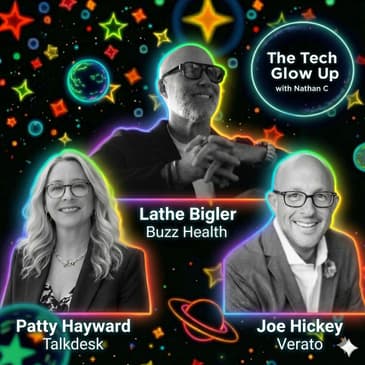
Healthcare has a data problem, but not the kind most people assume. The information exists. It's scattered across dozens of systems that don't talk to each other, and every provider encounter requires reconstructing your story from scratch. In this live Vive 2026 episode, I sit down with three leaders each working on a different layer of that gap.
Joe Hickey, VP of HIE and Provider Solutions at Verato, makes the case that stable patient identity is the foundation everything else is built on. Healthcare poured billions into EMRs, CRMs, and data lakes over the past decade and got fragmentation in return.
Patty Hayward, GM of Healthcare and Life Sciences at Talkdesk, returns to the show with a view of where AI earns its keep (scheduling, reminders, billing) while keeping clinical decisions with humans.
Lathe Bigler, SVP of Business Strategy at Buzz Health, closes with the case for price transparency as a patient right. Buzz Health embeds affordability intelligence as an API layer so providers and patients see the same price at the moment it counts.
Key Moments:
- [00:04:26] Identity as Infrastructure: How a decade of data investment created fragmentation, and how Verato unifies patient identity across the enterprise.
- [00:16:00] The AI Signal Worth Noticing: Physicians who planned to retire in two years now have three to five more, because ambient listening transformed their daily workload.
- [00:20:59] Where AI Belongs Right Now: Patty draws the line between what AI handles in patient communications and where human judgment stays essential.
- [00:25:00] The Change Management Blind Spot: Bring physicians into contact center projects early or they become the biggest blocker — Patty's most consistent advice.
- [00:34:10] The Prescription Abandonment Numbers: 75% of providers say cost barriers prevent patients from picking up prescriptions. Buzz Health puts the solution inside the prescribing workflow.
Three conversations, one clear thread — the gap between what patients need and what they get comes down to information that exists but isn't connected, surfaced, or trusted.
Watch the full episode on YouTube and subscribe so you never miss The Tech Glow Up.
Join the Tech Glow Up newsletter on Substack → https://substack.com/@mxnathanc
A "glow up" signifies a positive transformation, reflecting the journey of becoming a better, more successful version of oneself.
At The Tech Glow Up, we humanize the startup and innovation landscape by focusing on the essential aspects of the entrepreneurial journey. Groundbreaking ideas are often ahead of their time, making resilience and perseverance vital for founders and product leaders.
In our podcast, we engage with innovators to discuss their transformative ideas, the challenges they face, and how they create value for future success.
If you're a founder or product leader seeking your own glow up, or a seasoned entrepreneur with stories to share, we invite you to join our guest list via this link.
Welcome to the Tech Glow Up. It's Nathan C. I talk a lot with innovators and entrepreneurs about how to make products that people actually care about. In all my years of podcasting, I've talked to over 300 experts in innovation, leading on the cutting edge. And honestly, I don't think I've had an episode of The Tech Glow Up that was this customer first. That was this innovation centered on real people and what like you and me need from innovation in health tech, or even just in healthcare in general. Yes, of course. It's 2026, so there's going to be some conversation about ai, but AI is being used in very specific ways. It's not being used for everything. So let's talk about who we have on the show this week. I'm talking with Joe Hickey of Verato, Patty, Hayward of Talkdesk and Lathe Bigler of Buzz Health. Joe Hickey has a job title that I can barely pronounce as VP of HIE and Provider Solutions. That's the easiest I've ever said that at Verato Joe argues that it's not that we don't have the data, it's just that it is so fragmented, specifically the patient information is so fragmented across so many different silos, so many different tools. Every time you have to fill out that same information on a form that's going into a new tool, a new technology, and becoming a new slice of a very fragmented record about your data. Verato puts you back in the center and uses identity to solve a host of problems and pain points in your care journey When your healthcare providers understand who you are without asking, that's when we can start to unlock the promised land of personalized, preemptive care and outreach. Next, Patty Hayward comes back, GM of Life Sciences and Healthcare at Talkdesk. Now, talkdesk is using AI to solve problems and to make care more personalized, but they're not handing over the keys to everything just yet. There's certain things that people should be doing, and there's certain things that computers are way better at. And Patty's whole hypothesis is that people are spending way too much time being asked to act like computers. So let's let the AI handle that. The redundant task focus stuff like scheduling, like appointment reminders. Like billing and other outreach patty emphasizes that the ROI of AI can be accelerated pretty quickly even by just helping agents think about what the best next step might be. You don't always have to know all the answers, but if you understand where your patient is going, you can be a lot more helpful. All right. Lathe Bigler of Buzz Health he's the SVP of Business Strategy and he brings us home in this episode with his call to action around price transparency. It really should be a healthcare human right, but currently it's one of the most frustrating, confusing parts of getting a new prescription. Who has my medication? Where's the best deal on my medication? Do the people that I'm trying to get my prescriptions from even know who I am? By addressing transparency in cost and availability, Lathe is trying to give power back to patients and make care more effective by removing those burdens to just picking up your prescription. if there was one question or one topic, one conversation that we should have in their time together mm-hmm. What is the one thing we should absolutely talk about,
Joe Hickeyconsumerism and healthcare mm-hmm.
Nathan Cmm-hmm.
Joe HickeyIs not giving us the clarity we need.
Nathan C1, 2, 3. Hello and welcome to The Tech Glow Up. I'm Nathan C, and today I'm talking with Joe Hickey, VP of HIE, and Provider Solutions at Verato Joe, it is so great to talk with you today.
Joe HickeyYeah, thanks for the opportunity to be here, Nathan.
Nathan CThanks for joining me on the Tech Glow Up. let's just jump right in. can you talk a little bit about the work that you do in healthcare innovation at Verato
Joe HickeySo my name again is Joe Hickey. I'm the VP of provider and HIE. And when we say HIE, we're talking about health information exchanges.
Nathan Cyou.
Joe HickeyAnd my goal is to have conversations with healthcare organizations around a very important subject in healthcare. And that is identity. Mm-hmm. And making sure that identity is accurate, it's reliable and it's available. Yeah. Because that's the only way that we can really personalize healthcare. For exceptional experiences. Mm-hmm. that helps drive growth as well. And it also, when you bring together the right level of identity is gonna help you reduce the amount of inefficiencies. And that burden that is, is plaguing so many larger healthcare organizations.
Nathan CAnd when you're talking in this case about identity, I, my brain goes to a number of different ways that like identity could impact a healthcare journey. Can you talk a little bit specifically about, what part of that, identity and how Verrado Is helping, sort of solving in this space?
Joe HickeyYeah. And, and talk about how we got here.
Nathan CYeah.
Joe Hickeywhen you think about the past 10 years, healthcare has poured billions mm-hmm. Into. EMRs, CRMs, data Lakes, et cetera. And I think everyone had the right intention. Mm-hmm. But what it's actually done is not delivered the clarity we need. It's actually delivered a lot of uncertainty. And the reason that for that is so many of those contributing systems are all over the place. Mm-hmm. So the patient 360 that makes up Nathan, is in many, many different systems. And so we're trying to bring it all together and have that follow you through your healthcare journey so that your micro moments of care makes sense. We've all, we all go through this in our personal healthcare journeys where you show up and they're like, wait a minute, who are you and what's your story? And that's frustrating, right? Mm-hmm. And it also erodes your trust in that health system. So we're trying to bring together all of that identity that swirls around you and have that follow through your healthcare, personal journey so that we can personalize that for you and also deliver the right type of healthcare outcomes that you're looking. For,
Nathan Cyeah, I was remembering a conversation with my wife where we're both like flipping through our mobile phones trying to find which health record app the kid's appointment was in. Right. It was like, is it this? So I'd love to have like my app that had all of my appointments and like
Joe HickeyAnd you know, sometimes you even show up to, an appointment and your primary care physician may not have your images. May not have your labs. Yeah. And you end up showing your physician with your own phone. Mm-hmm. Here, here's, here's my results. Because they don't have access. And that, that kind of goes back to, you know, the interoperability. And not, not necessarily the movement of the data Yeah. But the trust in the data so that everybody's viewing it at the same time
Nathan Cthat idea of trust of data, like I sort of as like, I'm a, I'm a marketer, right? And I work in product marketing and like. I only want the things that like come in through my systems. Sure, yeah. Because it's organized for me. It's the data that I need. And I, I sort of, I, I can only imagine when you're talking about distrust of data that everybody's out there with like their arms around like, well, my data's gotta look like this and my data's over here. And like,
Joe HickeySo, you know, back to the point of all of the information coming in from a lot of different contributing sources, It's not good enough to know who's who in one system. Mm-hmm. You have to know who's who across the entire enterprise, and you gotta make sense of that. A lot of that overlapping data. So a call center agent may wanna see different information than a billing clerk who's trying to figure out a denied claim. Mm-hmm. So Verado comes in, not only are we unifying and connecting all that data, but then we're serving it up. Mm-hmm. For a specific business function or a specific business persona so that they can use it as a strategic asset.
Nathan CSo, so, Joe, I'm nobody starts their career as a VP managing for HIEs, and so I'm, I'm super curious what. Started, this is a very, like specific and interesting space. What started your journey in health tech innovation and
Joe HickeyYeah.
Nathan CBrought you here.
Joe HickeyI've been really lucky and I've had a lot of great mentors. Mm-hmm. yes. I did not start out in healthcare. It, I was in a totally different direction. but someone took a chance on me. And wanted me to help start to do a lot of project management in healthcare. Mm-hmm. And so I did that for a number of years and I really enjoyed it because that's where I, I learned what happens in the trenches with patients, with physicians, with nursing, with care teams, with executives. And everybody's extremely busy. They're trying to solve a lot of problems. and it really, I just gravitated to it because healthcare does have a lot of problems. Mm-hmm. It's very complex. But that's not an excuse to get complacent. Right? Yeah. We all have to do our part. And I said, man, I, I just wanna jump in these waters and I want to do my part and, and see how we could make a small dent in healthcare and enough, if enough of us do that, we'll make a big dent in healthcare. And we'll leave it better than we found it for future generations. And so I have a lot of passion around what RA is doing and, and what I'm doing, and. Thanks to a lot of mentors who Took, took, took a chance on me and believed in me. And helped me and guided me.
Nathan CYeah.
Joe Hickeyyou know, I, I am where I am today.
Nathan Care you able to share, how a mentor has been consequential in some of those key moments for you?
Joe HickeyYeah, absolutely. you know, I think it comes down to passion, right? Mm-hmm.'cause again, what we do is hard. you know, it, and it, it, it can't be all about the technology. And a lot of my mentors reminded me, you know, behind every piece of data there's a person. Yeah. Right. And don't forget that. And patients don't decide that they want to end up in the hospital and end up on a care journey. you know, when you consider, a person who receives a cancer diagnosis, the last thing that they need to even be thinking about is, can I trust the data and does my health system and my doctors and my care teams know who I am? Always remembering that, that there's a patient on the other end and there's families on the other end. It's just fueled me. It's just kept me going each and every day.
Nathan CAmazing. From that deep perspective in the challenges I, I love, right? I, I talk about being like a recovering project manager, but that idea that it is one of those roles that gets you. A seat at all of the interesting conversations and you get to see how everything comes together. Like I so relate to, you have this really inside perspective on the industry and some of the biggest players.
Joe HickeyYeah.
Nathan Cthe name of the show is The Tech Glow Up. We're looking at what are the transformations, the rebirth that need to happen, and I've heard a lot of people talk about there needs to be change in this space.
Joe HickeyMm-hmm.
Nathan CWhat's the Glow Up that you wanna see in healthcare in the next year or so?
Joe HickeyI really wanna see consumerism take hold.
Nathan CMm-hmm.
Joe Hickeyit's in our lives with our, you know, with retail, with banking, with travel, with leisure. At the very least it should be in our lives, in our healthcare journey. And it should be, should be very accurate, should be very personalized. So we're having a lot of conversations around, you know, call it patient 360, golden view of the patient, et cetera. And all of that is, that needs to be in place in order to drive personalized engagement. And that's gonna serve the patient well. It's gonna serve the providers well. It's going to serve larger healthcare organizations, growth strategies also. Mm-hmm. So it's all about those exceptional services. I think consumerism is finally going to get a seat at the table in healthcare. Mm-hmm. And Barato's gonna be there to ensure that we're making all of those contributing sources come into one place.
Nathan CYeah.
Joe HickeySo that, yes, we have your clinical history, but yes, we also know your social determinants of health. We're bringing that all together so that it's a very personalized journey. And so therefore, healthcare organizations can deliver on the promise, which they all promise, right? Mm-hmm. We wanna deliver on the promise of healthier communities. Mm-hmm. And consumerism and personalized experiences is the way to get there.
Nathan Chow do you view the idea of like consumerism in healthcare? Is that about like, I'm, I can like buy my prescriptions on Amazon or that. The care is, is more, you know, the customers are, are the, excuse me, patients are kind of shopping. Yeah. like they would, you know, a sofa for their heart doctor. Like, yeah. How, how do you see consumerism?
Joe HickeyYeah. I think it's,
PRyes.
Joe HickeySo it's in the clinical, the patient's journey. Mm-hmm. Right. you know, going back to the examples of. Is all my information available for who needs to see it. Mm-hmm. My can my care times care team see not only what's in the E emr Yeah. But everything else that's coming in about me. Sure. Okay. And I think that has a lot to do with that
Nathan Cidentity. That
Joe HickeyAnd, and that has a lot to do with how you are matching up the, what we call the micro moments of care. Mm-hmm.'cause collectively they compound and, and they all matter.
Nathan CAbsolutely.
Joe HickeyI think the other component that you talked about is more along the lines of engagement. Yeah. And outreach. Right? So healthcare systems want to be able to segment their data accurately so that they can reach out to pro proactive care nudges, to their, to their community. Also, if they onboard a new cardiologist or a newer orthopedic surgeon, they wanna make sure that the community knows about that.
Nathan CYeah.
Joe Hickeyso it's a great way if you have a stable identity foundation mm-hmm. Where you've harmonized everything, you know. Exactly. I want to target females between the ages of 30 and 45, and I wanna make sure that they're, you know, being proactive to mammographies or you, you name the specialty service that. is, is important. So I think that engagement and that outreach, you know, also with engagement, none of us want to have repeat messages or worse yet a message that comes to you that's inaccurate because then again, yeah, you're trusty rose
Nathan Cthree days too late.
Joe HickeyWhy? You know, why, why do you not know who I am? This is my healthcare journey. You know what? I might go across the street and see a different primary care physician because I feel like you don't know who I am.
Nathan CI so appreciate, and like I've literally had experience, I was talking about this earlier this week, where I've had experiences where like we're in the middle of like a major medical conversation with like a parent or a child that I'm supporting, and I get a phone call from somebody downstream who's following up on like a different part of the conversation. You're like, your timing is hilarious, right? Like, just Right. The, the synchronicity that happens there.
PRYeah.
Nathan CSo Joe, this is, we've been flying by, I've been loving this and enjoying the perspective. Thanks for, the side quest with me as well. One of the next conversations is I like to give folks the opportunity to share a spicy sound bite. Mm-hmm. Could be a hot take on data, on identity on healthcare as a whole. or even just like culture and trends do you have a hot take?
Joe HickeyYeah, I think so. I mean, we're here at Vive in Los Angeles, 2026 and you can't really walk five feet without seeing something pertaining to ai.
Nathan CYeah,
Joe HickeyUhhuh and, and hey, that's important. And AI is powerful. It's something that Verado is leveraging to become more efficient in our own organization. I think in healthcare we're still a little ways away from really trusting it. Yeah, especially from a clinical support type of type of situation. But that's where I think Rado is really gonna help the industry. We're really helping to, again, stabilize identity, make sure that the inputs are accurate and reliable so that everything upstream remains constant, et cetera. I also have learned here at VI that it's really interesting, AI is really extending, The careers of physicians and, and I think a great way, and a lot of it has to do with ambient listening.
Nathan COkay.
Joe HickeyI've talked to a few physicians who, you know, with that ambient listening, I'm not taking so many notes, I'm not doing so much paperwork and following up and where I thought maybe I was gonna retire two years ago. I think I got another 3, 4, 5 years left. And that's great to hear because they're, you know, we need more physicians, we need more nursing in the overall industry.
Nathan CWhat an anecdote that, so anytime somebody mentions AI to me, I, I follow up with the question of like, what is actually responsible, effective, like, revenue driving AI today, right? Like, not in some six month time, not in, you know, 2020 whatever.
Joe HickeyYeah.
Nathan CBut like, how does that look today?
Joe HickeyYeah.
Nathan CAnd I'm always like, well, who is that throughput for? Who is that? Right? And if you're telling me that providers, that clinicians, yeah. Feel like they have 3, 4, 5 more years. Yeah. That they can do this just because they're taking a notetaker or a scribe or you know, bringing in other ambient technologies. wow.
Joe HickeyThat's great to hear.
Nathan CThat's the kind of signal you look for. Right. Definitely. do you have an opinion on this question around effective, responsible ai? Like, what is your baseline for what is effective and responsible in 2026?
Joe HickeyWell, I, you know, we keep going back to trust. Mm-hmm. And, and, and, you know, trusting all of the data that's swirling around in healthcare, healthcare data is dynamic, right? Mm-hmm. It's, it's changing all the time and new data's coming in. And so I think in order to be responsible, you know, you really, again, have to make sure that it's connected, it's unified, it's stabilized, so that you're using it for good otherwise fragment and data, redundant data throughout the system, even if you have ai. Again, it's just gonna be amplified.
Nathan CYeah.
Joe HickeyYeah.
Nathan CI talk with go to market teams a lot about, like, automation's great. But it automates everything you do.
Joe HickeyRight.
Nathan CSo you wanna, like, you wanna be tidy before you go fast. That's right.
Joe HickeyThat's right.
Nathan CAmazing goodness Joe. I think we've done it.
Joe HickeyAlright,
Nathan Cwas there anything, that we didn't get to that you were hoping to share today?
Joe HickeyI would just encourage everyone that if you are looking to elevate your discussion around identity, you know, from being a, a technical discussion to more of a strategic initiative that you're going through, please visit Veratocom. If you're here at Vive, come visit us at the booth and, again, my name is Joe Hickey and we hope to meet everybody soon.
Nathan CJoe Hickey, VP of Goodness Provider Solutions. And HIE at Verato
Joe Hickeygot it.
Nathan CI'm. really thrilled to hear this idea of how, a focus on empowering, healthcare consumers with the data that they need to best navigate and understand, their care options, is one of those places that, AI and better data, could be really impacting how people experience the healthcare solution. Thank you so much for joining me on the tech logo. Yeah, thank you. It was a great conversation. Excellent. I also have to compliment your haircut. last but not least, we're gonna just clap it out. All
Joe HickeyAll right.
Nathan C1, 2, 3. Amazing. I'm gonna grab the, microphone before I forget. Oh, absolutely. sure. You got a good angle. One, two. Three. Hello and welcome to The Tech Glow Up. I'm Nathan C. Today we're live from Vive and I'm talking with Patty Hayward, GM of Healthcare and Life Sciences at Talkdesk. Patty, it's so good to talk with you again. to talk with you again.
Patty HaywardGood to talk to you as well.
Nathan CAnd in person. How's your Vive been?
Patty HaywardIt's been great.
Nathan CSo for those who haven't had the joy of, chatting with you, before. Can you introduce yourself? Yeah. And the work that you do at talkdesk?
Patty Haywardmy name's Patty Hayward and I'm the general manager of Healthcare and Life Sciences at talkdesk. we work a lot in the patient communications, area. We, power phone systems, contact centers, and really help to orchestrate the patient journey. So, and I'm responsible for sort of where we're going in our vision for healthcare and life sciences.
Nathan CWhen people are talking about AI in healthcare, I've had a follow up question around really trying to understand, there's like a lot of talk about what's possible, where we could go Yeah. What's happening.
Patty HaywardYeah.
Nathan CBut I'm trying to understand like, where are we at today, especially when it comes to responsible. Effective revenue driving ai.
Patty HaywardYeah.
Nathan CWhere are we with effective? Responsible AI in healthcare? Nah.
Patty HaywardWell, it depends on what sector you're in inside of healthcare, right? So I think that the area that we're in with patient communication, with being able to utilize AI to do outreach, to answer phones, to make appointments, pay bills, things like that, it's a really good. Spot, right? Mm-hmm. Because you don't have that clinical aspect to it. in fact, we very purposefully keep, you know, any sort of clinical references out and to humans. and that's important because I don't know that we've evolved in all the areas yet to sort of trust everything there. And trust is really important when it comes to ai. So when it comes to something like, I'm gonna schedule an appointment, you're having a nice conversation with an AI agent. but it's a pretty simple task of mm-hmm. Going out and calling an API. Now scheduling appointments in healthcare is not like scheduling a haircut, so it is complicated. and it's perfect for AI to be able to do same with things like paying bills and things like that. And, you know, when I think about return on investment mm-hmm. Which is a really important topic. Right. Let's face it, we are working on raise your thin margins. Yeah. you know, my perspective both from a, you know, what can we do that makes everything better but also brings back to the organizations is we need to really change contact center from just being an ask answer machine.'cause today the way we think about a good call is someone calls in, asks a question, we answer it correctly, boom. Done. Mm-hmm. Check, right? Mm-hmm. What we want to be able to provide is an experience where we're either. if it's a fully agentic discussion, then we ask more questions. So if you call in to say, you know, I am out of refills of a prescription that I need to get from Walgreens, and so, you know, I need my physician to send more refills out, well, there's probably a reason, right? So it's important to be able to do a lot of those things and be a lot more proactive, which gives back to the organization. And then I see that going even further in the future where we start to really do things like next best actions. Yeah. And how can we be care guides to ensure that we're making sure that they're doing things like, hey, we see a couple of, Referrals. Outstanding referrals to specialists out there. Have you taken advantage and gone in Yeah. You know, made your appointments and doing things like that more proactively as opposed to, you know, just as I said, the ask answer machine.
Nathan CYeah. As you're talking, the use case that you're talking about. In customer communications, right. Like as a product marketer by background, right? Like that is absolutely like a knowable Yes. Set of interactions. Mm-hmm. And you know, it, it is the kind of data set that Talkdesk is like very powerful. Yeah. With
Patty Haywardmm-hmm.
Nathan CYou know, very reliable, trusted data sources about what are the kinds of questions people ask, how do they ask, you know? Mm-hmm. That you can be a, it's a great match Yeah. To the data that you have and the mission
Patty HaywardCorrect.
Nathan CSo Patty, we thank you, for that dive. I have like four other questions on that topic, but I know our time is small, so we had a chance to talk like last year. Yeah. I think, digitally, and I think it was even before health, so it was like maybe over a year ago, so,
Patty Haywardyeah.
Nathan CAnd you shared a Glow Up that you were working on both like the cultural and procedural blockers for like making change in the way people use technology and healthcare.
Patty HaywardYeah.
Nathan CAre we, are we good? Did you solve it? How's, how's it going?
Patty HaywardI wish I could say we solved it.
Nathan CDo we know how to digitally transform now?
Patty HaywardI just had this discussion with a physician last night at one of the events We were talking about, he's like, what's your advice to your clients when you're first starting to work with them? And I, usually say, get physicians involved early and often in this, even though it's contact center, your biggest blocker in the world's gonna be your physician if they don't like the experience because that's their patient. Mm-hmm. And so being able to make sure you have a champion and someone in there to help with transformation is super important. And it's something that a lot of organizations miss. And it's a backfill. So, you know, I try to ensure that. We're not just talking about technology and how do we implement technology, but how do we actually think about champions in the organization? How do we think about our lines of business and how are we gonna work with them to make sure that they are thinking outside the box and thinking more holistically about how these different technologies inter interact. So with the EHR, you know, where, whether it's. You know, the revenue cycle.'cause when you think about patient access, it's really also a revenue cycle flow, right? Mm-hmm. Because if you don't have access, you're not getting revenue.
Nathan CYeah.
Patty HaywardSo how do we work through all of this? You've gotta work with all the different groups and make sure that you have integrations set up correctly that you're looking at. Your processes from the lens of technology and leveraging the technology you have versus trying to sort of lift and shift all the stuff you did before that you're trying to change because you didn't like the experience, which is why we're talking. Yeah. You know, to begin with and then you wanna rebuild it and then go from there.
Nathan CYeah. Automation will automate and make faster that process.
Patty Haywardbe really careful. Hundred percent.
Nathan CI'm gonna throw some big questions at you Okay. For some fast answers.
Patty HaywardOkay.
Nathan CSo, the show's the Glow Up. Mm-hmm. thanks for catching us up on the last Glow Up Yeah.
Patty HaywardYeah.
Nathan CAs you think about the healthcare industry as a whole. To meet the challenges of where we're at. What's the Glow Up the healthcare industry needs to make?
Patty HaywardI'm still working a lot on that one, but I'm also working a lot with cross-functionally, like how do we work between the different sort of ancillary sectors? Mm-hmm. So I'm working a lot with. But the payers, I'm working a lot with our pharma counterparts, our reference labs, you know, all of those different organizations that sort of feed into our healthcare systems and how can we, you know, really look at that patient experience across the spectrum. Mm-hmm. interoperability gets a lot of play. How can we make sure that all of that's going? So, you know, that's a big passion of mine and how can we work together to make those things more smooth, more accessible, and, and really improve patient care that way.
Nathan CI really, I know that. It takes so much heart and focus and grit to stay in an industry and fight for change.
Patty HaywardYeah.
Nathan CHow have mentors and coaches or guides, colleagues. Helped you on your journey, to stay so focused and powerful in the work that you do? Yeah.
Patty Haywardone of the great things about healthcare, despite some of the slow to adopt and change types of things, is everybody's really mission driven. To that end, I think people are really embracing of how can I mentor you? How can I help coach? How can I give you perspectives that are, whether it's from a CIO perspective or a physician. I actually got the chance to meet a physician friend in person who we kind of connected over LinkedIn over some articles both of us had written, and then today he was here, so I got to meet him in person. That was such a great thing, and so we continued to exchange information even though it has nothing to do with like how we're. It was just really like, how do we make healthcare better? And I love those kinds of connections.'cause he has such a different perspective being an academic Yeah. In an academic medical center, and a physician. So, and then working, with a lot of CIOs, again, working across these different perspectives of like, how is pharma thinking about things? Yeah. How is payer thinking about things? Right. How are we working at things? I love being able to really understand the. Full journey. Yeah.'cause let's face it, as patients, we have to interact with all of them. It's not just a health system.
Nathan CI always enjoy, learning about, how you approach these big problems and I share that like Galaxy interest in it. we're gonna have to grab more time next time. We are,
Patty Haywardwe
Nathan CSo the last Thank you so much for joining me on the, thanks for having me on. Well, the last thing is, we're just gonna clap it back out.
Patty HaywardOkay.
Nathan COkay. One. Two three. Amazing.
Patty HaywardAll right.
Nathan CThank you. Thank you so much. Thank you
Nathanso 1, 2, 3. Hello and welcome to the Tech Glow Up Live from vi. I'm Nathan C, and today I've got repeat guest Lathe Bigler with me. Lathe. It's so good to see you again. Thanks for joining the Tech Loa.
Lathe BiglerThank you for having me. It's great to see you, Nathan.
NathanAmazing. For those who haven't met you or met you in your new role Yeah. Can you introduce yourself and the work that you do?
Lathe BiglerCertainly. Well, again, Lathe Bigler. I'm Senior Vice President of Business Strategy for Buzz Health.
NathanAmazing.
Lathe Biglerwhich is a new organization I just joined.
NathanCongrats.
Lathe BiglerThank you.
NathanAwesome. as an SVP, what? What are you focused on? What is the main problem space that you're challenge chasing after at Buzz Health?
Lathe BiglerWell, Nathan, you know me for a while now. Yeah. And you know, I'm very, passionate about, price transparency in healthcare. Yeah. I've been advocating for this for many, many years now. I'm very excited about Buzz Health. I'm essentially, you know, we provide, an embedded, affordability, intelligence. Into layer into any workflow that includes a doctor, a patient, or a pharmacist.
NathanOh, so like starting from interoperability of data like. You can find the data where you need it.
Lathe BiglerThat's correct. Especially specifically to price options.
NathanYes.
Lathe BiglerYep.
NathanI'm curious in this mission for price transparency, right? Like the Glow Up is such a patient-centric, you know, user-centric, show anybody that's out there advocating for like, make this clear easier is gonna have my attention. how would you say the state of price transparency is going? What, how would you report that Glow Up, is going?
Lathe BiglerSo I think we're making a lot of progress. Mm-hmm. and I think last year when we talked a little bit about the Glow Up, it was around. Transparency and more access to price information?
NathanYeah.
Lathe BiglerTypically price information for drugs is siloed. So in a, in A PBM environment, it's there in a discount card, it's there and you know, maybe a coupon, a manufacturer coupon, it's there. Yeah. But none of those really sources talk to each other. So I think at the time it was more about getting more access to those sources. The Glow Up that we're seeing right now is Buzz Health's ability to see all those. Okay. And bring back the exact low, lowest price for that patient and the time of care, at the pharmacy they want for the specific prescription that they need.
Nathanwhat sort of driving your optimism in the space? What, How, how does Buzz's approach unlock that data?
Lathe BiglerSo again, we provide a, an intelligence layer Yeah. Through API integrations that are right within the workflow. So the, the doctor doesn't need to log off and go to another website. The patient doesn't need to go search the web for anything. it's right there and it's immediate, I think what. The optimism I'm seeing in, in healthcare and paradigm right now is around Trump. RX is a good example. Mm-hmm. So there, there's visibility, there's announcements. Yeah. Now I think it's great what Trump Rx is doing. No, by no means is, is these coupons and stuff have been around for a long time. But what it's doing is it's giving visibility and voice to the consumer community to say, listen, there are options out there. There are more prices, better prices out there. Yeah. Don't just rely on one source for it. there, there are options, but I think what, what I, what excites me about Buzz Health is doing is that we're making it very simple. So the patient doesn't have to go look everywhere. Doctor doesn't have to go look everywhere, right. Within their workflow, they can get the best price right there.
NathanI love that right? To solve a difficult problem, that you're, you're not trying to solve the whole chain of that tech stack, but you found a way that like your differentiator can be in. The channels where people are. Right. And when we talk about access, like making that barrier to start that barrier to good answers low is like so key. Absolutely. I love it. So thinking forward to this year, I don't know if, if price transparency is the only thing you're, you're focused on this year, but as you think about healthcare industry broadly, what does the industry need to do to meet all of these challenges? How, how should the industry grow up? What?
Lathe BiglerWell, I think the industry needs to focus on areas that, that we, we've probably been lacking for many years. It's educating the masses and letting'em know this is available and then, then looking, afford affordability to say, is there a discount card that can be applied to that to make it even cheaper so they can get access to that care.
NathanI love that. I. My brain keeps fighting to, like, tie things back to the, the really like pay, like the insurance driven model for care, but as like automation, speed to innovation and like patient choice becomes such important drivers. I, I find that I keep being, I, I'm being pushed to be less endless, precious with this old idea and really seeing how right, like the timeliness, the cost, effectness the excess is, is maybe way more important than any legacy structure that we had.
Lathe Biglerit all starts at the provider level, right? Mm-hmm. We, there's an ailment. We go see our doctor. And right now about 75% of all providers are saying that the, the cost barriers are an issue when it comes to patients taking, accessing, getting their drugs. Yeah. So they know it's a problem still even today. 75% say that of providers say that they want a side by side comparison mm-hmm. Of the insurance here, you just say Yeah. The, the benefit insurance. Yeah. As well as the discount card. They wanna see them side by side. we're seeing that about 65% of EHRs do show the benefit. Mm-hmm. And maybe another 70 show a discount card, but doesn't necessarily mean they're showing them both.
NathanYeah.
Lathe Biglerit's also a big problem because,
Nathanor even a way that the patients understand how to find
Lathe BiglerWell, exactly.
NathanClick it in and read the back of the PDF
Lathe BiglerLike seven, I think 78% of all providers on a weekly basis have patients asking them about pricing. They, they, they, they want to know, doctor, what do you recommend? And, and I think the issue, that's not what
Nathandoctors are for.
Lathe BiglerWell, right. Who, who knew they went to law school or medical school to sit around and, and, and, give prices information out, right? That's not what they're there for, but that they're being put in that position. And so we're trying to enable that for them. There's a big gap in, in healthcare when a patient is quoted a price, for a drug at the, at the provider though, and they get to the pharmacy and it's different,
Nathanright?
Lathe BiglerThat creates a problem because the patient that's expect trust,
Nathanexpectations.
Lathe BiglerSo we're trying to solve that problem, or rather we have solved that problem. And all it takes is for an EHR system to integrate with Buzz Health, to get access to all the pricing or a consumer, application to get access to us or a pharmacy to ensure that there's complete transparency on the exact lowest price for that patient.
Nathanour time is wrapping up so quickly. I've been so curious, especially, you know, passionate professionals who've been in the space for a while. what keeps, you know, you, you in the game keeps you inspired and I've heard time and time again that like mentors and coaches and guides along the way can play just a crucial part. In an innovator's journey quickly, how have mentors, supported, the growth and creation of the career that you've built today?
Lathe BiglerYou know, so many mentors in healthcare. one, one that comes to mind and, you know, he would probably shocked that I even brought up his name, but Garish Navani. is the CEO of eClinicalWorks, which is one of the most successful EHR systems in the country. And about 25 years ago, I went to a show and I, I saw garish sitting alone in a five by 10 booth.
NathanYeah.
Lathe BiglerDoing demos of his EHR by himself to anyone that would listen and to see that and to see where he's gone today is very impressive. And it's inspiring to create workflows that improve healthcare. hats off to Ridge'cause he is created an empire. and he's always treated me with a great deal of respect, which I appreciate.
NathanOh, that like grit, that dedication to getting in front of customers and learning and Right. The, the support to pass that grace along. It's been so great for this, Glow Up catch up episode. Thanks for joining me again at At ViVE.
Lathe BiglerAt VIVE okay. Here,
Nathanready to go?
Lathe BiglerReady?
NathanTwo three. Perfect.
Nathan CCan I ask you a favor? If you really enjoyed this episode, could you share it on your Instagram stories or maybe post the link with what you enjoyed on LinkedIn? The sort of sharing and engaging really helps small podcasters like me reach the audience that I know really cares about these kinds of conversations. If you've made it this far in the podcast, I really appreciate you. Thanks for listening. Please make sure to like and subscribe so that you never miss an episode of the Tech Glow Up. And hey, can I ask you a favor? If you really enjoyed this episode, could you share it on your Instagram stories or maybe post the link with what you enjoyed on LinkedIn? The sort of sharing and engaging really helps small podcasters like me reach the audience that I know really cares about these kinds of conversations.