
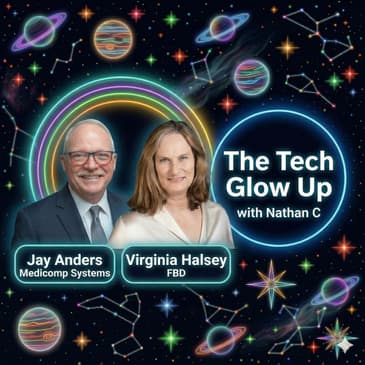
Everyone says AI in healthcare needs a "human in the loop." Fewer people can tell you what that actually means. This live Vive 2026 episode of The Tech Glow Up features two health IT veterans who are done waiting for theory to catch up with practice.
Virginia Halsey, SVP of Product and Strategy at First Data Bank, has 35 years in health IT and a clear view of where medication workflows are failing. Pharmacists spend 30 to 40% of their day verifying prescription orders, while the clinical judgment they trained for goes unused. FDB is building tools to fix medication reconciliation and free pharmacists to round and participate in real patient care.
Her hot take: even big tech companies love the AI buzzwords but aren't ready for healthcare-specific protocols like MCP when you get into the details.
Dr. Jay Anders, CMO at Medicomp Systems, practiced internal medicine for 20 years and has spent 21 years since as the bridge between clinicians and tech. Clinicians haven't been asked what they need from AI, and when ambient listening tools produce text that nobody verifies, "human in the loop" is just a phrase. Medicomp converts ambient AI output into structured clinical data and gives clinicians a fast way to validate what the system produced.
Key Moments:
- [00:04:04] The Medication Workflow Problem: Why pharmacists spend 30–40% of their day on verification — and what FDB is building to change that.
- [00:07:23] Med Rec on Admission: The fragmented data problem that makes medication reconciliation risky when patients can't speak for themselves.
- [00:10:03] The AI Readiness Gap: Many organizations love AI buzzwords but aren't ready for the protocols that make it real in clinical settings.
- [00:20:45] "They Haven't Been Asked": Why clinician trust in AI is in turmoil — and why the fix starts with asking doctors what they need.
- [00:21:32] Beyond the Text: Medicomp converts ambient AI transcripts into structured data, then gives clinicians a fast way to verify the output.
Watch the full episode on YouTube, subscribe to The Tech Glow Up, and join the newsletter on Substack → https://substack.com/@mxnathanc
About Jay Anders:
Dr. Jay Anders serves as the Chief Medical Officer of Medicomp Systems, where he plays a pivotal role in product development and acts as a liaison to the healthcare community. He hosts the award-winning HealthcareNOW Radio podcast, “Tell Me Where IT Hurts,” discussing critical issues such as physician burnout, EHR usability, healthcare interoperability, and the impact of technology on healthcare with industry experts.
About Virginia Halsey:
Virginia Halsey serves as senior vice president of strategy and product management where she manages the team responsible for the development and success of all FDB solutions spanning a variety of healthcare markets across the US and Canada.
A "glow up" signifies a positive transformation, reflecting the journey of becoming a better, more successful version of oneself.
At The Tech Glow Up, we humanize the startup and innovation landscape by focusing on the essential aspects of the entrepreneurial journey. Groundbreaking ideas are often ahead of their time, making resilience and perseverance vital for founders and product leaders.
In our podcast, we engage with innovators to discuss their transformative ideas, the challenges they face, and how they create value for future success.
If you're a founder or product leader seeking your own glow up, or a seasoned entrepreneur with stories to share, we invite you to join our guest list via this link.
One of the things that I heard over and over as I was talking with healthcare leaders at the VIVE event was this idea of AI really has some powerful capabilities in healthcare, but we need to keep providers, like clinicians, like doctors and nurses"in the loop." In this episode of The Tech Glow Up, we dive into a little bit more specific about what"in the loop" really should mean. So this is an episode with two OGs in Health IT Virginia Halsey is the SVP of Product and Strategy at First Data Bank, also called FDB. For Virginia, she's miffed that pharmacists are spending 30 to 40% of their days just verifying that prescriptions that patients have aren't going to cause problems. Reconciling whether or not this prescription in this amount is appropriate and safe for this patient takes up so much time. This is because the data is fragmented because there's so many inputs, because you really don't know what a patient is doing with that prescription once they leave the doctor's office. Virginia and her team at First Data Bank are focusing on fixing those workflows and making sure that pharmacists can be involved in checking prescriptions but not spending almost half of their day. There's some real questions about if healthcare is ready to take advantage of new technologies like MCP in this early stage. Jay Anders podcast extraordinaire. Is another healthcare OG who really brings a fantastic perspective to the show. While nobody's asked him specifically about how he wants to Glow Up, he gets the idea and is ready for the gauntlet on the show doc, Dr. Jay Presents an idea that almost every clinical innovator I've heard shares, we need doctors and clinicians involved in innovation more early so that they can help us define what's helpful, harmful, and just plain ridiculous. I don't know if Jay would say it that way. Jay explains how Medicomp is focused on verifiable results from their ambient listening solutions. I'm sure you've heard on several of the episodes from HLTH. That like a ambient listening, like AI scribes is taking a lot of the note taking responsibility out of doctor's hands and literally putting it into the cloud. it's automating these tasks, but physicians, if they're gonna sign their name to those notes or those orders, need to be sure that what's being reported is accurate and true. This is why we need more doctors involved in health tech innovation. Shocking that it isn't more common already. we've got Virginia Halsey of FDB, that's First Data Bank, and we've got Jay Anders, who is the Chief Medical Officer at Medicomp Systems.
Virginia HalseyI can't believe I almost wore a shirt that is just like that. It's black. With a white, like long thing and a little white car. Mm-hmm. That would've been so funny if I wore that.
Nathan CYeah. Virginia. This is like, this is why I come to healthcare and like show up like I do because the con like the authentic conversations that it attracts is like perfect. Yeah. So, to start the show, we're gonna do one silly thing where we clap in the microphone.
Virginia HalseyOkay.
Nathan CSo we make alligator hands toward the camera, and on three we clap. 1, 2, 3. Hello and welcome to the Tech Glow Up from vi. I'm Nathan C, and today I am here with Virginia Halsey, VP of Strategic and Product Management at FDB. Virginia, it is so great to meet you.
Virginia HalseyI am so happy to meet you, and I really thank you for having me.
Nathan CYes. So thanks for joining me on the Tech Glow Up. Can you very quickly introduce yourself and the work that you do at FDB?
Virginia HalseySure. my name's Virginia Halsey. I am Senior Vice President of Product and Strategy At First Data Bank. I am responsible for building products that reflect what people really need. And, a little tidbit. I've been in health it for 35 years.
Nathan CYeah. I'm curious what started and like maybe more importantly, like what has kept you connected to building great products in healthcare for so many years?
Virginia HalseyIt's challenging to your tenacity. It is. just very stimulating. Things keep changing. Mm-hmm. So they change, but they stay the same. So, you know, I've lived through the first internet boom, which was, you know, kind of wild. And then you had the advent of CPE and EMRs, and now we're in what I would consider the most exciting most. Changing time with AI and, new kinds of ways to solve problems.
Nathan CAmazing. What's the, quickly, what's the like big juicy problem that you're working on right now?
Virginia HalseyYeah, so, we are in the medication space. So we are tackling medication workflow. I would say this is an area that really needs a Glow Up is medication workflows.
Nathan CYep. And that's like how patients get prescribed, how they get their medicines. It's how they
Virginia Halseyactually
Nathan Cadopt
Virginia Halseyit's the patients.
Nathan CYep.
Virginia HalseyExperience with the medications. It's the nurse, the physician, the pharmacist. The physician ordering meds or prescribing meds. The pharmacist verifying meds. Giving advice and, and, nurses doing med rec, doing discharges, everything.
Nathan CI love talking with product people. Just all of these, like, people doing a task, like the focus on like actually impacting how people work with your work.
Virginia HalseyYeah, yeah. The jobs to be done is the hot topic.
Nathan Cin such a fast moving time, where patients are being bombarded by so many things, what do you see from your point of view as the Glow Up? that healthcare as a, as an entire industry should really be taking in the next year?
Virginia HalseyYeah. Well, I think it's pretty obvious that we have work to do on improving systems, and I think improving systems using agents and AI makes a big difference. It makes things, we're tackling the same problems, in many ways. And I just had a focus group on Sunday and people are talking about the same problems But in a faster way. In a better way. So I, I think that's really a big deal.
Nathan CYeah.
Virginia HalseyAnd that includes. Communication with the patient as well?
Nathan COh, always. And, how about for your work at FDB? No, what's, what's the big audacious thing that you're shooting for?
Virginia HalseyYeah, so right now we are really focused on two key things. One is improving medication reconciliation, which is something that has been a problem people struggle with for a long time. It's really important for safety, for instance, when a patient is being. admitted to the hospital, you need to know what meds they're on. Mm-hmm. And there are different sources of, seeing what the meds are, but they're not. Right. And sometimes the patient might be unconscious or they might be, you know, inebriated, who knows? And you can't get the information from the patient. They're not always good historians. So we need to tap into other systems throughout healthcare to, to bring the right information. The other area that we're really focused on is, helping the pharmacist. So the pharmacist is a clinician with a lot of experience, most knowledgeable about the drugs, and they're often spending 30 to 40% of their day verifying the med orders. And what they need to be free. We have to free them to be like rounding and, and part of patient care. And I don't think we're doing them justice right now. And we need to give them like really clear criteria with automated, checking of this specific patient's information In order to help them like do this more easily and quickly.
Nathan CPharmacists shouldn't be your bookkeepers
Virginia Halseyin the basement,
Nathan Cright?
Virginia Halseykeep them in the basement next to the morgue.
Nathan CFree the pharmacist.
Virginia HalseyYes.
Nathan CAmazing. Virginia. we're getting very close, but I do wanna ask, as somebody who has been in healthcare for, a notable career.
Virginia HalseyYeah.
Nathan Chow have mentors and coaches helped you and guides helped you get to where you are today?
Virginia HalseyI have learned from so many people. I am not the person who has had like one really specific mentor. Mm-hmm. It's, I've had people sharing their knowledge in a variety of different ways. Going way back to when I first started working with physicians, they really were opening my mind to, oh, this is very different than how the pharmacist works. Most recently, I would say, our deputy group head, Chuck NDA has really helped me come a long way with, Really, understanding what we need to do with AI and make things better for everybody.
Nathan CAmazing. I want to give you the opportunity, do you have like a hot take or a spicy soundbite to share about AI culture, healthcare technology?
Virginia HalseyOkay. So I have to say that you would be surprised how many organizations. Are really excited about ai, but when you really dig into the details, they're not necessarily ready. So I am talking about big tech companies even. Mm-hmm. I mean, they're, they're like going gangbusters in a lot of ways, but when you get to very specific functionality. Related to healthcare. sometimes they're not ready for an agent. They're not ready for these certain protocols like MCP mm-hmm. Which is a standard. And the same goes in some cases for the EHRs and, even hospital organizations. So they, they like the buzzwords, but sometimes they're just not. there yet. So,
Nathan Cwoo.
Virginia HalseyThat's, yeah.
Nathan Cwant the movement, but are you ready for the transformation? Oh my goodness, Virginia, we're gonna have to take more time soon. 10 minutes is not enough, for everything.
Virginia Halseythank you for having me, Nathan. this is fun.
Nathan CAmazing. So last, we're just gonna clap it back out. 1, 2, 3. Awesome.
Virginia HalseyThank you so much.
Nathan COh my gosh, I'm so excited. has anybody ever asked you about the Glow Up that you're working on in the past?
Jay Andersthey haven't used that term, but yes.
Nathan Cokay. Yes. And you're familiar with the term. Love it. So, this'll be pretty fast, the first thing that we do is we clap in the microphone. So we make hands like this toward the camera uhhuh, and on three we clap one. Two three. Amazing. Thank you. Hello and welcome to the Tech Glow Up I'm Nathan C Live from Vive, and today I'm talking with Jay Anders, Chief Medical Officer of Medicomp Systems. Jay, it's so great to talk with you. Thanks for joining me on the Tech Glow Up.
Jay AndersThank you so for having me.
Nathan CAmazing. So first off, can you introduce yourself and the work that you do as Chief Medical Officer at Medicomp Systems?
Jay AndersWell, I'm Dr. Jay Anders. I'm an internist by training practice for 20 years. my job role now is basically the interface between clinicians and tech for our company. So making sure that what we develop at Medicomp Systems is meeting the needs of clinicians.
Nathan CYeah. And what is the most important thing that clinicians need today?
Jay AndersRight now, I think they need to have trust in what's headed down the road with AI and some of this tech. And right now that's kind of a turmoil. They don't know what to trust. They don't know what they're gonna be given. And quite frankly, they haven't been asked.
Nathan COoh, I love it. what's your approach for helping clinicians build trust with technology?
Jay AndersWell, I try to get them involved.
Nathan CYeah.
Jay AndersThat's the one thing a lot of people sit around and complain.
Nathan CMm-hmm
Jay AndersThis isn't working for me, so what am I gonna do? Well, instead of complaining, why don't you come up with some ideas?
Nathan CYeah.
Jay AndersAnd get yourself involved in the whole thing because they don't know what they're going to give you until you tell them.
Nathan CYeah. Amazing. And what, specific problem is Medicomp, systems working on to help clinicians within the work that you're doing?
Jay AndersWell, right now there's a lot of the implementation of what's called ambient ai. Yeah. Where you sit in a room, you talk to your patient, it creates text. Mm-hmm. The problem is that text doesn't do anything for you.
Nathan Cdata set.
Jay AndersSo we are actually converting that into usable data to do all the things that sometimes clinicians just don't want to do.
Nathan CMm-hmm.
Jay AndersBut in addition to that, one of the issues is they're not reviewing what these systems are giving them, and you've got to review them. So we give them a very, very easy way to validate what they'll get from that ambient listening platform. Mm-hmm. To what they really need to know about that patient they just talked to.
Nathan CI'm so thrilled that you said this. every time somebody mentioned they had AI with a human in the loop, I always ask, how do you know that the human is actually checking?
Jay AndersThat's absolutely true.
Nathan CAnd the answer is surprising. Most people don't have like a percentage. That they can say,
Jay Andersright?
Nathan Cand That's shocking to me if, if it's supposed to be validated.
Jay AndersYeah.
Nathan CJay, I'm curious, the doctor to like innovation pipeline is like such an interesting mm-hmm. like transition. What got you excited to be in the mix so much with technology take on this translator role?
Jay AndersWell, I've been in this, in technology role for about 21 years now.
Yeah.
Jay AndersSo that's a long time.
Nathan CYeah.
Jay Andersone of the things I get asked all the time is that, why did you do this? Mm-hmm. Why didn't you make the conversion from seeing patients in an office as a general internist to this? well, here's what I tell people. When I was an internist, I would see between 4,000 and 5,000 people it a year.
Nathan CMm-hmm.
Jay AndersWhat I do now affects. Patients and clinicians providing the care at hundreds of thousands of times. So yes, it's a impact, much greater impact than what I used to do as a regular physician.
Nathan CYeah, I so adore that. Frame of mind. Thank you so much. So as a physician and technologist who has seen a lot of healthcare tech, what is the Glow Up or notable transformation that you think the healthcare industry needs to make in 2026 to meet the challenges we're looking at?
Jay AndersI would say it's time to get real.
Nathan CYeah.
Jay AndersIt's time to get real. There have been now several years of. Basically a brand new, it's not brand new, but it's now risen to the surface of AI and healthcare.
Nathan CYep.
Jay AndersSo let's start to get real about what it's going to do? Ask the clinicians about what they want help with.
Nathan CMm-hmm.
Jay AndersAnd then start to create systems that will actually assist that process.
Nathan CYeah. So as you think about the area that you have domain over where your, your scope of influence, what's the Glow Up that you see for Medicomp systems in like the next six months?
Jay AndersWell, right now we're in that process of how do you do what I just said? So how you take text trust and how you take stuff that doesn't work and actually make it work for a clinician. And one of the things, it's one of my soap boxes. Ask the physicians, we ask all of our clients, what do you need? What do you want? What's missing? Mm-hmm. Because you can't apply this technology to everything. It's gotta have a point. So let's talk to you as a clinician. What do you need help with? And a simple example is this. If you have a patient come in that's got, you know, a runny nose, a low grade fever, and headache, I don't need AI to tell me what that patient had. I don't,
Nathan Cyeah.
Jay AndersBut what I do need is maybe AI can help me with getting to the right codes, getting to quality measures. That patient might have other things that I have to do or should do mm-hmm. For that patient while they're there with that cold.
Nathan CYeah.
Jay AndersSo right now it seems like they're sticking right in the middle of a workflow that may or may not be needed.
Nathan CJust throwing some AI on it.
Jay AndersJust throw some AI on it, like mustard on a sandwich.
Nathan CAmazing. Jay. For, both being a physician and being somebody who has, has been in innovation for decades, I can only assume that you've had some help and encouragement on the way. How have mentors played in and coaches and guides played into your journey and success as a healthcare entrepreneur?
Jay AndersWell, along the way, I've had really great executive coaches. Mm-hmm. back when I was. The clinic I worked for, I was actually president of that clinic for seven years, so I've had executive coaching along the way, which was very, very helpful. But there are people that actually inspired me to do what I'm doing now. And one was Peter Altra, who was the, founder of Medicomp Systems, and I met Peter 20 years ago.
Nathan CMm-hmm.
Jay AndersThis man in 1976 developed a system that we are using today. He built it for what the technology would be today. Which is quite inspiring and I just the other day, our CEO, Dave Laro, who I've known for years, presented me with his original like legal pads where he sketched out this system that we're using today,
Nathan Cyo.
Jay AndersAnd it's amazing how it has developed to have somebody that bright be able to anticipate in the future what's going on.
Nathan CJay, we're pretty much close to our time. just quickly if you have one, do you have a spicy hot take or a soundbite about healthcare technology, ai or otherwise?
Jay Andersthis is kind of a message to the, my clinician colleagues mm-hmm. Out there. get involved. Feedback. When you don't like something, don't complain. Give'em an answer. Get involved with it.
Nathan CYeah.
Jay Andersand do it quickly and be unabashed about what you want them to do. All these new technologies,
Nathan Cbe an empowered user. make better products happen.
Jay AndersAbsolutely.
Nathan CJay Anders, it has been such a pleasure to get to learn about your work. Thank you for joining me on the Tech Glow Up from VIVE.
Jay AndersThanks for having me.
Nathan CNow we just clap it out. 1, 2, 3. Thank you.
Jay AndersYou're very welcome.
Nathan CAwesome. Oh my gosh, I'm so excited. has anybody ever asked you about the Glow Up that you're working on in the past?
Jay Andersthey haven't used that term, but yes.
Nathan Cokay. Yes. And you're familiar with the term. Love it. So, this'll be pretty fast, the first thing that we do is we clap in the microphone. So we make hands like this toward the camera uhhuh, and on three we clap one. Two three. Amazing. Thank you. Hello and welcome to the Tech Glow Up I'm Nathan C Live from Vive, and today I'm talking with Jay Anders, Chief Medical Officer of Medicomp Systems. Jay, it's so great to talk with you. Thanks for joining me on the Tech Glow Up.
Jay AndersThank you so for having me.
Nathan CAmazing. So first off, can you introduce yourself and the work that you do as Chief Medical Officer at Medicomp Systems?
Jay AndersWell, I'm Dr. Jay Anders. I'm an internist by training practice for 20 years. my job role now is basically the interface between clinicians and tech for our company. So making sure that what we develop at Medicomp Systems is meeting the needs of clinicians.
Nathan CYeah. And what is the most important thing that clinicians need today?
Jay AndersRight now, I think they need to have trust in what's headed down the road with AI and some of this tech. And right now that's kind of a turmoil. They don't know what to trust. They don't know what they're gonna be given. And quite frankly, they haven't been asked.
Nathan COoh, I love it. what's your approach for helping clinicians build trust with technology?
Jay AndersWell, I try to get them involved.
Nathan CYeah.
Jay AndersThat's the one thing a lot of people sit around and complain.
Nathan CMm-hmm
Jay AndersThis isn't working for me, so what am I gonna do? Well, instead of complaining, why don't you come up with some ideas?
Nathan CYeah.
Jay AndersAnd get yourself involved in the whole thing because they don't know what they're going to give you until you tell them.
Nathan CYeah. Amazing. And what, specific problem is Medicomp, systems working on to help clinicians within the work that you're doing?
Jay AndersWell, right now there's a lot of the implementation of what's called ambient ai. Yeah. Where you sit in a room, you talk to your patient, it creates text. Mm-hmm. The problem is that text doesn't do anything for you.
Nathan Cdata set.
Jay AndersSo we are actually converting that into usable data to do all the things that sometimes clinicians just don't want to do.
Nathan CMm-hmm.
Jay AndersBut in addition to that, one of the issues is they're not reviewing what these systems are giving them, and you've got to review them. So we give them a very, very easy way to validate what they'll get from that ambient listening platform. Mm-hmm. To what they really need to know about that patient they just talked to.
Nathan CI'm so thrilled that you said this. every time somebody mentioned they had AI with a human in the loop, I always ask, how do you know that the human is actually checking?
Jay AndersThat's absolutely true.
Nathan CAnd the answer is surprising. Most people don't have like a percentage. That they can say,
Jay Andersright?
Nathan Cand That's shocking to me if, if it's supposed to be validated.
Jay AndersYeah.
Nathan CJay, I'm curious, the doctor to like innovation pipeline is like such an interesting mm-hmm. like transition. What got you excited to be in the mix so much with technology take on this translator role?
Jay AndersWell, I've been in this, in technology role for about 21 years now.
Yeah.
Jay AndersSo that's a long time.
Nathan CYeah.
Jay Andersone of the things I get asked all the time is that, why did you do this? Mm-hmm. Why didn't you make the conversion from seeing patients in an office as a general internist to this? well, here's what I tell people. When I was an internist, I would see between 4,000 and 5,000 people it a year.
Nathan CMm-hmm.
Jay AndersWhat I do now affects. Patients and clinicians providing the care at hundreds of thousands of times. So yes, it's a impact, much greater impact than what I used to do as a regular physician.
Nathan CYeah, I so adore that. Frame of mind. Thank you so much. So as a physician and technologist who has seen a lot of healthcare tech, what is the Glow Up or notable transformation that you think the healthcare industry needs to make in 2026 to meet the challenges we're looking at?
Jay AndersI would say it's time to get real.
Nathan CYeah.
Jay AndersIt's time to get real. There have been now several years of. Basically a brand new, it's not brand new, but it's now risen to the surface of AI and healthcare.
Nathan CYep.
Jay AndersSo let's start to get real about what it's going to do? Ask the clinicians about what they want help with.
Nathan CMm-hmm.
Jay AndersAnd then start to create systems that will actually assist that process.
Nathan CYeah. So as you think about the area that you have domain over where your, your scope of influence, what's the Glow Up that you see for Medicomp systems in like the next six months?
Jay AndersWell, right now we're in that process of how do you do what I just said? So how you take text trust and how you take stuff that doesn't work and actually make it work for a clinician. And one of the things, it's one of my soap boxes. Ask the physicians, we ask all of our clients, what do you need? What do you want? What's missing? Mm-hmm. Because you can't apply this technology to everything. It's gotta have a point. So let's talk to you as a clinician. What do you need help with? And a simple example is this. If you have a patient come in that's got, you know, a runny nose, a low grade fever, and headache, I don't need AI to tell me what that patient had. I don't,
Nathan Cyeah.
Jay AndersBut what I do need is maybe AI can help me with getting to the right codes, getting to quality measures. That patient might have other things that I have to do or should do mm-hmm. For that patient while they're there with that cold.
Nathan CYeah.
Jay AndersSo right now it seems like they're sticking right in the middle of a workflow that may or may not be needed.
Nathan CJust throwing some AI on it.
Jay AndersJust throw some AI on it, like mustard on a sandwich.
Nathan CAmazing. Jay. For, both being a physician and being somebody who has, has been in innovation for decades, I can only assume that you've had some help and encouragement on the way. How have mentors played in and coaches and guides played into your journey and success as a healthcare entrepreneur?
Jay AndersWell, along the way, I've had really great executive coaches. Mm-hmm. back when I was. The clinic I worked for, I was actually president of that clinic for seven years, so I've had executive coaching along the way, which was very, very helpful. But there are people that actually inspired me to do what I'm doing now. And one was Peter Altra, who was the, founder of Medicomp Systems, and I met Peter 20 years ago.
Nathan CMm-hmm.
Jay AndersThis man in 1976 developed a system that we are using today. He built it for what the technology would be today. Which is quite inspiring and I just the other day, our CEO, Dave Laro, who I've known for years, presented me with his original like legal pads where he sketched out this system that we're using today,
Nathan Cyo.
Jay AndersAnd it's amazing how it has developed to have somebody that bright be able to anticipate in the future what's going on.
Nathan CJay, we're pretty much close to our time. just quickly if you have one, do you have a spicy hot take or a soundbite about healthcare technology, ai or otherwise?
Jay Andersthis is kind of a message to the, my clinician colleagues mm-hmm. Out there. get involved. Feedback. When you don't like something, don't complain. Give'em an answer. Get involved with it.
Nathan CYeah.
Jay Andersand do it quickly and be unabashed about what you want them to do. All these new technologies,
Nathan Cbe an empowered user. make better products happen.
Jay AndersAbsolutely.
Nathan CJay Anders, it has been such a pleasure to get to learn about your work. Thank you for joining me on the Tech Glow Up from VIVE.
Jay AndersThanks for having me.
Nathan CNow we just clap it out. 1, 2, 3. Thank you.
Jay AndersYou're very welcome.
Nathan CAwesome. Can I ask you a favor? If you really enjoyed this episode, could you share it on your Instagram stories or maybe post the link with what you enjoyed on LinkedIn? The sort of sharing and engaging really helps small podcasters like me reach the audience that I know really cares about these kinds of conversations. If you've made it this far in the podcast, I really appreciate you. Thanks for listening. Please make sure to like and subscribe so that you never miss an episode of the Tech Glow Up. And hey, can I ask you a favor? If you really enjoyed this episode, could you share it on your Instagram stories or maybe post the link with what you enjoyed on LinkedIn? The sort of sharing and engaging really helps small podcasters like me reach the audience that I know really cares about these kinds of conversations.