
Get a front row seat to the conversations about AI, AR smartglasses, and the future of enterprise technology from Augmented World Expo 2026.
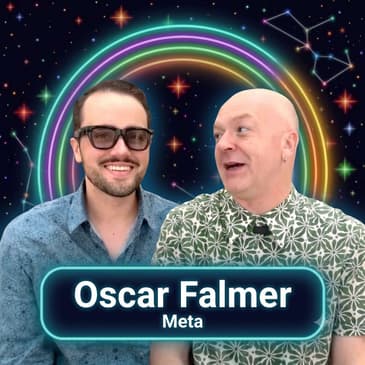
Oscar Falmer has spent eight years helping developers build for wearables — at Meta and at other companies doing interesting work in the space. As developer advocate for things like smartglasses, his job is to lower the floor for anyone who wants to build for AI smartglasses, whether they write code for a living or picked up an AI coding agent on a weekend.
The Meta Display Glasses use the familiar Ray-Ban form factor with a monocular waveguide display on the right side. Pair them with the Meta Neural Band — an EMG wristband that reads electrical signals from your wrist to recognize gestures — and you have a device that lets you interact with content without lifting your phone or draining your battery through computer vision.
Key Moments:
- [00:01:27] Meta Display Glasses hardware: monocular waveguide display, 70 grams, Neural Band gesture control, and why battery efficiency matters for all-day wear.
- [00:05:21] Web apps for Meta Glasses: how the platform opened one month ago and why power users — not just developers — are the ones shipping fastest.
- [00:06:06] The constellation app: star maps using GPS coordinates and IMU sensors, location-based context without full spatial tracking.
- [00:11:46] Personal software is here: why AI coding agents and HTML/CSS/JavaScript make it possible to go from idea to running glasses app in 30 minutes.
- [00:15:50] The Go-Giver playbook: how Oscar's open-source AR glasses dataset went from a single spreadsheet to C-suite circulation and a job at Meta.
Oscar builds community the same way he builds tools: share what you know, keep it open, and trust that the right people will find it. His AR glasses dataset — started when he was between jobs, shared for free — was being passed around at the highest levels of enterprise XR before anyone knew his name.
Catch the full episode on YouTube — like and subscribe if you want more conversations like this.
#SmartGlasses #MetaGlasses #TechGlowUp #AWE2026 #XR
About Oscar Falmer
Oscar Falmer is a Wearables Developer Advocate at Meta, where he supports developers and companies building for Meta AI glasses.
He's spent nearly a decade in XR, previously working in Developer Relations at both Snap and Apple, where he helped developers create AR experiences across mobile, social media, and wearable platforms.
A "glow up" signifies a positive transformation, reflecting the journey of becoming a better, more successful version of oneself.
At The Tech Glow Up, we humanize the startup and innovation landscape by focusing on the essential aspects of the entrepreneurial journey. Groundbreaking ideas are often ahead of their time, making resilience and perseverance vital for founders and product leaders.
In our podcast, we engage with innovators to discuss their transformative ideas, the challenges they face, and how they create value for future success.
If you're a founder or product leader seeking your own glow up, or a seasoned entrepreneur with stories to share, we invite you to join our guest list via this link.
Hello, and welcome to The Tech Glow Up. I'm Nathan C. And oh my goodness, talk about a get, I've got Oscar Falmer from Meta. He is a wearables developer advocate, and he's got some pretty cool shades on Thank you Oscar, thank you for joining me today.
Oscar FalmerGlad to be here. You know, I've seen your podcast for so long. I'm so happy to be here. Thank you so much for the invitation.
Nathan CI'm glad you're still re- you're still interested in joining after seeing it for a while. Oscar, for those who haven't been following your career like I have, can you introduce yourself and the work that you do as a wearables developer advocate at Meta?
Oscar FalmerYeah, sure. Basically, so my work is to support the growing community, of developers and actually users just building, the apps for their glasses, content for the glasses with and without displays is with display. And yeah, it's been, with the Neural Band. And yeah, it's been, like eight years I'm doing this, and I've, I've been doing it at other companies, that are also, uh, doing, uh, interesting stuff. But- I'm super happy to be here now, and actually to see so much traction with these glasses. And anyway, super happy to be here.
Nathan CYes. So cool to see you here, always advocating for developers, always helping people understand how they can bring smart glasses into their lives. This is actually the first time I've been this close to the Meta Display glasses. Yes. Can you tell me just like a, a, a high level about, like, what they are- Yeah and, like, maybe a little bit about, like, how you use them.
Oscar FalmerYeah, sure. So basically, uh, they are with the, you know, the familiar, uh, Ray-Ban, uh, form factor that, uh, you, you've seen before. Uh, and basically they have, um, a display on the right side. It's a monocular, um, uh, monocular glasses. So there's a waveguide on the right side with a 600 by 600 megapixel, like a square. Yeah. Uh, so it's very convenient. It's pretty, you know, it's very lightweight. I think these are about, uh, 70 grams. I'm sorry, I don't know the American units. But, yeah, they're very lightweight. And basically, uh, they are doing everything you could already do with your Meta Ray-Bans, but now with additional kind of display-based informations. And so this kind of provides, yeah, I mean, you can see, for example, navigation of the map. If you use multimodal AI with Meta AI, you can, have also visual information are gonna show up on screen. And the other thing which we don't have on the other products is this Meta Neural Band. So the Meta Neural Band is an EMG wristband. So basically it reads the electric signals going into your wrist and basically recognize this swiping, selecting gestures. And so that's a very kind of seamless, type of interaction with the glasses that doesn't require to use the camera- Mm-hmm that you may have seen maybe with competitors, where, uh, they need to monitor the camera of the computer vision algorithm, and that would actually usually drain the battery. So whereas with this, uh, it's very battery efficient. Oh. And yeah, so that allows for actually longer battery.
Nathan CI learned something new today. Uh, you were just, like just- Yes giving a talk, here at AWE. I have two questions about it. Yes. And, the first question is, did you use your display glasses at, for notes or teleprompter during your talk, and what was the talk about?
Oscar FalmerSo yeah, so the talk was about, uh, building content apps for AI glasses with or without display. I actually wanted to use my glasses as a teleprompter, you're absolutely right. Mm-hmm. But I didn't wanna read too much, so I, you know, I, I didn't wanna read my notes. I wanted to be as natural as possible, so I didn't use them this time. But, uh, that's for my, uh, for my next talk, I, I need to do that. I need to try it out. I hear... Yeah, it... I, I have actually a lot of colleagues using it already for that- Ooh and, and that works really well.
Nathan CI think it's a certain type of brain who can, like, teleprompter. I find that, like, the less prepared, the less notes I have in front of me, the more in the moment I am. I don't actually use a teleprompter much, but, like, if I'm ever referencing my notes, it's like a hard... And so I, I think I might do some really weird interactions. Yeah. Who
Oscar Falmerknows? I mean, I mean- Remains to be seen yeah, my, my, actually, my, we were two to do, uh, on stage. There was Abby that we just saw- Uh-huh and Abby was actually, uh, using a teleprompter app. Yeah. So he was, he did it, and it went really great. Oh, yeah. And at the end of his talk, he said, "Look, I was actually using a teleprompter that I was moving, basically text with my hands." And everyone kind of, you know, applauded because everyone thought it was funny because no one realized, because actually Meta has a kind of a technology that allows that people in front of you don't see it. Mm-hmm. Uh, so, you know, people don't realize actually you're seeing something on, on your
Nathan Cphone. Some, some of the wave guides have, uh, a little bit of, like, a rainbow
Oscar Falmerflicker- Yeah or a bit of a gray. Like, a lot of light leaking.
Nathan CYeah.
Oscar FalmerAnd, and a lot of light leakage. Uh, but yeah, it's, it's, yeah, one of the thing with glasses in general is that you can see it, or you can see the, the display, and in a social environment, that might, I don't know, make people slightly uncomfortable, or it might also, because you're looking at people in the eyes- Yeah it might be a little bit weird of seeing these kind of rectangles or something. Having almost no light leakage allows for, like, very natural interaction. Actually, when... I have a funny story to tell you about. So I live in London now, and I was in the, in the Tube, and I was playing a, I was playing a game on, on my glasses. And so I was sitting by someone, I was doing this, and the lady, uh, next to me, she had, you know, she couldn't see any display or anything, and she was just confused and like, "What is this crazy guy?" Mm-hmm. Because, you know, it's still not very common. And this, by the way, only available in the US, so very few people have seen them outside. Anyway, sometimes it creates funny interaction because she couldn't really imagine I'm seeing something in the glasses 'cause they look quite, you know, compact obviously.
Nathan CAmazing. I loved hearing you talk about, like, loading up a bunch of web apps- Yep onto your glasses so that you can share and sort of sh- uh, show people the capabilities. Yeah. Is there an application that you use the most lately?
Oscar FalmerYeah. I mean, it's been one month we had, uh, web apps, uh, you know, uh, the ability to create web apps for glasses, and you can load, you know, anyone's web app. You host them on your server, and you can basically broadcast to other people your link. And yeah, honestly, it's... I mean, we've been super excited by the enthusiasm. It's interesting because also I can see that we have some of the community maybe coming from XR, they come from glasses, but a lot of people are just power users that just love their glasses, and they have, like, a custom need. So, and with, you know, with the AI coding agent skills we provide, anyone, honestly, you don't need technical skills. In 30 minutes, one hour, I mean, you get, like, basically any idea you got running on the glasses. Uh, and it's just that easy. Because, you know, these are basically simple HTML, CSS, JavaScript apps, AI coding agents are really kind of adapted for that, so anyway. And what is my favorite fe- you were asking?
Nathan CYeah. No.
Oscar FalmerIt's a, it's a tough one. It's a tough one. I, I, I might wanna say mine because I, I love the one I did Well, do, do- No, I did, I did, I did... The one I really like that I did- I'm sorry, is, uh, the, uh, constellation, uh, app. Mm-hmm. Star constellations. So you can see, uh, it's using the GPS coordinates via your phone, and then the IMU sensors on the glasses to basically, yeah, check around you. I, I could turn it on right now. Where are the stars? What are the constellations? And, you know, it's... it actually, for example, you know, I know, uh, you and I, you know, we work a lot with AR. Mm-hmm. This, this is... There's no, like, spatial, uh, component because it's on one eye, but it feels like it because this is, like, in the sky, in this direction, and you can see around you when you turn your head. So I think a lot of people are starting to realize that, especially coming from the XR industry, the potential of having display glasses that are very lightweight, you can wear all day, and then you can basically have experiences that, you know, can provide location-based experiences. And they, they are not necessarily physically seeing of the world, but actually they provide the same value to the end user.
Nathan CThis is very much, like, dorky XR things, right? But, uh, there's so many different arguments about, like, what space are we using, what kind of spatial, how much spatial. And like, I like that the direction that you're talking about isn't about, like, a technological framework, but it's centered on what is the user looking at, what are they doing, what are they trying to accomplish, right? And sort of divorced from, having to build too much beyond- Yeah just, like, solving the problem. And so, like, it doesn't matter how mu- how spatial or where, because, like, the user... I, I always, when I was first explaining XR, I talked about it in just, like, it's content in space that knows what a user is trying to do, and anything beyond that is, like, just fine-tooth combing the details. Look, so
Oscar Falmerit's- And so I love the- So it's super interesting what you're saying- Yeah because I, I, I was not highlighting it too much, but the interesting part with those is even without having kind of the stereoscopic studio experiences, actually because we have the camera- Mm-hmm and you can run your AI models, basically you can get, you can create this contextual, uh, uh- Mm-hmm experience. So the example I was showing in my presentation right before, from Stijn in Belgium was basically he, he did a city tour guide app. Mm-hmm. Uh, where basically you're walking around the city, and we have a LLM that is pre-trained on the information of the city. You're coming up to a church, and it says, "Oh, this is the church XYZ, and this is the story of the church." So that provides basically, like, a very, uh, yeah, depending of your visual environment, but also the microphone of the- Mm-hmm context of the situation, you can have contextually, uh, based experiences.
Nathan CI'm so thrilled. Do
Oscar Falmeryou, do you have some? Do you have some display? Not yet, right?
Nathan CI don't... No.
Oscar FalmerUm-
Nathan CI'm... I- You
Oscar Falmerneed to try it out.
Nathan CMy Ray-Bans, for the longest time, were my favorite headphones because I liked the open ear and just the ability to have a little bit more context. Like, if I'm traveling, if I'm at an event and I need to get, like, from the hotel, I don't wanna be looking at my phone. And just, like, those little bits of, like, Nathan, you can listen to directions but also don't have to have, like, ear- too many layers. Yeah. I gotta get in there.
Oscar FalmerYeah. I know. That's the next, next, next step.
Nathan CI've been waiting, you know, to see which, which glasses really speak to me. Um- I get you. I get
Oscar Falmeryou.
Nathan CBut- At
Oscar Falmerleast you have a good choice. That's a good problem to have in 2026.
Nathan CRight? And that is- You have good choices. Well, and that's, like, such a good segue because, uh, on the Tech Glow Up, I love to use events as a way to sort of check in on the industry, see where we're at, maybe see where we need to grow. So I'm curious, looking at, like, the industry, it could be spatial, it could be smart glasses, however you wanna frame it, what's the glow up that you wanna see in spatial computing, maybe in the, like, next six months? Kind of a midterm, where do we need to be going?
Oscar FalmerWhat's kicking off clearly is that we're seeing how all of these devices, I mean, you and I have been in the industry for a while, all of these devices now I think with AI are basically getting to a next level. Like, they're- Mm-hmm they're really, I think... That's why, by the way, this is called AI glasses because I think you can do way more with AI glasses that basically give eyes and, uh, a microphone to your, uh, to your, uh, AI. So I feel what I see, and again, with web apps is for example people, like even people that are not developers, they have an idea, they do it, they create it. I think now we're in this new AI age where you don't necessarily need to have a lot of knowledge with Unity, let's say, which is a great tool, super powerful, but requires a lot of, uh, knowledge, or especially with 3D also- Mm-hmm like, in general, if you're using any tools, it's great, but it also requires some, uh, like, optimizations, and especially for lightweight devices. I think for example this kind of 2D displays where, with AI, you know, coding agents, you can just quickly create something. I think we see a pattern where developers and users of devices like that are actually, yeah, creating their own needs. So I think what we're, we're seeing now, and I really, I think it's super exciting, and I was delighted to see this since we launched the web apps, is just so many power users are just like, "Hey, I have an idea. I'm gonna do it." So- Mm-hmm like, I feel like some of them were, you know, it was so quick, I didn't expect them to jump the ship, uh, so quickly. Yeah. So I think that's a new era where, it's yeah, helping the development of this platform, and I think it actually helps democratizing it to everyone.
Nathan CWe had the era of personal computers, right? There's a lot of talk about personal AI, but where you're kind of pointing, it's curious to me why smart glasses unlock this. Because it seems like personal software is, i- is kind of where this is heading, right? Like, if a power user who has a pain point and they wanna solve it in a specific way, like the tools are there. You can get the repos from GitHub. You can put them in Cursor. You can connect those to your different build APIs and, like, you can-
Oscar FalmerIt's never been that easy, right? Yeah, it's crazy.
Nathan Cand like, I'm not a coder, but I get that it's... I've seen it happen, uh, you know, at the speed that you talk about, It's so funny to think that, like, software, which was so mystical and, like, something that would come out once every year in a pretty box, now might just be something that you can make, like, on the bus while you're going to work.
Oscar Falmer100%. No, you're right. It's, uh, democratizing, I think, uh, you know, the software, the ability. I mean, this, it's a lot of work to, uh... I also come from software engineering, background, and you know, I spent, uh, years to learn how that works, and this is great, and I still love it. Uh, but yeah, now I feel like it used to be for so long that you needed that knowledge, and it, that might be kind of... You, you might have a great idea, but it might be hard to do it on yourself- Mm-hmm and like on your own. And I feel now, yeah, just, um-
Nathan CTakes a team you're
Oscar Falmerjust giving more power to, to the end user.
Nathan CYeah,
Oscar Falmeryeah. I love it. Power to the people. Power to
Nathan Cthe people. Power to the developers- Power and the creators. Yes.
Oscar FalmerYes. And, and I think that, yeah, that unlocks the creativity of everyone in a, in a way that we couldn't see before. Mm-hmm. And, uh, yeah, just, uh, yeah. Anyone has a great idea, I mean, you can do it, and like two hours later, it's viral online. And, and everyone is downloading it. And we had this case with, uh, yeah, the, the app, the running app, uh, which, which Stijn did, where this app got vir- it got like 1.4 million views, I think, over LinkedIn and Twitter over one weekend. And even, uh, Mark Andreessen was talking it on the, I think, Joe Rogan podcast. I mean- Mm-hmm so, I mean, we're like... I mean, and originally, he did this project for a video that we're posting soon. Actually tomorrow, there's a video, uh, so when this is going live, that should be out already. Yeah. Where he's doing a tutorial about the city, experience. And he was, he was excited doing this video, but he was like, "I really want to do a web, web app," and he did this for the, the, the video, and unexpectedly, it got crazy viral, so. Mm-hmm. You see, just was like a weekend project, and that's it. So I would love to see, uh, the Nathan, uh, Nathan web app because I think you might, uh, you know, might get super viral, too.
Nathan CWhat, what's the awesome future display glasses web app? Follow back 2027 for the answer. Shit, I just gave myself a timeline. Uh, Oscar, I'm glad that we got into the creators. I think this is a thing that you and I are just very aligned Bringing this idea of the glow up in a little bit more personally- Yeah uh, what's the glow up that you're working on in your work as a developer advocate?
Oscar FalmerOne thing I launched a month ago, which I'm super happy about, it was a teamwork, but, uh, I was super excited about is the Reddit. We have a, I mean, new, like, a subreddit called Meta Glasses for Dev, where I'm basically trying to centralize all the interest from people building for display and non-display because, you know, most of the users have no display, uh, as well. And basically, yeah, that's where also the web apps I was telling you about, where people were sharing- Mm-hmm uh, sharing the links so other people can try it. Uh, this is something, yeah, I'm excited about, uh, that came out. But honestly, overall, since I, I joined Meta in January, we had monthly updates with these SDKs. Mm-hmm. We have something called Device Access Toolkit and now the web apps, and we just release on a monthly basis exciting new features. So yeah, just stay tuned I, I post those on my accounts and also on the Reddit, so you can, uh, find the latest update of that.
Nathan COh my gosh. So this idea of, like, shipping monthly, I absolutely love, right? You're-
Oscar FalmerYeah, the engineers are doing a fantastic job. This is all credit to the engineering product team. They've been, uh, really, uh, rocking it. You know, they're not necessarily always publicly seen as a, but they are doing a fantastic job. And I'm glad we got Abby, who's product engineer, that was also on stage. Yeah. And there's so much happening behind the scene.
Nathan CRight, like, if your users can make a new app in a weekend, you sure as heck better be able to ship-
Oscar FalmerIt's good. It's a good
Nathan Cpressure and respond on a regular basis. It's a
Oscar Falmerhealthy pressure.
Nathan CWell, I, that builds trust, that builds connection, right? That builds where people are headed.
Oscar FalmerYeah.
Nathan CThe Side quest that I wanna take is you did something really interesting, speaking of viral content, that I think is an example for, like, anybody trying to get started in this space. there was a moment where you were kinda, like, between things. Yep. And you started to focus on the data set- Yeah that was, like, really important to you.
Oscar FalmerYeah.
Nathan CAnd It started out as a single-page spreadsheet-
Oscar FalmerYes, yes, yes of
Nathan Call of the AR heads, all of the- Yeah AR glasses.
Oscar FalmerYeah.
Nathan CAnd it became, like, hundreds of rows across- multiple tabs. True. And I can tell you that it was being shared at, like, the highest levels of, like, enterprise XR- Oh,
Oscar Falmergreat to hear
Nathan Cbecause nobody had put the work in to just put all the data in the same place. And as somebody who is, like, trying to stand out, somebody who's trying to give back to the community, somebody who's trying to, like, share their knowledge and, like, thought leadership, this is such an amazing thing to watch. You get, like, global collaboration on a Google Doc that, like- Totally filled a need, spoke to exactly, like, who you are and the people that you support, and it sure looks like it got the attention of the right people- Yeah, yeah 'cause you, you weren't in between things long.
Oscar FalmerYeah.
Nathan CI literally have shared that with, like, people in the C-suite-
Oscar FalmerThank you so much. Thank you so much
Nathan Cit literally- Means a lot nobody had it. Yeah. Nobody had it, and it's- And I
Oscar Falmermade it for free,
Nathan Cright? Yeah. I mean, I- It took you some time at a coffee shop, I'm sure. But, like, I love when people, like, one, really understand the value that they bring to a conversation, and two, like, leverage that to the fullest both for their own and the community's betterment. And I just think it's an amazing example of how, like- Thank you a data set and a special interest can, like, do amazing things. Yeah, I feel,
Oscar FalmerI feel actually, uh, uh, I, I don't know what's the question, but- Yeah, no I wanna say something about that. You're fucking awesome. I was gonna say thank you so much. I was gonna say, you know what? This is, the, uh, I was inspired to do that, uh, from the book, I don't know if you heard of the book The Go-Giver?
Nathan CMm.
Oscar FalmerUh, The Go-Giver, I really like the book The Go-Giver, uh, which is like, you know, try to provide value to others without, and, you know, before expecting anything from them. Mm-hmm. Um, I think that kind of attracts the best opportunities usually. Yeah. And so yeah, I noticed, I mean, basically what I noticed is that, oh, like, I, it's hard to have a big picture. There's so much happening. There's great competition. I mean, which is great for the industry, and I was wondering, okay, how can I track that? And so I decided to track it myself, and I was like, "Oh, this can be valuable for others." Uh, and so I shared it online, and then I saw the enthusiasm. I just kept growing. And then after, it just created opportunities, uh, just a lot of interesting discussions. Actually, funny enough, I was sitting at this table we're really next to yesterday where I was talking with, some people doing great hardware, super interesting. And at some point said, "Oh, yeah, I've done this and that. You've done this and that?" I mean, that has been super helpful. We co- we duplicated it in case you, you, you close it, you make it private, so. Uh, yeah, so it's, it's funny. I mean, yeah, very glad. I mean, it's helpful, and I think, yeah, I think, you know, it's a kind of the karma of the world. I think, uh, do something you like, share it with others like I think you're doing right now, and- Mm-hmm that's re- I really, really sincerely appreciate it. and yeah, I think, you know, after basically that brings opportunities, and also it just brings honestly interesting people then you can work with or you just, I don't know, make new friends. So honestly- Oh, yeah uh, I don't know, just feel, uh, feels great down the line. And look, it's been, I released it in July. I've, I've dated a lot since then, but you still talk to me one year later. So, uh, you see, uh, sometimes things go down, uh, you know, for, you know, uh, go pretty far off, right? And this was just a Google Sheet, and yeah, that's it. You did, you didn't have to
Nathan Cbuild a totally immersive world- Yeah to get everybody's attention.
Oscar FalmerYeah, I, I want- some people tell me, "Oh, you should do a more, like- uh, sophisticated website." But I was like, "No, I think this is easier because people can copy it." Mm-hmm. Like, they can duplicate it. They can use it internally. Yeah. And I think, uh, yeah, I, I wanted to keep it simple.
Nathan CI love it. Okay, the last question is an opportunity for a hot take, maybe a spicy soundbite about technology, AR, wearables, you name it. Do you have a, a hot take for me?
Oscar FalmerNo, I would say the spicy part is that I think we're very lucky to be in this space in 2026. I feel super happy with the momentum we're seeing. It's been two days, of AWE. And honestly, there's just such a great momentum. I'm just so happy. I think not only is it great for everyone in the industry to catch up together like we're doing, to make, to meet new people, but honestly, I think it's never been, the better time for anyone that is not yet in XR to join us on this momentum. There are just so many capabilities with AI. It's never been easier. And so I think, Nathan and I, would love to, to welcome you in this very exciting world. So please, please join us on this adventure.
Nathan CI feel like, "Please join us," wasn't terribly controversial, but I love it— and I totally concur. Oscar Falmer— one of my hero advocates for developers and creators, an expert in the wearables and smart AI XR smart glasses space, and a supporter of so many of the creators that I- Yeah.
Oscar FalmerNo, they're, the people are fantastic. You know, honestly, just being able to- Right ena- enable, exciting creators, developers, even companies like everyone, honestly, people are just excited about it, and we're doing a lot of work, a lot of work actually that is not even, visible publicly to try doing our best to support it, support the momentum. And, you know, it's been a long time I'm doing this, and I will keep doing it. So yeah, feel free to reach out if I can help in any way.
Nathan CAmazing. Oscar, thank you so much for joining me— Thank you so much on the Tech Glow Up.