
Get a front row seat to the conversations about AI, AR smartglasses, and the future of enterprise technology from Augmented World Expo 2026.
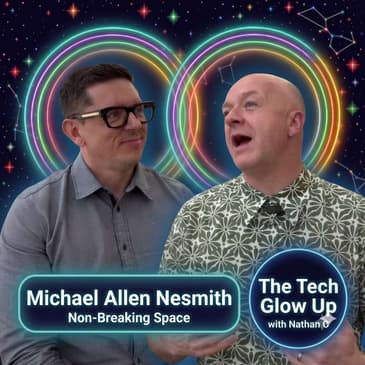
Michael Allen Nesmith spent 10 years as a creative director at Amazon's Brand Lab — and built something there that had nothing to do with e-commerce: an in-house interpreting agency that embedded sign language interpreters across his team and eventually scaled to Amazon's global workforce. He left that behind to start Non-Breaking Space, a consulting firm helping tech companies build products that actually work for deaf and hard-of-hearing users from day one.
His argument is straightforward. ASL is a spatial language. Signers navigate three-dimensional space as grammar — direction, location, and movement all carry meaning.
The smart glasses industry is working hard to invent spatial context. Michael has been living it his whole life. His response when a company builds spatial hardware without any deaf input: "Uh, hello. We're here. We've been here for a very long time."
At AWE 2026, he walked me through the survivor bias of accessibility data, the curb cut effect as a product strategy, and what it actually means to pressure-test hardware when you're someone the product was never designed for in the first place.
Key Moments:
- [00:00:29] Non-Breaking Space: why Michael left Amazon to consult on deaf inclusion in spatial tech
- [00:01:40] ASL as a spatial language: what the glasses industry is still missing
- [00:05:01] The curb cut effect: how designing for disability creates better products for everyone
- [00:09:09] Nothing for us without us: what real accessibility in the design phase looks like
- [00:16:23] Survivor bias and disability data: "No data is data"
No data on disabled consumers is not a neutral fact. It's a signal your product isn't reaching them — and that's a design failure.
Watch the full episode on YouTube → https://youtu.be/tT2wlc2Z6lc
#SpatialComputing #AccessibilityDesign #TechGlowUp #AWE2026 #SmartGlasses
About Michael Allen Nesmith
Michael Allen Nesmith is a Deaf creative director and accessibility strategist building Non-Breaking Space ( ), a disability-led creative studio focused on emerging technology and accessibility consulting. Prior to founding Non-Breaking Space, Michael spent a decade at Amazon's Brand Innovation Lab, where he led creative on emerging advertising tactics within Amazon's ecosystem.
He also built the Fire TV Global Brand Book, now in active use across 1,500+ marketers worldwide. Earlier in his career, he served as Art Director at Wieden + Kennedy Portland, contributing to early concept development for Google Glass marketing, and went on to build one of the first subtitle apps for Glass in 2013, the same instinct that shapes his work today.
He holds an MFA from the School of the Art Institute of Chicago, three B.A. degrees from Gallaudet University, and a CPACC certification. Michael has delivered a TED talk on inclusive wearable design and has been featured in Forbes, Campaign US, and Puget Sound Business Journal's 40 Under 40.
He also founded Amazon's first in-house ASL interpreting agency and has taught design courses and ASL at Columbia College Chicago, DePaul, Portland State, and SAIC.
A "glow up" signifies a positive transformation, reflecting the journey of becoming a better, more successful version of oneself.
At The Tech Glow Up, we humanize the startup and innovation landscape by focusing on the essential aspects of the entrepreneurial journey. Groundbreaking ideas are often ahead of their time, making resilience and perseverance vital for founders and product leaders.
In our podcast, we engage with innovators to discuss their transformative ideas, the challenges they face, and how they create value for future success.
If you're a founder or product leader seeking your own glow up, or a seasoned entrepreneur with stories to share, we invite you to join our guest list via this link.
Hello, and welcome to The Tech Glow Up. That's Jonah. I'm Nathan C, and we're here live from Augmented World Expo 2026. I'm here with Michael Allen Nesmith of Non-Breaking Space. Michael, thank you for joining me on The Tech Glow Up.
MichaelOf course. Thank you so much for having me here.
NathanOh my goodness. It's such a treat to meet you. You have such an interesting background in innovation. Can you, introduce yourself and the work that you do in the space?
MichaelSo I started, for 10 years I worked as a creative director at Amazon for their brand lab, and I started my consulting business here that's called Non-Breaking Space. And I really wanted to help tech companies to thrive within these smart glasses. Because for obvious reasons, I feel like the deaf individuals have such visual language that they could collaborate with this and really motivate to thrive to a bigger audience. So that's why I'm here.
NathanI love it. I've heard all week about how spatial content is content that's in the world, that responds to our bodies, that understands where we're at, and I feel like somebody working in a visual, spatial, physical language has some powers, in that space that I can only imagine.
MichaelYes. Yeah.
NathanCan you talk a little bit about your journey in innovation? And I, if I dare- Yeah uh, can I ask about what it's like being a deaf person speaking in ASL in that journey?
MichaelYeah. Great question. So I think first about the spatial context, just even using that word spatial, it's really important because when I think about spatial, that's how I speak. That's part of my language, and the ASL is my first language, and really, it is a very spatial language. I have to look around, and having those smart glasses, they're trying to invent that spatial context. And I'm over here like- "Uh, hello. I'm here. We're here. We've been here for a very long time." And then me as a deaf individual, I think that it's... I had a really interesting... I have a really interesting edge to myself. You know, I've done a lot of pressure testing on products to see if they're working, if they work through people- that have a lot of constraints with the smart glasses, and they really need to test that first before they have it to the, the larger audience. And as a deaf individual, I think that that's something that they need to think about and have that mindset.
NathanAmazing. what got you started working in brand innovation working with technology?
MichaelYes. So wonderful question again. Before Amazon, I worked for several different advertising agencies. One was in Portland about in, like, 2013 or so, and I worked on different campaigns, and I collaborated with Google.
NathanMm-hmm.
MichaelAnd they tried to find a better marketing story to be able to launch their glasses. So I promoted the idea of building such a simple thing like a captioning app so even deaf individuals were able to enjoy movie theaters. And that kind of just snowballed and became a, a marketing story for them to use, and it really wrote itself. Mm-hmm. You know, with Google and their glasses, they did shut down, so then I just feel like I changed to different, uh, ventures. You know, I went to Amazon, and then I got to see that smart glasses are coming back. Mm-hmm. So I feel like almost like a boomerang, I'm coming back to this. Yes. And that's my story with the smart glasses, and that's why I'm here where I am.
NathanSo as, uh, a marketer who's been working in XR, in spatial tech for a number of years, to meet somebody who had been in brand, who'd been in creative for Google Glass, arguably, like, one of the first, spatial headsets, camera glasses that people widely knew about, to be talking with you now when the industry got interesting for a second time is really interesting to me. What about this moment, caught your attention, caught your interest, made it feel like now was the time to come back now, something was ready, for what you'd been trying to do years before?
MichaelSo I think the one thing that really triggered me to come back was when I was seeing a bunch of smart glasses, the companies build and, and social media even companies. When they were trying to build smart glasses, their main feature was really having all these people posting things, and really just kinda shoving the camera onto the glasses. Hmm. And it, and trying to make them look normal. And I was looking at it and I was like, "No. No, no, no. That's, th- that's really backwards thinking." I remember the origin of it. Why do we even have these glasses in the first place?
NathanMm-hmm.
MichaelTo, you know, have that accommodation and have spatial language. That's where the trajectory should be going. And I was thinking about the curb cut effect. I've been thinking about that.
NathanHmm.
MichaelWhere, you know, if you're just walking outside, you have the curbs, and that st- that design was started for people in wheelchairs. But any parents with babies and strollers were able to benefit from that. A blind person was able to benefit from that. So just one simple solution was able to be a benefit for so many individuals. And I feel like when you look at smart glasses and those different companies, they kind of fo- they should follow that same trend. They're basically just sitting on the next curb cut effect. So who's that company exactly that can fit it? I'm not sure. Hmm. I'm trying to help them arrive to that goal.
NathanOoh. So you, you've set up sort of perfectly the, like, title question of the show that I ask everybody, which is around a glow up, which is a notable transformation or a rebirth. So I'm curious, for smart glasses, for the immersive industry, for the industry here today, what's the glow up as far as, like, accessible technology, universal design, that you wanna see happen in XR in, like, the next six to 12 months?
MichaelYes. So for smart technology or even smart wearable technology, it's really important to have people with disabilities in the room from day one.
NathanMm-hmm.
MichaelAnd that's the glow up that we need in order for them to make their product most effective.
NathanSo if we're saying that this technology is for everybody, that it's ready for consumers, if you haven't had somebody who has a different ability than you do in that room, it's maybe not actually for everybody Am I oversimplifying?
MichaelNo, no, no. Come on. I, keep going. You go on. So
Nathanthe, the idea of, right, like, uh, nothing for us without us is so key-
MichaelYeah
Nathanin the disability community. I feel like at a show like this, we hear a lot about the growing expansion of technology, the inevitable, permeation into culture. And what I'm hearing from you- Mm-hmm is that inevitability starts when you actually bring the end users, the deaf people, the blind people into the product story- Mm-hmm, mm-hmm way earlier. Right now, we're giving it to them as a finished product to try off the shelf. Yep. And what I'm hearing from you is that real accessibility starts- Mm-hmm in the design phase. So with that-
MichaelMm-hmm
NathanMy assumption is most people at this show haven't had a conversation with somebody who speaks ASL.
MichaelExactly.
NathanMost people haven't worked with somebody who speaks ASL. And so what advice do you have for somebody who is altruistic, who wants to be an ethical spatial developer, product owner- Mm-hmm It's like how do you do the right thing? How do you start engaging in universal design if you're not doing it already?
MichaelMm-hmm.
NathanThank you for letting me get there.
MichaelYeah. Yes. No, yes, that's wonderful. That really expands and is very helpful. The biggest challenge is that a lot of businesses or companies see accessibility as something to include later, and that's... it tends to be more expensive, whatever their reasoning is- Yeah or if they realize it or not. But from day one, if they have somebody in the room who is a leader, a thinker, a designer, you have such a variety of perspectives, you tend to have a better product. And you talk about that diversity of, of perspectives. Mm-hmm. Having, having a blind person there is important, having a deaf person there, all of that. And then I think, a- again, remembering that ASL is such a spatial language, you know- Mm-hmm you should talk about that. They're trying to come up with this, but we already have that structure there. And so I'm trying to really change that thinking.
NathanWe... Like, th- literally there's, like, five different examples of, like, how people are putting text and other kinds of content into spatial context all over the expo hall. And, there's maybe models- Yeah that we can already use. There's interaction modes. Mm-hmm. There's tools, that we don't need to start from scratch every time. Um.
MichaelYes. Yeah.
NathanSo the next question, Michael, is about your glow up, and I'm curious, uh, what's the glow up that you're working on at Non-Breaking Space today?
MichaelI think events like this are perfect places. All the leaders are in one place. And for me, I just think that being present is really my basic glow up. Mm-hmm. It's like, "Hi, I would love to use your product." Yeah. "How can I do that?" You know, so the companies are prepared for that kind of a question.
NathanYeah.
MichaelAnd they can figure out what to do with their product. You know, a lot of time they tend to fumble so much on the spot. Ooh. So I'm like, "See, that's where we have room for improvement- and I would love to come in and support this." So that's my glow up.
NathanYou have this pitch that sort of sells itself. You, you can walk up and be like, "Hey, can I use it?" Yeah. And if they don't have a good answer
MichaelExactly
Nathanwhat are they gonna
Michaelsay? Yeah, like, "Give it to me. Come on."
NathanOh, my goodness. So, one of the questions that I love to ask any innovator, I was actually just having this conversation before you walked up, which is that sometimes one of the most meaningful moments in an innovator's journey is when somebody says, "I believe in you. I think you can do this." Mm-hmm. And they push you to grow or to do something that feels out of your- Mm-hmm comfort zone. Can you share how a mentor or a coach has helped you in your journey as an innovator?
MichaelYeah. So the first person that comes to mind is Jim He was a creative director for Wieden+Kennedy-
NathanMm-hmm
Michaelin Portland.
NathanYeah,
Michaelicon. And I joined that c- that company. I was under him, and he was a very creative guy, but such a good people reader even. Mm-hmm. It seems like we really saw eye to eye. We were able to collaborate fully. And when the Google Glasses came out at that time, I told him- Mm-hmm that I would love to find some sort of solution for it to go to people like me. And several weeks later, he came back, and he gave me the Google Glasses on my table, and he said, "Go ahead. Figure it out." And I was, like, so shocked by that. Your turn. And ever since, I really looked up to him. So what I thought was interesting about our relationship is he doesn't sign, and it's really hard to communicate with him at times, but his thought process, his perspective, the way that we do communicate is typically by paper, but it still helped me grow so much. And, you know, every time I look back, I'm like, "Where I'm at right now is, can be directly led to his influence." So yeah.
NathanThere's, like, a meta lesson, not the company, but, like, a, a larger, that I think really speaks to this moment, where when it is hard to communicate, but we do it anyway a- around a common goal- Mm-hmm the outcomes are usually much bigger than any one of us can do on our own. And as somebody who has in-laws who speak a different language and live in a different country than I do, like, I know that, like, fighting to be understood, fighting to have common ground- Mm-hmm like, the struggle to have common ground-
MichaelYeah
Nathanis sometimes the thing that you remember 10 times more than the actual conversation or argument. and-
MichaelYeah
Nathanthat's because it's all about coming together and getting to that shared understanding. So, like-
MichaelYes
Nathanit sounds like a perfect tension of, like, growth-
MichaelYes
Nathanand conflict, at the same time.
MichaelYes. Yes, absolutely. I did wanna add one thing. You know, creativity has no limit. I think that's what we spoke about a lot, me and Jim. Our language was in this creative space. We found a common ground with this to be able to make it work. And one of his other words of wisdom that he shared with me is that if I feel too comfortable in one place, I'm doing something wrong. So I thought that was really, that really stuck with me, and it was basically the same reasoning why I ended up leaving Amazon. I was there for 10 years. I had a great impact and everything. But then I realized 10 years, wow, I'm kind of pretty comfortable here. So I left. Yeah.
NathanThanks, Jim. Wow! To have a job driving innovation at one of the top tech companies in the globe, working on, like, new products and features, that sort of golden safety net, you know, that we used to have in the world, how cool that, like, a mentor's voice from years ago, uh-
MichaelMm-hmm
Nathanwould come forward-
MichaelYeah
Nathanand keep pushing you to seek that space of uncomfortable innovation.
MichaelYeah.
NathanSo-
MichaelYes, yeah. I think to add to that layer even is that I built Amazon's in-house interpreting agency, and I had the intentions of the interpreters who they would go around and follow me throughout my career, and it was so embedded in my team. They became a part of my team. And the accommodations were so beautiful and just smooth to have the deaf individuals there within that program, and to watch it expand and become such a global thing. You know, the warehouse workers, just everywhere we got to see it. And the idea of leaving that and starting all over again was crazy, honestly. But then coming here, the conference, and seeing all the smart glasses, I'm like, "You know what? I absolutely made the right decision." This is a little bit like a wild, like the Wild West, honestly.
NathanMm-hmm. I got chills, honestly, like hearing about building that level of impact and culture of a design practice. one of the things that I heard Shelly Peterson say on ma- main stage yesterday- Mm-hmm was that it takes enterprise forever to do anything. And so to build something- Mm-hmm that's not directly related to, like the bottom line, you know, web store ROI, or, right, to build something that improves internal capabilities, that improves communication, those are the things that get thrown away so fast, like, in innovation. And to know that, like you had built something that supported you and others, and then to be like, "You know what?"
MichaelMm-hmm.
NathanIt's time for a change. Uh-
MichaelYeah, exactly.
NathanMm.
MichaelRight.
NathanSo I'm gonna ask another how can we question. So how can listeners today feel that sort of bravery to step into something that is uncomfortable, something that is new, something that's cutting edge for them? And why should they trust that little voice pushing them to do more or go further?
MichaelI think that a lot of businesses make their decisions based off of data. Often my experience from working as consulting them, most of the common responses that I get from them is that, "Oh, we have no disability consumers." So my response tends to be, it reminds me of the survivor bias. That concept started way back when in, in World War II. Yes. But that the military would send out bombers, like planes, to just drop bombs on Germany, and some of the planes would come back home with bullet holes on the plane. Mm-hmm. And that was the, the, the military's first reaction was to figure out the armor so that they can continue coming back home. And there was one guy that said, "No, that's not how you do it. You need to have the armor where the holes are not," That is the data of the plane, where it caused the crashes to happen. Mm-hmm. Where we weren't able to count those ones. So my mindset that I have is to tell, you know, them about my company, that you have no data with different disability options. Mm-hmm. And that is data. That's a big part of your data.
NathanThat you think that your customer is all consumers, and that you think you don't have any customers who are disabled means you really- Mm don't have any good data on the topic.
MichaelRight.
NathanYeah. that idea, right, of we look at where the holes are and say, "We, oh, we gotta patch these," but that it's the planes that don't come back with the holes in the other places that you're not seeing, right, I, I love as a metaphor.
MichaelExactly.
NathanYeah.
MichaelAnd basically it could be summarized all the way down to if you have No data is data.
NathanMm-hmm.
MichaelIt's really important to know that.
NathanIn your TED Talk, you also talk about we all have some level of disability at some point.
MichaelYes.
NathanRight? And so it's kind of self-serving and future-proofing. Permanent,
Michaeltemporary, yeah. Yeah, I mean, there's so many different ways to define disability, and the glasses even. Mm. You know, I can't see without my glasses. Deaf, I'm also deaf. My wife, when she's, you know, pregnant, it's almost like- Mm-hmm a disability for nine months. I broke my arm. I was disabled in a certain way. You know-
NathanI'm
Michaelcolorblind Everybody has some kind of disability at least once in their life, so you have to figure out the solution to your own disability- Mm-hmm whether it's temporary or permanent, and you have to come together with society to try to figure it out- Mm-hmm so we can be better humans.
NathanTo have somebody who will share their culture and their language with me on the show for a first time is such a huge treat and honor for me. I think I'm gonna get really sentimental- Yeah in thanking you for joining me on The Tech Glow Up. Um-
MichaelThank you for having me here. This was a, this was wonderful, and I already feel my glow up.
NathanMm.
MichaelSo you wanna know the- Yeah the sign for Tech Glow, Glow Up? Can you teach me? So here we go.
NathanUh, so I'm left-handed. It doesn't matter?
MichaelIt's fine. Yeah,
Nathanno, it's fine. Okay, fist. Yep. Uh- And then you're gonna do that. Move. Tap it. Yeah. Tech. Tech.
MichaelAnd then glow up.
NathanGlow up. Okay.
MichaelTech. Tech.
NathanOne time? Three times? Tech. Uh,
Michaeltwo, three times. Doesn't matter.
NathanSo
MichaelI'm gonna make
NathanTech glow up. Glow
Michaelup.
NathanOkay. There you go. Thank you.
MichaelCongratulations. Oh, my gosh. There you go. Good
Nathanjob.
MichaelThank you for watching- Tech The Tech Glow Up with me and Nathan.
NathanThank you so much.
MichaelYeah.
NathanAmazing.