
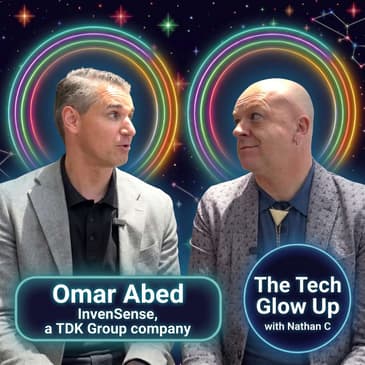

Most conversations about smart glasses focus on the software, the display, or the AI. Omar Abed, CTO of InvenSense, a TDK group company, wants you to think about what's underneath all of that.
Get a front row seat to the conversations about AI, AR smartglasses, and the future of enterprise technology from Augmented World Expo 2026.
Today's smart glasses carry 10 to 20 sensors each — and by count, sensors are the most numerous component in any pair. They're what connects the glasses to the person wearing them, connects the glasses to the world around them, and generates the raw data that makes the AI useful in the first place.
TDK started as the brand on your cassette tape. Today their sensors are inside more than 80% of the smart glasses on the market — you just don't see the name on the box anymore.
Omar oversees all of TDK's sensor technology development, and at AWE 2026 he made the case that the next big unlock for wearables isn't the display or the model. It's audio, power efficiency, and what he calls the "disappear effect" — the point where the form factor gets small and comfortable enough that you forget you're wearing them two minutes after you put them on.
Key Moments:
- [00:01:00] Sensors by the numbers: why today's smart glasses carry 10 to 20 sensors per pair
- [00:02:00] The "disappear effect": what it takes to make smart glasses truly wearable all day
- [00:04:00] Privacy by design: why keeping data on-device is a prerequisite for mass adoption
- [00:05:57] Audio as the next wave: why voice is the most natural interface for wearables
- [00:07:00] Pay it forward: the mentor chain that shaped a career in sensor engineering
The technology that makes smart glasses seamless isn't visible. Omar's work is making sure it keeps getting smaller, smarter, and better at protecting the people wearing it.
You can learn more about TDK MEMS and TMR sensors in smart glasses at https://www.invensense.tdk.com/en-us/smart-glasses
Watch on YouTube → https://youtu.be/kApav6sqA5g
Join the Tech Glow Up newsletter on Substack → https://substack.com/@mxnathanc
#SmartGlasses #SpatialComputing #TechGlowUp #AWE2026 #Sensors
About Omar Abed
Omar Abed is CTO of InvenSense, a TDK Group company. He holds degrees in Electrical Engineering and Computer Science from UC Berkeley and USC, is a Harvard Business School PLD alumnus, and holds five patents in MEMS pressure sensors.
A "glow up" signifies a positive transformation, reflecting the journey of becoming a better, more successful version of oneself.
At The Tech Glow Up, we humanize the startup and innovation landscape by focusing on the essential aspects of the entrepreneurial journey. Groundbreaking ideas are often ahead of their time, making resilience and perseverance vital for founders and product leaders.
In our podcast, we engage with innovators to discuss their transformative ideas, the challenges they face, and how they create value for future success.
If you're a founder or product leader seeking your own glow up, or a seasoned entrepreneur with stories to share, we invite you to join our guest list via this link.
Hello, and welcome to The Tech Glow Up. I'm Nathan C, live from Augmented World Expo 2026, and I am here today with Omar Abed of TDK InvenSense. So great to meet you. Likewise. Thank you for joining me on The Tech Glow Up.
OmarYeah, thanks for having us. I'm super excited to be here with you and at the show.
NathanAmazing. So TDK, I'm gonna date myself- Sure,
Omarsure
Nathanby saying that TDK is a media company that I've grown up with my entire life.
OmarYes.
NathanAnd when I saw that you were here at AWE, I was very excited- To learn more about what you're doing in spatial.
OmarYes.
NathanCould you introduce both yourself and a little bit more about what TDK InvenSense is up to?
OmarYes. So my name is Omar Abed. I'm the CTO for TDK InvenSense. and, uh, I oversee all the technology development, particularly in the sensor space. And so when we think about TDK, actually, the, the thing that comes to mind for those of us who are a little bit older is cassette tapes. Mm-hmm. And in the '80s, '90s, you recorded that favorite mixtape, TDK was the brand you reached to for that trusted material. Fast-forward to today, TDK has become less of a frontline company and more in the back. And so what's really exciting here is you see all these different new smart glasses being launched, virtual reality headsets, and really what takes a normal pair of glasses to a smart pair is the content that TDK brings, whether that's the sensors that connects the glasses to the wearer or the glasses to the outside world, or whether it's the sensors that generate the data that are powering spatial compute and the newest models. It's, uh, TDK at the, kind of the heart of bringing these things to life.
NathanI mean, every product is a beautiful child.
OmarYes.
NathanDo you have a favorite sensor right now?
OmarThat's funny. I would say, there's sort of, like, where we've come to it from- Mm and then where we're going. Yeah. So, our motion sensors, so our, our IMU, uh, which is the gyroscope and accelerometer, so everything from head gestures and detection to basically, navigation, and also just spatial, right? Mm-hmm. So basically the ability to execute SLAM or putting augmented reality on the world around us is really powered by motion sensing, and so it's really exciting. We're in more than 80% of the, smart glasses products out there. Yo. So I can't say specific, uh- companies, but I can tell you for the most of the cases, you're gonna find TDK technology inside. What's exciting about the future though is audio. And here, I think the more natural interface is going to be the way we talk and communicate with the smart glasses or, headsets. And so again, we're getting the audio content around us. We're getting, audio interface between people. and so that's really, I think, the next wave here of innovation.
NathanAmazing. I wanna take it personal really quickly. You don't start your career as a chief technology officer. Yeah. I'm curious, what was your origin story working in technology and in spatial?
OmarYeah. So I started actually on the compute side with AMD beginning of my career, but quickly found a love for this, like, multidisciplinary sensor space. Mm-hmm. It's, it's, it's kind of electrical- it's mechanical. It's, like, sensing the world around us. So I just found it was like a, this multidimensional problem. and honestly, the sensors available at that time, weren't really small enough, low power enough, flexible enough to really be embedded in something like a smart glass. That was just unfathomable. And so, uh, for me what was exciting is how can we leverage the Moore's Law that we've had in semiconductors that has been shrinking, yeah- Mm-hmm every 18 months and apply that to sensors, and make these big mechanical clunky devices, like a ball and tube, into these tiny, tiny sensors that we now, embed in s- for example, smart glasses. And you're gonna have more, 10 to 20 sensors per pair of smart glasses. Like, by count, there's more sensors than any other type of component in a pair of, today's smart glasses.
NathanMm. So the show is called The Tech Glow Up. A glow up is a notable transformation- Yeah improvement, a rebirth. When we're here at an industry event thinking about the future of what is possible in XR-
OmarYeah
Nathanwhat's the glow up that you wanna see happen in spatial computing industry as a whole?
OmarYeah. Actually, when I look at it, there's a couple of intersections that are kind of taking place. So first is about basically the efficiency gains we're getting in the models.
NathanMm.
OmarThat's allowing a lot more of the compute to come on board on device. That allows us to drive power down, so we're talking about all-day wear. That's number one. And number two is privacy. Cause I think one of the biggest things we've been dealing with is pri- that's really a fundamental limiter. If we can't protect people, they won't buy. and so what we wanna do is keep the data on device so it stays with the owner. It's, the data's your data and it stays with you. But the only way for that to happen is the compute has to continue to get better, sensors have to get more efficient, and the models have to be more efficient. And as those kind of three points intersect, what I expect is you'll see more compute done locally, and privacy, power, and size will all come down.
NathanOh, my goodness. I love that the CTO running the sensor company is also advocating for the privacy with that data.
OmarYes.
NathanThat's the kind of accountability for innovation that we like to see. Yeah. and absolutely, I, I feel like the question on everybody's mind- Yeah whether they're industry or consumer, is how do we get to where, right, like the cafe wear standard- Yes we feel safe wearing it in a cafe and knowing that, like, the rest of our patrons aren't gonna revolt at us. That's right. I love it. That's right. So taking it a little bit closer home.
OmarYes.
NathanUh, what's the glow up that you're working on with TDK InvenSense
OmarSo right now it's really about, again, driving power down, and size. And so there's two things. One, we're really striving for all-day wear.
NathanMm-hmm.
OmarAnd what I call on, in terms of size the disappear effect, which is basically you put the glasses on- Two, three minutes later, you forgot you're wearing them. So if we can get to that point, I think adoption is gonna explode. I agree with also the cafe point as well. not just how you experience it as the wearer, but if you show up and everybody, like, you know, part the seas and everybody goes away, that's also not gonna work. So it's also about privacy. Mm-hmm. But that comes back to, again, we're trying to do more compute in the sensor- Mm-hmm more edge AI, so that we can protect your data.
NathanI'm absolutely loving this idea that you've planted with me, that large language models are driving down the cost of processing- Yes certain kinds of data, making it easier for the kinds of experiences we want on smart glasses.
OmarYes.
NathanIt's the first time I've, like, heard those two things together in that same equation. So, uh-
OmarYeah
Nathantotally cool.
OmarYeah.
NathanSo one of the things that I love asking long-term innovators is about the role that mentors, guides, and coaches have had in their work in innovation. Yeah. So I'm curious, how has a mentor, in any sense, uh, supported you on the journey that you've had to where you are today?
OmarYeah. I, I would say my... I, I can't, um, describe my journey without the mentors I've received along the way. If there's one thing I'm grateful for- Mm-hmm um, I feel like at each jo- of my first few jobs, there was always that, that kind of older engineer who took me under their wing and really brought me in and were generous with their time and their knowledge. you know, I was fortunate enough to have a pretty fast trajectory in my career, but really standing on the shoulders of these mentors.
NathanYeah.
OmarSo I would just say, um, you know, pay it forward and try to also mentor also younger engineers, because I think there's, an energy that the younger engineers bring, but there's a wisdom that the experience also brings, and I think when you put that together, you can really make, careers really, take off and, yeah, and it, it impacts the industry. Oh
Nathanmy gosh, I love that. if there was a key takeaway that listeners to the podcast took away from our conversation today-
OmarYeah
Nathanuh, what should that be?
Omardon't forget about sensors. They're at the heart of, again, the interaction, the h- human user interface with the glasses or s- or virtual reality headset. They're also taking in all the data from the world around you, and again, it's that same data that powers the models. And as we advance the technology and sensors in terms of size and power, but also advance the models, I think, um, that the augmented reality becomes seamless in a way that the user experience, but also the way you experience the world becomes, uh, more fluid.
NathanOoh, I love it. Sensors are the key to the XR experiences we are all hoping for.
OmarYeah.
NathanSo, last question. Do you have a spicy soundbite, like a hot take on maybe AI, wearables, culture, otherwise?
OmarYeah. Um-
NathanCassette tapes?
OmarI would r- Yeah. I, I, I would actually go back to, I, I think it's a little bit in the direction of the privacy. Mm-hmm. But I think it's more, like, that the AI has to work for, for people, um, and that we wanna be connected to the real world. It can't just take us away. It has to be truly augmented, uh, reality. We have to be in reality. And so I think technologies that will connect us to ourselves and to the people and world around us while also offering information, experiences, will ultimately be powerful in transforming this technology.
NathanUm- Oh, my goodness. Omar, this is such a treat, right? Sensors, privacy, and basis in reality- Yeah is what are coming together to drive the next level of experiences- Yeah that we're all dreaming and building. Such a treat, uh, to talk with such an iconic media brand. thank you for joining me on the Tech Glow Up.
OmarThank you, Nathan. Thank you for having me. It's been
Nathana pleasure. Amazing.